
Aromatic Compounds Market Report 2026
Global Outlook – By Type (Benzene, Toluene, Xylene, Ethylbenzene, Styrene, Other Types), By Source (Petroleum Based Aromatics, Coal Tar Based Aromatics, Bio Based Aromatics), By Production Process (Catalytic Reforming, Steam Cracking, Coal Carbonization, Toluene Disproportionation), By Application (Solvents, Additives, Fuel Blending Components, Other Applications), By End Use Industry (Automotive, Packaging, Paints And Coatings, Pharmaceuticals, Chemicals And Petrochemicals, Textiles, Construction, Electronics, Other End Users) – Market Size, Trends, Strategies, and Forecast to 2030
Aromatic Compounds Market Overview
• Aromatic Compounds market size has reached to $187.47 billion in 2025 • Expected to grow to $262.1 billion in 2030 at a compound annual growth rate (CAGR) of 6.8% • Growth Driver: Growth In Petrochemical Industry Driving The Market Growth Due To Rising Demand For Chemical Feedstocks And Industrial Manufacturing Expansion • Market Trend: Innovation In Sustainable Benzyl Benzoate Solutions For High-Performance Fragrance Formulations • Asia-Pacific was the largest region and fastest growing region.What Is Covered Under Aromatic Compounds Market?
Aromatic compounds are organic chemical compounds that contain one or more aromatic rings, typically characterized by a stable cyclic structure with delocalized electrons. They serve as essential chemical intermediates and raw materials in the production of polymers, pharmaceuticals, dyes, agrochemicals, detergents, resins, and specialty chemicals. These compounds provide chemical stability, reactivity, and functional properties that support a wide range of industrial manufacturing and processing applications. The main types of aromatic compounds include benzene, toluene, xylene, ethylbenzene, styrene, and other types. Benzene refers to a fundamental aromatic hydrocarbon widely used as a chemical intermediate in the production of various industrial compounds, polymers, and specialty chemicals. These compounds are derived from petroleum based aromatics, coal tar based aromatics, and bio based aromatics and are produced through processes such as catalytic reforming, steam cracking, coal carbonization, and toluene disproportionation. The various applications involved are solvents, additives, fuel blending components, and others, and they are used by several end use industries such as automotive, packaging, paints and coatings, pharmaceuticals, chemicals and petrochemicals, textiles, construction, electronics, and others.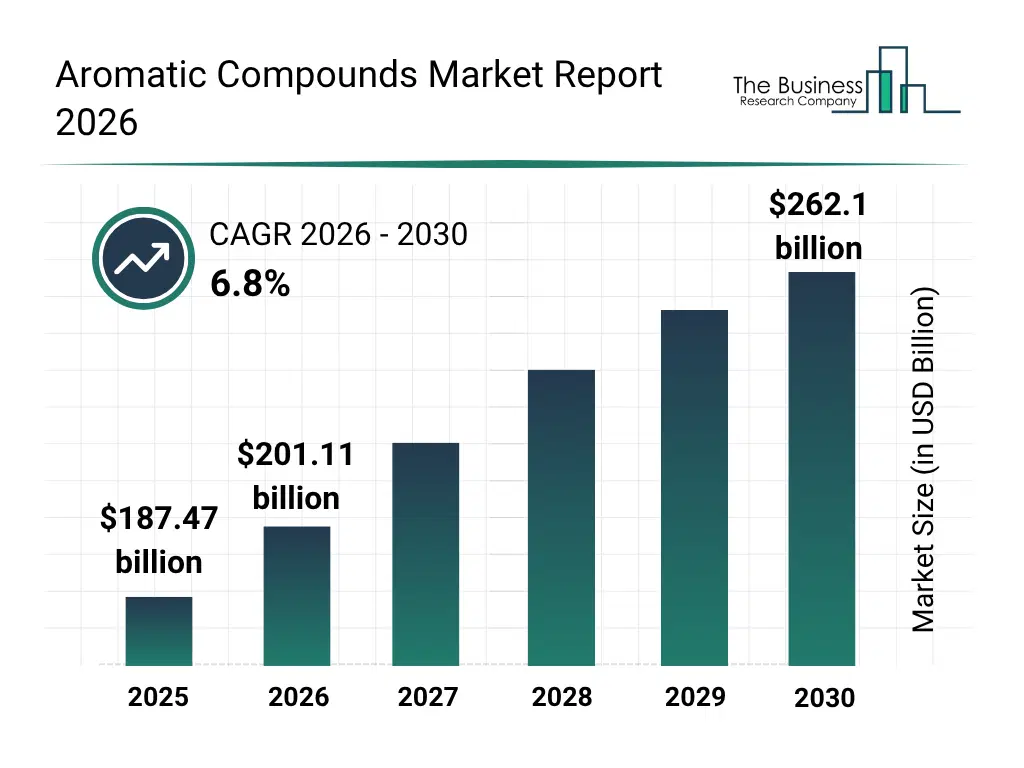
What Is The Aromatic Compounds Market Size and Share 2026?
The aromatic compounds market size has grown strongly in recent years. It will grow from $187.47 billion in 2025 to $201.11 billion in 2026 at a compound annual growth rate (CAGR) of 7.3%. The growth in the historic period can be attributed to increasing demand for petrochemical intermediates, growing polymer production, rising consumption of paints and coatings, expanding pharmaceutical manufacturing, increasing industrial chemical processing.What Is The Aromatic Compounds Market Growth Forecast?
The aromatic compounds market size is expected to see strong growth in the next few years. It will grow to $262.1 billion in 2030 at a compound annual growth rate (CAGR) of 6.8%.The growth in the forecast period can be attributed to growing demand for specialty chemicals, rising investment in bio based chemical production, increasing consumption of high performance polymers, expanding electronics manufacturing, growing demand for sustainable chemical feedstocks. Major trends in the forecast period include increasing adoption of high purity aromatic compounds, growing demand for bio based aromatic feedstocks, rising production of specialty aromatic intermediates, expansion of high performance aromatic chemical applications, increasing development of low emission aromatic manufacturing processes.
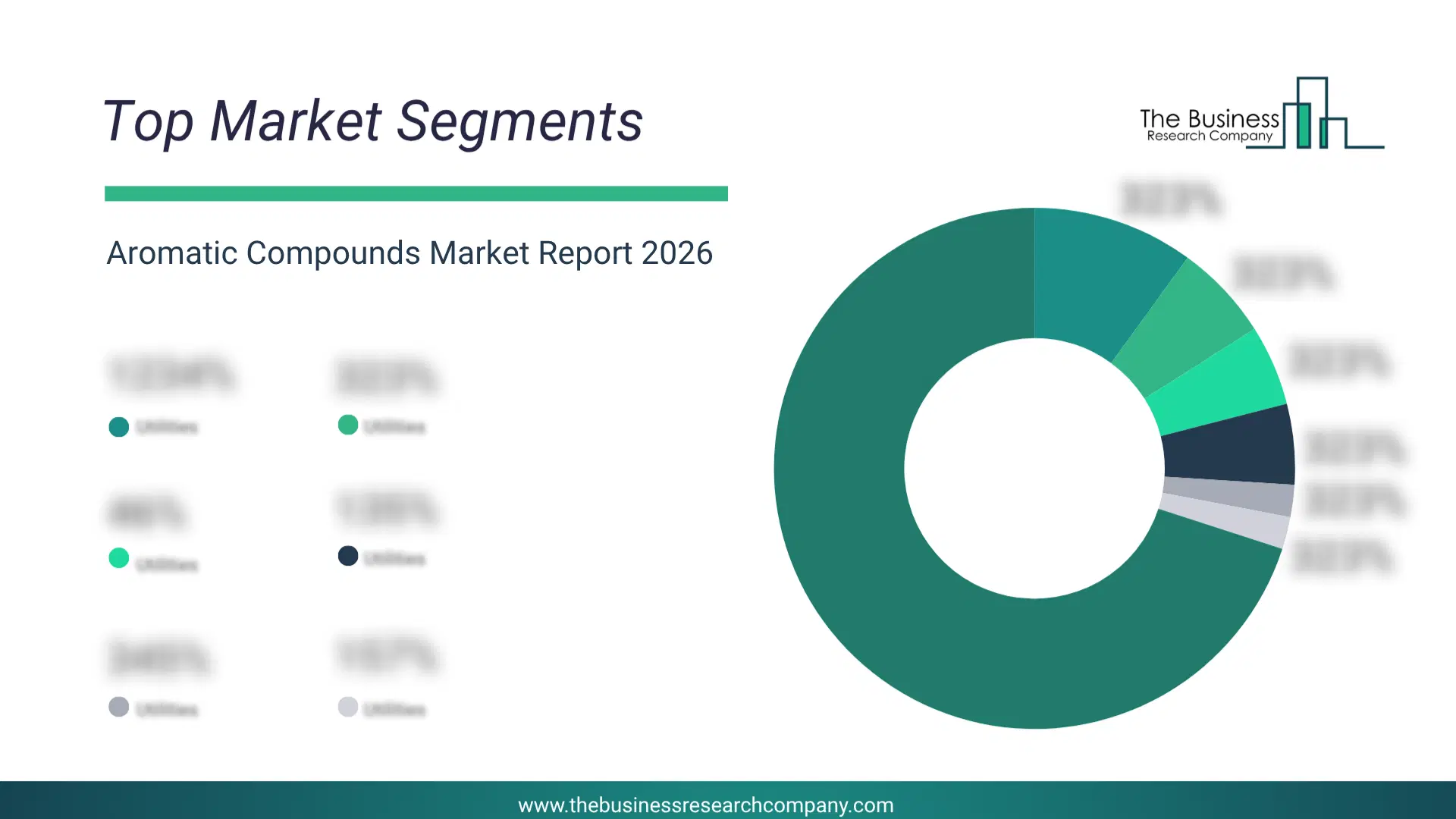
Global Aromatic Compounds Market Segmentation
2) By Source: Petroleum Based Aromatics, Coal Tar Based Aromatics, Bio Based Aromatics 3) By Production Process: Catalytic Reforming, Steam Cracking, Coal Carbonization, Toluene Disproportionation 4) By Application: Solvents, Additives, Fuel Blending Components, Other Applications 5) By End Use Industry: Automotive, Packaging, Paints And Coatings, Pharmaceuticals, Chemicals And Petrochemicals, Textiles, Construction, Electronics, Other End Users Subsegments: 1) By Benzene: Refined Benzene, Chemical Grade Benzene, Industrial Grade Benzene, Aromatics Feedstock Benzene 2) By Toluene: Refined Toluene, Solvent Grade Toluene, Chemical Grade Toluene, Hydrodealkylation Toluene 3) By Xylene: Mixed Xylene, Ortho Xylene, Meta Xylene, Para Xylene, Xylene Isomer Blends 4) By Ethylbenzene: High Purity Ethylbenzene, Industrial Grade Ethylbenzene, Styrene Feedstock Ethylbenzene, Aromatics Derivative Ethylbenzene 5) By Styrene: Monomer Styrene, Polymer Grade Styrene, Expandable Styrene, High Purity Styrene 6) By Other Types: Cumene, Nitrobenzene, Alkylbenzene, Aromatic Naphtha, Heavy Aromatic SolventsWhat Is The Driver Of The Aromatic Compounds Market?
The growth in the petrochemical industry is expected to propel the growth of the aromatic compounds market going forward. The petrochemical industry involves the production of chemical products derived from petroleum and natural gas, which serve as essential raw materials for manufacturing a wide range of industrial and consumer goods. The petrochemical industry is expanding due to rising demand for chemical feedstocks, as industries increasingly require raw materials such as benzene, toluene, ethylene, and propylene to manufacture plastics, synthetic fibers, packaging materials, automotive components, construction products, and a wide range of consumer goods. The petrochemical industry drives the demand for aromatic compounds such as benzene, toluene, and xylene, as they serve as essential feedstocks for the production of plastics, synthetic fibers, resins, solvents, detergents, and a wide range of industrial and consumer products. For instance, in May 2024, according to Zero Carbon Analytics, a UK-based nonprofit organization, oil demand for petrochemical feedstocks is expected to account for around 40% of total oil demand growth during 2022–2028. Therefore, the growth in the petrochemical industry is driving the growth of the aromatic compounds industry.Key Players In The Global Aromatic Compounds Market
Major companies operating in the aromatic compounds market are Saudi Arabian Oil Company, China Petroleum & Chemical Corporation, Exxon Mobil Corporation, Shell plc, BASF SE, Dow Inc., LG Chem Ltd., Mitsubishi Chemical Group Corporation, LyondellBasell Industries N.V., INEOS Group Holdings S.A., Toray Industries Inc., PTT Global Chemical Public Company Limited, Reliance Industries Limited, Eastman Chemical Company, DIC Corporation, Chevron Phillips Chemical Company LLC, Trinseo PLC, Nippon Steel Corporation, Tosoh Corporation, TotalEnergies SE, Formosa Plastics Corporation, Repsol S.A., China National Petroleum Corporation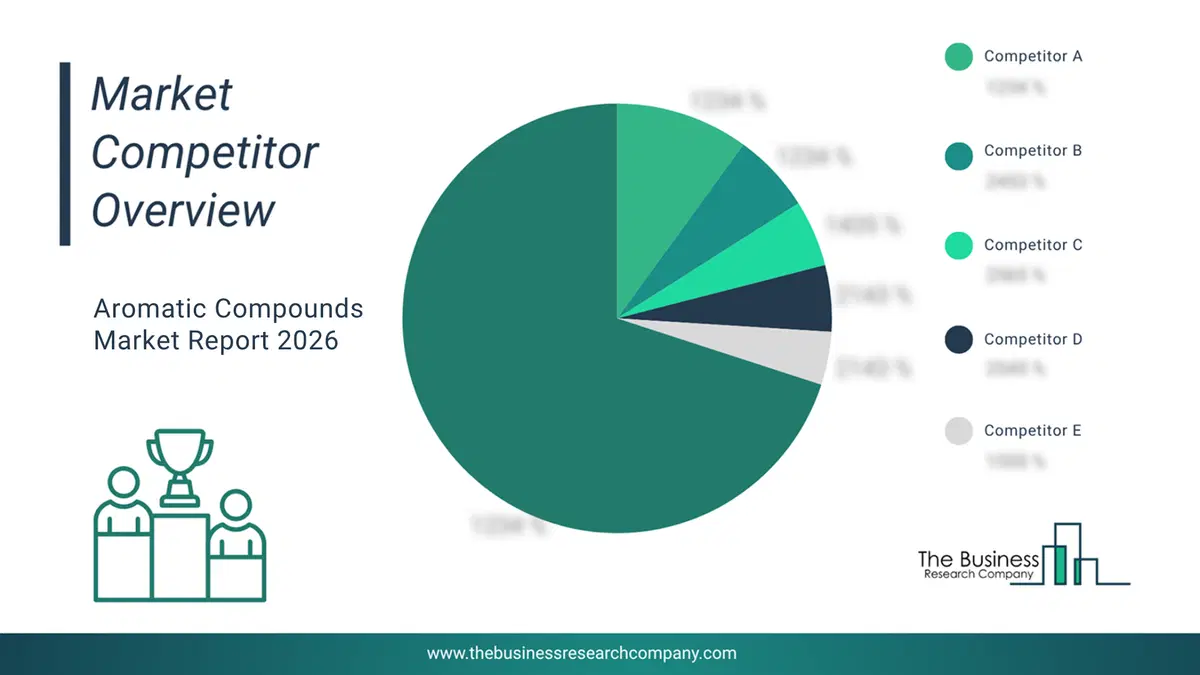
This chart is for illustrative purposes; the full report includes a detailed competitor analysis and comprehensive overview of the top 10 companies in the market.
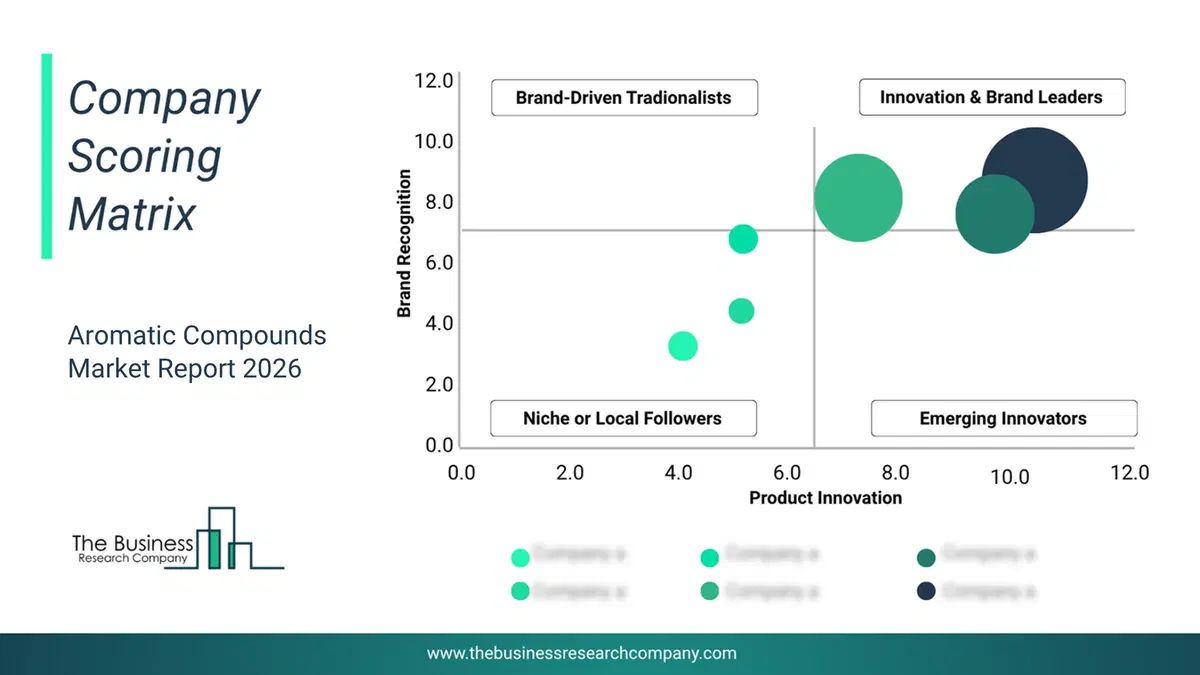
This chart maps companies by product innovation and brand strength, with bubble size indicating relative revenue, helping identify market leaders, challengers, and niche players. This is an illustrative chart; the full report provides a complete and accurate competitive analysis.
Global Aromatic Compounds Market Trends and Insights
Major companies operating in the aromatic compounds market are focusing on developing innovative chemicals, such as sustainable high-purity benzyl benzoate solvents, to enhance fragrance performance, formulation stability, and environmental sustainability. High-purity benzyl benzoate solvents are aromatic solvent compounds used as fixatives and carriers in fragrances, cosmetics, pharmaceuticals, and specialty chemical formulations, helping improve fragrance longevity, ingredient solubility, and odor consistency while offering higher purity and performance compared to conventional solvent grades. For instance, in May 2025, LANXESS AG, a Germany-based specialty chemicals company, showcased its Ultrapure Scopeblue benzyl benzoate at SIMPPAR 2025 as part of its portfolio of sustainable aroma chemicals. The product is a high-purity aromatic solvent and fragrance fixative formulated with a minimum of 50% sustainable raw materials and certified under the ISCC Plus Plusmass balance framework. It is designed to provide superior fragrance performance, enhanced scent longevity, and a lower carbon footprint compared to conventional petroleum-based alternatives. The solution is widely applicable in deodorants, perfumes, candles, and various personal care formulations, where fragrance stability, product quality, and sustainability are essential. This development highlights the increasing industry focus on sustainable aromatic ingredients that combine environmental benefits with high-performance functionality in fragrance and personal care applications.What Are Latest Mergers And Acquisitions In The Aromatic Compounds Market?
In April 2026, BlueAlp B.V., a Netherlands-based chemical recycling technology company, partnered with BioBTX B.V. to develop and deploy an integrated plastics-to-aromatics solution at BioBTX’s Delfzijl facility in the Netherlands. Through this partnership, BlueAlp B.V. and BioBTX B.V. aim to convert hard-to-recycle mixed plastic waste into high-value circular aromatic chemicals, including benzene, toluene, and xylene (BTX), by combining BlueAlp’s patented pyrolysis technology with BioBTX’s proprietary ICCP catalytic process. BioBTX B.V. is a Netherlands-based chemistry technology company that specializes in providing benzene, toluene, and xylene (BTX).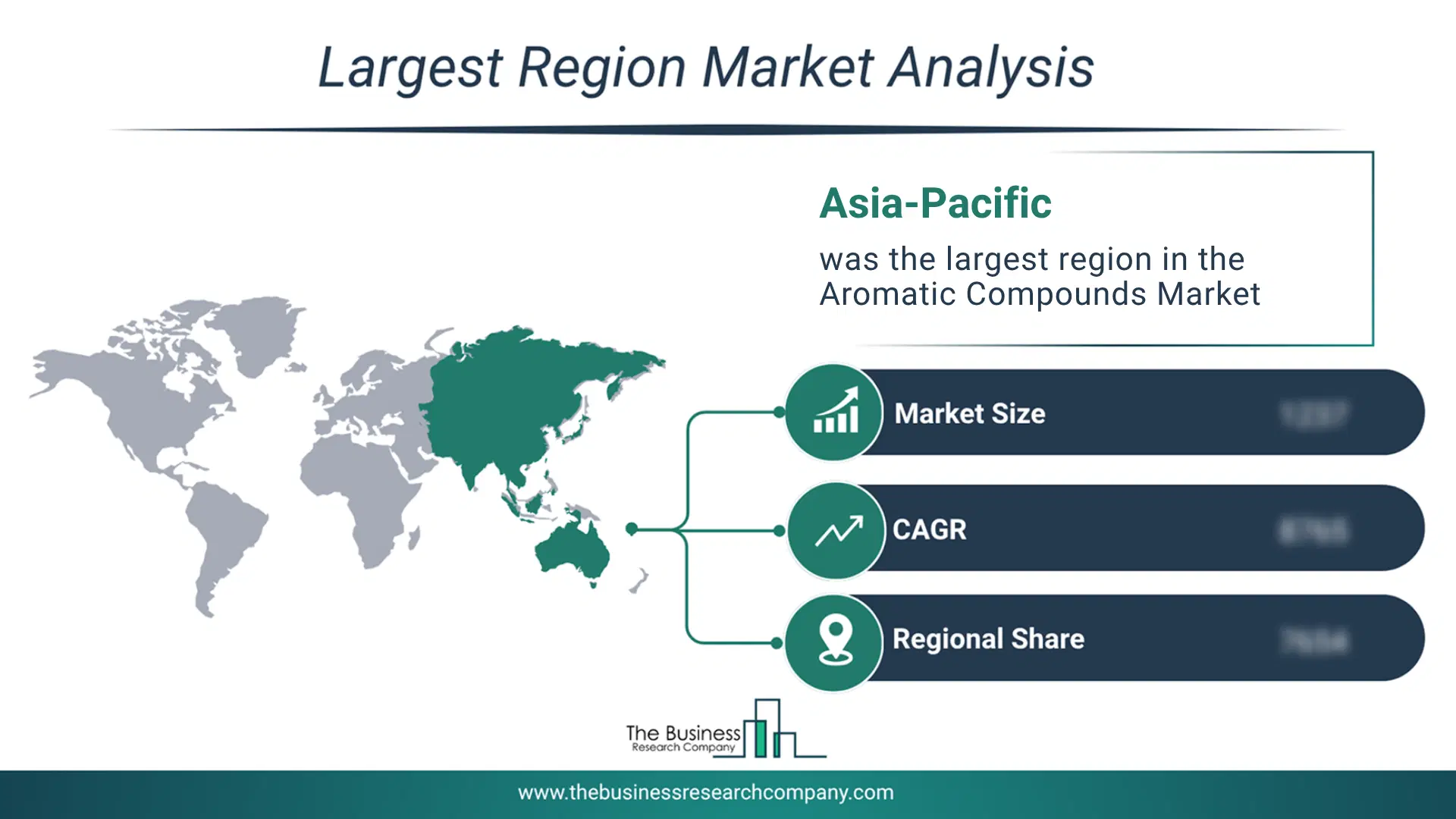
Regional Outlook/Insights
Asia-Pacific was the largest region in the aromatic compounds market in 2025. Asia-Pacific is expected to be the fastest-growing region in the forecast period. The regions covered in this market report are Asia-Pacific, South East Asia, Western Europe, Eastern Europe, North America, South America, Middle East, Africa. The countries covered in this market report are Australia, Brazil, China, France, Germany, India, Indonesia, Japan, Taiwan, Russia, South Korea, UK, USA, Canada, Italy, Spain.What Defines the Aromatic Compounds Market?
The aromatic compounds market consists of sales of cumene, phenol, aniline, nitrobenzene, terephthalic acid, phthalic anhydride, alkylbenzenes, chlorobenzenes, aromatic amines, aromatic acids, aromatic aldehydes, aromatic ketones, and aromatic alcohols. Values in this market are ‘factory gate’ values, that is, the value of goods sold by the manufacturers or creators of the goods, whether to other entities (including downstream manufacturers, wholesalers, distributors, and retailers) or directly to end customers. The value of goods in this market includes related services sold by the creators of the goods.How is Market Value Defined and Measured?
The market value is defined as the revenues that enterprises gain from the sale of goods and/or services within the specified market and geography through sales, grants, or donations in terms of the currency (in USD unless otherwise specified). The revenues for a specified geography are consumption values that are revenues generated by organizations in the specified geography within the market, irrespective of where they are produced. It does not include revenues from resales along the supply chain, either further along the supply chain or as part of other products.
This chart presents market attractiveness based on a quantitative evaluation of growth, competition, strategic alignment, and risk, offering a clear view of opportunity areas for decision-making. This chart is for illustrative purposes; the full report contains the complete analysis.

This chart highlights the Total Addressable Market (TAM) by estimating the maximum revenue opportunity using an assumption-driven approach, supporting strategic planning and opportunity sizing across markets. The chart is illustrative; the full report provides a more comprehensive analysis.
What Key Data and Analysis Are Included in the Aromatic Compounds Market Report 2026?
The aromatic compounds market research report is one of a series of new reports from The Business Research Company that provides aromatic compounds market statistics, including aromatic compounds industry global market size, regional shares, competitors with a aromatic compounds market share, detailed aromatic compounds market segments, market trends and opportunities, and any further data you may need to thrive in the aromatic compounds industry. This aromatic compounds market research report delivers a complete perspective of everything you need, with an in-depth analysis of the current and future scenario of the industry.Aromatic Compounds Market Report Forecast Analysis
| Report Attribute | Details |
|---|---|
| Market Size Value In 2026 | $201.11 billion |
| Revenue Forecast In 2030 | $262.1 billion |
| Growth Rate | CAGR of 6.8% from 2026 to 2030 |
| Base Year For Estimation | 2025 |
| Actual Estimates/Historical Data | 2020-2025 |
| Forecast Period | 2026 - 2030 |
| Market Representation | Revenue in USD Billion and CAGR from 2026 to 2030 |
| Segments Covered | Type, Source, Production Process, Application, End Use Industry |
| Regional Scope | Asia-Pacific, Western Europe, Eastern Europe, North America, South America, Middle East, Africa |
| Country Scope | The countries covered in the report are Australia, Brazil, China, France, Germany, India, Indonesia, Japan, Taiwan, Russia, South Korea, UK, USA, Canada, Italy, Spain. |
| Key Companies Profiled | Saudi Arabian Oil Company, China Petroleum & Chemical Corporation, Exxon Mobil Corporation, Shell plc, BASF SE, Dow Inc., LG Chem Ltd., Mitsubishi Chemical Group Corporation, LyondellBasell Industries N.V., INEOS Group Holdings S.A., Toray Industries Inc., PTT Global Chemical Public Company Limited, Reliance Industries Limited, Eastman Chemical Company, DIC Corporation, Chevron Phillips Chemical Company LLC, Trinseo PLC, Nippon Steel Corporation, Tosoh Corporation, TotalEnergies SE, Formosa Plastics Corporation, Repsol S.A., China National Petroleum Corporation |
| Customization Scope | Request for Customization |
| Pricing And Purchase Options | Explore Purchase Options |