
Arthritis Monoclonal Antibodies Market Report 2026
Global Outlook – By Drug (Remicade, Humira, Enbrel, Rituxan, Orencia, Actemra, Simponi, Cimzia, Remsima), By Application (Rheumatoid Arthritis, Osteoarthritis, Psoriatic Arthritis, Ankylosing Spondylitis, Fibromyalgia, Other Applications), By End-Use (Hospitals, Research Institutes, Other End-Users) – Market Size, Trends, Strategies, and Forecast to 2030
Arthritis Monoclonal Antibodies Market Overview
• Arthritis Monoclonal Antibodies market size has reached to $66.45 billion in 2025 • Expected to grow to $98.46 billion in 2030 at a compound annual growth rate (CAGR) of 8.3% • Growth Driver: Rising Approvals For Personalized Medicines Are Anticipated To Fuel The Growth Of The Arthritis Monoclonal Antibody Market • Market Trend: New Version To Provide A Cheaper Alternatives • North America was the largest region in 2025.What Is Covered Under Arthritis Monoclonal Antibodies Market?
Arthritis monoclonal antibodies refer to a class of sophisticated and useful biological medicines used to treat rheumatoid arthritis and other immune-mediated inflammatory conditions. They inhibit the inflammatory protein interleukin-6, which reduces arthritis-related joint pain and swelling as well as other inflammation-related symptoms. To prevent the body from rejecting the new organ after surgery, they reduce the body's defense mechanism. The main types of drugs in arthritis monoclonal antibodies are Remicade, humira, enbrel, Rituxan, orencia, actemra, simponi, Cinzia, and Remsima. REMICADE is a prescription drug for persons with slightly too severely active Crohn's disease who haven't had success with other treatments. The different applications include rheumatoid arthritis, osteoarthritis, psoriatic arthritis, ankylosing spondylitis, fibromyalgia, and others, and involve various sectors such as hospitals, research institutes, and others.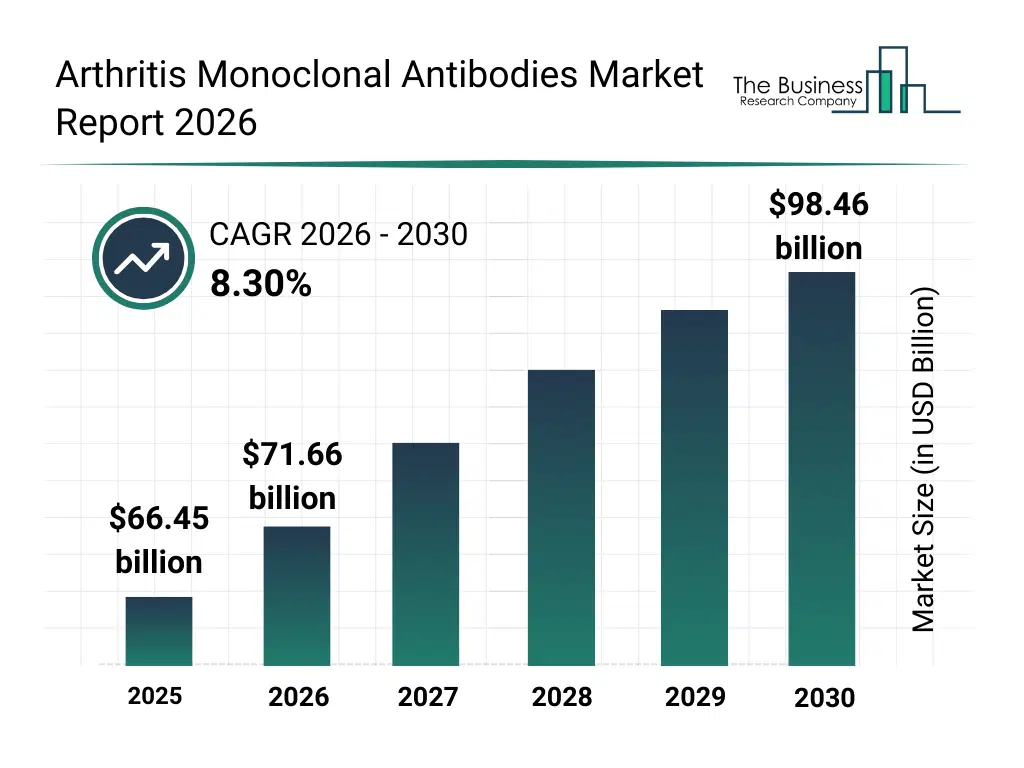
What Is The Arthritis Monoclonal Antibodies Market Size and Share 2026?
The arthritis monoclonal antibodies market size has grown strongly in recent years. It will grow from $66.45 billion in 2025 to $71.66 billion in 2026 at a compound annual growth rate (CAGR) of 7.8%. The growth in the historic period can be attributed to increasing prevalence of rheumatoid arthritis, limited effectiveness of conventional dmards, growing awareness of biologic therapies, expansion of hospital-based rheumatology care, rising healthcare expenditure.What Is The Arthritis Monoclonal Antibodies Market Growth Forecast?
The arthritis monoclonal antibodies market size is expected to see strong growth in the next few years. It will grow to $98.46 billion in 2030 at a compound annual growth rate (CAGR) of 8.3%. The growth in the forecast period can be attributed to development of next-generation monoclonal antibodies, increasing launch of biosimilars, growth in personalized immunotherapy approaches, rising aging population with arthritis conditions, improving reimbursement policies for biologics. Major trends in the forecast period include rising adoption of biologic therapies for autoimmune arthritis, increasing preference for targeted monoclonal antibody treatments, growth in early and aggressive treatment approaches, expansion of biosimilars for arthritis monoclonal antibodies, improved patient access through hospital and specialty clinics.
Global Arthritis Monoclonal Antibodies Market Segmentation
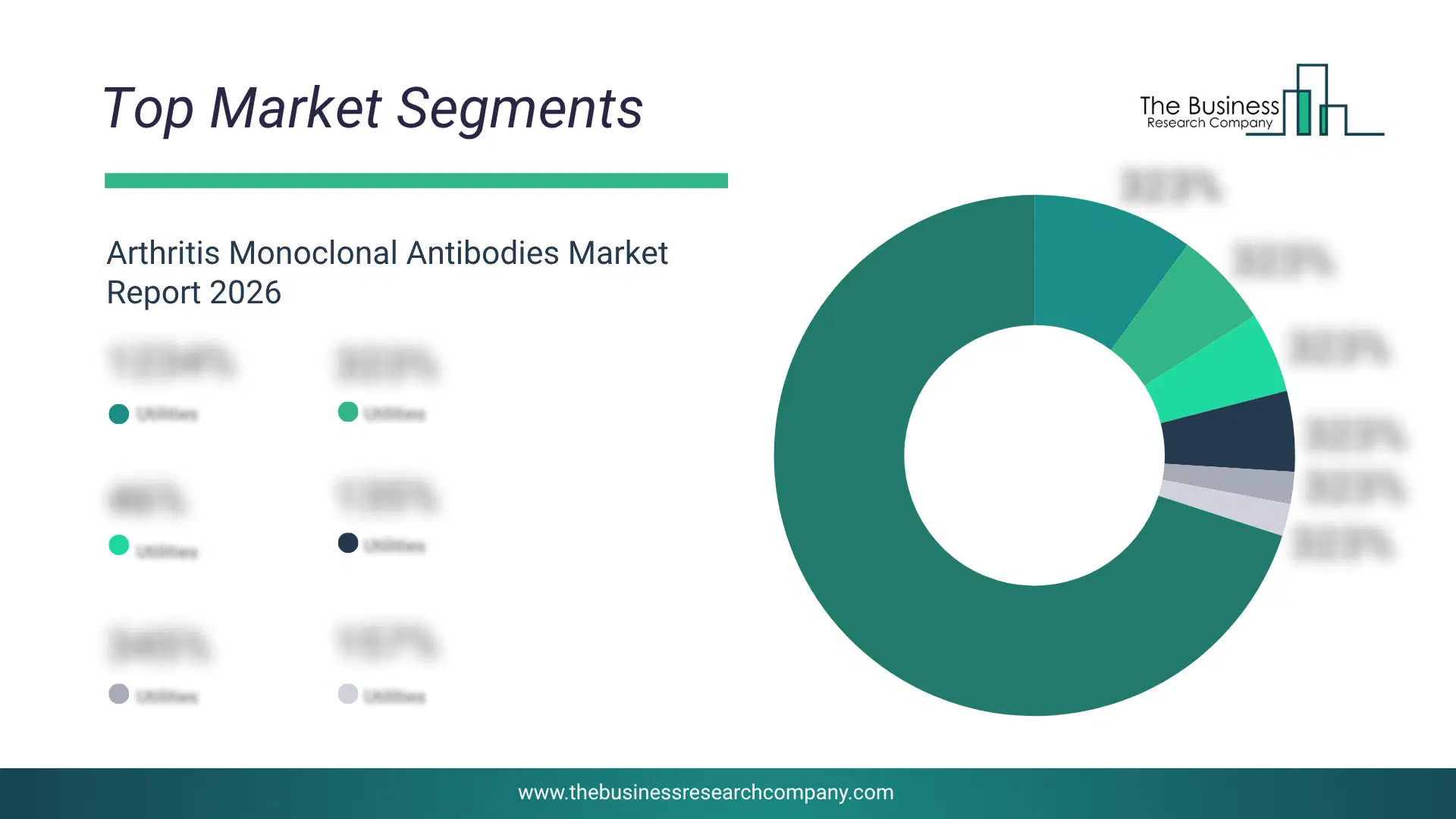
1) By Drug: Remicade, Humira, Enbrel, Rituxan, Orencia, Actemra, Simponi, Cimzia, Remsima 2) By Application: Rheumatoid Arthritis, Osteoarthritis, Psoriatic Arthritis, Ankylosing Spondylitis, Fibromyalgia, Other Applications 3) By End-Use: Hospitals, Research Institutes, Other End-UsersWhat Is The Driver Of The Arthritis Monoclonal Antibodies Market?
The rising approvals for personalized medicines are expected to propel the arthritis monoclonal antibody market going forward. Personalized medicines refer to therapeutic products or treatments tailored to the individual patient. They are designed based on a patient's genetic, biomarker, phenotypic, or psychosocial characteristics that can predict an individual's response to a treatment. Monoclonal antibodies (mABs) are the latest generation of drugs that fit the personalized medicine paradigm and have the potential to improve patient outcomes and efficiency in healthcare. For instance, in February 2024, according to the Personalized Medicine Coalition, a US-based non-profit organization promoting the adoption of personalized medicine, the report examines the importance of 26 newly approved personalized treatments, 19 expanded indications for existing personalized medicines, and 17 notable new or expanded indications for 12 diagnostic testing products. Therefore, the rising approvals for personalized medicines drive the arthritis monoclonal antibody market.Key Players In The Global Arthritis Monoclonal Antibodies Market
Major companies operating in the arthritis monoclonal antibodies market are Johnson & Johnson, Hoffmann-La Roche Ltd., Novartis AG, Pfizer Inc., AbbVie Inc., Amgen Inc., Genentech Inc., GlaxoSmithKline plc., AstraZeneca plc, Bristol Myers Squibb, Eli Lilly and Company, Thermo Fisher Scientific Inc., Sanofi SA, Daiichi Sankyo Company Ltd., Seattle Genetics, Teva Pharmaceutical Industries Ltd., Shanghai Junshi Biosciences Co. Ltd., GenScript Biotech Corporation, Sigma-Aldrich Co. LLC, AbGenomics Corp., ADC Therapeutics SA, Agensys Inc., Alexion Pharmaceuticals Inc., ALMAC Group Ltd., Ambrx Inc., Astellas Pharma Inc., Celgene Corporation, Celldex Therapeutics Inc., Boehringer Ingelheim International GmbH, Celltrion Inc., HanAll Biopharma Co. Ltd., Merck & Co. Inc., Mitsubishi Tanabe Pharma Corporation, Regeneron Pharmaceuticals Inc., Samsung Bioepis Co. Ltd.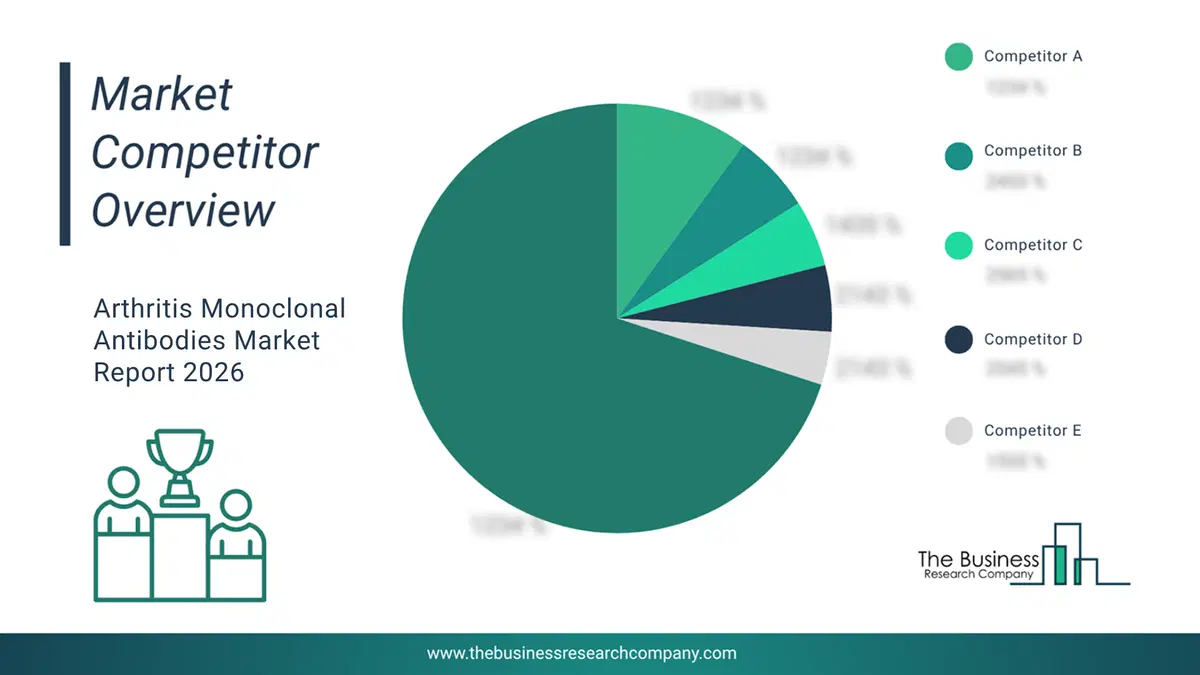
This chart is for illustrative purposes; the full report includes a detailed competitor analysis and comprehensive overview of the top 10 companies in the market.
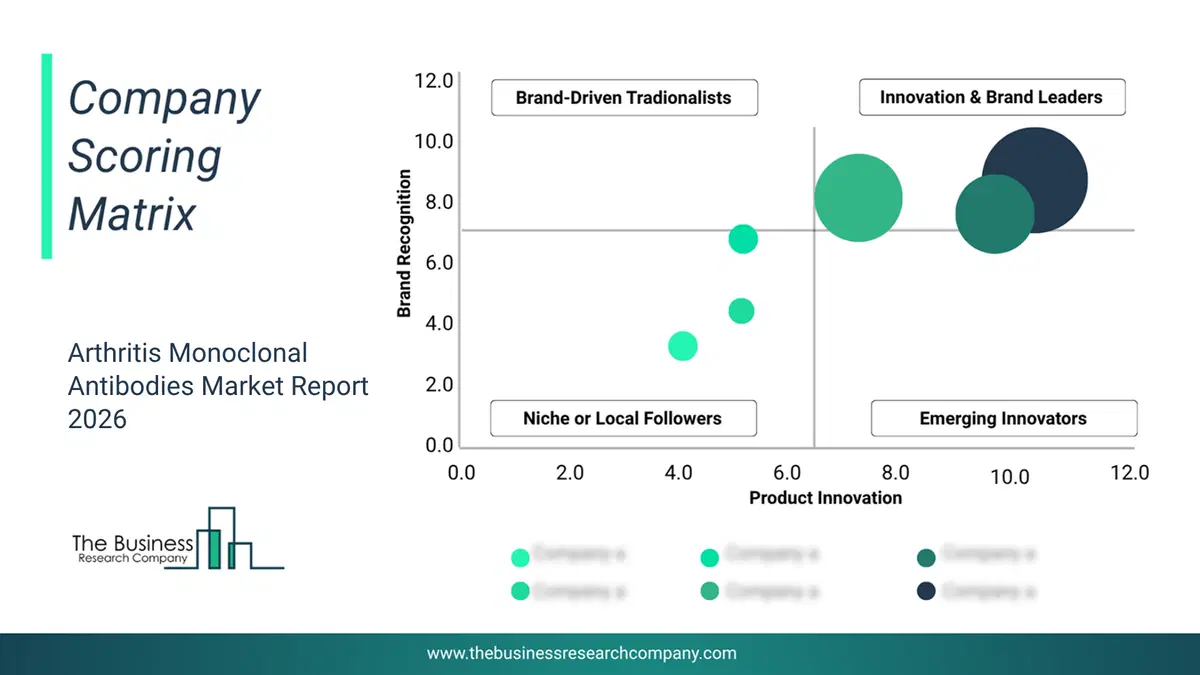
This chart maps companies by product innovation and brand strength, with bubble size indicating relative revenue, helping identify market leaders, challengers, and niche players. This is an illustrative chart; the full report provides a complete and accurate competitive analysis.
Global Arthritis Monoclonal Antibodies Market Trends and Insights
Major companies operating in the arthritis monoclonal antibody market are launching new biosimilar versions such as the Hulio to provide affordable treatment. Hulio is a biosimilar version of AbbVie's blockbuster rheumatoid arthritis drug, Humira. For instance, in July 2023, Biocon Biologics, an India-based subsidiary of Biocon Limited, focused on developing biosimilar therapies launched, the Hulio (adalimumab-fkjp), a biosimilar counterpart of Humira. This monoclonal antibody, used for conditions like rheumatoid arthritis and psoriatic arthritis, is priced 5% lower than Humira, which is currently listed at $6,922 per carton.What Are Latest Mergers And Acquisitions In The Arthritis Monoclonal Antibodies Market?
In May 2023, Abiogen Pharma Spa, an Italy-based pharmaceutical company, acquired EffRx Pharmaceuticals SA for $8.77 million. The acquisition of a majority stake in EffRx is consistent with Abiogen's growth strategy. It provides a springboard for their international expansion and affirms their dedication to improving osteoarticular and bone metabolism diseases. EffRx Pharmaceuticals SA is a Switzerland-based pharmaceutical company involved in treating various disorders, including arthritis.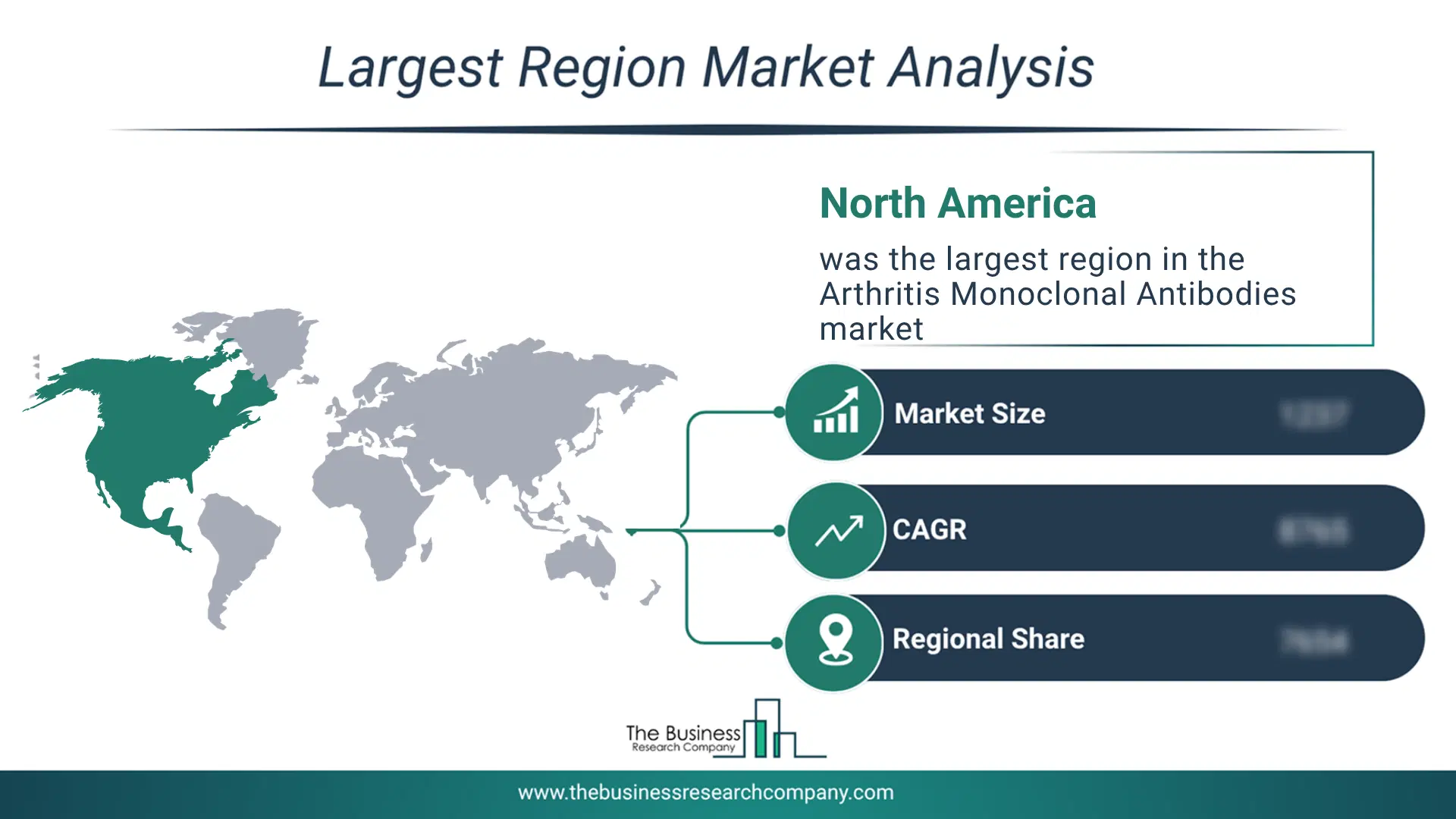
Regional Insights
North America was the largest region in the arthritis monoclonal antibodies market in 2025. The regions covered in this market report are Asia-Pacific, South East Asia, Western Europe, Eastern Europe, North America, South America, Middle East, Africa. The countries covered in this market report are Australia, Brazil, China, France, Germany, India, Indonesia, Japan, Taiwan, Russia, South Korea, UK, USA, Canada, Italy, Spain.What Defines the Arthritis Monoclonal Antibodies Market?
The arthritis monoclonal antibodies market consists of sales of infliximab, adalimumab, golimumab, and certolizumab. Values in this market are factory gate values, that is the value of goods sold by the manufacturers or creators of the goods, whether to other entities (including downstream manufacturers, wholesalers, distributors, and retailers) or directly to end customers. The value of goods in this market includes related services sold by the creators of the goods.How is Market Value Defined and Measured?
The market value is defined as the revenues that enterprises gain from the sale of goods and/or services within the specified market and geography through sales, grants, or donations in terms of the currency (in USD unless otherwise specified). The revenues for a specified geography are consumption values that are revenues generated by organizations in the specified geography within the market, irrespective of where they are produced. It does not include revenues from resales along the supply chain, either further along the supply chain or as part of other products.
This chart presents market attractiveness based on a quantitative evaluation of growth, competition, strategic alignment, and risk, offering a clear view of opportunity areas for decision-making. This chart is for illustrative purposes; the full report contains the complete analysis.

This chart highlights the Total Addressable Market (TAM) by estimating the maximum revenue opportunity using an assumption-driven approach, supporting strategic planning and opportunity sizing across markets. The chart is illustrative; the full report provides a more comprehensive analysis.
What Key Data and Analysis Are Included in the Arthritis Monoclonal Antibodies Market Report 2026?
The arthritis monoclonal antibodies market research report is one of a series of new reports from The Business Research Company that provides market statistics, including industry global market size, regional shares, competitors with the market share, detailed market segments, market trends and opportunities, and any further data you may need to thrive in the arthritis monoclonal antibodies industry. The market research report delivers a complete perspective of everything you need, with an in-depth analysis of the current and future state of the industry.Arthritis Monoclonal Antibodies Market Report Forecast Analysis
| Report Attribute | Details |
|---|---|
| Market Size Value In 2026 | $71.66 billion |
| Revenue Forecast In 2030 | $98.46 billion |
| Growth Rate | CAGR of 7.8% from 2026 to 2030 |
| Base Year For Estimation | 2025 |
| Actual Estimates/Historical Data | 2020-2025 |
| Forecast Period | 2026 - 2030 |
| Market Representation | Revenue in USD Billion and CAGR from 2026 to 2030 |
| Segments Covered | Drug, Application, End-Use |
| Regional Scope | Asia-Pacific, Western Europe, Eastern Europe, North America, South America, Middle East, Africa |
| Country Scope | The countries covered in the report are Australia, Brazil, China, France, Germany, India, Indonesia, Japan, Taiwan, Russia, South Korea, UK, USA, Canada, Italy, Spain. |
| Key Companies Profiled | Johnson & Johnson, Hoffmann-La Roche Ltd., Novartis AG, Pfizer Inc., AbbVie Inc., Amgen Inc., Genentech Inc., GlaxoSmithKline plc., AstraZeneca plc, Bristol Myers Squibb, Eli Lilly and Company, Thermo Fisher Scientific Inc., Sanofi SA, Daiichi Sankyo Company Ltd., Seattle Genetics, Teva Pharmaceutical Industries Ltd., Shanghai Junshi Biosciences Co. Ltd., GenScript Biotech Corporation, Sigma-Aldrich Co. LLC, AbGenomics Corp., ADC Therapeutics SA, Agensys Inc., Alexion Pharmaceuticals Inc., ALMAC Group Ltd., Ambrx Inc., Astellas Pharma Inc., Celgene Corporation, Celldex Therapeutics Inc., Boehringer Ingelheim International GmbH, Celltrion Inc., HanAll Biopharma Co. Ltd., Merck & Co. Inc., Mitsubishi Tanabe Pharma Corporation, Regeneron Pharmaceuticals Inc., Samsung Bioepis Co. Ltd. |
| Customization Scope | Request for Customization |
| Pricing And Purchase Options | Explore Purchase Options |