

Artificial General Intelligence Market Report 2026
Global Outlook – By Type (Software, Hardware), By Deployment Type (Cloud-Based Artificial General Intelligence, On-Premise Artificial General Intelligence, Hybrid Artificial General Intelligence, Edge-Deployed Artificial General Intelligence), By Service Type (Artificial General Intelligence Research And Development Platforms, Artificial Intelligence Model Licensing And Deployment Services, Predictive Analytics And Decision-Making Solutions, Automation And Cognitive Task Services, Artificial General Intelligence-Driven Autonomous Agent Solutions, Training And Support Services), By Technology Type (Peinforcement Learning-Driven Artificial General), By Industry Vertical (Healthcare, Automotive, Manufacturing, Retail, Banking) – Market Size, Trends, Strategies, and Forecast to 2030
Artificial General Intelligence Market Overview
• Artificial General Intelligence market size has reached to $6.94 billion in 2025 • Expected to grow to $29.67 billion in 2030 at a compound annual growth rate (CAGR) of 33.7% • Growth Driver: Increasing Research Investments In Advanced Artificial Intelligence (AI) Technologies Fueling The Growth Of The Market Due To Rising Focus On Developing Human-Like Cognitive Capabilities • Market Trend: • North America was the largest region in 2025 and Asia-Pacific is the fastest growing region.Market Gains By 2030 – Top Opportunities By Segment
Market Gain identifies the most promising market opportunities by highlighting the segments or products expected to generate the highest incremental revenue growth over the next five years.
What Is Covered Under Artificial General Intelligence Market?
Artificial general intelligence is a form of artificial intelligence designed to understand, learn, and apply knowledge across a wide range of tasks at a level comparable to human cognitive abilities. It is capable of reasoning, adapting to new situations, and transferring learning from one domain to another without task-specific programming. It is used to exhibit flexible, autonomous problem-solving that mirrors human-like intelligence. The main types of the artificial general intelligence (AGI) market include software and hardware. Software encompasses AGI platforms, frameworks, and algorithms designed to perform autonomous reasoning, learning, and decision-making across diverse domains, enabling machines to mimic human-level intelligence and adaptability. The deployment type into cloud-based artificial general intelligence, on-premise artificial general intelligence, hybrid artificial general intelligence, and edge-deployed artificial general intelligence. The service type, it includes artificial general intelligence research and development platforms, AI model licensing and deployment services, predictive analytics and decision-making solutions, automation and cognitive task services, AGI-driven autonomous agent solutions, and training and support services. The technology type, it comprises deep learning and foundation model-based artificial general intelligence, reinforcement learning-driven artificial general intelligence, cognitive architecture-based artificial general intelligence, symbolic and neural hybrid artificial general intelligence, multi-modal artificial general intelligence, and quantum-enhanced artificial general intelligence. The industry vertical covers healthcare, automotive, manufacturing, retail, BFSI, IT and telecom, education, government and defense, energy, transportation, and others.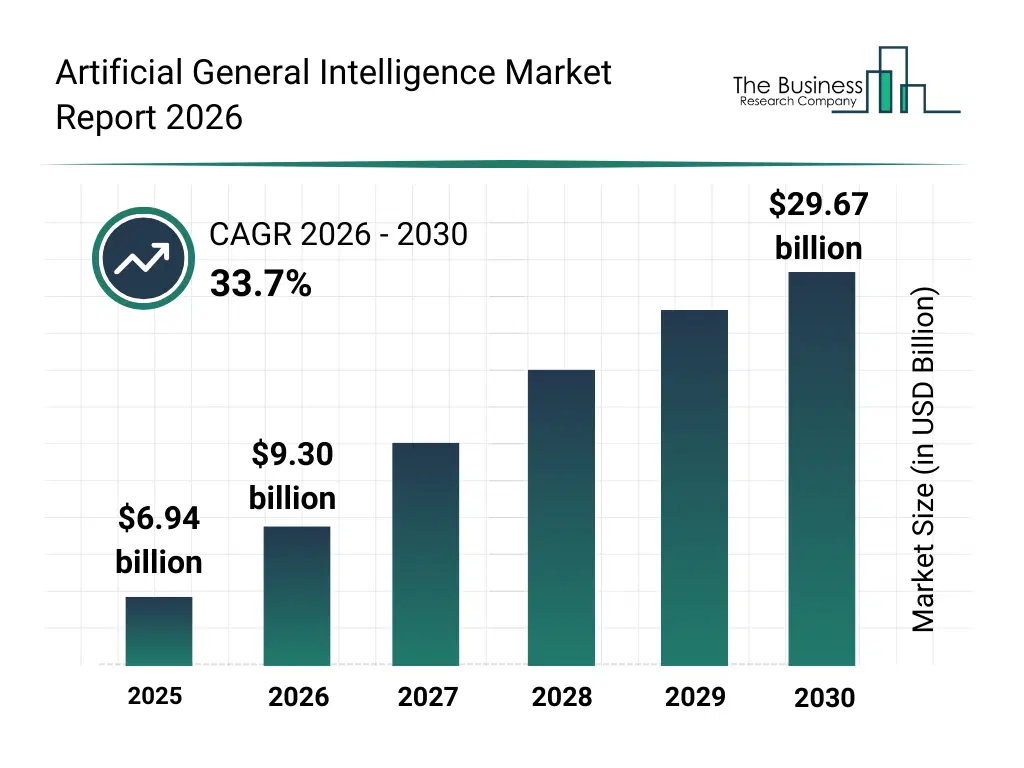
What Is The Artificial General Intelligence Market Size and Share 2026?
The artificial general intelligence market size has grown exponentially in recent years. It will grow from $6.94 billion in 2025 to $9.30 billion in 2026 at a compound annual growth rate (CAGR) of 33.9%. The growth in the historic period can be attributed to increasing investment in artificial intelligence research, rising adoption of automation across industries, growing computational power and data availability, expansion of machine learning and deep learning applications, increasing demand for cognitive decision-making systems.What Is The Artificial General Intelligence Market Growth Forecast?
The artificial general intelligence market size is expected to see exponential growth in the next few years. It will grow to $29.67 billion in 2030 at a compound annual growth rate (CAGR) of 33.7%. The growth in the forecast period can be attributed to growing enterprise shift toward autonomous intelligence solutions, rising adoption of cloud-based agi platforms, increasing government and private funding for next-gen ai development, expansion of agi use cases in robotics and mission-critical operations, increasing demand for human-level ai decision augmentation. Major trends in the forecast period include advancements in generalizable neural network architectures, rapid innovations in cognitive computing and multimodal learning, development of autonomous self-evolving ai models, increasing research and development toward explainable agi systems, emerging breakthroughs in quantum-powered agi experimentation.
Global Artificial General Intelligence Market Segmentation
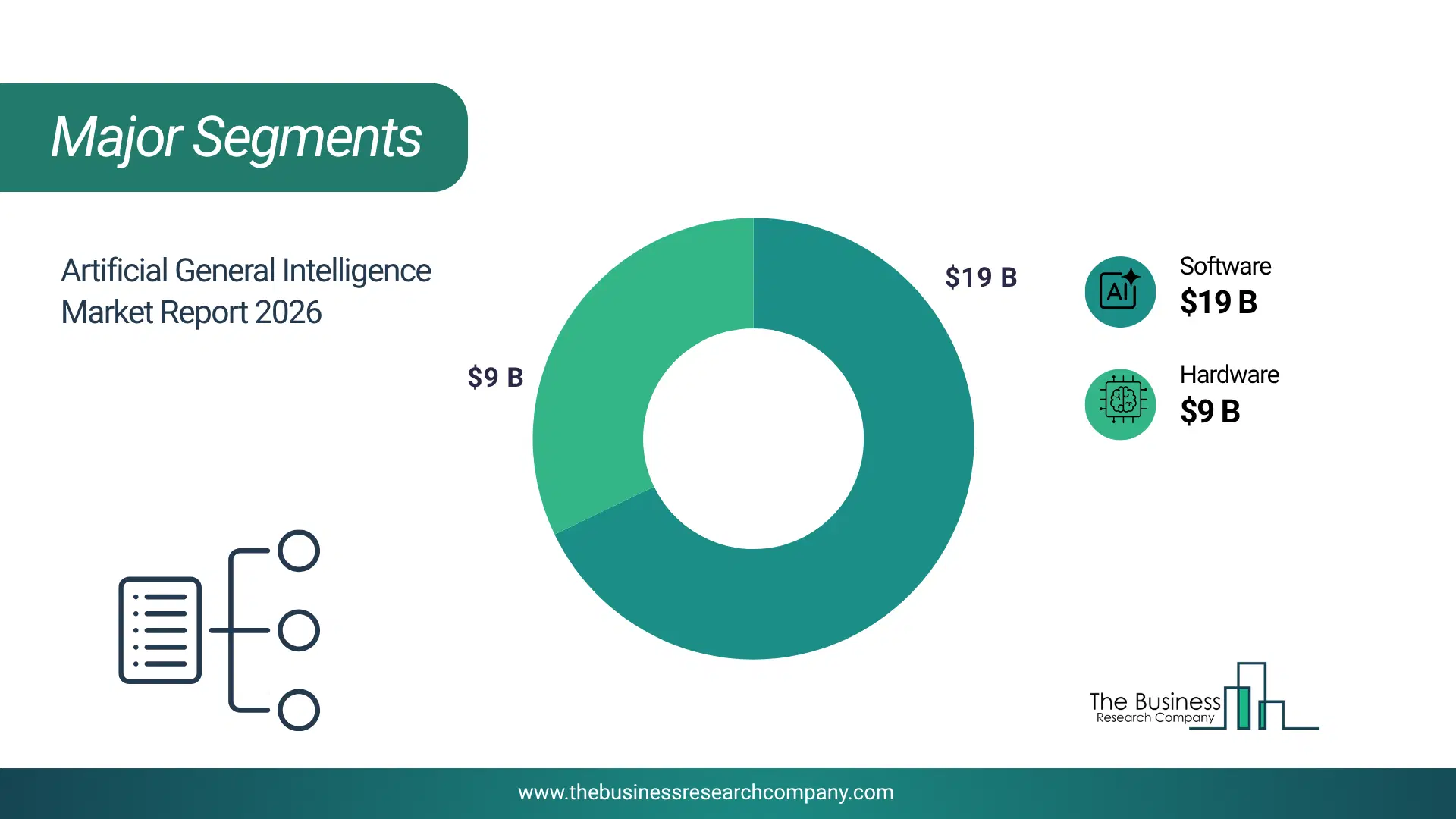
1) By Type: Software, Hardware 2) By Deployment Type: Cloud-Based Artificial General Intelligence, On-Premise Artificial General Intelligence, Hybrid Artificial General Intelligence, Edge-Deployed Artificial General Intelligence 3) By Service Type: Artificial General Intelligence Research And Development Platforms, Artificial Intelligence Model Licensing And Deployment Services, Predictive Analytics And Decision-Making Solutions, Automation And Cognitive Task Services, Artificial General Intelligence-Driven Autonomous Agent Solutions, Training And Support Services 4) By Technology Type: Deep Learning And Foundation Model-Based Artificial General Intelligence, Reinforcement Learning-Driven Artificial General Intelligence, Cognitive Architecture-Based Artificial General Intelligence, Symbolic And Neural Hybrid Artificial General Intelligence, Multi-Modal Artificial General Intelligence, Quantum-Enhanced Artificial General Intelligence 5) By Industry Vertical: Healthcare, Automotive, Manufacturing, Retail, Banking, Financial Services, And Insurance, Information Technology And Telecom, Education, Government And Defense, Energy, Transportation, Other Industry Verticals Subsegments: 1) By Software: Cognitive Computing Platforms, Machine Learning Frameworks, Natural Language Processing Systems, Predictive Analytics Tools, Decision Support Systems 2) By Hardware: Graphics Processing Units, Tensor Processing Units, High-Performance Computing Servers, Edge Computing Devices, Quantum Computing Systems The top segments in the artificial general intelligence market will be: • Software will reach $19.04 Billion by 2030. • Hardware will reach $8.77 Billion by 2030.What Are The Drivers Of The Artificial General Intelligence Market?
The increasing research investments in advanced artificial intelligence (AI) technologies are expected to propel the growth of the artificial general intelligence market going forward. Advanced artificial intelligence technologies refer to artificial intelligence (AI) systems capable of performing complex tasks, learning from diverse data, and exhibiting reasoning and problem-solving abilities similar to human cognition. The rise in research investments is due to growing interest from governments, private enterprises, and academic institutions in developing artificial intelligence (AI) systems that can perform a wide range of tasks autonomously, enhance decision-making, and drive innovation across sectors. Artificial intelligence (AI) supports investments in advanced artificial intelligence (AI) technologiesby aiming to achieve human-like understanding and adaptability, enabling applications in robotics, healthcare, finance, and scientific research. For instance, in November 2024, according to the Networking and Information Technology Research and Development Program (NITRD), a US-based government agency, the proposed fiscal year 2025 budget request for artificial intelligence (AI) research and development is $3.3 billion, representing a 6.5% increase over the requested level for fiscal year 2024. Therefore, the increasing research investments in advanced artificial intelligence technologies are driving the growth of the artificial general intelligence industry. The growing demand for artificial intelligence across industries is expected to propel the growth of the artificial general intelligence market going forward. Artificial intelligence adoption across industries refers to the increasing use of AI technologies by sectors such as healthcare, finance, manufacturing, retail, transportation, and defense to automate processes, enhance decision-making, and improve operational efficiency. The rise in demand for artificial intelligence across industries is due to its ability to automate complex tasks enhance decision-making with data-driven insights and unlock new efficiency and innovation opportunities at scale. Artificial general intelligence supports artificial intelligence across industries by enabling systems to perform a wide range of cognitive tasks, adapt to new situations, and apply reasoning and learning across multiple domains, beyond narrow task-specific artificial intelligence (AI). For instance, in December 2025, according to Eurostat, a Brussels-based statistical office of the European Union, 19.95% of EU enterprises with ten or more employees and self-employed persons used at least one artificial intelligence technology in 2025, reflecting a 6.47 percentage point increase from 2024, with adoption highest among large enterprises at 55.03% compared with 30.36% of medium enterprises and 17% of small enterprises. Therefore, the growing demand for artificial intelligence across industries is driving the growth of the artificial general intelligence industry.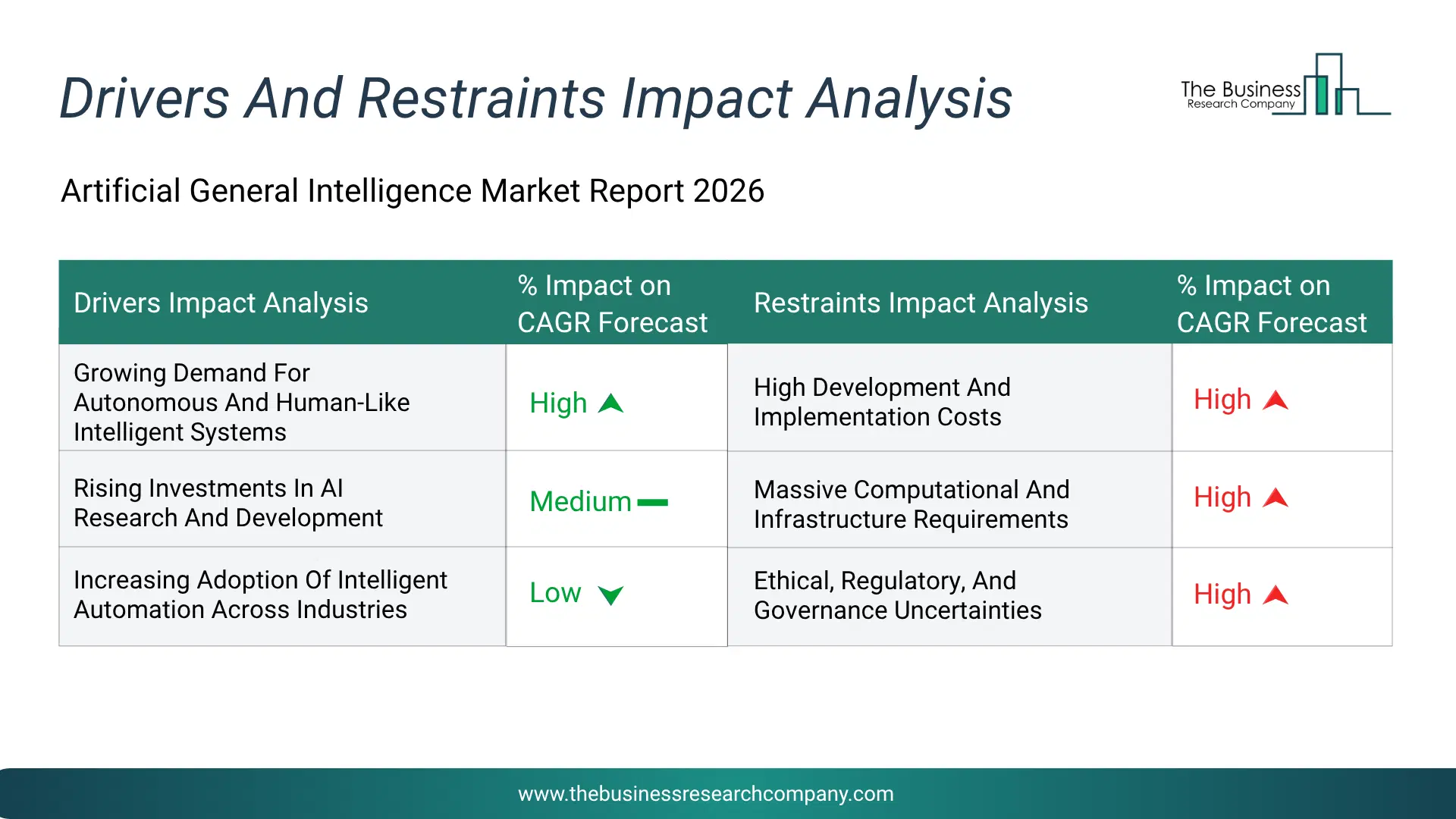
Infographic Chart Showing Key Market Drivers Analysis And Restraints For Artificial General Intelligence Market
The chart presents an impact analysis of key drivers and restraints, quantifying their relative influence on the market's growth rate and helping assess the balance between growth enablers and limiting factors. This chart offers a high-level perspective; the full report contains more detailed insights.
How Will The Drivers Impact Growth In The Global Artificial General Intelligence Market?
• Growing Demand For Autonomous And Human-Like Intelligent Systems (High) – During the forecast period, the growing demand for autonomous and human-like intelligent systems is expected to become a key growth driver for the Artificial General Intelligence market by 2030. Enterprises are increasingly adopting intelligent systems capable of reasoning, learning, and adapting across diverse environments without relying on predefined rules. These capabilities enable AGI to support complex decision-making, contextual understanding, and problem-solving across multiple industries. Organizations are expanding investments in next-generation cognitive platforms to improve operational flexibility, reduce manual intervention, and enhance business responsiveness. This growing preference for adaptable intelligent systems is strengthening the long-term outlook for AGI adoption. • Rising Investments In AI Research And Development (Medium) – During the forecast period, rising investments in AI research and development are expected to emerge as a major factor driving the expansion of the Artificial General Intelligence market by 2030. Increased funding from public and private sectors is accelerating breakthroughs in advanced learning architectures, high-performance computing infrastructure, and scalable training environments required for AGI development. Continuous innovation is improving model capabilities, reducing technological limitations, and enabling faster commercialization of sophisticated AI solutions. Growing financial support for frontier AI programs is also encouraging collaboration between research organizations and technology providers. • Increasing Adoption Of Intelligent Automation Across Industries (Low) – During the forecast period, the increasing adoption of intelligent automation across industries is expected to act as a key growth catalyst for the Artificial General Intelligence market by 2030. Businesses are deploying advanced automation technologies to optimize complex workflows, improve resource utilization, and enhance enterprise-wide productivity. AGI enables intelligent systems to adapt to changing operational conditions, manage dynamic processes, and deliver more accurate outcomes across manufacturing, healthcare, transportation, and financial services. The shift toward adaptive automation is creating strong demand for next-generation cognitive platforms capable of supporting strategic business operations.How Will The Restraints Impact Growth In The Global Artificial General Intelligence Market?
• High Development And Implementation Costs (High) – During the forecast period, the high development and implementation costs act as a major restraint on the artificial general intelligence (AGI) market because creating systems capable of human-like reasoning and learning requires significant financial investment. Organizations must allocate substantial resources toward advanced research, algorithm development, data acquisition, specialized hardware, and highly skilled AI talent. In addition, the development of AGI-enabled products such as autonomous robots, intelligent sensors, edge computing devices, and neural processing units involves extensive testing, integration, and optimization to ensure reliable performance across diverse tasks. Businesses adopting AGI solutions often face considerable expenses related to deployment, employee training, maintenance, and system upgrades. These high upfront and ongoing costs can discourage small and medium-sized enterprises from investing in AGI technologies, limiting market penetration. As a result, adoption remains concentrated among large organizations with sufficient financial resources, slowing the overall expansion of the AGI market. • Massive Computational And Infrastructure Requirements (Medium) – During the forecast period, the massive computational and infrastructure requirements restrain the artificial general intelligence market by increasing the complexity and cost of developing and operating AGI systems. AGI applications require enormous processing power, large-scale data storage, high-speed networking, and advanced computing architectures to support continuous learning, reasoning, and decision-making. Training sophisticated AGI models often demands access to powerful data centers, specialized processors, and energy-intensive computing resources, which can be costly to acquire and maintain. Furthermore, organizations must invest in robust cloud or edge infrastructure to enable real-time performance, scalability, and reliability of AGI-driven products and services. In regions with limited digital infrastructure or access to advanced computing facilities, the deployment of AGI solutions can be particularly challenging. These infrastructure barriers increase operational expenses and restrict the widespread adoption of AGI technologies, thereby limiting the market’s growth potential. • Ethical, Regulatory, And Governance Uncertainties (Low) – During the forecast period, the ethical, regulatory, and governance uncertainties are expected to restrain the growth of the artificial general intelligence (AGI) market. The development of artificial general intelligence raises complex ethical, legal, and societal concerns regarding accountability, transparency, decision-making, and the potential misuse of highly autonomous systems. Governments and regulatory bodies are still formulating comprehensive frameworks to govern the development, deployment, and oversight of AGI technologies, creating uncertainty for technology developers and investors. Organizations may delay large-scale adoption due to evolving compliance requirements, liability concerns, and the absence of globally harmonized regulations. In addition, concerns related to algorithmic bias, explainability, human oversight, and the potential impact of AGI on employment and public safety have intensified scrutiny from policymakers and the public. Companies are therefore required to invest significantly in responsible AI governance, risk management, and compliance measures, increasing development complexity and operational costs. These regulatory and ethical uncertainties may slow commercialization and limit broader adoption of AGI solutions across industries. Consequently, ethical, regulatory, and governance uncertainties remain a significant restraint on the growth of the artificial general intelligence market.Key Players In The Global Artificial General Intelligence Market
Major companies operating in the artificial general intelligence market are Amazon Web Services Inc., Google Cloud, Microsoft Corporation, International Business Machines Corporation (IBM), Meta Platforms Inc., NVIDIA Corporation, OpenAI Inc., Palantir Technologies Inc., DeepMind Technologies Limited, C3.ai Inc., xAI Corp., Anthropic PBC, Tenstorrent Inc., H2O.ai Inc., Hugging Face Inc., GoodAI, SingularityNET Foundation, Graphcore Ltd., Vicarious, Numenta Inc.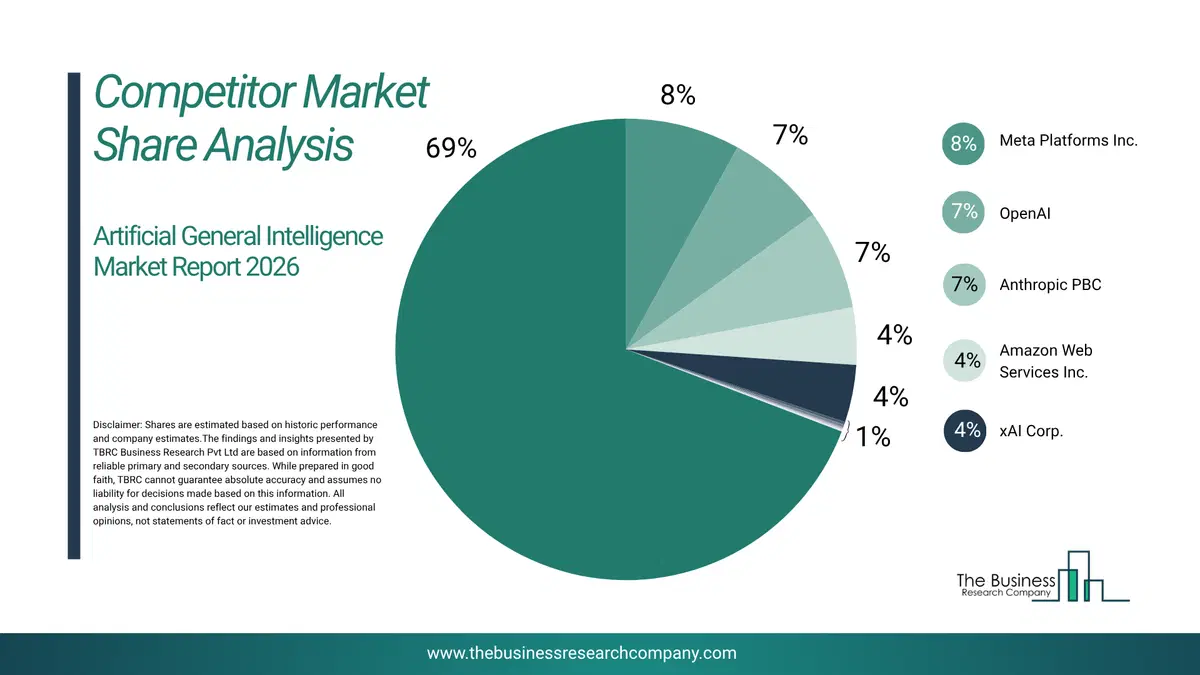
This chart is for illustrative purposes; the full report includes a detailed competitor analysis and comprehensive overview of the top 10 companies in the market.
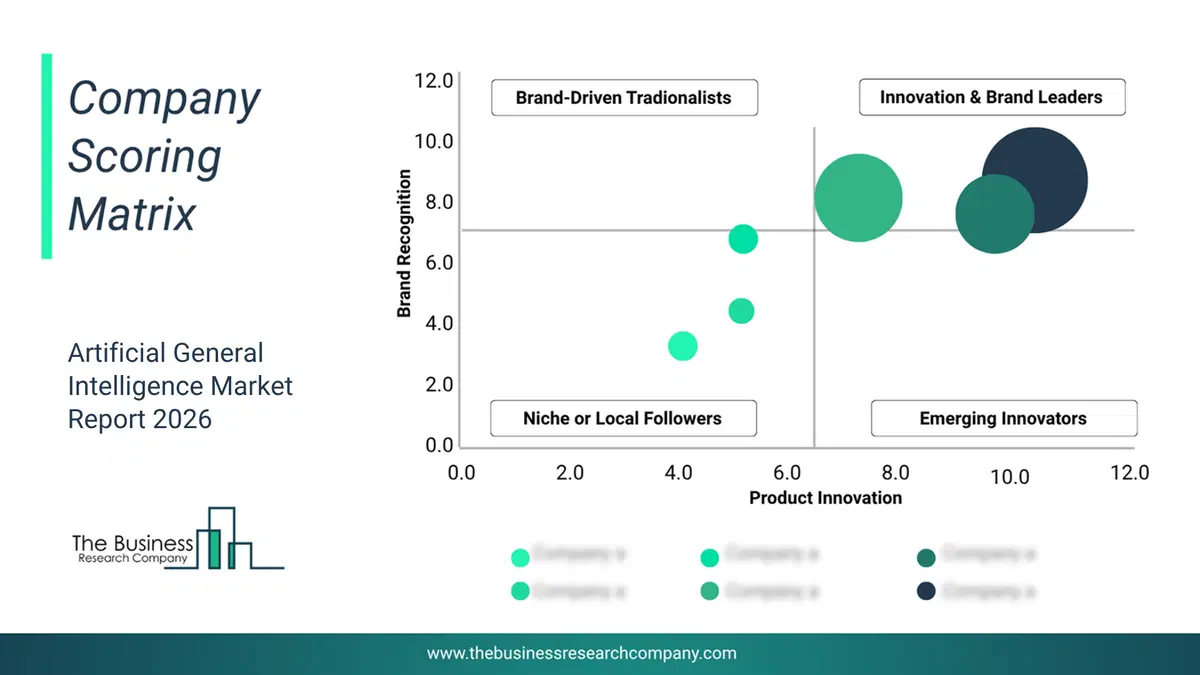
This chart maps companies by product innovation and brand strength, with bubble size indicating relative revenue, helping identify market leaders, challengers, and niche players. This is an illustrative chart; the full report provides a complete and accurate competitive analysis.
What Are Latest Mergers And Acquisitions In The Artificial General Intelligence Market?
In December 2025, Banco Bilbao Vizcaya Argentaria S.A. (BBVA), a Spain-based multinational banking group, partnered with OpenAI, to integrate advanced artificial general intelligence (AGI) capabilities into banking operations and customer experiences. Through this partnership, BBVA and OpenAI aim to leverage cutting-edge language models and artificial general intelligence (AGI) technologies to enhance financial decision-making, automate customer support, optimize risk management, and create innovative, AI-driven banking products and services. OpenAI is a US-based artificial general intelligence (AGI) research and deployment company.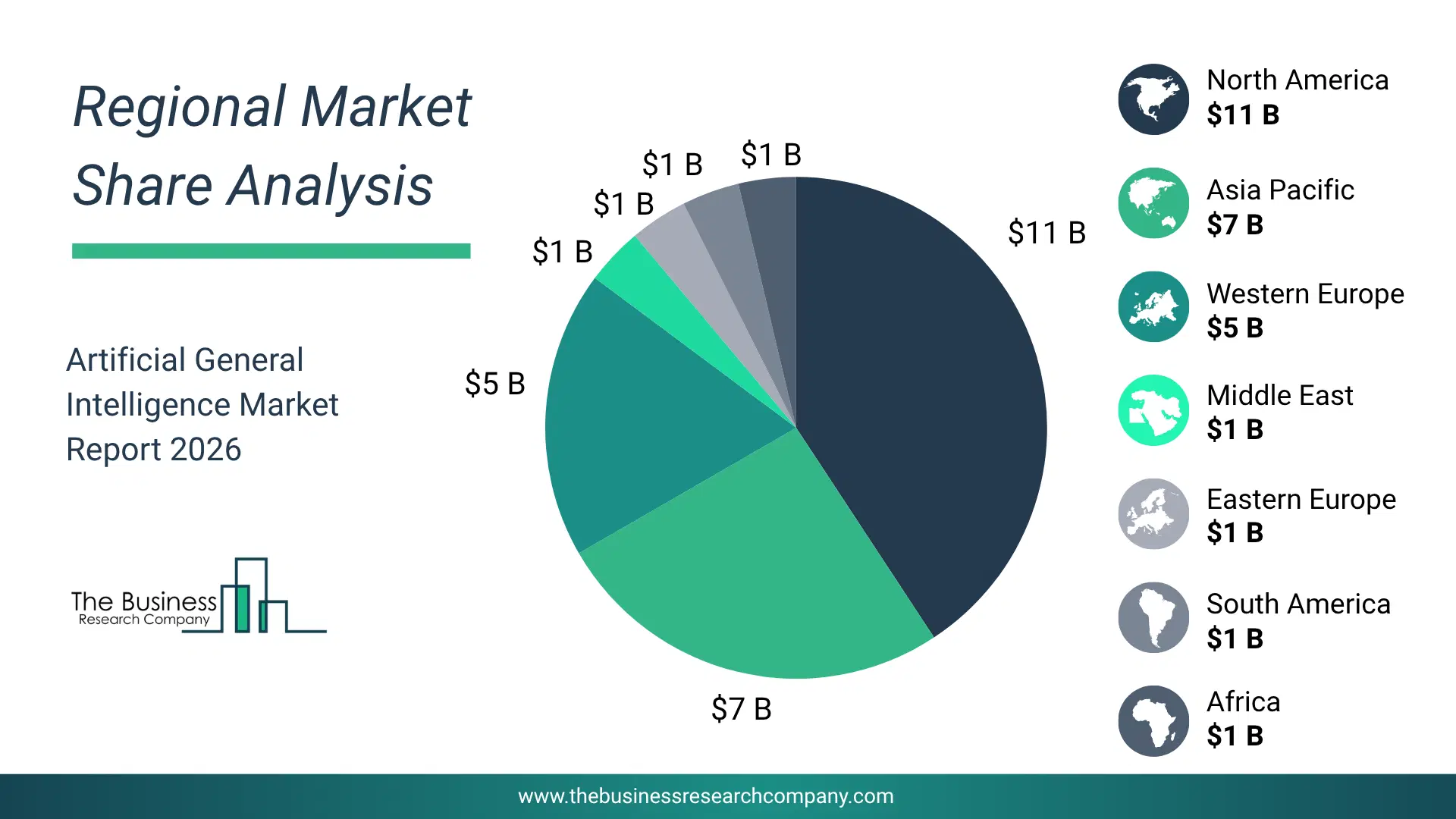
Regional Insights
North America was the largest region in theartificial general intelligence market in 2025. Asia-Pacific is expected to be the fastest-growing region in the forecast period. The regions covered in this market report are Asia-Pacific, South East Asia, Western Europe, Eastern Europe, North America, South America, Middle East, Africa. The countries covered in this market report are Australia, Brazil, China, France, Germany, India, Indonesia, Japan, Taiwan, Russia, South Korea, UK, USA, Canada, Italy, Spain.What Defines the Artificial General Intelligence Market?
The artificial general intelligence market consists of revenues earned by entities by providing services such as training and development services, maintenance and support services, and system optimization services. The market value includes the value of related goods sold by the service provider or included within the service offering. The artificial general intelligence market includes sales of autonomous robots, intelligent sensors, edge computing devices, and neural processing units. Values in this market are ‘factory gate’ values, that is, the value of goods sold by the manufacturers or creators of the goods, whether to other entities (including downstream manufacturers, wholesalers, distributors, and retailers) or directly to end customers. The value of goods in this market includes related services sold by the creators of the goods.How is Market Value Defined and Measured?
The market value is defined as the revenues that enterprises gain from the sale of goods and/or services within the specified market and geography through sales, grants, or donations in terms of the currency (in USD unless otherwise specified). The revenues for a specified geography are consumption values that are revenues generated by organizations in the specified geography within the market, irrespective of where they are produced. It does not include revenues from resales along the supply chain, either further along the supply chain or as part of other products.
This chart presents market attractiveness based on a quantitative evaluation of growth, competition, strategic alignment, and risk, offering a clear view of opportunity areas for decision-making. This chart is for illustrative purposes; the full report contains the complete analysis.

This chart highlights the Total Addressable Market (TAM) by estimating the maximum revenue opportunity using an assumption-driven approach, supporting strategic planning and opportunity sizing across markets. The chart is illustrative; the full report provides a more comprehensive analysis.
What Key Data and Analysis Are Included in the Artificial General Intelligence Market Report 2026?
The artificial general intelligence market research report is one of a series of new reports from The Business Research Company that provides market statistics, including industry global market size, regional shares, competitors with the market share, detailed market segments, market trends and opportunities, and any further data you may need to thrive in the artificial general intelligence industry. The market research report delivers a complete perspective of everything you need, with an in-depth analysis of the current and future state of the industry.Artificial General Intelligence Market Report Forecast Analysis
| Report Attribute | Details |
|---|---|
| Market Size Value In 2026 | $9.30 billion |
| Revenue Forecast In 2030 | $29.67 billion |
| Growth Rate | CAGR of 33.9% from 2026 to 2030 |
| Base Year For Estimation | 2025 |
| Actual Estimates/Historical Data | 2020-2025 |
| Forecast Period | 2026 - 2030 |
| Market Representation | Revenue in USD Billion and CAGR from 2026 to 2030 |
| Segments Covered | Type, Deployment Type, Service Type, Technology Type, Industry Vertical |
| Regional Scope | Asia-Pacific, Western Europe, Eastern Europe, North America, South America, Middle East, Africa |
| Country Scope | The countries covered in the report are Australia, Brazil, China, France, Germany, India, Indonesia, Japan, Taiwan, Russia, South Korea, UK, USA, Canada, Italy, Spain. |
| Key Companies Profiled | Amazon Web Services Inc., Google Cloud, Microsoft Corporation, International Business Machines Corporation (IBM), Meta Platforms Inc., NVIDIA Corporation, OpenAI Inc., Palantir Technologies Inc., DeepMind Technologies Limited, C3.ai Inc., xAI Corp., Anthropic PBC, Tenstorrent Inc., H2O.ai Inc., Hugging Face Inc., GoodAI, SingularityNET Foundation, Graphcore Ltd., Vicarious, Numenta Inc. |
| Customization Scope | Request for Customization |
| Pricing And Purchase Options | Explore Purchase Options |