
Artificial Intelligence (AI) Annotation Market Report 2026
Global Outlook – By Data Modality (Image And Video Computer Vision, LiDAR And Sensor Fusion, Text And Natural Language Processing (NLP), Audio And Speech, Tabular, Structured, And Synthetic Data Tagging), By Buyer Type (Original Equipment Manufacturer (OEMs) And Large Enterprises, Small And Medium Enterprises (SMEs), Non-Governmental Organization (NGOs) And Public Sector, Software As A Service (SaaS) Companies And Platform Owners), By Annotation Technique (Manual Annotation, Semi-Automated Annotation, Automated Annotation), By End-Use Industry (Automotive And Transportation, Information Technology (IT) And Telecom, Agriculture, Media And Entertainment, Government And Security) – Market Size, Trends, Strategies, and Forecast to 2030
Artificial Intelligence (AI) Annotation Market Overview
• Artificial Intelligence (AI) Annotation market size has reached to $1.91 billion in 2025 • Expected to grow to $7.32 billion in 2030 at a compound annual growth rate (CAGR) of 30.7% • Growth Driver: Rising Artificial Intelligence (AI) And Machine Learning (ML) Adoption Fueling The Growth Of The Market Due To Increasing Need For High-Quality Training Data • Market Trend: Empowering Enterprises With Seamless Integration Of Artificial Intelligence Into Real?World Applications, Enhanced Accuracy, And Scalable Annotation Workflows • North America was the largest region in 2025 and Asia-Pacific is the fastest growing region.Market Gains By 2030 – Top Opportunities By Segment
Market Gain identifies the most promising market opportunities by highlighting the segments or products expected to generate the highest incremental revenue growth over the next five years.
What Is Covered Under Artificial Intelligence (AI) Annotation Market?
Artificial intelligence (AI) annotation refers to the process of labeling data such as images, text, audio, or video so that machine learning models can learn patterns and make accurate predictions. It involves tagging or marking relevant features within datasets to help algorithms understand context and meaning. This process is essential for improving model performance and enabling reliable artificial intelligence applications. The main date modality of artificial intelligence (AI) annotation include image and video computer vision, LiDAR and sensor fusion, text and natural language processing (NLP), audio and speech, and tabular, structured, and synthetic data tagging. Image and video computer vision refers to the annotation of visual content from images and videos, including object detection, segmentation, classification, and labeling of elements to train AI models for tasks such as autonomous driving, facial recognition, and visual search. Different buyer types are original equipment manufacturers (OEMs) and large enterprises, small and medium enterprises (SMEs), non-governmental organizations (NGOs) and public sector entities, as well as software as a service (SaaS) companies and platform owners. Multiple annotation techniques are manual annotation, semi-automated annotation, and automated annotation, and they are used by several end-use industries such as automotive and transportation, healthcare and life sciences, retail and e-commerce, manufacturing, information technology (IT) and telecom, agriculture, media and entertainment, and government and security.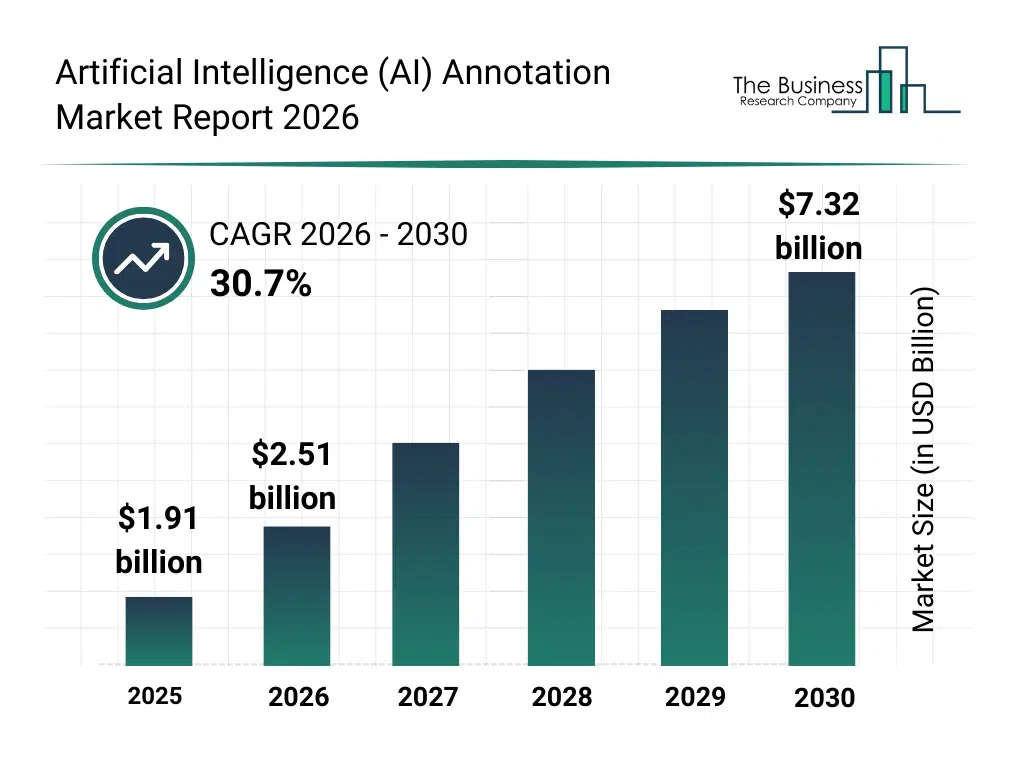
What Is The Artificial Intelligence (AI) Annotation Market Size and Share 2026?
The artificial intelligence (AI) annotation market size has grown exponentially in recent years. It will grow from $1.91 billion in 2025 to $2.51 billion in 2026 at a compound annual growth rate (CAGR) of 31.0%. The growth in the historic period can be attributed to increasing demand for high-quality training data in ai models, rising adoption of computer vision applications across industries, growing need for annotated datasets for natural language processing, increasing use of ai in autonomous vehicles requiring precise labeling, and rising deployment of artificial intelligence (AI)-based healthcare diagnostics needing structured data.What Is The Artificial Intelligence (AI) Annotation Market Growth Forecast?
The artificial intelligence (AI) annotation market size is expected to see exponential growth in the next few years. It will grow to $7.32 billion in 2030 at a compound annual growth rate (CAGR) of 30.7%. The growth in the forecast period can be attributed to growing adoption of machine learning in retail and e-commerce personalization, increasing reliance on supervised learning techniques, rising demand for labeled data in robotics and automation, growing use of artificial intelligence (AI) for fraud detection and security analytics, and increasing investment in ai research and development worldwide. Major trends in the forecast period include advancement of automated and semi-automated annotation tools, innovation in synthetic data generation to reduce manual labeling needs, integration of artificial intelligence (AI)-assisted quality validation systems, advancement of self-supervised and weakly supervised learning techniques, and innovation in annotation platforms supporting multimodal datasets.
Global Artificial Intelligence (AI) Annotation Market Segmentation
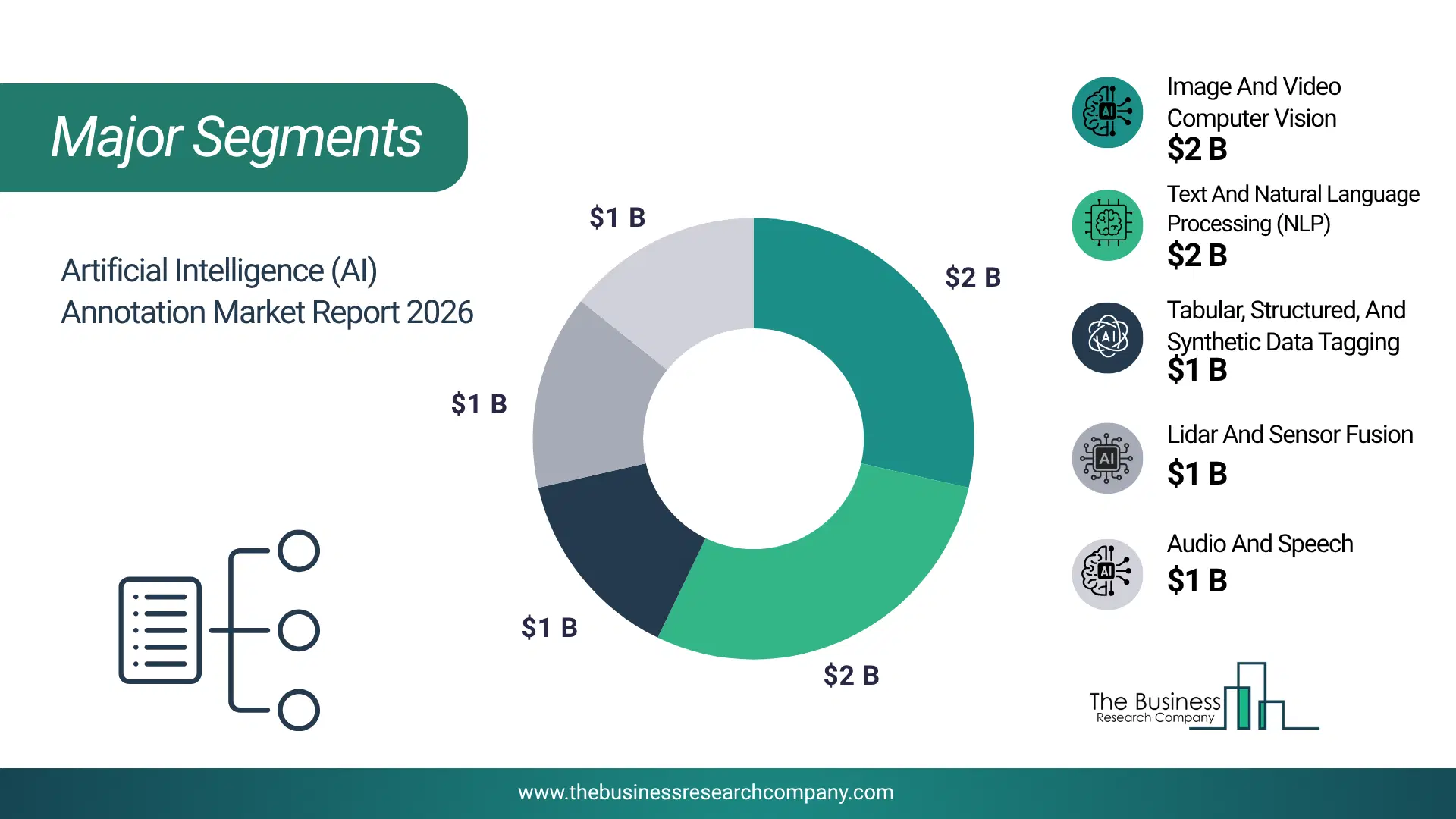
1) By Data Modality: Image And Video Computer Vision, LiDAR And Sensor Fusion, Text And Natural Language Processing (NLP), Audio And Speech, Tabular, Structured, And Synthetic Data Tagging 2) By Buyer Type: Original Equipment Manufacturer (OEMs) And Large Enterprises, Small And Medium Enterprises (SMEs), Non-Governmental Organization (NGOs) And Public Sector, Software As A Service (SaaS) Companies And Platform Owners 3) By Annotation Technique: Manual Annotation, Semi-Automated Annotation, Automated Annotation 4) By End-Use Industry: Automotive And Transportation, Healthcare And Life Sciences, Retail And E-Commerce, Manufacturing, Information Technology (IT) And Telecom, Agriculture, Media And Entertainment, Government And Security Subsegments: 1) By Image And Video Computer Vision: Bounding Box Annotation, Semantic Segmentation, Instance Segmentation, Polygon And Polyline Annotation, Keypoint And Landmark Annotation, Image Or Video Classification And Tagging 2) By LiDAR And Sensor Fusion: Text Classification And Categorization, Named Entity Recognition (NER), Sentiment And Intent Annotation, Text Summarization And Translation Tagging, Part-Of-Speech (POS) Tagging, LiDAR Segmentation And Classification 3) By Text And Natural Language Processing (NLP): Text Classification And Categorization, Named Entity Recognition (NER), Sentiment And Intent Annotation, Text Summarization And Translation Tagging, Part-Of-Speech (POS) Tagging, Document Classification And Content Labeling 4) By Audio And Speech: Speech-To-Text Transcription, Speaker Identification And Diarization, Emotion And Sentiment Annotation, Acoustic Event Detection, Audio Classification, Phoneme And Linguistic Annotation 4) By Tabular, Structured, And Synthetic Data Tagging: Data Cleansing And Normalization, Attribute And Metadata Tagging, Synthetic Data Label Generation, Anomaly And Pattern Detection Annotation, Column-Level Classification And Categorization, Structured Data Mapping And Transformation The top segments in the artificial intelligence (ai) annotation market will be: • Image And Video Computer Vision will reach $2.42 Billion by 2030. • Text And Natural Language Processing (NLP) will reach $1.6 Billion by 2030. • Tabular, Structured, And Synthetic Data Tagging will reach $0.88 Billion by 2030. • Lidar And Sensor Fusion will reach $0.83 Billion by 2030. • Audio And Speech will reach $0.79 Billion by 2030.What Is The Driver Of The Artificial Intelligence (AI) Annotation Market?
The rising adoption of artificial intelligence (AI) and machine learning (ML) technologies is expected to propel the growth of the artificial intelligence (AI) annotation market going forward. Artificial intelligence (AI) and machine learning (ML) refers to computer systems that mimic human intelligence by learning patterns from data and automatically improving their decisions and predictions over time. The rise in artificial intelligence (AI) and machine learning (ML) technologies is due to the explosive growth of digital data and computing power that lets organizations automate complex tasks and make faster data-driven decisions across every industry. The artificial intelligence (AI) annotation market supports adoption of artificial intelligence (AI) and machine learning (ML) technologies by offering annotation services and tools that convert raw data into high quality labeled datasets necessary for training artificial intelligence (AI)/machine learning (ML) models. For instance, in January 2025, according to Eurostat, the statistical office of the European Union, 13.5% of enterprises in the European Union with 10 or more employees used artificial intelligence technologies in 2024, representing a 5.5 percentage point increase from 8.0% in 2023. Therefore, the rising adoption of artificial intelligence (AI) and machine learning (ML) technologies is driving the growth of the artificial intelligence (AI) annotation industry.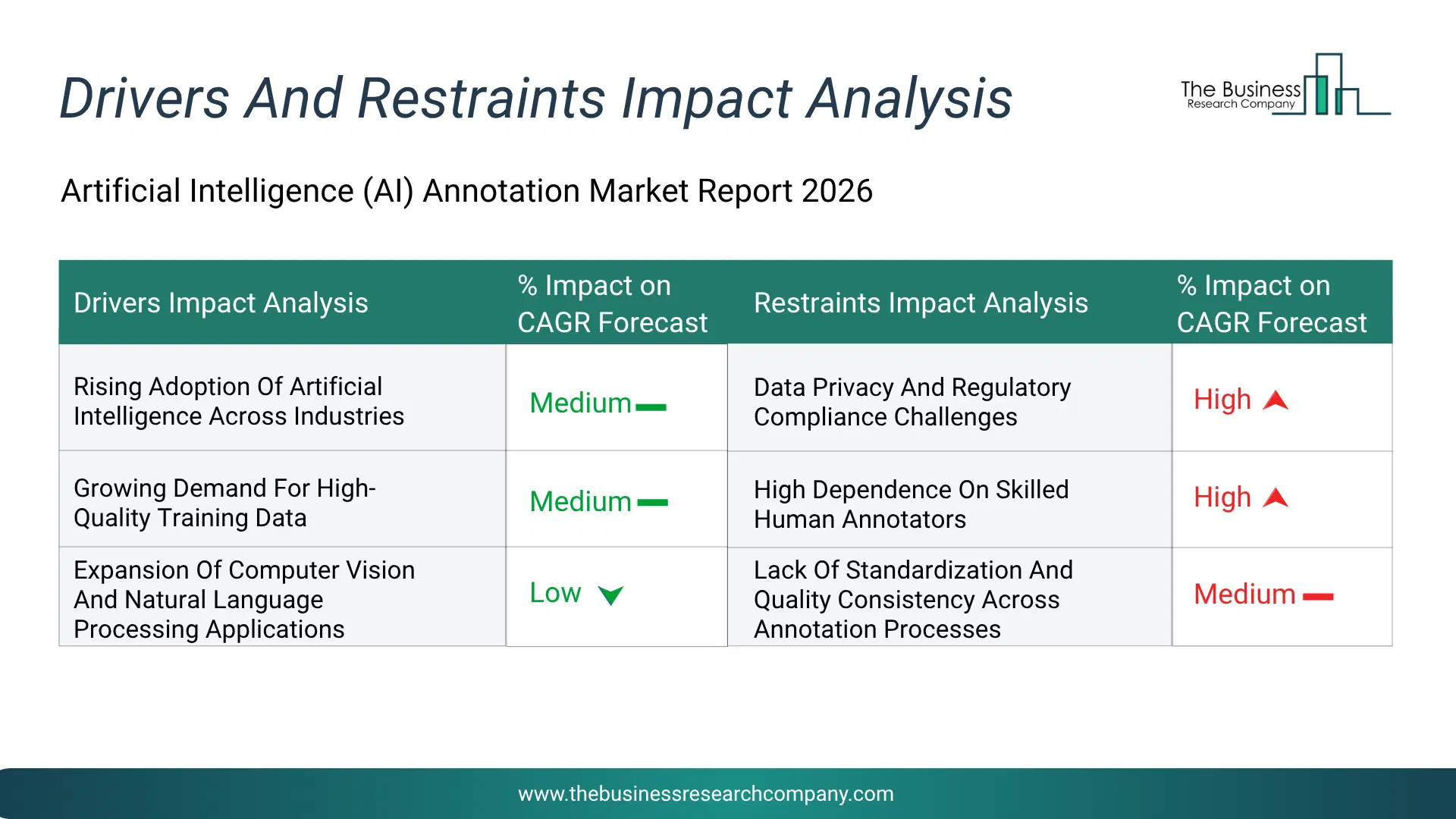
Infographic Chart Showing Key Market Drivers Analysis And Restraints For Artificial Intelligence (Ai) Annotation Market
The chart presents an impact analysis of key drivers and restraints, quantifying their relative influence on the market's growth rate and helping assess the balance between growth enablers and limiting factors. This chart offers a high-level perspective; the full report contains more detailed insights.
How Will The Drivers Impact Growth In The Global Artificial Intelligence (AI) Annotation Market?
• Rising Adoption Of Artificial Intelligence Across Industries (Medium) – During the forecast period, the rising adoption of artificial intelligence across industries is expected to become a key growth driver for the artificial intelligence (AI) annotation market by 2030. Enterprises are rapidly integrating AI into operational workflows, customer engagement, fraud detection, diagnostics, and industrial automation, creating continuous demand for accurately annotated datasets. The expansion of AI-enabled business processes is increasing the need for scalable annotation workflows capable of supporting diverse data formats and industry-specific requirements. Organizations are also emphasizing data consistency and annotation precision to improve the reliability of production-grade AI systems. This accelerating enterprise-wide AI adoption is reinforcing sustained market expansion. • Growing Demand For High-Quality Training Data (Medium) – During the forecast period, the growing demand for high-quality training data is expected to emerge as a major factor driving the expansion of the artificial intelligence (AI) annotation market by 2030. Developers are increasingly investing in comprehensive data preparation processes to support next-generation AI models with greater contextual understanding and prediction accuracy. The increasing complexity of machine learning workloads is encouraging the creation of richer, more representative annotated datasets across multiple languages, domains, and data sources. Enterprises are also strengthening quality assurance processes to ensure dependable model performance in real-world environments. • Expansion Of Computer Vision And Natural Language Processing Applications (Low) – During the forecast period, the expansion of computer vision and natural language processing applications is expected to act as a key growth catalyst for the artificial intelligence (AI) annotation market by 2030. The rapid commercialization of intelligent imaging, conversational AI, document intelligence, and multimodal applications is increasing annotation requirements across increasingly complex datasets. Organizations are expanding AI capabilities that require fine-grained labeling, semantic interpretation, and continuous dataset refinement to achieve higher model effectiveness. The growing diversity of AI-enabled products is also encouraging annotation providers to deliver more scalable and technology-driven services.How Will The Restraints Impact Growth In The Global Artificial Intelligence (AI) Annotation Market?
• Data Privacy And Regulatory Compliance Challenges (Medium) – During the forecast period, the data privacy and regulatory compliance challenges are limiting the efficient handling and annotation of sensitive datasets across multiple industries. Annotation processes often involve access to personal, financial, healthcare, or confidential business information that must comply with strict regulatory requirements. Organizations face increasing obligations related to data protection, consent management, and cross-border data transfers. Failure to meet compliance standards can result in legal liabilities, financial penalties, and reputational damage. These concerns can slow annotation projects and restrict market growth opportunities. • High Dependence On Skilled Human Annotators (Medium) – During the forecast period, the high dependence on skilled human annotators is creating operational challenges related to workforce availability, consistency, and project scalability. Accurate labeling of complex datasets often requires domain expertise and careful quality control to ensure reliable outputs. Maintaining annotation accuracy across large-scale projects can increase labor requirements and management complexity. Variations in human judgment may also affect dataset consistency and model performance. These factors can increase operational costs and constrain the ability of providers to meet growing market demand efficiently. • Lack Of Standardization And Quality Consistency Across Annotation Processes (Low) – During the forecast period, the lack of standardization and quality consistency across annotation processes is expected to restrain the growth of the data annotation and labeling market. Data annotation projects often involve multiple annotators, service providers, annotation tools, and quality assurance methodologies, resulting in inconsistencies in labeling standards across datasets. Variations in annotation guidelines, human interpretation, and domain-specific requirements can reduce dataset accuracy and negatively affect the performance of artificial intelligence and machine learning models. Maintaining consistent quality across large-scale multilingual and multimodal annotation projects requires extensive validation, auditing, and continuous quality control, increasing project complexity and operational costs. In addition, the absence of universally accepted annotation standards can create interoperability challenges when integrating datasets from different sources or vendors. Organizations may need to invest additional time and resources in dataset review, re-annotation, and quality assurance before model training can begin. These challenges can delay AI development initiatives and reduce confidence in outsourced annotation services. Consequently, the lack of standardization and quality consistency across annotation processes remains a significant restraint on the growth of the data annotation and labeling market.Key Players In The Global Artificial Intelligence (AI) Annotation Market
Major companies operating in the artificial intelligence (AI) annotation market are Lionbridge Technologies Inc., iMerit Technology Services Pvt. Ltd., TaskUs Inc., CloudFactory Limited, Scale AI Inc., Sama Inc., Appen Limited, Shaip Inc., Hive Inc., Toloka AI Inc., Labelbox Inc., Encord Ltd., Alegion Inc., Anolytics LLC, TELUS International (Cda) Inc., Keymakr Ltd., Dataloop AI Ltd., SuperAnnotate AI Inc., Label Your Data GmbH, Kili Technology SAS, V7 Labs Ltd., Cogito Tech LLC, Lightly AG, Heartex Inc.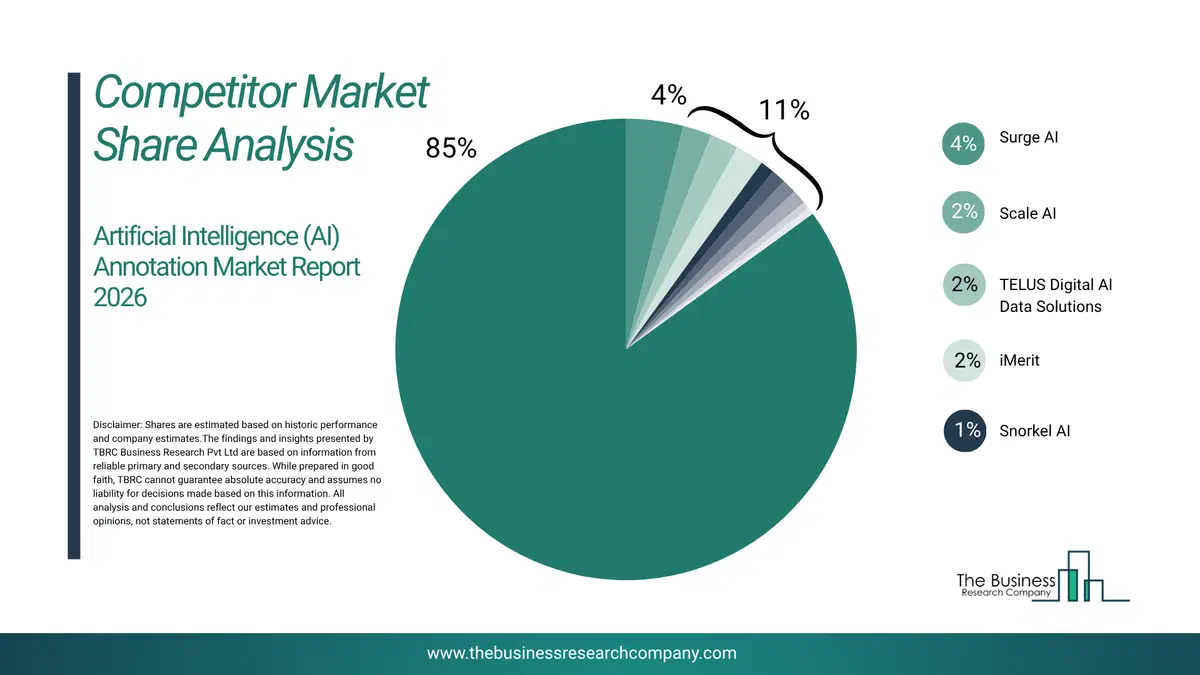
This chart is for illustrative purposes; the full report includes a detailed competitor analysis and comprehensive overview of the top 10 companies in the market.
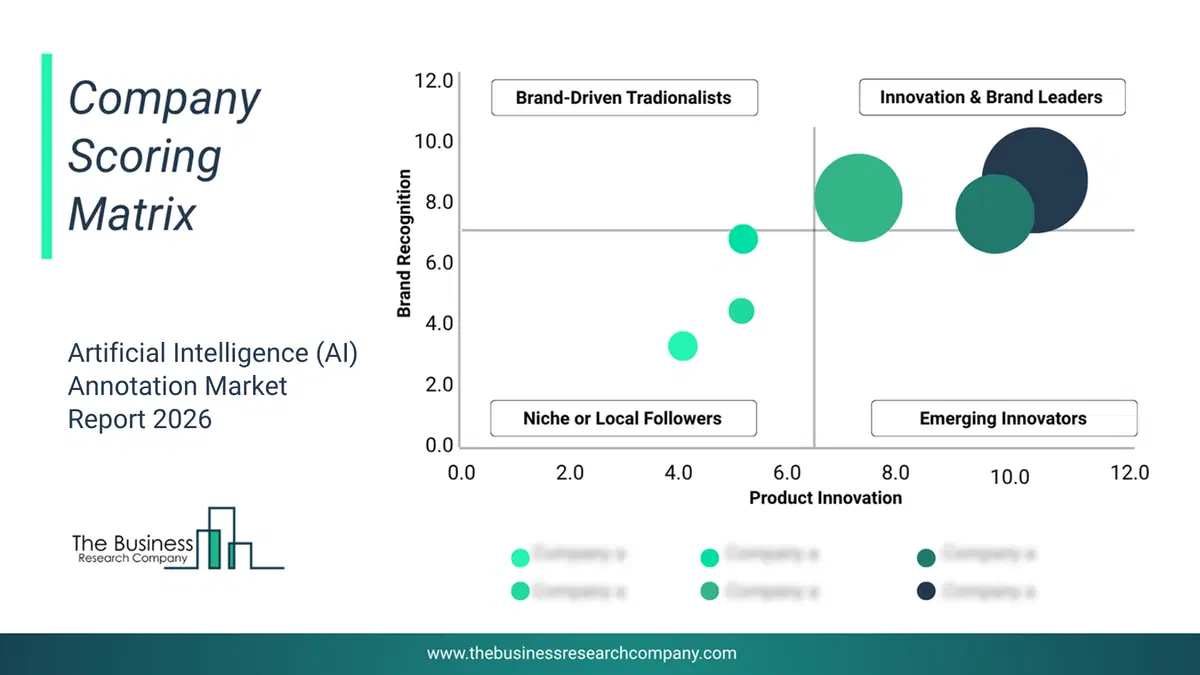
This chart maps companies by product innovation and brand strength, with bubble size indicating relative revenue, helping identify market leaders, challengers, and niche players. This is an illustrative chart; the full report provides a complete and accurate competitive analysis.
Global Artificial Intelligence (AI) Annotation Market Trends and Insights
Major companies operating in the artificial intelligence annotation market are focusing on advanced technology, such as seamless integration of AI into real‑world applications, to accelerate model development, improve data quality, and reduce time‑to‑deployment for artificial intelligence (AI) initiatives across industries. Seamless integration of AI into real‑world applications is the capability of an annotation platform to support end‑to‑end data preparation, governance, and deployment pipelines. For instance, in September 2023, iMerit Inc., an India‑based artificial intelligence (AI) data services company, launched Ango Hub, its artificial intelligence (AI) data annotation platform designed to streamline the creation, validation, and management of annotated datasets for machine learning and artificial intelligence use cases. The platform enables rich multimodal annotation, collaboration across distributed teams, quality control workflows, and integration with downstream machine learning environments to ensure that models can be trained and deployed efficiently into real‑world applications. Ango Hub is built to help enterprises reduce annotation bottlenecks, enhance dataset accuracy, and improve model performance by providing intuitive tooling, real‑time reporting, and seamless integration with existing development pipelines.What Are Latest Mergers And Acquisitions In The Artificial Intelligence (AI) Annotation Market?
In June 2025, TP Fuels Inc., a US-based artificial intelligence (AI) data services company, acquired Agents Only LLC for an undisclosed amount. Through this acquisition, TP Fuels Inc. aims to enhance its artificial intelligence (AI) annotation and data-services offerings by integrating Agents Only LLC’s expertise in high-quality labeled datasets and annotation workflows, enabling more accurate machine-learning model training, improved AI performance, and accelerated deployment of AI solutions across industries. Agents Only LLC is a US-based data-annotation service provider delivering human-verified datasets and annotation support for computer vision, natural language processing, and other AI applications.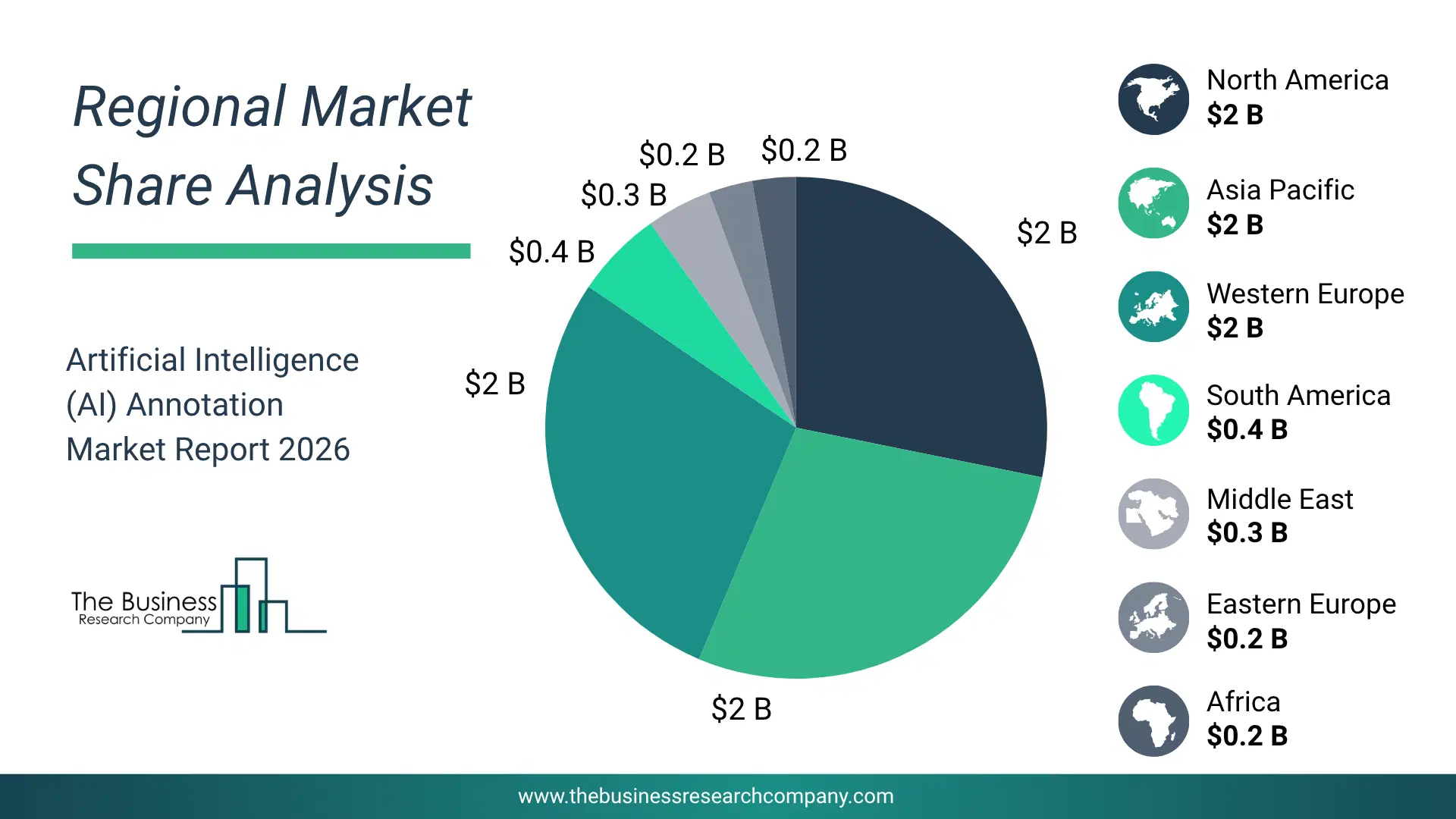
Regional Insights
North America was the largest region in the artificial intelligence (AI) annotation market in 2025. Asia-Pacific is expected to be the fastest-growing region in the forecast period. The regions covered in this market report are Asia-Pacific, South East Asia, Western Europe, Eastern Europe, North America, South America, Middle East, Africa. The countries covered in this market report are Australia, Brazil, China, France, Germany, India, Indonesia, Japan, Taiwan, Russia, South Korea, UK, USA, Canada, Italy, Spain.What Defines the Artificial Intelligence (AI) Annotation Market?
The artificial intelligence (AI) annotation market consists of revenues earned by entities by providing services such as data labeling, image and video tagging, text and audio annotation, quality validation of annotated datasets, and artificial intelligence (AI)-assisted annotation support. The market value includes the value of related goods sold by the service provider or included within the service offering. The artificial intelligence (AI) annotation market also includes sales of annotation software platforms, data labeling tools, automated tagging systems, quality assurance solutions, and artificial intelligence (AI)-driven annotation frameworks. Values in this market are ‘factory gate’ values, that is, the value of goods sold by the manufacturers or creators of the goods, whether to other entities (including downstream manufacturers, wholesalers, distributors, and retailers) or directly to end customers. The value of goods in this market includes related services sold by the creators of the goods.How is Market Value Defined and Measured?
The market value is defined as the revenues that enterprises gain from the sale of goods and/or services within the specified market and geography through sales, grants, or donations in terms of the currency (in USD unless otherwise specified). The revenues for a specified geography are consumption values that are revenues generated by organizations in the specified geography within the market, irrespective of where they are produced. It does not include revenues from resales along the supply chain, either further along the supply chain or as part of other products.
This chart presents market attractiveness based on a quantitative evaluation of growth, competition, strategic alignment, and risk, offering a clear view of opportunity areas for decision-making. This chart is for illustrative purposes; the full report contains the complete analysis.

This chart highlights the Total Addressable Market (TAM) by estimating the maximum revenue opportunity using an assumption-driven approach, supporting strategic planning and opportunity sizing across markets. The chart is illustrative; the full report provides a more comprehensive analysis.
What Key Data and Analysis Are Included in the Artificial Intelligence (AI) Annotation Market Report 2026?
The artificial intelligence (ai) annotation market research report is one of a series of new reports from The Business Research Company that provides market statistics, including industry global market size, regional shares, competitors with the market share, detailed market segments, market trends and opportunities, and any further data you may need to thrive in the artificial intelligence (ai) annotation industry. The market research report delivers a complete perspective of everything you need, with an in-depth analysis of the current and future state of the industry.Artificial Intelligence (AI) Annotation Market Report Forecast Analysis
| Report Attribute | Details |
|---|---|
| Market Size Value In 2026 | $2.51 billion |
| Revenue Forecast In 2030 | $7.32 billion |
| Growth Rate | CAGR of 31.0% from 2026 to 2030 |
| Base Year For Estimation | 2025 |
| Actual Estimates/Historical Data | 2020-2025 |
| Forecast Period | 2026 - 2030 |
| Market Representation | Revenue in USD Billion and CAGR from 2026 to 2030 |
| Segments Covered | Data Modality, Buyer Type, Annotation Technique, End-Use Industry |
| Regional Scope | Asia-Pacific, Western Europe, Eastern Europe, North America, South America, Middle East, Africa |
| Country Scope | The countries covered in the report are Australia, Brazil, China, France, Germany, India, Indonesia, Japan, Taiwan, Russia, South Korea, UK, USA, Canada, Italy, Spain. |
| Key Companies Profiled | Lionbridge Technologies Inc., iMerit Technology Services Pvt. Ltd., TaskUs Inc., CloudFactory Limited, Scale AI Inc., Sama Inc., Appen Limited, Shaip Inc., Hive Inc., Toloka AI Inc., Labelbox Inc., Encord Ltd., Alegion Inc., Anolytics LLC, TELUS International (Cda) Inc., Keymakr Ltd., Dataloop AI Ltd., SuperAnnotate AI Inc., Label Your Data GmbH, Kili Technology SAS, V7 Labs Ltd., Cogito Tech LLC, Lightly AG, Heartex Inc. |
| Customization Scope | Request for Customization |
| Pricing And Purchase Options | Explore Purchase Options |