
Artificial Intelligence (AI) Applications For Smart Cities Market Report 2026
Global Outlook – By Type (Safety and Security, Mobility and Transportation, Energy and Resource Management, Infrastructure Management, Healthcare), By Deployment (Cloud-Based, On-Premises), By Technology (Machine Learning, Computer Vision, IoT Integration, Big Data Analytics), By Application (Big City, Medium and Small Cities) – Market Size, Trends, Strategies, and Forecast to 2030
Artificial Intelligence (AI) Applications For Smart Cities Market Overview
• Artificial Intelligence (AI) Applications For Smart Cities market size has reached to $15.78 billion in 2025 • Expected to grow to $38.35 billion in 2030 at a compound annual growth rate (CAGR) of 19.4% • Growth Driver: Rising Adoption Of Smart-City Initiatives Is Drivingl The Market Growth Due To Increasing Demand For Automated Urban Management Systems • Market Trend: Technological Innovation in AI-Derived Insights from High-Resolution Aerial Imagery • North America was the largest region in 2025 and Asia-Pacific is the fastest growing region.Market Gains By 2030 – Top Opportunities By Segment
Market Gain identifies the most promising market opportunities by highlighting the segments or products expected to generate the highest incremental revenue growth over the next five years.
What Is Covered Under Artificial Intelligence (AI) Applications For Smart Cities Market?
Artificial intelligence (AI) applications for smart cities refer to the use of AI technologies to enhance urban infrastructure, services, and overall quality of life. These applications leverage data analytics, machine learning, and automation to optimize traffic management, energy consumption, public safety, and other city operations. It helps cities become more efficient, sustainable, and responsive to the needs of their residents. The main types of the artificial intelligence (AI) applications for smart cities include safety and security, mobility and transportation, energy and resource management, infrastructure management, and healthcare. Safety and security solutions refer to AI-driven systems designed to monitor urban environments, detect anomalies, predict and prevent incidents, and enhance public safety through real-time surveillance, threat detection, and emergency response optimization. There are deployment modes such as cloud-based and on-premises. The key technologies include machine learning, computer vision, IoT integration, and big data analytics. The applications cover big cities as well as medium and small cities.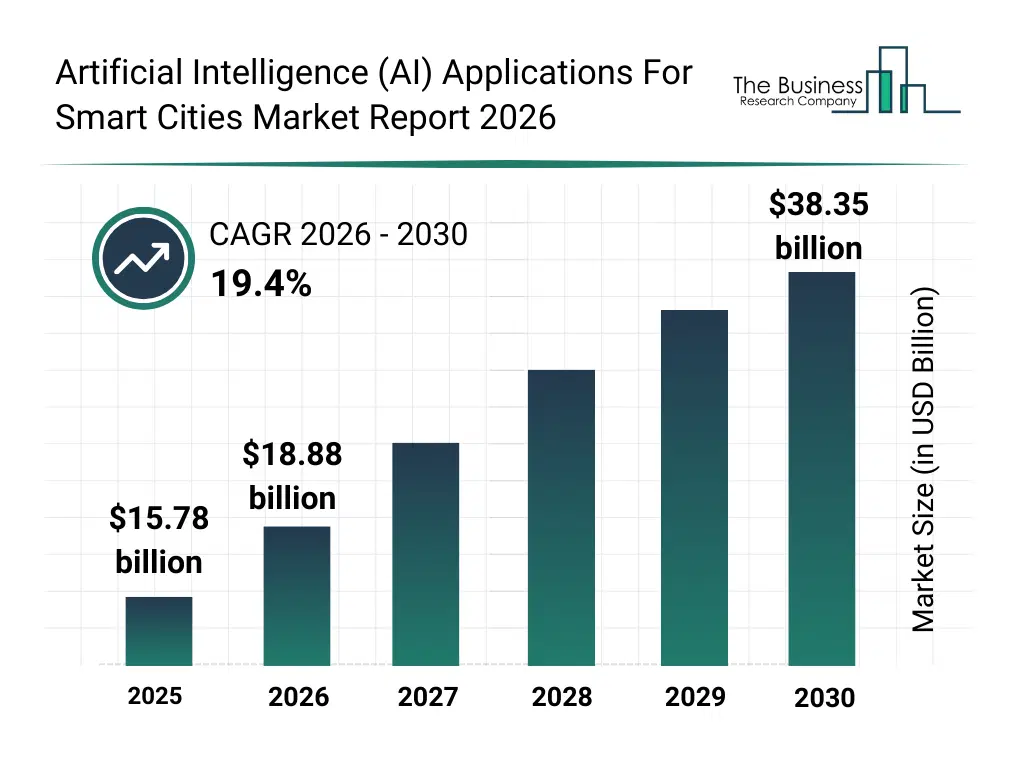
What Is The Artificial Intelligence (AI) Applications For Smart Cities Market Size and Share 2026?
The artificial intelligence (AI) applications for smart cities market size has grown rapidly in recent years. It will grow from $15.78 billion in 2025 to $18.88 billion in 2026 at a compound annual growth rate (CAGR) of 19.6%. The growth in the historic period can be attributed to increasing urbanization, growing demand for efficient city management, rising need for traffic optimization, expansion of public safety initiatives, and increasing adoption of IoT infrastructure.What Is The Artificial Intelligence (AI) Applications For Smart Cities Market Growth Forecast?
The artificial intelligence (AI) applications for smart cities market size is expected to see rapid growth in the next few years. It will grow to $38.35 billion in 2030 at a compound annual growth rate (CAGR) of 19.4%. The growth in the forecast period can be attributed to growing investment in smart city projects, rising government funding for AI deployment, increasing integration of AI with city services, expansion of cloud and edge computing in urban applications, and growing awareness about sustainable urban development. Major trends in the forecast period include technology advancements in AI algorithms, innovations in real-time data analytics, developments in autonomous traffic management, research and developments in predictive maintenance, and integration of AI with IoT and sensor networks.
Global Artificial Intelligence (AI) Applications For Smart Cities Market Segmentation
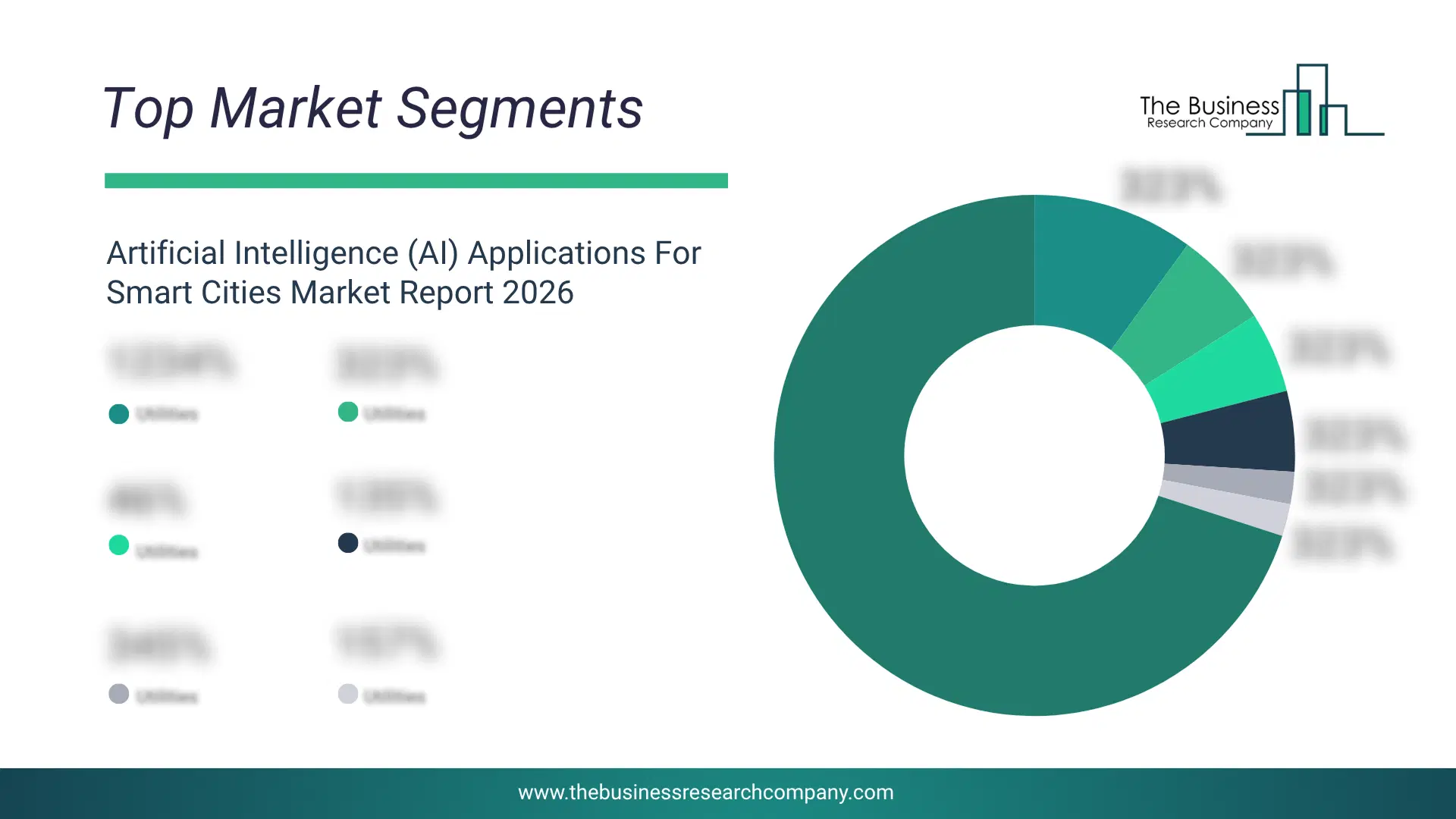
1) By Type: Safety and Security, Mobility and Transportation, Energy and Resource Management, Infrastructure Management, Healthcare 2) By Deployment: Cloud-Based, On-Premises 3) By Technology: Machine Learning, Computer Vision, IoT Integration, Big Data Analytics 4) By Application: Big City, Medium and Small Cities Subsegments: 1) By Safety And Security: Surveillance Systems, Emergency Response Systems, Crime Detection and Prevention, Fire Safety Management, Access Control Systems 2) By Mobility And Transportation: Traffic Management Systems, Public Transport Optimization, Autonomous Vehicles, Route Planning and Navigation, Fleet Management 3) By Energy And Resource Management: Smart Grids, Energy Consumption Monitoring, Water Resource Management, Waste Management Systems, Renewable Energy Management 4) By Infrastructure Management: Building Automation Systems, Structural Health Monitoring, Smart Lighting, Road and Bridge Monitoring, Facility Management Systems 5) By Healthcare: Remote Patient Monitoring, Predictive Diagnostics, Hospital Management Systems, Telemedicine Platforms, Emergency Medical Services Management The top segments in the artificial intelligence (ai) applications for smart cities market will be: • Mobility And Transportation will reach $12.51 Billion by 2030. • Safety And Security will reach $9.47 Billion by 2030. • Energy And Resource Management will reach $7.46 Billion by 2030. • Infrastructure Management will reach $5.49 Billion by 2030. • Healthcare will reach $4.6 Billion by 2030.What Is The Driver Of The Artificial Intelligence (AI) Applications For Smart Cities Market?
The rising adoption of smart-city initiatives is expected to fuel the growth of the artificial intelligence (AI) applications for smart cities market going forward. Smart-city initiatives refer to urban development strategies that utilize digital technologies and data analytics to optimize city functions and drive economic growth. Adoption of smart-city initiatives is rising as municipalities increasingly deploy intelligent transportation systems to reduce traffic congestion and improve mobility for citizens. Artificial intelligence (AI) applications for smart cities are anticipated to benefit from this trend by providing the intelligent algorithms needed to manage traffic, energy grids, and waste systems efficiently. For instance, in October 2025, according to the European Commission, a Belgium-based executive branch of the European Union, 10 cities received the EU Mission Label in October 2023, which increased to 23 additional cities in March 2024, 20 more cities in October 2024, and 39 additional cities in May 2025, bringing the total number of labelled climate-neutral and smart cities to 103 out of 112 participating cities. Therefore, the rising adoption of smart city initiatives is driving the growth of the artificial intelligence (AI) applications for smart cities industry.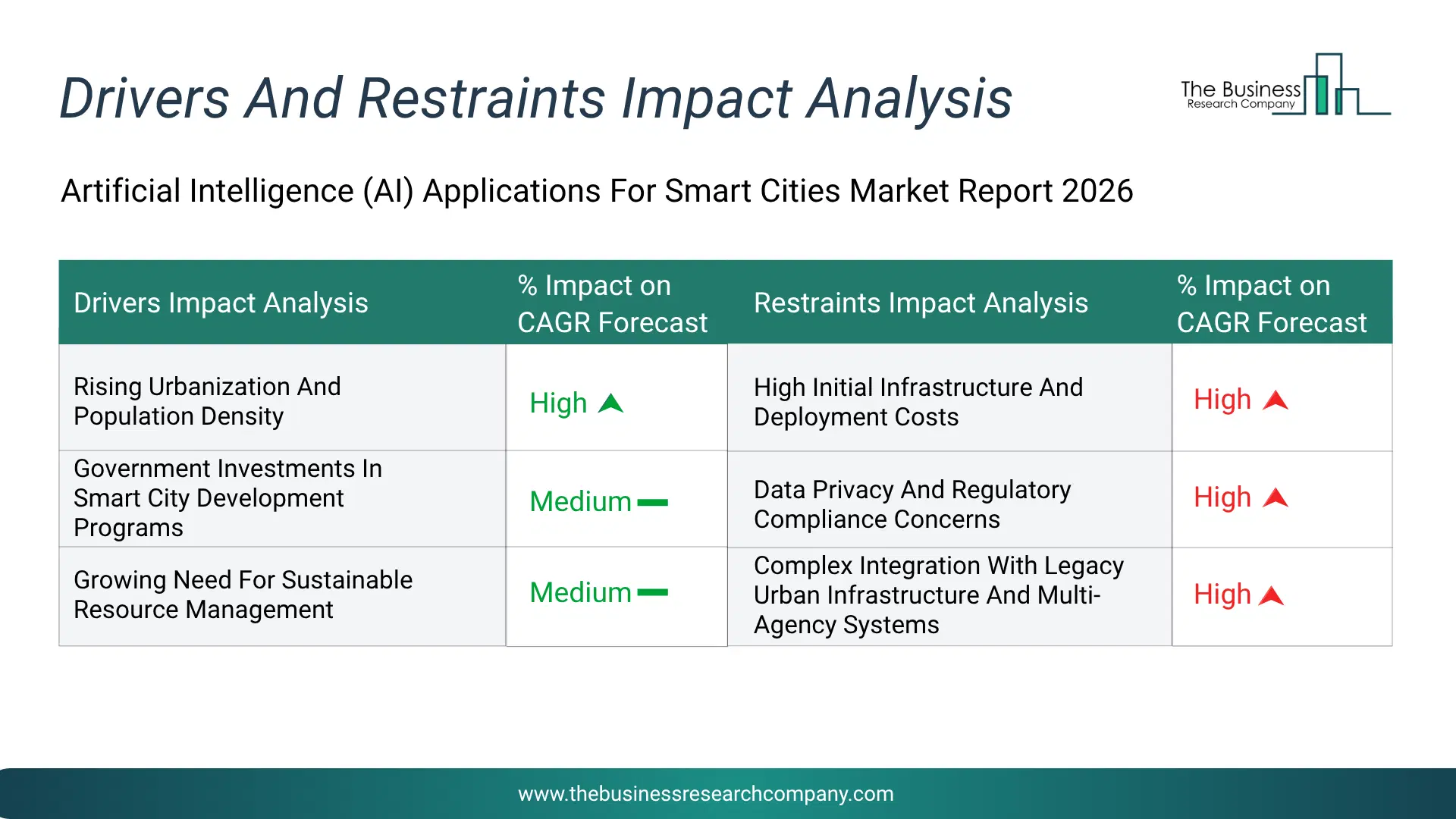
Infographic Chart Showing Key Market Drivers Analysis And Restraints For Artificial Intelligence (Ai) Applications For Smart Cities Market
The chart presents an impact analysis of key drivers and restraints, quantifying their relative influence on the market's growth rate and helping assess the balance between growth enablers and limiting factors. This chart offers a high-level perspective; the full report contains more detailed insights.
How Will The Drivers Impact Growth In The Global Artificial Intelligence (AI) Applications For Smart Cities Market?
• Rising Urbanization And Population Density (High) – During the forecast period, rising urbanization and population density is expected to become a key growth driver for the artificial intelligence (AI) applications for smart cities market by 2030. Expanding metropolitan areas are creating increasing demand for intelligent digital platforms capable of coordinating transportation, utilities, emergency response, and public infrastructure. AI-powered analytics enable city authorities to monitor urban activities, predict service requirements, and improve operational efficiency across densely populated environments. The growing complexity of city operations is encouraging municipalities to deploy advanced AI solutions that enhance responsiveness and long-term urban planning. • Government Investments In Smart City Development Programs (Medium) – During the forecast period, government investments in smart city development programs are expected to emerge as a major factor driving the expansion of the artificial intelligence (AI) applications for smart cities market by 2030. Public authorities are expanding digital transformation initiatives focused on modernizing civic infrastructure through intelligent technologies and connected platforms. AI is increasingly being adopted to improve administrative efficiency, strengthen public service delivery, and support data-driven governance across urban ecosystems. Strategic funding programs and long-term city modernization initiatives are accelerating implementation of advanced AI capabilities across municipal operations. • Growing Need For Sustainable Resource Management (Medium) – During the forecast period, the growing need for sustainable resource management is expected to act as a key growth catalyst for the artificial intelligence (AI) applications for smart cities market by 2030. Increasing environmental priorities are encouraging cities to deploy AI solutions that enhance the efficiency of critical resources through intelligent monitoring and automated optimization. Advanced AI technologies improve forecasting, detect operational inefficiencies, and support proactive management of urban assets, enabling municipalities to achieve sustainability objectives while lowering operating costs. As cities continue pursuing resilient and environmentally responsible development, adoption of AI-enabled resource optimization platforms is expected to accelerate.How Will The Restraints Impact Growth In The Global Artificial Intelligence (AI) Applications For Smart Cities Market?
• High Initial Infrastructure And Deployment Costs (High) – During the forecast period, the high initial infrastructure and deployment costs limit the adoption of artificial intelligence applications, particularly in cities with constrained financial resources. Implementing smart city ecosystems often requires substantial investments in sensors, communication networks, monitoring systems, and supporting infrastructure. Budget limitations can delay project execution and reduce the scale of deployments. Municipal authorities may prioritize essential public expenditures over long-term modernization initiatives. These financial barriers can restrict market penetration and slow overall growth. • Data Privacy And Regulatory Compliance Concerns (Medium) – During the forecast period, the data privacy and regulatory compliance concerns create challenges for the deployment of artificial intelligence applications that rely on extensive collection and analysis of citizen and infrastructure data. Governments and residents are increasingly focused on protecting personal information and ensuring responsible data usage. Compliance with diverse regulatory frameworks can increase administrative complexity and implementation costs. Concerns regarding surveillance, data governance, and information security may reduce public acceptance of smart city projects. These factors can hinder adoption and delay investment decisions. • Complex Integration With Legacy Urban Infrastructure And Multi-Agency Systems (Medium) – During the forecast period, the complex integration with legacy urban infrastructure and multi-agency systems is expected to restrain the growth of the artificial intelligence in smart cities market. Artificial intelligence solutions for smart cities must integrate with a wide range of existing urban infrastructure, including transportation systems, utility networks, public safety platforms, surveillance systems, and municipal information systems. However, many cities continue to operate with aging infrastructure and fragmented technologies that were not designed to support AI-driven automation and real-time data exchange. Differences in communication protocols, data formats, and system architectures create interoperability challenges, requiring extensive customization, infrastructure upgrades, and coordination among multiple government agencies and technology providers. These integration complexities increase implementation timelines, operational costs, and project risks while making large-scale deployments more difficult. In addition, ensuring seamless collaboration across various municipal departments and service providers further adds to deployment complexity. Consequently, complex integration with legacy urban infrastructure and multi-agency systems remains a significant restraint on the growth of the artificial intelligence in smart cities market.Key Players In The Global Artificial Intelligence (AI) Applications For Smart Cities Market
Major companies operating in the artificial intelligence (AI) applications for smart cities market are Hitachi Ltd., International Business Machines Corporation, Cisco Systems Inc., Schneider Electric SE, ABB Ltd., Tata Consultancy Services Limited, Larsen & Toubro Limited, Infosys Limited, HCL Technologies Limited, PTC Inc., Verkada Inc., Optibus Ltd., Huawei Technologies Co. Ltd, Ubicquia Inc., Gorilla Technology Group Inc., Utilidata Inc., Ekin Smart City Technologies Inc., Ecube Labs Co. Ltd., Nodeflux Inc., Enevo Oy, Seoul Robotics Inc.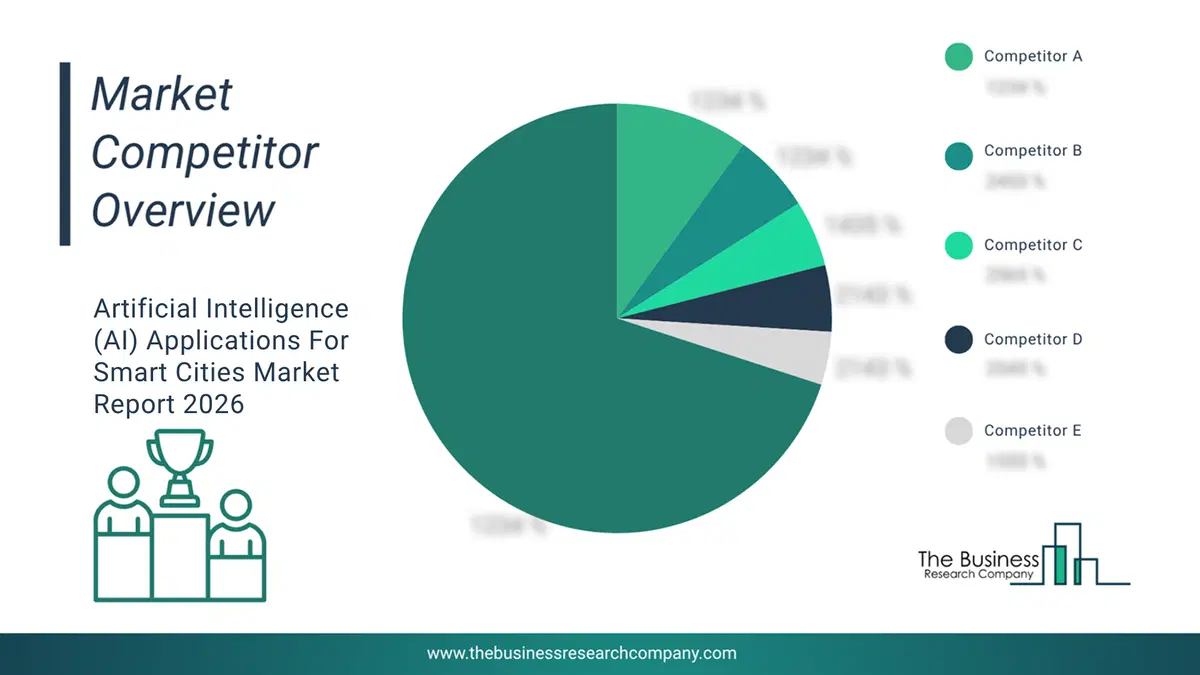
This chart is for illustrative purposes; the full report includes a detailed competitor analysis and comprehensive overview of the top 10 companies in the market.
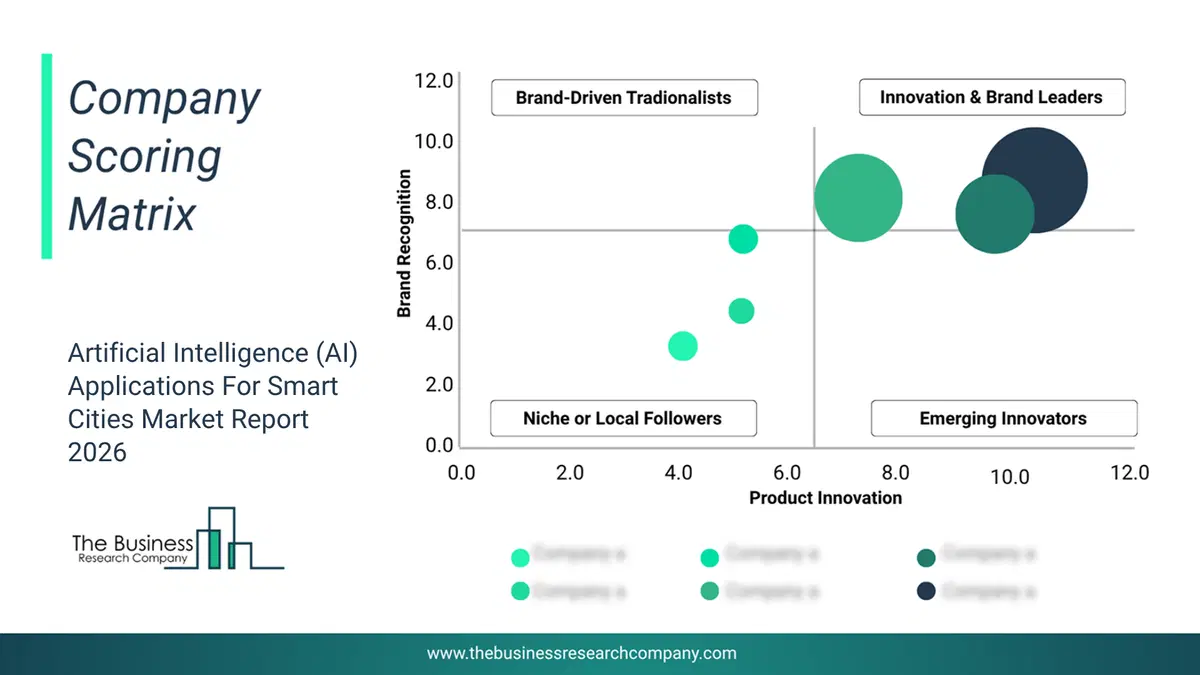
This chart maps companies by product innovation and brand strength, with bubble size indicating relative revenue, helping identify market leaders, challengers, and niche players. This is an illustrative chart; the full report provides a complete and accurate competitive analysis.
Global Artificial Intelligence (AI) Applications For Smart Cities Market Trends and Insights
Major companies operating in the artificial intelligence (AI) applications for smart cities market are focusing on technological innovations, such as AI-powered location intelligence platforms, to deliver real-time, location-based insights that optimize urban planning and support more responsive, data-driven public services across smart city ecosystems. AI-powered location intelligence platform refers to an AI-driven system that analyzes real-time geospatial data to help cities optimize mobility, resource allocation, and public service delivery. For instance, in August 2024, Nearmap Pty Ltd., an Australia-based provider of location intelligence and aerial imagery, launched Generation 6 (Gen 6), a major upgrade to its location intelligence platform featuring over 130 AI-derived detections and scores across high-resolution aerial imagery in Australia, the US, Canada, and New Zealand. The platform is designed to provide over 130 AI-derived data layers, including new detections for solar panels, construction sites, and detailed road markings, trained on millions of images to deliver insights that support applications such as pavement management, urban planning, and vegetation monitoring for smart cities, with data delivered as vector files for easy integration into GIS platforms.What Are Latest Mergers And Acquisitions In The Artificial Intelligence (AI) Applications For Smart Cities Market?
In November 2024, Almaviva, an Italy-based digital innovation group specializing in information and communications technology for the transportation and logistics sectors, acquired Iteris Inc. for an undisclosed amount. With this acquisition, Almaviva sought to expand its smart mobility portfolio and strengthen its presence in the North American intelligent transportation market through the integration of advanced ClearMobility platform capabilities and an extensive network of public agency clients. Iteris Inc. is a US-based provider of smart mobility infrastructure management solutions, cloud-enabled software, and artificial intelligence (AI) applications for smart cities.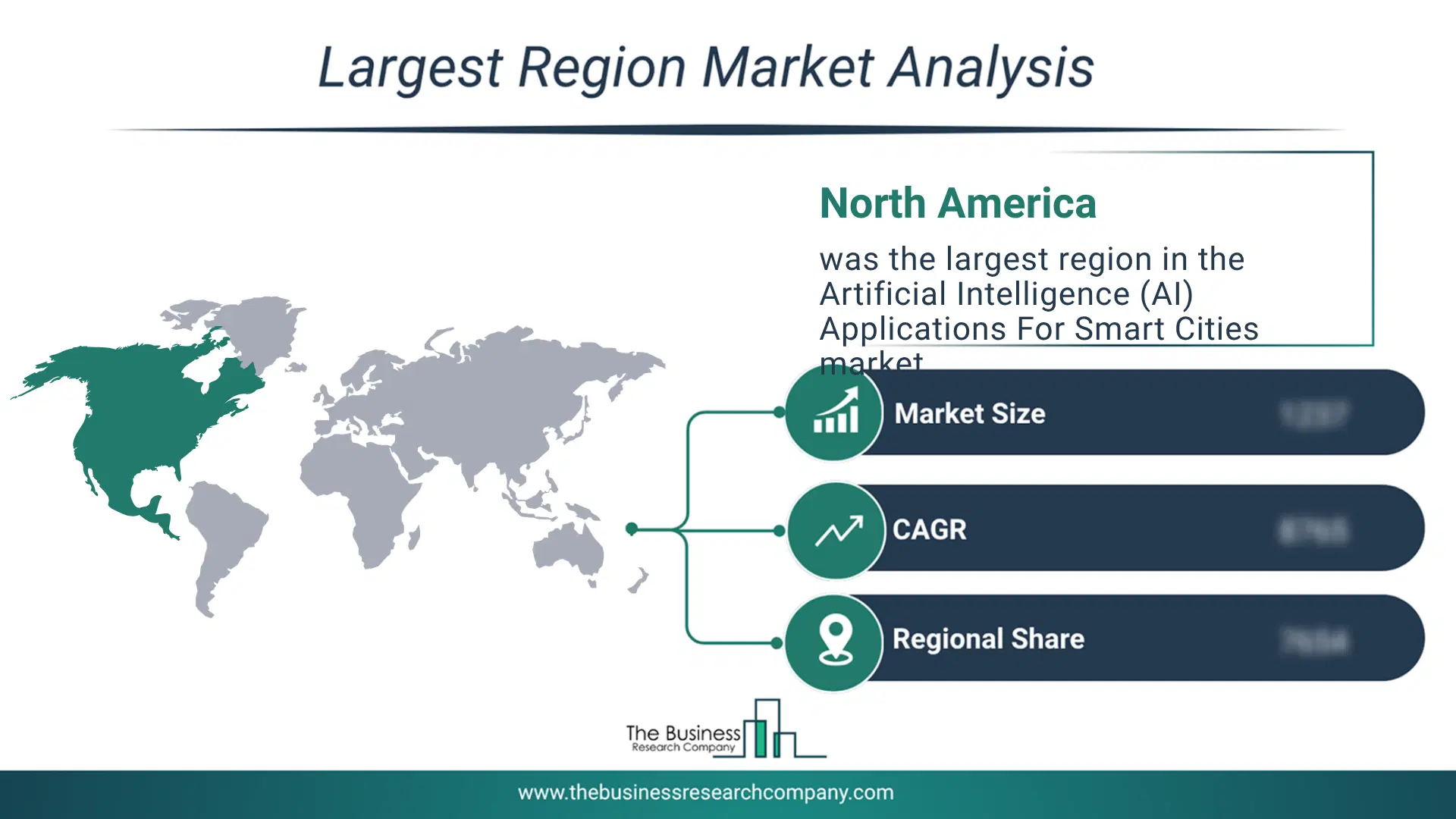
Regional Insights
North America was the largest region in the artificial intelligence (AI) applications for smart cities market in 2025. Asia-Pacific is expected to be the fastest-growing region in the forecast period. The regions covered in this market report are Asia-Pacific, South East Asia, Western Europe, Eastern Europe, North America, South America, Middle East, Africa. The countries covered in this market report are Australia, Brazil, China, France, Germany, India, Indonesia, Japan, Taiwan, Russia, South Korea, UK, USA, Canada, Italy, Spain.What Defines the Artificial Intelligence (AI) Applications For Smart Cities Market?
The artificial intelligence (AI) applications for smart cities market consist of revenues earned by entities by providing services such as waste management solutions, smart healthcare services, environmental monitoring, and citizen engagement platforms. The market value includes the value of related goods sold by the service provider or included within the service offering. The artificial intelligence (AI) applications for smart cities market include sales of smart meters, drones, wearable health devices, intelligent streetlights, and robotic cleaning systems. Values in this market are ‘factory gate’ values, that is, the value of goods sold by the manufacturers or creators of the goods, whether to other entities (including downstream manufacturers, wholesalers, distributors, and retailers) or directly to end customers. The value of goods in this market includes related services sold by the creators of the goods.How is Market Value Defined and Measured?
The market value is defined as the revenues that enterprises gain from the sale of goods and/or services within the specified market and geography through sales, grants, or donations in terms of the currency (in USD unless otherwise specified). The revenues for a specified geography are consumption values that are revenues generated by organizations in the specified geography within the market, irrespective of where they are produced. It does not include revenues from resales along the supply chain, either further along the supply chain or as part of other products.
This chart presents market attractiveness based on a quantitative evaluation of growth, competition, strategic alignment, and risk, offering a clear view of opportunity areas for decision-making. This chart is for illustrative purposes; the full report contains the complete analysis.

This chart highlights the Total Addressable Market (TAM) by estimating the maximum revenue opportunity using an assumption-driven approach, supporting strategic planning and opportunity sizing across markets. The chart is illustrative; the full report provides a more comprehensive analysis.
What Key Data and Analysis Are Included in the Artificial Intelligence (AI) Applications For Smart Cities Market Report 2026?
The artificial intelligence (ai) applications for smart cities market research report is one of a series of new reports from The Business Research Company that provides market statistics, including industry global market size, regional shares, competitors with the market share, detailed market segments, market trends and opportunities, and any further data you may need to thrive in the artificial intelligence (ai) applications for smart cities industry. The market research report delivers a complete perspective of everything you need, with an in-depth analysis of the current and future state of the industry.Artificial Intelligence (AI) Applications For Smart Cities Market Report Forecast Analysis
| Report Attribute | Details |
|---|---|
| Market Size Value In 2026 | $18.88 billion |
| Revenue Forecast In 2030 | $38.35 billion |
| Growth Rate | CAGR of 19.6% from 2026 to 2030 |
| Base Year For Estimation | 2025 |
| Actual Estimates/Historical Data | 2020-2025 |
| Forecast Period | 2026 - 2030 |
| Market Representation | Revenue in USD Billion and CAGR from 2026 to 2030 |
| Segments Covered | Type, Deployment, Technology, Application |
| Regional Scope | Asia-Pacific, Western Europe, Eastern Europe, North America, South America, Middle East, Africa |
| Country Scope | The countries covered in the report are Australia, Brazil, China, France, Germany, India, Indonesia, Japan, Taiwan, Russia, South Korea, UK, USA, Canada, Italy, Spain. |
| Key Companies Profiled | Hitachi Ltd., International Business Machines Corporation, Cisco Systems Inc., Schneider Electric SE, ABB Ltd., Tata Consultancy Services Limited, Larsen & Toubro Limited, Infosys Limited, HCL Technologies Limited, PTC Inc., Verkada Inc., Optibus Ltd., Huawei Technologies Co. Ltd, Ubicquia Inc., Gorilla Technology Group Inc., Utilidata Inc., Ekin Smart City Technologies Inc., Ecube Labs Co. Ltd., Nodeflux Inc., Enevo Oy, Seoul Robotics Inc. |
| Customization Scope | Request for Customization |
| Pricing And Purchase Options | Explore Purchase Options |