
Artificial Intelligence (AI)-Based Gas Analyzer Market Report 2026
Global Outlook – By Component (Hardware, Software, Services), By Technology (Infrared Spectroscopy, Gas Chromatography, Electrochemical Sensors, Photoionization Detection), By Product Type (Portable Gas Analyzers, Fixed Gas Analyzers, Multi-Gas Analyzers), By Application (Environmental Monitoring, Industrial Safety, Emission Testing, Process Control), By End-Use (Chemical Industry, Oil And Gas, Power Generation, Automotive) – Market Size, Trends, Strategies, and Forecast to 2035
Artificial Intelligence (AI)-Based Gas Analyzer Market Overview
• Artificial Intelligence (AI)-Based Gas Analyzer market size has reached to $2.24 billion in 2025 • Expected to grow to $3.95 billion in 2030 at a compound annual growth rate (CAGR) of 12% • Growth Driver: Increasing Adoption Of Industry 4.0 And Smart Factory Solutions Driving The Market Growth Due To Rising Focus On Productivity And Operational Efficiency • Market Trend: Advancements In Market Driven By AI-Powered Emission Detectors Enabling Real-Time Monitoring, Autonomous Leak Detection, Regulatory Compliance, And Cost-Effective Industrial Operations • North America was the largest region in 2025 and Asia-Pacific is the fastest growing region.What Is Covered Under Artificial Intelligence (AI)-Based Gas Analyzer Market?
Artificial intelligence (AI)-based gas analyzers are advanced analytical systems that combine gas sensing technologies with artificial intelligence algorithms to detect, identify, and quantify gas compositions with high accuracy. These systems use machine learning and data analytics to process real-time sensor inputs, improve detection precision, enable predictive insights, and support automated decision-making in monitoring gas emissions, air quality, and process conditions. The main components of artificial intelligence (AI)-based gas analyzer include hardware, software, and services. Hardware refers to physical sensing and processing units designed to detect and analyze gas composition in real time using AI-enabled systems. These systems are based on technologies such as infrared spectroscopy, gas chromatography, electrochemical sensors, and photoionization detection and are available in product types including portable gas analyzers, fixed gas analyzers, and multi-gas analyzers. They find applications such as environmental monitoring, industrial safety, emission testing, and process control, while the end-use includes chemical industry, oil and gas, power generation, and automotive.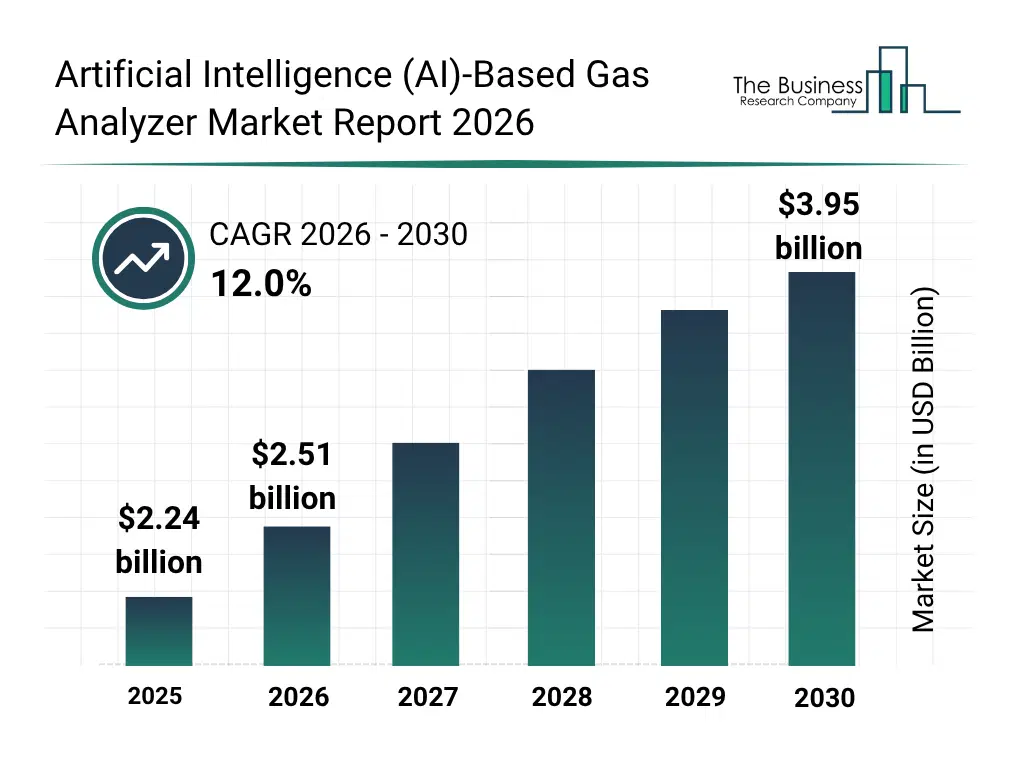
What Is The Artificial Intelligence (AI)-Based Gas Analyzer Market Size and Share 2026?
The artificial intelligence (AI)-based gas analyzer market size has grown rapidly in recent years. It will grow from $2.24 billion in 2025 to $2.51 billion in 2026 at a compound annual growth rate (CAGR) of 11.8%. The growth in the historic period can be attributed to increasing industrial emissions monitoring requirements, expansion of oil and gas exploration activities, rising workplace safety regulations in manufacturing plants, growth in chemical processing industries, early adoption of fixed gas detection systems.What Is The Artificial Intelligence (AI)-Based Gas Analyzer Market Growth Forecast?
The artificial intelligence (AIi)-based gas analyzer market size is expected to see rapid growth in the next few years. It will grow to $3.95 billion in 2030 at a compound annual growth rate (CAGR) of 12.0%. The growth in the forecast period can be attributed to stringent global emission compliance mandates, rising demand for predictive maintenance in industrial safety systems, expansion of hydrogen and alternative fuel infrastructure monitoring, increasing adoption of portable gas analyzers in field operations, growth in smart manufacturing and automated process safety systems. Major trends in the forecast period include miniaturization of high-sensitivity gas sensing modules for portable analyzers, increasing adoption of continuous emission monitoring systems in regulated industries, rising demand for real-time industrial leak detection and workplace safety monitoring, integration of multi-gas detection systems with process control infrastructure in heavy industries, growing use of hybrid spectroscopic and electrochemical sensing for improved gas accuracy.
Global Artificial Intelligence (AI)-Based Gas Analyzer Market Segmentation
1) By Component: Hardware, Software, Services 2) By Technology: Infrared Spectroscopy, Gas Chromatography, Electrochemical Sensors, Photoionization Detection 3) By Product Type: Portable Gas Analyzers, Fixed Gas Analyzers, Multi-Gas Analyzers 4) By Application: Environmental Monitoring, Industrial Safety, Emission Testing, Process Control 5) By End-Use: Chemical Industry, Oil And Gas, Power Generation, Automotive Subsegments: 1) By Hardware: Sensor Modules, Gas Detection Probes, Signal Processing Units, Display Panels, Connectivity Modules 2) By Software: Data Analytics Software, Predictive Maintenance Software, Visualization Software, Control And Monitoring Software, Cloud Integration Software 3) By Services: Installation Services, Calibration Services, Maintenance Services, Technical Support Services, Consulting ServicesWhat Are The Drivers Of The Artificial Intelligence (AI)-Based Gas Analyzer Market?
The increasing adoption of industry 4.0 and smart factory solutions is expected to propel the growth of the artificial intelligence (AI)-based gas analyzer market going forward. Industry 4.0 and smart factory solutions refer to the integration of advanced digital technologies such as AI, IoT, automation, and data analytics into manufacturing systems to enable intelligent, connected, and highly efficient production environments. The adoption of industry 4.0 and smart factory solutions is rising due to manufacturers increasingly seeking to improve productivity by automating operations, optimizing resource use, and enabling real-time decision-making through connected digital systems. AI-enhanced gas analyzers play a critical role, particularly in emission-intensive industries such as chemicals, energy, and manufacturing, where continuous gas monitoring is essential for safety, regulatory compliance, and operational efficiency. These analyzers leverage real-time sensor data and advanced analytics to improve detection accuracy, support predictive maintenance, and reduce operational risks. For instance, in March 2024, according to Rockwell Automation Inc., a US-based automation company, around 83% of manufacturers expect to implement generative AI in their operations, and 95% are using or assessing smart manufacturing technologies, up from 84% in 2023. Therefore, the increasing adoption of industry 4.0 and smart factory solutions is driving the growth of the artificial intelligence (AI)-based gas analyzer industry. The increasingly stringent environmental regulations are expected to propel the growth of the artificial intelligence (AI)-based gas analyzer market going forward. Stringent environmental regulations are strict laws and rules established by governments or regulatory bodies to control pollution, limit emissions, and ensure the protection of air, water, and overall environmental quality. Stringent environmental regulations are rising due to increasing concerns about climate change, as governments and regulatory bodies are under pressure to reduce greenhouse gas emissions and limit environmental degradation caused by industrial and human activities. Stringent environmental regulations drive the adoption of artificial intelligence (AI)-based gas analyzers by compelling industries to continuously monitor, accurately detect, and rapidly report harmful gas emissions in real time to ensure compliance with strict emission limits and avoid penalties. For instance, in December 2024, United States Environmental Protection Agency, a US-based government agency, the EPA finalized a record settlement with Marathon Oil Company over Clean Air Act violations at nearly 90 oil and natural gas production facilities on the Fort Berthold Indian Reservation in North Dakota. Therefore, the increasingly stringent environmental regulations is driving the growth of the artificial intelligence (AI)-based gas analyzer industry.Key Players In The Global Artificial Intelligence (AI)-Based Gas Analyzer Market
Major companies operating in the artificial intelligence (ai)-based gas analyzer market are Siemens AG, Thermo Fisher Scientific Inc., GE Measurement & Control Solutions, Honeywell International Inc, ABB Ltd., Emerson Electric Co., Ametek Inc., Teledyne Technologies, Endress+Hauser, Mettler-Toledo, Yokogawa Electric Corporation, Horiba Ltd., Industrial Scientific Corporation, DILO Company Inc., Gasera Ltd., Applied Analytics Inc., BlueSens gas sensor GmbH, Cambridge Sensotec Ltd., Ellona SAS, CleanConnect.aiGlobal Artificial Intelligence (AI)-Based Gas Analyzer Market Trends and Insights
Major companies operating in the artificial intelligence (AI)-based gas analyzer market are focusing on developing advanced solutions such as, AI-powered emission detector to enhance real-time monitoring accuracy, automate leak detection, improve regulatory compliance, and reduce operational costs through scalable, data-driven insights. An AI-powered emission detector is a system that combines traditional gas-sensing technologies with artificial intelligence to automatically detect, identify, and quantify gas emissions, such as methane or volatile organic compounds in real time. For instance, in June 2025, Percepto, an Israeli technology company specializing in autonomous inspection and monitoring solutions that integrate robotics, artificial intelligence, and cloud-based data management, launched an AI-powered emission detector that uses autonomous drones to remotely identify methane leaks in oil and gas operations. The system captures Optical Gas Imaging (OGI) footage and analyzes it in real time, detecting emissions down to 100 g/hr with high confidence while sending precise, verified alerts. Designed for large-scale deployment, it reduces the need for field inspections, lowers costs, improves safety, and helps operators meet upcoming Environmental Protection Agency regulations.Regional Outlook/Insights
North America was the largest region in the artificial intelligence (AI)-based gas analyzer market in 2025. Asia-Pacific is expected to be the fastest-growing region in the forecast period. The regions covered in this market report are Asia-Pacific, South East Asia, Western Europe, Eastern Europe, North America, South America, Middle East, Africa. The countries covered in this market report are Australia, Brazil, China, France, Germany, India, Indonesia, Japan, Taiwan, Russia, South Korea, UK, USA, Canada, Italy, Spain.What Defines the Artificial Intelligence (AI)-Based Gas Analyzer Market?
The artificial intelligence (AI)-based gas analyzer market consists of revenues earned by entities by providing services such as real-time gas monitoring, emission analysis, predictive maintenance, AI-driven calibration and diagnostics, data analytics and visualization, remote monitoring services, and system integration for industrial and environmental monitoring solutions. The market value includes the value of related goods sold by the service provider or included within the service offering. The artificial intelligence (AI)-based gas analyzer market also includes sales of AI-enabled gas analyzers, multi-gas detectors, infrared gas sensors, electrochemical sensors, laser-based gas analyzers, portable gas monitoring devices, fixed gas detection systems, and associated software platforms and cloud-based analytics tools. Values in this market are ‘factory gate’ values, that is, the value of goods sold by the manufacturers or creators of the goods, whether to other entities (including downstream manufacturers, wholesalers, distributors, and retailers) or directly to end customers. The value of goods in this market includes related services sold by the creators of the goods.How is Market Value Defined and Measured?
The market value is defined as the revenues that enterprises gain from the sale of goods and/or services within the specified market and geography through sales, grants, or donations in terms of the currency (in USD unless otherwise specified). The revenues for a specified geography are consumption values that are revenues generated by organizations in the specified geography within the market, irrespective of where they are produced. It does not include revenues from resales along the supply chain, either further along the supply chain or as part of other products.What Key Data and Analysis Are Included in the Artificial Intelligence (AI)-Based Gas Analyzer Market Report 2026?
The artificial intelligence (ai)-based gas analyzer market research report is one of a series of new reports from The Business Research Company that provides market statistics, including industry global market size, regional shares, competitors with the market share, detailed market segments, market trends and opportunities, and any further data you may need to thrive in the artificial intelligence (ai)-based gas analyzer industry. The market research report delivers a complete perspective of everything you need, with an in-depth analysis of the current and future state of the industry.Artificial Intelligence (AI)-Based Gas Analyzer Market Report Forecast Analysis
| Report Attribute | Details |
|---|---|
| Market Size Value In 2026 | $2.51 billion |
| Revenue Forecast In 2035 | $3.95 billion |
| Growth Rate | CAGR of 12.0% from 2026 to 2035 |
| Base Year For Estimation | 2025 |
| Actual Estimates/Historical Data | 2020-2025 |
| Forecast Period | 2026 - 2030 - 2035 |
| Market Representation | Revenue in USD Billion and CAGR from 2026 to 2035 |
| Segments Covered | Component, Technology, Product Type, Application, End-Use |
| Regional Scope | Asia-Pacific, Western Europe, Eastern Europe, North America, South America, Middle East, Africa |
| Country Scope | The countries covered in the report are Australia, Brazil, China, France, Germany, India, Indonesia, Japan, Taiwan, Russia, South Korea, UK, USA, Canada, Italy, Spain. |
| Key Companies Profiled | Siemens AG, Thermo Fisher Scientific Inc., GE Measurement & Control Solutions, Honeywell International Inc, ABB Ltd., Emerson Electric Co., Ametek Inc., Teledyne Technologies, Endress+Hauser, Mettler-Toledo, Yokogawa Electric Corporation, Horiba Ltd., Industrial Scientific Corporation, DILO Company Inc., Gasera Ltd., Applied Analytics Inc., BlueSens gas sensor GmbH, Cambridge Sensotec Ltd., Ellona SAS, CleanConnect.ai |
| Customization Scope | Request for Customization |
| Pricing And Purchase Options | Explore Purchase Options |