

Artificial Intelligence (AI) Copilot Market Report 2026
Global Outlook – By Type (Coding Copilots, Content Creation Copilots, Business Process Copilots, Healthcare Copilots, Customer Support Copilots), By Deployment (Cloud-Based, On-Premises), By Technology or Model Type (Generative Artificial Intelligence (Large Language Models - LLMs), Predictive Artificial Intelligence (Machine Learning - ML), Natural Language Processing (NLP) Focus), By Organization Size (Small and Medium Enterprises (SMEs), Large Enterprises, Individual Developers or Freelancers), By End-User Industry (Information Technology and Telecom, Banking, Financial Services, and Insurance, Healthcare and Life Sciences, Retail and E-commerce, Manufacturing, Education, Other End-Users) – Market Size, Trends, Strategies, and Forecast to 2030
Artificial Intelligence (AI) Copilot Market Overview
• Artificial Intelligence (AI) Copilot market size has reached to $16.94 billion in 2025 • Expected to grow to $56.43 billion in 2030 at a compound annual growth rate (CAGR) of 27.1% • Growth Driver: Expansion Of Remote Work Driving The Growth Of The Market Due To Rising Adoption Of Hybrid And Distributed Work Models • Market Trend: Adoption Of Advanced LLM-Integrated Copilots To Enhance Productivity And Decision-Making • North America was the largest region in 2025 and Asia-Pacific is the fastest growing region.Market Gains By 2030 – Top Opportunities By Segment
Market Gain identifies the most promising market opportunities by highlighting the segments or products expected to generate the highest incremental revenue growth over the next five years.
What Is Covered Under Artificial Intelligence (AI) Copilot Market?
Artificial intelligence copilot is an artificial intelligence system designed to assist users in performing tasks more efficiently by providing real-time suggestions, automation, and predictive guidance. Its primary goal is to enhance productivity, accuracy, and decision-making across applications and workflows. It also enables workflow automation, context-aware recommendations, and adaptive learning to improve user experience and outcomes. The main types of the artificial intelligence (AI) copilot include coding copilots, content creation copilots, business process copilots, healthcare copilots, and customer support copilots. Coding copilots assist software developers by suggesting code snippets, automating repetitive programming tasks, and improving development efficiency. There are deployment modes such as cloud-based and on-premises. The technology or model types include generative AI (Large Language Models - LLMs), predictive AI (Machine Learning - ML), and NLP-focused models. The organization sizes include small and medium enterprises (SMEs), large enterprises, and individual developers or freelancers. The Key end-user industries include information technology and telecom, banking, financial services, and insurance, healthcare and life sciences, retail and e-commerce, manufacturing, education, and others.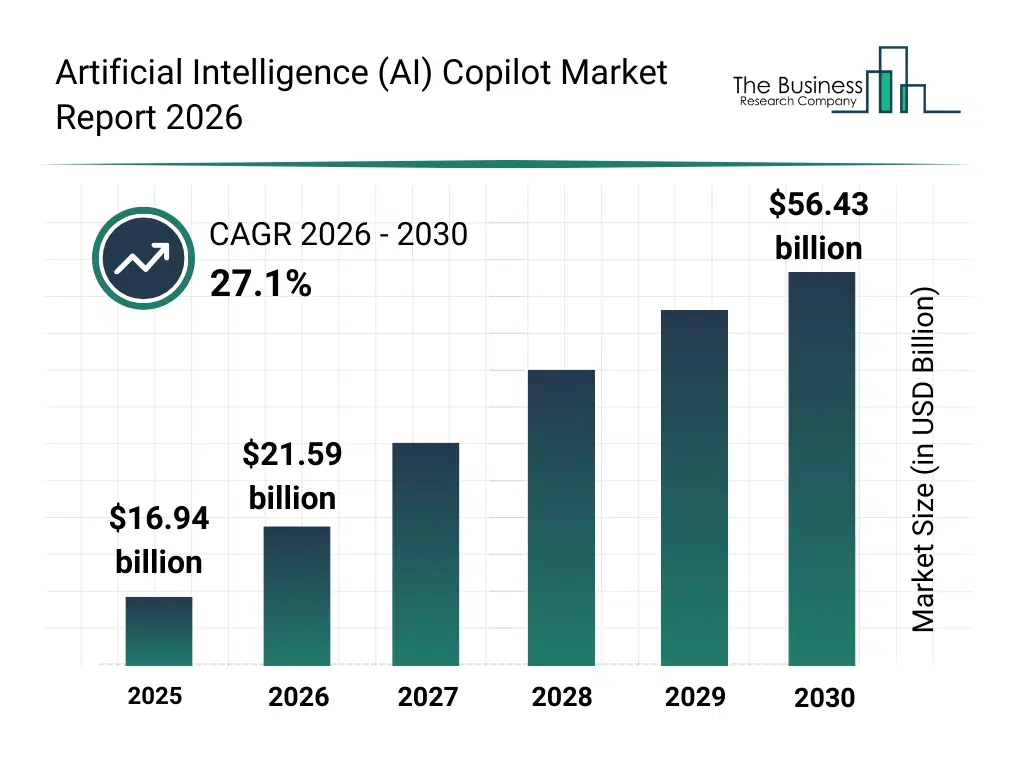
What Is The Artificial Intelligence (AI) Copilot Market Size and Share 2026?
The artificial intelligence (AI) copilot market size has grown exponentially in recent years. It will grow from $16.94 billion in 2025 to $21.59 billion in 2026 at a compound annual growth rate (CAGR) of 27.4%. The growth in the historic period can be attributed to increasing automation demand post-COVID, open-source model proliferation, falling inference costs, shift from rule-based automation to generative AI, strong VC and corporate investment in AI tooling.What Is The Artificial Intelligence (AI) Copilot Market Growth Forecast?
The artificial intelligence (AI) copilot market size is expected to see exponential growth in the next few years. It will grow to $56.43 billion in 2030 at a compound annual growth rate (CAGR) of 27.1%. The growth in the forecast period can be attributed to rise of agentic and autonomous AI systems, vertical-specific copilots (healthcare, legal, finance, manufacturing), multimodal model adoption, cost reductions through model optimization and distillation, enterprise-wide AI adoption roadmaps, regulatory clarity and AI governance frameworks, expansion of on-premise and private-cloud AI deployments, increasing ROI evidence for productivity and error reduction, integration of copilots into all major SaaS ecosystems. Major trends in the forecast period include Shift from assistant to multi-agent workflows, copilots embedded directly inside core applications, multimodal input/output capabilities, usage-based and hybrid subscription pricing models, increasing focus on trust/safety/governance features, emphasis on measurable business outcomes, consolidation around major AI/cloud platforms.
Global Artificial Intelligence (AI) Copilot Market Segmentation
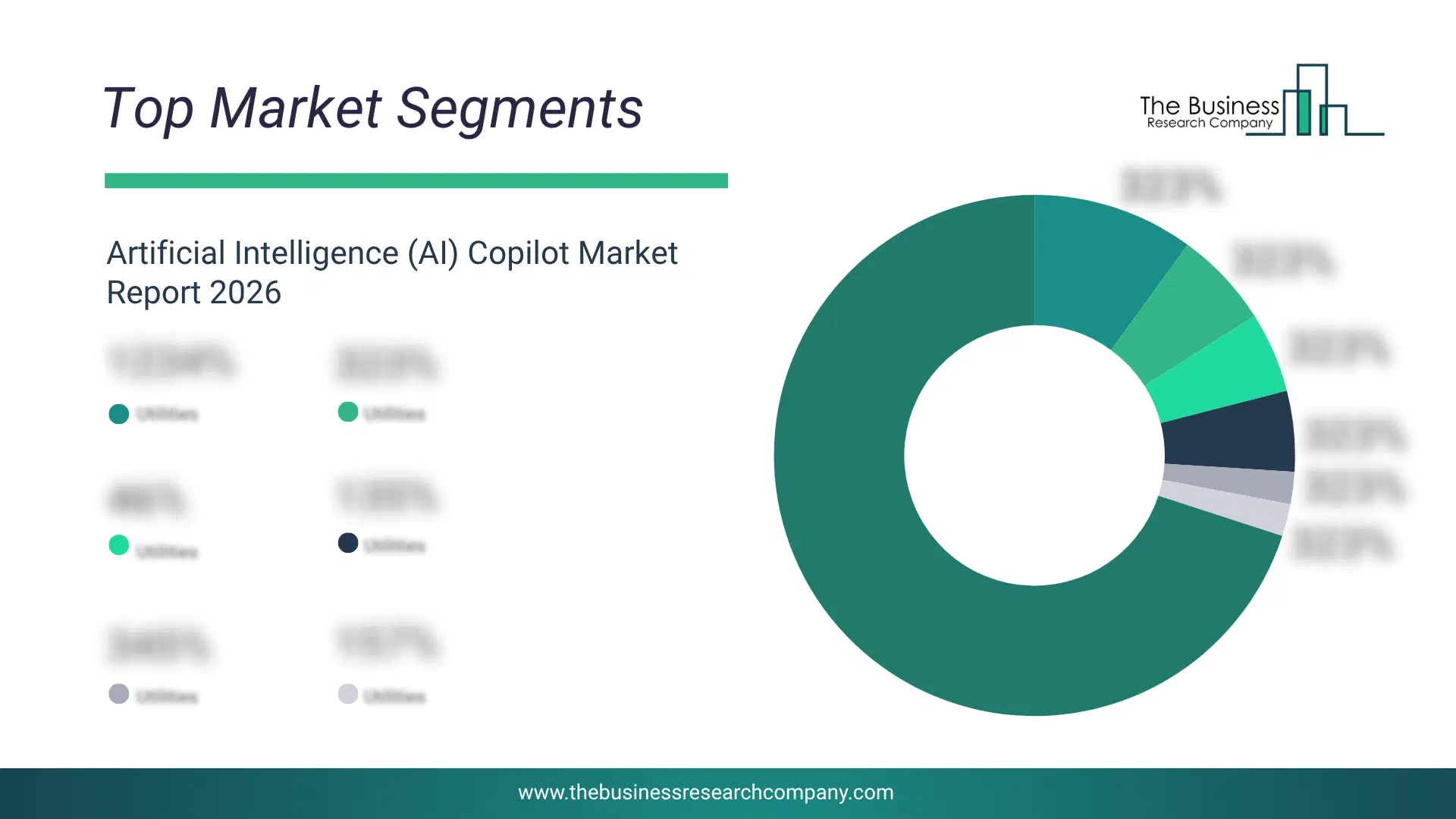
1) By Type: Coding Copilots, Content Creation Copilots, Business Process Copilots, Healthcare Copilots, Customer Support Copilots 2) By Deployment: Cloud-Based, On-Premises 3) By Technology or Model Type: Generative Artificial Intelligence (Large Language Models - LLMs), Predictive Artificial Intelligence (Machine Learning - ML), Natural Language Processing (NLP) Focus 4) By Organization Size: Small and Medium Enterprises (SMEs), Large Enterprises, Individual Developers or Freelancers 5) By End-User Industry: Information Technology and Telecom, Banking, Financial Services, and Insurance, Healthcare and Life Sciences, Retail and E-commerce, Manufacturing, Education, Other End-Users Subsegments: 1) By Coding Copilots: Code Generation Tools, Code Completion Tools, Code Review Tools, Debugging Assistance Tools, Programming Error Detection Tools, Software Development Recommendation Tools, Integrated Development Environment Enhancement Tools 2) By Content Creation Copilots: Text Generation Tools, Content Editing Tools, Creative Writing Assistance Tools, Marketing Content Creation Tools, Social Media Content Creation Tools, Document Drafting Tools, Multimedia Script Creation Tools 3) By Business Process Copilots: Workflow Automation Tools, Process Optimization Tools, Data Analysis Assistance Tools, Task Management Assistance Tools, Decision Support Tools, Document Processing Tools, Enterprise Reporting Assistance Tools 4) By Healthcare Copilots: Medical Documentation Assistance Tools, Clinical Decision Support Tools, Patient Record Summarization Tools, Medical Coding Assistance Tools, Treatment Recommendation Tools, Healthcare Workflow Automation Tools, Clinical Data Interpretation Tools 5) By Customer Support Copilots: Customer Query Response Tools, Conversation Assistance Tools, Knowledge Retrieval Tools, Ticket Summarization Tools, Support Agent Productivity Tools, Customer Interaction Automation Tools, Customer Issue Resolution Assistance Tools The top segments in the artificial intelligence (ai) copilot market will be: • Business Process Copilots will reach $1.37 Billion by 2030. • Coding Copilots will reach $1.04 Billion by 2030. • Content Creation Copilots will reach $0.8 Billion by 2030. • Customer Support Copilots will reach $0.53 Billion by 2030. • Healthcare Copilots will reach $0.38 Billion by 2030.What Is The Driver Of The Artificial Intelligence (AI) Copilot Market?
The expansion of remote work is expected to propel the growth of the artificial intelligence (AI) copilot market going forward. Remote work refers to employment in which work tasks are performed wholly or partly away from a central workplace, using information and communication technologies to communicate, collaborate, and deliver outputs. The expansion of remote work is rising as more employers and employees adopt distributed and hybrid arrangements to improve flexibility, access wider talent pools, and lower office costs. AI copilots support remote work by providing real-time assistance for virtual collaboration, automating routine tasks, surfacing contextually relevant knowledge across distributed systems, and improving individual and team productivity in distributed settings, making it easier for organizations to scale hybrid and fully remote operations. For instance, in March 2025, according to the Bureau of Labor Statistics, a US-based government agency, in the first quarter of 2024, 35.5 million people teleworked or worked at home for pay in the United States, an increase of 5.1 million over the prior year. Therefore, the expansion of remote work is driving the growth of the artificial intelligence (AI) copilot industry.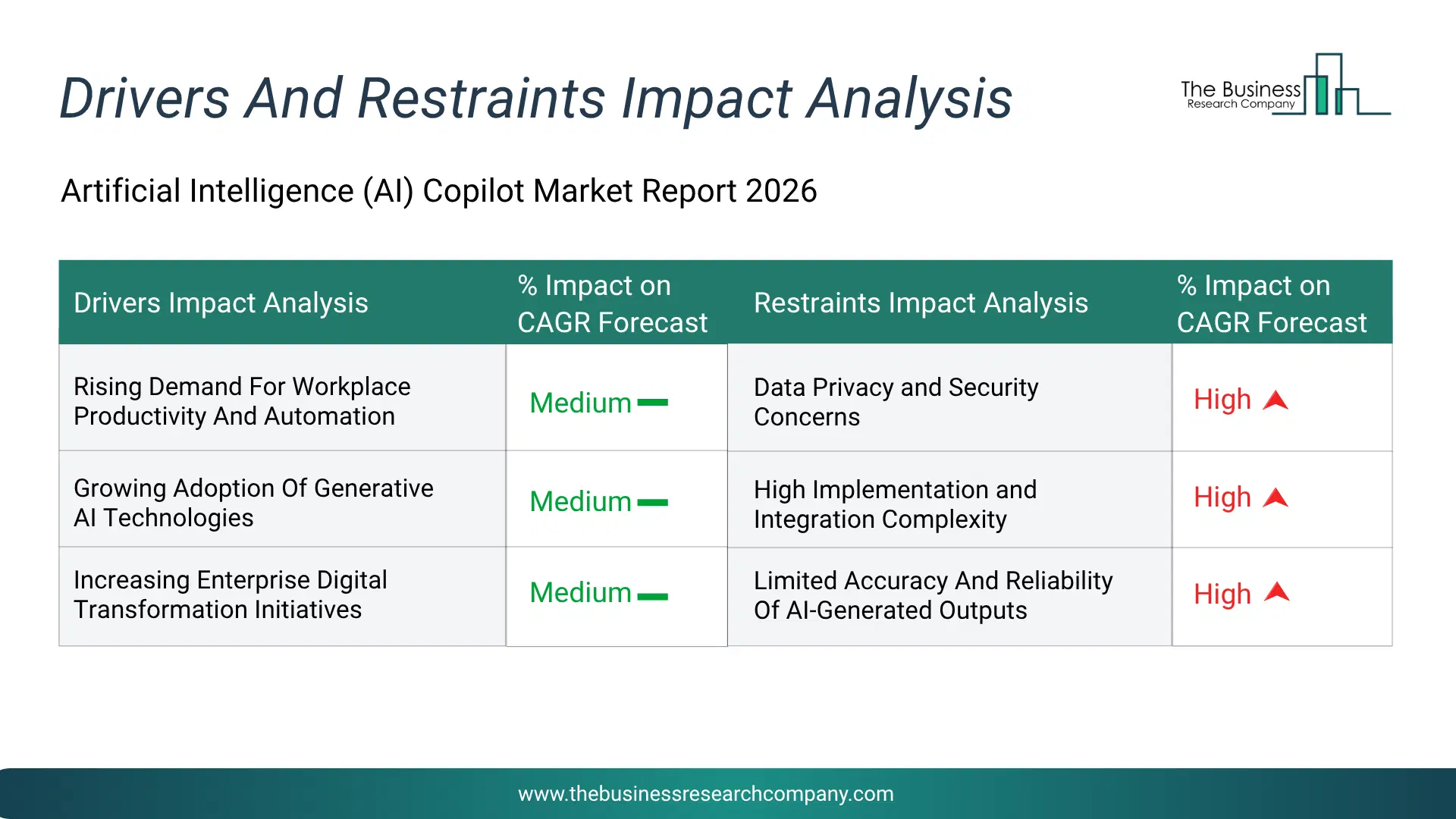
Infographic Chart Showing Key Market Drivers Analysis And Restraints For Artificial Intelligence (Ai) Copilot Market
The chart presents an impact analysis of key drivers and restraints, quantifying their relative influence on the market's growth rate and helping assess the balance between growth enablers and limiting factors. This chart offers a high-level perspective; the full report contains more detailed insights.
How Will The Drivers Impact Growth In The Global Artificial Intelligence (AI) Copilot Market?
• Rising Demand For Workplace Productivity And Automation (Medium) – During the forecast period, the rising demand for workplace productivity and automation is expected to become a key growth driver for the artificial intelligence (AI) copilot market by 2030. Enterprises are increasingly deploying AI copilots to automate repetitive business functions, accelerate document creation, simplify information retrieval, and improve task execution across departments. These intelligent assistants reduce operational bottlenecks while enabling employees to devote more time to innovation and strategic activities. Organizations are recognizing measurable improvements in efficiency, collaboration, and resource utilization through AI-powered workflow automation. • Growing Adoption Of Generative AI Technologies (Medium) – During the forecast period, the growing adoption of generative AI technologies is expected to emerge as a major factor driving the expansion of the artificial intelligence (AI) copilot market by 2030. Continuous advancements in foundation models are enabling AI copilots to deliver more accurate recommendations, contextual responses, and intelligent content generation across diverse enterprise use cases. Businesses are increasingly leveraging these capabilities to improve software development, customer engagement, knowledge management, and business intelligence. The expanding accessibility of generative AI solutions is accelerating deployment across organizations of all sizes. • Increasing Enterprise Digital Transformation Initiatives (Medium) – During the forecast period, the increasing enterprise digital transformation initiatives are expected to act as a key growth catalyst for the artificial intelligence (AI) copilot market by 2030. Organizations are modernizing legacy systems by integrating AI copilots into cloud environments, enterprise applications, and collaborative platforms to enhance business agility. These solutions improve data accessibility, optimize business processes, and support faster, data-driven decision-making across functions. Growing investments in intelligent enterprise infrastructure are further strengthening adoption of AI-powered assistants.How Will The Restraints Impact Growth In The Global Artificial Intelligence (AI) Copilot Market?
• Data Privacy and Security Concerns (Medium) – During the forecast period, the AI copilots often process large volumes of sensitive business and personal data, raising concerns about privacy and security. Organizations must ensure compliance with data protection regulations and industry standards. Risks related to unauthorized access, data leakage, and misuse of confidential information can hinder adoption. Many enterprises remain cautious about sharing proprietary information with AI systems. These concerns can slow deployment, particularly in highly regulated sectors such as healthcare, finance, and government. • High Implementation and Integration Complexity (Medium) – During the forecast period, the deploying AI copilots within existing enterprise environments can be technically challenging and costly. Organizations often need to integrate AI systems with multiple applications, databases, and workflows. Customization, employee training, and ongoing maintenance require significant investment. Small and medium-sized businesses may face resource constraints when adopting advanced AI solutions. Integration difficulties and operational costs can limit market penetration despite the technology’s benefits. • Limited Accuracy And Reliability Of AI-Generated Outputs (Medium) – During the forecast period, the limited accuracy and reliability of AI-generated outputs are expected to restrain the growth of the AI copilot market. AI copilots can occasionally generate inaccurate, incomplete, or misleading responses due to limitations in training data, contextual understanding, and reasoning capabilities. These inaccuracies may result in incorrect recommendations, flawed business decisions, or operational inefficiencies, particularly in high-stakes industries such as healthcare, finance, legal services, and engineering. Organizations often require human review and validation of AI-generated outputs to ensure accuracy, compliance, and quality, reducing the expected productivity gains from automation. In addition, concerns over AI hallucinations, inconsistent performance, and limited explainability may reduce user confidence and slow enterprise adoption. Businesses must invest in model fine-tuning, continuous monitoring, and governance frameworks to improve output reliability, increasing implementation complexity and operational costs. Consequently, limited accuracy and reliability of AI-generated outputs remain a significant restraint on the growth of the AI copilot market.Key Players In The Global Artificial Intelligence (AI) Copilot Market
Major companies operating in the artificial intelligence (AI) copilot market are Amazon Web Services Inc., Microsoft Corporation, International Business Machines Corporation (IBM), NVIDIA Corporation, Oracle Corporation, Salesforce Inc., SAP SE, Adobe Inc., ServiceNow Inc., Zoom Video Communications Inc., Atlassian Corporation plc, Palantir Technologies Inc., UiPath Inc., GitLab Inc., Cohere Inc., Hugging Face Inc., Anthropic PBC, Jasper AI Inc., Perplexity AI Inc., Mistral AI SAS, Replit Inc., Aleph Alpha GmbH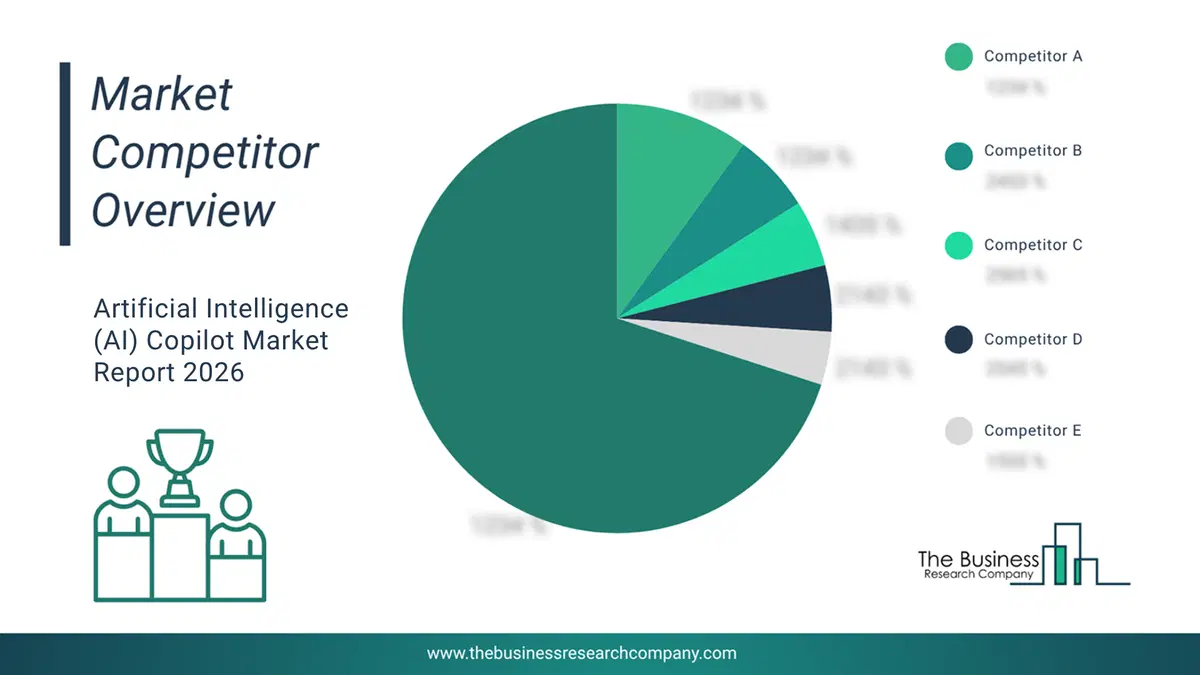
This chart is for illustrative purposes; the full report includes a detailed competitor analysis and comprehensive overview of the top 10 companies in the market.
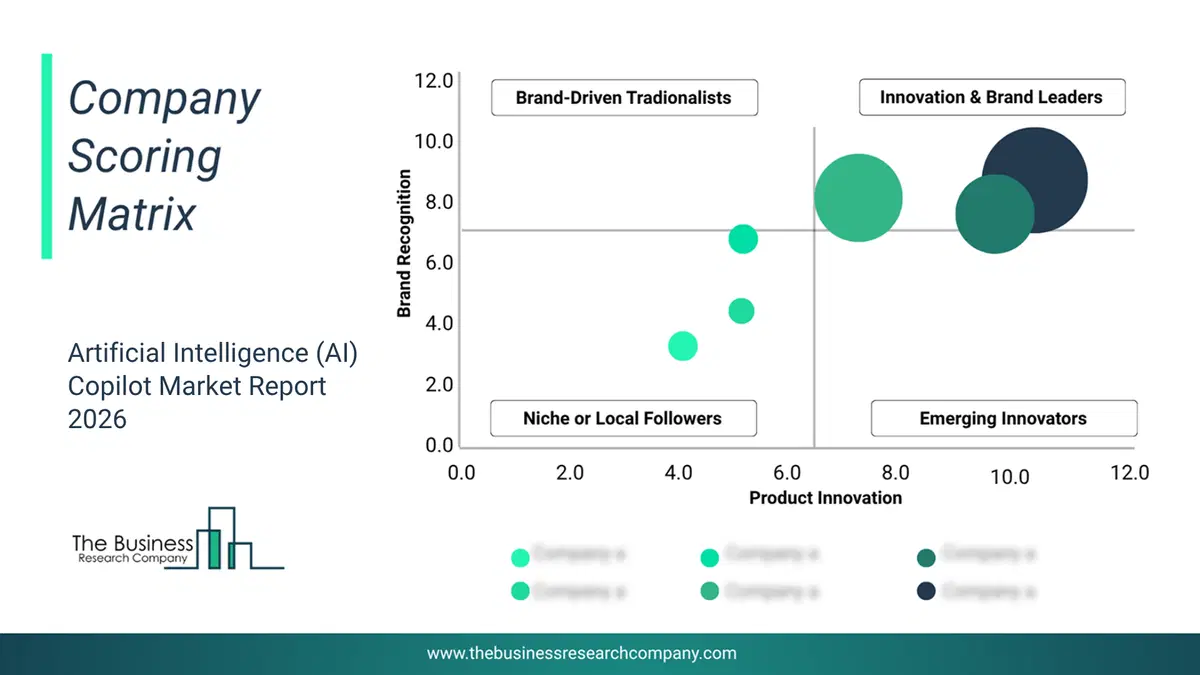
This chart maps companies by product innovation and brand strength, with bubble size indicating relative revenue, helping identify market leaders, challengers, and niche players. This is an illustrative chart; the full report provides a complete and accurate competitive analysis.
Global Artificial Intelligence (AI) Copilot Market Trends and Insights
Major companies operating in the artificial intelligence (AI) copilot market are focusing on developing advanced solutions, such as large language models (LLMs) integrated copilots, to seamlessly synthesize information from multiple sources. Large language model (LLM)–integrated copilots are AI-powered assistants that leverage advanced natural language models to provide real-time guidance, automate tasks, and enhance decision-making within software applications and workflows. For instance, in March 2023, Microsoft Corporation, a US-based technology company, launched the Microsoft 365 Copilot. It integrates large language models (LLMs) with data in Microsoft Graph and Microsoft 365 apps to transform natural language inputs into advanced productivity outputs. It is embedded across Microsoft 365 applications such as Word, Excel, PowerPoint, Outlook, and Teams to enhance creativity, efficiency, and skill development. The new Business Chat experience leverages LLMs, Microsoft 365 apps, and organizational data, including calendar, emails, chats, documents, meetings, and contacts, to generate contextual summaries and updates from multiple sources. Users retain full control over outputs, deciding what to accept, modify, or discard, enabling more creative, analytical, expressive, and collaborative work.What Are Latest Mergers And Acquisitions In The Artificial Intelligence (AI) Copilot Market?
In October 2023, Siemens Ag, a Germany-based automation company, partnered with Microsoft Corporation to accelerate cross-industry AI adoption. As a result of the partnership, the companies are launching the Siemens Industrial Copilot, a jointly developed AI-powered assistant designed to enhance human–machine collaboration in manufacturing. Additionally, the integration of Siemens Teamcenter product lifecycle management software with Microsoft Teams will enable the industrial metaverse by streamlining virtual collaboration among design engineers, frontline workers, and cross-functional teams. Microsoft Corporation is a US-based technology company.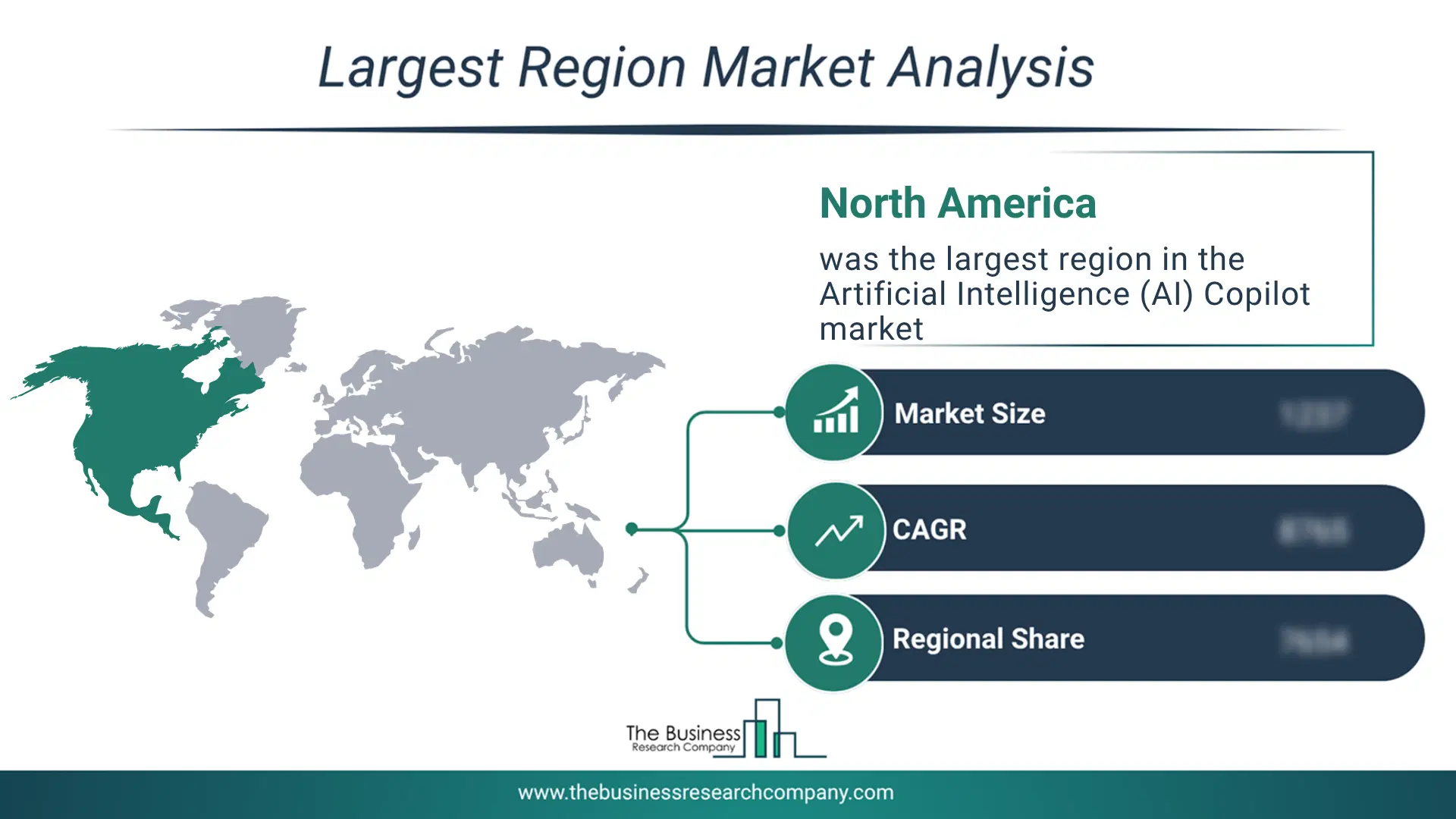
Regional Insights
North America was the largest region in the artificial intelligence (AI) copilot market in 2025. Asia-Pacific is expected to be the fastest-growing region in the forecast period. The regions covered in this market report are Asia-Pacific, South East Asia, Western Europe, Eastern Europe, North America, South America, Middle East, Africa. The countries covered in this market report are Australia, Brazil, China, France, Germany, India, Indonesia, Japan, Taiwan, Russia, South Korea, UK, USA, Canada, Italy, Spain.What Defines the Artificial Intelligence (AI) Copilot Market?
The artificial intelligence copilot market consists of revenues earned by entities by providing services such as real-time task assistance, automated content generation, predictive analytics, and workflow optimization. The market value includes the value of related goods sold by the service provider or included within the service offering. The artificial intelligence copilot market also includes sales of artificial intelligence -powered productivity software, integration platforms, recommendation engines, and enterprise artificial intelligence solutions. Values in this market are ‘factory gate’ values, that is, the value of goods sold by the manufacturers or creators of the goods, whether to other entities (including downstream manufacturers, wholesalers, distributors, and retailers) or directly to enterprises. The value of goods in this market includes related services sold by the creators of the goods.How is Market Value Defined and Measured?
The market value is defined as the revenues that enterprises gain from the sale of goods and/or services within the specified market and geography through sales, grants, or donations in terms of the currency (in USD unless otherwise specified). The revenues for a specified geography are consumption values that are revenues generated by organizations in the specified geography within the market, irrespective of where they are produced. It does not include revenues from resales along the supply chain, either further along the supply chain or as part of other products.
This chart presents market attractiveness based on a quantitative evaluation of growth, competition, strategic alignment, and risk, offering a clear view of opportunity areas for decision-making. This chart is for illustrative purposes; the full report contains the complete analysis.

This chart highlights the Total Addressable Market (TAM) by estimating the maximum revenue opportunity using an assumption-driven approach, supporting strategic planning and opportunity sizing across markets. The chart is illustrative; the full report provides a more comprehensive analysis.
What Key Data and Analysis Are Included in the Artificial Intelligence (AI) Copilot Market Report 2026?
The artificial intelligence (ai) copilot market research report is one of a series of new reports from The Business Research Company that provides market statistics, including industry global market size, regional shares, competitors with the market share, detailed market segments, market trends and opportunities, and any further data you may need to thrive in the artificial intelligence (ai) copilot industry. The market research report delivers a complete perspective of everything you need, with an in-depth analysis of the current and future state of the industry.Artificial Intelligence (AI) Copilot Market Report Forecast Analysis
| Report Attribute | Details |
|---|---|
| Market Size Value In 2026 | $21.59 billion |
| Revenue Forecast In 2030 | $56.43 billion |
| Growth Rate | CAGR of 27.4% from 2026 to 2030 |
| Base Year For Estimation | 2025 |
| Actual Estimates/Historical Data | 2020-2025 |
| Forecast Period | 2026 - 2030 |
| Market Representation | Revenue in USD Billion and CAGR from 2026 to 2030 |
| Segments Covered | Type, Deployment, Technology or Model Type, Organization Size, End-User Industry |
| Regional Scope | Asia-Pacific, Western Europe, Eastern Europe, North America, South America, Middle East, Africa |
| Country Scope | The countries covered in the report are Australia, Brazil, China, France, Germany, India, Indonesia, Japan, Taiwan, Russia, South Korea, UK, USA, Canada, Italy, Spain. |
| Key Companies Profiled | Amazon Web Services Inc., Microsoft Corporation, International Business Machines Corporation (IBM), NVIDIA Corporation, Oracle Corporation, Salesforce Inc., SAP SE, Adobe Inc., ServiceNow Inc., Zoom Video Communications Inc., Atlassian Corporation plc, Palantir Technologies Inc., UiPath Inc., GitLab Inc., Cohere Inc., Hugging Face Inc., Anthropic PBC, Jasper AI Inc., Perplexity AI Inc., Mistral AI SAS, Replit Inc., Aleph Alpha GmbH |
| Customization Scope | Request for Customization |
| Pricing And Purchase Options | Explore Purchase Options |