

Artificial Intelligence (AI) Deception Tools Market Report 2026
Global Outlook – By Tools (Generative Adversarial Networks (GANs), Fuzzing Tools, Attack Simulation Tools, Data Poisoning Tools, Other Tools), By Technology (Natural Language Processing (NLP), Machine Learning, Large Language Model (LLM), Generative AI (GANs), Computer Vision, Other Technologies), By Deployment Type (Cloud-Based, On-Premises, Hybrid), By Application (Fraud Detection, Security Testing, Data Privacy), By End-Use (Healthcare, Banking, Financial Services, And Insurance (BFSI), Telecom And Information Technology (IT), Government, Retail, Other End-Uses) – Market Size, Trends, Strategies, and Forecast to 2030
Artificial Intelligence (AI) Deception Tools Market Overview
• Artificial Intelligence (AI) Deception Tools market size has reached to $0.57 billion in 2025 • Expected to grow to $1.85 billion in 2030 at a compound annual growth rate (CAGR) of 26.6% • Growth Driver: Rising Cyber Threat Complexity And Frequency Due To Escalating Security Incidents And System Vulnerabilities • Market Trend: AI-Driven Deception Tools Enhance Spam Protection And Digital Trust • North America was the largest region in 2025 and Asia-Pacific is the fastest growing region.What Is Covered Under Artificial Intelligence (AI) Deception Tools Market?
Artificial intelligence (AI) deception tools are sophisticated, AI-driven systems designed to create or manipulate text, images, audio, or video compellingly with the intent to mislead or deceive individuals or organizations. They are increasingly used in large-scale disinformation campaigns, deepfake creation, and complex fraud schemes, producing content that appears authentic and is difficult to detect without advanced verification methods. The main types of tools in artificial intelligence (AI) deception tools are generative adversarial networks (GANs), fuzzing tools, attack simulation tools, data poisoning tools, and others. Generative adversarial networks (GANs) refer to a machine learning framework where two neural networks compete to produce highly realistic synthetic data that closely resembles real-world examples. It uses various technologies such as natural language processing (NLP), machine learning, large language models (LLMs), generative AI (GANs), computer vision, and others, and is deployed through cloud-based, on-premises, and hybrid systems. It is applied in various applications such as fraud detection, security testing, and data privacy, and caters to diverse end users, including healthcare, banking, financial services, and insurance (BFSI), telecom, and information technology (IT), government, retail, and others.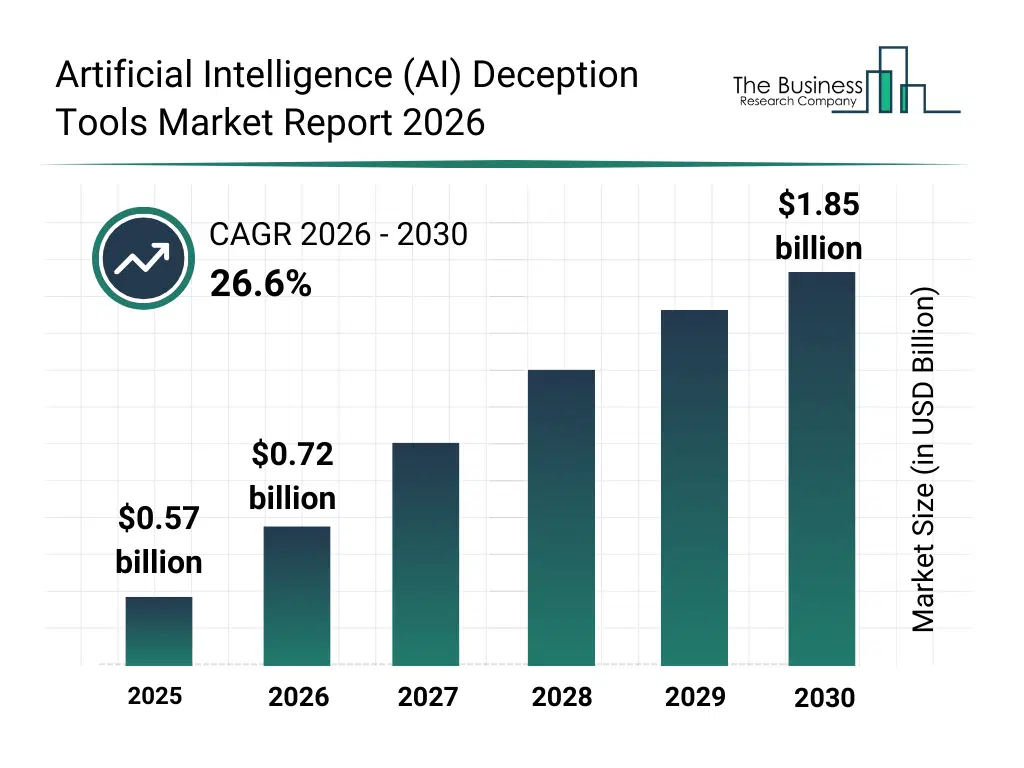
What Is The Artificial Intelligence (AI) Deception Tools Market Size and Share 2026?
The artificial intelligence (AI) deception tools market size has grown exponentially in recent years. It will grow from $0.57 billion in 2025 to $0.72 billion in 2026 at a compound annual growth rate (CAGR) of 26.3%. The growth in the historic period can be attributed to growth in social media content consumption, expansion of generative AI models, increased cybercrime activities, rising digital media manipulation incidents, accessibility of open source AI tools.What Is The Artificial Intelligence (AI) Deception Tools Market Growth Forecast?
The artificial intelligence (AI) deception tools market size is expected to see exponential growth in the next few years. It will grow to $1.85 billion in 2030 at a compound annual growth rate (CAGR) of 26.6%. The growth in the forecast period can be attributed to advancement in large language model capabilities, expansion of multimedia AI generation tools, rising demand for security simulation platforms, growth in online misinformation campaigns, increasing investment in adversarial AI research. Major trends in the forecast period include advanced deepfake content generation, automated disinformation campaign tools, synthetic media creation expansion, realistic voice cloning development, AI based social engineering simulation.
Global Artificial Intelligence (AI) Deception Tools Market Segmentation
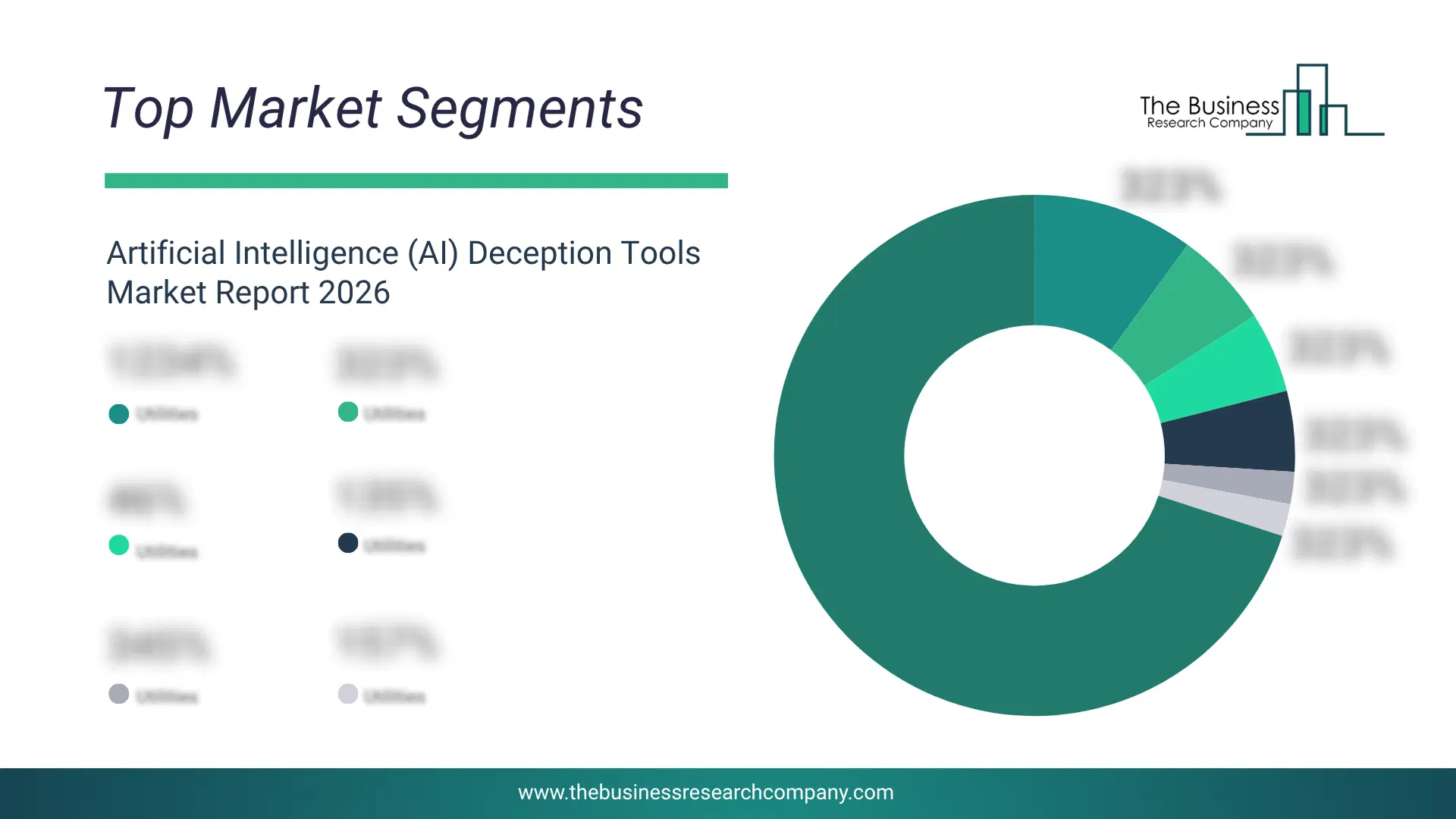
1) By Tools: Generative Adversarial Networks (GANs), Fuzzing Tools, Attack Simulation Tools, Data Poisoning Tools, Other Tools 2) By Technology: Natural Language Processing (NLP), Machine Learning, Large Language Model (LLM), Generative AI (GANs), Computer Vision, Other Technologies 3) By Deployment Type: Cloud-Based, On-Premises, Hybrid 4) By Application: Fraud Detection, Security Testing, Data Privacy 5) By End-Use: Healthcare, Banking, Financial Services, And Insurance (BFSI), Telecom And Information Technology (IT), Government, Retail, Other End-Uses Subsegments: 1) By Generative Adversarial Networks: Image Generation Models, Video Generation Models, Audio Generation Models, Text Generation Models 2) By Fuzzing Tools: Mutation-Based Fuzzers, Generation-Based Fuzzers, Coverage-Guided Fuzzers, Protocol Fuzzers 3) By Attack Simulation Tools: Network Attack Simulators, Endpoint Attack Simulators, Social Engineering Simulators, Application Attack Simulators 4) By Data Poisoning Tools: Label Flipping Tools, Backdoor Injection Tools, Feature Manipulation Tools, Gradient Manipulation Tools 5) By Other Tools: Deepfake Detection Tools, Adversarial Example Generation Tools, Model Evasion Tools, Model Inversion ToolsWhat Is The Driver Of The Artificial Intelligence (AI) Deception Tools Market?
The increasing complexity and frequency of cyber threats are expected to propel the growth of the artificial intelligence (AI) deception tools market going forward. Cyber threats refer to malicious activities aiming to damage, steal, or disrupt data, digital systems, or networks. The growth in complexity and frequency of cyber threats is due to increasing reliance on interconnected digital systems, which creates more vulnerabilities for attackers to exploit. Artificial intelligence (AI) deception tools address the increasing complexity and frequency of cyber threats by deploying realistic decoys and traps to mislead attackers while detecting malicious activity early and gathering intelligence on attack patterns to protect real systems. For instance, October 2025, National Cyber Security Centre (NCSC), a UK-based government cyber security agency, 204 nationally significant cyber-attacks in the year to August 2025, more than doubling from 89 the previous year, in which out of 429 total incidents, 18 were highly significant, marking a 50% rise. Therefore, the increasing complexity and frequency of cyber threats are driving the growth of the artificial intelligence (AI) deception tools industry.Key Players In The Global Artificial Intelligence (AI) Deception Tools Market
Major companies operating in the artificial intelligence (AI) deception tools market are Fortinet Inc., Proofpoint Inc., Commvault Systems Inc., Rapid7 Inc., SentinelOne Inc., Darktrace PLC., Cybereason Inc., ZeroFOX Holdings Inc., Cynet Ltd., Shield AI Inc., Acalvio Technologies Inc., CounterCraft Ltd., CyberTrap Machine Learning GmbH, Sensity Systems Inc., HiddenLayer Inc., Deceptive Bytes Ltd., Treacle Technologies Private Limited., PacketViper LLC, Lupovis Ltd., NeroSwarm GmbH Ltd.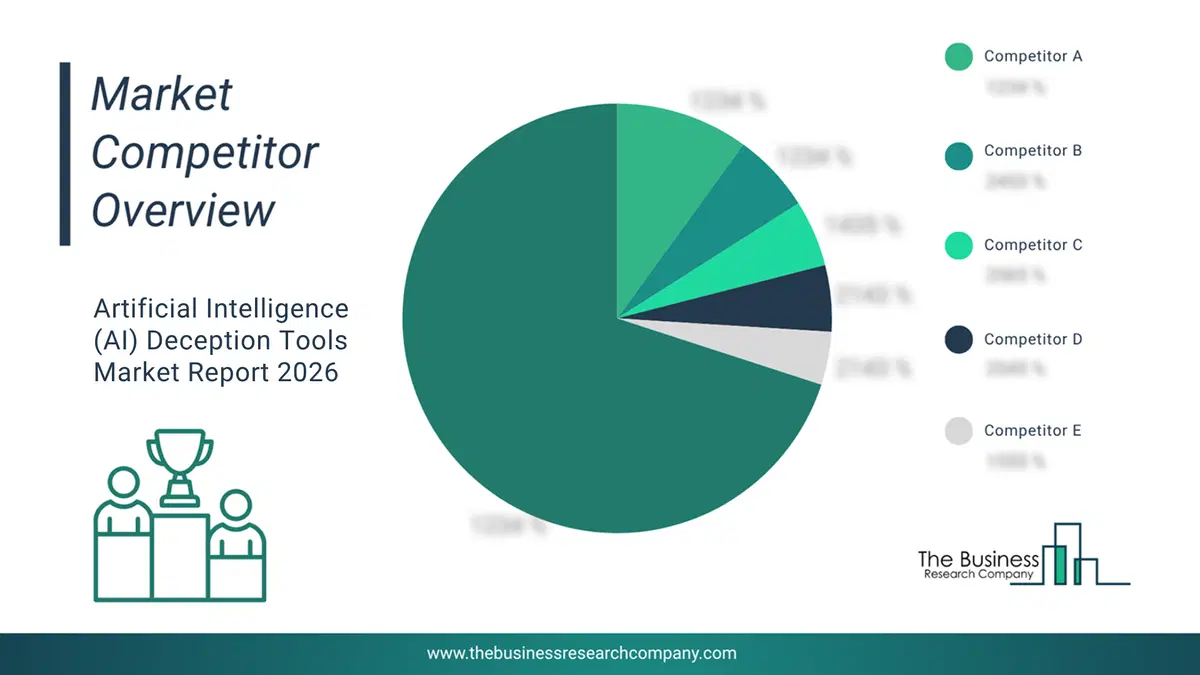
This chart is for illustrative purposes; the full report includes a detailed competitor analysis and comprehensive overview of the top 10 companies in the market.
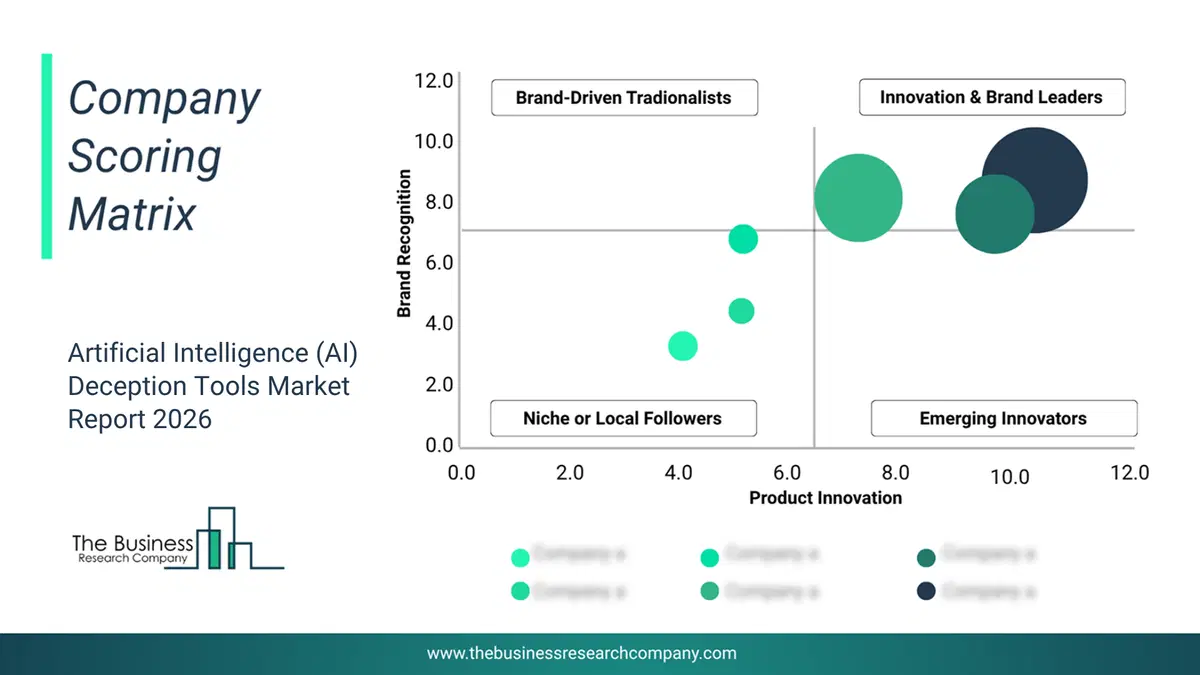
This chart maps companies by product innovation and brand strength, with bubble size indicating relative revenue, helping identify market leaders, challengers, and niche players. This is an illustrative chart; the full report provides a complete and accurate competitive analysis.
Global Artificial Intelligence (AI) Deception Tools Market Trends and Insights
Major companies operating in the artificial intelligence (AI) deception tools market are focusing on developing advanced solutions, such as artificial intelligence (AI)-driven protection against spam, to prevent fraudulent activities and build greater trust across digital platforms. Artificial intelligence (AI)-driven spam protection leverages AI algorithms to identify and block unwanted or harmful messages while continuously learning from patterns to stop spam and adapt to new threats. For instance, in February 2024, Bumble Inc., a US-based online dating and social networking company, introduced Deception Detector, an AI-driven tool that protects against spam aimed at spotting and blocking spam, scams, and fake profiles across its platforms, such as Bumble, Badoo, and Bumble For Friends. The tool leverages advanced machine learning to verify account authenticity and remove suspicious profiles before users interact with them. By integrating automated detection with human moderation, Bumble achieved a 45% drop in member reports of deceptive accounts within just two months, reinforcing its commitment to creating safer and more reliable online connections.What Are Latest Mergers And Acquisitions In The Artificial Intelligence (AI) Deception Tools Market?
In December 2023, Proofpoint, Inc., a US-based cybersecurity and compliance company, acquired Illusive Networks Inc. for an undisclosed amount. Through this acquisition, Proofpoint seeks to strengthen its threat protection portfolio by integrating Illusive Networks’ advanced identity threat detection and response (ITDR) technology, which mitigates privileged identity risks and lateral movement paths across hybrid environments. Illusive Networks Inc. is an Israel-based company that specializes in AI-powered deception technology.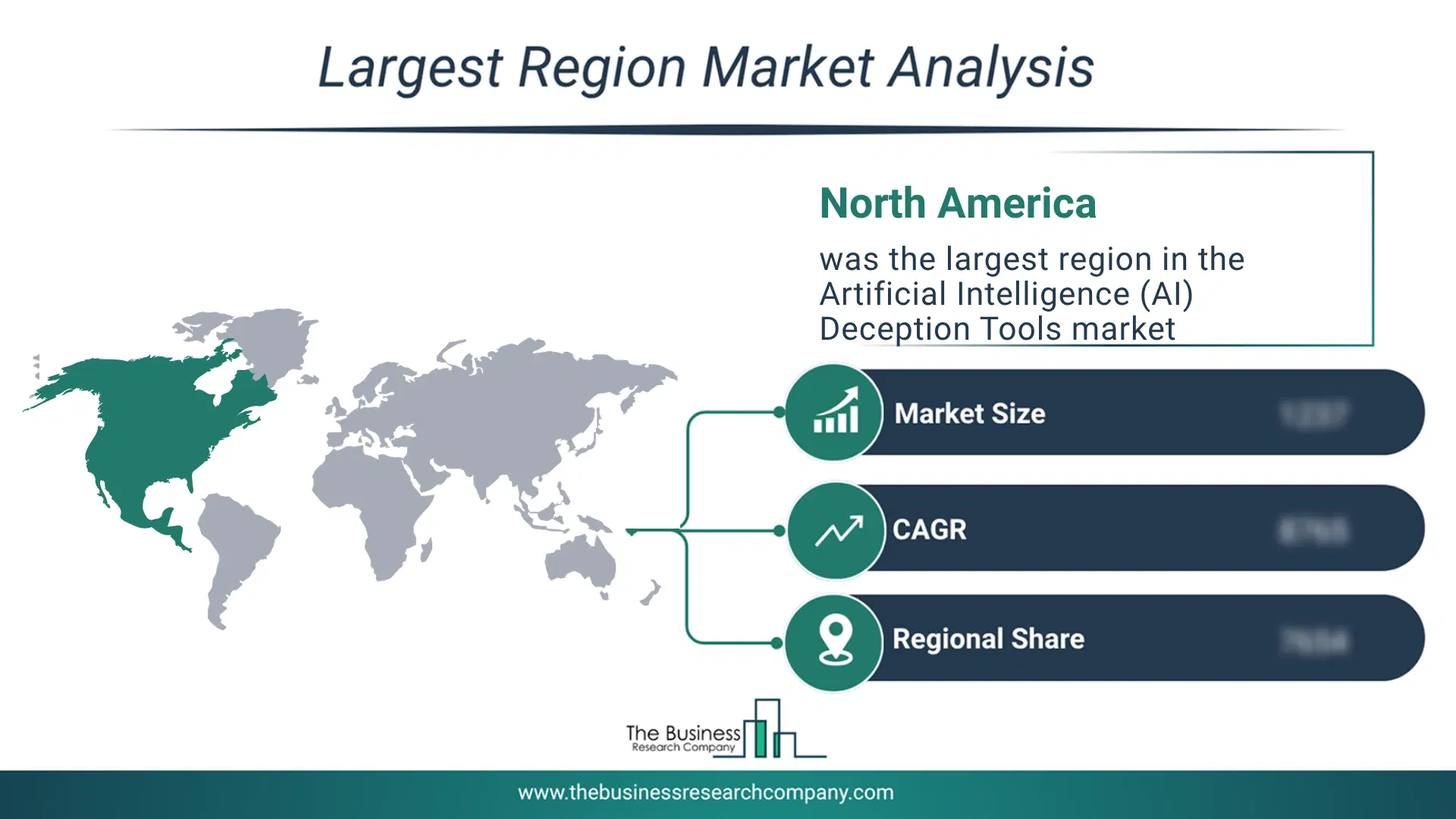
Regional Insights
North America was the largest region in the artificial intelligence (AI) deception tools market in 2025. Asia-Pacific is expected to be the fastest-growing region in the forecast period. The regions covered in this market report are Asia-Pacific, South East Asia, Western Europe, Eastern Europe, North America, South America, Middle East, Africa. The countries covered in this market report are Australia, Brazil, China, France, Germany, India, Indonesia, Japan, Taiwan, Russia, South Korea, UK, USA, Canada, Italy, Spain.What Defines the Artificial Intelligence (AI) Deception Tools Market?
The artificial intelligence (AI) deception tools market consists of revenues earned by entities by providing services, such as deepfake video and image generation, synthetic voice creation, decoy asset deployment, honeytoken generation, and behavioral simulation. The market value includes the value of related goods sold by the service provider or included within the service offering. The artificial intelligence (AI) deception tools market also includes sales of synthetic media generation tools, facial reenactment software, emotion simulation tools, cybersecurity deception platforms, and chatbot impersonation tools. Values in this market are ‘factory gate’ values, that is, the value of goods sold by the manufacturers or creators of the goods, whether to other entities (including downstream manufacturers, wholesalers, distributors, and retailers) or directly to end customers. The value of goods in this market includes related services sold by the creators of the goods.How is Market Value Defined and Measured?
The market value is defined as the revenues that enterprises gain from the sale of goods and/or services within the specified market and geography through sales, grants, or donations in terms of the currency (in USD unless otherwise specified). The revenues for a specified geography are consumption values that are revenues generated by organizations in the specified geography within the market, irrespective of where they are produced. It does not include revenues from resales along the supply chain, either further along the supply chain or as part of other products.
This chart presents market attractiveness based on a quantitative evaluation of growth, competition, strategic alignment, and risk, offering a clear view of opportunity areas for decision-making. This chart is for illustrative purposes; the full report contains the complete analysis.

This chart highlights the Total Addressable Market (TAM) by estimating the maximum revenue opportunity using an assumption-driven approach, supporting strategic planning and opportunity sizing across markets. The chart is illustrative; the full report provides a more comprehensive analysis.
What Key Data and Analysis Are Included in the Artificial Intelligence (AI) Deception Tools Market Report 2026?
The artificial intelligence (ai) deception tools market research report is one of a series of new reports from The Business Research Company that provides market statistics, including industry global market size, regional shares, competitors with the market share, detailed market segments, market trends and opportunities, and any further data you may need to thrive in the artificial intelligence (ai) deception tools industry. The market research report delivers a complete perspective of everything you need, with an in-depth analysis of the current and future state of the industry.Artificial Intelligence (AI) Deception Tools Market Report Forecast Analysis
| Report Attribute | Details |
|---|---|
| Market Size Value In 2026 | $0.72 billion |
| Revenue Forecast In 2030 | $1.85 billion |
| Growth Rate | CAGR of 26.6% from 2026 to 2030 |
| Base Year For Estimation | 2025 |
| Actual Estimates/Historical Data | 2020-2025 |
| Forecast Period | 2026 - 2030 |
| Market Representation | Revenue in USD Billion and CAGR from 2026 to 2030 |
| Segments Covered | Tools, Technology, Deployment Type, Application, End-Use |
| Regional Scope | Asia-Pacific, Western Europe, Eastern Europe, North America, South America, Middle East, Africa |
| Country Scope | The Countries Covered In This Market Report Are Australia, Brazil, China, France, Germany, India, Indonesia, Japan, Taiwan, Russia, South Korea, Uk, Usa, Canada, Italy, Spain. |
| Key Companies Profiled | Fortinet Inc., Proofpoint Inc., Commvault Systems Inc., Rapid7 Inc., SentinelOne Inc., Darktrace PLC., Cybereason Inc., ZeroFOX Holdings Inc., Cynet Ltd., Shield AI Inc., Acalvio Technologies Inc., CounterCraft Ltd., CyberTrap Machine Learning GmbH, Sensity Systems Inc., HiddenLayer Inc., Deceptive Bytes Ltd., Treacle Technologies Private Limited., PacketViper LLC, Lupovis Ltd., NeroSwarm GmbH Ltd. |
| Customization Scope | Request for Customization |
| Pricing And Purchase Options | Explore Purchase Options |