
Artificial Intelligence (AI)-Driven Smart Grid Intrusion Detection Market Report 2026
Global Outlook – By Component (Software, Hardware, Services), By Deployment Mode (On-Premises, Cloud), By Security Type (Network Security, Endpoint Security, Application Security, Other Security Types), By Application (Energy Management, Critical Infrastructure Protection, Fraud Detection, Other Applications), By End-User (Utilities, Industrial, Commercial, Residential, Other End-Users) – Market Size, Trends, Strategies, and Forecast to 2030
Artificial Intelligence (AI)-Driven Smart Grid Intrusion Detection Market Overview
• Artificial Intelligence (AI)-Driven Smart Grid Intrusion Detection market size has reached to $2.11 billion in 2025 • Expected to grow to $5.13 billion in 2030 at a compound annual growth rate (CAGR) of 19.4% • Growth Driver: Surge in Cybersecurity Threats Fueling The Growth Of The Market Due To Increasing Digitalization Of Critical Infrastructure • North America was the largest region in 2025 and Asia-Pacific is the fastest growing region.What Is Covered Under Artificial Intelligence (AI)-Driven Smart Grid Intrusion Detection Market?
Artificial Intelligence (AI)-driven smart grid intrusion detection is a system that uses artificial intelligence to continuously monitor and protect smart power grids from cyberattacks by detecting unusual activities in real-time, ensuring the security and stability of energy infrastructure. It applies advanced machine learning techniques to identify and respond to both known and emerging threats quickly, minimizing disruptions and enhancing grid resilience. The main components of artificial intelligence (AI)-driven smart grid intrusion detection are software, hardware, and services. Software includes intelligent programs that analyze data in real time, detect anomalies, and support automated, adaptive responses to emerging threats. It can be deployed on-premises or in the cloud, and provides different types of security, including network security, endpoint security, application security, and other security types. It is used in various applications such as energy management, critical infrastructure protection, fraud detection, and other applications, and serves different end-users including utilities, industrial, commercial, residential, and other sectors.
What Is The Artificial Intelligence (AI)-Driven Smart Grid Intrusion Detection Market Size and Share 2026?
The artificial intelligence (ai)-driven smart grid intrusion detection market size has grown rapidly in recent years. It will grow from $2.11 billion in 2025 to $2.52 billion in 2026 at a compound annual growth rate (CAGR) of 19.4%. The growth in the historic period can be attributed to expansion of smart grid infrastructure, rising cyberattack incidents on utilities, adoption of digital substations, increasing connectivity of grid assets, early implementation of network security solutions.What Is The Artificial Intelligence (AI)-Driven Smart Grid Intrusion Detection Market Growth Forecast?
The artificial intelligence (ai)-driven smart grid intrusion detection market size is expected to see rapid growth in the next few years. It will grow to $5.13 billion in 2030 at a compound annual growth rate (CAGR) of 19.4%. The growth in the forecast period can be attributed to increasing investments in critical infrastructure cybersecurity, rising adoption of ai-driven threat intelligence, expansion of distributed energy resources, growing regulatory focus on grid security compliance, increasing deployment of advanced analytics platforms. Major trends in the forecast period include increasing deployment of ai-based intrusion detection platforms, rising integration of real-time grid monitoring systems, growing adoption of cloud-based security analytics, expansion of machine learning threat detection models, enhanced focus on grid cyber resilience.
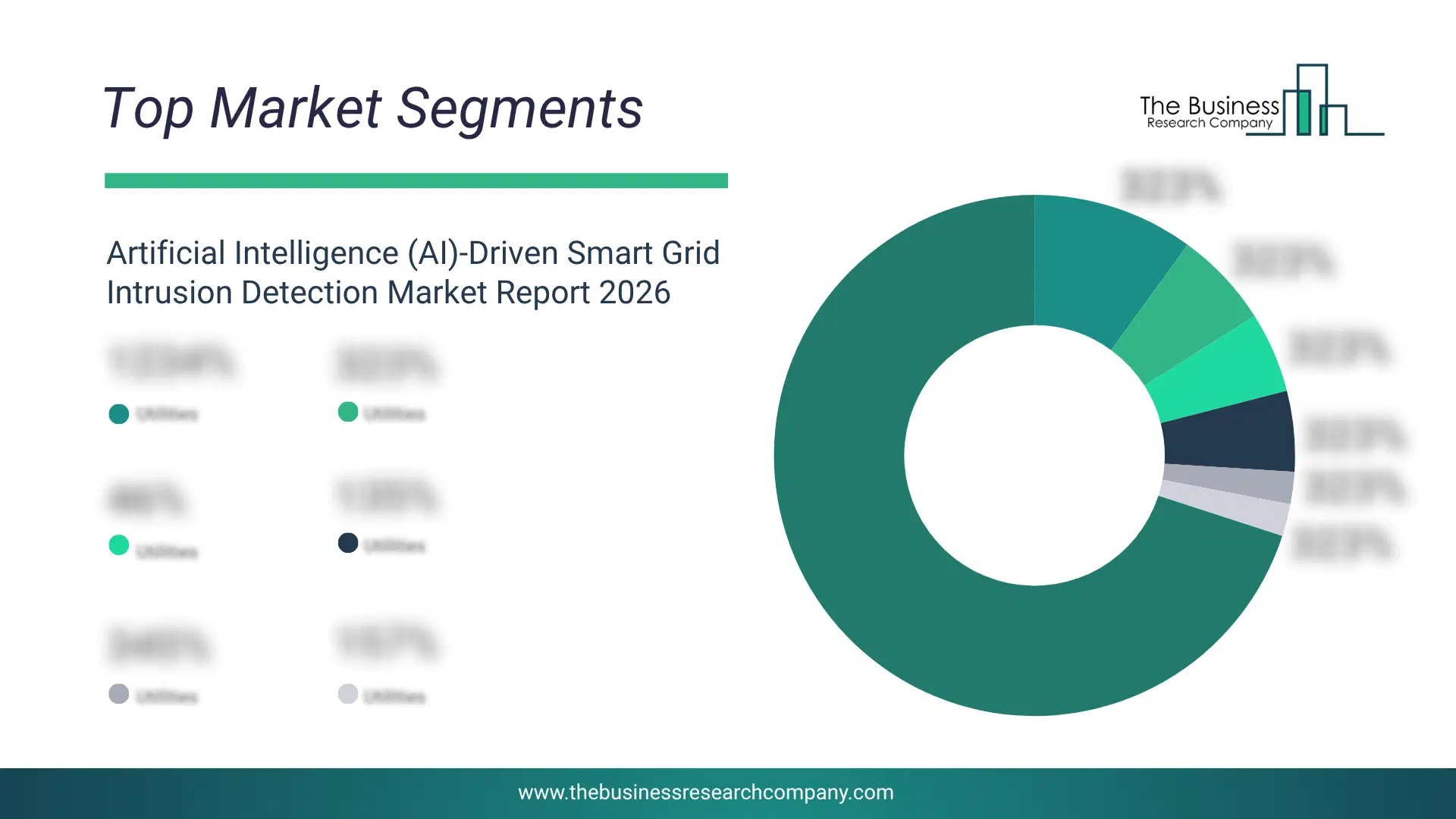
Global Artificial Intelligence (AI)-Driven Smart Grid Intrusion Detection Market Segmentation
1) By Component: Software, Hardware, Services 2) By Deployment Mode: On-Premises, Cloud 3) By Security Type: Network Security, Endpoint Security, Application Security, Other Security Types 4) By Application: Energy Management, Critical Infrastructure Protection, Fraud Detection, Other Applications 5) By End-User: Utilities, Industrial, Commercial, Residential, Other End-Users Subsegments: 1) By Software: Intrusion Detection Systems, Security Information And Event Management, Network Monitoring Tools, Data Analytics Platforms, Machine Learning Algorithms 2) By Hardware: Sensors, Servers, Network Devices, Gateways, Storage Devices 3) By Services: Consulting Services, Managed Security Services, Support And Maintenance, Training And Education, System IntegrationWhat Are The Drivers Of The Artificial Intelligence (AI)-Driven Smart Grid Intrusion Detection Market?
The rising cybersecurity threats are expected to propel the growth of the artificial intelligence (AI)-driven smart grid intrusion detection market going forward. Cybersecurity threats are malicious actions or events that aim to compromise the confidentiality, integrity, or availability of digital systems, networks, or data. The rise in cybersecurity threats is primarily due to increasing digitalization, which expands the attack surface by putting more data, systems, and services online, making them vulnerable to malicious actors. Artificial intelligence (AI)-driven smart grid intrusion detection helps mitigate cybersecurity threats by continuously monitoring the grid, detecting anomalies in real time, and preventing potential attacks before they disrupt critical infrastructure. For instance, in November 2023, according to the Australian Signals Directorate, an Australia-based government agency, during the 2022-23 financial year, nearly 94,000 cybercrime reports were submitted to report cyber, reflecting a 23% increase compared to the previous financial year, with an average of one report being received every 6 minutes. Therefore, the rising cybersecurity threats are driving the growth of the artificial intelligence (AI)-driven smart grid intrusion detection industry. The increasing number of connected devices is expected to propel the growth of the artificial intelligence (AI)-driven smart grid intrusion detection market going forward. Connected devices refer to physical objects embedded with sensors, software, and other technologies that enable them to collect and exchange data over the internet. The proliferation of connected devices is primarily driven by advancements in communication technologies to enable faster, more reliable, and seamless data exchange across networks. Artificial intelligence (AI)-driven smart grid intrusion detection helps connected devices by continuously monitoring network activity to identify and respond to potential security threats in real-time, ensuring safe and reliable operation. For instance, in July 2025, the European Commission, a Belgium-based governing body, reported that in 2023, the number of installed IoT-connected devices was around 40 billion and is projected to grow to 49 billion by 2026, representing an annual growth rate of 7%. Therefore, the increasing number of connected devices is driving the growth of the artificial intelligence (AI)-driven smart grid intrusion detection industry. The growing energy demand is expected to propel the growth of the artificial intelligence (AI)-driven smart grid intrusion detection market going forward. Energy refers to the capacity to do work or produce power, derived from resources such as electricity, fossil fuels, or renewable sources, to run homes, industries, transportation, and technology. Energy demand is increasing due to population growth because more people require electricity, heating, transportation, and industrial services, which collectively raise the overall consumption of energy. Growing energy demand increases the complexity and scale of power grids, making AI-driven smart grid intrusion detection essential for monitoring, analyzing, and protecting the network from potential threats in real time. For instance, in March 2025, according to the International Energy Agency (IEA), a France-based intergovernmental energy organization, in 2024, global energy demand increased by 2.2%, building on a decade-long average growth of about 1.3% per year, while electricity consumption grew by nearly 4.3%, marking the largest absolute increase on record. Therefore, the growing energy demand is driving the growth of the artificial intelligence (AI)-driven smart grid intrusion detection industry.Key Players In The Global Artificial Intelligence (AI)-Driven Smart Grid Intrusion Detection Market
Major companies operating in the artificial intelligence (ai)-driven smart grid intrusion detection market are Siemens AG, Hitachi Energy Ltd, IBM Corporation, Cisco Systems Inc, ABB Ltd, BAE Systems plc, Palo Alto Networks Inc, Fortinet Inc, Splunk Inc, Trend Micro Incorporated, Tenable Holdings Inc, Honeywell International Inc, Darktrace plc, Dragos Inc, Nozomi Networks Inc, Claroty Ltd, Trellix, Schneider Electric SE, Mitsubishi Electric Corporation, ReliaQuest.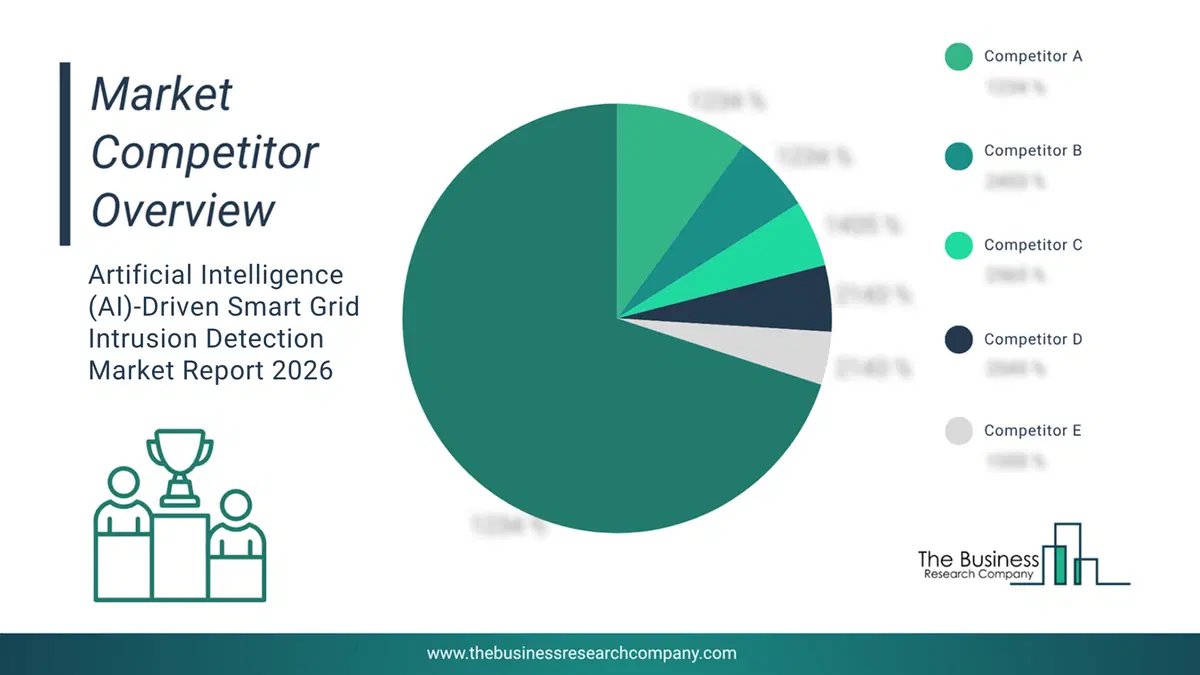
This chart is for illustrative purposes; the full report includes a detailed competitor analysis and comprehensive overview of the top 10 companies in the market.
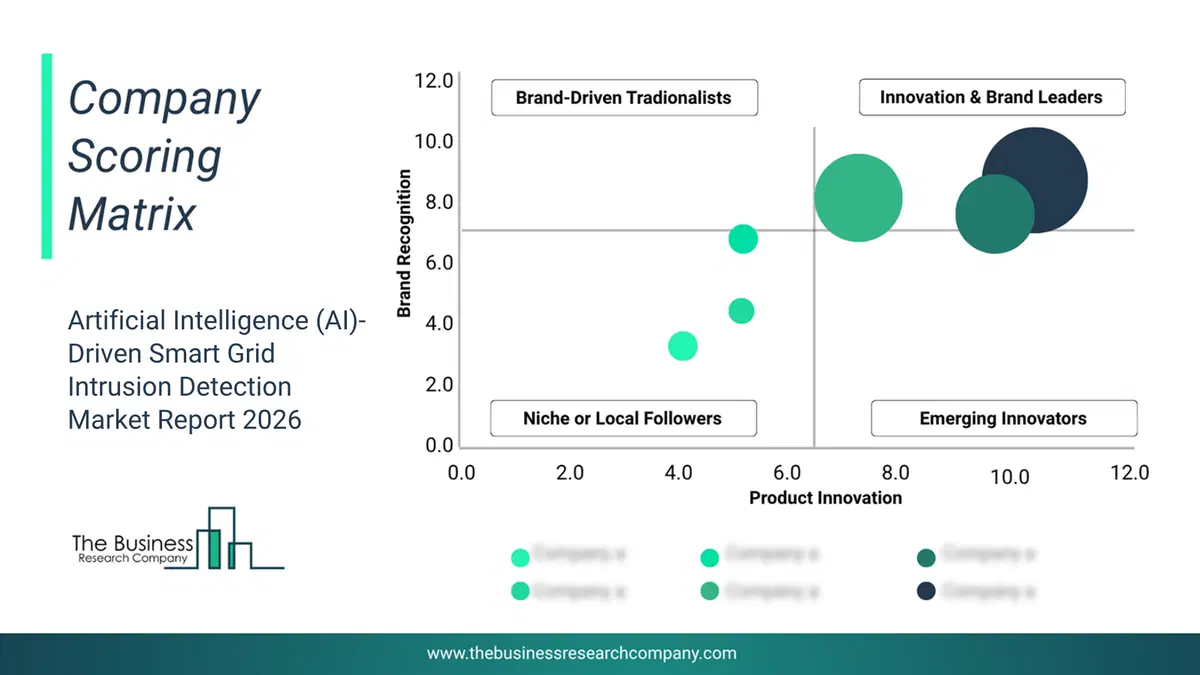
This chart maps companies by product innovation and brand strength, with bubble size indicating relative revenue, helping identify market leaders, challengers, and niche players. This is an illustrative chart; the full report provides a complete and accurate competitive analysis.
Regional Outlook
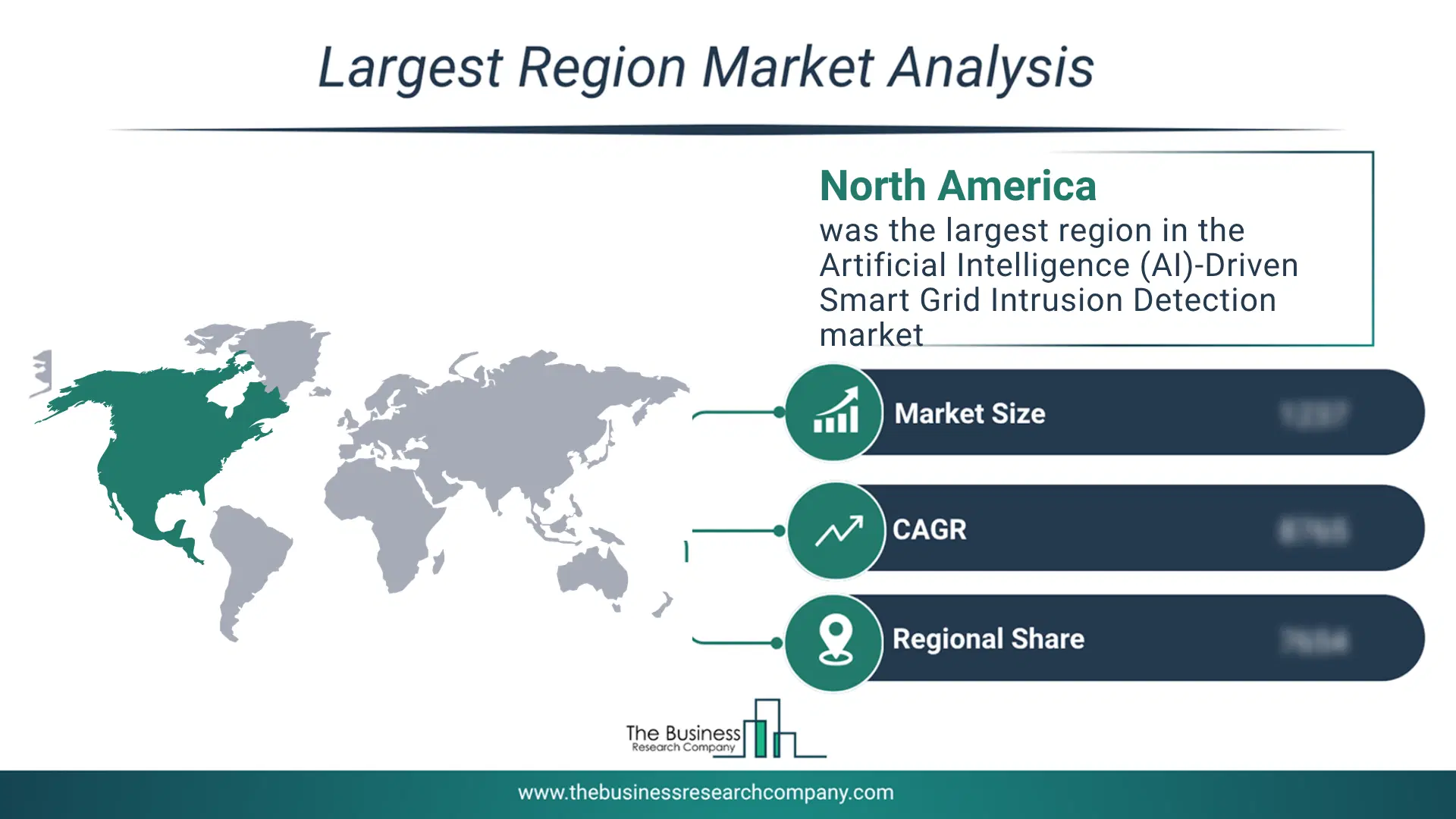
North America was the largest region in the artificial intelligence-driven smart grid intrusion detection market in 2025. Asia-Pacific is expected to be the fastest-growing region in the forecast period. The regions covered in this market report are Asia-Pacific, South East Asia, Western Europe, Eastern Europe, North America, South America, Middle East, Africa. The countries covered in this market report are Australia, Brazil, China, France, Germany, India, Indonesia, Japan, Taiwan, Russia, South Korea, UK, USA, Canada, Italy, SpainWhat Defines the Artificial Intelligence (AI)-Driven Smart Grid Intrusion Detection Market?
The artificial intelligence (AI)-driven smart grid intrusion detection market consists of revenues earned by entities by providing services such as consulting and professional services, integration services, managed security services, training and support services, and bundled end-to-end services. The market value includes the value of related goods sold by the service provider or included within the service offering. The artificial intelligence (AI)-driven smart grid intrusion detection market also includes sales of antivirus and antimalware solutions, firewall solutions, identity and access management systems, security and vulnerability management tools, and distributed denial-of-service (DDoS) protection solutions. Values in this market are ‘factory gate’ values, that is the value of goods sold by the manufacturers or creators of the goods, whether to other entities (including downstream manufacturers, wholesalers, distributors and retailers) or directly to end customers. The value of goods in this market includes related services sold by the creators of the goods.How is Market Value Defined and Measured?
The market value is defined as the revenues that enterprises gain from the sale of goods and/or services within the specified market and geography through sales, grants, or donations in terms of the currency (in USD unless otherwise specified). The revenues for a specified geography are consumption values that are revenues generated by organizations in the specified geography within the market, irrespective of where they are produced. It does not include revenues from resales along the supply chain, either further along the supply chain or as part of other products.
This chart presents market attractiveness based on a quantitative evaluation of growth, competition, strategic alignment, and risk, offering a clear view of opportunity areas for decision-making. This chart is for illustrative purposes; the full report contains the complete analysis.

This chart highlights the Total Addressable Market (TAM) by estimating the maximum revenue opportunity using an assumption-driven approach, supporting strategic planning and opportunity sizing across markets. The chart is illustrative; the full report provides a more comprehensive analysis.
What Key Data and Analysis Are Included in the Artificial Intelligence (AI)-Driven Smart Grid Intrusion Detection Market Report 2026?
The artificial intelligence (ai)-driven smart grid intrusion detection market research report is one of a series of new reports from The Business Research Company that provides market statistics, including Market Report 2026?global market size, regional shares, competitors with the market share, detailed market segments, market trends and opportunities, and any further data you may need to thrive in the artificial intelligence (ai)-driven smart grid intrusion detection Market Report 2026? The market research report delivers a complete perspective of everything you need, with an in-depth analysis of the current and future state of the Market Report 2026?Artificial Intelligence (AI)-Driven Smart Grid Intrusion Detection Market Report Forecast Analysis
| Report Attribute | Details |
|---|---|
| Market Size Value In 2026 | $2.52 billion |
| Revenue Forecast In 2030 | $5.13 billion |
| Growth Rate | CAGR of 19.4% from 2026 to 2030 |
| Base Year For Estimation | 2025 |
| Actual Estimates/Historical Data | 2020-2025 |
| Forecast Period | 2026 - 2030 - 2030 |
| Market Representation | Revenue in USD Billion and CAGR from 2026 to 2030 |
| Segments Covered | Component, Deployment Mode, Security Type, Application, End-User |
| Regional Scope | Asia-Pacific, Western Europe, Eastern Europe, North America, South America, Middle East, Africa |
| Country Scope | The countries covered in the report are Australia, Brazil, China, France, Germany, India, Indonesia, Japan, Taiwan, Russia, South Korea, UK, USA, Canada, Italy, Spain. |
| Key Companies Profiled | Siemens AG, Hitachi Energy Ltd, IBM Corporation, Cisco Systems Inc, ABB Ltd, BAE Systems plc, Palo Alto Networks Inc, Fortinet Inc, Splunk Inc, Trend Micro Incorporated, Tenable Holdings Inc, Honeywell International Inc, Darktrace plc, Dragos Inc, Nozomi Networks Inc, Claroty Ltd, Trellix, Schneider Electric SE, Mitsubishi Electric Corporation, ReliaQuest. |
| Customization Scope | Request for Customization |
| Pricing And Purchase Options | Explore Purchase Options |