
Artificial Intelligence (AI) Enabled Pharma Supply Chain Market Report 2026
Global Outlook – By Component (Software, Services, Platforms), By Deployment (Cloud Based, On Premises), By Enterprise Size (Large Enterprises, Small And Medium Enterprises), By Application (Demand Forecasting, Inventory Optimization, Procurement And Supplier Risk Management, Warehouse Automation, Route Optimization And Logistics Management, Cold Chain Monitoring, Predictive Maintenance, Real Time Supply Chain Visibility, Regulatory Compliance And Track And Trace, Other Applications), By End User (Pharmaceutical Manufacturers, Biotechnology Companies, Contract Manufacturing Organizations, Pharmaceutical Distributors, Hospital And Healthcare Supply Networks, Third Party Logistics Providers, Other End Users) – Market Size, Trends, Strategies, and Forecast to 2030
Artificial Intelligence (AI) Enabled Pharma Supply Chain Market Overview
• Artificial Intelligence (AI) Enabled Pharma Supply Chain market size has reached to $1.1 billion in 2025 • Expected to grow to $2.23 billion in 2030 at a compound annual growth rate (CAGR) of 15.1% • Growth Driver: The Growing Personalized Medicines Driving The Growth Of The Market Due To Increasing Adoption Of Genomics And Molecular Biology Enabling Precision Therapeutics • Market Trend: Artificial Intelligence-Driven Predictive Analytics Enhancing Demand Forecasting and Route Optimization in Pharmaceutical Supply Chains • North America was the largest region in 2025 and Asia-Pacific is the fastest growing region.What Is Covered Under Artificial Intelligence (AI) Enabled Pharma Supply Chain Market?
Artificial intelligence (AI) enabled pharma supply chain refers to the integration of AI technologies such as machine learning, predictive analytics, and automation into pharmaceutical supply chain operations to improve efficiency, accuracy, and responsiveness. It enables real-time decision-making across drug manufacturing, inventory management, distribution, and demand forecasting to ensure timely and cost-effective delivery of medicines. The main components of artificial intelligence (AI) enabled pharma supply chain include software, services, and platforms or artificial intelligence models. Software refers to AI-driven solutions that analyze, automate, and optimize pharmaceutical supply chain operations, improving efficiency, visibility, and decision-making. These solutions are deployed through cloud based and on premises models and are adopted by large enterprises and small and medium enterprises. The various applications involved are demand forecasting, inventory optimization, procurement and supplier risk management, warehouse automation, route optimization and logistics management, cold chain monitoring, predictive maintenance, real time supply chain visibility, regulatory compliance and track and trace, and others and they are utilized by end users including pharmaceutical manufacturers, biotechnology companies, contract manufacturing organizations, pharmaceutical distributors, hospital and healthcare supply networks, third party logistics providers, and others.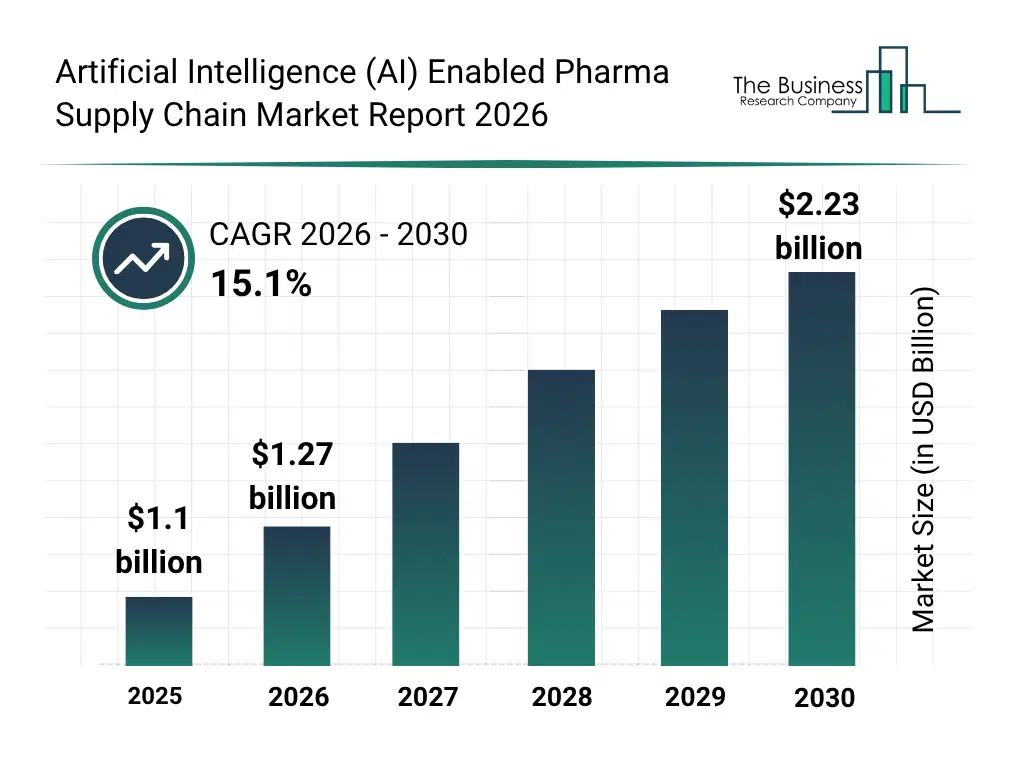
What Is The Artificial Intelligence (AI) Enabled Pharma Supply Chain Market Size and Share 2026?
The artificial intelligence (AI) enabled pharma supply chain market size has grown rapidly in recent years. It will grow from $1.1 billion in 2025 to $1.27 billion in 2026 at a compound annual growth rate (CAGR) of 15.5%. The growth in the historic period can be attributed to manual pharmaceutical supply chain operations, fragmented global drug distribution networks, limited adoption of digital tracking systems, paper-based inventory and procurement processes, reactive demand planning during healthcare crises.What Is The Artificial Intelligence (AI) Enabled Pharma Supply Chain Market Growth Forecast?
The artificial intelligence (AI) enabled pharma supply chain market size is expected to see rapid growth in the next few years. It will grow to $2.23 billion in 2030 at a compound annual growth rate (CAGR) of 15.1%. The growth in the forecast period can be attributed to rapid adoption of ai-driven predictive supply chain platforms, expansion of biologics and personalized medicine distribution, increasing regulatory compliance and traceability requirements, growth of cold chain logistics for temperature-sensitive drugs, rising integration of iot-enabled real-time tracking and monitoring systems. Major trends in the forecast period include decentralized pharmaceutical manufacturing and regional production expansion, surge in epidemic-driven demand volatility and preparedness planning, increasing complexity in biologics and temperature-sensitive drug logistics, stricter pharmaceutical quality assurance and compliance documentation requirements, growing dependence on specialized pharmaceutical third-party logistics and outsourcing networks.
Global Artificial Intelligence (AI) Enabled Pharma Supply Chain Market Segmentation
1) By Component: Software; Services; Platforms 2) By Deployment: Cloud Based; On Premises 3) By Enterprise Size: Large Enterprises; Small And Medium Enterprises 4) By Application: Demand Forecasting; Inventory Optimization; Procurement And Supplier Risk Management; Warehouse Automation; Route Optimization And Logistics Management; Cold Chain Monitoring; Predictive Maintenance; Real Time Supply Chain Visibility; Regulatory Compliance And Track And Trace; Other Applications 5) By End User: Pharmaceutical Manufacturers; Biotechnology Companies; Contract Manufacturing Organizations; Pharmaceutical Distributors; Hospital And Healthcare Supply Networks; Third Party Logistics Providers; Other End Users Subsegments: 1) By Software: Inventory Management Software; Demand Forecasting Software; Supply Chain Planning Software; Warehouse Management Software; Transportation Management Software; Predictive Analytics Software; Risk Monitoring Software; Quality Compliance Software; Procurement Management Software 2) By Services: Consulting Services; Implementation Services; Integration Services; Training And Support Services; Maintenance Services; Managed Services; Data Analytics Services; Cloud Deployment Services; Regulatory Compliance Services; System Optimization Services 3) By Platforms: Machine Learning Platforms; Predictive Analytics Platforms; Computer Vision Platforms; Natural Language Processing Platforms; Digital Twin Platforms; Decision Intelligence Platforms; Generative Artificial Intelligence Models; Prescriptive Analytics Platforms; Autonomous Supply Chain PlatformsWhat Is The Driver Of The Artificial Intelligence (AI) Enabled Pharma Supply Chain Market?
The growing personalized medicines are expected to propel the growth of the artificial intelligence (AI) enabled pharma supply chain market going forward. Personalized medicine is a healthcare approach that tailors therapeutic interventions to individual patient profiles by using genetic, biomarker, and clinical data to improve treatment precision and outcomes. Growing personalized medicines is driven by advances in genomics and molecular biology, which enable precise identification of genetic and molecular differences among patients to tailor treatments for improved effectiveness and safety. Artificial intelligence (AI)-enabled pharma supply chains enable personalized medicines by leveraging real-time data integration, predictive analytics, and precise demand–supply alignment to ensure the right therapy is manufactured, distributed, and delivered to individual patients in a timely and efficient manner. For instance, in February 2024, according to the Personalized Medicine Coalition, a US-based nonprofit organization, in 2023, the FDA approved 16 new personalized therapies for patients with rare diseases, marking a substantial rise from the six approvals recorded in 2022. Therefore, the growing personalized medicines are driving the growth of the artificial intelligence (AI) enabled pharma supply chain industry.Key Players In The Global Artificial Intelligence (AI) Enabled Pharma Supply Chain Market
Major companies operating in the artificial intelligence (AI) enabled pharma supply chain market are Microsoft Corporation; Amazon Web Services Inc.; Google LLC; IBM Corporation; Oracle Corporation; SAP SE; Infor Inc.; Coupa Software Inc.; Blue Yonder Group Inc.; Palantir Technologies Inc.; SAS Institute Inc.; Manhattan Associates Inc.; Kinaxis Inc.; o9 Solutions Inc.; The Descartes Systems Group Inc.; Flexport Inc.; Logility Inc.; C3.ai Inc.; project44 Inc.; FourKites Inc.; Aera Technology Inc.; ToolsGroup S.r.l.; Shippeo SAS; ParkourSC Inc.; FarEye Technologies Pvt. Ltd.Global Artificial Intelligence (AI) Enabled Pharma Supply Chain Market Trends and Insights
Major companies operating in the artificial intelligence (AI) enabled pharma supply chain market are focusing on developing innovative solutions, such as predictive supply chain analytics to anticipate demand fluctuations, optimize inventory levels, and enhance end-to-end visibility for improved efficiency and reduced operational risks. Predictive supply chain analytics is the use of artificial intelligence, machine learning, and historical plus real-time data to forecast future demand, disruptions, and inventory needs so companies can make proactive and more efficient supply chain decisions. For instance, in April 2024, Lonza Group AG, a Switzerland-based pharmaceutical manufacturing company, launched its AI-Enabled Route Scouting Service, an advanced digital solution designed to streamline synthetic route identification for novel APIs by combining Lonza’s global chemical supply chain intelligence with artificial intelligence capabilities from Elsevier’s Reaxys database. The service integrates vast reaction datasets, process R&D expertise, and AI-driven recommendation engines to suggest optimized synthetic routes with improved efficiency and reduced development timelines, while also supporting sustainability by minimizing wasteful reaction screening. It is primarily applied in early-stage drug development and process optimization for pharmaceutical manufacturing, helping companies reduce costs, improve scalability assessments, and accelerate time-to-market for new therapies.What Are Latest Mergers And Acquisitions In The Artificial Intelligence (AI) Enabled Pharma Supply Chain Market?
In April 2025, Aptean Inc., a US-based software company, acquired Logility for $442.75 million. With this acquisition, Aptean aims to strengthen its AI-driven supply chain planning and expand its cloud-based enterprise software portfolio by integrating Logility’s advanced demand forecasting and supply chain optimization capabilities to enhance end-to-end decision intelligence for customers. Logility Supply Chain Solutions Inc. is a US-based provider of AI-enabled supply chain planning software, offering solutions for demand forecasting, inventory optimization, sales and operations planning (S&OP), and end-to-end supply chain visibility.Regional Outlook
North America was the largest region in the artificial intelligence (AI) enabled pharma supply chain market in 2025. Asia-Pacific is expected to be the fastest-growing region in the forecast period. The regions covered in this market report are Asia-Pacific, South East Asia, Western Europe, Eastern Europe, North America, South America, Middle East, Africa. The countries covered in this market report are Australia, Brazil, China, France, Germany, India, Indonesia, Japan, Taiwan, Russia, South Korea, UK, USA, Canada, Italy, Spain.What Defines the Artificial Intelligence (AI) Enabled Pharma Supply Chain Market?
The artificial intelligence (AI) enabled pharma supply chain market includes revenues earned by entities by providing services such as artificial intelligence-based demand forecasting, predictive maintenance, supplier risk management, and real-time pharmaceutical supply chain visibility services. The market value includes the value of related goods sold by the service provider or included within the service offering. Only goods and services traded between entities or sold to end consumers are included.How is Market Value Defined and Measured?
The market value is defined as the revenues that enterprises gain from the sale of goods and/or services within the specified market and geography through sales, grants, or donations in terms of the currency (in USD unless otherwise specified). The revenues for a specified geography are consumption values that are revenues generated by organizations in the specified geography within the market, irrespective of where they are produced. It does not include revenues from resales along the supply chain, either further along the supply chain or as part of other products.What Key Data and Analysis Are Included in the Artificial Intelligence (AI) Enabled Pharma Supply Chain Market Report 2026?
The artificial intelligence (ai) enabled pharma supply chain market research report is one of a series of new reports from The Business Research Company that provides market statistics, including industry global market size, regional shares, competitors with the market share, detailed market segments, market trends and opportunities, and any further data you may need to thrive in the artificial intelligence (ai) enabled pharma supply chain industry. The market research report delivers a complete perspective of everything you need, with an in-depth analysis of the current and future state of the industry.Artificial Intelligence (AI) Enabled Pharma Supply Chain Market Report Forecast Analysis
| Report Attribute | Details |
|---|---|
| Market Size Value In 2026 | $1.27 billion |
| Revenue Forecast In 2030 | $2.23 billion |
| Growth Rate | CAGR of 15.1% from 2026 to 2030 |
| Base Year For Estimation | 2025 |
| Actual Estimates/Historical Data | 2020-2025 |
| Forecast Period | 2026 - 2030 |
| Market Representation | Revenue in USD Billion and CAGR from 2026 to 2030 |
| Segments Covered | Component, Deployment, Enterprise Size, Application, End User |
| Regional Scope | Asia-Pacific, Western Europe, Eastern Europe, North America, South America, Middle East, Africa |
| Country Scope | The countries covered in the report are Australia, Brazil, China, France, Germany, India, ... |
| Key Companies Profiled | Microsoft Corporation; Amazon Web Services Inc.; Google LLC; IBM Corporation; Oracle Corporation; SAP SE; Infor Inc.; Coupa Software Inc.; Blue Yonder Group Inc.; Palantir Technologies Inc.; SAS Institute Inc.; Manhattan Associates Inc.; Kinaxis Inc.; o9 Solutions Inc.; The Descartes Systems Group Inc.; Flexport Inc.; Logility Inc.; C3.ai Inc.; project44 Inc.; FourKites Inc.; Aera Technology Inc.; ToolsGroup S.r.l.; Shippeo SAS; ParkourSC Inc.; FarEye Technologies Pvt. Ltd. |
| Customization Scope | Request for Customization |
| Pricing And Purchase Options | Explore Purchase Options |