

Artificial Intelligence (AI) Hearing Aid Market Report 2026
Global Outlook – By Product Type (Behind The Ear (BTE), In The Ear (ITE), Receiver In The Canal (RIC), Completely In The Canal (CIC)), By Technology (Machine Learning Algorithms (MLA), Deep Neural Network (DNN), Real-Time Noise Reduction (RTNR), Speech Enhancement Algorithms), By Indication (Sensorineural Hearing Loss, Conductive Hearing Loss), By Diagnosis (Audiometry, Otoacoustic Emissions (OAE) Testing, Real-Ear Measurement (REM), Patient-Reported Outcomes (PROs)), By End User (Individuals, Hospitals And Clinics, Ear, Nose, and Throat (ENT) Specialists) – Market Size, Trends, Strategies, and Forecast to 2030
Artificial Intelligence (AI) Hearing Aid Market Overview
• Artificial Intelligence (AI) Hearing Aid market size has reached to $2.99 billion in 2025 • Expected to grow to $4.5 billion in 2030 at a compound annual growth rate (CAGR) of 8.4% • Growth Driver: Hearing Loss Propel Growth Of The Artificial Intelligence Hearing Aid Market • Market Trend: Real-Time Artificial Intelligence Enhances Hearing Aids For Clearer Speech In Noisy Environments • North America was the largest region in 2025.What Is Covered Under Artificial Intelligence (AI) Hearing Aid Market?
An artificial intelligence (AI) hearing aid refers to a sophisticated device that leverages AI algorithms to enhance hearing capabilities. It adapts to various listening environments by automatically adjusting settings, filtering background noise, and improving speech clarity. This technology aims to provide a more personalized and effective hearing experience. The main product types of artificial intelligence hearing aid are behind the ear (BTE), in the ear (ITE), receiver in the canal (RIC), and completely in the canal (CIC). Behind the ear (BTE) refers to a type of hearing aid that sits behind the outer ear and is connected to a custom earpiece or ear mold inside the ear canal. The technology includes machine learning algorithms (MLA), deep neural networks (DNN), real-time noise reduction (RTNR), and speech enhancement algorithms. These hearing aids are indicated for conditions such as sensorineural hearing loss and conductive hearing loss, with diagnosis through audiometry, otoacoustic emissions (OAE) testing, real-ear measurement (REM), and patient-reported outcomes (PROs). The end users include individuals, hospitals and clinics, and ear, nose, and throat specialists.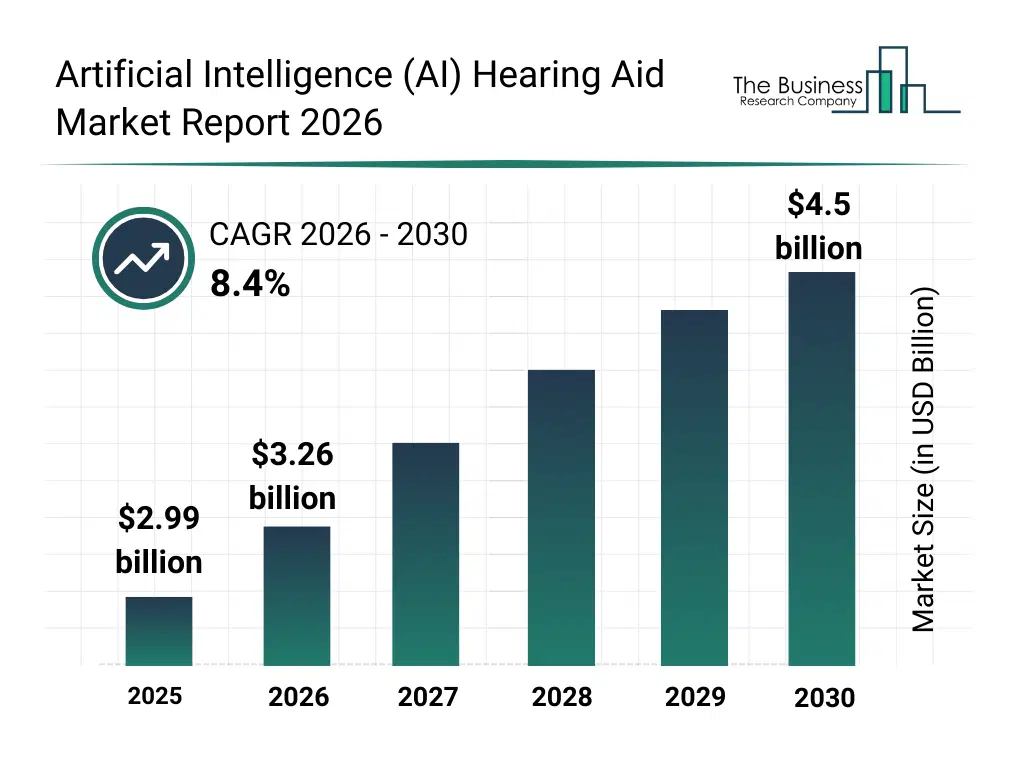
What Is The Artificial Intelligence (AI) Hearing Aid Market Size and Share 2026?
The artificial intelligence (AI) hearing aid market size has grown strongly in recent years. It will grow from $2.99 billion in 2025 to $3.26 billion in 2026 at a compound annual growth rate (CAGR) of 8.8%. The growth in the historic period can be attributed to rising prevalence of hearing loss, aging global population, technological advancements in digital hearing aids, increased awareness of hearing health, early adoption of noise reduction technologies.What Is The Artificial Intelligence (AI) Hearing Aid Market Growth Forecast?
The artificial intelligence (AI) hearing aid market size is expected to see strong growth in the next few years. It will grow to $4.5 billion in 2030 at a compound annual growth rate (CAGR) of 8.4%. The growth in the forecast period can be attributed to integration of deep learning algorithms, demand for personalized healthcare devices, expansion of tele-audiology services, growth in wearable health technology adoption, rising healthcare digitalization investments. Major trends in the forecast period include adaptive sound environment recognition, AI-based speech enhancement, personalized hearing profiles, real-time noise suppression, smart device connectivity integration.
Global Artificial Intelligence (AI) Hearing Aid Market Segmentation
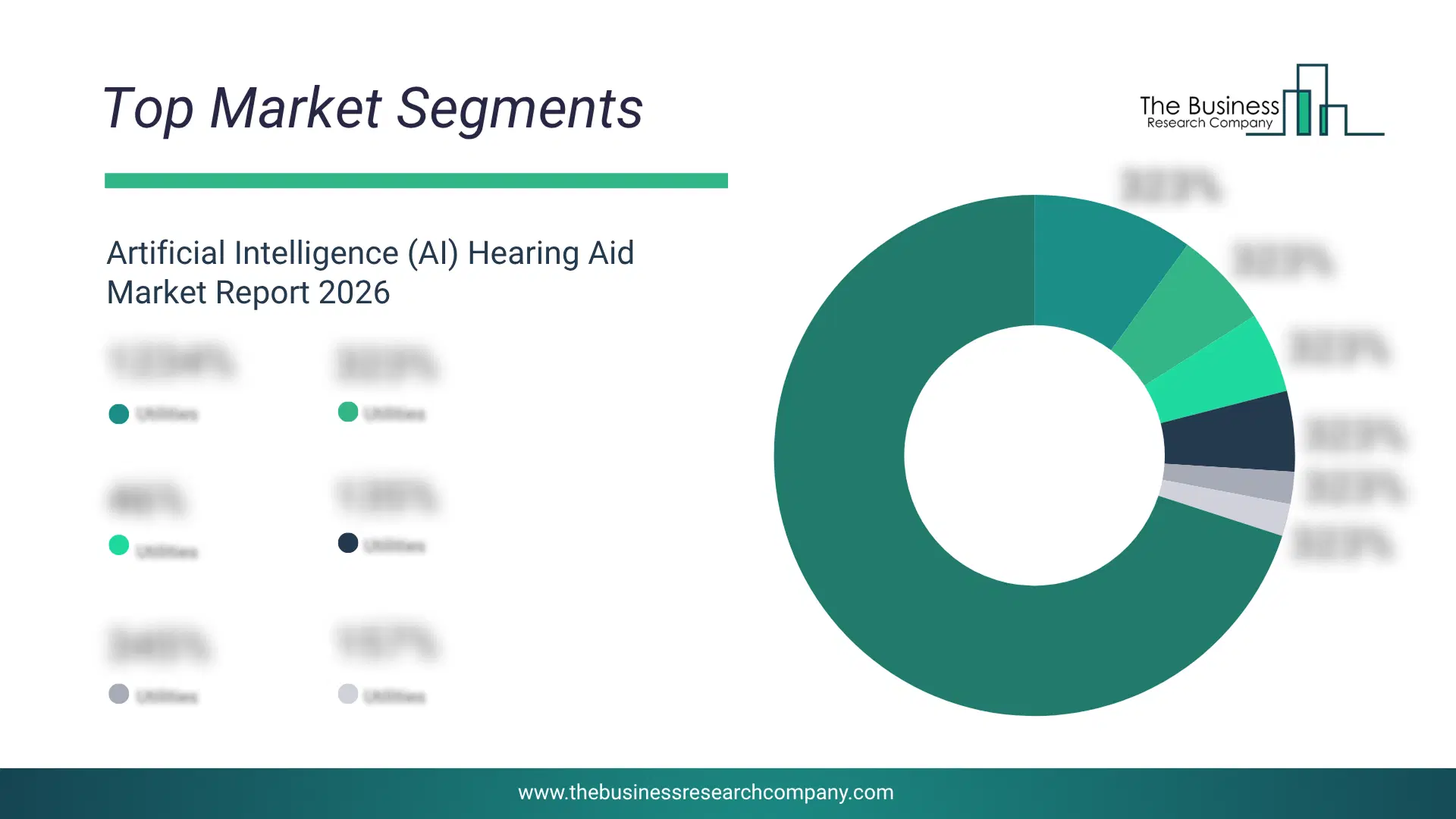
1) By Product Type: Behind The Ear (BTE), In The Ear (ITE), Receiver In The Canal (RIC), Completely In The Canal (CIC) 2) By Technology: Machine Learning Algorithms (MLA), Deep Neural Network (DNN), Real-Time Noise Reduction (RTNR), Speech Enhancement Algorithms 3) By Indication: Sensorineural Hearing Loss, Conductive Hearing Loss 4) By Diagnosis: Audiometry, Otoacoustic Emissions (OAE) Testing, Real-Ear Measurement (REM), Patient-Reported Outcomes (PROs) 5) By End User: Individuals, Hospitals And Clinics, Ear, Nose, and Throat (ENT) Specialists Subsegments: 1) By Behind The Ear (BTE): Standard BTE Hearing Aids, BTE with Slim Tube, BTE with Receiver in the Ear (RITE), BTE with Bluetooth Connectivity, BTE with Rechargeable Batteries 2) By In The Ear (ITE): Full-Shell ITE Hearing Aids, Half-Shell ITE Hearing Aids, In-the-Canal (ITC) ITE Hearing Aids, ITE with Bluetooth Connectivity, ITE with Rechargeable Batteries 3) By Receiver In The Canal (RIC): Standard RIC Hearing Aids, RIC with Rechargeable Batteries, RIC with Bluetooth Connectivity, RIC with AI-Powered Noise Reduction, RIC with Tinnitus Masking Features 4) By Completely In The Canal (CIC): Standard CIC Hearing Aids, CIC with AI-Powered Speech Enhancement, CIC with Rechargeable Batteries, Invisible CIC Hearing Aids, CIC with Bluetooth ConnectivityWhat Is The Driver Of The Artificial Intelligence (AI) Hearing Aid Market?
The prevalence of hearing loss is expected to propel the growth of the artificial intelligence hearing aid market going forward. Hearing loss refers to the partial or total inability to hear sounds, which can affect communication and quality of life. The rise of hearing loss is due to several reasons, including the aging population, noise exposure, use of ototoxic medications, and genetic factors. Artificial intelligence hearing aids enhance the management of hearing loss by automatically adapting to different sound environments, improving clarity, and reducing background noise. For instance, in February 2024, according to the World Health Organization, a Switzerland-based international public health organization, over 5% of the global population, or approximately 430 million people, need rehabilitation for disabling hearing loss, including 34 million children. By 2050, it is projected that more than 700 million people, or 1 in 10 individuals, will experience disabling hearing loss. Therefore, the prevalence of hearing loss is driving the growth of the artificial intelligence hearing aid market.Key Players In The Global Artificial Intelligence (AI) Hearing Aid Market
Major companies operating in the artificial intelligence (AI) hearing aid market are Koninklijke Philips N.V., Sonova Holding AG, Amplifon S.p.A., Starkey Laboratories Inc., Oticon, Widex A/S, MED-EL Medical Electronics, Beltone Electronics Corporation, Hear.com NV, Earlens Corporation, iHEAR Medical Inc., Signia Inc., Audibel, Tunity Inc., NuEar Hearing Instruments, Rexton Inc., Alango Technologies Ltd., Audicus Inc., Orka Labs Inc., Soundwave Hearing LLC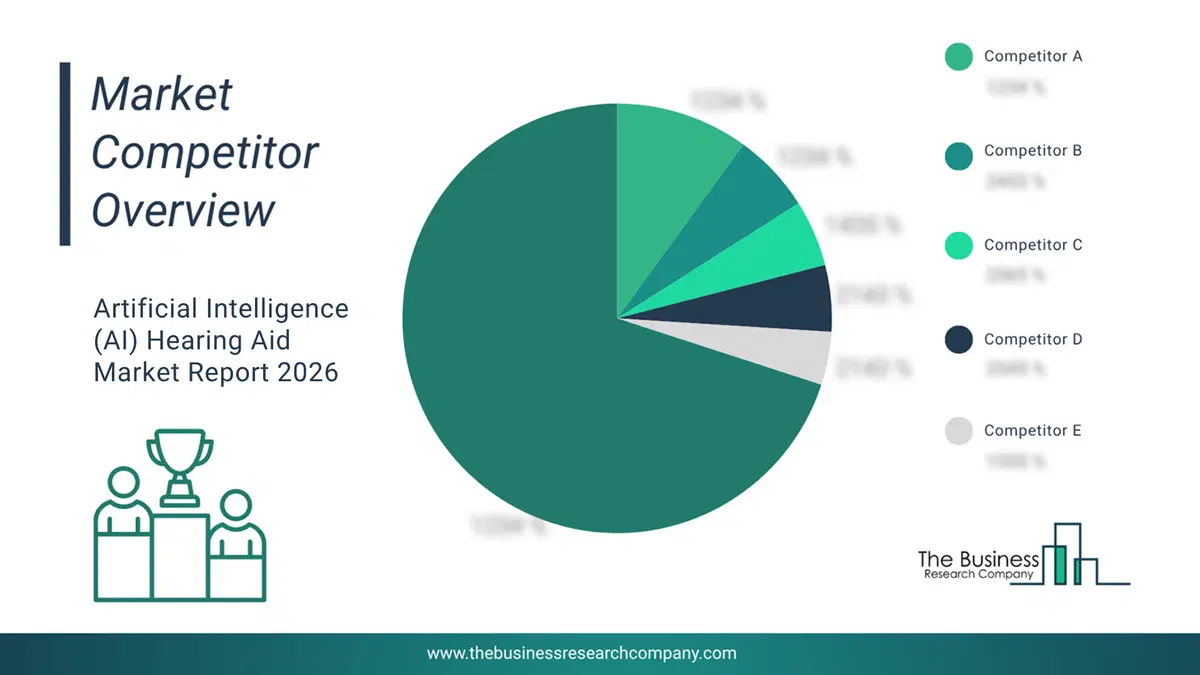
This chart is for illustrative purposes; the full report includes a detailed competitor analysis and comprehensive overview of the top 10 companies in the market.
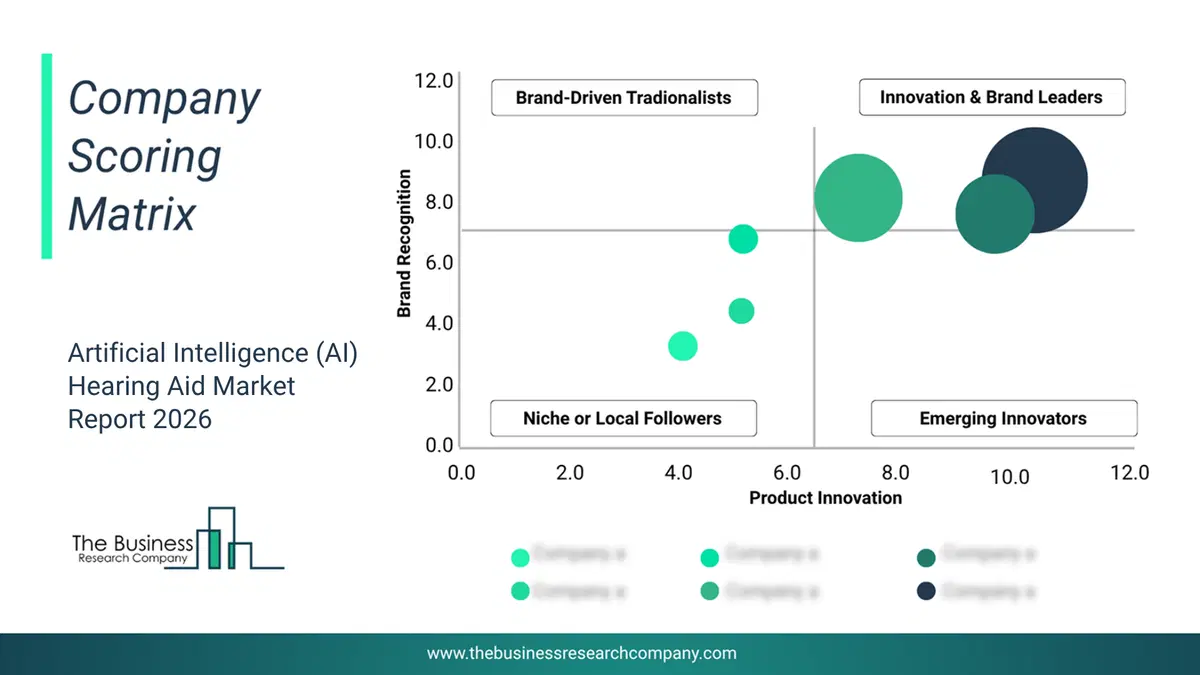
This chart maps companies by product innovation and brand strength, with bubble size indicating relative revenue, helping identify market leaders, challengers, and niche players. This is an illustrative chart; the full report provides a complete and accurate competitive analysis.
Global Artificial Intelligence (AI) Hearing Aid Market Trends and Insights
Major companies operating in the artificial intelligence hearing aid market are focusing on developing technological developments, such as real-time artificial intelligence to improve speech clarity from background noise. Real-time artificial intelligence in hearing aids involves processing sound input instantly to enhance auditory experiences. It adjusts to various environments and user needs in real time, improving speech clarity and reducing background noise. For instance, in August 2024, Sonova Holding AG, a Switzerland-based medical equipment manufacturing company, launched Sphere Infinio to address the most pressing need for people with hearing loss. It integrates real-time AI sound processing, enhancing speech intelligibility and connectivity with advanced dual-chip technology. Designed to improve hearing in noisy settings such as public transport and restaurants, the DEEPSONIC chip enables the hearing aid to effectively distinguish clear speech from background noise, greatly boosting speech comprehension in difficult acoustic environments.What Are Latest Mergers And Acquisitions In The Artificial Intelligence (AI) Hearing Aid Market?
In January 2025, EssilorLuxottica, a France-based global leader in eyewear and hearing solutions, acquired Pulse Audition for an undisclosed amount. With this acquisition, EssilorLuxottica aims to enhance its technological capabilities in hearing solutions by integrating Pulse Audition’s AI-driven noise reduction and voice enhancement algorithms, improving speech clarity in hearing devices, and strengthening its long-term product innovation. Pulse Audition is a France-based AI technology startup specializing in hearing-assist algorithms and audio signal processing.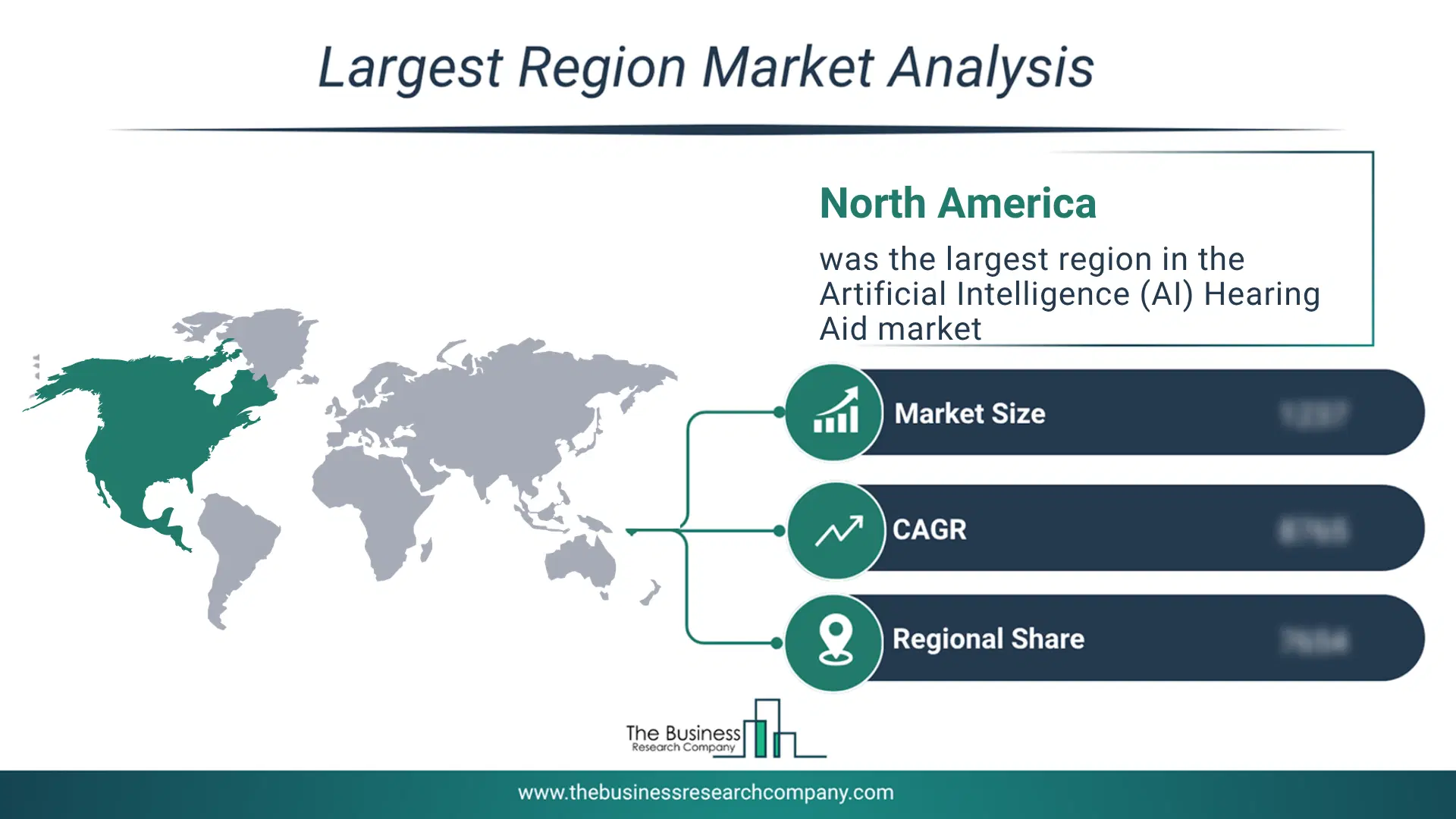
Regional Insights
North America was the largest region in the artificial intelligence hearing aid market in 2025. The regions covered in this market report are Asia-Pacific, South East Asia, Western Europe, Eastern Europe, North America, South America, Middle East, Africa. The countries covered in this market report are Australia, Brazil, China, France, Germany, India, Indonesia, Japan, Taiwan, Russia, South Korea, UK, USA, Canada, Italy, Spain.What Defines the Artificial Intelligence (AI) Hearing Aid Market?
The artificial intelligence hearing aid market consists of revenues earned by entities by providing services such as automatic sound adjustment, background noise reduction, voice recognition, environment detection, personalized hearing experience, and sound classification. The market value includes the value of related goods sold by the service provider or included within the service offering. The artificial intelligence hearing aid market also includes sales of invisible-in-canal (IIC) hearing aids, bone-anchored hearing aids (BAHA), and rechargeable hearing aids. Values in this market are ‘factory gate’ values, that is the value of goods sold by the manufacturers or creators of the goods, whether to other entities (including downstream manufacturers, wholesalers, distributors and retailers) or directly to end customers. The value of goods in this market includes related services sold by the creators of the goods.How is Market Value Defined and Measured?
The market value is defined as the revenues that enterprises gain from the sale of goods and/or services within the specified market and geography through sales, grants, or donations in terms of the currency (in USD unless otherwise specified). The revenues for a specified geography are consumption values that are revenues generated by organizations in the specified geography within the market, irrespective of where they are produced. It does not include revenues from resales along the supply chain, either further along the supply chain or as part of other products.
This chart presents market attractiveness based on a quantitative evaluation of growth, competition, strategic alignment, and risk, offering a clear view of opportunity areas for decision-making. This chart is for illustrative purposes; the full report contains the complete analysis.

This chart highlights the Total Addressable Market (TAM) by estimating the maximum revenue opportunity using an assumption-driven approach, supporting strategic planning and opportunity sizing across markets. The chart is illustrative; the full report provides a more comprehensive analysis.
What Key Data and Analysis Are Included in the Artificial Intelligence (AI) Hearing Aid Market Report 2026?
The artificial intelligence (ai) hearing aid market research report is one of a series of new reports from The Business Research Company that provides market statistics, including industry global market size, regional shares, competitors with the market share, detailed market segments, market trends and opportunities, and any further data you may need to thrive in the artificial intelligence (ai) hearing aid industry. The market research report delivers a complete perspective of everything you need, with an in-depth analysis of the current and future state of the industry.Artificial Intelligence (AI) Hearing Aid Market Report Forecast Analysis
| Report Attribute | Details |
|---|---|
| Market Size Value In 2026 | $3.26 billion |
| Revenue Forecast In 2030 | $4.5 billion |
| Growth Rate | CAGR of 8.4% from 2026 to 2030 |
| Base Year For Estimation | 2025 |
| Actual Estimates/Historical Data | 2020-2025 |
| Forecast Period | 2026 - 2030 |
| Market Representation | Revenue in USD Billion and CAGR from 2026 to 2030 |
| Segments Covered | Product Type, Technology, Indication, Diagnosis, End User |
| Regional Scope | Asia-Pacific, Western Europe, Eastern Europe, North America, South America, Middle East, Africa |
| Country Scope | The Countries Covered In This Market Report Are Australia, Brazil, China, France, Germany, India, Indonesia, Japan, Taiwan, Russia, South Korea, Uk, Usa, Canada, Italy, Spain. |
| Key Companies Profiled | Koninklijke Philips N.V., Sonova Holding AG, Amplifon S.p.A., Starkey Laboratories Inc., Oticon, Widex A/S, MED-EL Medical Electronics, Beltone Electronics Corporation, Hear.com NV, Earlens Corporation, iHEAR Medical Inc., Signia Inc., Audibel, Tunity Inc., NuEar Hearing Instruments, Rexton Inc., Alango Technologies Ltd., Audicus Inc., Orka Labs Inc., Soundwave Hearing LLC |
| Customization Scope | Request for Customization |
| Pricing And Purchase Options | Explore Purchase Options |