

Artificial Intelligence (AI) In Aviation Market Report 2026
Global Outlook – By Offering (Software, Hardware, Services), By Technology (Machine Learning, Computer Vision, Natural Language Processing, Context Awareness Computing, Predictive Analytics), By Deployment Model (On-Premise, Cloud-Based, Hybrid), By Application (Flight Operations, Smart Maintenance, Air Traffic Management, Passenger Experience And Customer Service, Manufacturing And Design, Surveillance And Security), By End User (Airlines, Airports, Original Equipment Manufacturers, Maintenance, Repair, And Overhaul Providers, Air Navigation Service Providers) – Market Size, Trends, Strategies, and Forecast to 2035
Artificial Intelligence (AI) In Aviation Market Overview
• Artificial Intelligence (AI) In Aviation market size has reached to $4.88 billion in 2025 • Expected to grow to $16.47 billion in 2030 at a compound annual growth rate (CAGR) of 27.4% • Growth Driver: Growing Air Passenger Traffic Fueling The Growth Of The Market Due To Increasing Demand For Air Travel And Fleet Utilization • Market Trend: Artificial Intelligence Innovation Accelerates On-Time Performance Improvement • North America was the largest region in 2025 and Asia-Pacific is the fastest growing region.What Is Covered Under Artificial Intelligence (AI) In Aviation Market?
Artificial intelligence (AI) in aviation refers to the application of intelligent software and data-driven technologies to improve operational performance and support informed decision-making across the aviation industry. It enables organizations to analyze large volumes of data, automate routine processes, and enhance the accuracy and speed of critical operations. The technology helps improve safety, operational efficiency, resource utilization, and cost-effectiveness while supporting more reliable and resilient aviation services. The main offerings of artificial intelligence (AI) in aviation include software, hardware, and services. Software refers to artificial intelligence-based programs and platforms that process aviation data, automate tasks, support decision-making, and improve operational efficiency. These offerings use machine learning, computer vision, natural language processing, context awareness computing, and predictive analytics, and are deployed through on-premise, cloud-based, and hybrid models. The various applications involved are flight operations, smart maintenance, air traffic management, passenger experience and customer service, manufacturing and design, and surveillance and security, and they are used by several end users such as airlines, airports, original equipment manufacturers, maintenance, repair, and overhaul providers, and air navigation service providers.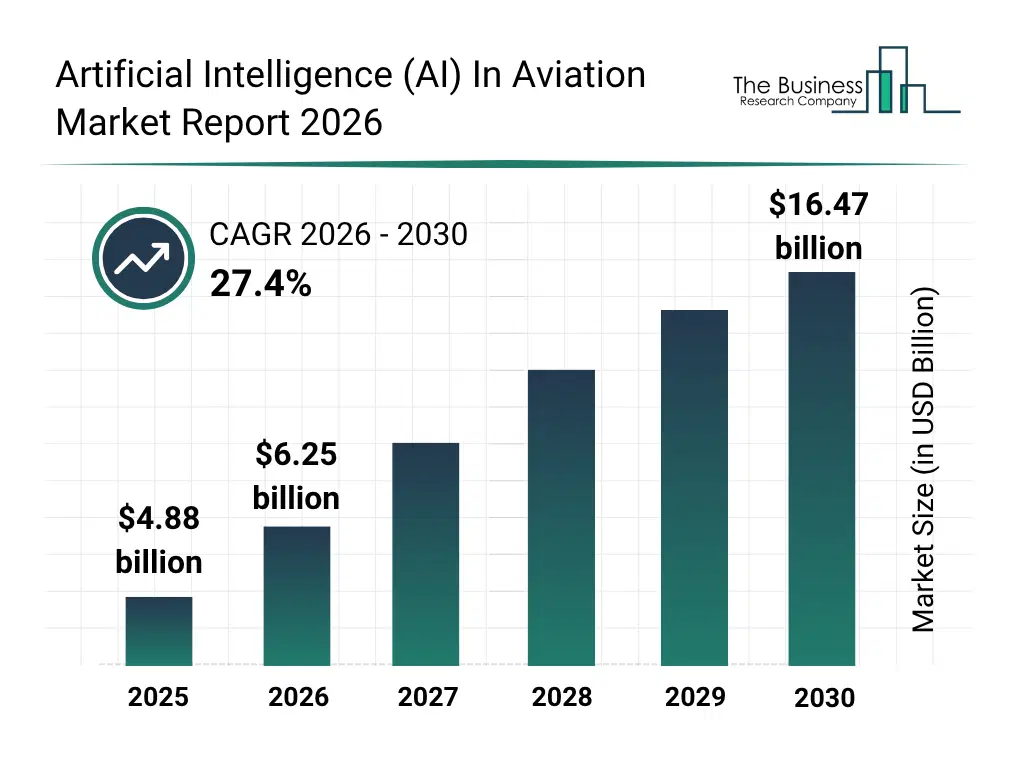
What Is The Artificial Intelligence (AI) In Aviation Market Size and Share 2026?
The artificial intelligence (AI) in aviation market size has grown exponentially in recent years. It will grow from $4.88 billion in 2025 to $6.25 billion in 2026 at a compound annual growth rate (CAGR) of 28.1%. The growth in the historic period can be attributed to increasing aviation data volumes, rising demand for improved aviation safety, growing need for operational cost reduction, increasing complexity of aviation operations, expanding adoption of automated aviation processes.What Is The Artificial Intelligence (AI) In Aviation Market Growth Forecast?
The artificial intelligence (AI) in aviation market size is expected to see exponential growth in the next few years. It will grow to $16.47 billion in 2030 at a compound annual growth rate (CAGR) of 27.4%. The growth in the forecast period can be attributed to increasing demand for AI-assisted decision making, rising requirements for predictive aviation operations, growing demand for intelligent resource optimization, increasing need for real-time operational visibility, expanding deployment of AI across aviation functions. Major trends in the forecast period include increasing adoption of AI-enabled flight data analysis, rising use of predictive decision support systems, growing automation of aviation operational workflows, increasing demand for real-time aviation intelligence, expanding use of AI-based risk and anomaly detection.Tariff Impact On Artificial Intelligence (AI) In Aviation Market
Tariffs are impacting the artificial intelligence (AI) in aviation market by increasing the cost of imported computing hardware, semiconductors, sensors, networking equipment, and other components required for AI deployments. This is raising implementation and procurement costs, particularly for hardware-intensive applications such as smart maintenance, flight operations, air traffic management, and surveillance and security in regions dependent on imported electronics. Hardware and edge AI infrastructure segments are most affected due to global semiconductor and electronics supply chain dependencies. However, tariffs are also encouraging domestic sourcing, regional supplier diversification, and increased investment in local AI computing and aviation technology ecosystems, creating greater long-term supply chain resilience.
Global Artificial Intelligence (AI) In Aviation Market Segmentation
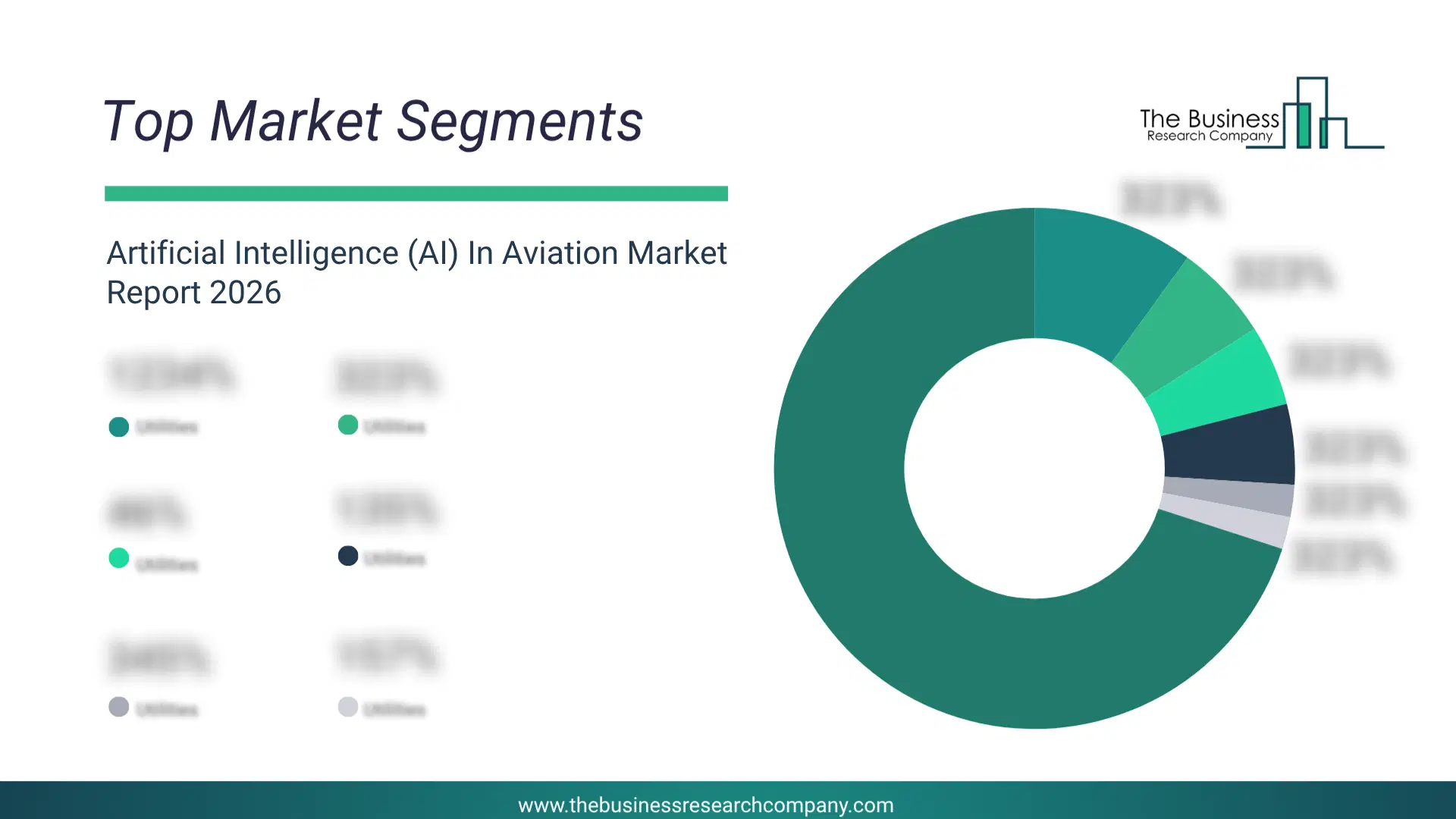
2) By Technology: Machine Learning, Computer Vision, Natural Language Processing, Context Awareness Computing, Predictive Analytics 3) By Deployment Model: On-Premise, Cloud-Based, Hybrid 4) By Application: Flight Operations, Smart Maintenance, Air Traffic Management, Passenger Experience And Customer Service, Manufacturing And Design, Surveillance And Security 5) By End User: Airlines, Airports, Original Equipment Manufacturers, Maintenance, Repair, And Overhaul Providers, Air Navigation Service Providers Subsegments: 1) By Software: Flight Operations Software, Predictive Maintenance Software, Air Traffic Management Software, Passenger Experience Software, Crew Management Software, Aviation Analytics Software, Computer Vision Software, Natural Language Processing Software 2) By Hardware: Edge Artificial Intelligence Computing Devices, Graphics Processing Units, Artificial Intelligence Servers, Smart Sensors, Vision Cameras, Flight Data Recorders, Onboard Processing Units, Networking And Communication Devices 3) By Services: Consulting Services, System Integration Services, Deployment And Implementation Services, Training And Education Services, Maintenance And Support Services, Managed Services, Data Annotation Services, Artificial Intelligence Model Development ServicesWhat Is The Driver Of The Artificial Intelligence (AI) In Aviation Market?
The increasing air passenger traffic is expected to propel the growth of the artificial intelligence (AI) in aviation market going forward. Air passenger traffic refers to the movement of travelers carried by commercial airlines on domestic and international routes. The volume of air passenger traffic is rising due to increasing disposable incomes, enabling more people to travel by air for business and leisure purposes. Increasing air passenger traffic is driving the adoption of artificial intelligence in aviation by enabling airlines and airports to optimize flight operations, improve passenger experience, enhance predictive maintenance, and manage growing operational complexity more efficiently. For instance, in August 2026, according to the International Air Transport Association (IATA), a Canada-based trade association, domestic demand increased by 0.6% compared with July 2025, while capacity grew by 0.2% year-on-year. Therefore, the increasing air passenger traffic is driving the growth of the artificial intelligence (AI) in aviation industry.Key Players In The Global Artificial Intelligence (AI) In Aviation Market
Major companies operating in the artificial intelligence (AI) in aviation market are Amazon Web Services Inc., Alphabet Inc., Microsoft Corporation, NVIDIA Corporation, RTX Corporation, The Boeing Company, Airbus SE, International Business Machines Corporation, Siemens AG, GE Aerospace, Honeywell International Inc., Intel Corporation, SAP SE, Thales SA, Safran SA, Leidos Holdings Inc., Amadeus IT Group SA, Palantir Technologies Inc., Sabre Corporation, Societe Internationale de Telecommunications Aeronautiques, Garmin Ltd.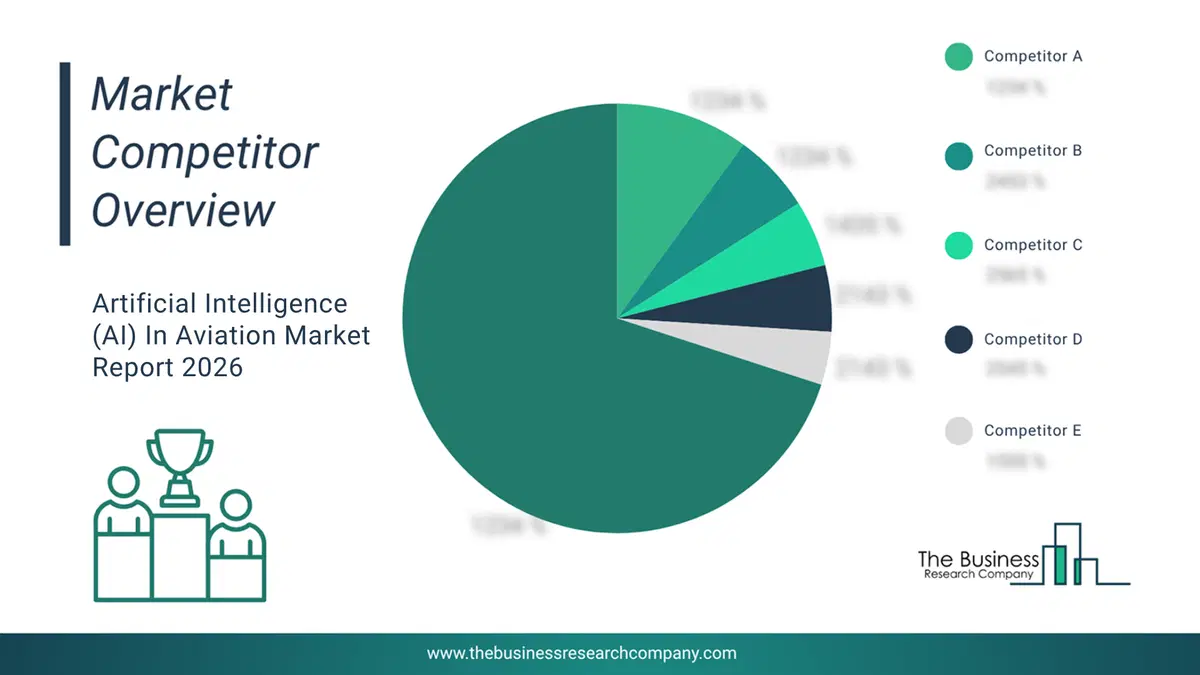
This chart is for illustrative purposes; the full report includes a detailed competitor analysis and comprehensive overview of the top 10 companies in the market.
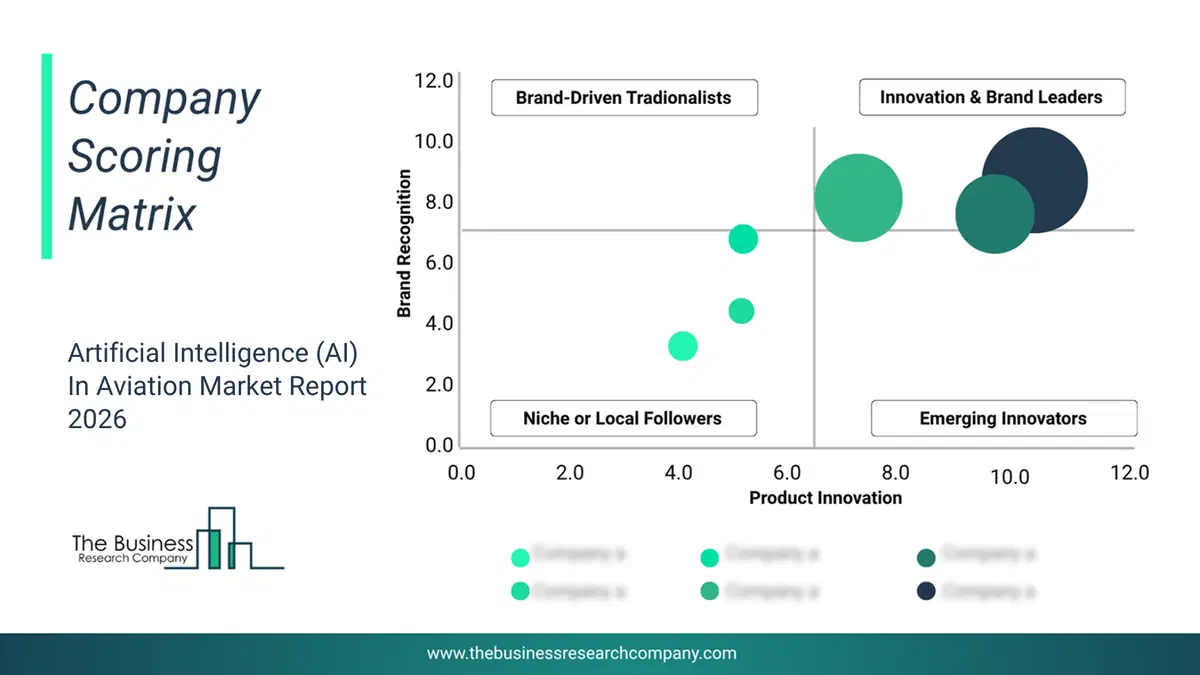
This chart maps companies by product innovation and brand strength, with bubble size indicating relative revenue, helping identify market leaders, challengers, and niche players. This is an illustrative chart; the full report provides a complete and accurate competitive analysis.
Global Artificial Intelligence (AI) In Aviation Market Trends and Insights
Major companies operating in the artificial intelligence (AI) in aviation market are focusing on developing innovative platforms, such as generative AI-powered on-time performance (OTP) analytics platforms, to enhance operational efficiency, disruption management, and data-driven decision-making for airlines and airports. Generative AI-powered on-time performance (OTP) analytics platforms are AI-driven software solutions that analyze flight schedules, delays, operational disruptions, and historical aviation data to generate predictive insights and actionable recommendations that improve flight punctuality and operational efficiency. For instance, in June 2025, Cirium, a UK-based aviation analytics company, launched OTP Improvement AI, the industry's first AI-powered solution for on-time performance analysis. The solution is built on advanced generative AI and integrates directly with Cirium Core aviation data to transform complex operational datasets into actionable insights. It enables airlines and airports to analyze delay propagation, monitor block times, evaluate operational disruptions, perform benchmark comparisons, and conduct scenario planning through natural language interactions. The platform helps users anticipate operational challenges caused by factors such as adverse weather or technical issues, streamline resource utilization, improve situational awareness, and support predictive decision-making, ultimately enhancing on-time performance and passenger experience across aviation operations.What Are Latest Mergers And Acquisitions In The Artificial Intelligence (AI) In Aviation Market?
In July 2026, Pratt & Whitney, a US-based aerospace manufacturer, acquired Aiir Innovations for an undisclosed amount. With this acquisition, Pratt and Whitney aims to strengthen its artificial intelligence-powered engine inspection capabilities by integrating AI-assisted borescope software to improve inspection accuracy, accelerate maintenance processes, enhance operational efficiency, and reduce aircraft downtime across commercial, civil, and military engine fleets. Aiir Innovations B.V. is a Netherlands-based company that provides artificial intelligence (AI)-powered aviation maintenance and engine inspection solutions.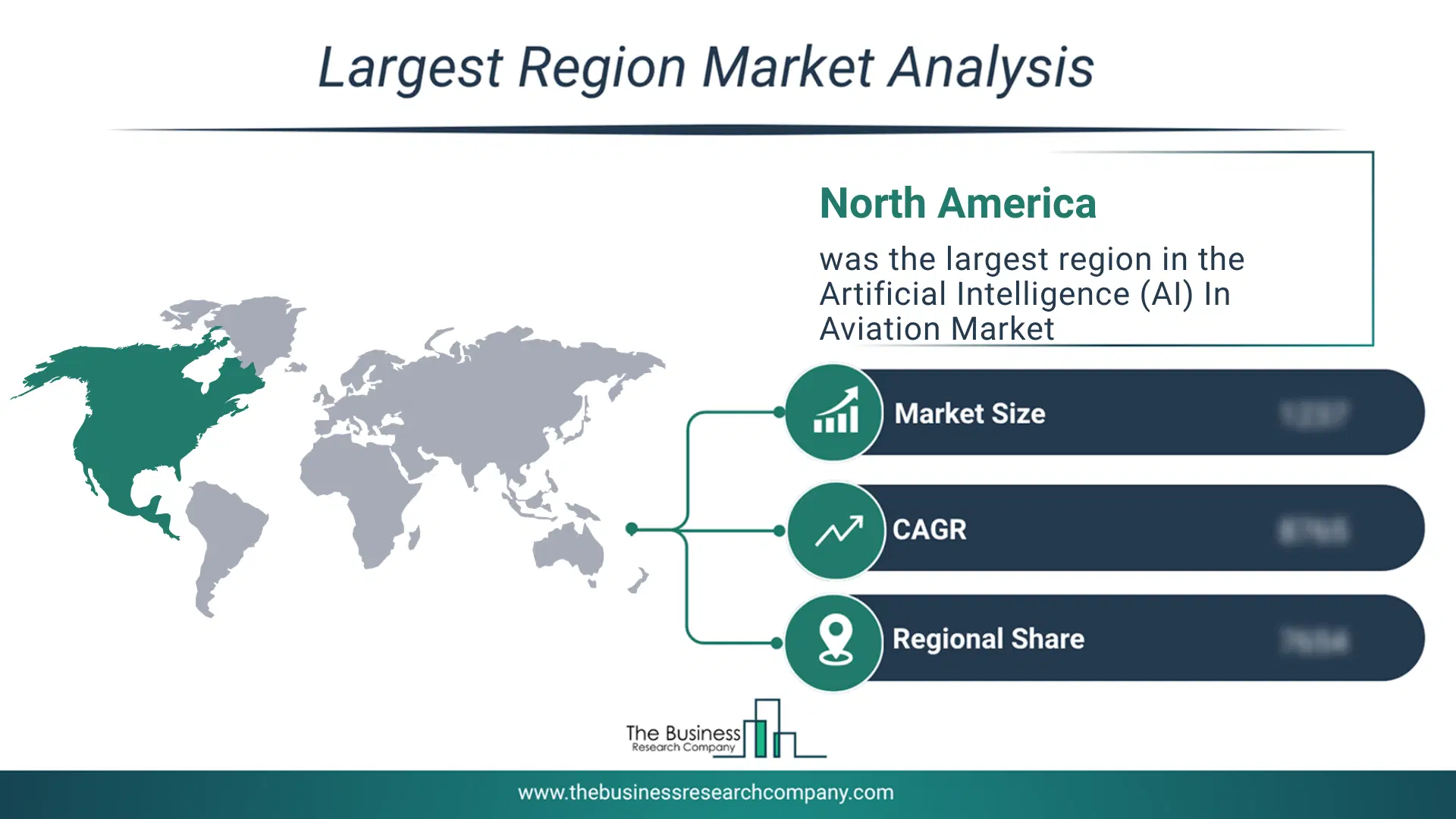
Regional Outlook/Insights
North America was the largest region in the artificial intelligence (AI) in aviation market in 2025. Asia-Pacific is expected to be the fastest-growing region in the forecast period. The regions covered in this market report are Asia-Pacific, South East Asia, Western Europe, Eastern Europe, North America, South America, Middle East, Africa. The countries covered in this market report are Australia, Brazil, China, France, Germany, India, Indonesia, Japan, Taiwan, Russia, South Korea, UK, USA, Canada, Italy, Spain.What Defines the Artificial Intelligence (AI) In Aviation Market?
The artificial intelligence (AI) in aviation market consists of revenues earned by entities by providing services such as predictive maintenance and asset performance management services, autonomous flight and navigation software development services, and aviation operations optimization and automation services. The market value includes the value of related goods sold by the service provider or included within the service offering. The artificial intelligence (AI) in aviation market also includes sales of onboard AI computing modules, AI-enabled avionics hardware, AI-powered aircraft inspection cameras, intelligent surveillance cameras, and AI-enabled navigation sensors. Values in this market are ‘factory gate’ values, that is the value of goods sold by the manufacturers or creators of the goods, whether to other entities (including downstream manufacturers, wholesalers, distributors and retailers) or directly to end customers. The value of goods in this market includes related services sold by the creators of the goods.How is Market Value Defined and Measured?
The market value is defined as the revenues that enterprises gain from the sale of goods and/or services within the specified market and geography through sales, grants, or donations in terms of the currency (in USD unless otherwise specified). The revenues for a specified geography are consumption values that are revenues generated by organizations in the specified geography within the market, irrespective of where they are produced. It does not include revenues from resales along the supply chain, either further along the supply chain or as part of other products.
This chart presents market attractiveness based on a quantitative evaluation of growth, competition, strategic alignment, and risk, offering a clear view of opportunity areas for decision-making. This chart is for illustrative purposes; the full report contains the complete analysis.

This chart highlights the Total Addressable Market (TAM) by estimating the maximum revenue opportunity using an assumption-driven approach, supporting strategic planning and opportunity sizing across markets. The chart is illustrative; the full report provides a more comprehensive analysis.
What Key Data and Analysis Are Included in the Artificial Intelligence (AI) In Aviation Market Report 2026?
The artificial intelligence (ai) in aviation market research report is one of a series of new reports from The Business Research Company that provides market statistics, including industry global market size, regional shares, competitors with the market share, detailed market segments, market trends and opportunities, and any further data you may need to thrive in the artificial intelligence (ai) in aviation industry. The market research report delivers a complete perspective of everything you need, with an in-depth analysis of the current and future state of the industry.Artificial Intelligence (AI) In Aviation Market Report Forecast Analysis
| Report Attribute | Details |
|---|---|
| Market Size Value In 2026 | $6.25 billion |
| Revenue Forecast In 2030 | $16.47 billion |
| Growth Rate | CAGR of 27.4% from 2026 to 2035 |
| Base Year For Estimation | 2025 |
| Actual Estimates/Historical Data | 2020-2025 |
| Forecast Period | 2026 - 2030 |
| Market Representation | Revenue in USD Billion and CAGR from 2026 to 2030 |
| Segments Covered | Offering, Technology, Deployment Model, Application, End User |
| Regional Scope | Asia-Pacific, Western Europe, Eastern Europe, North America, South America, Middle East, Africa |
| Country Scope | The countries covered in the report are Australia, Brazil, China, France, Germany, India, Indonesia, Japan, Taiwan, Russia, South Korea, UK, USA, Canada, Italy, Spain. |
| Customization Scope | Request for Customization |
| Pricing And Purchase Options | Explore Purchase Options |