

Artificial Intelligence (AI) In Digital Ethics Market Report 2026
Global Outlook – By Component (Software, Hardware, Services), By Deployment Mode (On-Premises, Cloud), By Organization Size (Large Enterprises, Small And Medium Enterprises (SMEs)), By Application (Data Privacy, Bias Detection and Mitigation, Transparency and Explainability, Compliance Management, Risk Assessment, Other Applications), By End-Users (Banking, Financial Services, and Insurance (BFSI), Healthcare, Government, Information and Technology and Telecommunications, Education, Other End-Users) – Market Size, Trends, Strategies, and Forecast to 2030
Artificial Intelligence (AI) In Digital Ethics Market Overview
• Artificial Intelligence (AI) In Digital Ethics market size has reached to $3.26 billion in 2025 • Expected to grow to $11.07 billion in 2030 at a compound annual growth rate (CAGR) of 27.8% • Growth Driver: Surge In Rising Public Concern Over Data Privacy And Misuse Fueling The Growth Of The Market Due To Increasing Citizen Skepticism And Demand For Responsible AI • Market Trend: Holistic AI Launched Open-Source Library To Advance Responsible AI • North America was the largest region in 2025 and Asia-Pacific is the fastest growing region.What Is Covered Under Artificial Intelligence (AI) In Digital Ethics Market?
Artificial intelligence (AI) in digital ethics refers to the application of ethical principles and governance practices to ensure that artificial intelligence systems are developed and used responsibly. It emphasizes fairness, transparency, accountability, privacy protection, and the mitigation of bias in AI-driven processes and decisions. It helps align artificial intelligence technologies with societal values, regulatory expectations, and trust in digital ecosystems. The main components of artificial intelligence (AI) in digital ethics include software, hardware, and services. Software refers to solutions that help organizations implement ethical AI practices by monitoring algorithms, detecting bias, ensuring transparency, and maintaining compliance with regulations and internal policies. These solutions can be deployed through on-premises or cloud modes and are used by organizations of different sizes, including large enterprises and small and medium enterprises. The various applications involved are data privacy, bias detection and mitigation, transparency and explainability, compliance management, risk assessment, and other applications. The multiple end users include banking, financial services, and insurance, healthcare, government, information technology and telecommunications, education, and other end users.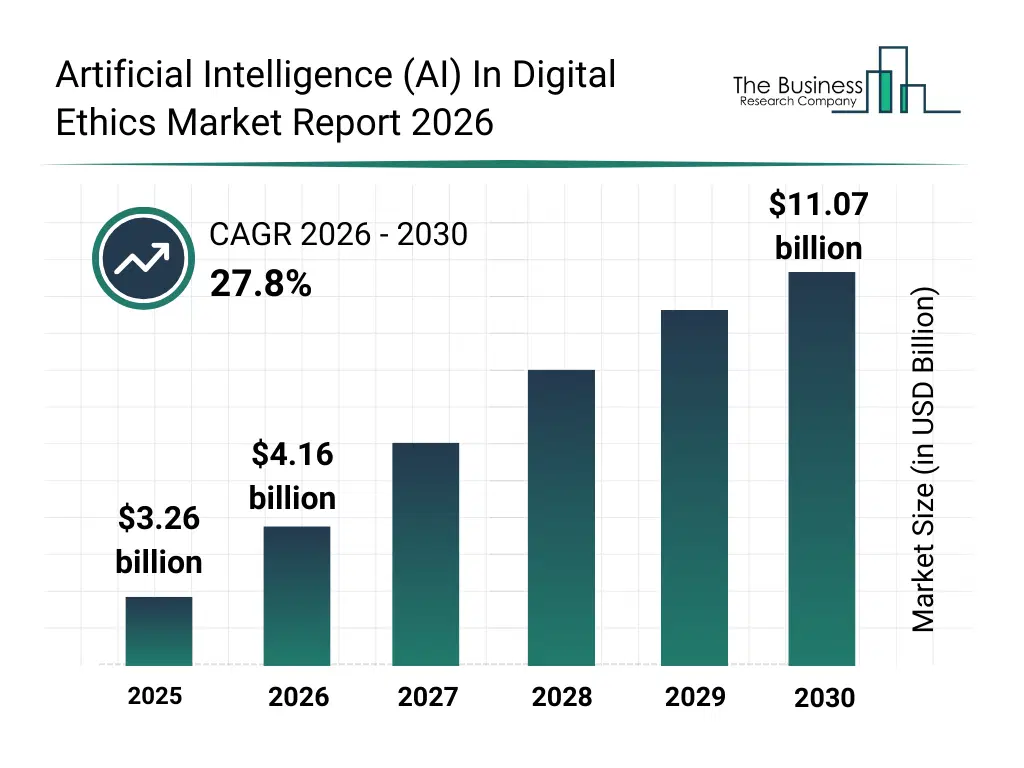
What Is The Artificial Intelligence (AI) In Digital Ethics Market Size and Share 2026?
The artificial intelligence (AI) in digital ethics market size has grown exponentially in recent years. It will grow from $3.26 billion in 2025 to $4.16 billion in 2026 at a compound annual growth rate (CAGR) of 27.5%. The growth in the historic period can be attributed to increasing use of AI in decision-making systems, rising public scrutiny of automated decisions, early adoption of AI ethics guidelines, growth of data-driven business models, initial regulatory actions on AI fairness.What Is The Artificial Intelligence (AI) In Digital Ethics Market Growth Forecast?
The artificial intelligence (AI) in digital ethics market size is expected to see exponential growth in the next few years. It will grow to $11.07 billion in 2030 at a compound annual growth rate (CAGR) of 27.8%. The growth in the forecast period can be attributed to expansion of global AI ethics regulations, increasing enterprise investments in trustworthy ai, rising demand for explainability in regulated industries, growth of cross-border digital compliance requirements, increasing integration of ethics-by-design in AI development. Major trends in the forecast period include increasing adoption of ethical AI assessment services, rising demand for Explainable AI solutions, growing deployment of bias audit and fairness tools, expansion of AI transparency and accountability frameworks, enhanced focus on data privacy and consent management.

Global Artificial Intelligence (AI) In Digital Ethics Market Segmentation
1) By Component: Software; Hardware; Services 2) By Deployment Mode: On-Premises; Cloud 3) By Organization Size: Large Enterprises; Small And Medium Enterprises (SMEs) 4) By Application: Data Privacy; Bias Detection and Mitigation; Transparency and Explainability; Compliance Management; Risk Assessment; Other Applications 5) By End-Users: Banking, Financial Services, and Insurance (BFSI); Healthcare; Government; Information and Technology and Telecommunications; Education; Other End-Users Subsegments: 1) By Software: Ethical Artificial Intelligence Governance Platforms; Bias Detection And Mitigation Software; Transparency And Explainability Tools; Artificial Intelligence Compliance And Risk Management Software; Data Privacy And Protection Software 2) By Hardware: Ethical Artificial Intelligence Accelerators; Secure Artificial Intelligence Processing Units; Privacy Preserving Edge Devices; Trusted Execution Environment Hardware; Artificial Intelligence Audit And Monitoring Hardware 3) By Services: Ethical Artificial Intelligence Consulting Services; Artificial Intelligence Governance Implementation Services; Risk And Compliance Advisory Services; Bias Audit And Fairness Assessment Services; Training And Awareness ServicesWhat Is The Driver Of The Artificial Intelligence (AI) In Digital Ethics Market?
The rising public concern over data privacy and misuse is expected to propel the growth of artificial intelligence (AI) in the digital ethics market going forward. Data privacy means safeguarding individuals’ personal information from unauthorized access, use, or sharing to uphold confidentiality and control over personal data. Concern over data privacy and misuse is increasing due to the rapid expansion of data-intensive digital services that collect, share, and process large volumes of personal and sensitive information across interconnected platforms. AI in digital ethics solutions helps address this concern by embedding privacy-preserving frameworks, enabling organizations to align AI systems with ethical data usage expectations. For instance, in September 2025, according to the MediaPost Communications, a US-based publisher and conference organizer, generative AI has heightened consumer concern about data protection, with 82% of users fearing potential misuse, up from 74% in 2024, underscoring rising demands for trust and transparency. Therefore, a rising public concern over data privacy and misuse is expected to drive the growth of AI in the digital ethics market.Key Players In The Global Artificial Intelligence (AI) In Digital Ethics Market
Major companies operating in the artificial intelligence (AI) in digital ethics market are Amazon Web Services Inc., Meta Platforms Inc., Deloitte Touche Tohmatsu Limited, Accenture plc, International Business Machines Corporation, Intel Corporation, Ernst & Young Global Limited, Oracle Corporation, SAP SE, Salesforce Inc., Tata Consultancy Services Limited, NVIDIA Corporation, Capgemini SE, Infosys Limited, McKinsey & Company Inc., Anthropic PBC, OneTrust LLC, Credo AI Inc., Fiddler AI Inc., Arthur AI Inc., Algorithmic Justice League Inc., Xapien Ltd, Holistic AI Ltd, Cyabra Ltd, EthicaLogic Inc.
This chart is for illustrative purposes; the full report includes a detailed competitor analysis and comprehensive overview of the top 10 companies in the market.
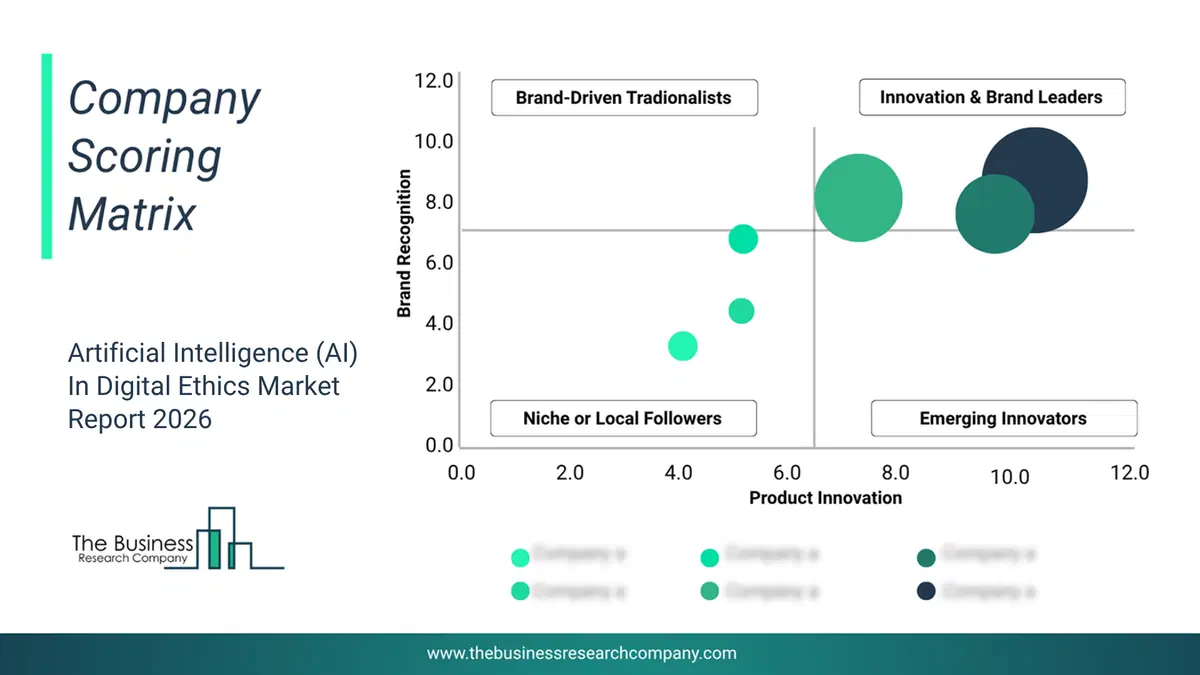
This chart maps companies by product innovation and brand strength, with bubble size indicating relative revenue, helping identify market leaders, challengers, and niche players. This is an illustrative chart; the full report provides a complete and accurate competitive analysis.
Global Artificial Intelligence (AI) In Digital Ethics Market Trends and Insights
Major companies operating in the artificial intelligence (AI) in digital ethics market are focusing on innovations in automated bias detection and mitigation tools, such as open‑source responsible AI libraries, to gain a competitive advantage. Open‑source responsible AI libraries provide standardized functions for bias mitigation, explainability, robustness, security, and efficacy so developers can build and evaluate models that align with ethical principles while supporting transparent decision processes. For instance, in October 2024, Holistic AI, a US-based AI software company, launched Holistic AI OSL, an open-source library designed to help organizations implement responsible AI practices through bias assessment, risk evaluation, and governance-aligned model documentation. It is an optimized open-source library built to help developers create fair, transparent, and responsible AI systems. It provides strong capabilities for bias mitigation, including 35+ bias metrics across multiple machine learning tasks and around 30 mitigation strategies. The library also improves explainability by showing how models make decisions, supporting transparency and trust. In addition, it strengthens robustness so models perform reliably under changing conditions and potential attacks. Holistic AI OSL includes security tools such as anonymization and defenses against privacy risks like attribute inference attacks.What Are Latest Mergers And Acquisitions In The Artificial Intelligence (AI) In Digital Ethics Market?
In May 2025, Diligent Corporation, a US-based provider of AI-driven governance, risk, and compliance (GRC) software, acquired Vault for an undisclosed amount. With this acquisition, Diligent aimed to enhance its AI-powered ethics and compliance offerings by integrating Vault’s advanced AI-enabled ethical risk intelligence and secure speak-up solutions into its GRC platform, thereby expanding its capabilities in detecting and mitigating misconduct and fostering ethical organizational cultures. Vault is a UK-based provider of artificial intelligence (AI) in digital ethics solutions that applies AI to ethics, compliance, and misconduct risk management.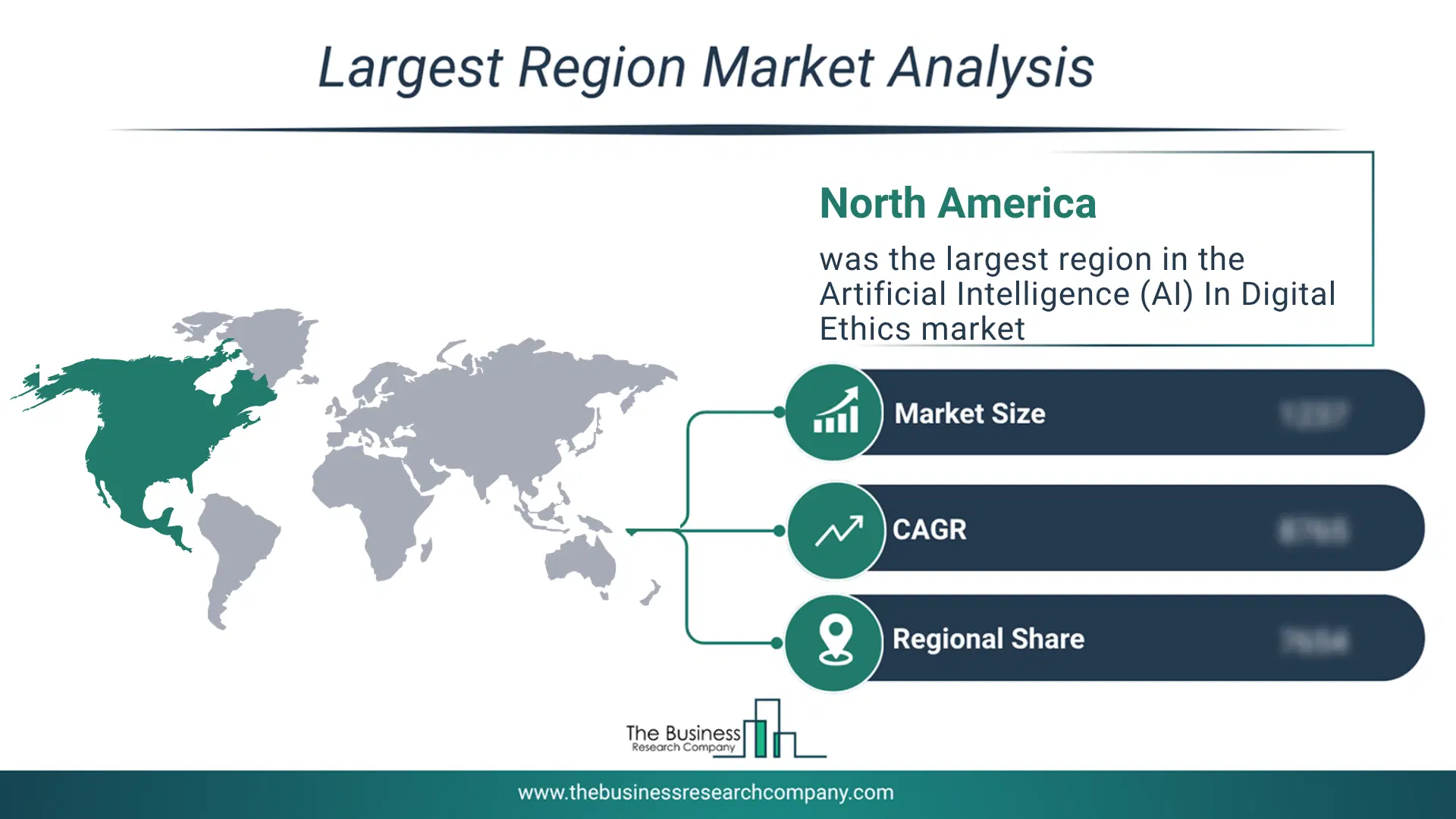
Regional Insights
North America was the largest region in the artificial intelligence (AI) in digital ethics market in 2025. Asia-Pacific is expected to be the fastest-growing region in the forecast period. The regions covered in this market report are Asia-Pacific, South East Asia, Western Europe, Eastern Europe, North America, South America, Middle East, Africa. The countries covered in this market report are Australia, Brazil, China, France, Germany, India, Indonesia, Japan, Taiwan, Russia, South Korea, UK, USA, Canada, Italy, Spain.What Defines the Artificial Intelligence (AI) In Digital Ethics Market?
The artificial intelligence (AI) in digital ethics market consists of revenues earned by entities by providing services such as ethical risk assessment and impact analysis services, algorithm audit and validation services, bias detection and mitigation services, explainability and transparency advisory services, and regulatory compliance and governance services. The market value includes the value of related goods sold by the service provider or included within the service offering. The artificial intelligence (AI) in digital ethics market includes sales of algorithmic bias detection and mitigation tools, explainable AI (XAI) products, fairness and transparency assessment platforms, ethical risk assessment tools, compliance and audit software, and data privacy and consent management products. Values in this market are ‘factory gate’ values, that is, the value of goods sold by the manufacturers or creators of the goods, whether to other entities (including downstream manufacturers, wholesalers, distributors, and retailers) or directly to end customers. The value of goods in this market includes related services sold by the creators of the goods.How is Market Value Defined and Measured?
The market value is defined as the revenues that enterprises gain from the sale of goods and/or services within the specified market and geography through sales, grants, or donations in terms of the currency (in USD unless otherwise specified). The revenues for a specified geography are consumption values that are revenues generated by organizations in the specified geography within the market, irrespective of where they are produced. It does not include revenues from resales along the supply chain, either further along the supply chain or as part of other products.
This chart presents market attractiveness based on a quantitative evaluation of growth, competition, strategic alignment, and risk, offering a clear view of opportunity areas for decision-making. This chart is for illustrative purposes; the full report contains the complete analysis.

This chart highlights the Total Addressable Market (TAM) by estimating the maximum revenue opportunity using an assumption-driven approach, supporting strategic planning and opportunity sizing across markets. The chart is illustrative; the full report provides a more comprehensive analysis.
What Key Data and Analysis Are Included in the Artificial Intelligence (AI) In Digital Ethics Market Report 2026?
The artificial intelligence (ai) in digital ethics market research report is one of a series of new reports from The Business Research Company that provides market statistics, including industry global market size, regional shares, competitors with the market share, detailed market segments, market trends and opportunities, and any further data you may need to thrive in the artificial intelligence (ai) in digital ethics industry. The market research report delivers a complete perspective of everything you need, with an in-depth analysis of the current and future state of the industry.Artificial Intelligence (AI) In Digital Ethics Market Report Forecast Analysis
| Report Attribute | Details |
|---|---|
| Market Size Value In 2026 | $4.16 billion |
| Revenue Forecast In 2030 | $11.07 billion |
| Growth Rate | CAGR of 27.8% from 2026 to 2030 |
| Base Year For Estimation | 2025 |
| Actual Estimates/Historical Data | 2020-2025 |
| Forecast Period | 2026 - 2030 |
| Market Representation | Revenue in USD Billion and CAGR from 2026 to 2030 |
| Segments Covered | Component, Deployment Mode, Organization Size, Application, End-Users |
| Regional Scope | Asia-Pacific, Western Europe, Eastern Europe, North America, South America, Middle East, Africa |
| Country Scope | The Countries Covered In This Market Report Are Australia, Brazil, China, France, Germany, India, Indonesia, Japan, Taiwan, Russia, South Korea, Uk, Usa, Canada, Italy, Spain. |
| Key Companies Profiled | Amazon Web Services Inc., Meta Platforms Inc., Deloitte Touche Tohmatsu Limited, Accenture plc, International Business Machines Corporation, Intel Corporation, Ernst & Young Global Limited, Oracle Corporation, SAP SE, Salesforce Inc., Tata Consultancy Services Limited, NVIDIA Corporation, Capgemini SE, Infosys Limited, McKinsey & Company Inc., Anthropic PBC, OneTrust LLC, Credo AI Inc., Fiddler AI Inc., Arthur AI Inc., Algorithmic Justice League Inc., Xapien Ltd, Holistic AI Ltd, Cyabra Ltd, EthicaLogic Inc. |
| Customization Scope | Request for Customization |
| Pricing And Purchase Options | Explore Purchase Options |