
Artificial Intelligence (AI) In Digital Transformation Market Report 2026
Global Outlook – By Component (Solution, Services), By Technology (Machine Learning (ML), Natural Language Processing (NLP), Computer Vision, Other Technologies), By Deployment Mode (Cloud-Based, On-Premise), By Industry Vertical (Banking Financial Services And Insurance (BFSI), Information Technology (IT) And Telecommunications, Government And Public Sector, Healthcare, Manufacturing, Retail, Other End-Use Industries) – Market Size, Trends, Strategies, and Forecast to 2030
Artificial Intelligence (AI) In Digital Transformation Market Overview
• Artificial Intelligence (AI) In Digital Transformation market size has reached to $424.75 billion in 2025 • Expected to grow to $1677.29 billion in 2030 at a compound annual growth rate (CAGR) of 31.5% • Growth Driver: Impact Of Growing Cloud Services Adoption On The AI In Digital Transformation Market • Market Trend: AI-Powered DevSecOps Platforms Revolutionizing Digital Transformation • North America was the largest region in 2025.Market Gains By 2030 – Top Opportunities By Segment
Market Gain identifies the most promising market opportunities by highlighting the segments or products expected to generate the highest incremental revenue growth over the next five years.
What Is Covered Under Artificial Intelligence (AI) In Digital Transformation Market?
Artificial intelligence (AI) in digital transformation refers to the integration of AI technologies into business processes to enhance efficiency, innovation, and customer experience. AI enables automation of repetitive tasks, data-driven decision-making, and personalized customer interactions. It also optimizes operations, improves cybersecurity, and accelerates product development, driving overall business growth and competitiveness. The main components in the artificial intelligence (AI) in digital transformation market are solution and services. Solutions in AI digital transformation are pre-packaged or custom-designed software and tools that help organizations integrate AI into their processes. It encompasses various technologies such as machine learning (ML), natural language processing (NLP), computer vision, and others, with deployment modes including cloud-based and on-premise. This market serves multiple industry verticals, including banking, financial services, and insurance (BFSI), information technology (IT) and telecommunications, government and public sector, healthcare, manufacturing, retail, and others.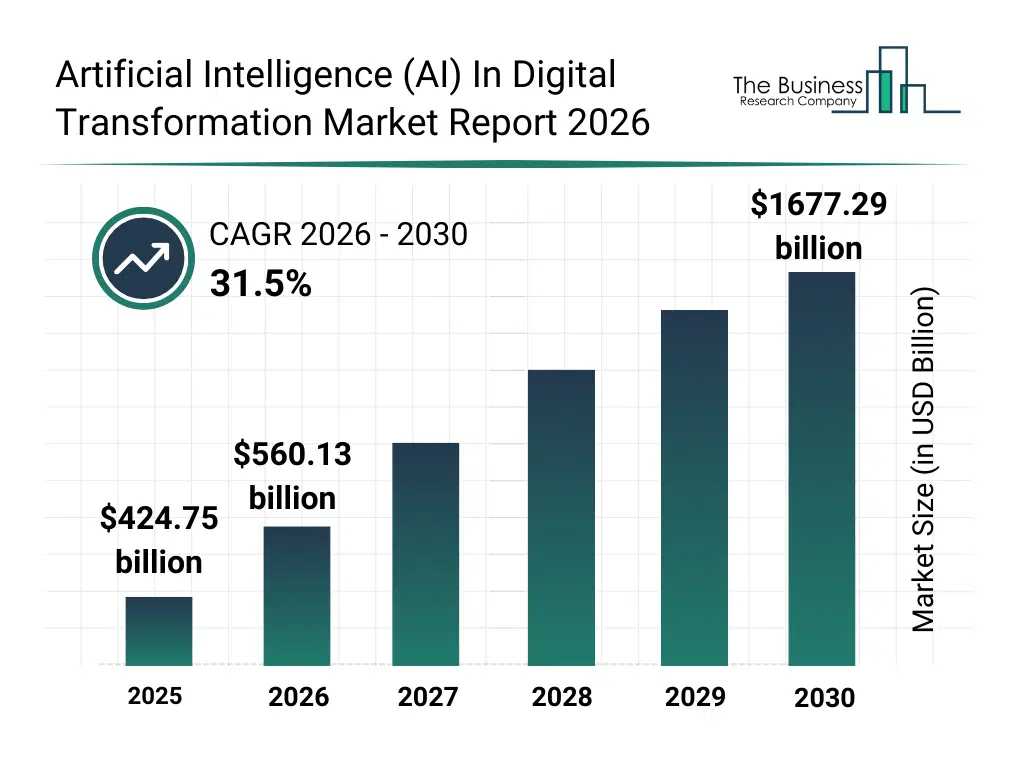
What Is The Artificial Intelligence (AI) In Digital Transformation Market Size and Share 2026?
The artificial intelligence (AI) in digital transformation market size has grown exponentially in recent years. It will grow from $424.75 billion in 2025 to $560.13 billion in 2026 at a compound annual growth rate (CAGR) of 31.9%. The growth in the historic period can be attributed to enterprise digitization initiatives, early automation technologies, growing data driven decision making, cloud adoption growth, operational efficiency requirements.What Is The Artificial Intelligence (AI) In Digital Transformation Market Growth Forecast?
The artificial intelligence (AI) in digital transformation market size is expected to see exponential growth in the next few years. It will grow to $1677.29 billion in 2030 at a compound annual growth rate (CAGR) of 31.5%. The growth in the forecast period can be attributed to autonomous enterprise systems adoption, AI first IT strategies, expansion of hybrid cloud models, real time operational intelligence demand, cybersecurity risk escalation. Major trends in the forecast period include enterprise process automation with AI, AI driven business intelligence, predictive operational analytics, intelligent cybersecurity automation, AI enabled cloud transformation.
Global Artificial Intelligence (AI) In Digital Transformation Market Segmentation
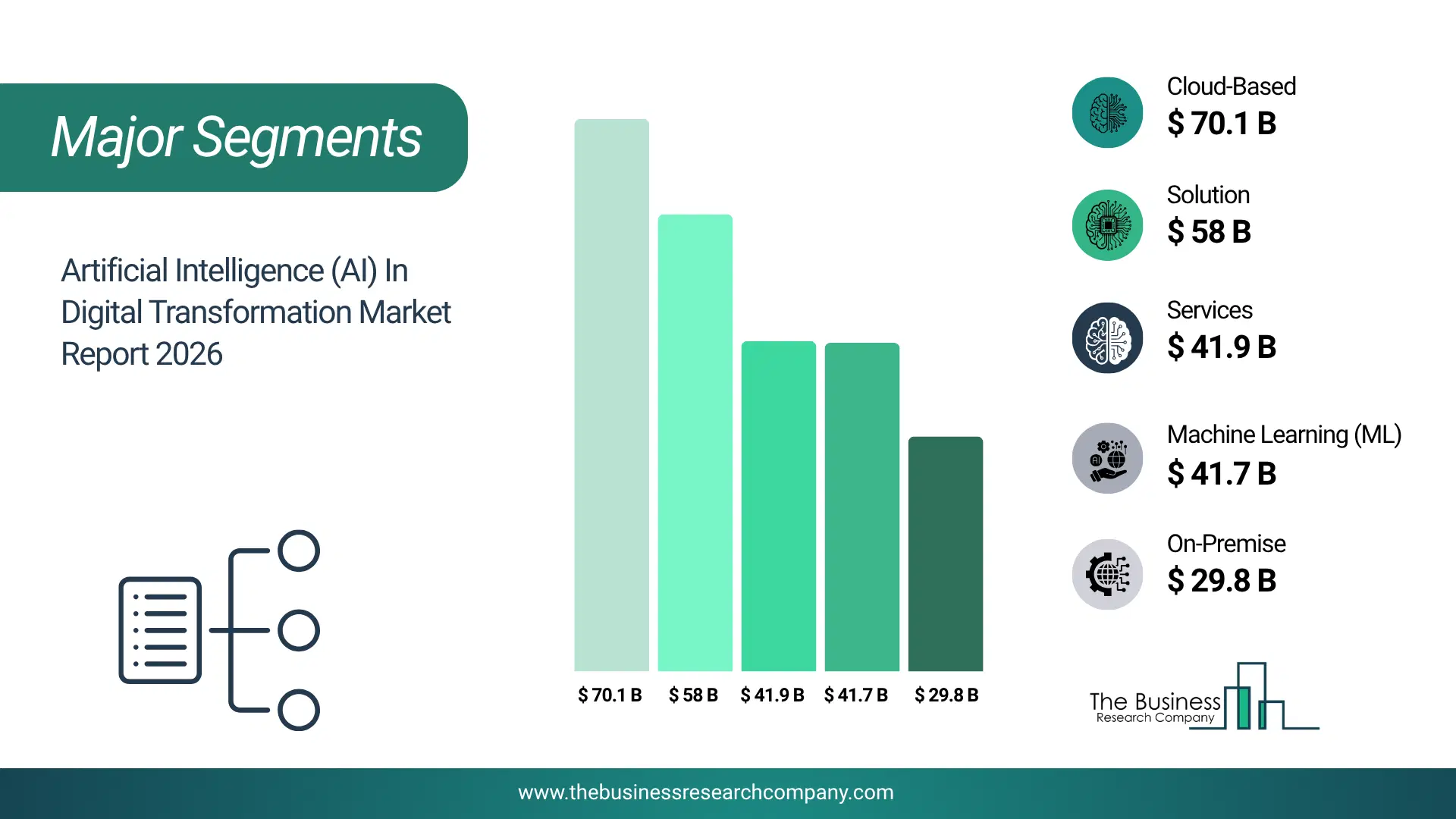
1) By Component: Solution, Services 2) By Technology: Machine Learning (ML), Natural Language Processing (NLP), Computer Vision, Other Technologies 3) By Deployment Mode: Cloud-Based, On-Premise 4) By Industry Vertical: Banking Financial Services And Insurance (BFSI), Information Technology (IT) And Telecommunications, Government And Public Sector, Healthcare, Manufacturing, Retail, Other End-Use Industries Subsegments: 1) By Solution: AI-Powered Cloud Computing Solutions, AI-Based Automation Tools, AI-Driven Data Analytics Platforms, Predictive Analytics And Forecasting Tools, AI-Based Business Intelligence Solutions, Natural Language Processing (NLP) Solutions, AI For Cybersecurity Solutions, AI-Enabled Customer Relationship Management (CRM) Systems, AI-Powered Enterprise Resource Planning (ERP) Solutions 2) By Services: AI Integration And Implementation Services, Consulting Services For Digital Transformation Strategy, AI And Data Analytics Training Services, Cloud Migration And Integration Services, AI-Powered Process Automation Services, AI-Driven IT Infrastructure Management, Managed AI Services, Post-Implementation Support And Maintenance Services The top segments in the artificial intelligence (ai) in digital transformation market will be: • Cloud-Based will reach $70101.74 Million by 2030. • Solution will reach $58061.02 Million by 2030. • Machine Learning (ML) will reach $41717.19 Million by 2030. • Services will reach $41913.54 Million by 2030. • On-Premise will reach $29872.82 Million by 2030.What Is The Driver Of The Artificial Intelligence (AI) In Digital Transformation Market?
The growing adoption of cloud services is expected to propel the growth of the AI in digital transformation market going forward. Cloud services deliver computing resources such as servers, storage, databases, networking, software, and analytics over the Internet, allowing users to access. Cloud services are attributed to offering scalable and flexible computing resources, storage, and applications over the Internet, enabling businesses and individuals to access and manage these resources on demand without needing physical infrastructure. AI in digital transformation drives cloud service adoption by highlighting the benefits of cloud-based AI tools, which enhance operational efficiency, data analysis, and overall digital transformation efforts. For instance, in November 2024, Gartner, a UK-based IT service management company, reported that public cloud spending is projected to reach $723.4 billion in 2025, up from $595.7 billion in 2024, with 90% of organizations expected to adopt a hybrid cloud approach by 2027. Therefore, the growing adoption of cloud services is driving the growth of AI in the digital transformation market.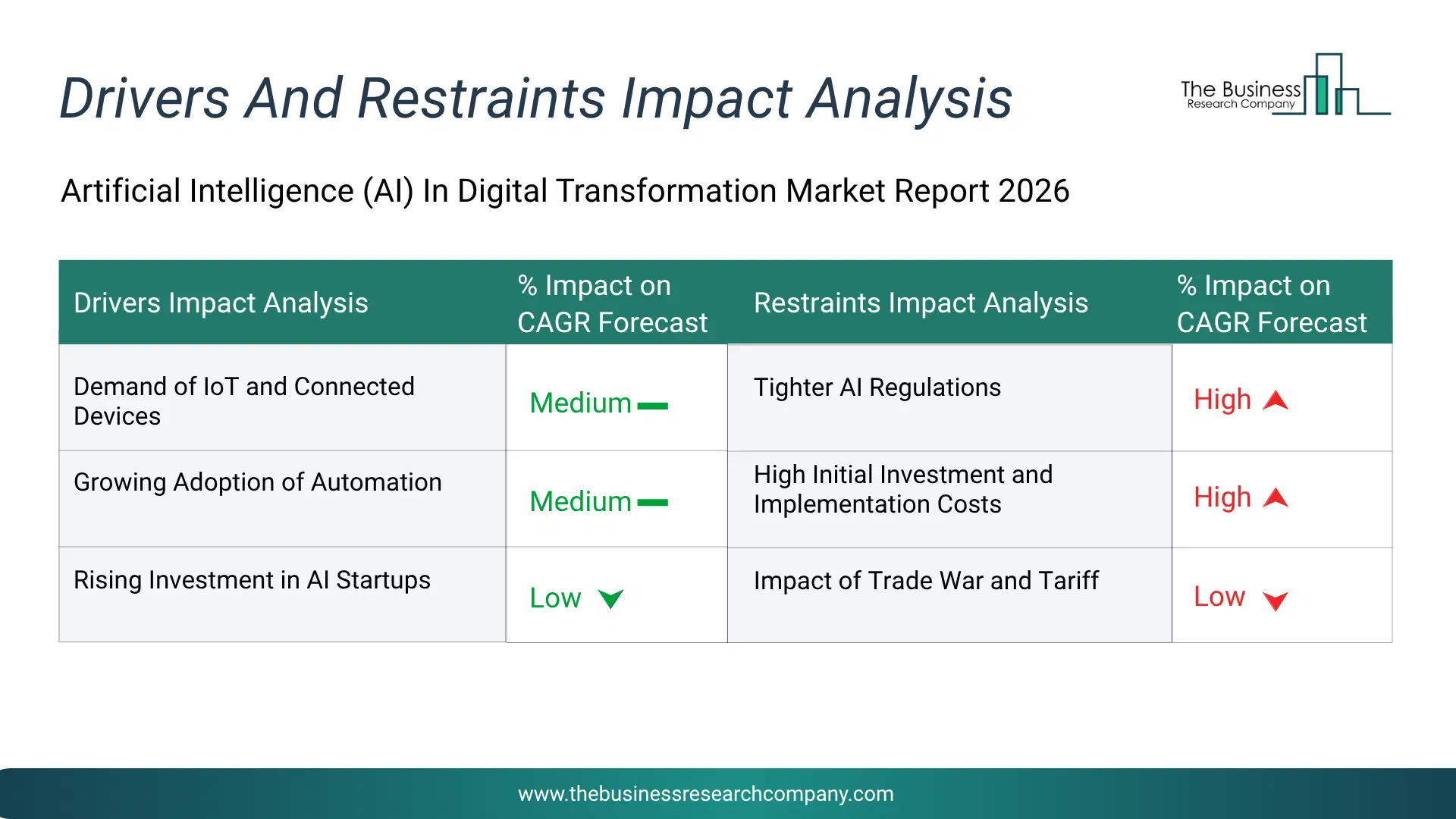
Infographic Chart Showing Key Market Drivers Analysis And Restraints For Artificial Intelligence (Ai) In Digital Transformation Market
The chart presents an impact analysis of key drivers and restraints, quantifying their relative influence on the market's growth rate and helping assess the balance between growth enablers and limiting factors. This chart offers a high-level perspective; the full report contains more detailed insights.
How Will The Drivers Impact Growth In The Global Artificial Intelligence (AI) In Digital Transformation Market?
• Demand of IoT and Connected Devices (Medium) – During the forecast period, the demand of iot and connected devices will become a key driver of growth in the artificial intelligence (ai) in digital transformation market by 2030. as enterprises and industries increasingly adopt iot solutions to collect, transmit and analyze vast amounts of machine-generated data, the proliferation of connected devices drives the need for intelligent, ai-based systems that can process and derive actionable insights in real-time. analyst projections indicate that the number of connected iot devices worldwide is growing rapidly year on year, with billions of connections expected through the decade, reflecting a broader trend toward pervasive connectivity and digital ecosystems. as organizations deploy larger and more diverse iot networks that feed vast datasets into enterprise systems, the integration of ai capabilities becomes essential to automate decision-making, optimize operations and create predictive intelligence, thereby significantly driving demand for ai-enabled digital transformation solutions across sectors. as a result, demand of iot and connected devices is anticipated to contributing to a 1.5% annual growth in the market. • Growing Adoption of Automation (Medium) – During the forecast period, the growing adoption of automation will serve as a key growth catalyst for the artificial intelligence (ai) in digital transformation market by 2030. industrial automation through robotics is rapidly expanding as manufacturers seek to enhance productivity, reduce labor costs, improve precision and strengthen resilience against supply chain disruptions, with global factory robot installations more than doubling over the past decade. the widespread deployment of robots across key sectors such as automotive, electronics, consumer goods and logistics underscores how automation technologies are becoming central to modern industrial operations, enabling real-time data collection, predictive maintenance and integrated control systems that feed rich datasets into enterprise decision engines. this accelerating shift toward automated production environments is driving organizations to invest in intelligent ai platforms and solutions that can manage, interpret and drive action from automation-generated data. therefore, this growing adoption of automation is projected to supporting to a 1.0% annual growth in the market. • Rising Investment in AI Startups (Low) – During the forecast period, the rising investment in AI startups will propel the growth of the artificial intelligence (AI) in digital transformation market. Increased capital flows into early-stage and growth-stage AI companies provide critical funding for research and development, talent acquisition and the commercialization of innovative AI solutions across sectors such as enterprise software, automation, analytics and customer experience platforms. Around the world and particularly in major technology hubs, investors are channeling record amounts of venture capital and strategic funding into AI-centric startups, with many companies securing significant rounds that fuel rapid scaling and attract further institutional participation. This surge in AI funding not only accelerates product innovation but also increases the availability of enterprise-ready AI solutions. The rising investment in AI startups growth contribution during the forecast period in 2025 is 0.5%. • Adoption of Digital Twins and Simulation Technologies (Low) – During the forecast period, the adoption of digital twins and simulation technologies will emerge as a major factor driving the expansion of the artificial intelligence (ai) in digital transformation market by 2030. digital twins, dynamic, data-driven virtual replicas of physical systems such as cities, infrastructure and enterprise operations, enable organizations to monitor, simulate and optimize processes in real time by integrating live data streams from sensors and enterprise systems, supporting predictive analytics and decision-making. as more enterprises and public-sector organizations deploy digital twins and advanced simulation tools to enhance operational efficiency, risk mitigation and scenario planning, the demand for ai-enabled platforms and services that can interpret, learn from and generate insights from these simulations significantly increases. consequently, the adoption of digital twins and simulation technologies is projected to contributing to a 1.3% annual growth in the market.How Will The Restraints Impact Growth In The Global Artificial Intelligence (AI) In Digital Transformation Market?
• Tighter AI Regulations (Medium) – During the forecast period, tighter ai regulations are restricting the growth of the artificial intelligence (ai) in digital transformation market during the forecast period. regulatory frameworks that impose stricter safety, accountability, transparency and compliance requirements for ai systems, especially in leading technology hubs, increase operational complexity and compliance costs for enterprises adopting advanced ai solutions. these regulations often mandate rigorous documentation, risk assessments, model audits and explainability measures that require significant investment in governance, legal expertise and technical safeguards before ai systems can be deployed at scale. from a business perspective, tighter ai rules may slow down enterprise decision-making, delay product rollouts and deter smaller adopters who lack the resources to meet evolving compliance standards. as a result, organizations may postpone or scale back ai initiatives in digital transformation projects, particularly in regulated industries or markets where regulatory uncertainty is high, thereby restricting the growth of the artificial intelligence (ai) in digital transformation market. growth affected by the tighter ai regulations during the forecast period in 2025 is -2.8%. • High Initial Investment and Implementation Costs (Medium) – During the forecast period, high initial investment and implementation costs are restricting the growth of the artificial intelligence (ai) in digital transformation market during the forecast period. many organizations undertaking ai initiatives face substantial upfront expenses related to acquiring advanced ai technologies, upgrading legacy systems and building the necessary data infrastructure, all of which can strain it budgets and delay adoption timelines. from a financial standpoint, these elevated costs can make it difficult for small and medium-sized enterprises to justify ai investments, particularly when the return on investment is uncertain or tied to long-term performance gains. as a result, many organizations may postpone or scale back their ai transformation initiatives to manage budgetary pressures. growth affected by the high initial investment and implementation costs during the forecast period in 2025 is -2.5%. • Impact of Trade War and Tariff (Low) – During the forecast period, impact of trade war and tariffs are restricting the growth of the artificial intelligence (ai) in digital transformation market during the forecast period. escalating global trade tensions and the imposition of steep tariffs on key technology components, such as data-center hardware, networking equipment and semiconductor supply chain inputs, increase production costs and create uncertainty for enterprises planning large-scale ai investments. tariff-related disruptions to supply chains can delay infrastructure build-outs critical for ai workloads, including data centers and edge compute facilities and may force organizations to reallocate budgets from digital transformation initiatives to offset increased expenses and mitigated risks. as a result, enterprises may postpone or scale back the adoption of ai-enabled digital transformation solutions in the face of heightened geopolitical and economic uncertainties. growth affected by the impact of trade war and tariffs during the forecast period in 2025 is -0.3%.Key Players In The Global Artificial Intelligence (AI) In Digital Transformation Market
Major companies operating in the artificial intelligence (AI) in digital transformation market are Amazon.com Inc., Google LLC, Microsoft Corporation, Dell Technologies Inc., Huawei Technologies Co. Ltd., Siemens AG, General Electric Company, Accenture plc, Intel Corporation, International Business Machines Corporation, Cisco Systems Inc., Qualcomm Incorporated, Oracle Corporation, Fujitsu Limited, SAP SE, Salesforce Inc., ABB Ltd., Tata Consultancy Services Limited, Hewlett Packard Enterprise Company, Nvidia Corporation, Capgemini SE, Cognizant Technology Solutions Corporation, Infosys Limited, Adobe Inc., Vmware LLC, Wipro Limited, Hitachi Vantara Corporation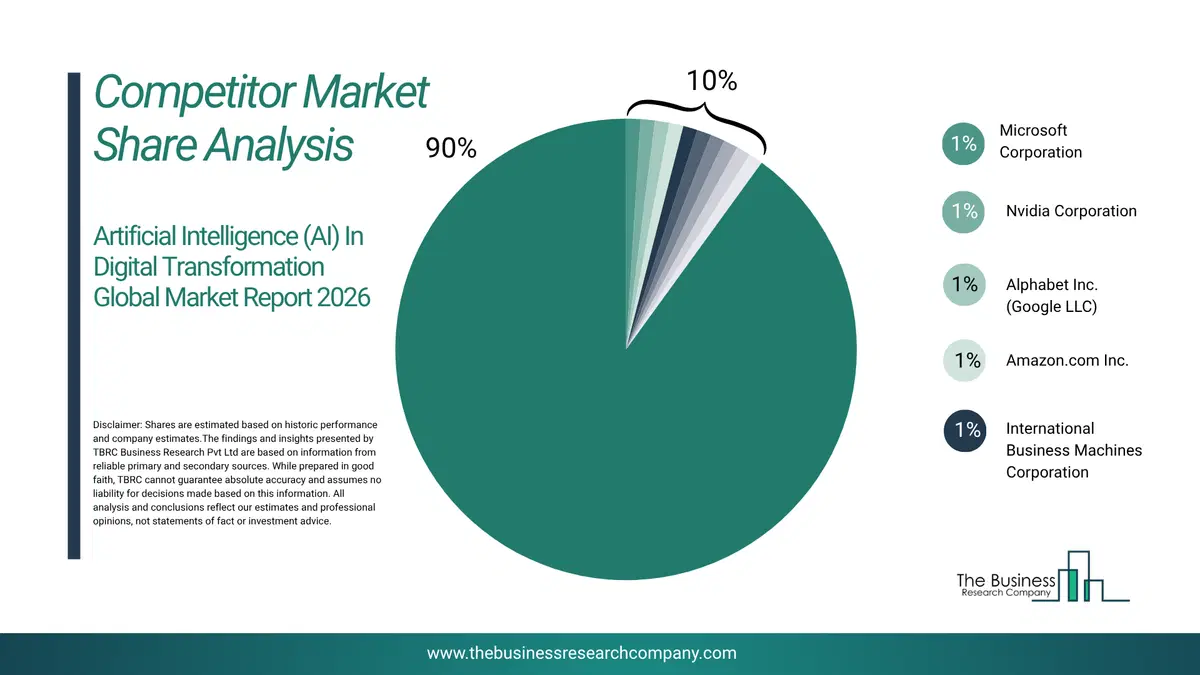
This chart is for illustrative purposes; the full report includes a detailed competitor analysis and comprehensive overview of the top 10 companies in the market.
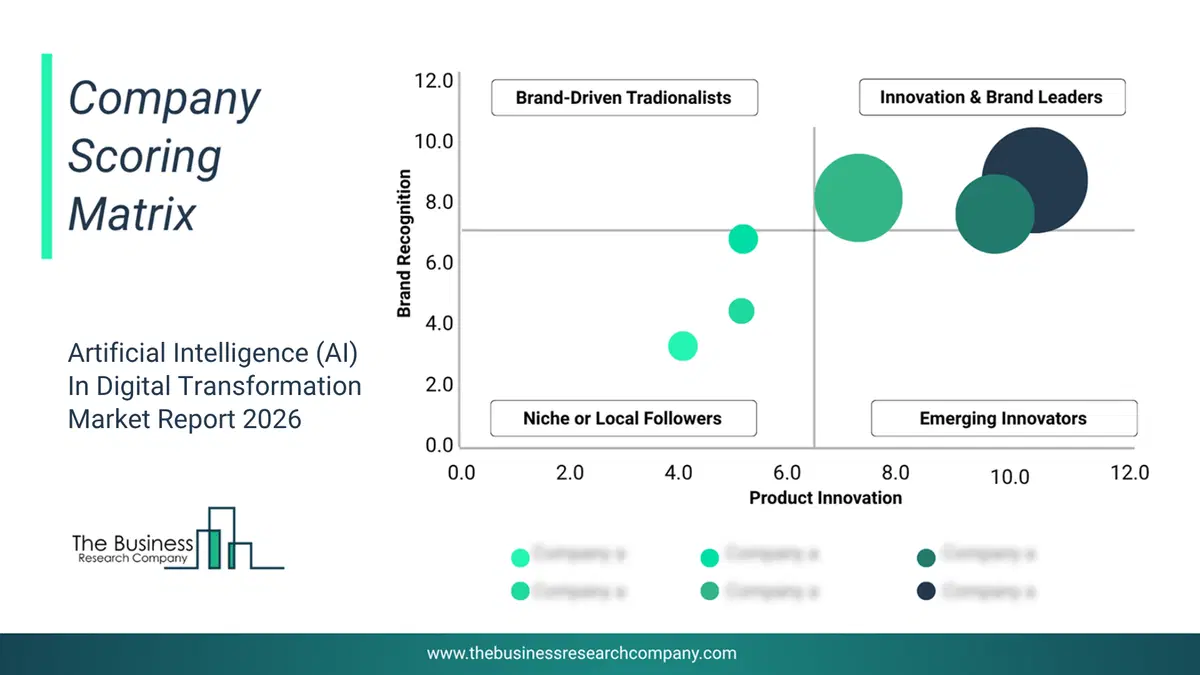
This chart maps companies by product innovation and brand strength, with bubble size indicating relative revenue, helping identify market leaders, challengers, and niche players. This is an illustrative chart; the full report provides a complete and accurate competitive analysis.
Global Artificial Intelligence (AI) In Digital Transformation Market Trends and Insights
Major companies operating in the AI in digital transformation market are developing AI-powered DevSecOps platforms to enhance security, streamline development processes, and ensure compliance. AI-powered DevSecOps platforms leverage AI to automate security testing, identify vulnerabilities, and provide real-time threat detection throughout the development lifecycle. For instance, in October 2023, Digital.ai, a US-based technology company, launched Denali, an open, AI-powered DevSecOps platform designed to accelerate enterprise software delivery. This platform enhances security for web applications and automates software delivery processes, improving developer efficiency and aligning outcomes with business strategies. The advanced features include ARM protection for iOS applications and expanded test coverage, enabling teams to deliver high-quality, secure applications at scale.What Are Latest Mergers And Acquisitions In The Artificial Intelligence (AI) In Digital Transformation Market?
In January 2024, Accenture, an Ireland-based technology company, acquired Navisite for an undisclosed amount. This acquisition is set to bolster Accenture’s application and infrastructure managed services, enabling the company to better support North American clients in cloud transformations and IT modernization for the AI era, thereby accelerating their digital transformation journeys. Navisite is a US-based digital transformation and managed services provider that leverages AI and machine learning to assist organizations in predicting outcomes and enhancing decision-making.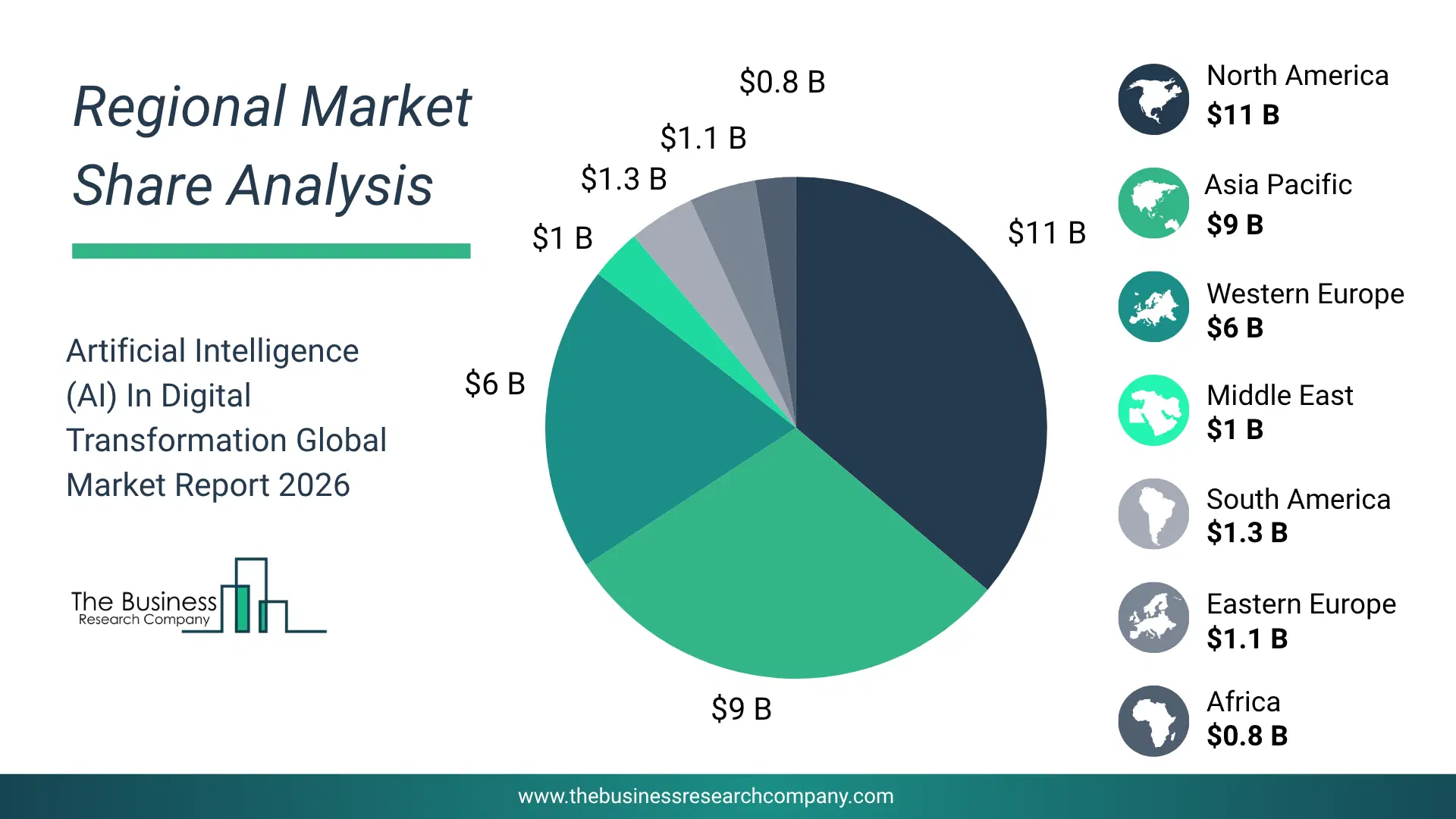
Regional Insights
North America was the largest region in the AI in digital transformation market in 2025. The regions covered in this market report are Asia-Pacific, South East Asia, Western Europe, Eastern Europe, North America, South America, Middle East, Africa. The countries covered in this market report are Australia, Brazil, China, France, Germany, India, Indonesia, Japan, Taiwan, Russia, South Korea, UK, USA, Canada, Italy, Spain.What Defines the Artificial Intelligence (AI) In Digital Transformation Market?
The AI in digital transformation market consists of revenues earned by entities by providing services such as AI-driven analytics, automation solutions, and predictive maintenance. The market value includes the value of related goods sold by the service provider or included within the service offering. The AI in digital transformation market also includes sales of edge computing devices, tensor processing units, and graphics processing units. Values in this market are ‘factory gate’ values, that is the value of goods sold by the manufacturers or creators of the goods, whether to other entities (including downstream manufacturers, wholesalers, distributors and retailers) or directly to end customers. The value of goods in this market includes related services sold by the creators of the goods.How is Market Value Defined and Measured?
The market value is defined as the revenues that enterprises gain from the sale of goods and/or services within the specified market and geography through sales, grants, or donations in terms of the currency (in USD unless otherwise specified). The revenues for a specified geography are consumption values that are revenues generated by organizations in the specified geography within the market, irrespective of where they are produced. It does not include revenues from resales along the supply chain, either further along the supply chain or as part of other products.
This chart presents market attractiveness based on a quantitative evaluation of growth, competition, strategic alignment, and risk, offering a clear view of opportunity areas for decision-making. This chart is for illustrative purposes; the full report contains the complete analysis.

This chart highlights the Total Addressable Market (TAM) by estimating the maximum revenue opportunity using an assumption-driven approach, supporting strategic planning and opportunity sizing across markets. The chart is illustrative; the full report provides a more comprehensive analysis.
What Key Data and Analysis Are Included in the Artificial Intelligence (AI) In Digital Transformation Market Report 2026?
The artificial intelligence (ai) in digital transformation market research report is one of a series of new reports from The Business Research Company that provides market statistics, including industry global market size, regional shares, competitors with the market share, detailed market segments, market trends and opportunities, and any further data you may need to thrive in the artificial intelligence (ai) in digital transformation industry. The market research report delivers a complete perspective of everything you need, with an in-depth analysis of the current and future state of the industry.Artificial Intelligence (AI) In Digital Transformation Market Report Forecast Analysis
| Report Attribute | Details |
|---|---|
| Market Size Value In 2026 | $560.13 billion |
| Revenue Forecast In 2030 | $1677.29 billion |
| Growth Rate | CAGR of 31.9% from 2026 to 2030 |
| Base Year For Estimation | 2025 |
| Actual Estimates/Historical Data | 2020-2025 |
| Forecast Period | 2026 - 2030 - 2035 |
| Market Representation | Revenue in USD Billion and CAGR from 2026 to 2030 |
| Segments Covered | Component, Technology, Deployment Mode, Industry Vertical |
| Regional Scope | Asia-Pacific, Western Europe, Eastern Europe, North America, South America, Middle East, Africa |
| Country Scope | The countries covered in the report are Australia, Brazil, China, France, Germany, India, Indonesia, Japan, Taiwan, Russia, South Korea, UK, USA, Canada, Italy, Spain. |
| Key Companies Profiled | Amazon.com Inc., Google LLC, Microsoft Corporation, Dell Technologies Inc., Huawei Technologies Co. Ltd., Siemens AG, General Electric Company, Accenture plc, Intel Corporation, International Business Machines Corporation, Cisco Systems Inc., Qualcomm Incorporated, Oracle Corporation, Fujitsu Limited, SAP SE, Salesforce Inc., ABB Ltd., Tata Consultancy Services Limited, Hewlett Packard Enterprise Company, Nvidia Corporation, Capgemini SE, Cognizant Technology Solutions Corporation, Infosys Limited, Adobe Inc., Vmware LLC, Wipro Limited, Hitachi Vantara Corporation |
| Customization Scope | Request for Customization |
| Pricing And Purchase Options | Explore Purchase Options |