
Artificial Intelligence (AI) In Energy And Power Global Market Opportunities And Strategies To 2035
By Technology (Machine Learning, Natural Language Processing, Computer Vision, Other Technologies), By Application (Demand Forecasting, Energy Production And Distribution Optimization, Energy Management, Smart Grids, Smart Meter, Other Applications), By End-User (Commercial And Industrial, Residential), And By Region, Opportunities And Strategies – Global Forecast To 2035
Artificial Intelligence (AI) In Energy And Power Market Definition
Artificial Intelligence (AI) in energy and power refers to the application of advanced algorithms, machine learning, and data analytics to optimize the generation, transmission, distribution, and consumption of energy. AI systems analyze large volumes of data from smart grids, sensors, and energy infrastructure to automate decision-making, improve efficiency, and enhance grid reliability. The primary purpose of AI in the energy and power sector is to increase operational efficiency, reduce costs, and support the transition to sustainable energy systems. The AI in energy and power market consists of sales, by entities (organizations, sole traders, or partnerships), of AI in energy and power that is used by a range of stakeholders, including electric utility companies, grid operators, energy producers, renewable energy plant owners, commercial and industrial energy users and residential consumers. AI applications are used both in real-time (such as in grid stability control or predictive maintenance) and for future-oriented tasks (such as long-term energy forecasting or infrastructure planning).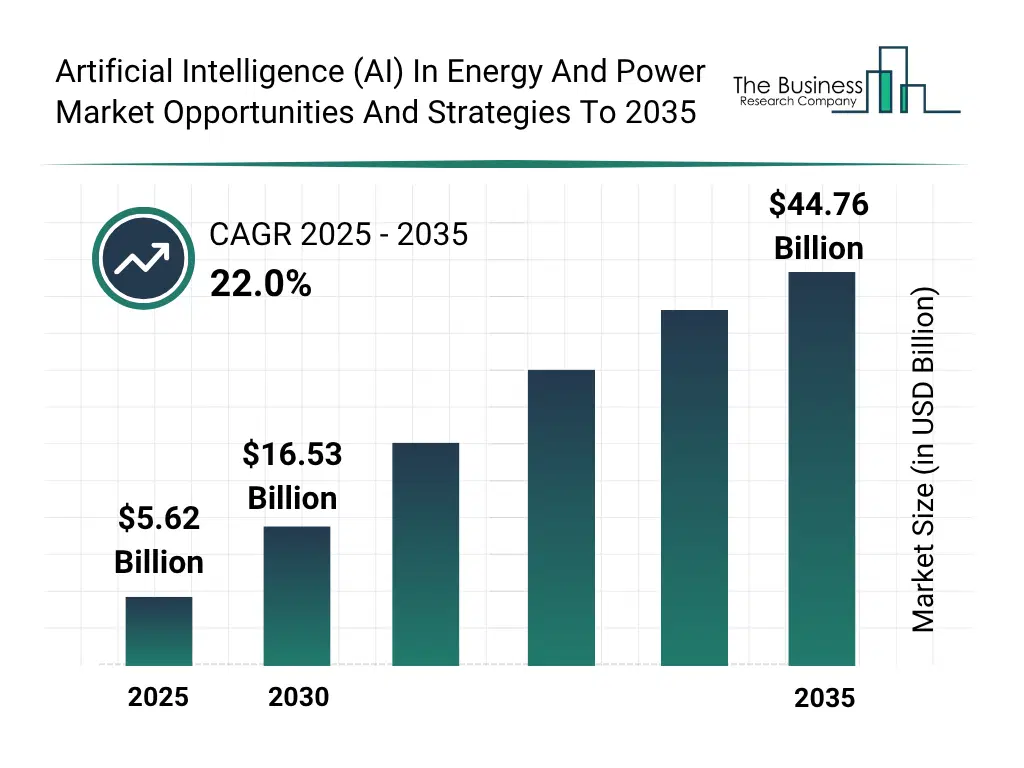
Artificial Intelligence (AI) In Energy And Power Market Size
The global AI in energy and power market reached a value of nearly $5,618.3 million in 2025, having grown at a compound annual growth rate (CAGR) of 26.6% since 2020. The market is expected to grow from $5,618.3 million in 2025 to $16,532.1 million in 2030 at a rate of 24.1%. The market is then expected to grow at a CAGR of 22.0% from 2030 and reach $44,758.6 million in 2035. Growth in the historic period resulted from rising integration of renewable energy sources, growing investments in grid modernization, expansion of virtual power plants (VPPs) and growth of smart cities and digital infrastructure. factors that negatively affected growth in the historic period were high capital investment requirements and lack of skilled workforce. Going forward, increasing deployment of advanced metering infrastructure (Ami), increasing need for cybersecurity in energy and power infrastructure, government funding and incentives for digital energy transformation and regulatory push for decarbonization and net-zero targets will drive the growth. Factors that could hinder the growth of the AI in energy and power market in the future include cybersecurity and data privacy concerns, lack of interoperability and standardization and impact of trade war and tariff.
Artificial Intelligence (AI) In Energy And Power Market Segmentation
The AI in energy and power market is segmented by technology, by application, and by end-user.By Technology –
The AI in energy and power market is segmented by technology into:
- a) Machine Learning
- b) Natural Language Processing
- c) Computer Vision
- d) Other Technologies
By Application –
The AI in energy and power market is segmented by application into:
- a) Demand Forecasting
- b) Energy Production And Distribution Optimization
- c) Energy Management
- d) Smart Grids
- e) Smart Meter
- f) Other Applications
By End-User –
The AI in energy and power market is segmented by end-user into:
- a) Commercial And Industrial
- b) Residential
By Geography - The AI in energy and power market is segmented by geography into:
- China
- India
- Japan
- Australia
- Indonesia
- South Korea
- USA
- Canada
- Brazil
- France
- Germany
- UK
- Italy
- Spain
- Russia
-
o Asia Pacific
o Africa