

Artificial Intelligence (AI) In Legal Market Report 2026
Global Outlook – By Component (Software, Hardware, Services), By Deployment Mode (On-Premises, Cloud), By Application (Contract Management, E-Discovery, Legal Research, Compliance And Risk Management, Case Prediction And Litigation Analytics, Document Automation), By End User (Law Firms, Corporate Legal Departments, Government) – Market Size, Trends, Strategies, and Forecast to 2030
Artificial Intelligence (AI) In Legal Market Overview
• Artificial Intelligence (AI) In Legal market size has reached to $4.59 billion in 2025 • Expected to grow to $12.49 billion in 2030 at a compound annual growth rate (CAGR) of 22.3% • Growth Driver: Increasing Adoption Of Artificial Intelligence Powered Contract Review Tools Fueling The Growth Of The Market Due To Increasing Need For Faster, More Accurate Legal Document Analysis • Market Trend: Generative AI Platforms Transform Legal Research And Drafting • North America was the largest region in 2025 and Asia-Pacific is the fastest growing region.Market Gains By 2030 – Top Opportunities By Segment
Market Gain identifies the most promising market opportunities by highlighting the segments or products expected to generate the highest incremental revenue growth over the next five years.
What Is Covered Under Artificial Intelligence (AI) In Legal Market?
Artificial intelligence (AI) in legal refers to the use of machine learning, natural language processing, and automation tools to perform tasks traditionally handled by legal professionals. It helps analyze documents, review contracts, predict case outcomes, and streamline research with greater accuracy and speed. It helps to increase efficiency, reduce human error, lower costs, and enable faster, data-driven decision-making in legal operations. The main components of the artificial intelligence (AI) in legal include software, hardware, and services. Software refers to AI-driven platforms and algorithms designed to automate, optimize, and enhance legal workflows, including contract analysis, e-discovery, legal research, compliance monitoring, and case prediction. Deployment modes include on-premises and cloud. The various applications include contract management, e-discovery, legal research, compliance and risk management, case prediction and litigation analytics, and document automation, and they are used by several end-users such as law firms, corporate legal departments, government, and others.
What Is The Artificial Intelligence (AI) In Legal Market Size and Share 2026?
The artificial intelligence (AI) in the legal market size has grown exponentially in recent years. It will grow from $4.59 billion in 2025 to $5.59 billion in 2026 at a compound annual growth rate (CAGR) of 22.3%. The growth in the historic period can be attributed to growing demand for faster legal research, increasing need to reduce legal operational costs, rising volume of digital legal documentation, expanding adoption of e-discovery solutions, and increasing shift toward digital transformation across law firms.What Is The Artificial Intelligence (AI) In Legal Market Growth Forecast?
The artificial intelligence (AI) in the legal market size is expected to see exponential growth in the next few years. It will grow to $12.49 billion in 2030 at a compound annual growth rate (CAGR) of 22.3%. The growth in the forecast period can be attributed to growing adoption of generative ai for legal automation, rising need for predictive case outcome analytics, increasing demand for cloud-based legal ai platforms, expanding automation of contract lifecycle management, and rising focus on artificial intelligence (AI)-driven compliance and risk monitoring. Major trends in the forecast period include technology advancements in natural language processing (NLP) for legal research, innovations in generative artificial intelligence (AI) for document drafting, developments in artificial intelligence (AI)-powered legal analytics systems, research and developments in multilingual legal ai models, and advancements in blockchain and artificial intelligence (AI) integration for smart contracts.
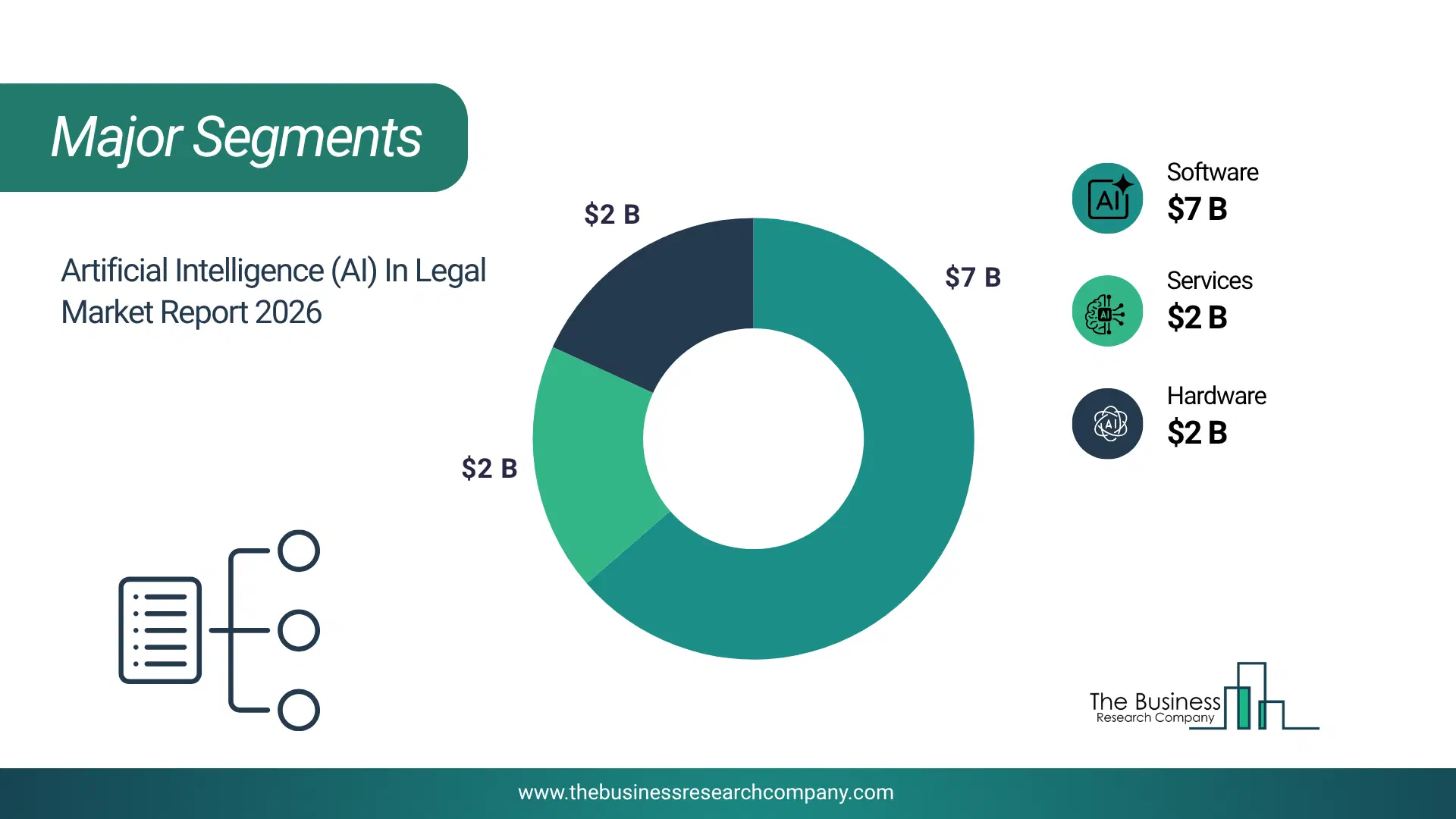
Global Artificial Intelligence (AI) In Legal Market Segmentation
1) By Component: Software, Hardware, Services 2) By Deployment Mode: On-Premises, Cloud 3) By Application: Contract Management, E-Discovery, Legal Research, Compliance And Risk Management, Case Prediction And Litigation Analytics, Document Automation 4) By End User: Law Firms, Corporate Legal Departments, Government Subsegments: 1) By Software: Document Review Software, Legal Research Software, Contract Analysis Software, Case Management Software, Compliance Management Software 2) By Hardware: Computing Servers, Data Storage Systems, Graphics Processing Units, Network Devices, Edge Computing Devices 3) By Services: Consulting Services, Integration And Deployment Services, Support And Maintenance Services, Training And Education Services, Managed Services The top segments in the artificial intelligence (ai) in legal market will be: • Software will reach $3 Billion by 2030. • Services will reach $0.96 Billion by 2030. • Hardware will reach $0.61 Billion by 2030.What Is The Driver Of The Artificial Intelligence (AI) In Legal Market?
The increasing adoption of artificial intelligence (AI)-powered contract review tools is expected to propel the growth of the artificial intelligence (AI) in legal market going forward. Artificial intelligence (AI)-powered contract review tools use machine learning and natural language processing technologies to analyze, interpret, and extract key information from legal documents with high accuracy and speed. The rise in adoption of artificial intelligence (AI)-powered contract review tools is due to the growing need for faster contract turnaround times and increased pressure on legal teams to manage large volumes of documentation efficiently. Artificial intelligence (AI)-powered tools help address these needs by automating time-consuming review tasks, improving consistency, enhancing compliance, and enabling lawyers to focus on higher-value legal work. For instance, in October 2024, according to Clio, a Canada-based legal technology company, 19% of law firms reported using artificial intelligence in 2023 and adoption has now surged to 79% among legal professionals. Therefore, the increasing adoption of artificial intelligence-powered contract review tools is driving the growth of the artificial intelligence (AI) in legal industry.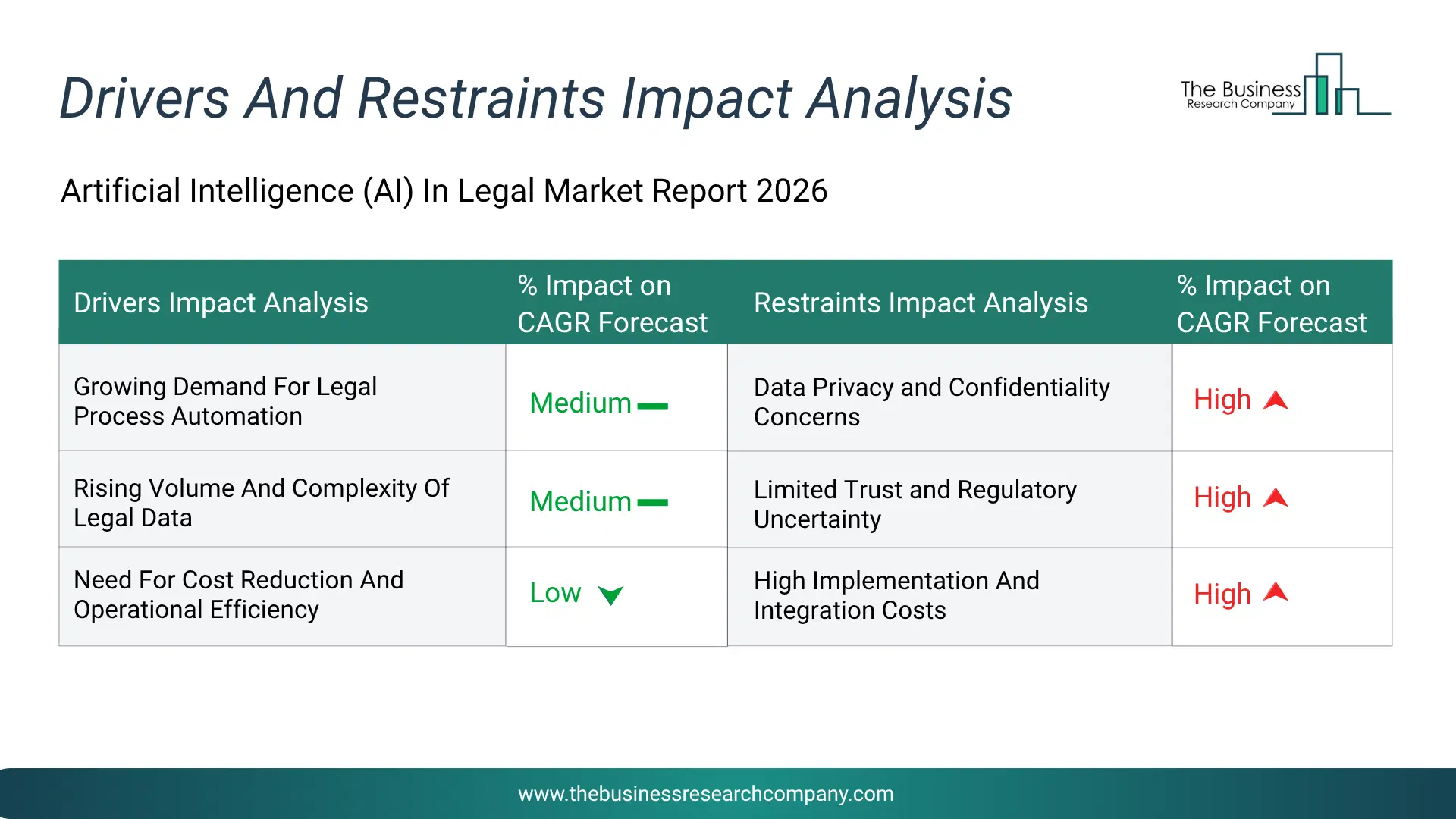
Infographic Chart Showing Key Market Drivers Analysis And Restraints For Artificial Intelligence (Ai) In Legal Market
The chart presents an impact analysis of key drivers and restraints, quantifying their relative influence on the market's growth rate and helping assess the balance between growth enablers and limiting factors. This chart offers a high-level perspective; the full report contains more detailed insights.
How Will The Drivers Impact Growth In The Global Artificial Intelligence (AI) In Legal Market?
• Growing Demand for Legal Process Automation (High) – During the forecast period, the growing demand for legal process automation will be a key growth driver for the artificial intelligence (AI) in legal market by 2030. Legal teams are seeking ways to reduce repetitive work in document review, contract preparation, research, and compliance checks. AI tools can help retrieve relevant passages, categorize records, and produce preliminary summaries for professional review. Applying these capabilities within established workflows can shorten preparation cycles. Demand for more efficient execution supports adoption while legal professionals retain responsibility for interpretation and final decisions. • Rising Volume and Complexity of Legal Data (Medium) – During the forecast period, the rising volume and complexity of legal data will be a major factor supporting expansion of the artificial intelligence (AI) in legal market by 2030. Contracts, case records, and regulatory documents create large information collections that legal teams must search and compare. AI systems can organize these records and identify potentially relevant content, helping users navigate material that is difficult to review manually at scale. Linking outputs to underlying documents supports verification. Increasing information volume therefore creates demand for tools that improve retrieval and structured analysis. • Need for Cost Reduction and Operational Efficiency (High) – During the forecast period, the need for cost reduction and operational efficiency will be a key growth catalyst for the artificial intelligence (AI) in legal market by 2030. Labor-intensive review and research can increase the cost of delivering legal services. AI assistance can reduce time spent locating information and preparing routine outputs, allowing teams to allocate professional effort more selectively. Benefits depend on implementation quality and the amount of verification required. Pressure to manage budgets and improve turnaround times encourages evaluation of tools that support efficient service delivery without compromising review standards.How Will The Restraints Impact Growth In The Global Artificial Intelligence (AI) In Legal Market?
• Data Privacy and Confidentiality Concerns (High) – During the forecast period, legal professionals handle highly sensitive client information, making data security a critical concern. AI systems often require access to confidential documents and case records, creating potential risks related to data breaches or unauthorized access. Regulatory requirements regarding privacy and data protection further complicate AI deployment. These concerns can slow adoption, particularly among firms dealing with highly sensitive legal matters. • Limited Trust and Regulatory Uncertainty (Medium) – During the forecast period, many legal professionals remain cautious about relying on AI for critical legal decisions due to concerns about accuracy, transparency, and accountability. AI-generated recommendations may be difficult to explain or justify in legal proceedings. Additionally, regulations governing the use of AI in legal practice are still evolving in many jurisdictions. This uncertainty can delay implementation and limit the extent to which organizations integrate AI into core legal functions. • Integration Costs And Shortages Of Legal Technology Skills (High) – During the forecast period, integration costs and shortages of legal technology skills will restrain the artificial intelligence (AI) in legal market by slowing implementation within established legal workflows. Firms may need to connect AI tools with document management systems, research databases, and client-specific knowledge repositories. Effective use also requires staff training and review procedures suited to professional obligations. Smaller practices can struggle to fund customization or retain specialists who understand both legal work and AI systems. These operational barriers can limit deployment even when firms recognize the potential efficiency benefits.Key Players In The Global Artificial Intelligence (AI) In Legal Market
Major companies operating in the artificial intelligence (AI) in legal market are Amazon.com Inc., Microsoft Corporation, International Business Machines Corporation, Salesforce Inc., SAP SE, ServiceNow Inc., Thomson Reuters Corporation, Wolters Kluwer N.V, OpenText Corporation, RELX plc, FTI Consulting Inc., DocuSign Inc., Tyler Technologies Inc., Pegasystems Inc., UiPath Inc., Elastic N.V., LegalZoom.com Inc., Intapp Inc., CS Disco Inc., Nuix Limited, Veritone Inc., KLDiscovery Inc.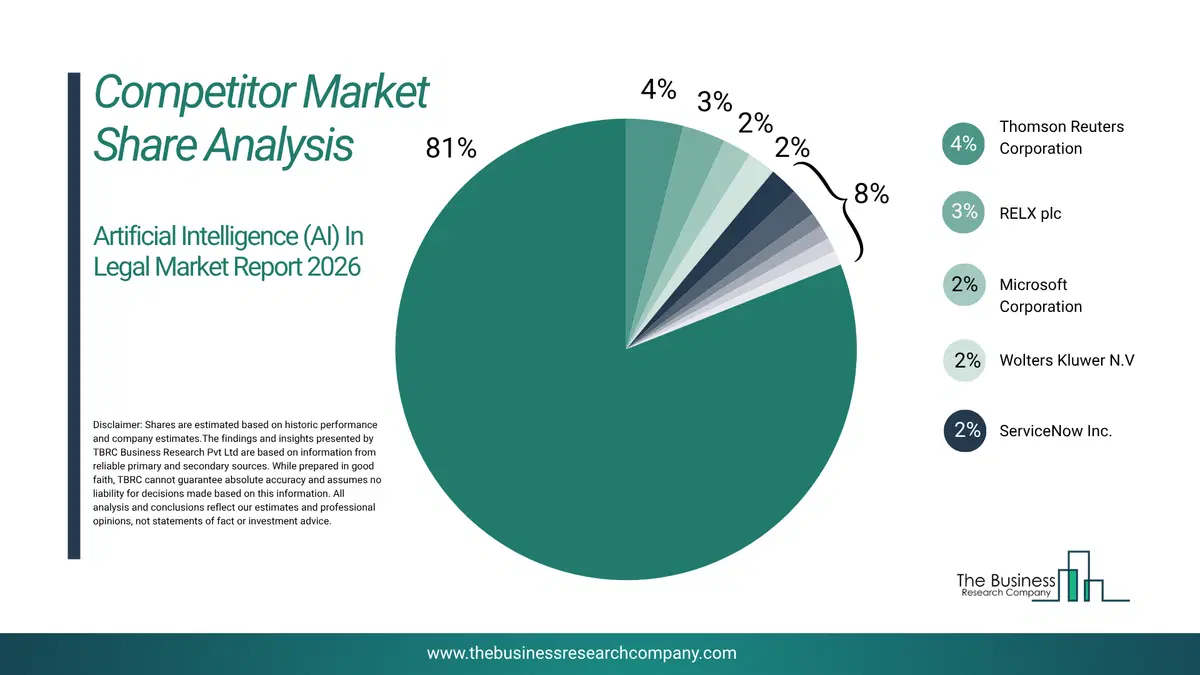
This chart is for illustrative purposes; the full report includes a detailed competitor analysis and comprehensive overview of the top 10 companies in the market.
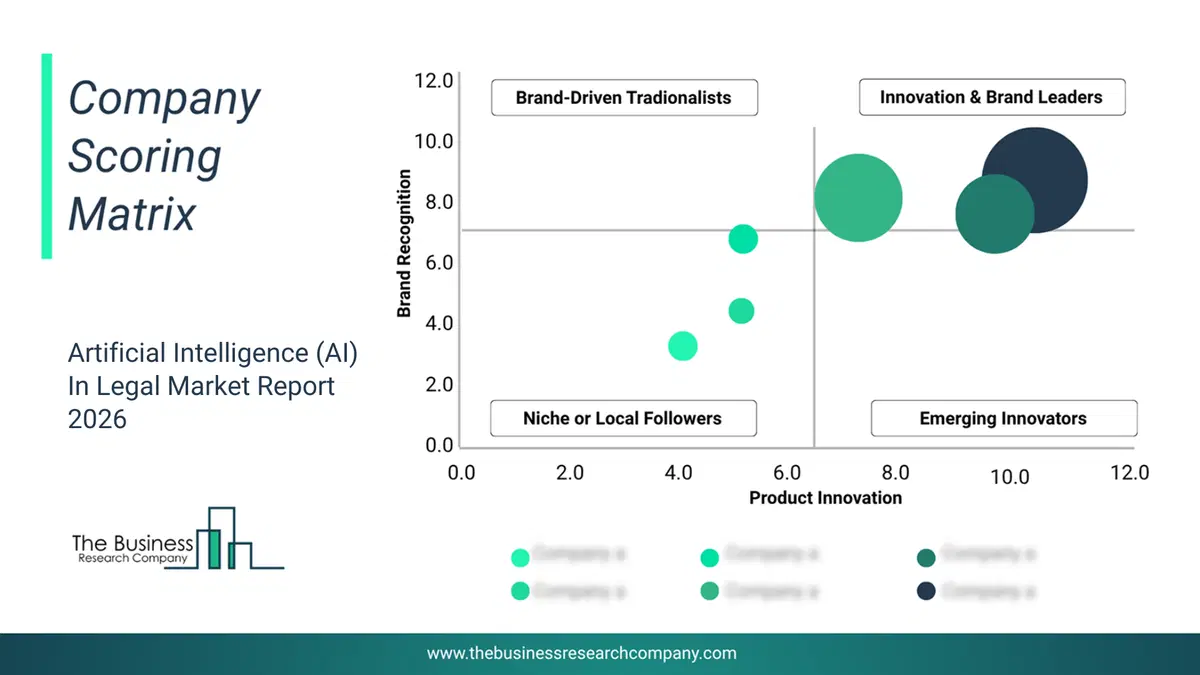
This chart maps companies by product innovation and brand strength, with bubble size indicating relative revenue, helping identify market leaders, challengers, and niche players. This is an illustrative chart; the full report provides a complete and accurate competitive analysis.
Global Artificial Intelligence (AI) In Legal Market Trends and Insights
Major companies operating in the artificial intelligence (AI) in the legal market are focusing on developing advanced platforms, such as generative AI systems, to boost efficiency, enhance accuracy, and reduce manual research and drafting efforts. Generative AI systems refer to advanced software in legal practice that automatically analyzes documents, conducts research, and generates drafts based on natural language prompts. For instance, in April 2025, Anytime AI, a US-based legal technology company, launched its 5th Generation Legal AI Platform, an all-in-one solution built for plaintiff attorneys to streamline and supercharge every stage of litigation. The platform enables everything from smart intake and generative artificial intelligence (AI)-powered document drafting to medical record reviews, discovery responses, summarization of lengthy files, and advanced legal research across jurisdictions. It enables law firms to modernize their practices, reduce manual overhead, speed up case handling, and scale up operations, allowing attorneys to allocate more time to strategy, client advocacy, and achieving better outcomes for clients.What Are Latest Mergers And Acquisitions In The Artificial Intelligence (AI) In Legal Market?
In June 2025, Consilio, a US‑based provider of legal technology and data analytics services, acquired TrueLaw for an undisclosed amount. Through this acquisition, Consilio aims to strengthen its position in the legal artificial intelligence (AI) automation by integrating TrueLaw’s advanced legal data analytics and artificial intelligence platforms, enabling more efficient e‑discovery, data processing, and predictive legal risk assessment services. TrueLaw is a US‑based legal‑tech company specializing in artificial intelligence (AI)‑powered document analysis and legal data management solutions.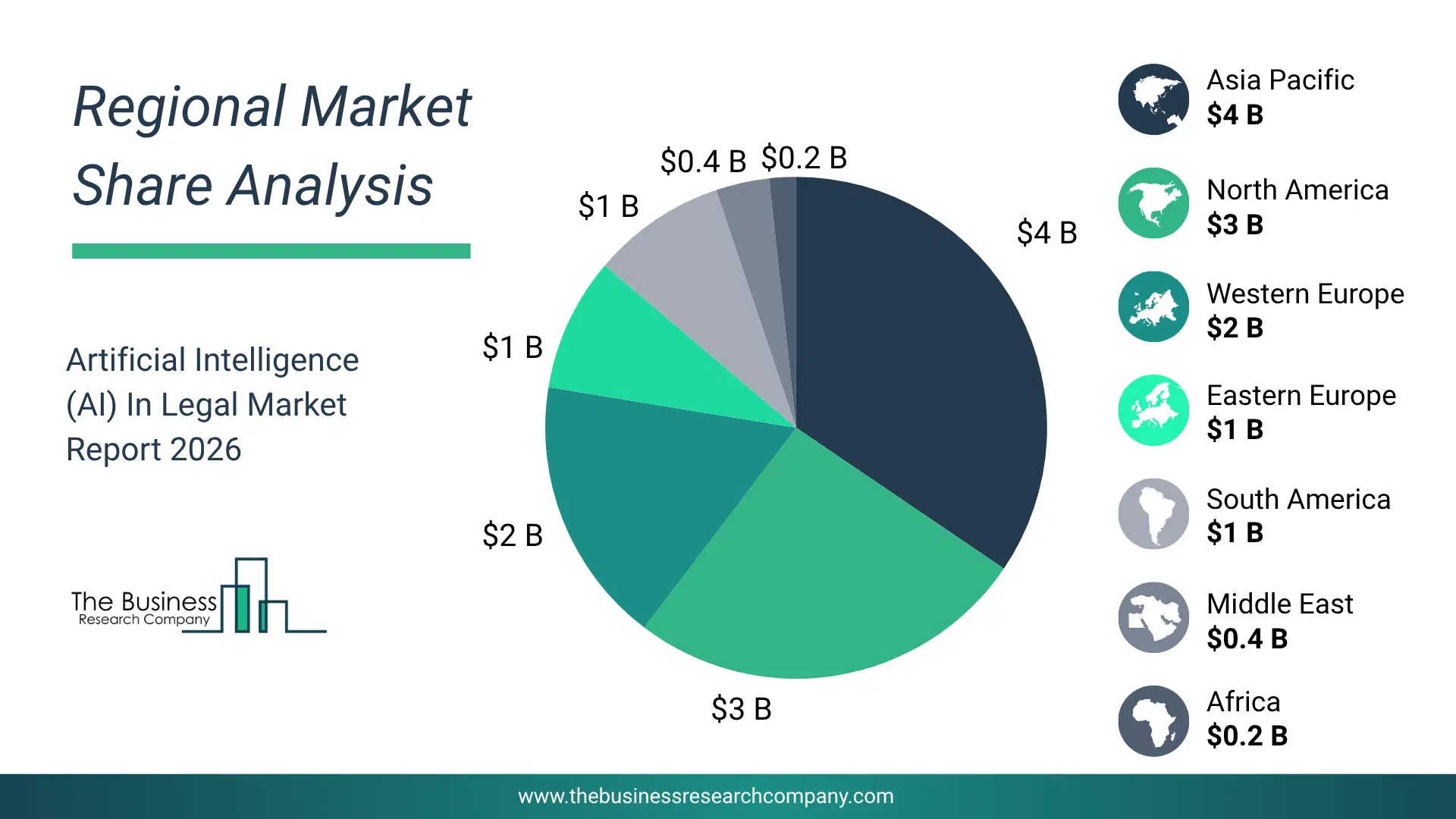
Regional Insights
North America was the largest region in the artificial intelligence (AI) in Legal market in 2025. Asia-Pacific is expected to be the fastest-growing region in the forecast period. The regions covered in this market report are Asia-Pacific, South East Asia, Western Europe, Eastern Europe, North America, South America, Middle East, Africa. The countries covered in this market report are Australia, Brazil, China, France, Germany, India, Indonesia, Japan, Taiwan, Russia, South Korea, UK, USA, Canada, Italy, Spain.What Defines the Artificial Intelligence (AI) In Legal Market?
The artificial intelligence (AI) in the legal market consists of revenues earned by entities by providing services such as legal consulting services, artificial intelligence (AI) model training services, workflow automation services, integration and implementation services, managed legal analytics services, and document review outsourcing services. The market value includes the value of related goods sold by the service provider or included within the service offering. The artificial intelligence (AI) in the legal market also includes sales of data storage appliances, high-performance computing workstations, optical document scanners, secure hardware tokens, and network routers. Values in this market are ‘factory gate’ values, that is the value of goods sold by the manufacturers or creators of the goods, whether to other entities (including downstream manufacturers, wholesalers, distributors and retailers) or directly to end customers. The value of goods in this market includes related services sold by the creators of the goods.How is Market Value Defined and Measured?
The market value is defined as the revenues that enterprises gain from the sale of goods and/or services within the specified market and geography through sales, grants, or donations in terms of the currency (in USD unless otherwise specified). The revenues for a specified geography are consumption values that are revenues generated by organizations in the specified geography within the market, irrespective of where they are produced. It does not include revenues from resales along the supply chain, either further along the supply chain or as part of other products.
This chart presents market attractiveness based on a quantitative evaluation of growth, competition, strategic alignment, and risk, offering a clear view of opportunity areas for decision-making. This chart is for illustrative purposes; the full report contains the complete analysis.

This chart highlights the Total Addressable Market (TAM) by estimating the maximum revenue opportunity using an assumption-driven approach, supporting strategic planning and opportunity sizing across markets. The chart is illustrative; the full report provides a more comprehensive analysis.
What Key Data and Analysis Are Included in the Artificial Intelligence (AI) In Legal Market Report 2026?
The artificial intelligence (ai) in legal market research report is one of a series of new reports from The Business Research Company that provides market statistics, including industry global market size, regional shares, competitors with the market share, detailed market segments, market trends and opportunities, and any further data you may need to thrive in the artificial intelligence (ai) in legal industry. The market research report delivers a complete perspective of everything you need, with an in-depth analysis of the current and future state of the industry.Artificial Intelligence (AI) In Legal Market Report Forecast Analysis
| Report Attribute | Details |
|---|---|
| Market Size Value In 2026 | $5.59 billion |
| Revenue Forecast In 2035 | $12.49 billion |
| Growth Rate | CAGR of 22.3% from 2026 to 2035 |
| Base Year For Estimation | 2025 |
| Actual Estimates/Historical Data | 2020-2025 |
| Forecast Period | 2026 - 2030 - 2035 |
| Market Representation | Revenue in USD Billion and CAGR from 2026 to 2035 |
| Segments Covered | Component, Deployment Mode, Application, End User |
| Regional Scope | Asia-Pacific, Western Europe, Eastern Europe, North America, South America, Middle East, Africa |
| Country Scope | The countries covered in the report are Australia, Brazil, China, France, Germany, India, ... |
| Key Companies Profiled | Amazon.com Inc., Microsoft Corporation, International Business Machines Corporation, Salesforce Inc., SAP SE, ServiceNow Inc., Thomson Reuters Corporation, Wolters Kluwer N.V, OpenText Corporation, RELX plc, FTI Consulting Inc., DocuSign Inc., Tyler Technologies Inc., Pegasystems Inc., UiPath Inc., Elastic N.V., LegalZoom.com Inc., Intapp Inc., CS Disco Inc., Nuix Limited, Veritone Inc., KLDiscovery Inc. |
| Customization Scope | Request for Customization |
| Pricing And Purchase Options | Explore Purchase Options |