

Artificial Intelligence (AI) In Logistics Automation Market Report 2026
Global Outlook – By Components (Hardware, Software, Services), By Deployment Modes (Cloud-Based, On-Premises, Hybrid), By Enterprise Sizes (Small And Medium Enterprises, Large Enterprises), By Applications (Warehouse Automation, Fleet Management And Autonomous Vehicles, Last-Mile Delivery, Supply Chain Planning And Forecasting, Customer Service And Experience, Cross-Border Logistics And Customs Automation), By End-User Industry (E-Commerce And Retail, Manufacturing, Transportation And Logistics, Food And Beverage, Pharmaceuticals) – Market Size, Trends, Strategies, and Forecast to 2030
Artificial Intelligence (AI) In Logistics Automation Market Overview
• Artificial Intelligence (AI) In Logistics Automation market size has reached to $12.29 billion in 2025 • Expected to grow to $53.14 billion in 2030 at a compound annual growth rate (CAGR) of 34.1% • Growth Driver: Expansion Of E-Commerce Fueling The Growth Of The Market Due To Rising Warehouse Automation Demand And Faster Order Fulfillment Requirements • Market Trend: Artificial Intelligence-Powered Grid-Based Robotic Fulfillment System Boosts Warehouse Efficiency And Order Throughput • North America was the largest region in 2025 and Asia-Pacific is the fastest growing region.What Is Covered Under Artificial Intelligence (AI) In Logistics Automation Market?
Artificial intelligence (AI) in logistics automation refers to the use of advanced algorithms and machine learning systems to streamline and optimize logistics operations such as transportation, warehousing, inventory management, and supply chain coordination. It enables real-time decision-making, predictive analytics, and process automation to improve efficiency, reduce costs, and enhance delivery accuracy. The main components of artificial intelligence (AI) in logistics automation include hardware, software, and services. Hardware refers to AI-enabled devices and infrastructure such as sensors, robotics, and automated systems that support logistics operations and decision-making. These solutions are deployed through cloud-based, on-premises, and hybrid models and are adopted by small and medium enterprises and large enterprises. The various applications involved are warehouse automation, fleet management and autonomous vehicles, last-mile delivery, supply chain planning and forecasting, customer service and experience, and cross-border logistics and customs automation, and they are used by several end user industries such as e-commerce and retail, manufacturing, transportation and logistics, food and beverage, and pharmaceuticals.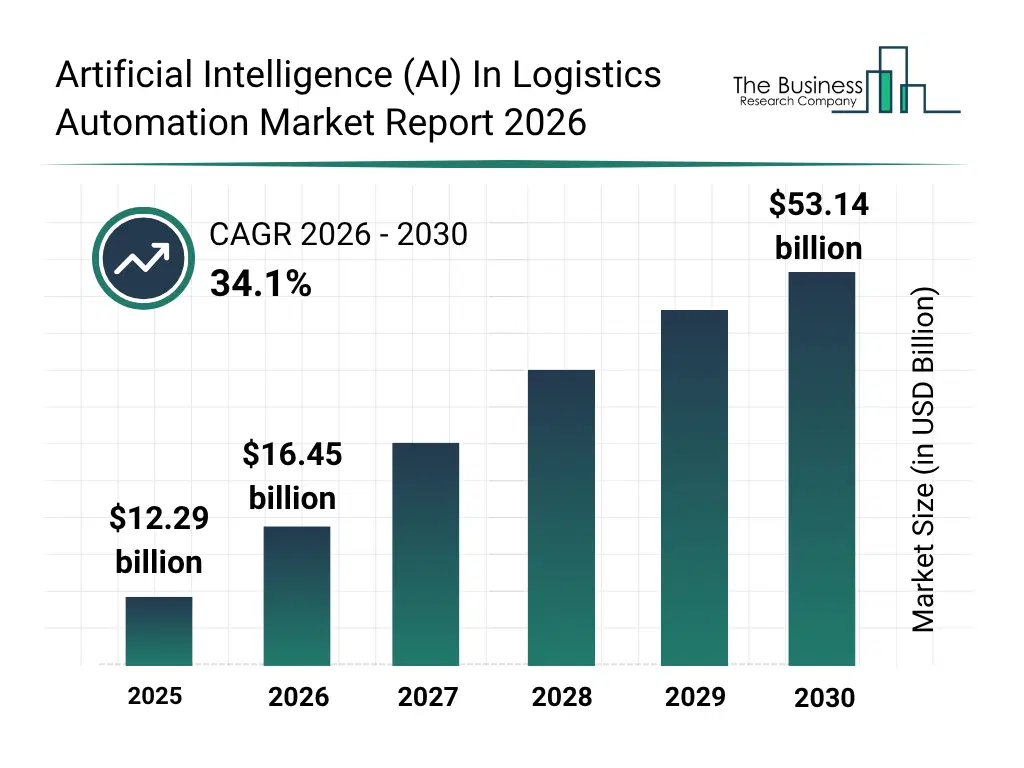
What Is The Artificial Intelligence (AI) In Logistics Automation Market Size and Share 2026?
The artificial intelligence (AI) in logistics automation market size has grown exponentially in recent years. It will grow from $12.29 billion in 2025 to $16.45 billion in 2026 at a compound annual growth rate (CAGR) of 33.8%. The growth in the historic period can be attributed to growth of e commerce logistics demand, expansion of warehouse automation systems, rising adoption of transportation management software, increasing globalization of supply chains, early integration of machine learning in logistics planning.What Is The Artificial Intelligence (AI) In Logistics Automation Market Growth Forecast?
The artificial intelligence (AI) in logistics automation market size is expected to see exponential growth in the next few years. It will grow to $53.14 billion in 2030 at a compound annual growth rate (CAGR) of 34.1%. The growth in the forecast period can be attributed to advancement in autonomous delivery vehicles and drones, expansion of ai driven supply chain orchestration platforms, rising demand for real time logistics visibility, growth of edge computing in warehouse operations, increasing focus on cost efficient and sustainable logistics operations. Major trends in the forecast period include rise of hyperlocal last-mile delivery optimization platforms, increasing adoption of predictive demand-based inventory positioning, expansion of autonomous drone and vehicle-based delivery networks, growing integration of digital twin models for logistics simulation, surge in cross-border e-commerce logistics automation and customs digitization.
Global Artificial Intelligence (AI) In Logistics Automation Market Segmentation
1) By Components: Hardware; Software; Services 2) By Deployment Modes: Cloud-Based; On-Premises; Hybrid 3) By Enterprise Sizes: Small And Medium Enterprises; Large Enterprises 4) By Applications: Warehouse Automation; Fleet Management And Autonomous Vehicles; Last-Mile Delivery; Supply Chain Planning And Forecasting; Customer Service And Experience; Cross-Border Logistics And Customs Automation 5) By End-User Industry: E-Commerce And Retail; Manufacturing; Transportation And Logistics; Food And Beverage; Pharmaceuticals Subsegments: 1) By Hardware: Autonomous Mobile Robots; Automated Guided Vehicles; Sensors; Cameras; Radio Frequency Identification Devices; Industrial Robots; Automated Storage And Retrieval Systems; Drones; Conveyor Systems 2) By Software: Transportation Management Software; Warehouse Management Software; Inventory Optimization Software; Predictive Analytics Software; Route Optimization Software; Supply Chain Visibility Software; Fleet Management Software; Order Management Software 3) By Services: Consulting Services; System Integration Services; Deployment Services; Maintenance And Support Services; Managed Services; Training Services; Data Analytics Services; Cloud ServicesWhat Is The Driver Of The Artificial Intelligence (AI) In Logistics Automation Market?
The e-commerce expansion is expected to propel the growth of the artificial intelligence (AI) in logistics automation market going forward. E-commerce is the process of buying and selling goods or services through digital platforms and online networks. E-commerce is expanding due to the increasing use of smartphones and internet connectivity, which enables consumers to conveniently browse, compare, and purchase products anytime and from virtually any location. The expansion of e-commerce necessitates the demand for artificial intelligence (AI) in logistics automation by increasing order volumes and delivery expectations, prompting warehouses to adopt AI-powered systems to accelerate picking, sorting, packaging, and inventory management operations with greater accuracy and efficiency. For instance, in May 2026, according to the Census Bureau, a US-based government agency, e-commerce estimates for the first quarter of 2026 rose by 9.7% (±1.8%) compared to the corresponding period in 2025. Therefore, the e-commerce expansion is driving the growth of the artificial intelligence (AI) in logistics automation industry.Key Players In The Global Artificial Intelligence (AI) In Logistics Automation Market
Major companies operating in the artificial intelligence (AI) in logistics automation market are Amazon Robotics LLC; Oracle Corporation; Siemens AG; ABB Ltd.; Daifuku Co. Ltd.; KUKA AG; Zebra Technologies Corp.; Kardex Holding AG; Manhattan Associates Inc.; Dematic Corp.; Ocado Group plc; Blue Yonder Group Inc.; Symbotic Inc.; AutoStore Holdings Ltd.; Swisslog Holding AG; Boston Dynamics Inc.; GreyOrange Pte. Ltd.; Geekplus Technology Co. Ltd.; Addverb Technologies Pvt. Ltd.; Locus Robotics Corporation; Fortna Inc.; Llama Logisol Private Limited; FarEye Technologies Inc.; Brightpick Inc.Global Artificial Intelligence (AI) In Logistics Automation Market Trends and Insights
Major companies operating in the artificial intelligence (AI) in logistics automation market are focusing on developing innovative solutions, such as AI-powered grid-based robotic fulfillment systems, to enhance operational efficiency, accelerate order processing, and improve warehouse throughput. AI-powered grid-based robotic fulfillment systems are warehouse automation systems that use artificial intelligence-driven robots operating within a structured grid layout to efficiently store, retrieve, and process orders with minimal human intervention. For instance, in March 2026, Brightpick Inc., a US-based warehouse robotics and automation company, launched Gridpicker, an AI-powered grid-based robotic fulfillment system to enable high-throughput, fully automated warehouse order picking and fulfillment operations. The system is built on Brightpick’s established Autopicker technology and uses AI-powered mobile manipulators operating within a dense grid storage architecture to execute autonomous item picking and order consolidation. It integrates computer vision, machine learning-based task allocation, and real-time fleet orchestration to optimize picking paths and minimize idle time. The solution is designed to significantly increase warehouse throughput, reduce labor dependency, and enhance fulfillment speed and accuracy, positioning it as a next-generation alternative to conventional automated storage and retrieval systems.What Are Latest Mergers And Acquisitions In The Artificial Intelligence (AI) In Logistics Automation Market?
In September 2023, Logility Inc., a US-based supply chain planning software company, acquired Garvis for an undisclosed amount. With this acquisition, Logility aims to strengthen its artificial intelligence-driven supply chain planning capabilities by integrating generative artificial intelligence, machine learning, and AI-native demand forecasting into its digital supply chain platform to improve forecasting accuracy and operational decision-making. Garvis Analytics NV is a Belgium-based software as a service company that specializes in artificial intelligence (AI) for logistics automation, with a particular focus on automating supply chain and logistics planning processes.Regional Outlook
North America was the largest region in the artificial intelligence (AI) in logistics automation market in 2025. Asia-Pacific is expected to be the fastest-growing region in the forecast period. The regions covered in this market report are Asia-Pacific, South East Asia, Western Europe, Eastern Europe, North America, South America, Middle East, Africa. The countries covered in this market report are Australia, Brazil, China, France, Germany, India, Indonesia, Japan, Taiwan, Russia, South Korea, UK, USA, Canada, Italy, Spain.What Defines the Artificial Intelligence (AI) In Logistics Automation Market?
The artificial intelligence (AI) in logistics automation market consists of revenues earned by entities by providing services such as route optimization, demand forecasting, warehouse automation, shipment tracking, and fleet management. The market value includes the value of related goods sold by the service provider or included within the service offering. The artificial intelligence (AI) in logistics automation market also includes sales of warehouse automation systems, autonomous robots, and smart warehouse management systems. Values in this market are ‘factory gate’ values, that is the value of goods sold by the manufacturers or creators of the goods, whether to other entities (including downstream manufacturers, wholesalers, distributors and retailers) or directly to end customers. The value of goods in this market includes related services sold by the creators of the goods.How is Market Value Defined and Measured?
The market value is defined as the revenues that enterprises gain from the sale of goods and/or services within the specified market and geography through sales, grants, or donations in terms of the currency (in USD unless otherwise specified). The revenues for a specified geography are consumption values that are revenues generated by organizations in the specified geography within the market, irrespective of where they are produced. It does not include revenues from resales along the supply chain, either further along the supply chain or as part of other products.What Key Data and Analysis Are Included in the Artificial Intelligence (AI) In Logistics Automation Market Report 2026?
The artificial intelligence (ai) in logistics automation market research report is one of a series of new reports from The Business Research Company that provides market statistics, including industry global market size, regional shares, competitors with the market share, detailed market segments, market trends and opportunities, and any further data you may need to thrive in the artificial intelligence (ai) in logistics automation industry. The market research report delivers a complete perspective of everything you need, with an in-depth analysis of the current and future state of the industry.Artificial Intelligence (AI) In Logistics Automation Market Report Forecast Analysis
| Report Attribute | Details |
|---|---|
| Market Size Value In 2026 | $16.45 billion |
| Revenue Forecast In 2030 | $53.14 billion |
| Growth Rate | CAGR of 34.1% from 2026 to 2030 |
| Base Year For Estimation | 2025 |
| Actual Estimates/Historical Data | 2020-2025 |
| Forecast Period | 2026 - 2030 |
| Market Representation | Revenue in USD Billion and CAGR from 2026 to 2030 |
| Segments Covered | Components, Deployment Modes, Enterprise Sizes, Applications, End-User Industry |
| Regional Scope | Asia-Pacific, Western Europe, Eastern Europe, North America, South America, Middle East, Africa |
| Country Scope | The countries covered in the report are Australia, Brazil, China, France, Germany, India, ... |
| Key Companies Profiled | Amazon Robotics LLC; Oracle Corporation; Siemens AG; ABB Ltd.; Daifuku Co. Ltd.; KUKA AG; Zebra Technologies Corp.; Kardex Holding AG; Manhattan Associates Inc.; Dematic Corp.; Ocado Group plc; Blue Yonder Group Inc.; Symbotic Inc.; AutoStore Holdings Ltd.; Swisslog Holding AG; Boston Dynamics Inc.; GreyOrange Pte. Ltd.; Geekplus Technology Co. Ltd.; Addverb Technologies Pvt. Ltd.; Locus Robotics Corporation; Fortna Inc.; Llama Logisol Private Limited; FarEye Technologies Inc.; Brightpick Inc. |
| Customization Scope | Request for Customization |
| Pricing And Purchase Options | Explore Purchase Options |