
Artificial Intelligence (AI) In Materials Discovery Market Report 2026
Global Outlook – By Offering (Software, Hardware, Services), By Material Type (Polymers, Metals and Alloys, Ceramics, Composites, Nanomaterials, Semiconductors), By Technology (Machine Learning, Deep Learning, Generative Artificial Intelligence, Natural Language Processing), By Deployment Mode (On Premise, Cloud Based, Hybrid), By End-User (Chemical Companies, Pharmaceutical Companies, Research Institutions, Manufacturing Companies, Other End-Users) – Market Size, Trends, Strategies, and Forecast to 2030
Artificial Intelligence (AI) In Materials Discovery Market Overview
• Artificial Intelligence (AI) In Materials Discovery market size has reached to $0.74 billion in 2025 • Expected to grow to $2.77 billion in 2030 at a compound annual growth rate (CAGR) of 30% • Growth Driver: Increasing Adoption Of AI-Driven Computational Modeling And Simulations Fueling The Growth Of The Market Due To Faster Innovation Cycles And Reduced Research And Development Costs • Market Trend: Deep-Learning Crystal Prediction Advances Materials Discovery And Screening • North America was the largest region in 2025 and Asia-Pacific is the fastest growing region.Market Gains By 2030 – Top Opportunities By Segment
Market Gain identifies the most promising market opportunities by highlighting the segments or products expected to generate the highest incremental revenue growth over the next five years.
What Is Covered Under Artificial Intelligence (AI) In Materials Discovery Market?
Artificial Intelligence (AI) in materials discovery uses artificial intelligence to analyze vast chemical and molecular datasets to predict promising new materials with desired properties. It speeds up research by automating simulations, identifying optimal compositions, and reducing trial-and-error experimentation. It helps researchers move from concept to validated material candidates far faster than traditional methods. The main offerings in the AI in materials discovery market include software, hardware, and services. Software comprises AI platforms, modeling tools, and simulation environments that enable data-driven materials design and prediction. The key material types addressed include polymers, metals and alloys, ceramics, composites, nanomaterials, and semiconductors, supporting innovation across diverse material classes. The core technologies used in this market include machine learning, deep learning, generative artificial intelligence, and natural language processing, enabling accelerated materials screening, property prediction, and knowledge extraction from scientific data. The various deployment modes include on premise, cloud based, and hybrid solutions. These solutions are utilized by several end-users such as chemical companies, pharmaceutical companies, research institutions, manufacturing companies, and others.
What Is The Artificial Intelligence (AI) In Materials Discovery Market Size and Share 2026?
The artificial intelligence (AI) in materials discovery market size has grown exponentially in recent years. It will grow from $0.74 billion in 2025 to $0.97 billion in 2026 at a compound annual growth rate (CAGR) of 30.3%. The growth in the historic period can be attributed to increasing adoption of computational modeling, growing availability of digital materials datasets, rising investment in artificial intelligence-based research, expanding use of machine learning in laboratories, and increasing industry-academia collaborations.What Is The Artificial Intelligence (AI) In Materials Discovery Market Growth Forecast?
The artificial intelligence (AI) in materials discovery market size is expected to see exponential growth in the next few years. It will grow to $2.77 billion in 2030 at a compound annual growth rate (CAGR) of 30.0%. The growth in the forecast period can be attributed to increasing need for rapid discovery of advanced materials, growing demand for high-performance energy storage materials, rising adoption of generative artificial intelligence models, expanding deployment of cloud-based simulation platforms, and increasing pressure to shorten research and development cycles. Major trends in the forecast period include advancements in multimodal artificial intelligence models, innovations in high-throughput computational screening, developments in autonomous laboratory systems, research and development in materials-focused foundation models, and progress in quantum-enhanced materials simulations.
Global Artificial Intelligence (AI) In Materials Discovery Market Segmentation
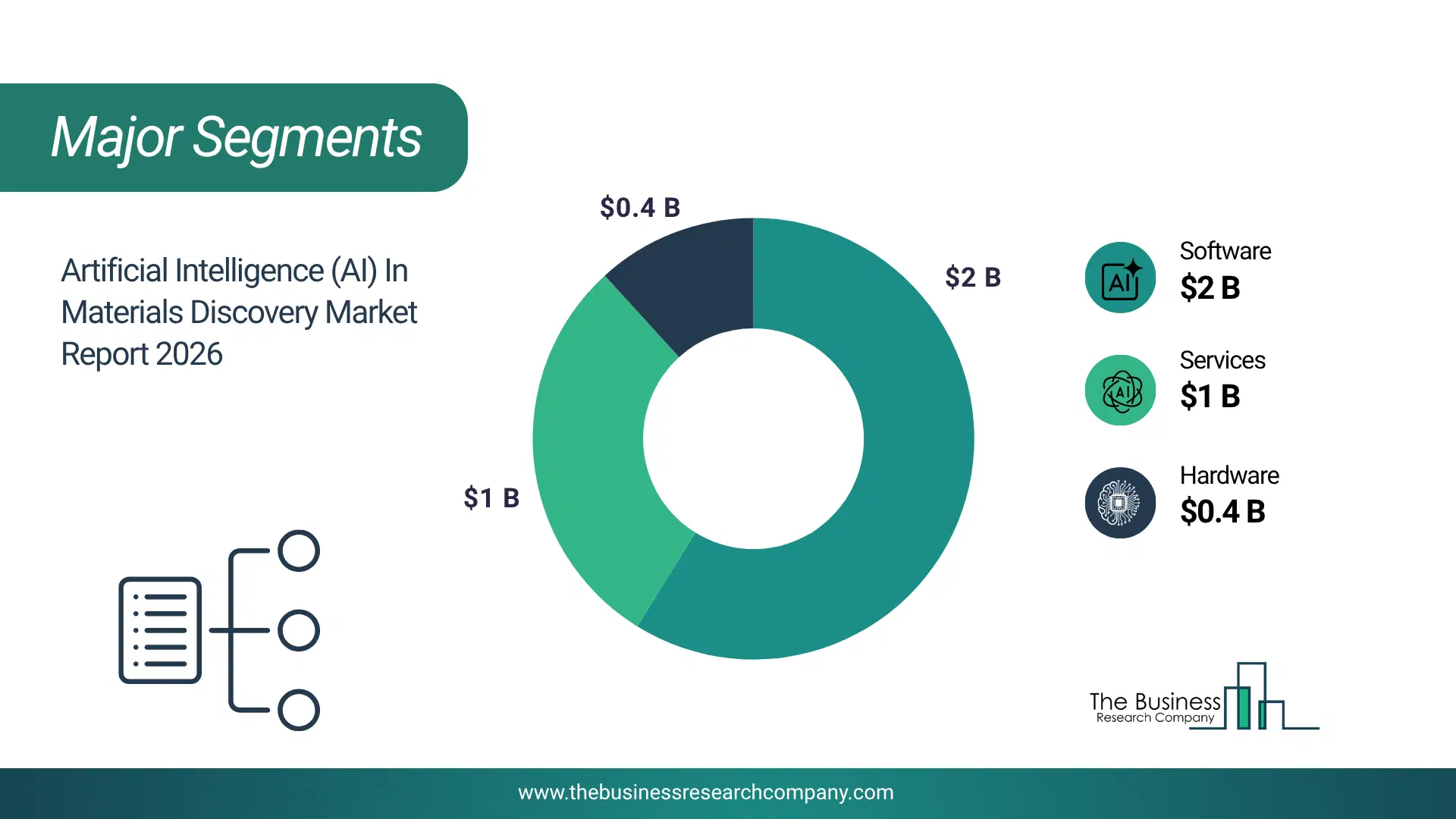
1) By Offering: Software, Hardware, Services 2) By Material Type: Polymers, Metals and Alloys, Ceramics, Composites, Nanomaterials, Semiconductors 3) By Technology: Machine Learning, Deep Learning, Generative Artificial Intelligence, Natural Language Processing 4) By Deployment Mode: On Premise, Cloud Based, Hybrid 5) By End-User: Chemical Companies, Pharmaceutical Companies, Research Institutions, Manufacturing Companies, Other End-Users Subsegments: 1) By Software: Predictive Modeling Platforms, Materials Simulation Tools, Data Analytics Systems, Molecular Design Software, Materials Informatics Platforms 2) By Hardware: High Performance Computing Systems, Graphics Processing Units, Specialized Accelerators, Data Storage Servers, Workstations For Computational Modeling 3) By Services: Consulting And Integration, Custom Model Development, Data Management Services, Simulation And Testing Services, Training And Support The top segments in the artificial intelligence (ai) in materials discovery market will be: • Software will reach $1.63 Billion by 2030. • Services will reach $0.66 Billion by 2030. • Hardware will reach $0.42 Billion by 2030.What Is The Driver Of The Artificial Intelligence (AI) In Materials Discovery Market?
The increasing adoption of AI‑driven computational modeling and simulations is expected to propel the growth of the artificial intelligence (AI) in materials discovery market going forward. AI‑driven computational modeling and simulations use machine learning and computational algorithms to predict material properties, design new compounds, and optimize structures, reducing reliance on traditional trial-and-error experimentation. The adoption of AI-driven modeling is increasing due to growing pressure on research institutions and industries to accelerate innovation and reduce development costs. AI in materials discovery supports this trend by enabling high-throughput virtual screening, accurate property prediction, and rapid identification of novel materials. For instance, in September 2023, according to Ames National Laboratory, a US-based government research lab, AI-based modeling achieved a speed-up of 100× compared to first-principles calculations, identifying 16 new P-rich compounds. Therefore, the increasing adoption of AI-driven computational modeling and simulations is driving the growth of the artificial intelligence (AI) in materials discovery industry.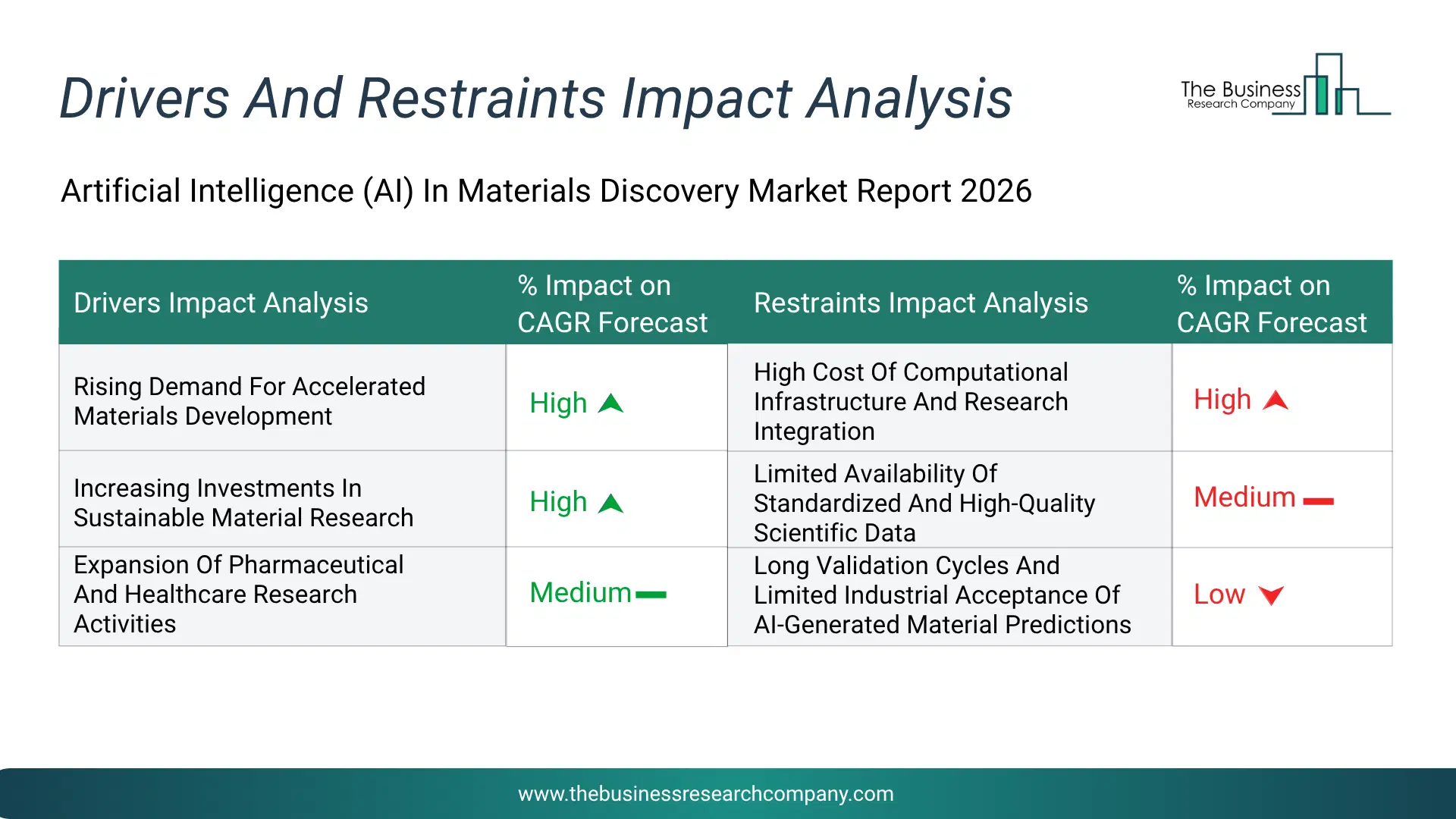
Infographic Chart Showing Key Market Drivers Analysis And Restraints For Artificial Intelligence (Ai) In Materials Discovery Market
The chart presents an impact analysis of key drivers and restraints, quantifying their relative influence on the market's growth rate and helping assess the balance between growth enablers and limiting factors. This chart offers a high-level perspective; the full report contains more detailed insights.
How Will The Drivers Impact Growth In The Global Artificial Intelligence (AI) In Materials Discovery Market?
• Rising Demand For Accelerated Materials Development (High) – During the forecast period, the rising demand for accelerated materials development is expected to become a key growth driver for the artificial intelligence (AI) in materials discovery market by 2030. Organizations are increasingly adopting AI-powered discovery platforms to shorten material design cycles, improve prediction accuracy, and rapidly identify high-performance compounds for commercial applications. Conventional experimentation methods require significant time and resources, encouraging researchers to utilize machine learning models for virtual screening and simulation. These capabilities enable faster validation of material properties while improving research productivity across multiple industries. This transition toward AI-enabled materials innovation is reinforcing sustained market expansion. • Increasing Investments In Sustainable Material Research (High) – During the forecast period, the increasing investments in sustainable material research are expected to emerge as a major factor driving the expansion of the artificial intelligence (AI) in materials discovery market by 2030. Public and private organizations are expanding funding for the development of environmentally responsible materials that support decarbonization and circular manufacturing objectives. AI technologies enable efficient evaluation of complex chemical datasets, allowing researchers to identify promising material candidates with improved sustainability characteristics. The growing focus on recyclable materials, next-generation batteries, and resource-efficient manufacturing is strengthening adoption of intelligent discovery platforms. Supportive sustainability initiatives across industrial sectors continue to accelerate commercialization of advanced materials. • Expansion Of Pharmaceutical And Healthcare Research Activities (Medium) – During the forecast period, the expansion of pharmaceutical and healthcare research activities is expected to act as a key growth catalyst for the artificial intelligence (AI) in materials discovery market by 2030. Growing biomedical research programs are increasing the use of AI for identifying novel biomaterials, optimizing molecular structures, and supporting precision drug development. Advanced computational models are helping researchers improve the efficiency of material selection for medical devices, drug delivery systems, tissue engineering, and diagnostic technologies. Rising investments in life sciences innovation and advanced therapeutic development are further strengthening demand for AI-assisted discovery solutions. As healthcare research activities continue to expand globally, adoption of intelligent materials discovery technologies is expected to increase steadily.How Will The Restraints Impact Growth In The Global Artificial Intelligence (AI) In Materials Discovery Market?
• High Cost Of Computational Infrastructure And Research Integration (High) – During the forecast period, the high cost of computational infrastructure and research integration is restraining the artificial intelligence in materials discovery market because implementing advanced computational platforms requires substantial financial investment. Organizations must allocate significant resources toward high-performance computing systems, cloud infrastructure, specialized software, and data management capabilities. Small and medium-sized enterprises often face difficulties in affording these integrated research environments, limiting broader market adoption. In addition, integrating artificial intelligence tools into existing laboratory workflows may require extensive operational restructuring and skilled personnel training. These financial and operational barriers can reduce adoption rates, particularly in cost-sensitive research environments. • Limited Availability Of Standardized And High-Quality Scientific Data (High) – During the forecast period, the limited availability of standardized and high-quality scientific data is limiting the growth of the artificial intelligence in materials discovery market because predictive modeling accuracy depends heavily on reliable and structured datasets. Many research institutions and industrial laboratories maintain fragmented or inconsistent material databases, which can reduce analytical precision and validation reliability. Incomplete experimental records and variations in testing methodologies further create challenges for effective artificial intelligence model training. The absence of universally accepted data-sharing standards also restricts collaboration between organizations and slows knowledge integration. As a result, data quality limitations continue to hinder the full-scale commercialization and scalability of artificial intelligence-driven materials discovery solutions. • Long Validation Cycles And Limited Industrial Acceptance Of AI-Generated Material Predictions (Medium) – During the forecast period, the long validation cycles and limited industrial acceptance of AI-generated material predictions are expected to restrain the growth of the artificial intelligence in materials discovery market. Although artificial intelligence can rapidly identify promising material candidates, predicted outcomes must undergo extensive laboratory testing, prototype development, and real-world validation before they can be adopted for commercial applications. Experimental verification is often time-consuming, resource-intensive, and dependent on specialized research facilities, reducing the speed-to-market benefits offered by AI-driven discovery platforms. In addition, many organizations remain cautious about relying solely on AI-generated predictions due to concerns regarding model explainability, reproducibility, and the reliability of computational results across diverse material systems. The need for repeated experimental validation and expert review increases research timelines and development costs, particularly in highly regulated industries such as aerospace, healthcare, energy, and electronics. These challenges may discourage organizations from fully integrating AI into their materials research and development workflows. Consequently, long validation cycles and limited industrial acceptance of AI-generated material predictions remain significant restraints on the growth of the artificial intelligence in materials discovery market.Key Players In The Global Artificial Intelligence (AI) In Materials Discovery Market
Major companies operating in the artificial intelligence (AI) in materials discovery market are Google LLC, Microsoft Corporation, BASF SE, International Business Machine Corp, Dassault Systèmes, Nautilus Materials Inc., Schrödinger Inc., Enthought Inc., Citrine Informatics Inc., Iktos SA, Quantum Motion, Aionics Inc., Exabyte.io, Materials Zone Ltd., Aionics Inc., Polymerize AG, Atinary Technologies GmbH, Phaseshift Technologies, Polaron Analytics, Kebotix Inc.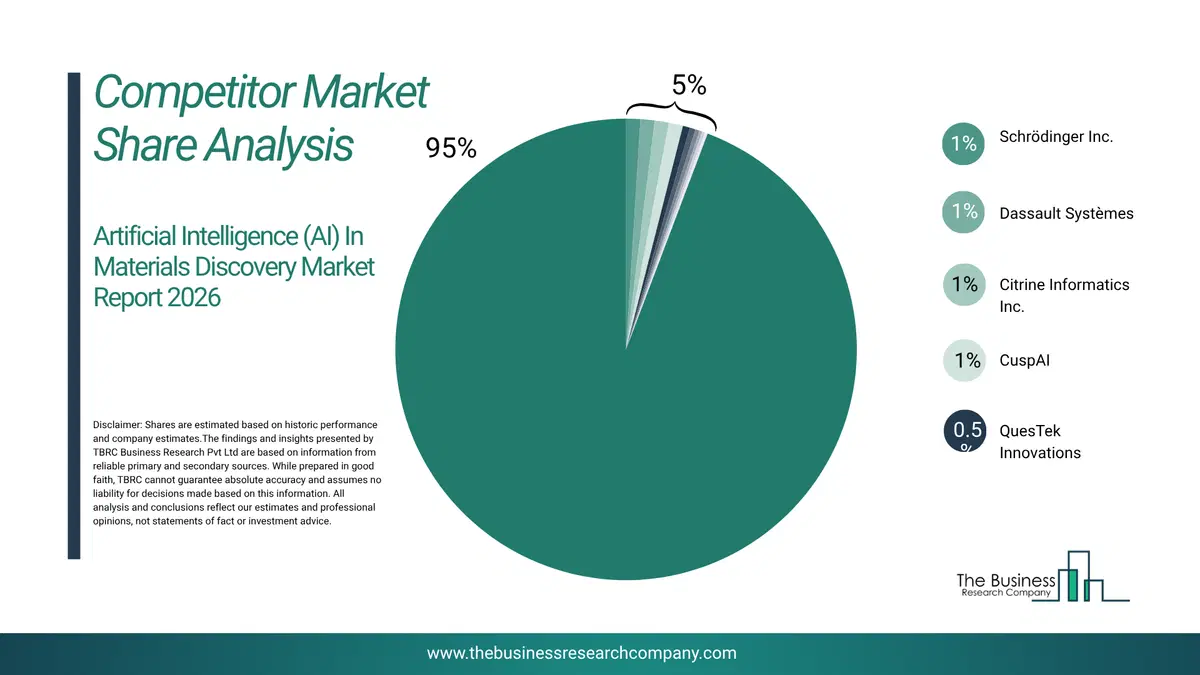
This chart is for illustrative purposes; the full report includes a detailed competitor analysis and comprehensive overview of the top 10 companies in the market.
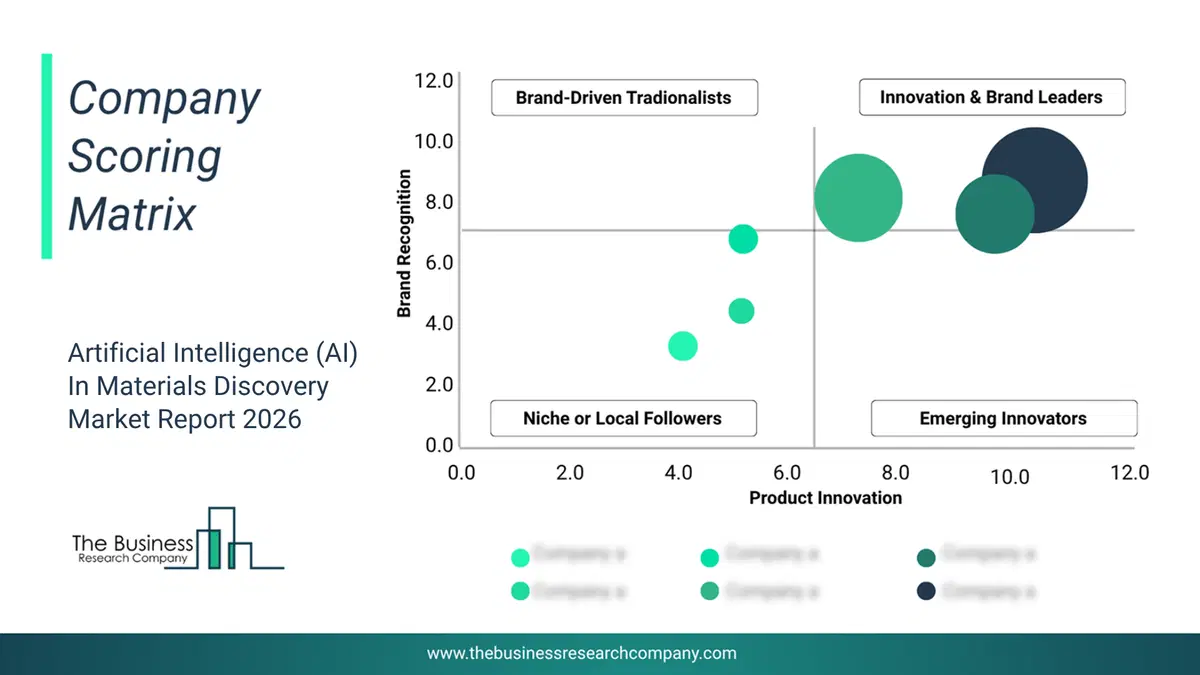
This chart maps companies by product innovation and brand strength, with bubble size indicating relative revenue, helping identify market leaders, challengers, and niche players. This is an illustrative chart; the full report provides a complete and accurate competitive analysis.
Global Artificial Intelligence (AI) In Materials Discovery Market Trends and Insights
Major companies operating in the artificial intelligence (AI) in materials discovery market are focusing on advancing large-scale crystal structure prediction, such as deep-learning-driven exploration of new crystalline compounds, to expand the accessible chemical space, speed up material identification, and enhance computational screening workflows. Large-scale crystal structure prediction refers to the use of graph-based neural networks and algorithmic exploration systems that generate, evaluate, and rank millions of hypothetical crystal structures against known stability and performance criteria. For instance, in November 2023, Google DeepMind, a UK-based artificial intelligence company, introduced GNoME, an AI-powered materials discovery system that predicted 2.2 million new crystal structures and identified around 380,000 as potentially stable. The system uses graph neural networks to model atomic interactions, integrates active learning to continuously refine predictions, and applies high-accuracy density functional theory (DFT) checks to validate structural stability. This launch represents a significant advancement in computational materials discovery by expanding the library of known stable crystals, accelerating early-stage screening, and enabling researchers to uncover candidates with promising functional properties across diverse material classes.What Are Latest Mergers And Acquisitions In The Artificial Intelligence (AI) In Materials Discovery Market?
In October 2024, Comstock Inc., a US-based provider of renewable energy technologies and advanced materials solutions, acquired Quantum Generative Materials LLC (GenMat) for an undisclosed amount. With this acquisition, Comstock aims to accelerate its AI-led materials innovation by integrating GenMat’s physics-based generative modeling platform, automated synthesis workflows, and specialized materials research capabilities to expand its portfolio of high-performance, energy-efficient, and sustainability-focused materials, thereby strengthening long-term competitiveness in next-generation materials development. Quantum Generative Materials LLC is a US-based provider of AI-driven materials discovery solutions that combine computational modeling, advanced algorithms, and autonomous experimentation to design, predict, and optimize novel materials for applications across energy, sustainability, and advanced manufacturing sectors.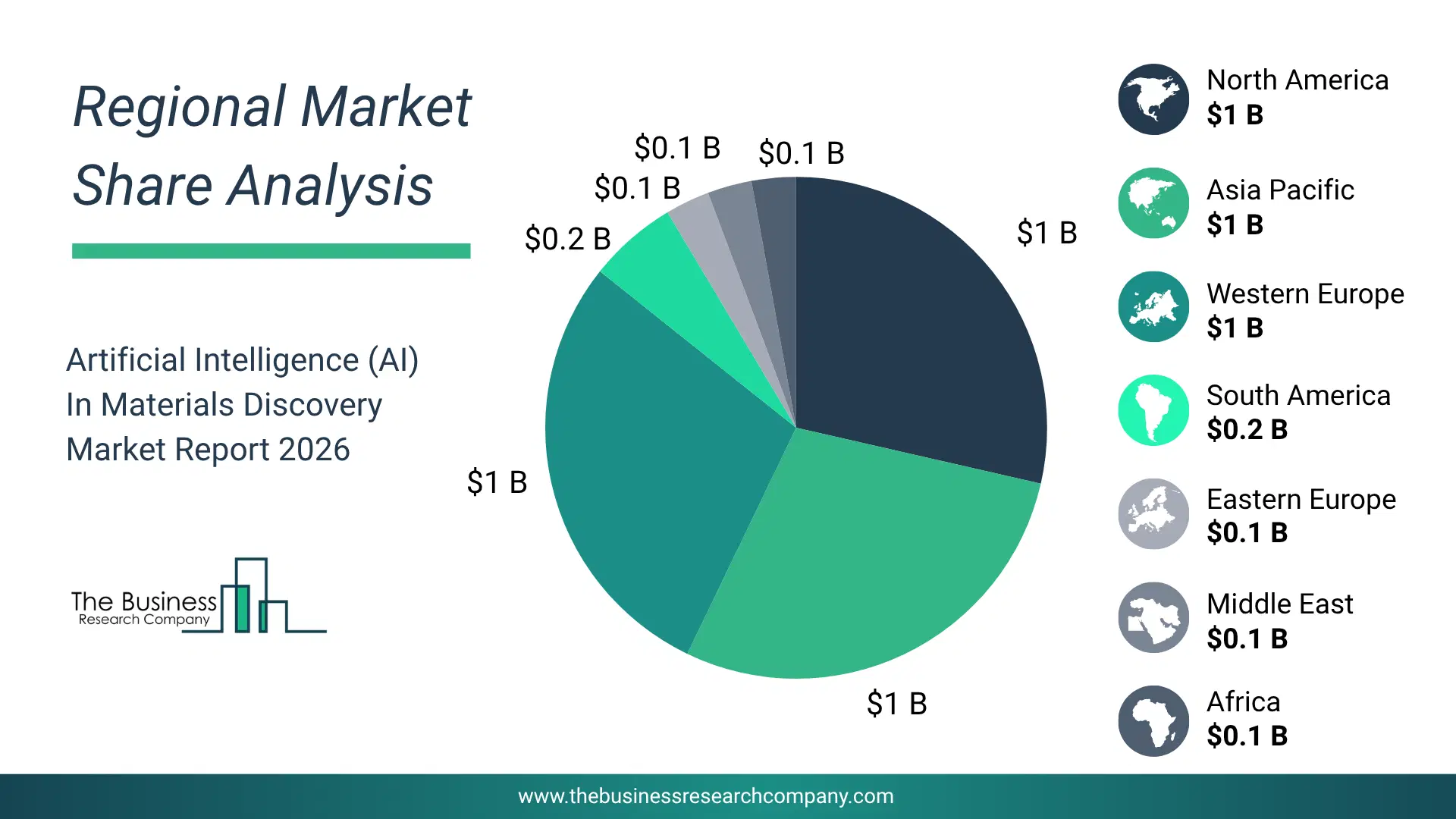
Regional Insights
North America was the largest region in the artificial intelligence (AI) in materials discovery market in 2025. Asia-Pacific is expected to be the fastest-growing region in the forecast period. The regions covered in this market report are Asia-Pacific, South East Asia, Western Europe, Eastern Europe, North America, South America, Middle East, Africa. The countries covered in this market report are Australia, Brazil, China, France, Germany, India, Indonesia, Japan, Taiwan, Russia, South Korea, UK, USA, Canada, Italy, Spain.What Defines the Artificial Intelligence (AI) In Materials Discovery Market?
The artificial intelligence in materials discovery market consists of revenues earned by entities by providing services such as developing predictive algorithms, running large-scale computational simulations, generating virtual material prototypes, delivering cloud-based modeling platforms, and offering data analytics that accelerate material identification and optimization. The market value includes the value of related goods sold by the service provider or included within the service offering.The artificial intelligence in materials discovery market includes sales of artificial intelligence-driven simulation software, machine learning modeling platforms, computational chemistry tools, materials property prediction engines, data management and analytics systems.Values in this market are ‘factory gate’ values, that is, the value of goods sold by the manufacturers or creators of the goods, whether to other entities (including downstream manufacturers, wholesalers, distributors, and retailers) or directly to end customers. The value of goods in this market includes related services sold by the creators of the goods.How is Market Value Defined and Measured?
The market value is defined as the revenues that enterprises gain from the sale of goods and/or services within the specified market and geography through sales, grants, or donations in terms of the currency (in USD unless otherwise specified). The revenues for a specified geography are consumption values that are revenues generated by organizations in the specified geography within the market, irrespective of where they are produced. It does not include revenues from resales along the supply chain, either further along the supply chain or as part of other products.
This chart presents market attractiveness based on a quantitative evaluation of growth, competition, strategic alignment, and risk, offering a clear view of opportunity areas for decision-making. This chart is for illustrative purposes; the full report contains the complete analysis.

This chart highlights the Total Addressable Market (TAM) by estimating the maximum revenue opportunity using an assumption-driven approach, supporting strategic planning and opportunity sizing across markets. The chart is illustrative; the full report provides a more comprehensive analysis.
What Key Data and Analysis Are Included in the Artificial Intelligence (AI) In Materials Discovery Market Report 2026?
The artificial intelligence (ai) in materials discovery market research report is one of a series of new reports from The Business Research Company that provides market statistics, including industry global market size, regional shares, competitors with the market share, detailed market segments, market trends and opportunities, and any further data you may need to thrive in the artificial intelligence (ai) in materials discovery industry. The market research report delivers a complete perspective of everything you need, with an in-depth analysis of the current and future state of the industry.Artificial Intelligence (AI) In Materials Discovery Market Report Forecast Analysis
| Report Attribute | Details |
|---|---|
| Market Size Value In 2026 | $0.97 billion |
| Revenue Forecast In 2030 | $2.77 billion |
| Growth Rate | CAGR of 30.3% from 2026 to 2030 |
| Base Year For Estimation | 2025 |
| Actual Estimates/Historical Data | 2020-2025 |
| Forecast Period | 2026 - 2030 |
| Market Representation | Revenue in USD Billion and CAGR from 2026 to 2030 |
| Segments Covered | Offering, Material Type, Technology, Deployment Mode, End-User |
| Regional Scope | Asia-Pacific, Western Europe, Eastern Europe, North America, South America, Middle East, Africa |
| Country Scope | The countries covered in the report are Australia, Brazil, China, France, Germany, India, Indonesia, Japan, Taiwan, Russia, South Korea, UK, USA, Canada, Italy, Spain. |
| Key Companies Profiled | Google LLC, Microsoft Corporation, BASF SE, International Business Machine Corp, Dassault Systèmes, Nautilus Materials Inc., Schrödinger Inc., Enthought Inc., Citrine Informatics Inc., Iktos SA, Quantum Motion, Aionics Inc., Exabyte.io, Materials Zone Ltd., Aionics Inc., Polymerize AG, Atinary Technologies GmbH, Phaseshift Technologies, Polaron Analytics, Kebotix Inc. |
| Customization Scope | Request for Customization |
| Pricing And Purchase Options | Explore Purchase Options |