

Artificial Intelligence (AI) In Military Training Market Report 2026
Global Outlook – By Component (Software, Hardware, Services), By Technology (Machine Learning, Natural Language Processing, Computer Vision, Simulation And Modeling, Other Technologies), By Deployment Mode (On-Premises, Cloud), By Application (Combat Training, Flight Simulation, Tactical Training, Chemical, Biological, Radiological, And Nuclear (CNRN) Simulation, Cyber Warfare Training, Electronic Warfare Training, Other Applications), By End-User (Army, Navy, Air Force, Other End-Users) – Market Size, Trends, Strategies, and Forecast to 2030
Artificial Intelligence (AI) In Military Training Market Overview
• Artificial Intelligence (AI) In Military Training market size has reached to $1.46 billion in 2025 • Expected to grow to $2.17 billion in 2030 at a compound annual growth rate (CAGR) of 8.3% • Growth Driver: The Rising Demand For Realistic, Adaptive Training Solutions Is Fueling Market Growth Due To Increasing Military Modernization • Market Trend: Expansion Of AI Training Initiatives Enhancing Military Operational Capabilities • North America was the largest region in 2025 and Asia-Pacific is the fastest growing region.Market Gains By 2030 – Top Opportunities By Segment
Market Gain identifies the most promising market opportunities by highlighting the segments or products expected to generate the highest incremental revenue growth over the next five years.
What Is Covered Under Artificial Intelligence (AI) In Military Training Market?
Artificial intelligence (AI) in military training refers to the use of advanced computational systems to simulate realistic combat scenarios and decision-making environments. It enables adaptive learning, predictive analysis, and automated feedback to enhance strategic skills and operational readiness. By processing vast amounts of data, AI helps refine tactics, improve situational awareness, and optimize training efficiency. The main components in the artificial intelligence (AI) in military training market are software, hardware, and services. Software includes programs and platforms such as, simulation tools, data analysis applications, and decision-support systems that enable AI functions within military training workflows. The various technologies include machine learning, natural language processing, computer vision, simulation and modeling, and others, deployed based on on-premises and cloud modes. Key applications include combat training, flight simulation, tactical training, chemical, biological, radiological, and nuclear (CNRN) simulation, cyber warfare training, electronic warfare training, and others. The different end-users encompass army, navy, air force, and others.
What Is The Artificial Intelligence (AI) In Military Training Market Size and Share 2026?
The artificial intelligence (AI) in military training market size has grown strongly in recent years. It will grow from $1.46 billion in 2025 to $1.57 billion in 2026 at a compound annual growth rate (CAGR) of 8.0%. The growth in the historic period can be attributed to use of simulation-based training programs, adoption of ai for adaptive learning, integration of autonomous drones in exercises, deployment of intelligent performance assessment tools, implementation of cyber threat training.What Is The Artificial Intelligence (AI) In Military Training Market Growth Forecast?
The artificial intelligence (AI) in military training market size is expected to see strong growth in the next few years. It will grow to $2.17 billion in 2030 at a compound annual growth rate (CAGR) of 8.3%. The growth in the forecast period can be attributed to development of immersive ar/vr training solutions, expansion of predictive mission planning systems, integration with real-time battlefield data, growth in autonomous vehicle training platforms, adoption of cloud-based collaborative training environments. Major trends in the forecast period include increase in ai-driven adaptive training models, growth in autonomous simulation environments, expansion of real-time mission scenario modeling, rising use of intelligent performance scoring systems, integration of smart behavioral and tactical assessment tools.
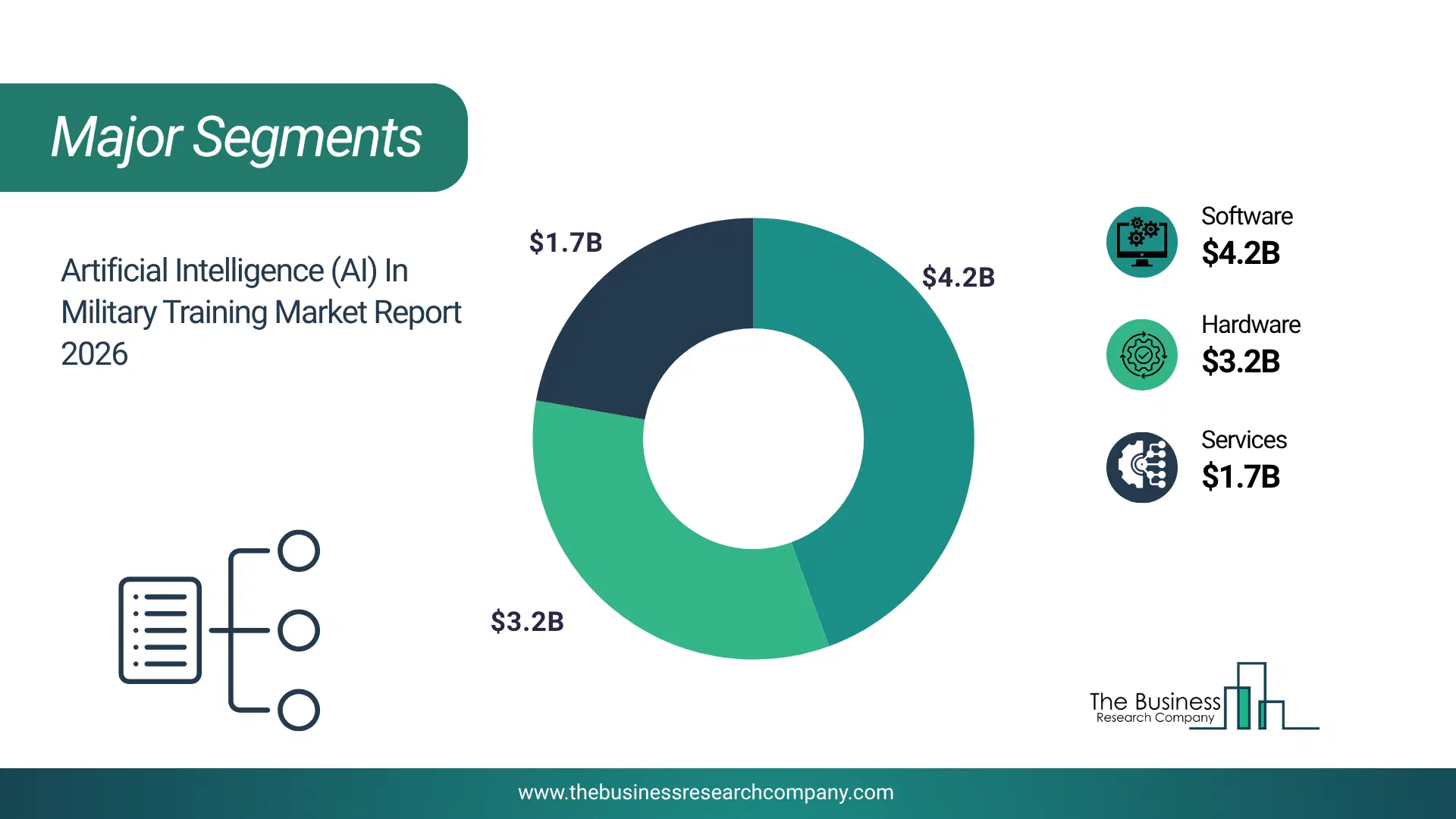
Global Artificial Intelligence (AI) In Military Training Market Segmentation
1) By Component: Software, Hardware, Services 2) By Technology: Machine Learning, Natural Language Processing, Computer Vision, Simulation And Modeling, Other Technologies 3) By Deployment Mode: On-Premises, Cloud 4) By Application: Combat Training, Flight Simulation, Tactical Training, Chemical, Biological, Radiological, And Nuclear (CNRN) Simulation, Cyber Warfare Training, Electronic Warfare Training, Other Applications 5) By End-User: Army, Navy, Air Force, Other End-Users Subsegments: 1) By Software: Simulation Platforms, Learning Management Systems, Performance Analysis Tools, Data Integration Software, Scenario Generation Software 2) By Hardware: Training Simulators, Virtual Reality Devices, Augmented Reality Equipment, Computing Systems, Display Units 3) By Services: Training and Support, System Integration, Consulting Services, Maintenance and Upgrades, Customization Services The top segments in the artificial intelligence (ai) in military training market will be: • Software will reach $4.15 billion by 2030. • Hardware will reach $3.17 billion by 2030. • Services will reach $1.67 billion by 2030.What Is Driver Of The Artificial Intelligence (AI) In Military Training Market?
The rising demand for realistic, adaptive training solutions is expected to propel the growth of the artificial intelligence (AI) in military training market going forward. Realistic, adaptive training solutions refer to training programs or systems that closely mimic real-world scenarios and automatically adjust to the learner’s progress or needs. Realistic, adaptive training solutions are rising due to the growing need for personalized, technology-driven learning experiences that improve effectiveness, efficiency, and readiness in rapidly changing environments. Artificial intelligence (AI) in military training supports realistic, adaptive training solutions by simulating complex battlefield environments, analyzing trainee performance in real time, and dynamically adjusting scenarios to match individual skill levels, ensuring both authenticity and personalized skill development. For instance, in August 2025, according to the Ministry of Defence, a UK-based government department, between 1 July 2024 and 31 June 2025, 1,580 more people joined the UK Regular Armed Forces than in the previous year, representing a 13% increase. Therefore, the rising demand for realistic, adaptive training solutions is driving the growth of the artificial intelligence (AI) in military training industry.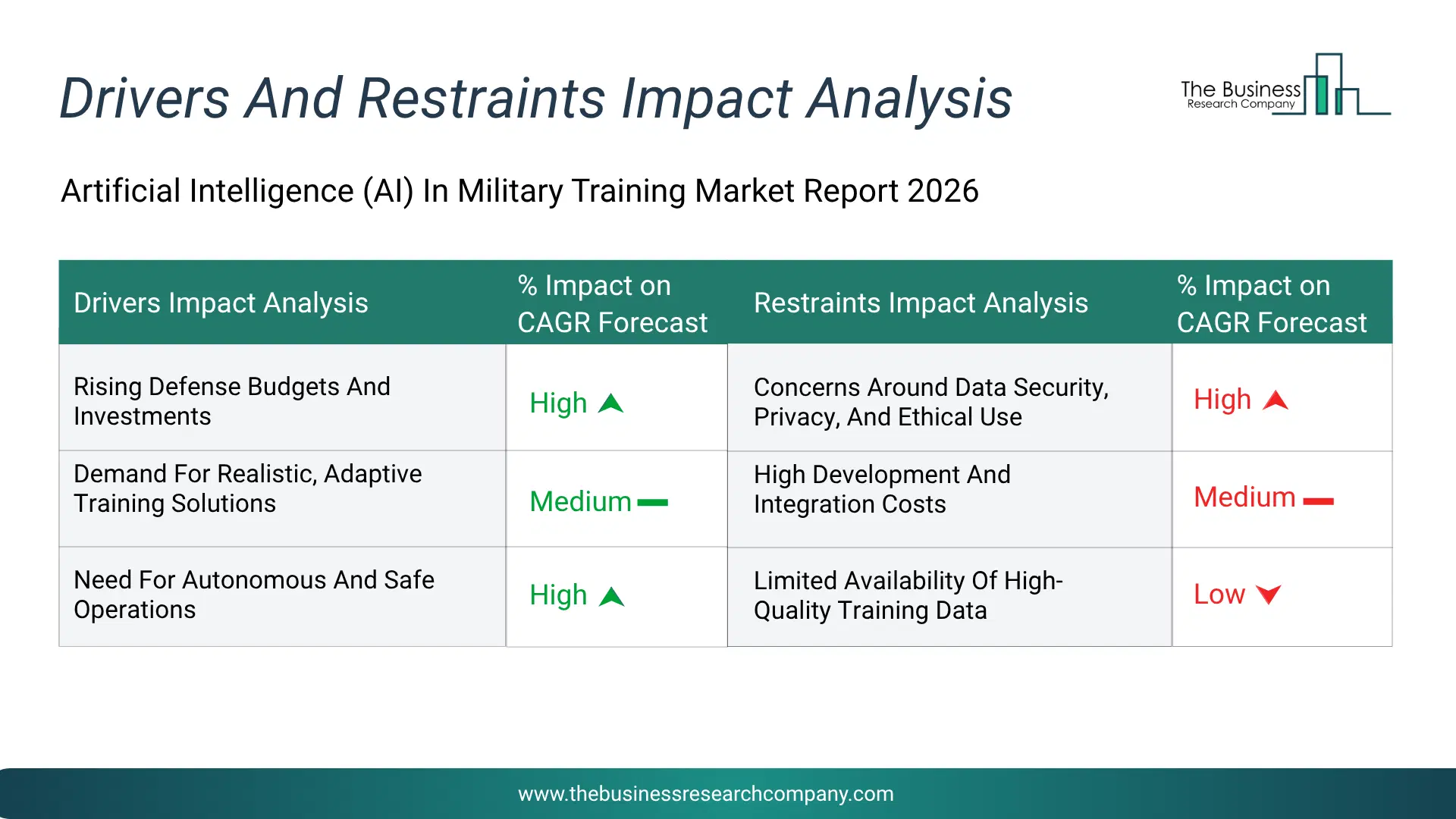
Infographic Chart Showing Key Market Drivers Analysis And Restraints For Artificial Intelligence (Ai) In Military Training Market
The chart presents an impact analysis of key drivers and restraints, quantifying their relative influence on the market's growth rate and helping assess the balance between growth enablers and limiting factors. This chart offers a high-level perspective; the full report contains more detailed insights.
How Will The Drivers Impact Growth In The Global Artificial Intelligence (AI) In Military Training Market?
• Rising Defense Budgets And Investments (High) – During the forecast period, the rising defense budgets and investments are expected to become a key growth driver for the artificial intelligence (ai) in military training market by 2030. Increasing global defense spending enables armed forces to allocate greater resources toward advanced technologies, including ai-powered training systems. This rise in funding supports the development and deployment of sophisticated ai-driven simulation platforms, helping militaries address evolving security threats. Significant investments also encourage innovation and partnerships with technology providers, accelerating ai adoption in defense training programs. • Demand For Realistic, Adaptive Training Solutions (Medium) – During the forecast period, the growing demand for realistic, adaptive training solutions is expected to emerge as a major factor driving the expansion of the artificial intelligence (ai) in military training market by 2030. Modern defense forces require training systems that replicate real-world combat environments with high accuracy. Ai-enabled platforms create immersive, responsive scenarios that adjust dynamically to user actions, delivering personalized and performance-based training experiences. These systems support complex mission simulations, including cyber and electronic warfare, which are challenging and costly to reproduce through conventional methods. • Need For Autonomous And Safe Operations (High) – During the forecast period, the need for autonomous and safe operations is expected to act as a key growth catalyst for the artificial intelligence (ai) in military training market by 2030. As autonomous vehicles, drones, and ai-assisted decision-support systems become more prevalent in defense operations, there is a growing requirement to train personnel in effectively operating and coordinating with these technologies. Ai-based training platforms provide secure and controlled environments to simulate such interactions, minimizing operational risks and equipment damage. This ensures readiness for next-generation warfare systems.How Will The Restraints Impact Growth In The Global Artificial Intelligence (AI) In Military Training Market?
• Concerns Around Data Security, Privacy, And Ethical Use (High) – During the forecast period, the use of ai in military training raises concerns about protecting sensitive data and ensuring ethical use. Handling large volumes of personal and mission-critical information creates vulnerabilities to breaches, unauthorized access, and cyber threats. Additionally, there is ongoing debate about transparency, accountability, and bias in ai decision-making, highlighting the need for robust security protocols and clear ethical guidelines. • High Development And Integration Costs (Medium) – During the forecast period, the developing and integrating advanced ai training systems demand substantial financial investment, specialized skills, and continuous operational spending. The costs span software development, infrastructure upgrades, maintenance, and compute resources. These expenses can strain budgets and may deter widespread adoption, particularly in countries with smaller defense allocations or modernizing legacy infrastructure. • Limited Availability Of High-Quality Training Data (Low) – During the forecast period, the limited availability of high-quality training data acts as a significant restraint in the artificial intelligence (ai) in military training market, as effective ai systems require large volumes of accurate, diverse, and mission-relevant datasets. In many defense scenarios, data is restricted due to confidentiality, security classifications, and operational sensitivity. This lack of accessible and standardized data can reduce model accuracy, limit simulation realism, and hinder effective training outcomes. Additionally, inconsistent data formats across military systems further complicate ai model development and integration. As a result, these data constraints slow down the deployment and effectiveness of ai-driven military training solutions.Key Players In The Global Artificial Intelligence (AI) In Military Training Market
Major companies operating in the artificial intelligence (AI) in military training market are BAE Systems plc, Lockheed Martin Corp., Northrop Grumman Corporation, CAE Inc., Raytheon Technologies Corp., The Boeing Company, Thales Group, Palantir Technologies Inc., Anduril Industries Inc., Leidos Group, IAI (Israel Aerospace Industries), General Dynamics Corp., Shield AI, Scale AI Inc., Calian, BigBear.ai Holdings Inc., Elbit Systems Ltd., Peraton, Soar Technology (SoarTech), Charles River Analytics Inc., International Business Machine Corp., Microsoft Corp., SimCentric Technologies Ltd., The ASTA Group, Athena AI, Inzpire Ltd.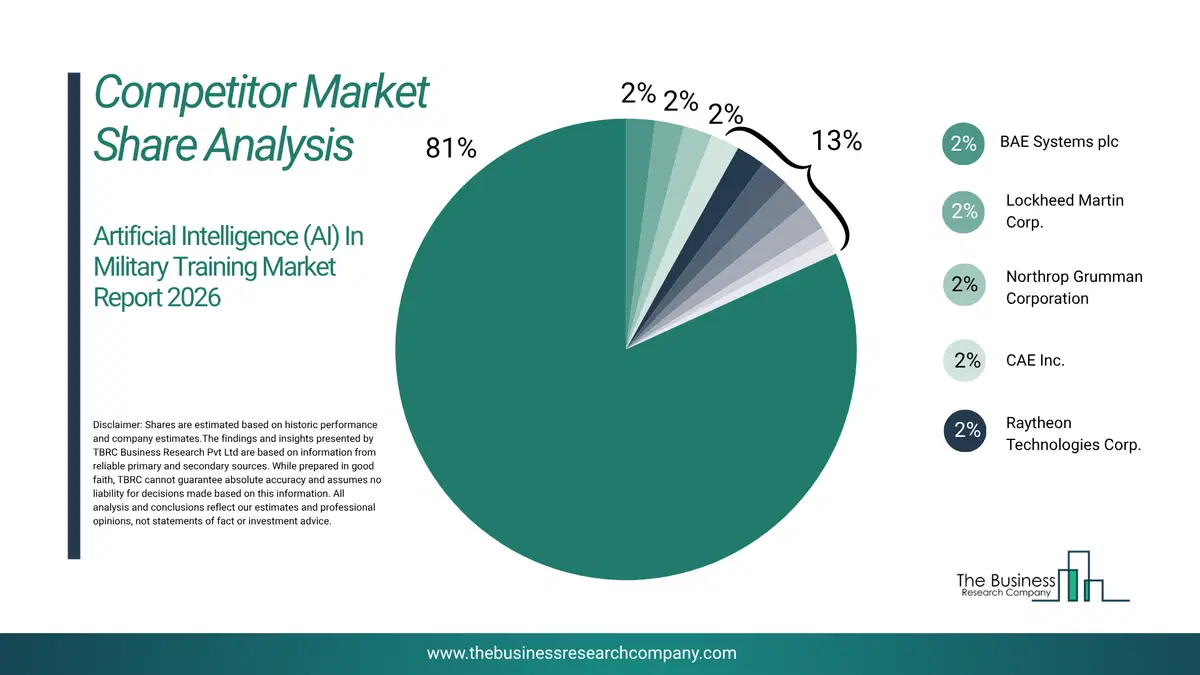
This chart is for illustrative purposes; the full report includes a detailed competitor analysis and comprehensive overview of the top 10 companies in the market.
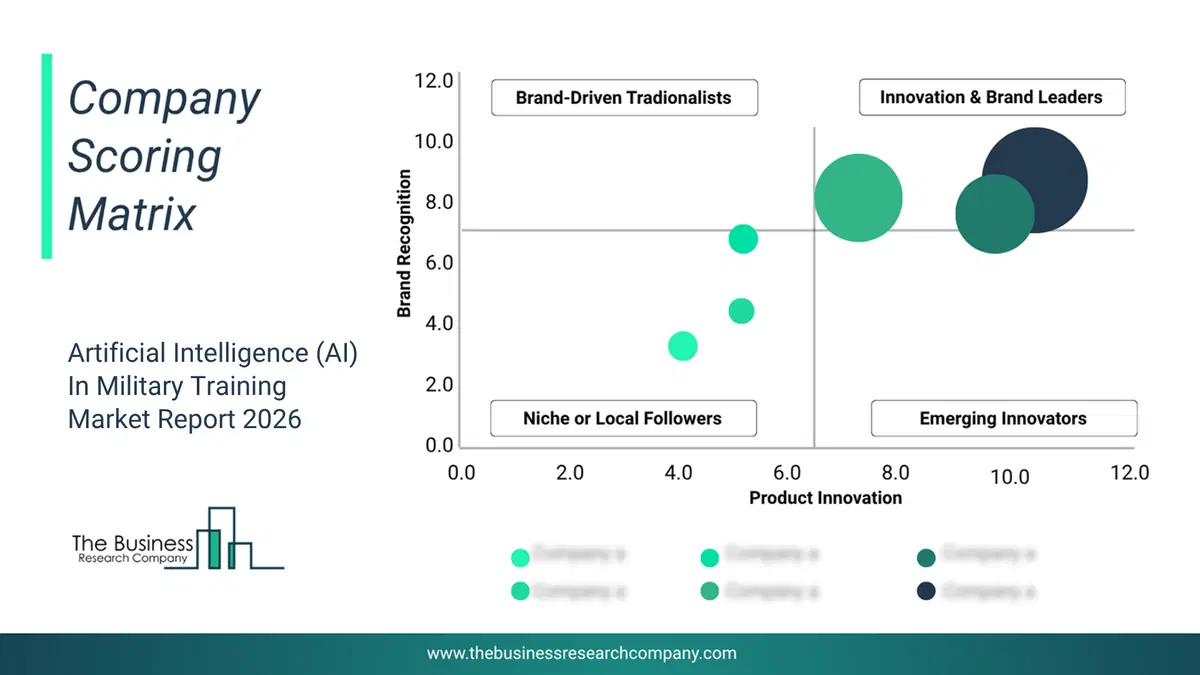
This chart maps companies by product innovation and brand strength, with bubble size indicating relative revenue, helping identify market leaders, challengers, and niche players. This is an illustrative chart; the full report provides a complete and accurate competitive analysis.
Global Artificial Intelligence (AI) In Military Training Market Trends and Insights
Major companies in the AI in military training market are focusing on conducting AI-powered training programs to equip military personnel with expertise in emerging AI technologies. AI-powered training programs are designed to strengthen operational readiness, improve strategic decision-making, and ensure the seamless integration of AI-driven systems into defense operations. For instance, in June 2025, the Nigerian Air Force (NAF), a Nigeria-based armed forces, launched an intensive three-week artificial intelligence (AI) training program at the Air Force Research and Development Institute (AFRDI) in Osogbo. The initiative aims to enhance the NAF's capabilities in AI and space technology, equipping personnel with the skills necessary to leverage AI in military applications such as satellite operations, unmanned aerial systems, and cyber defense. By integrating AI into military operations, the program seeks to improve decision-making, boost operational efficiency, and maintain technological superiority.What Are Latest Mergers And Acquisitions In The Artificial Intelligence (AI) In Military Training Market? Applied Intuition Inc. Acquires EpiSys Science Inc. To Strengthen Position As Leader In All-Domain Autonomy Software For National Security
In February 2025, Applied Intuition Inc., a US-based vehicle software company, acquired EpiSys Science Inc. (EpiSci) for an undisclosed amount. With this acquisition, Applied Intuition Inc. aims to expand its defense product portfolio to include artificial intelligence (AI)-powered software for national security and defense, enhancing all-domain autonomy capabilities across land, air, sea, and space. EpiSys Science Inc. is a US-based company that develops and provides artificial intelligence (AI) solutions for military training.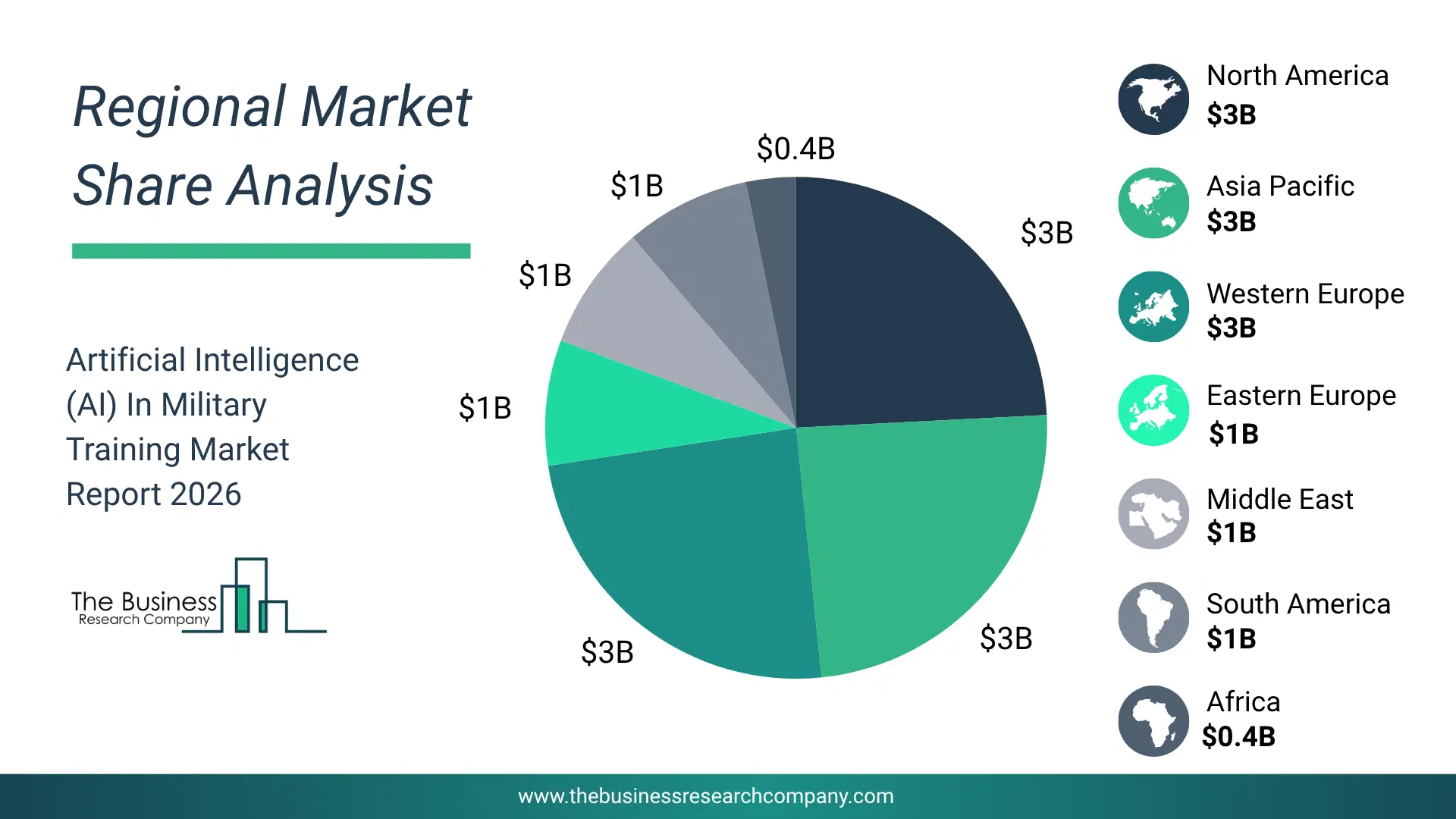
Regional Insights
North America was the largest region in the artificial intelligence (AI) in military training market in 2025. Asia-Pacific is expected to be the fastest-growing region in the forecast period. The regions covered in this market report are Asia-Pacific, South East Asia, Western Europe, Eastern Europe, North America, South America, Middle East, Africa. The countries covered in this market report are Australia, Brazil, China, France, Germany, India, Indonesia, Japan, Taiwan, Russia, South Korea, UK, USA, Canada, Italy, SpainWhat Defines the Artificial Intelligence (AI) In Military Training Market?
The artificial Intelligence (AI) in military training market consists of revenues earned by entities by providing services such as cybersecurity training, decision support systems, mission planning tools, autonomous vehicle training, and threat analysis services. The market value includes the value of related goods sold by the service provider or included within the service offering. The artificial Intelligence (AI) in military training market also includes sales of immersive augmented reality devices, autonomous training drones, and intelligent performance assessment systems. Values in this market are ‘factory gate’ values, that is the value of goods sold by the manufacturers or creators of the goods, whether to other entities (including downstream manufacturers, wholesalers, distributors and retailers) or directly to end customers. The value of goods in this market includes related services sold by the creators of the goods.How is Market Value Defined and Measured?
The market value is defined as the revenues that enterprises gain from the sale of goods and/or services within the specified market and geography through sales, grants, or donations in terms of the currency (in USD unless otherwise specified). The revenues for a specified geography are consumption values that are revenues generated by organizations in the specified geography within the market, irrespective of where they are produced. It does not include revenues from resales along the supply chain, either further along the supply chain or as part of other products.
This chart presents market attractiveness based on a quantitative evaluation of growth, competition, strategic alignment, and risk, offering a clear view of opportunity areas for decision-making. This chart is for illustrative purposes; the full report contains the complete analysis.

This chart highlights the Total Addressable Market (TAM) by estimating the maximum revenue opportunity using an assumption-driven approach, supporting strategic planning and opportunity sizing across markets. The chart is illustrative; the full report provides a more comprehensive analysis.
What Key Data and Analysis Are Included in the Artificial Intelligence (AI) In Military Training Market Report 2026?
The artificial intelligence (ai) in military training market research report is one of a series of new reports from The Business Research Company that provides market statistics, including industry global market size, regional shares, competitors with the market share, detailed market segments, market trends and opportunities, and any further data you may need to thrive in the artificial intelligence (ai) in military training industry. The market research report delivers a complete perspective of everything you need, with an in-depth analysis of the current and future state of the industry.Artificial Intelligence (AI) In Military Training Market Report Forecast Analysis
| Report Attribute | Details |
|---|---|
| Market Size Value In 2026 | $1.57 billion |
| Revenue Forecast In 2030 | $2.17 billion |
| Growth Rate | CAGR of 8.3% from 2026 to 2030 |
| Base Year For Estimation | 2025 |
| Actual Estimates/Historical Data | 2020-2025 |
| Forecast Period | 2026 - 2030 |
| Market Representation | Revenue in USD Billion and CAGR from 2026 to 2030 |
| Segments Covered | Component, Technology, Deployment Mode, Application, End-User |
| Regional Scope | Asia-Pacific, Western Europe, Eastern Europe, North America, South America, Middle East, Africa |
| Country Scope | The countries covered in the report are Australia, Brazil, China, France, Germany, India, ... |
| Key Companies Profiled | BAE Systems plc, Lockheed Martin Corp., Northrop Grumman Corporation, CAE Inc., Raytheon Technologies Corp., The Boeing Company, Thales Group, Palantir Technologies Inc., Anduril Industries Inc., Leidos Group, IAI (Israel Aerospace Industries), General Dynamics Corp., Shield AI, Scale AI Inc., Calian, BigBear.ai Holdings Inc., Elbit Systems Ltd., Peraton, Soar Technology (SoarTech), Charles River Analytics Inc., International Business Machine Corp., Microsoft Corp., SimCentric Technologies Ltd., The ASTA Group, Athena AI, Inzpire Ltd. |
| Customization Scope | Request for Customization |
| Pricing And Purchase Options | Explore Purchase Options |