
Artificial Intelligence (AI) In Nuclear Energy Market Report 2026
Global Outlook – By Component (Software, Hardware, Services, Data, Application Programming Interfaces and Middleware), By Deployment Mode (Cloud-Based, On-Premises), By Technology (Machine Learning, Deep Learning, Computer Vision, Natural Language Processing, Robotics and Automation, Other Technologies), By Application (Asset Management and Predictive Maintenance, Reactor Operation and Control, Fuel Management and Waste Reduction, Safety and Security Monitoring, Radiation Monitoring and Dose Management, Supply Chain and Project Management, Other Applications), By End User (Regulatory Bodies and Safety Agencies, Research Institutions and National Labs, Service Providers and Third-Party Inspectors) – Market Size, Trends, Strategies, and Forecast to 2030
Artificial Intelligence (AI) In Nuclear Energy Market Overview
• Artificial Intelligence (AI) In Nuclear Energy market size has reached to $3.86 billion in 2025 • Expected to grow to $9.66 billion in 2030 at a compound annual growth rate (CAGR) of 20.1% • Growth Driver: Rising Focus On Safety And Anomaly Detection Fueling The Growth Of The Market Due To Increasing Need For Operational Efficiency And Regulatory Compliance • Market Trend: Accelerating Nuclear Operations With Domain-Specific Artificial Intelligence, Enhanced Security, And On-Premise Deployment • North America was the largest region in 2025 and Asia-Pacific is the fastest growing region.Market Gains By 2030 – Top Opportunities By Segment
Market Gain identifies the most promising market opportunities by highlighting the segments or products expected to generate the highest incremental revenue growth over the next five years.
What Is Covered Under Artificial Intelligence (AI) In Nuclear Energy Market?
Artificial intelligence in nuclear energy refers to the application of advanced machine learning algorithms and data-driven models to enhance the operation, safety, and efficiency of nuclear power systems. It enables predictive maintenance, real-time monitoring, and optimization of nuclear reactors by analyzing complex datasets generated during energy production. This helps improve decision-making, reduce operational risks, and advance the overall performance of nuclear energy facilities. The main components of the artificial intelligence in nuclear energy include software, hardware, services, data, and application programming interfaces (APIs) and middleware. Software refers to AI-driven platforms and algorithms designed to optimize nuclear energy operations, enabling tasks such as predictive maintenance, reactor control, fuel management, safety monitoring, and operational efficiency. There are deployment modes including cloud-based and on-premises. The technology types encompass machine learning, deep learning, computer vision, natural language processing, robotics and automation, and others. The applications include asset management and predictive maintenance, reactor operation and control, fuel management and waste reduction, safety and security monitoring, radiation monitoring and dose management, supply chain and project management, and others, and the major end-users are nuclear power utilities or operators, engineering, procurement, and construction (EPC) firms, plant original equipment manufacturers and vendors, regulatory bodies and safety agencies, research institutions and national labs, and service providers and third-party inspectors.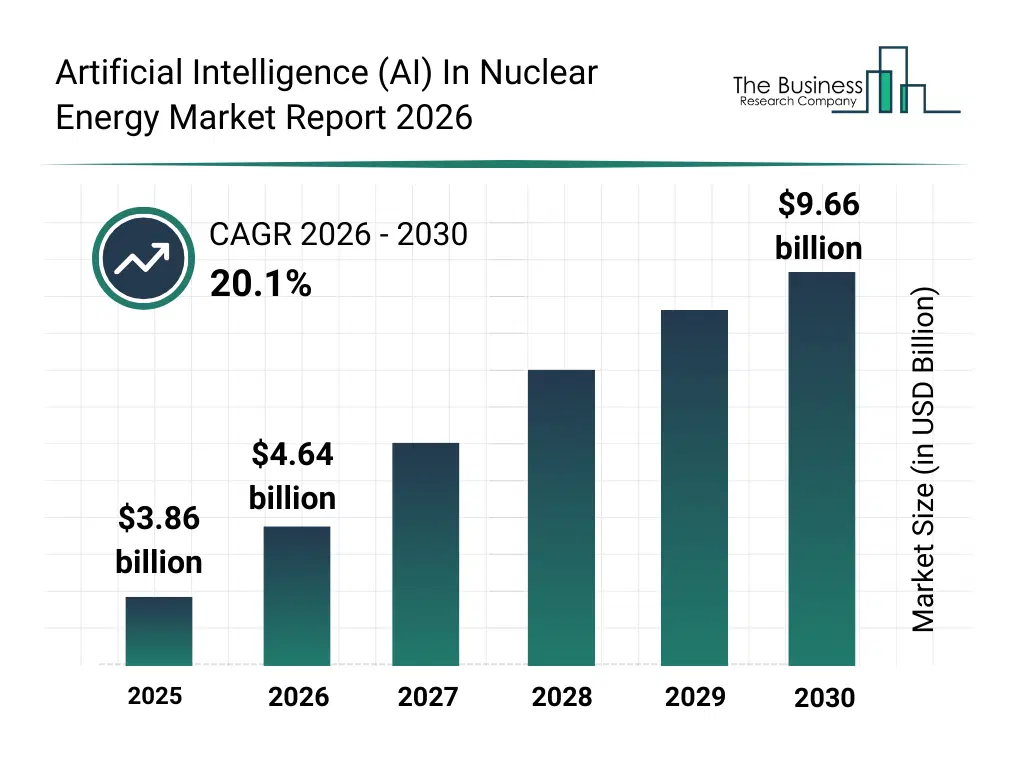
What Is The Artificial Intelligence (AI) In Nuclear Energy Market Size and Share 2026?
The artificial intelligence in nuclear energy market size has grown exponentially in recent years. It will grow from $3.86 billion in 2025 to $4.64 billion in 2026 at a compound annual growth rate (CAGR) of 20.4%. The growth in the historic period can be attributed to increasing focus on improving nuclear safety through real-time monitoring, rising demand for automation to reduce operational risks in nuclear plants, growing adoption of predictive maintenance to prevent equipment failures, increasing deployment of digital systems for optimizing plant performance, and rising need for efficient radiation detection and analysis.What Is The Artificial Intelligence (AI) In Nuclear Energy Market Growth Forecast?
The artificial intelligence in nuclear energy market size is expected to see exponential growth in the next few years. It will grow to $9.66 billion in 2030 at a compound annual growth rate (CAGR) of 20.1%. The growth in the forecast period can be attributed to growing investment in modernizing nuclear infrastructure with digital technologies, increasing need for high-accuracy monitoring solutions in next-generation reactors, rising adoption of ai-enabled simulation tools for fuel cycle optimization, growing reliance on autonomous inspection systems to enhance operational efficiency, and increasing government support for safe and advanced nuclear power development. Major trends in the forecast period include advancement in ai-based digital twins for reactor modeling, innovation in autonomous robotic inspection tools for hazardous environments, integration of machine learning algorithms to enhance radiation forecasting, advancement in intelligent control systems for small modular reactors, and integration of ai-enabled cybersecurity frameworks to protect nuclear assets.
Global Artificial Intelligence (AI) In Nuclear Energy Market Segmentation
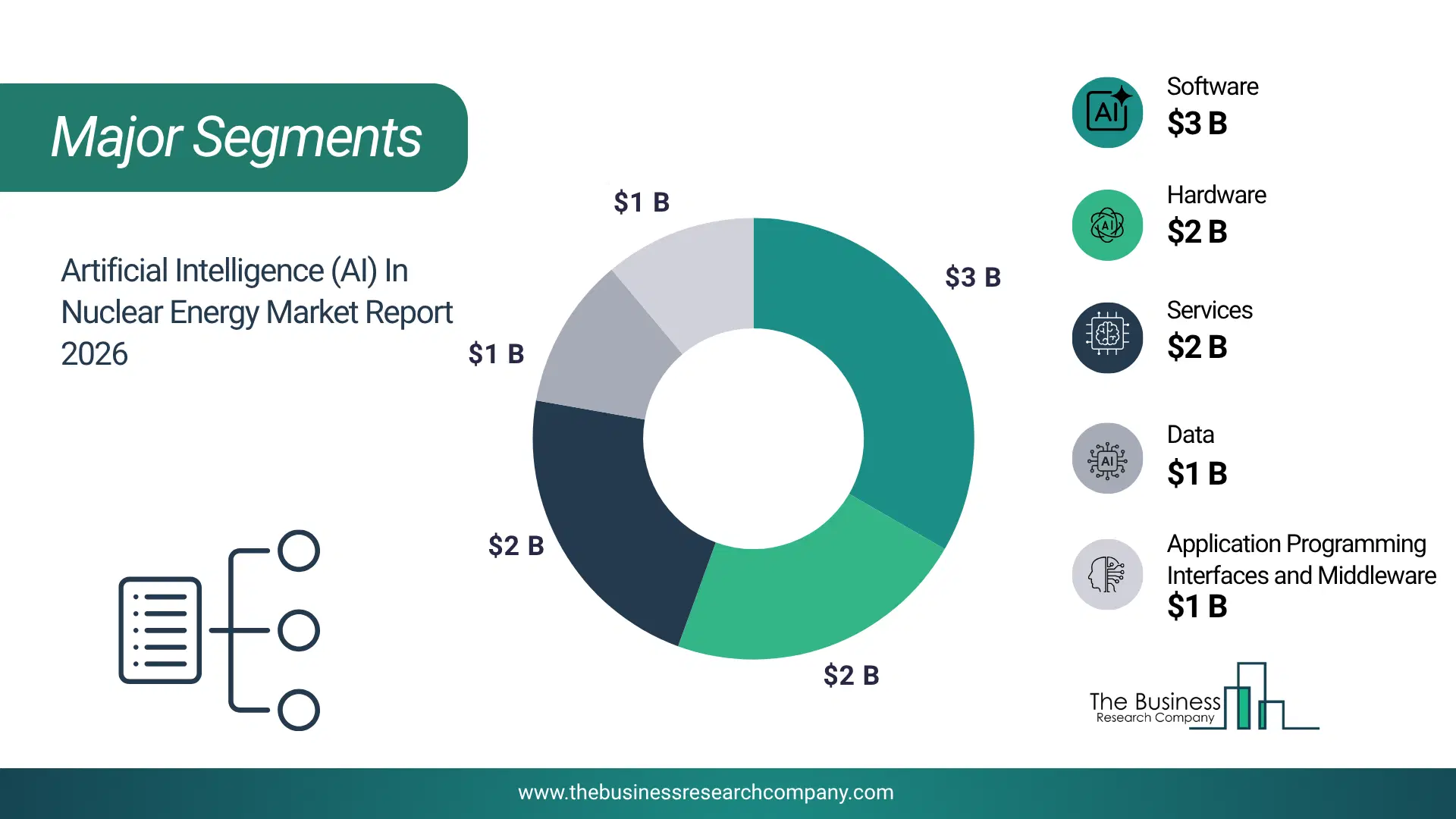
1) By Component: Software, Hardware, Services, Data, Application Programming Interfaces and Middleware 2) By Deployment Mode: Cloud-Based, On-Premises 3) By Technology: Machine Learning, Deep Learning, Computer Vision, Natural Language Processing, Robotics and Automation, Other Technologies 4) By Application: Asset Management and Predictive Maintenance, Reactor Operation and Control, Fuel Management and Waste Reduction, Safety and Security Monitoring, Radiation Monitoring and Dose Management, Supply Chain and Project Management, Other Applications 5) By End User: Nuclear Power Utilities or Operators, Engineering, Procurement and Construction (EPC) Firms, Plant Original Equipment Manufacturer and Vendors, Regulatory Bodies and Safety Agencies, Research Institutions and National Labs, Service Providers and Third-Party Inspectors Subsegments: 1) By Software: AI Modeling Software, Predictive Maintenance Software, Reactor Simulation Software, Data Analytics and Visualization Tools, Safety Monitoring Software, Workflow Automation Platforms, Cybersecurity Software for Nuclear Systems 2) By Hardware: Sensors (Temperature, Pressure, Radiation, Vibration), Edge Devices and Controllers, AI Chips and Processors, Robotics Hardware, Monitoring and Inspection Devices, Industrial Servers and Storage Units 3) By Services: Consulting Services, System Integration Services, Predictive Maintenance Services, Training and Support Services, Managed AI Services, Installation and Commissioning 4) By Data: Operational Data, Environmental and Radiation Data, Safety and Compliance Data, Predictive Maintenance Datasets, Historical Reactor Performance Data, Real-Time Monitoring Data Streams 5) By APIs and Middleware: Integration APIs, Data Exchange APIs, Machine-Learning Model APIs, Security and Authentication Middleware, Cloud Connectivity Middleware, Workflow Orchestration Middleware The top segments in the artificial intelligence (ai) in nuclear energy market will be: • Software will reach $3.42 Billion by 2030. • Hardware will reach $2.09 Billion by 2030. • Services will reach $1.64 Billion by 2030. • Data will reach $1.14 Billion by 2030. • Application Programming Interfaces and Middleware will reach $0.71 Billion by 2030.What Is The Driver Of The Artificial Intelligence (AI) In Nuclear Energy Market?
The rising focus on safety and anomaly detection is expected to propel the growth of the artificial intelligence (AI) in nuclear energy market going forward. Safety and anomaly detection refers to the use of advanced technologies to identify irregular patterns, equipment malfunctions, or operational deviations that could indicate potential safety risks in nuclear facilities. The rise in focus on safety and anomaly detection is due to the need for real-time monitoring and proactive risk prevention to avoid equipment failures, radiation leaks, or unplanned shutdowns. Artificial intelligence (AI) in nuclear energy enhances safety and anomaly detection by analyzing vast amounts of operational data in real-time to predict potential issues before they occur, ensuring higher reliability and compliance with safety standards. For instance, in July 2024, according to Microsoft, a US-based technology and cybersecurity company, the company processed 78 trillion security signals per day from the cloud, endpoints, software tools, and partner ecosystem in 2024, up from 65 trillion signals per day in 2023 to protect against digital threats and cybercriminal activity. Therefore, rising focus on safety and anomaly detection is driving the growth of the artificial intelligence (AI) in nuclear energy industry.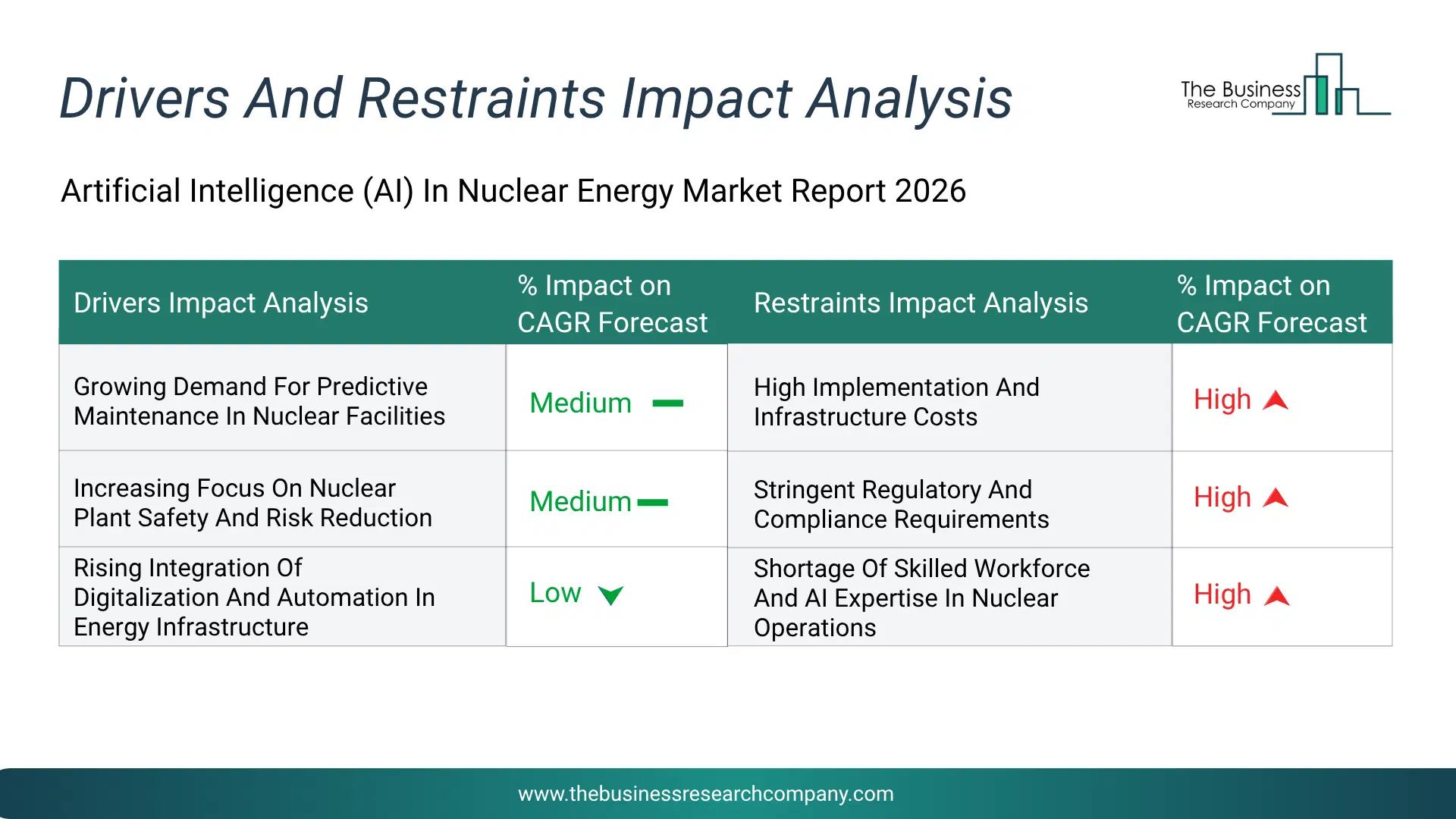
Infographic Chart Showing Key Market Drivers Analysis And Restraints For Artificial Intelligence (Ai) In Nuclear Energy Market
The chart presents an impact analysis of key drivers and restraints, quantifying their relative influence on the market's growth rate and helping assess the balance between growth enablers and limiting factors. This chart offers a high-level perspective; the full report contains more detailed insights.
How Will The Drivers Impact Growth In The Global Artificial Intelligence (AI) In Nuclear Energy Market?
• Growing Demand For Predictive Maintenance In Nuclear Facilities (Medium) – During the forecast period, the growing demand for predictive maintenance in nuclear facilities is expected to become a key growth driver for the artificial intelligence (AI) in nuclear energy market by 2030. Nuclear operators are increasingly deploying AI-powered predictive analytics to evaluate equipment health, forecast maintenance requirements, and optimize maintenance schedules before critical failures occur. These capabilities improve plant availability, reduce operational disruptions, and lower lifecycle maintenance costs across nuclear assets. Utilities are therefore expanding investments in intelligent monitoring platforms that strengthen long-term asset performance and operational efficiency. • Increasing Focus On Nuclear Plant Safety And Risk Reduction (Medium) – During the forecast period, the increasing focus on nuclear plant safety and risk reduction is expected to emerge as a major factor driving the expansion of the artificial intelligence (AI) in nuclear energy market by 2030. AI technologies enable continuous assessment of reactor conditions, automated anomaly detection, and faster incident response through advanced data interpretation and intelligent decision support. The growing emphasis on strengthening safety frameworks and maintaining reliable plant operations is encouraging wider deployment of AI-enabled monitoring and diagnostic solutions. Regulatory expectations for higher operational resilience are further supporting investments in intelligent nuclear technologies. • Rising Integration Of Digitalization And Automation In Energy Infrastructure (Low) – During the forecast period, the rising integration of digitalization and automation in energy infrastructure is expected to act as a key growth catalyst for the artificial intelligence (AI) in nuclear energy market by 2030. Nuclear facilities are increasingly adopting interconnected digital systems that combine AI, automation, and advanced analytics to streamline plant operations and improve resource utilization. Intelligent automation supports optimized process control, enhances operational visibility, and enables faster performance optimization across complex nuclear environments. As digital transformation accelerates throughout the energy sector, adoption of AI-enabled platforms within nuclear infrastructure is expected to expand significantly.How Will The Restraints Impact Growth In The Global Artificial Intelligence (AI) In Nuclear Energy Market?
• High Implementation And Infrastructure Costs (Medium) – During the forecast period, the high implementation and infrastructure costs act as a restraint for the artificial intelligence in nuclear energy market because deploying advanced AI systems in nuclear facilities requires significant investment in computing infrastructure, monitoring equipment, cybersecurity systems, and data integration platforms. Nuclear plants often operate with highly specialized legacy systems that require costly upgrades before AI technologies can be integrated effectively. The expenses associated with system validation, testing, and regulatory approvals further increase deployment costs. Smaller operators and developing economies may face budget limitations that delay modernization initiatives. These financial barriers reduce the pace of large-scale adoption across the market. • Stringent Regulatory And Compliance Requirements (Medium) – During the forecast period, the stringent regulatory and compliance requirements act as a restraint for the artificial intelligence in nuclear energy market due to the highly regulated nature of the nuclear industry. Artificial intelligence solutions used in reactor operations and safety monitoring must undergo extensive verification, certification, and approval processes before deployment. Regulatory authorities require strict reliability and transparency standards to ensure operational safety and prevent system failures. The lengthy approval timelines can slow innovation and delay commercialization of advanced AI technologies. This regulatory complexity limits faster integration of AI systems within nuclear facilities. • Shortage Of Skilled Workforce And AI Expertise In Nuclear Operations (Low) – During the forecast period, the shortage of skilled workforce and AI expertise in nuclear operations is expected to restrain the growth of the artificial intelligence in nuclear energy market. The successful deployment of artificial intelligence in nuclear facilities requires professionals with expertise in nuclear engineering, artificial intelligence, data science, cybersecurity, and industrial automation. However, the availability of personnel possessing both nuclear domain knowledge and advanced AI skills remains limited, creating challenges for utilities and technology providers. Organizations often face difficulties in recruiting and retaining qualified professionals to develop, validate, operate, and maintain AI-driven systems used for reactor monitoring, predictive maintenance, safety analysis, and operational optimization. In addition, specialized workforce training is required to ensure the safe and reliable use of AI technologies within highly regulated nuclear environments, increasing implementation time and operational costs. The shortage of multidisciplinary expertise can delay digital transformation initiatives, reduce implementation efficiency, and slow the commercialization of AI-powered nuclear solutions. Consequently, the shortage of skilled workforce and AI expertise in nuclear operations remains a significant restraint on the growth of the artificial intelligence in nuclear energy market.Key Players In The Global Artificial Intelligence (AI) In Nuclear Energy Market
Major companies operating in the artificial intelligence (AI) in nuclear energy market are Rosatom State Atomic Energy Corporation, Palantir Technologies Inc., Cameco Corporation, Hitachi Ltd., Veolia Nuclear Solutions, Honeywell International Inc., Siemens Energy AG, GE Vernova Inc., Asea Brown Boveri Ltd., Mitsubishi Heavy Industries Ltd., Toshiba Corporation, Jacobs Solutions Inc., Framatome SAS, BWX Technologies Inc., Mirion Technologies Inc., Assystem S.A., Kinectrics Inc., TerraPower LLC., X-energy LLC., NuScale Power Corporation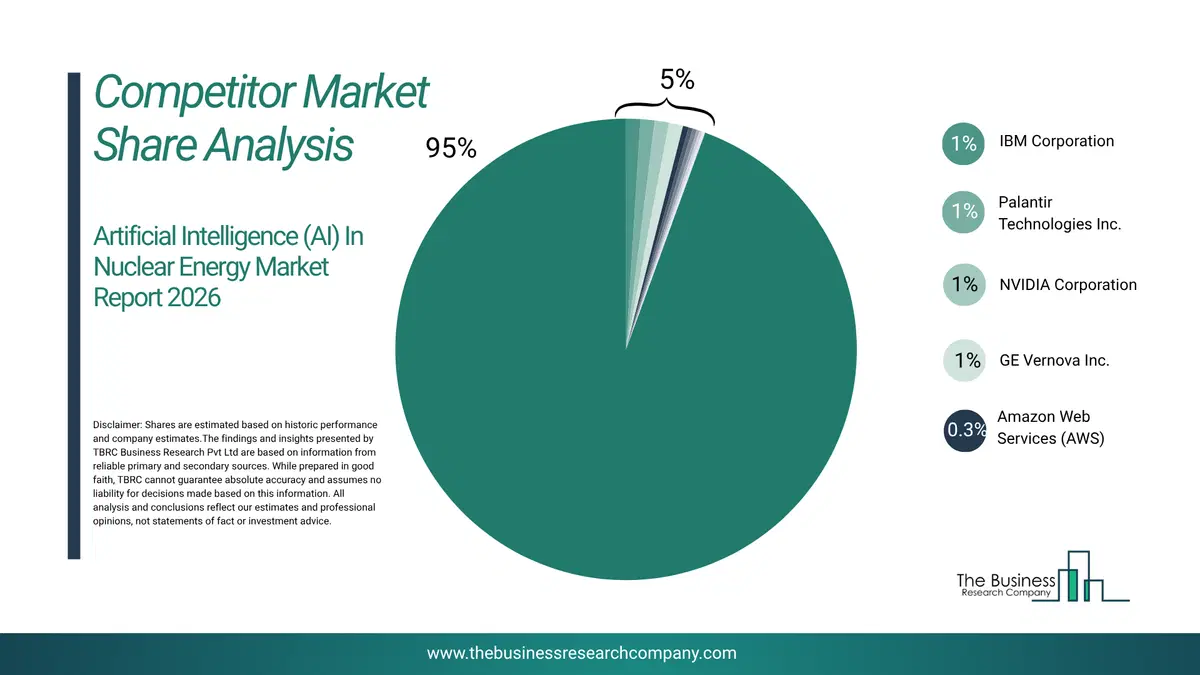
This chart is for illustrative purposes; the full report includes a detailed competitor analysis and comprehensive overview of the top 10 companies in the market.
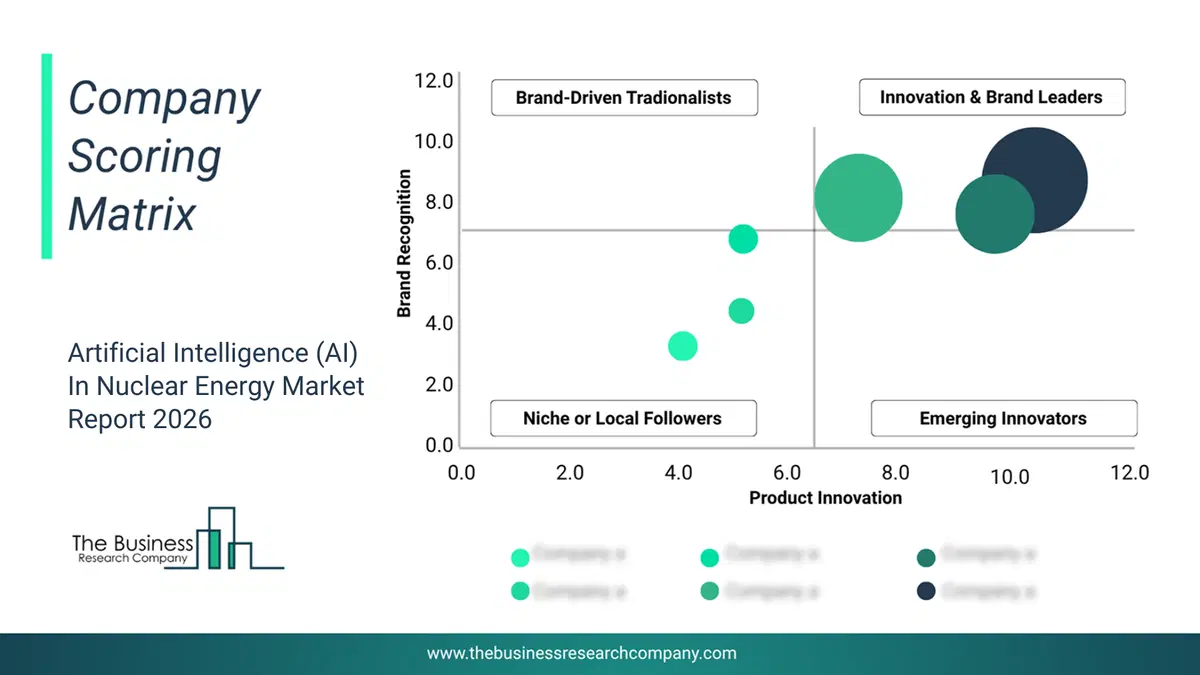
This chart maps companies by product innovation and brand strength, with bubble size indicating relative revenue, helping identify market leaders, challengers, and niche players. This is an illustrative chart; the full report provides a complete and accurate competitive analysis.
Global Artificial Intelligence (AI) In Nuclear Energy Market Trends and Insights
Major companies operating in the artificial intelligence (AI) in nuclear energy market are focusing on cutting-edge technology, such as nuclear-focused large language models, to streamline technical workflows, enhance knowledge discovery, and improve operational decision-making in highly regulated environments. Nuclear-focused large language models are the capability of artificial intelligence (AI) systems to understand, process, and generate content specific to nuclear power operations, including regulatory, technical, design, and operational documentation. For instance, in May 2024, NuclearN.ai, a US-based nuclear artificial intelligence (AI) company, launched SPARK-mini, the first openly available large language model trained specifically for the nuclear power domain. The model is deployable on-premise, allowing secure access for researchers, practitioners, and nuclear service providers with strict data security requirements. SPARK-mini powers NuclearN's AtomAssist platform, enabling information discovery, questions and answers, chat, and document preparation, and is trained on millions of regulatory and technical records from the Nuclear Regulatory Commission’s Automated Dynamic Analysis of Mechanical Systems (ADAMS) Public Library. This domain-specific training allows SPARK-mini to accurately interpret complex nuclear terminology and provide actionable insights for nuclear operators and service providers.What Are Latest Mergers And Acquisitions In The Artificial Intelligence (AI) In Nuclear Energy Market?
In July 2025, Mirion Technologies Inc., a US-based provider of radiation detection and safety solutions, acquired Certrec Inc. for $81 million. With this acquisition, Mirion Technologies, Inc. aims to strengthen its position across nuclear power facilities and expand its digital ecosystem by integrating Certrec’s licensing and compliance software to better serve the energy industry. Certrec Inc. is a US-based regulatory compliance and reporting software company leveraging AI-driven solutions for the nuclear energy sector.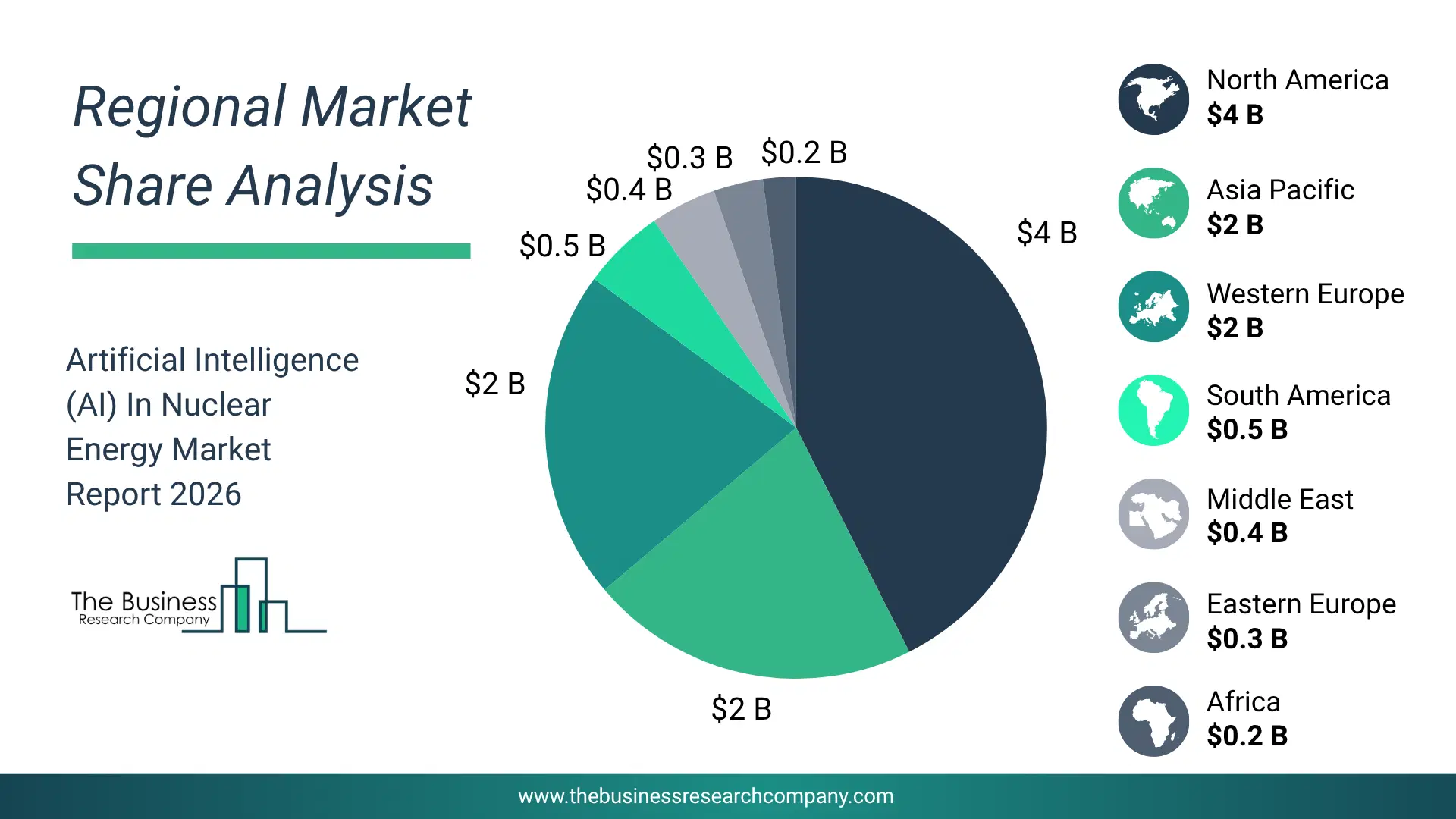
Regional Insights
North America was the largest region in the artificial intelligence in nuclear energy market in 2025. Asia-Pacific is expected to be the fastest-growing region in the forecast period. The regions covered in this market report are Asia-Pacific, South East Asia, Western Europe, Eastern Europe, North America, South America, Middle East, Africa. The countries covered in this market report are Australia, Brazil, China, France, Germany, India, Indonesia, Japan, Taiwan, Russia, South Korea, UK, USA, Canada, Italy, Spain.What Defines the Artificial Intelligence (AI) In Nuclear Energy Market?
The artificial intelligence in nuclear energy market consists of revenues earned by entities by providing services such as operational efficiency consulting, simulation and modeling, cybersecurity solutions, data analytics services, and regulatory compliance support. The market value includes the value of related goods sold by the service provider or included within the service offering. The artificial intelligence in nuclear energy market includes sales of monitoring instruments, smart meters, data acquisition hardware, radiation detectors, automated testing equipment, and computing servers. Values in this market are ‘factory gate’ values, that is, the value of goods sold by the manufacturers or creators of the goods, whether to other entities (including downstream manufacturers, wholesalers, distributors, and retailers) or directly to end customers. The value of goods in this market includes related services sold by the creators of the goods.How is Market Value Defined and Measured?
The market value is defined as the revenues that enterprises gain from the sale of goods and/or services within the specified market and geography through sales, grants, or donations in terms of the currency (in USD unless otherwise specified). The revenues for a specified geography are consumption values that are revenues generated by organizations in the specified geography within the market, irrespective of where they are produced. It does not include revenues from resales along the supply chain, either further along the supply chain or as part of other products.
This chart presents market attractiveness based on a quantitative evaluation of growth, competition, strategic alignment, and risk, offering a clear view of opportunity areas for decision-making. This chart is for illustrative purposes; the full report contains the complete analysis.

This chart highlights the Total Addressable Market (TAM) by estimating the maximum revenue opportunity using an assumption-driven approach, supporting strategic planning and opportunity sizing across markets. The chart is illustrative; the full report provides a more comprehensive analysis.
What Key Data and Analysis Are Included in the Artificial Intelligence (AI) In Nuclear Energy Market Report 2026?
The artificial intelligence (ai) in nuclear energy market research report is one of a series of new reports from The Business Research Company that provides market statistics, including industry global market size, regional shares, competitors with the market share, detailed market segments, market trends and opportunities, and any further data you may need to thrive in the artificial intelligence (ai) in nuclear energy industry. The market research report delivers a complete perspective of everything you need, with an in-depth analysis of the current and future state of the industry.Artificial Intelligence (AI) In Nuclear Energy Market Report Forecast Analysis
| Report Attribute | Details |
|---|---|
| Market Size Value In 2026 | $4.64 billion |
| Revenue Forecast In 2030 | $9.66 billion |
| Growth Rate | CAGR of 20.4% from 2026 to 2030 |
| Base Year For Estimation | 2025 |
| Actual Estimates/Historical Data | 2020-2025 |
| Forecast Period | 2026 - 2030 |
| Market Representation | Revenue in USD Billion and CAGR from 2026 to 2030 |
| Segments Covered | Component, Deployment Mode, Technology, Application, End User |
| Regional Scope | Asia-Pacific, Western Europe, Eastern Europe, North America, South America, Middle East, Africa |
| Country Scope | The countries covered in the report are Australia, Brazil, China, France, Germany, India, Indonesia, Japan, Taiwan, Russia, South Korea, UK, USA, Canada, Italy, Spain. |
| Key Companies Profiled | Rosatom State Atomic Energy Corporation, Palantir Technologies Inc., Cameco Corporation, Hitachi Ltd., Veolia Nuclear Solutions, Honeywell International Inc., Siemens Energy AG, GE Vernova Inc., Asea Brown Boveri Ltd., Mitsubishi Heavy Industries Ltd., Toshiba Corporation, Jacobs Solutions Inc., Framatome SAS, BWX Technologies Inc., Mirion Technologies Inc., Assystem S.A., Kinectrics Inc., TerraPower LLC., X-energy LLC., NuScale Power Corporation |
| Customization Scope | Request for Customization |
| Pricing And Purchase Options | Explore Purchase Options |