
Artificial Intelligence (AI) In Predictive Toxicology Market 2026
By Component (Solution, Services), By Technology (Machine Learning, Natural Language Processing, Computer Vision, Other Technologies), By Toxicity Endpoints (Genotoxicity, Hepatotoxicity, Neurotoxicity, Cardiotoxicity, Other Toxicity Endpoints), By End User (Pharmaceutical And Biotechnology Companies, Chemical And Cosmetics, Contract Research Organizations, Other End Users), And By Region, Opportunities And Strategies – Global Forecast To 2035
Artificial intelligence (AI) in predictive toxicology Market Definition
Artificial intelligence (AI) in predictive toxicology refers to the use of machine learning, deep learning, and data analytics to predict the toxic effects of chemicals, drugs, and environmental substances on human health and biological systems. The primary purpose of artificial intelligence (AI) in predictive toxicology is to enhance the speed, accuracy, and efficiency of toxicity assessment while reducing ethical and financial burdens. It enables early identification of hazardous compounds, supports safer drug and chemical development, and improves regulatory decision-making through data-driven toxicity prediction. The artificial intelligence (AI) in predictive toxicology market consists of sales, by entities (organizations, sole traders, or partnerships), of artificial intelligence (AI) in predictive toxicology is used by pharmaceutical and biotechnology companies, chemical and cosmetics manufacturers, contract research organizations (CROs), academic research institutions and regulatory agencies. These users employ AI-based predictive toxicology tools during drug discovery, chemical safety evaluation and regulatory submission stages to assess potential toxic effects such as genotoxicity, hepatotoxicity and cardiotoxicity early in the development cycle.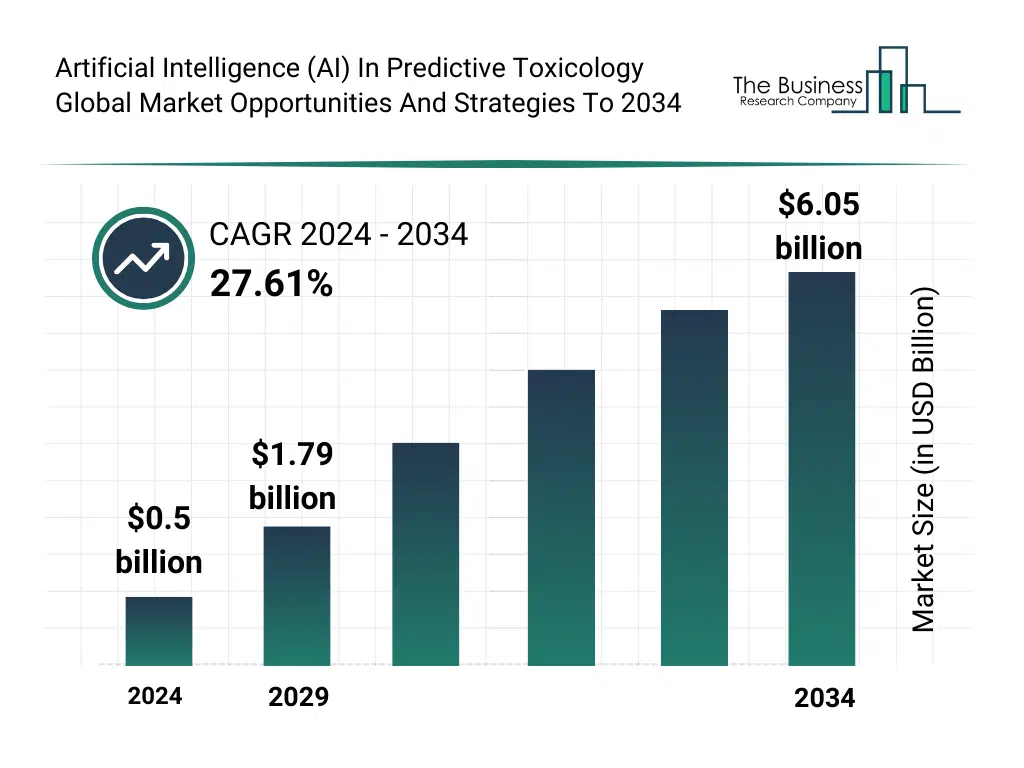
Artificial intelligence (AI) in predictive toxicology Market Size
The global artificial intelligence (AI) in predictive toxicology market reached a value of nearly $495.44 million in 2024, having grown at a compound annual growth rate (CAGR) of 30.62% since 2019. The market is expected to grow from $495.44 million in 2024 to $1,788.49 million in 2029 at a rate of 29.27%. The market is then expected to grow at a CAGR of 27.61% from 2029 and reach $6,051.34 million in 2034. Growth in the historic period resulted from shift towards plant-based products, growth in the pharmaceutical industry, rising health and wellness concerns and growing demand for functional foods. Factors that negatively affected growth in the historic period were the high production costs and regulatory hurdles. Going forward, expansion of the cosmetics industry, growing demand for dietary supplements, increased prevalence of chronic diseases and rising demand for natural antioxidants will drive growth. Factors that could hinder the growth of the artificial intelligence (AI) in predictive toxicology market in the future include limited clinical validation, competition from substitute products and impact of trade war and tariff.> Artificial intelligence (AI) in predictive toxicology Market Drivers
The key drivers of the > artificial intelligence (ai) in predictive toxicology market include: Rising Demand For Faster Drug Discovery And Development During the forecast period, the increasing demand for faster drug discovery and development will significantly propel the growth of the artificial intelligence (AI) in predictive toxicology market. Pharmaceutical companies are under pressure to shorten the timelines and reduce the costs associated with bringing new drugs to market. AI-driven predictive toxicology solutions enable early identification of potential safety concerns, allowing for more informed decision-making and prioritization of drug candidates. By 2025, it is estimated that AI will drive new drug discoveries, cutting costs and accelerating personalized treatments. This shift towards AI integration in the drug development process not only enhances efficiency but also improves the success rates of clinical trials, thereby addressing the industry's need for expedited and cost-effective drug development. The increasing demand for faster drug discovery and development during the forecast period in 2024 is 1.50%.Artificial intelligence (AI) in predictive toxicology Market Restraints
The key restraints on the artificial intelligence (ai) in predictive toxicology market include: Bias and Overfitting Risk During the forecast period, bias and overfitting risk will restrict the growth of the artificial intelligence (AI) in predictive toxicology market. Overfitting occurs when AI models excessively learn from training data, including noise and errors, resulting in poor performance on new datasets. Similarly, bias arises when training data lacks representativeness, leading to skewed or unfair predictions. These issues can compromise the accuracy, reliability, and transparency of AI models, limiting their acceptance in regulatory and drug safety applications where precision and credibility are essential, thereby hindering market expansion. Growth affected by bias and overfitting risk during the forecast period in 2024 is -2.00%..Artificial intelligence (AI) in predictive toxicology Market Trends
Major trends shaping the artificial intelligence (ai) in predictive toxicology market include: Major companies in the artificial intelligence (AI) in predictive toxicology market are focusing on the development of AI-driven risk-assessment tools aimed at improving early-stage drug safety predictions. These innovations aim to reduce dependency on animal testing, accelerate the transition to clinical trials, and enhance decision-making in drug discovery. For instance, in September 2025, GATC Health, a US based technology company revolutionizing drug discovery and development, unveiled Derisq, an AI-driven platform introduced at Fierce Biotech Week 2025, that is designed to streamline the early stages of drug development by providing accurate toxicity predictions. The platform seeks to identify safety and off target risks early, thereby reducing the time, cost, and uncertainty associated with traditional preclinical testing. By offering actionable insights grounded in AI analysis, GATC Health aims to empower researchers, investors, and pharmaceutical developers with enhanced predictive confidence and efficiency in both domestic and global markets. Introduction Of AI-Powered Modules For Predicting Combination Regimen Efficacy In Cancer Treatment Major companies in the artificial intelligence (AI) in predictive toxicology market are focusing on the development of AI-powered modules designed to predict the activity and efficacy of combination treatment regimens, while also minimizing potential toxicity risks. These innovations leverage machine learning and advanced computational algorithms to support more precise and safer therapeutic strategies, enhancing both clinical decision-making and patient outcomes. For instance, in July 2025, Lantern Pharma, a US-based clinical-stage oncology company, unveiled a new AI-powered module that predicts the activity and efficacy of combination regimens in cancer treatment. The new AI module marks a transformative advancement in precision oncology, using machine learning to identify the most effective drug combinations for individual patient groups while reducing the risk of toxicity. By integrating AI-driven predictions with clinical expertise, the company aims to accelerate personalized treatment strategies and improve the safety and effectiveness of cancer therapies across global markets.Opportunities And Recommendations In The Automotive Aftermarket Market
Opportunities – The top opportunities in the automotive aftermarket market segmented by type will arise in the battery segment, which will gain $116,557.63 million of global annual sales by 2029. The top opportunities in the automotive aftermarket market segmented by vehicle type will arise in the passenger cars segment, which will gain $467,554.63 million of global annual sales by 2029. The top opportunities in the automotive aftermarket market segmented by certification outlook will arise in the genuine parts segment, which will gain $376,895.55 million of global annual sales by 2029. The top opportunities in the automotive aftermarket market segmented by distribution channel will arise in the online distribution channel segment, which will gain $292,757.77 million of global annual sales by 2029. The automotive aftermarket market size will gain the most in the USA at $54,587.64 million. Recommendations- To take advantage of the opportunities, The Business Research Company recommends the automotive aftermarket companies to focus on advancing hydrogen-compatible turbocharging solutions, focus on expanding vehicle coverage and localized product development, focus on high-performance and customizable wheel solutions, focus on expanding product portfolios aligned with emerging vehicle technologies, focus on expanding specialized filtration solutions for advanced vehicle needs, focus on developing advanced body repair tools for efficient collision restoration, focus on advancing exhaust technologies for performance and personalization, focus on integrating fast-charging battery technologies to strengthen ev support services, focus on expanding sustainable material integration to drive green aftermarket growth, focus on advancing microled lighting to expand aftermarket opportunities, focus on lighting and electronic components to drive accelerated aftermarket growth, focus on passenger cars to maximize aftermarket expansion, expand in emerging markets, focus on expanding multichannel distribution networks, focus on building competitive and value-based pricing structures, develop an integrated and data-driven digital promotion strategy, strengthen trade partnerships and customer engagement for sustainable promotion, focus on online distribution channel to capture rapid market growth.
Artificial Intelligence (AI) In Predictive Toxicology Market Segmentation
The artificial intelligence (AI) in predictive toxicology market is segmented segmented by component, by technology, by toxicity endpoints and by end user.By Component –
The artificial intelligence (AI) in predictive toxicology market is segmented by component into:
- a) Solution
- b) Services
By Technology –
The artificial intelligence (AI) in predictive toxicology market is segmented by technology into:
- a) Machine Learning
- b) Natural Language Processing
- c) Computer Vision
- d) Other Technologies
By Toxicity Endpoints –
The artificial intelligence (AI) in predictive toxicology market is segmented by toxicity endpoints into:
- a) Genotoxicity
- b) Hepatotoxicity
- c) Neurotoxicity
- d) Cardiotoxicity
- e) Other Toxicity Endpoints
By End User –
The artificial intelligence (AI) in predictive toxicology market is segmented by end user into:
- a) Pharmaceutical
- b) Biotechnology Companies
- c) Chemical And Cosmetics
- d) Contract Research Organizations
- e) Other End Users
By Geography - The artificial intelligence (AI) in predictive toxicology market is segmented by geography into:
- • China
- • India
- • Japan
- • Australia
- • Indonesia
- • South Korea
- • USA
- • Canada
- • Brazil
- • France
- • Germany
- • UK
- • Italy
- • Spain
- • Russia
-
o Asia Pacific
o Africa