
Artificial Intelligence (AI) In Reverse Logistics Market Report 2026
Global Outlook – By Component (Software, Services, Hardware), By Deployment (Cloud, On Premises), By Enterprise Size (Large Enterprises, Small And Medium Sized Enterprises), By Application (Returns Management And Authorization, Transportation And Route Optimization, Inventory And Warehouse Management, Product Inspection And Sorting, Other Applications), By End User Industry (Retail And E Commerce, Manufacturing, Automotive, Electronics, Healthcare, Logistics And Transportation, Other End User Industries) – Market Size, Trends, Strategies, and Forecast to 2030
Artificial Intelligence (AI) In Reverse Logistics Market Overview
• Artificial Intelligence (AI) In Reverse Logistics market size has reached to $3.89 billion in 2025 • Expected to grow to $5.93 billion in 2030 at a compound annual growth rate (CAGR) of 8.7% • Growth Driver: The Growth Of E-Commerce Product Returns Driving The Growth Of The Market Due To Inaccurate Product Expectations • Market Trend: Artificial Intelligence-Driven Reverse Logistics Optimization Platform To Enhance Returns Processing And Strengthen Resale Efficiency • North America was the largest region in 2025 and Asia-Pacific is the fastest growing region.What Is Covered Under Artificial Intelligence (AI) In Reverse Logistics Market?
Artificial intelligence (AI) in reverse logistics refers to the use of AI technologies such as machine learning, predictive analytics, and automation to optimize the processes of product returns, recycling, refurbishment, and disposal. It helps companies improve efficiency, reduce costs, and make data-driven decisions by accurately forecasting returns and streamlining reverse supply chain operations. The main components of artificial intelligence (AI) in reverse logistics include software, services, and hardware. Software refers to AI-driven systems used to optimize return flows, automate reverse supply chain processes, and improve operational efficiency. These solutions are deployed through cloud and on premises models and are adopted by enterprise sizes including large enterprises and small and medium sized enterprises. The key applications of returns management and authorization, transportation and route optimization, inventory and warehouse management, product inspection and sorting, and others, while the end-user industries includes retail and e commerce, manufacturing, automotive, electronics, healthcare, logistics and transportation, and others.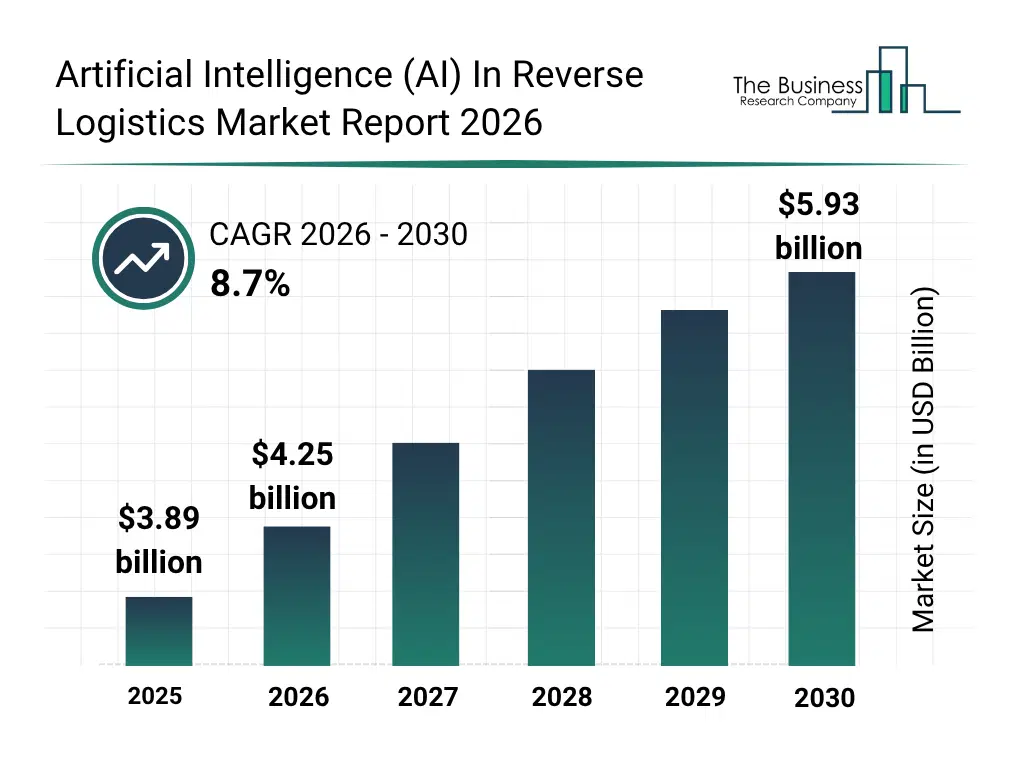
What Is The Artificial Intelligence (AI) In Reverse Logistics Market Size and Share 2026?
The artificial intelligence (AI) in reverse logistics market size has grown strongly in recent years. It will grow from $3.89 billion in 2025 to $4.25 billion in 2026 at a compound annual growth rate (CAGR) of 9.1%. The growth in the historic period can be attributed to rising e commerce return volumes, increasing logistics operational costs, growth in organized retail supply chains, expansion of product warranty and return policies, adoption of basic returns management systems.What Is The Artificial Intelligence (AI) In Reverse Logistics Market Growth Forecast?
The artificial intelligence (AI) in reverse logistics market size is expected to see strong growth in the next few years. It will grow to $5.93 billion in 2030 at a compound annual growth rate (CAGR) of 8.7%. The growth in the forecast period can be attributed to increasing adoption of AI based reverse logistics platforms, growing emphasis on circular economy practices, expansion of automated sorting and refurbishment systems, rising demand for cost efficient returns processing, increasing integration of predictive analytics in supply chain operations. Major trends in the forecast period include AI driven returns prediction and reverse flow optimization systems, automation of product refurbishment and refurbishment lifecycle tracking, intelligent sorting and grading systems for returned goods, integration of circular economy focused reverse logistics platforms, predictive analytics for reducing return rates and improving product quality insights.
Global Artificial Intelligence (AI) In Reverse Logistics Market Segmentation
1) By Component: Software; Services; Hardware 2) By Deployment: Cloud; On Premises 3) By Enterprise Size: Large Enterprises; Small And Medium Sized Enterprises 4) By Application: Returns Management And Authorization; Transportation And Route Optimization; Inventory And Warehouse Management; Product Inspection And Sorting; Other Applications 5) By End User Industry: Retail And E Commerce; Manufacturing; Automotive; Electronics; Healthcare; Logistics And Transportation; Other End User Industries Subsegments: 1) By Software: Returns Management Software; Predictive Analytics Software; Computer Vision Software; Route Optimization Software; Warehouse Management Software; Inventory Recovery Software; Warranty Processing Software 2) By Services: Implementation Services; Integration Services; Consulting Services; Managed Services; Support Services; Training Services 3) By Hardware: Machine Vision Cameras; Sensors; Edge Computing Devices; Robotics Systems; Automated Sorting Equipment; Conveyors; Scanning DevicesWhat Is The Driver Of The Artificial Intelligence (AI) In Reverse Logistics Market?
The growth of e-commerce product returns are expected to propel the growth of the artificial intelligence (AI) in reverse logistics market going forward. E-commerce product returns refer to the process in which customers send back purchased goods to an online retailer for reasons such as defects, dissatisfaction, wrong items, or change of mind, typically for a refund, replacement, or exchange. The growth of e-commerce product returns is primarily due to inaccurate product expectations, where customers receive items that differ from what they saw or expected online in terms of quality, size, color, or fit. Artificial intelligence (AI) in reverse logistics help e-commerce product returns by enabling faster, more accurate decision-making in return authorization, routing, and restocking, thereby reducing costs and improving customer satisfaction. For instance, in January 2024, according to PUDO Inc., a US-based logistics company, the proportion of returned e-commerce goods increased from about 20% in 2022 to roughly 25% in 2023. Therefore, the growth of e-commerce product returns is driving the growth of the artificial intelligence (AI) in reverse logistics industry.Key Players In The Global Artificial Intelligence (AI) In Reverse Logistics Market
Major companies operating in the artificial intelligence (AI) in reverse logistics market are Microsoft Corporation; International Business Machines Corporation; Oracle Corporation; Honeywell International Inc.; SAP SE; ABB Ltd.; Zebra Technologies Corporation; Infor Inc.; Manhattan Associates Inc.; o9 Solutions Inc.; The Descartes Systems Group Inc.; Kinaxis Inc.; project44 Inc.; FourKites Inc.; Locus; Shipsy Services Pvt. Ltd.; Covariant Inc.; LogiNext Solutions Inc.; FarEye Technologies Pvt. Ltd.; eShipzGlobal Artificial Intelligence (AI) In Reverse Logistics Market Trends and Insights
Major companies operating in the artificial intelligence (AI) in reverse logistics market are focusing on developing innovative solutions, such as artificial intelligence-powered reverse logistics optimization platforms, to enhance returns processing efficiency, reduce operational costs, and improve value recovery across the reverse supply chain. Artificial intelligence-powered reverse logistics optimization platforms are software systems that use AI to automate, analyze, and improve the returns process by optimizing product routing, processing, resale, and recovery within the reverse supply chain. For instance, in September 2025, RQ Tech LLC, a US-based reverse logistics and supply chain technology company, launched its re-engineered AI-enabled returns marketplace platform, an artificial intelligence-powered reverse logistics optimization platform to transform how product returns are processed. The platform enables features such as AI-driven return routing, automated resale matching, virtual try-on capabilities, and smart logistics coordination for home pickups and returns. It also leverages AI models to optimize inventory recovery, reduce return processing time, and enhance customer experience by connecting returns with resale and reuse ecosystems. The solution is designed to help retailers minimize losses from returns while improving operational efficiency and supporting sustainable commerce models.What Are Latest Mergers And Acquisitions In The Artificial Intelligence (AI) In Reverse Logistics Market?
In August 2025, Blue Yonder Group Inc., a US-based supply chain management company, acquired Optoro for an undisclosed amount. With this acquisition, Blue Yonder aims to strengthen its returns management and reverse logistics capabilities by integrating Optoro’s technology to enhance product returns processing efficiency, improve recovery value, and expand its end-to-end retail supply chain ecosystem. Optoro Inc. is a US-based company that provides advanced AI and machine learning solutions specifically designed for reverse logistics and returns management.Regional Outlook
North America was the largest region in the artificial intelligence (AI) in reverse logistics market in 2025. Asia-Pacific is expected to be the fastest-growing region in the forecast period. The regions covered in this market report are Asia-Pacific, South East Asia, Western Europe, Eastern Europe, North America, South America, Middle East, Africa. The countries covered in this market report are Australia, Brazil, China, France, Germany, India, Indonesia, Japan, Taiwan, Russia, South Korea, UK, USA, Canada, Italy, Spain.What Defines the Artificial Intelligence (AI) In Reverse Logistics Market?
The artificial intelligence (AI) in reverse logistics market consists of revenues earned by entities by providing services such as product inspection, sorting, route optimization, inventory recovery, refurbishment planning, recycling management, and warranty processing. The market value includes the value of related goods sold by the service provider or included within the service offering. The artificial intelligence (AI) in reverse logistics market also includes sales of autonomous mobile robots, automated guided vehicles, robotic picking arms, and reverse vending machines. Values in this market are ‘factory gate’ values, that is the value of goods sold by the manufacturers or creators of the goods, whether to other entities (including downstream manufacturers, wholesalers, distributors and retailers) or directly to end customers. The value of goods in this market includes related services sold by the creators of the goods.How is Market Value Defined and Measured?
The market value is defined as the revenues that enterprises gain from the sale of goods and/or services within the specified market and geography through sales, grants, or donations in terms of the currency (in USD unless otherwise specified). The revenues for a specified geography are consumption values that are revenues generated by organizations in the specified geography within the market, irrespective of where they are produced. It does not include revenues from resales along the supply chain, either further along the supply chain or as part of other products.What Key Data and Analysis Are Included in the Artificial Intelligence (AI) In Reverse Logistics Market Report 2026?
The artificial intelligence (ai) in reverse logistics market research report is one of a series of new reports from The Business Research Company that provides market statistics, including industry global market size, regional shares, competitors with the market share, detailed market segments, market trends and opportunities, and any further data you may need to thrive in the artificial intelligence (ai) in reverse logistics industry. The market research report delivers a complete perspective of everything you need, with an in-depth analysis of the current and future state of the industry.Artificial Intelligence (AI) In Reverse Logistics Market Report Forecast Analysis
| Report Attribute | Details |
|---|---|
| Market Size Value In 2026 | $4.25 billion |
| Revenue Forecast In 2030 | $5.93 billion |
| Growth Rate | CAGR of 8.7% from 2026 to 2030 |
| Base Year For Estimation | 2025 |
| Actual Estimates/Historical Data | 2020-2025 |
| Forecast Period | 2026 - 2030 |
| Market Representation | Revenue in USD Billion and CAGR from 2026 to 2030 |
| Segments Covered | Component, Deployment, Enterprise Size, Application, End User Industry |
| Regional Scope | Asia-Pacific, Western Europe, Eastern Europe, North America, South America, Middle East, Africa |
| Country Scope | The countries covered in the report are Australia, Brazil, China, France, Germany, India, ... |
| Key Companies Profiled | Microsoft Corporation; International Business Machines Corporation; Oracle Corporation; Honeywell International Inc.; SAP SE; ABB Ltd.; Zebra Technologies Corporation; Infor Inc.; Manhattan Associates Inc.; o9 Solutions Inc.; The Descartes Systems Group Inc.; Kinaxis Inc.; project44 Inc.; FourKites Inc.; Locus; Shipsy Services Pvt. Ltd.; Covariant Inc.; LogiNext Solutions Inc.; FarEye Technologies Pvt. Ltd.; eShipz |
| Customization Scope | Request for Customization |
| Pricing And Purchase Options | Explore Purchase Options |