
Artificial Intelligence (AI) In Satellite Internet Market Report 2026
Global Outlook – By Component (Hardware, Software, Services), By Deployment Mode (On-Premises, Cloud), By Application (Network Optimization, Traffic Management, Predictive Maintenance, Cybersecurity, Customer Experience Management, Other Applications), By End-User (Telecommunications, Government And Defense, Maritime, Aviation, Enterprise, Other End-Users) – Market Size, Trends, Strategies, and Forecast to 2030
Artificial Intelligence (AI) In Satellite Internet Market Overview
• Artificial Intelligence (AI) In Satellite Internet market size has reached to $2.52 billion in 2025 • Expected to grow to $8.91 billion in 2030 at a compound annual growth rate (CAGR) of 28.7% • Growth Driver: The Growing Demand For High Bandwidth Is Fueling Market Growth Due To Increasing Internet Usage • Market Trend: Transforming Satellite Internet With Intelligent Signal Monitoring • North America was the largest region in 2025 and Asia-Pacific is the fastest growing region.What Is Covered Under Artificial Intelligence (AI) In Satellite Internet Market?
Artificial intelligence (AI) in satellite internet refers to the use of AI technologies to improve the performance, efficiency, and reliability of satellite-based internet networks. It enables intelligent management of bandwidth, predictive maintenance of satellites and ground stations, signal optimization, and autonomous operations. By analyzing large volumes of data, AI ensures faster, more stable, and secure connectivity for users across the globe. The main components of artificial intelligence (AI) in satellite internet are hardware, software, and services. Hardware in satellite internet systems refers to the physical devices that enable data transmission, reception, and processing for reliable connectivity. These components can be deployed in different modes, such as on-premises or cloud-based systems. They are used for various applications, including network optimization, traffic management, predictive maintenance, cybersecurity, customer experience management, and others, and cater to end-users such as telecommunications companies, government and defense organizations, maritime and aviation sectors, enterprises, and others.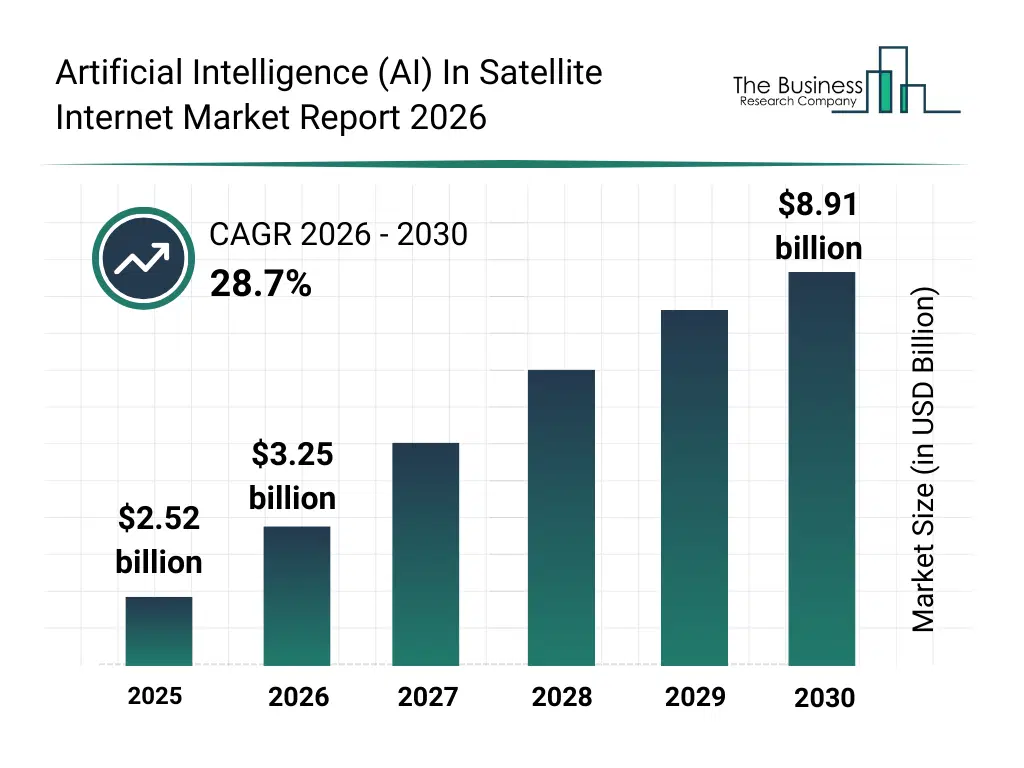
What Is The Artificial Intelligence (AI) In Satellite Internet Market Size and Share 2026?
The artificial intelligence (AI) in satellite internet market size has grown exponentially in recent years. It will grow from $2.52 billion in 2025 to $3.25 billion in 2026 at a compound annual growth rate (CAGR) of 29.0%. The growth in the historic period can be attributed to growing adoption of satellite internet for remote and underserved regions, advancements in ai algorithms for network optimization, increasing investment in satellite infrastructure, partnerships between ai technology providers and satellite operators, early integration of predictive maintenance and signal enhancement solutions.What Is The Artificial Intelligence (AI) In Satellite Internet Market Growth Forecast?
The artificial intelligence (AI) in satellite internet market size is expected to see exponential growth in the next few years. It will grow to $8.91 billion in 2030 at a compound annual growth rate (CAGR) of 28.7%. The growth in the forecast period can be attributed to development of fully autonomous satellite network management systems, rising demand for ai-powered smart antennas and terminals, integration of ai for dynamic bandwidth allocation and signal optimization, expansion of satellite internet services in commercial and enterprise sectors, emphasis on data analytics platforms for real-time network performance monitoring. Major trends in the forecast period include ai-driven bandwidth optimization, growth of predictive satellite maintenance, integration of smart antennas and ai terminals, expansion of automated ground station systems, adoption of onboard ai processors for real-time decision-making.
Global Artificial Intelligence (AI) In Satellite Internet Market Segmentation
1) By Component: Hardware, Software, Services 2) By Deployment Mode: On-Premises, Cloud 3) By Application: Network Optimization, Traffic Management, Predictive Maintenance, Cybersecurity, Customer Experience Management, Other Applications 4) By End-User: Telecommunications, Government And Defense, Maritime, Aviation, Enterprise, Other End-Users Subsegments: 1) By Hardware: Satellite Terminals, Antennas, Modems, Transceivers, Network Equipment 2) By Software: Network Management Software, Artificial Intelligence Analytics Software, Security And Encryption Software, Bandwidth Optimization Software 3) By Services: Installation And Integration Services, Maintenance And Support Services, Consulting And Training Services, Managed Satellite Connectivity ServicesWhat Is Driver Of The Artificial Intelligence (AI) In Satellite Internet Market?
The growing demand for high bandwidth is expected to propel the growth of the artificial intelligence (AI) in satellite internet market going forward. High bandwidth refers to the ability of a network or communication channel to transmit large amounts of data per second. The rising demand for high bandwidth is due to the increasing use of data-intensive applications that require fast and reliable data transfer. Artificial intelligence (AI) in satellite internet enables efficient network management and dynamic traffic optimization, intelligently allocating resources, reducing latency, and predicting demand patterns to ensure high-bandwidth applications receive reliable, fast, and uninterrupted data transmission across diverse geographic regions. For instance, in November 2024, according to the UK Parliament's House of Commons Library, a UK-based government administration, as of January 2024, 78% of UK premises had access to gigabit-capable broadband, up from 72% in January 2023, 64% in January 2022. Therefore, the growing demand for high bandwidth is driving the growth of the artificial intelligence (AI) in satellite internet industry.Key Players In The Global Artificial Intelligence (AI) In Satellite Internet Market
Major companies operating in the artificial intelligence (AI) in satellite internet market are Viasat Inc., SES S.A., Kratos Defense & Security Solutions Inc., Marlink AS, Iridium Communications Inc., Space42 PLC, Comtech Telecommunications Corp., Hughes Network Systems LLC, Telesat Canada, Anuvu Operations LLC, ST Engineering iDirect Inc., Gilat Satellite Networks Ltd., Kymeta Corporation, Avanti Communications Group plc, ThinKom Solutions Inc., Skylo Technologies Inc., Kepler Communications Inc., SpaceBridge Inc., Integrasys S.A., Xovian Aerospace Private Limited.
This chart is for illustrative purposes; the full report includes a detailed competitor analysis and comprehensive overview of the top 10 companies in the market.
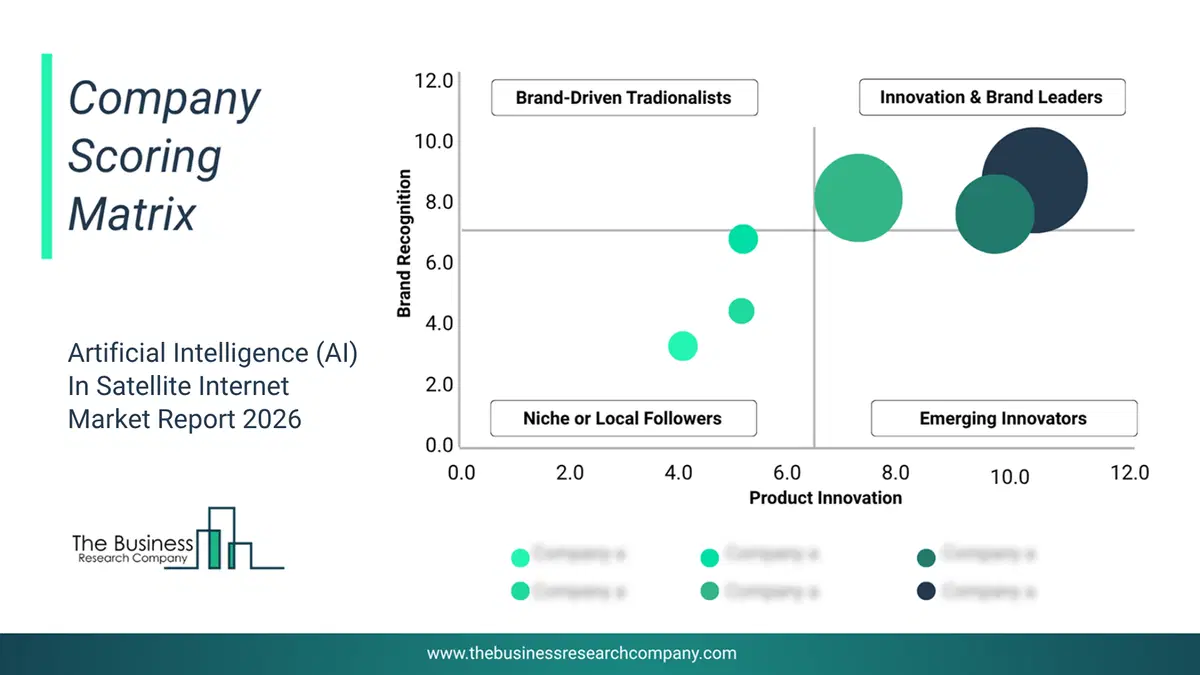
This chart maps companies by product innovation and brand strength, with bubble size indicating relative revenue, helping identify market leaders, challengers, and niche players. This is an illustrative chart; the full report provides a complete and accurate competitive analysis.
Global Artificial Intelligence (AI) In Satellite Internet Market Trends and Insights
Major companies operating in the artificial intelligence (AI) in satellite internet market are focusing on developing innovative solutions such as real-time signal processing to enhance data transmission efficiency, reduce latency, detect and mitigate interference, and optimize network performance for seamless connectivity. Real-time signal processing is the continuous analysis and manipulation of signals as they are received, helping to improve communication quality, reduce errors, and enable satellites to respond instantly to changing conditions or interference. For instance, in August 2025, Xovian Aerospace Private Limited, an India-based aerospace company, secured $2.5 million in a pre-seed funding round to develop the world’s first AI-native radio frequency (RF) satellite infrastructure. The company aims to embed AI directly into satellites for real-time RF signal analysis, enabling the detection of dynamic threats, covert transmissions, and interference often missed by conventional optical satellites. Equipped with multi-frequency RF payloads, these satellites will simultaneously monitor a wide spectrum of communication signals, delivering continuous situational awareness and intelligence for government and commercial users. Xovian plans to launch its first spacecraft aboard an ISRO rocket by late 2025, followed by the deployment of nanosatellites and expansion of its engineering and operational capabilities.What Are Latest Mergers And Acquisitions In The Artificial Intelligence (AI) In Satellite Internet Market? SES Acquires Intelsat To Strengthen Satellite Connectivity And Services
In July 2025, SES S.A., a Luxembourg-based telecommunications company, acquired Intelsat S.A. for $3.1 billion. The deal creates a stronger, integrated satellite operator with an expanded fleet of geostationary earth orbit (GEO) and medium earth orbit (MEO) satellites, strategic access to low earth orbit (LEO), and diverse spectrum bands to deliver next-generation connectivity and space-enabled services across government, aviation, media, and maritime sectors. Intelsat S.A. is a US-based telecommunications company that provides satellite communication services such as broadband, video distribution, and mobility solutions for governments, enterprises, media companies, and network operators worldwide.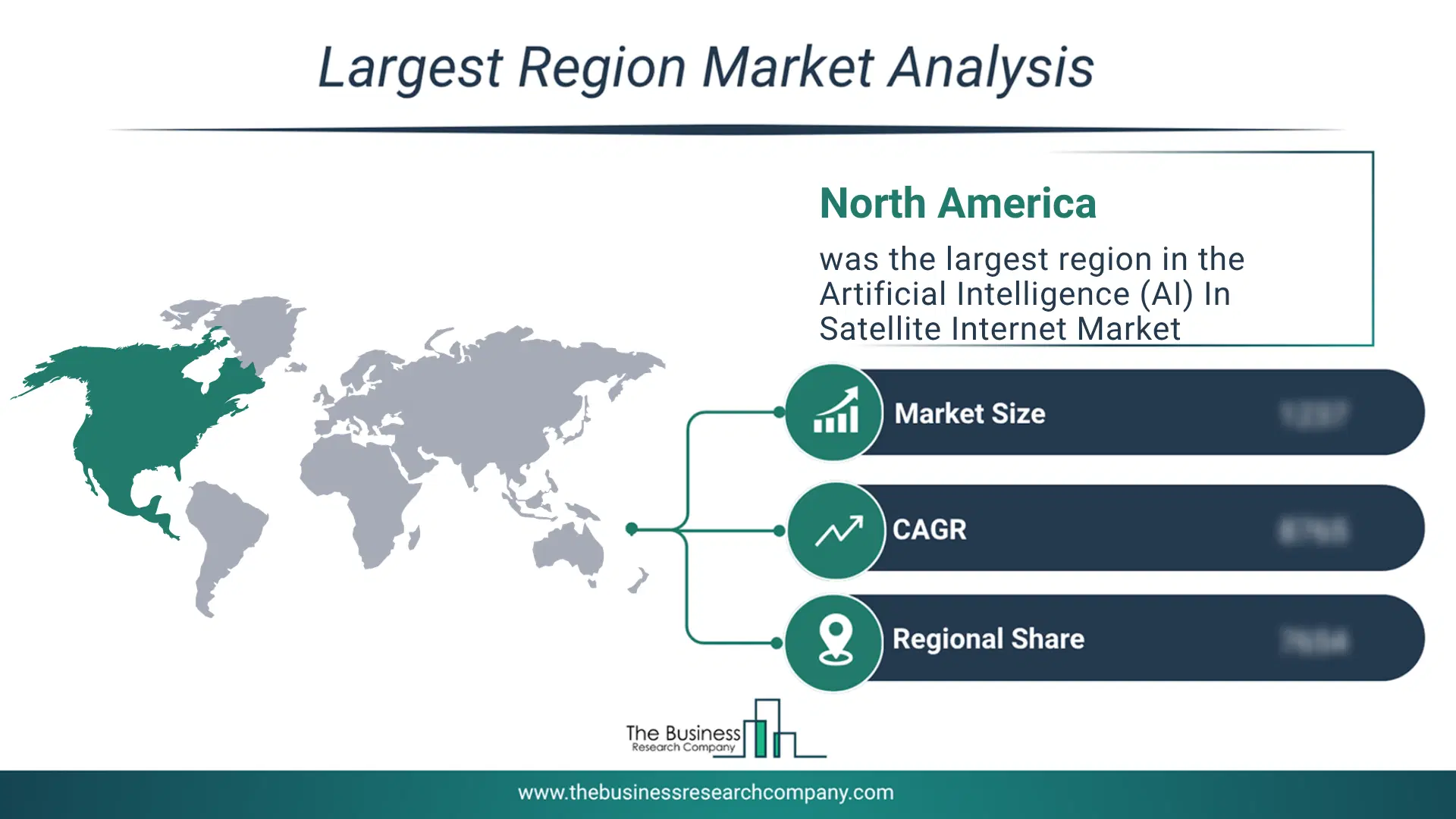
Regional Insights
North America was the largest region in the artificial intelligence (AI) in satellite internet market in 2025. Asia-Pacific is expected to be the fastest-growing region in the forecast period. The regions covered in this market report are Asia-Pacific, South East Asia, Western Europe, Eastern Europe, North America, South America, Middle East, Africa. The countries covered in this market report are Australia, Brazil, China, France, Germany, India, Indonesia, Japan, Taiwan, Russia, South Korea, UK, USA, Canada, Italy, SpainWhat Defines the Artificial Intelligence (AI) In Satellite Internet Market?
The artificial intelligence (AI) in satellite internet market consists of revenues earned by entities by providing services such as network optimization, predictive maintenance, signal enhancement, resource allocation, and autonomous operations. The market value includes the value of related goods sold by the service provider or included within the service offering. The artificial intelligence (AI) in satellite internet market also includes of sales of AI-powered satellite terminals, smart antennas, onboard artificial intelligence (AI) processors, ground station automation systems, and data analytics platforms. Values in this market are ‘factory gate’ values, that is the value of goods sold by the manufacturers or creators of the goods, whether to other entities (including downstream manufacturers, wholesalers, distributors and retailers) or directly to end customers. The value of goods in this market includes related services sold by the creators of the goods.How is Market Value Defined and Measured?
The market value is defined as the revenues that enterprises gain from the sale of goods and/or services within the specified market and geography through sales, grants, or donations in terms of the currency (in USD unless otherwise specified). The revenues for a specified geography are consumption values that are revenues generated by organizations in the specified geography within the market, irrespective of where they are produced. It does not include revenues from resales along the supply chain, either further along the supply chain or as part of other products.
This chart presents market attractiveness based on a quantitative evaluation of growth, competition, strategic alignment, and risk, offering a clear view of opportunity areas for decision-making. This chart is for illustrative purposes; the full report contains the complete analysis.

This chart highlights the Total Addressable Market (TAM) by estimating the maximum revenue opportunity using an assumption-driven approach, supporting strategic planning and opportunity sizing across markets. The chart is illustrative; the full report provides a more comprehensive analysis.
What Key Data and Analysis Are Included in the Artificial Intelligence (AI) In Satellite Internet Market Report 2026?
The artificial intelligence (ai) in satellite internet market research report is one of a series of new reports from The Business Research Company that provides market statistics, including industry global market size, regional shares, competitors with the market share, detailed market segments, market trends and opportunities, and any further data you may need to thrive in the artificial intelligence (ai) in satellite internet industry. The market research report delivers a complete perspective of everything you need, with an in-depth analysis of the current and future state of the industry.Artificial Intelligence (AI) In Satellite Internet Market Report Forecast Analysis
| Report Attribute | Details |
|---|---|
| Market Size Value In 2026 | $3.25 billion |
| Revenue Forecast In 2030 | $8.91 billion |
| Growth Rate | CAGR of 28.7% from 2026 to 2030 |
| Base Year For Estimation | 2025 |
| Actual Estimates/Historical Data | 2020-2025 |
| Forecast Period | 2026 - 2030 |
| Market Representation | Revenue in USD Billion and CAGR from 2026 to 2030 |
| Segments Covered | Component, Deployment Mode, Application, End-User |
| Regional Scope | Asia-Pacific, Western Europe, Eastern Europe, North America, South America, Middle East, Africa |
| Country Scope | The countries covered in the artificial intelligence (AI) in satellite internet market report are Australia, Brazil, China, France, Germany, India, Indonesia, Japan, Taiwan, Russia, South Korea, UK, USA, Canada, Italy, Spain |
| Key Companies Profiled | Viasat Inc., SES S.A., Kratos Defense & Security Solutions Inc., Marlink AS, Iridium Communications Inc., Space42 PLC, Comtech Telecommunications Corp., Hughes Network Systems LLC, Telesat Canada, Anuvu Operations LLC, ST Engineering iDirect Inc., Gilat Satellite Networks Ltd., Kymeta Corporation, Avanti Communications Group plc, ThinKom Solutions Inc., Skylo Technologies Inc., Kepler Communications Inc., SpaceBridge Inc., Integrasys S.A., Xovian Aerospace Private Limited. |
| Customization Scope | Request for Customization |
| Pricing And Purchase Options | Explore Purchase Options |