
Artificial Intelligence (AI) In Smart City Mobility Market Report 2026
Global Outlook – By Component (Software, Hardware, Services), By Deployment Mode (On-Premises, Cloud), By Technology (Machine Learning And Deep Learning, Computer Vision, Sensor Fusion), By Application (Traffic Management, Public Transportation, Parking Management, Autonomous Vehicles, Ride Sharing, Other Applications), By End-User (Government, Transportation Agencies, Private Operators, Other End-Users) – Market Size, Trends, Strategies, and Forecast to 2030
Artificial Intelligence (AI) In Smart City Mobility Market Overview
• Artificial Intelligence (AI) In Smart City Mobility market size has reached to $7.54 billion in 2025 • Expected to grow to $20.72 billion in 2030 at a compound annual growth rate (CAGR) of 22.5% • Growth Driver: Surge In Increasing Adoption Of Autonomous Vehicles Fueling The Growth Of The Market Due To Rising Real-World Deployment • Market Trend: DubAI Roads And Transport Authority Launched AI-And V2X-Enabled Traffic Signal System To Enable Predictive Maintenance And Intelligent Traffic Management • North America was the largest region in 2025 and Asia-Pacific is the fastest growing region.What Is Covered Under Artificial Intelligence (AI) In Smart City Mobility Market?
Artificial intelligence (AI) in smart city mobility refers to the use of AI technologies to optimize urban transportation systems, including traffic management, public transit, autonomous vehicles, and ride-sharing services. It analyzes real-time data from sensors, cameras, and connected vehicles to improve efficiency, reduce congestion, and enhance safety. It also helps city planners and operators make data-driven decisions for infrastructure planning and traffic flow optimization. The main components of artificial intelligence in smart city mobility include software, hardware, and services. Software refers to solutions that use artificial intelligence to analyze mobility data, optimize transportation systems, and improve urban movement efficiency and safety. The systems are deployed through on-premises and cloud models and utilize technologies such as machine learning and deep learning, computer vision, and sensor fusion. The various applications involved are traffic management, public transportation, parking management, autonomous vehicles, ride sharing, and other applications and are used by end users such as government, transportation agencies, private operators, and other end users.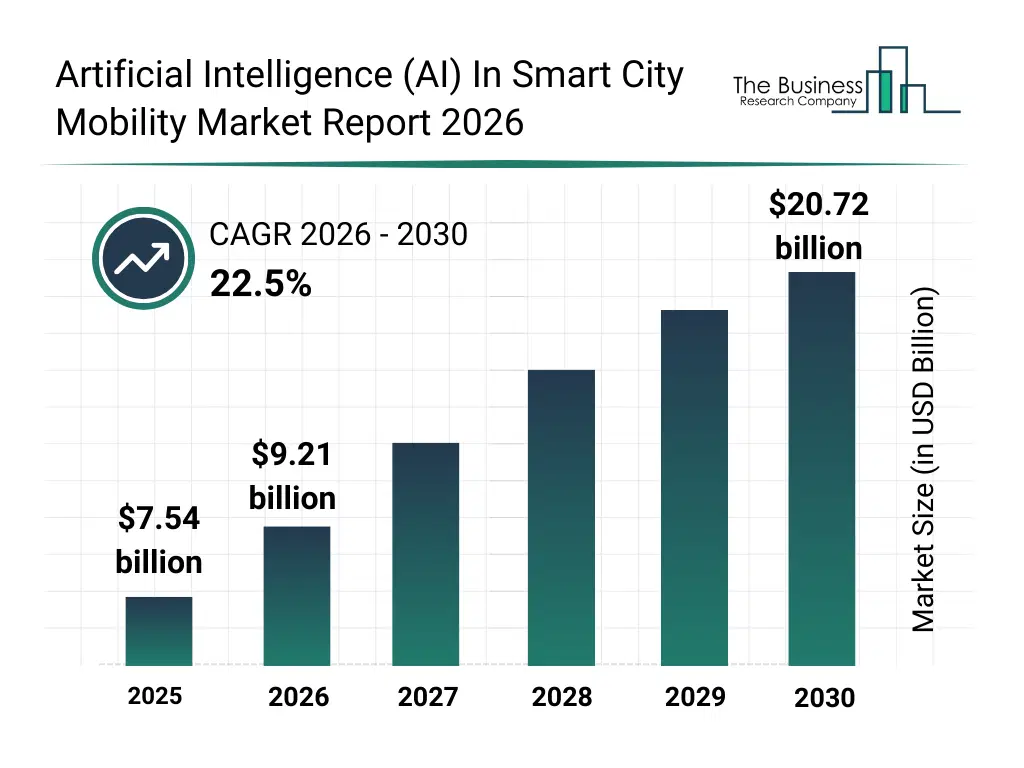
What Is The Artificial Intelligence (AI) In Smart City Mobility Market Size and Share 2026?
The artificial intelligence (AI) in smart city mobility market size has grown exponentially in recent years. It will grow from $7.54 billion in 2025 to $9.21 billion in 2026 at a compound annual growth rate (CAGR) of 22.2%. The growth in the historic period can be attributed to expansion of urbanization trends, increasing traffic congestion challenges, early adoption of Intelligent Transport Systems, growth of sensor-enabled city infrastructure, rising investments in smart city pilots.What Is The Artificial Intelligence (AI) In Smart City Mobility Market Growth Forecast?
The artificial intelligence (AI) in smart city mobility market size is expected to see exponential growth in the next few years. It will grow to $20.72 billion in 2030 at a compound annual growth rate (CAGR) of 22.5%. The growth in the forecast period can be attributed to expansion of autonomous and connected vehicle ecosystems, increasing investments in smart mobility infrastructure, growing demand for low-emission urban transport solutions, rising integration of AI with urban planning tools, expansion of data-driven traffic management platforms. Major trends in the forecast period include increasing deployment of AI-driven traffic optimization systems, rising adoption of smart public transit analytics, growing integration of autonomous mobility platforms, expansion of intelligent parking management solutions, enhanced focus on real-time urban mobility insights.
Global Artificial Intelligence (AI) In Smart City Mobility Market Segmentation
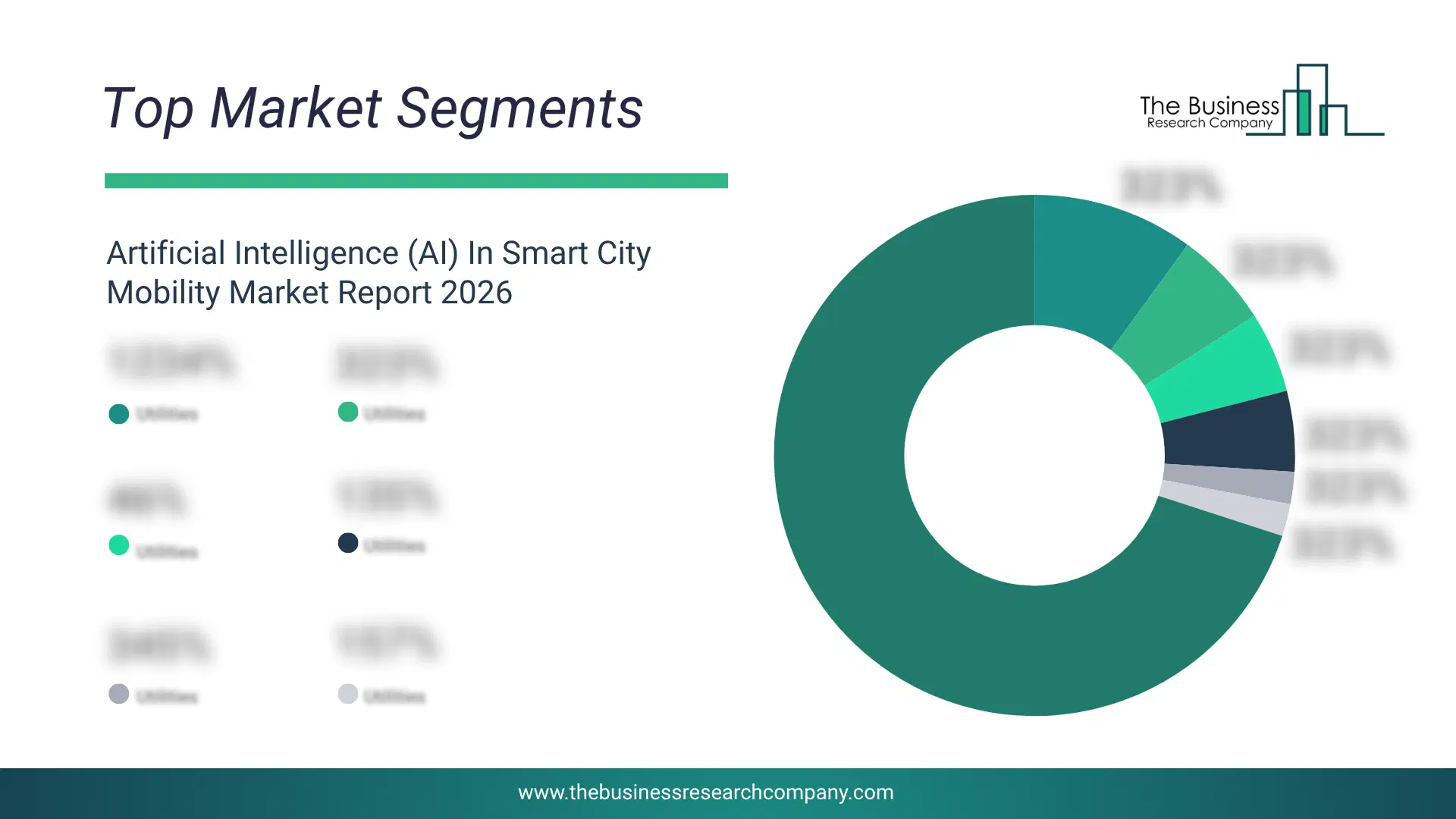
1) By Component: Software; Hardware; Services 2) By Deployment Mode: On-Premises; Cloud 3) By Technology: Machine Learning And Deep Learning; Computer Vision; Sensor Fusion 4) By Application: Traffic Management; Public Transportation; Parking Management; Autonomous Vehicles; Ride Sharing; Other Applications 5) By End-User: Government; Transportation Agencies; Private Operators; Other End-Users Subsegments: 1) By Software: Traffic Analytics Platforms; Mobility Management Systems; Data Visualization Solutions; Predictive Analytics Tools; Route Optimization Software; Incident Detection Systems 2) By Hardware: Traffic Sensors; Surveillance Cameras; Communication Devices; Edge Computing Units; Control Centers Equipment 3) By Services: System Integration Services; Consulting Services; Maintenance And Support Services; Data Management Services; Deployment And Training Services; Managed Mobility ServicesWhat Is The Driver Of The Artificial Intelligence (AI) In Smart City Mobility Market?
The increasing adoption of autonomous vehicles is expected to propel the growth of AI in the smart city mobility market going forward. Autonomous vehicles are vehicles equipped with advanced systems that can navigate and operate without human drivers by using sensors and artificial intelligence. Adoption of autonomous vehicles is rising due to public regulatory approvals, and commercial deployments have expanded services that allow driverless ride-hailing operations in urban environments, increasing user acceptance and utilization. AI in smart city mobility solutions provides crucial infrastructure support such as traffic prediction, real-time routing, and connected vehicle data, enabling autonomous vehicles to integrate safely and efficiently with urban traffic systems. For instance, in December 2023, according to the Insurance Institute for Highway Safety (IIHS), a US-based non-profit organization, it is projected that there will be approximately 3.5 billion autonomous vehicle connections globally by 2025, increasing to 4.5 billion by 2030. Therefore, an increasing adoption of autonomous vehicles is expected to drive the growth of AI in the smart city mobility market.Key Players In The Global Artificial Intelligence (AI) In Smart City Mobility Market
Major companies operating in the artificial intelligence (AI) in smart city mobility market are Metropolis Technologies Inc., Waymo LLC, Via Transportation Inc., EasyMile SAS, INRIX Inc., Optibus Ltd., May Mobility Inc., Smart Parking Limited, Swiftly Inc., Mundys S.p.A., NoTraffic Ltd., Zoox Inc., NextBillion.AI Pte. Ltd., GoodVision Labs s.r.o., Autofleet Inc., Valerann Ltd., GridMatrix Ltd., Videonetics Technology Private Limited, Watsoo Express Private Limited, Mobipar Inc., Beep Inc., TrafiXCT Ltd., Intozi Tech Private Limited, Surf Beyond Limited.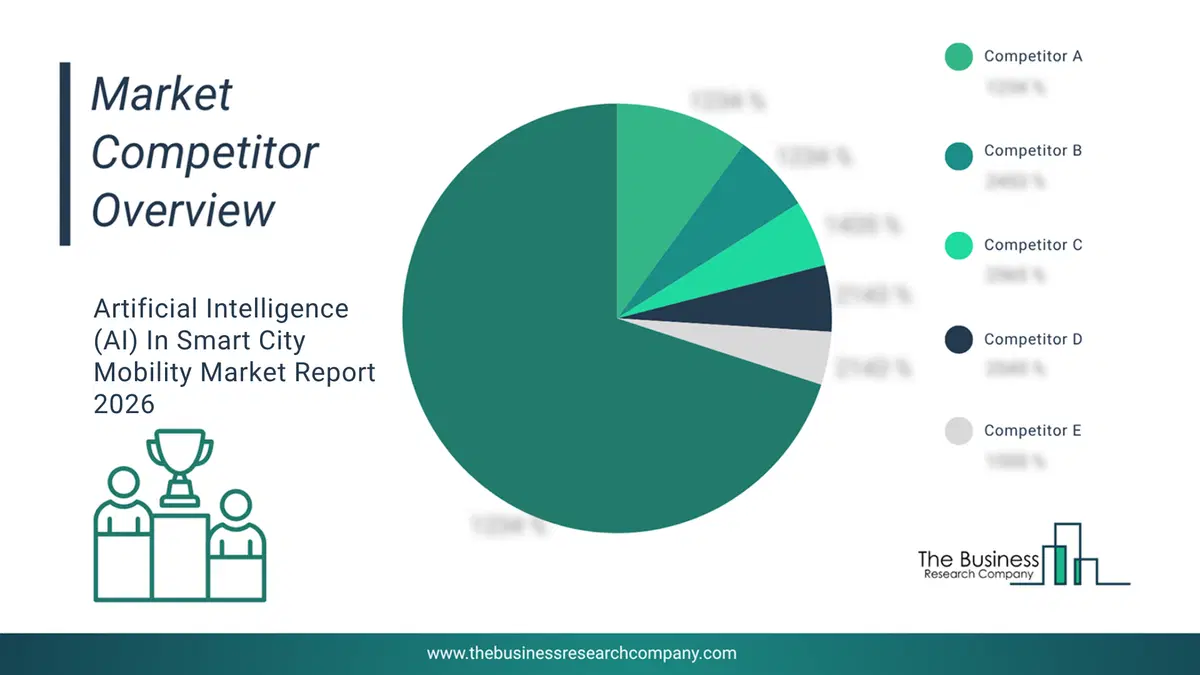
This chart is for illustrative purposes; the full report includes a detailed competitor analysis and comprehensive overview of the top 10 companies in the market.
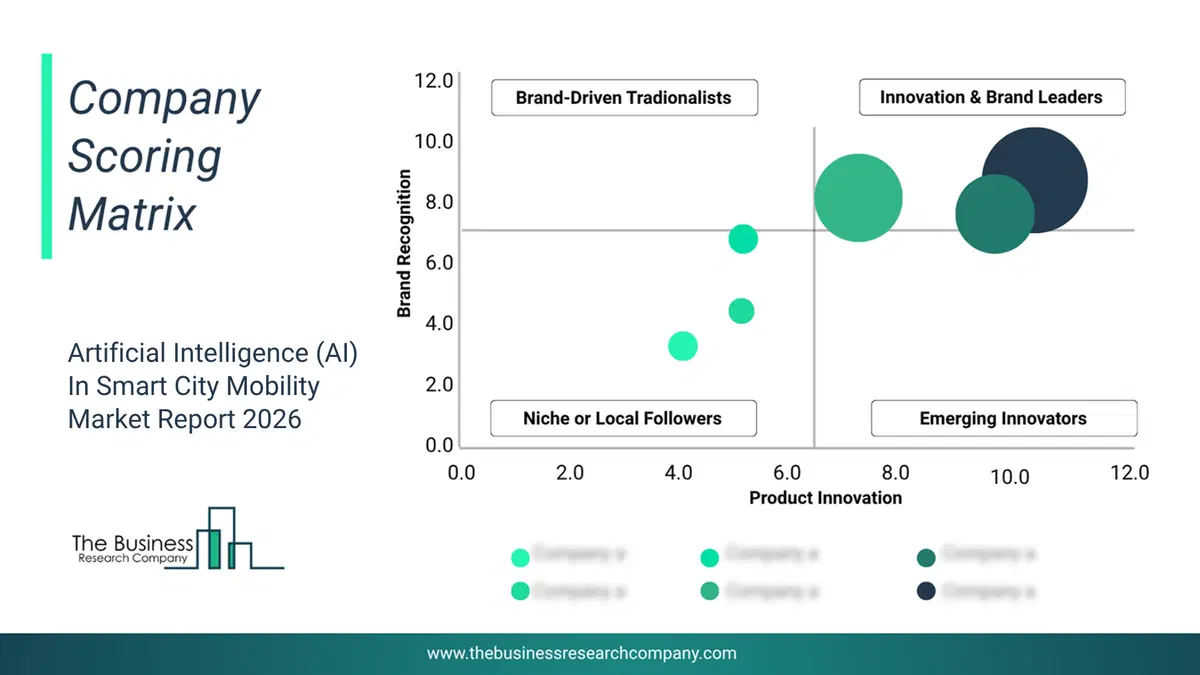
This chart maps companies by product innovation and brand strength, with bubble size indicating relative revenue, helping identify market leaders, challengers, and niche players. This is an illustrative chart; the full report provides a complete and accurate competitive analysis.
Global Artificial Intelligence (AI) In Smart City Mobility Market Trends and Insights
Major companies operating in the artificial intelligence in smart city mobility market are focusing on advanced software solutions that enable predictive maintenance, such as AI and vehicle-to-everything (V2X)-enabled intelligent traffic management systems, to gain a competitive advantage by enabling real-time monitoring, early fault detection, and proactive maintenance of urban mobility infrastructure. AI and V2X refer to the integration of artificial intelligence algorithms with vehicle-to-everything communication technologies that enable real-time data exchange between vehicles, infrastructure, pedestrians, and networks to optimize traffic operations and support predictive maintenance of smart city mobility systems. For instance, in October 2024, the DubAI Roads and Transport Authority, a UAE-based public transportation and mobility authority, launched the V2X Network to enable real-time vehicle-to-infrastructure communication and improve traffic safety and efficiency. It is a smart mobility initiative that enables real-time communication between vehicles and road infrastructure (Vehicle-to-Everything). It connects traffic signals with in-vehicle systems to deliver live updates such as signal status, speed guidance, and road conditions. By using connected data, it helps optimize traffic flow, reduce congestion, and improve travel time reliability across key corridors. The network also supports safer driving through timely alerts and improved intersection awareness.What Are Latest Mergers And Acquisitions In The Artificial Intelligence (AI) In Smart City Mobility Market?
In March 2024, Transit Technologies LLC, a US-based provider of mobility software and connected transportation platforms, acquired TripShot Inc. for an undisclosed amount. With this acquisition, Transit Technologies aimed to enhance its smart mobility and AI-enabled urban transportation capabilities by integrating TripShot’s fleet management, route optimization, and real-time mobility data software into its comprehensive AI-powered SaaS mobility platform to support more efficient transit operations, real-time analytics, and optimized routing that contribute to smart city mobility initiatives. TripShot Inc. is a US-based developer of mobility operating system solutions that collect and analyze fleet, route, and passenger data.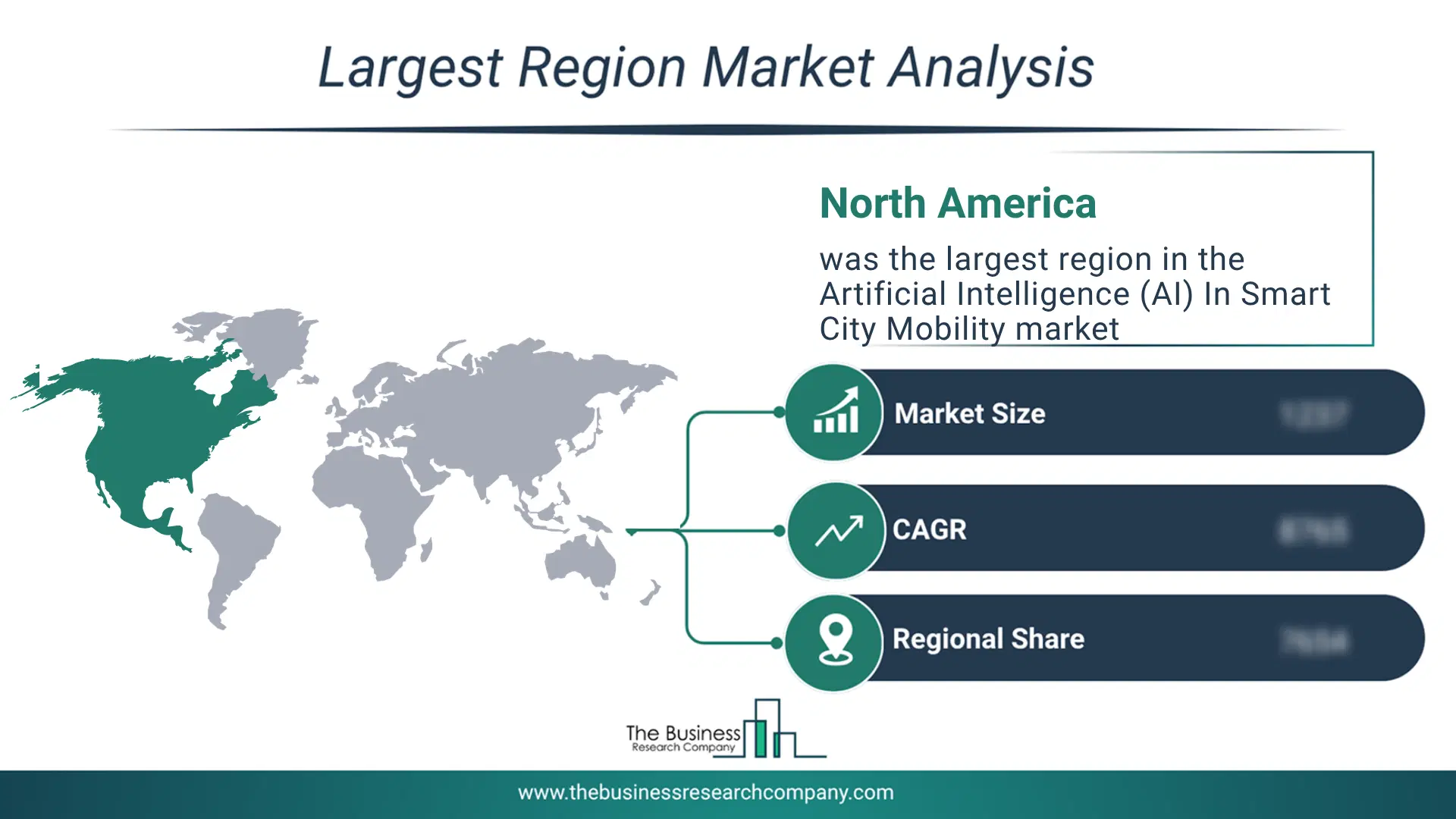
Regional Insights
North America was the largest region in the AI in smart city mobility market in 2025. Asia-Pacific is expected to be the fastest-growing region in the forecast period. The regions covered in this market report are Asia-Pacific, South East Asia, Western Europe, Eastern Europe, North America, South America, Middle East, Africa. The countries covered in this market report are Australia, Brazil, China, France, Germany, India, Indonesia, Japan, Taiwan, Russia, South Korea, UK, USA, Canada, Italy, Spain.What Defines the Artificial Intelligence (AI) In Smart City Mobility Market?
The artificial intelligence (AI) in smart city mobility market consists of revenues earned by entities by providing services such as predictive maintenance for transportation infrastructure, smart parking solutions, public transport scheduling and route optimization, and autonomous vehicle integration. The market value includes the value of related goods sold by the service provider or included within the service offering. The artificial intelligence (AI) in smart city mobility market also includes sales of AI-powered parking management solutions, intelligent public transport systems, connected vehicle platforms, route optimization software, and AI-driven analytics platforms. Values in this market are ‘factory gate’ values, that is the value of goods sold by the manufacturers or creators of the goods, whether to other entities (including downstream manufacturers, wholesalers, distributors and retailers) or directly to end customers. The value of goods in this market includes related services sold by the creators of the goods.How is Market Value Defined and Measured?
The market value is defined as the revenues that enterprises gain from the sale of goods and/or services within the specified market and geography through sales, grants, or donations in terms of the currency (in USD unless otherwise specified). The revenues for a specified geography are consumption values that are revenues generated by organizations in the specified geography within the market, irrespective of where they are produced. It does not include revenues from resales along the supply chain, either further along the supply chain or as part of other products.
This chart presents market attractiveness based on a quantitative evaluation of growth, competition, strategic alignment, and risk, offering a clear view of opportunity areas for decision-making. This chart is for illustrative purposes; the full report contains the complete analysis.

This chart highlights the Total Addressable Market (TAM) by estimating the maximum revenue opportunity using an assumption-driven approach, supporting strategic planning and opportunity sizing across markets. The chart is illustrative; the full report provides a more comprehensive analysis.
What Key Data and Analysis Are Included in the Artificial Intelligence (AI) In Smart City Mobility Market Report 2026?
The artificial intelligence (ai) in smart city mobility market research report is one of a series of new reports from The Business Research Company that provides market statistics, including industry global market size, regional shares, competitors with the market share, detailed market segments, market trends and opportunities, and any further data you may need to thrive in the artificial intelligence (ai) in smart city mobility industry. The market research report delivers a complete perspective of everything you need, with an in-depth analysis of the current and future state of the industry.Artificial Intelligence (AI) In Smart City Mobility Market Report Forecast Analysis
| Report Attribute | Details |
|---|---|
| Market Size Value In 2026 | $9.21 billion |
| Revenue Forecast In 2030 | $20.72 billion |
| Growth Rate | CAGR of 22.5% from 2026 to 2030 |
| Base Year For Estimation | 2025 |
| Actual Estimates/Historical Data | 2020-2025 |
| Forecast Period | 2026 - 2030 |
| Market Representation | Revenue in USD Billion and CAGR from 2026 to 2030 |
| Segments Covered | Component, Deployment Mode, Technology, Application, End-User |
| Regional Scope | Asia-Pacific, Western Europe, Eastern Europe, North America, South America, Middle East, Africa |
| Country Scope | The Countries Covered In This Market Report Are Australia, Brazil, China, France, Germany, India, Indonesia, Japan, Taiwan, Russia, South Korea, Uk, Usa, Canada, Italy, Spain. |
| Key Companies Profiled | Metropolis Technologies Inc., Waymo LLC, Via Transportation Inc., EasyMile SAS, INRIX Inc., Optibus Ltd., May Mobility Inc., Smart Parking Limited, Swiftly Inc., Mundys S.p.A., NoTraffic Ltd., Zoox Inc., NextBillion.AI Pte. Ltd., GoodVision Labs s.r.o., Autofleet Inc., Valerann Ltd., GridMatrix Ltd., Videonetics Technology Private Limited, Watsoo Express Private Limited, Mobipar Inc., Beep Inc., TrafiXCT Ltd., Intozi Tech Private Limited, Surf Beyond Limited. |
| Customization Scope | Request for Customization |
| Pricing And Purchase Options | Explore Purchase Options |