

Artificial Intelligence (AI) In Textile Market Report 2026
Global Outlook – By Component (Software, Services, Hardware), By Technology (Machine Learning, Computer Vision, Natural Language Processing, Predictive Analytics, Robotics And Automation), By Deployment Mode (Cloud-Based, On-Premises), By Application (Quality Control And Defect Detection, Predictive Maintenance, Production Planning And Optimization, Supply Chain And Inventory Management, Textile Design And Product Development, Demand Forecasting, Sustainability And Waste Management), By End User (Textile Manufacturers, Apparel Manufacturers, Technical Textile Producers, Fashion And Retail Brands, Textile Processing Companies) – Market Size, Trends, Strategies, and Forecast to 2030
Artificial Intelligence (AI) In Textile Market Overview
• Artificial Intelligence (AI) In Textile market size has reached to $4.13 billion in 2025 • Expected to grow to $17.65 billion in 2030 at a compound annual growth rate (CAGR) of 33.6% • Growth Driver: The Increasing Adoption Of Smart Manufacturing Practices Driving The Growth Of The Market Due To Enhance Automation And Digitalization • Market Trend: Innovation In Intelligent Textile Material Recognition And Automated Separation Technologies • Asia-Pacific was the largest region in 2025 and North America is the fastest growing region.What Is Covered Under Artificial Intelligence (AI) In Textile Market?
Artificial intelligence (AI) in textile refers to the application of artificial intelligence technologies, including machine learning, computer vision, predictive analytics, and automation, to optimize textile manufacturing processes, improve product quality, and enhance operational efficiency. It enables intelligent decision-making by analyzing production data, detecting defects, forecasting demand, optimizing resource utilization, and automating design and production workflows. It supports digital transformation across the textile value chain by improving productivity, reducing waste, and enabling data-driven manufacturing operations. The main components of artificial intelligence (AI) in textile include software, services, and hardware. Software refers to AI-enabled solutions used to analyze textile production data, identify quality issues, optimize manufacturing processes, and support decision-making across textile operations. These solutions utilize technologies such as machine learning, computer vision, natural language processing, predictive analytics, and robotics and automation and are deployed through cloud-based and on-premises models. They find application in quality control and defect detection, predictive maintenance, production planning and optimization, supply chain and inventory management, textile design and product development, demand forecasting, and sustainability and waste management, serving end users including textile manufacturers, apparel manufacturers, technical textile producers, fashion and retail brands, and textile processing companies.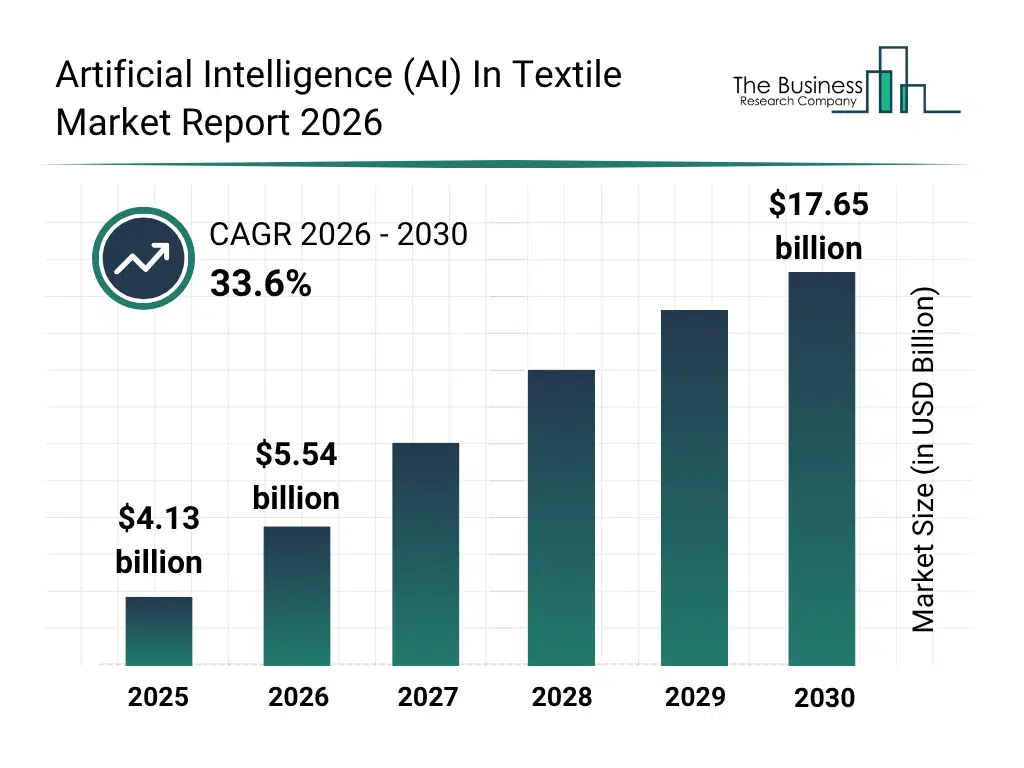
What Is The Artificial Intelligence (AI) In Textile Market Size and Share 2026?
The artificial intelligence (AI) in textile market size has grown exponentially in recent years. It will grow from $4.13 billion in 2025 to $5.54 billion in 2026 at a compound annual growth rate (CAGR) of 34.0%. The growth in the historic period can be attributed to increasing textile production volumes, rising demand for improved textile product quality, growing complexity of textile manufacturing processes, increasing production waste, rising demand for manufacturing efficiency.What Is The Artificial Intelligence (AI) In Textile Market Growth Forecast?
The artificial intelligence (AI) in textile market size is expected to see exponential growth in the next few years. It will grow to $17.65 billion in 2030 at a compound annual growth rate (CAGR) of 33.6%. The growth in the forecast period can be attributed to increasing demand for real-time production optimization, rising need for automated textile quality inspection, growing demand for accurate demand forecasting, increasing adoption of intelligent textile design solutions, rising need for predictive maintenance of textile machinery. Major trends in the forecast period include increasing demand for personalized textile products, rising adoption of digital textile printing, growing demand for faster textile product development cycles, increasing emphasis on textile product traceability, rising demand for customized textile production.
Global Artificial Intelligence (AI) In Textile Market Segmentation
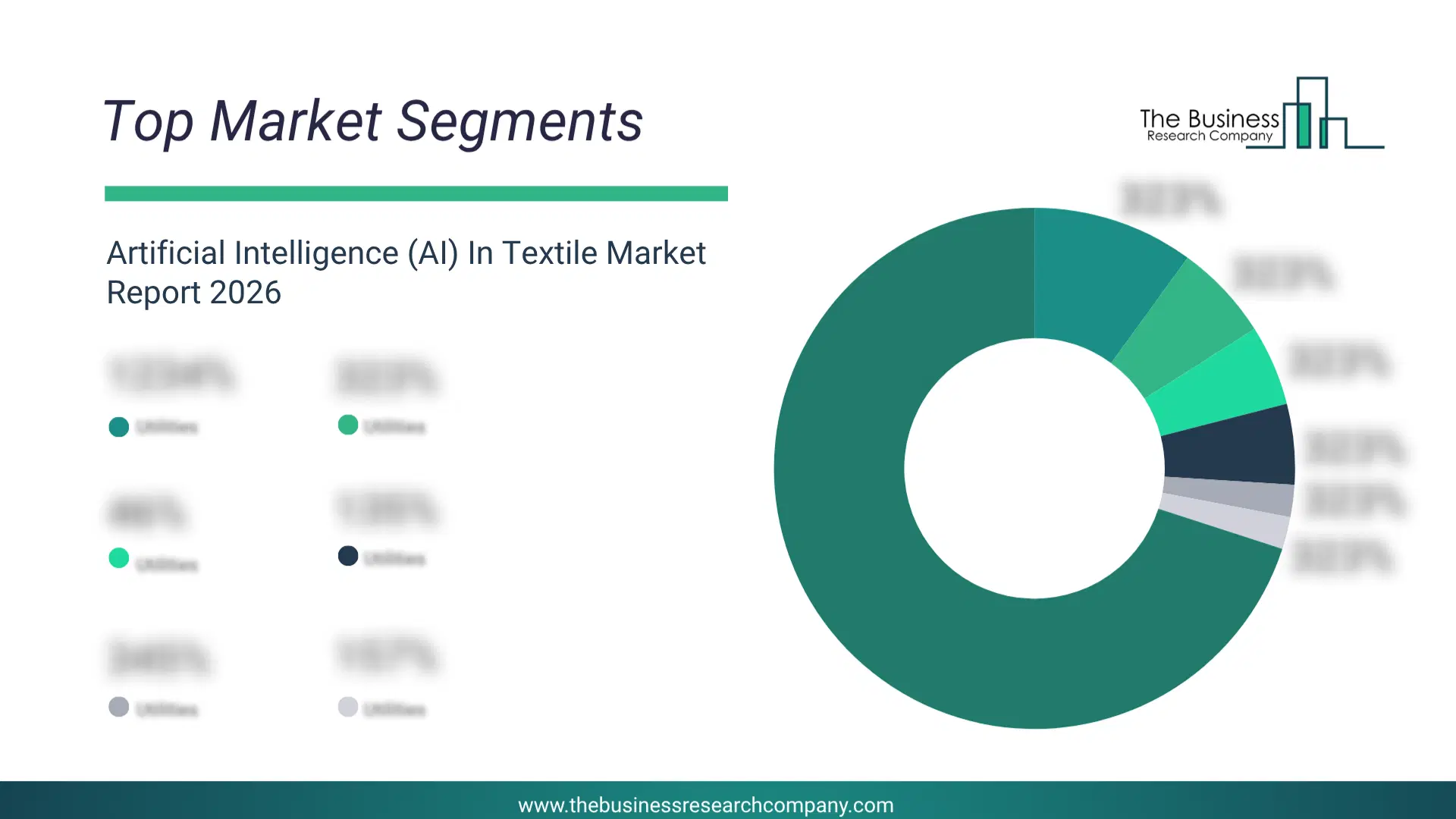
1) By Component: Software, Services, Hardware 2) By Technology: Machine Learning, Computer Vision, Natural Language Processing, Predictive Analytics, Robotics And Automation 3) By Deployment Mode: Cloud-Based, On-Premises 4) By Application: Quality Control And Defect Detection, Predictive Maintenance, Production Planning And Optimization, Supply Chain And Inventory Management, Textile Design And Product Development, Demand Forecasting, Sustainability And Waste Management 5) By End User: Textile Manufacturers, Apparel Manufacturers, Technical Textile Producers, Fashion And Retail Brands, Textile Processing Companies Subsegments: 1) By Software: Artificial Intelligence Design And Pattern Generation Software, Artificial Intelligence Quality Inspection Software, Artificial Intelligence Production Planning And Optimization Software, Artificial Intelligence Predictive Maintenance Software 2) By Services: Artificial Intelligence Consulting Services, Implementation And Integration Services, Training And Support Services, Managed Artificial Intelligence Services 3) By Hardware: Artificial Intelligence Vision Inspection Systems, Edge Artificial Intelligence Computing Devices, Industrial Sensors And Smart Cameras, Graphics Processing Unit-Based Computing HardwareWhat Is The Driver Of The Artificial Intelligence (AI) In Textile Market?
The increasing adoption of smart manufacturing practices is expected to propel the growth of the artificial intelligence (AI) in textile market going forward. Smart manufacturing practices refer to the use of connected digital technologies, automation, real-time data analytics, and intelligent systems to improve production efficiency, product quality, and operational performance across manufacturing facilities. The adoption of smart manufacturing practices is increasing due to advancements in digital technologies, which facilitate automation, real-time monitoring, and data-driven decision-making. Smart manufacturing practices integrate digital technologies, automation, and real-time data to support AI implementation in the textile industry, enabling process optimization, quality improvement, predictive maintenance, and efficient decision-making. For instance, in March 2024, according to Rockwell Automation, a U.S.-based industrial automation company, 95% of manufacturers were using or evaluating smart manufacturing technology in 2024, compared with 84% in 2023, representing an increase of 11 percentage points. Therefore, the increasing adoption of smart manufacturing practices is driving the growth of the artificial intelligence (AI) in textile industry.Key Players In The Global Artificial Intelligence (AI) In Textile Market
Major companies operating in the artificial intelligence (AI) in textile market are Lectra SA, Inspectorio Inc., CALA Inc., Desion GmbH, Browzwear Solutions Pte. Ltd., Alvanon Inc., TrusTrace AB, Material Exchange Ventures ApS, Shelton Machines Limited, Gridbots Technologies Private Limited, GoldenEye Smart Vision SAS, sewts GmbH, ColorDigital GmbH, AI-Guided Design Laboratory Limited, unspun inc., CountAI Technologies Private Limited, DataBeyond Technology Co. Ltd., Zhejiang Lingdi Digital Technology Co. Ltd.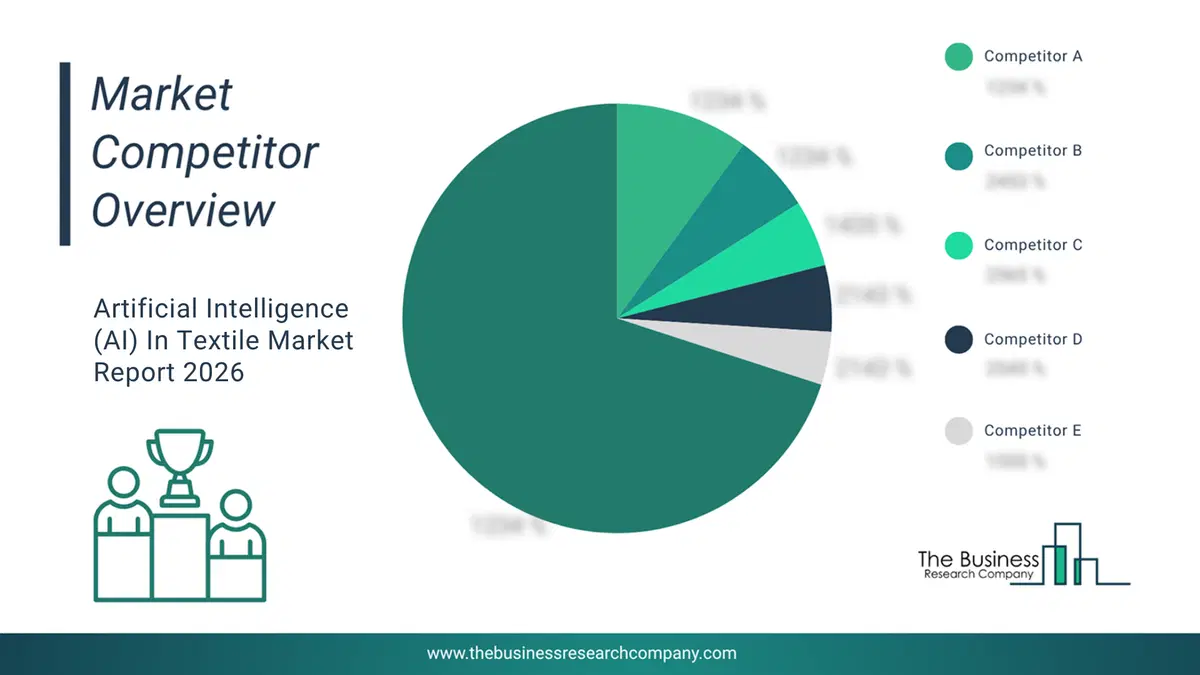
This chart is for illustrative purposes; the full report includes a detailed competitor analysis and comprehensive overview of the top 10 companies in the market.
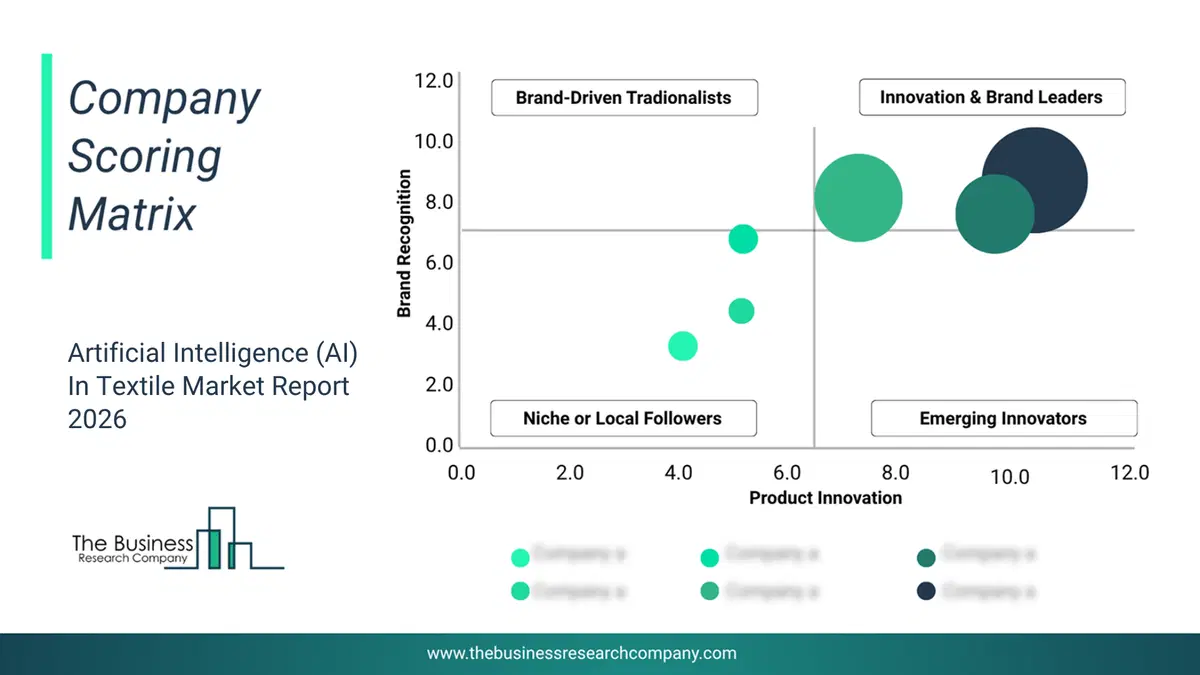
This chart maps companies by product innovation and brand strength, with bubble size indicating relative revenue, helping identify market leaders, challengers, and niche players. This is an illustrative chart; the full report provides a complete and accurate competitive analysis.
Global Artificial Intelligence (AI) In Textile Market Trends and Insights
Major companies operating in the artificial intelligence (AI) in textile market are focusing on developing innovative solutions such as, AI-powered hyperspectral textile recognition systems to improve material identification, automate sorting processes, and support efficient textile recycling. AI-powered hyperspectral textile recognition systems combine hyperspectral imaging with artificial intelligence algorithms to accurately identify textile fibers, blended materials, and contaminants by analyzing their unique spectral signatures, enabling precise real-time material classification beyond the capabilities of conventional vision systems. For instance, in April 2026, Specim, a Finland-based hyperspectral imaging solutions company, launched RETEX, an AI-powered hyperspectral textile recognition solution designed for automated textile material identification and separation. The solution integrates hyperspectral cameras with AI-based classification software to accurately identify fibers such as cotton, polyester, polyamide, viscose, wool, and acrylic, while also detecting blends, elastane, impurities, and colors in real time. RETEX supports scalable textile processing by enabling automated material separation, improving sorting accuracy, and enhancing recycling efficiency in industrial textile processing environments.What Are Latest Mergers And Acquisitions In The Artificial Intelligence (AI) In Textile Market?
In March 2023, Smartex.AI S.A., a Portugal-based technology company, acquired Tuvis AI for an undisclosed amount. With this acquisition, Smartex.AI, S.A. aimed to strengthen its global engineering capabilities, expand its presence in the Turkish textile market, and enhance its AI-powered textile quality control platform by integrating Tuvis AI's deep learning expertise while establishing a new engineering technology center in Istanbul. Tuvis AI is a Türkiye-based artificial intelligence technology company that specializes in providing AI for textile use cases.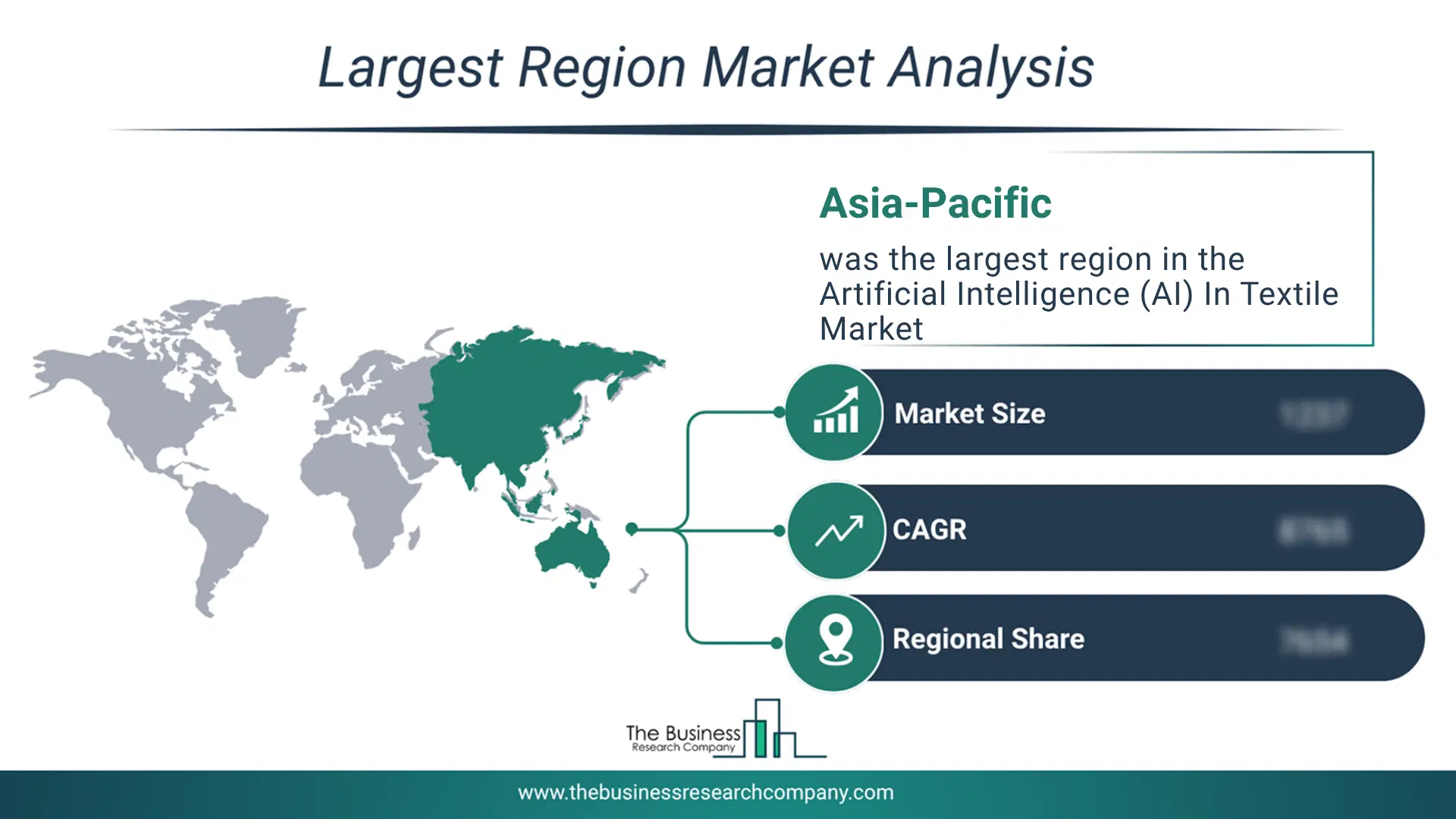
Regional Insights
Asia-Pacific was the largest region in the artificial intelligence (AI) in textile market in 2025. North America is expected to be the fastest-growing region in the forecast period. The regions covered in this market report are Asia-Pacific, South East Asia, Western Europe, Eastern Europe, North America, South America, Middle East, Africa. The countries covered in this market report are Australia, Brazil, China, France, Germany, India, Indonesia, Japan, Taiwan, Russia, South Korea, UK, USA, Canada, Italy, Spain.What Defines the Artificial Intelligence (AI) In Textile Market?
The artificial intelligence (AI) in textile market consists of revenues earned by entities by providing services such as AI-powered quality inspection, fabric defect detection, predictive maintenance, production planning and optimization, demand forecasting, inventory optimization, process automation, and pattern recognition. The market value includes the value of related goods sold by the service provider or included within the service offering. The artificial intelligence (AI) in textile market also includes sales of AI-enabled smart cameras, edge AI devices, industrial sensors, machine vision systems, AI processors, robotics controllers, and textile production monitoring hardware. Values in this market are ‘factory gate’ values, that is, the value of goods sold by the manufacturers or creators of the goods, whether to other entities (including downstream manufacturers, wholesalers, distributors, and retailers) or directly to end customers. The value of goods in this market includes related services sold by the creators of the goods.How is Market Value Defined and Measured?
The market value is defined as the revenues that enterprises gain from the sale of goods and/or services within the specified market and geography through sales, grants, or donations in terms of the currency (in USD unless otherwise specified). The revenues for a specified geography are consumption values that are revenues generated by organizations in the specified geography within the market, irrespective of where they are produced. It does not include revenues from resales along the supply chain, either further along the supply chain or as part of other products.
This chart presents market attractiveness based on a quantitative evaluation of growth, competition, strategic alignment, and risk, offering a clear view of opportunity areas for decision-making. This chart is for illustrative purposes; the full report contains the complete analysis.

This chart highlights the Total Addressable Market (TAM) by estimating the maximum revenue opportunity using an assumption-driven approach, supporting strategic planning and opportunity sizing across markets. The chart is illustrative; the full report provides a more comprehensive analysis.
What Key Data and Analysis Are Included in the Artificial Intelligence (AI) In Textile Market Report 2026?
The artificial intelligence (ai) in textile market research report is one of a series of new reports from The Business Research Company that provides market statistics, including industry global market size, regional shares, competitors with the market share, detailed market segments, market trends and opportunities, and any further data you may need to thrive in the artificial intelligence (ai) in textile industry. The market research report delivers a complete perspective of everything you need, with an in-depth analysis of the current and future state of the industry.Artificial Intelligence (AI) In Textile Market Report Forecast Analysis
| Report Attribute | Details |
|---|---|
| Market Size Value In 2026 | $5.54 billion |
| Revenue Forecast In 2030 | $17.65 billion |
| Growth Rate | CAGR of 33.6% from 2026 to 2030 |
| Base Year For Estimation | 2025 |
| Actual Estimates/Historical Data | 2020-2025 |
| Forecast Period | 2026 - 2030 |
| Market Representation | Revenue in USD Billion and CAGR from 2026 to 2030 |
| Segments Covered | Component, Technology, Deployment Mode, Application, End User |
| Regional Scope | Asia-Pacific, Western Europe, Eastern Europe, North America, South America, Middle East, Africa |
| Country Scope | The countries covered in the report are Australia, Brazil, China, France, Germany, India, Indonesia, Japan, Taiwan, Russia, South Korea, UK, USA, Canada, Italy, Spain. |
| Key Companies Profiled | Lectra SA, Inspectorio Inc., CALA Inc., Desion GmbH, Browzwear Solutions Pte. Ltd., Alvanon Inc., TrusTrace AB, Material Exchange Ventures ApS, Shelton Machines Limited, Gridbots Technologies Private Limited, GoldenEye Smart Vision SAS, sewts GmbH, ColorDigital GmbH, AI-Guided Design Laboratory Limited, unspun inc., CountAI Technologies Private Limited, DataBeyond Technology Co. Ltd., Zhejiang Lingdi Digital Technology Co. Ltd. |
| Customization Scope | Request for Customization |
| Pricing And Purchase Options | Explore Purchase Options |