
Artificial Intelligence (AI) In Travel Market Report 2026
Global Outlook – By Component (Software, Services), By Deployment mode (On-Premises, Cloud-Based), By Application (Customer Service, Booking And Reservations, Travel Planning And Personalization, Marketing And Advertising, Operations Management, Security And Fraud Detection) – Market Size, Trends, Strategies, and Forecast to 2030
Artificial Intelligence (AI) In Travel Market Overview
• Artificial Intelligence (AI) In Travel market size has reached to $4.37 billion in 2025 • Expected to grow to $12.11 billion in 2030 at a compound annual growth rate (CAGR) of 22.5% • Growth Driver: Rising Global Tourism Fuels Growth in AI-Driven Travel Market • Market Trend: AI Integration in Personalized Travel Enhancing Customer Experiences with Tailored Solutions and Smart Assistance • North America was the largest region in 2025 and is the fastest growing region.What Is Covered Under Artificial Intelligence (AI) In Travel Market?
Artificial Intelligence (AI) in travel refers to the use of artificial intelligence technologies to enhance and personalize the travel experience, including tasks such as booking, customer service, and itinerary planning. AI in travel helps with personalized recommendations, customer service, dynamic pricing, predicting travel trends, language translation, facial recognition, and managing itineraries. The main components in the artificial intelligence (AI) in travel market are software and services. AI software in travel encompasses specialized programs and algorithms designed to automate and enhance various aspects of the travel industry. The various deployment modes include on-premises and cloud-based, and several applications including customer service, booking and reservations, travel planning and personalization, marketing and advertising, operations management, and security and fraud detection.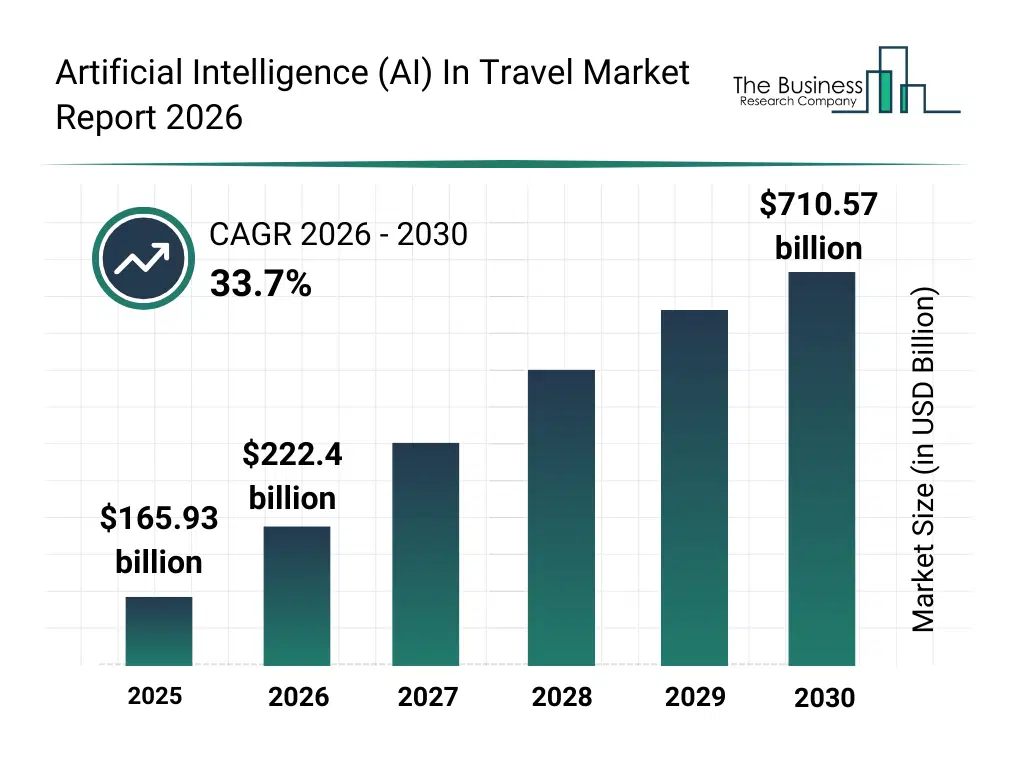
What Is The Artificial Intelligence (AI) In Travel Market Size and Share 2026?
The artificial intelligence (AI) in travel market size has grown exponentially in recent years. It will grow from $4.37 billion in 2025 to $5.37 billion in 2026 at a compound annual growth rate (CAGR) of 23.0%. The growth in the historic period can be attributed to expansion of online travel booking platforms, increasing use of digital customer service tools, growth of data-driven marketing in travel, rising cloud adoption, increased availability of travel data.What Is The Artificial Intelligence (AI) In Travel Market Growth Forecast?
The artificial intelligence (AI) in travel market size is expected to see exponential growth in the next few years. It will grow to $12.11 billion in 2030 at a compound annual growth rate (CAGR) of 22.5%. The growth in the forecast period can be attributed to increasing investments in end-to-end ai travel platforms, rising demand for hyper-personalized travel experiences, expansion of ai-enabled operational optimization, growing focus on real-time traveler insights, increasing adoption of biometric and facial recognition tools. Major trends in the forecast period include increasing adoption of ai-powered personalization engines, rising use of chatbots and virtual travel assistants, growing deployment of dynamic pricing algorithms, expansion of ai-driven fraud detection systems, enhanced focus on predictive travel analytics.
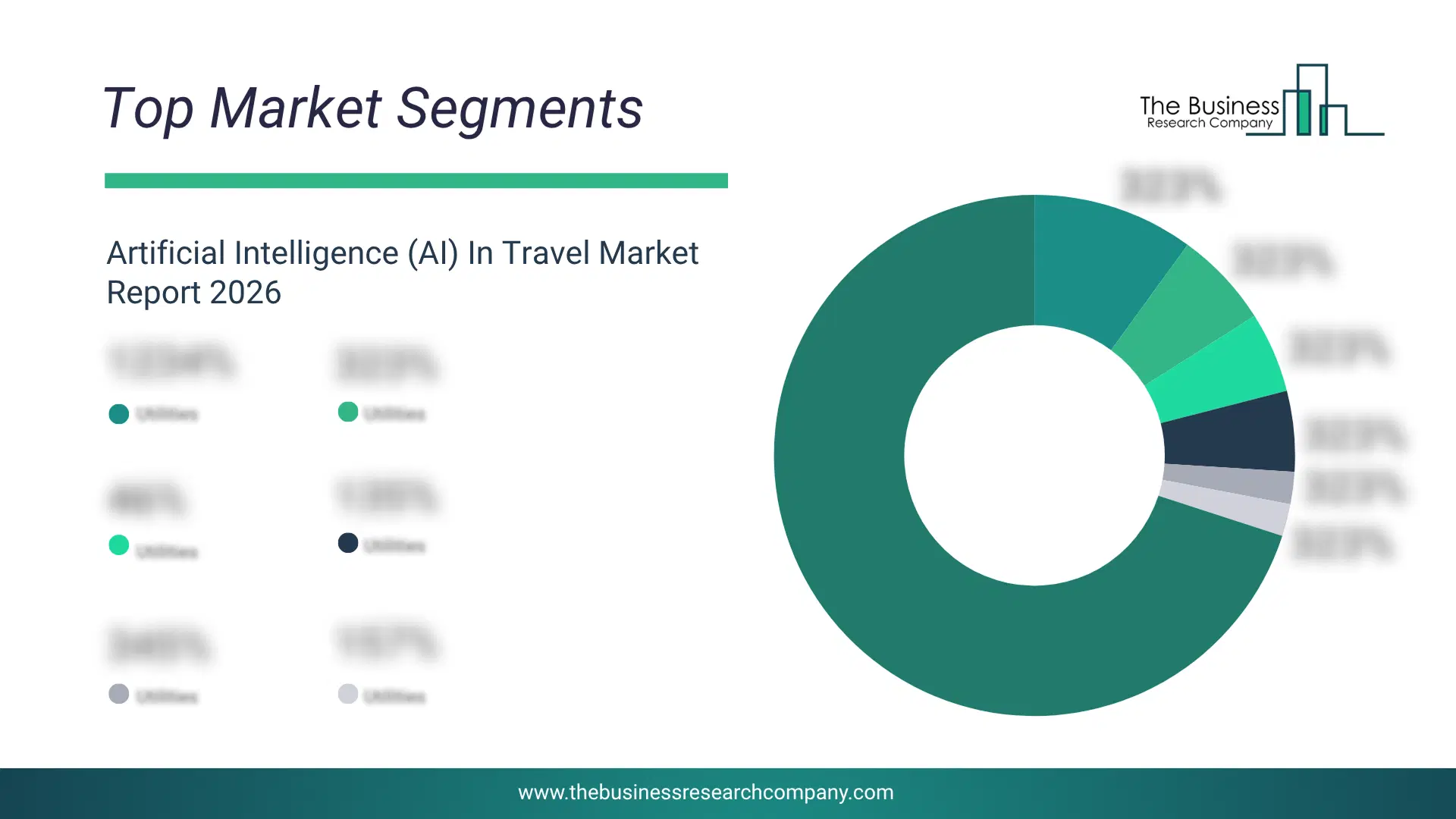
Global Artificial Intelligence (AI) In Travel Market Segmentation
2) By Deployment mode: On-Premises, Cloud-Based 3) By Application: Customer Service, Booking And Reservations, Travel Planning And Personalization, Marketing And Advertising, Operations Management, Security And Fraud Detection Subsegments: 1) By Software: AI-powered Travel Booking Platforms, Chatbots and Virtual Assistants, Personalization and Recommendation Engines, Revenue Management Software, Customer Relationship Management (CRM) Tools 2) By Services: Consulting Services, Implementation and Integration Services, Data Analytics and Insights Services, Training and Support Services, Digital Marketing ServicesWhat Is The Driver Of The Artificial Intelligence (AI) In Travel Market?
The rise in global tourism is expected to propel the growth of the artificial intelligence (AI) in travel market going forward. Global tourism involves people traveling internationally for leisure, business, or other reasons, fostering cultural exchange, economic development, and worldwide connections. The surge in global tourism is driven by higher disposable incomes, easier access to international travel, a greater desire to explore different destinations, and advancements in travel technology. AI in travel enhances tourism by providing personalized recommendations, automating bookings, and optimizing customer service, which improves overall traveler experiences and operational efficiency. For instance, in 2024, according to the World Travel and Tourism Council, a UK-based travel company, in 2023, the travel and tourism sector accounted for 9.1% of the global GDP, marking a 23.2% rise compared to 2022. Therefore, the rise in global tourism drives the artificial intelligence (AI) in travel industry.Key Players In The Global Artificial Intelligence (AI) In Travel Market
Major companies operating in the artificial intelligence (AI) in travel market are International Business Machines Corporation, Expedia Group Inc., Priceline.com, Booking.com B.V., Airbnb Inc., Sabre Corporation, TripAdvisor Inc., Agoda Company Pte. Ltd., SAP Concur, Travelport Worldwide Ltd., Hotelbeds Group, Skyscanner Ltd., Trivago N.V., MakeMyTrip Limited, Fareportal, Kayak Software Corporation, Despegar.com Inc., Cendyn Group LLC, Hopper, Cleartrip Private Limited, Sojern Inc., OTA Insight Ltd., Adara Inc., Viator Inc., Duetto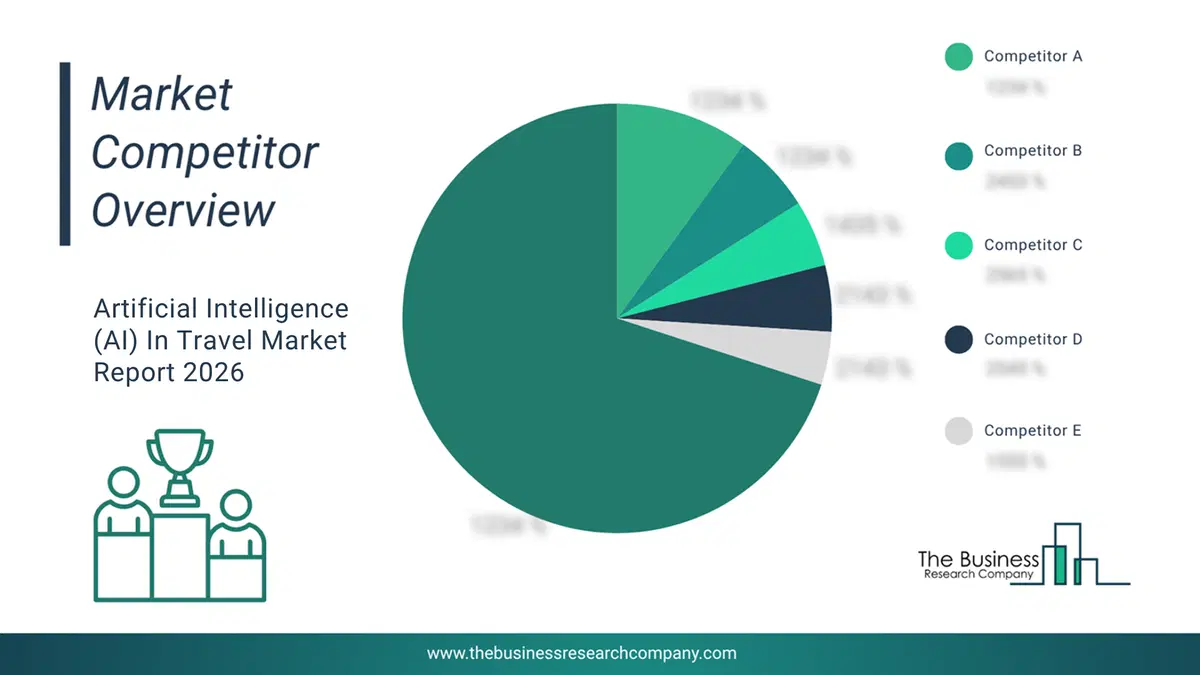
This chart is for illustrative purposes; the full report includes a detailed competitor analysis and comprehensive overview of the top 10 companies in the market.
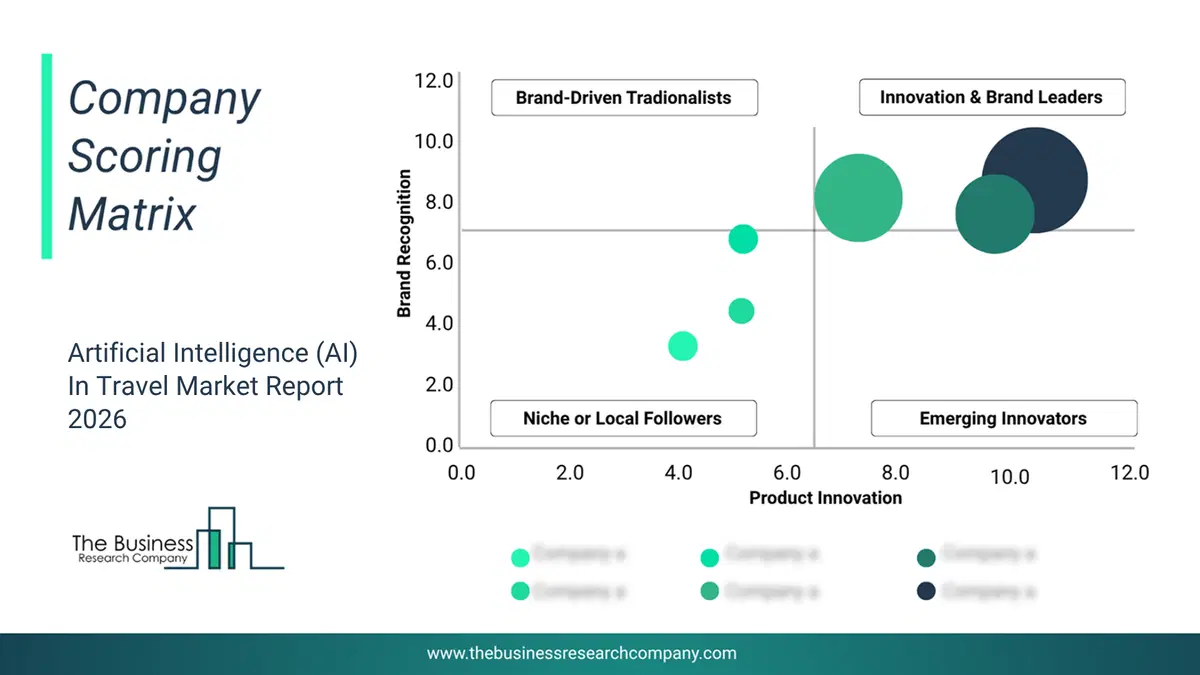
This chart maps companies by product innovation and brand strength, with bubble size indicating relative revenue, helping identify market leaders, challengers, and niche players. This is an illustrative chart; the full report provides a complete and accurate competitive analysis.
Global Artificial Intelligence (AI) In Travel Market Trends and Insights
Major companies operating in the artificial intelligence (AI) in travel market are focusing on technological development such as integrating artificial intelligence in personalized travel to enhance customer experiences by delivering tailored recommendations, optimizing travel itineraries, and providing real-time assistance. AI in personalized travel customizes travel experiences by leveraging technology to analyze user data and preferences, providing tailored suggestions for destinations, accommodations, and activities based on individual needs and past behaviors. For instance, in May 2024, Expedia Group Inc., a US-based travel technology company, launched an AI-powered assistant called Romie. Romie is an AI travel assistant who is a personal travel agent, aiding in planning, booking, and handling last-minute travel changes. It learns the user's preferences over time to offer personalized recommendations and features for group chat planning, smart search, and itinerary building.What Are Latest Mergers And Acquisitions In The Artificial Intelligence (AI) In Travel Market?
In May 2024, Headout, a US-based tours and activities platform, acquired Dabble for an undisclosed amount. The acquisition aims to enhance Headout's mission of providing top-tier real-life experiences through advanced AI technology. Dabble is a Canada-based startup that helps companies use artificial intelligence (AI) more effectively to boost travel experiences search.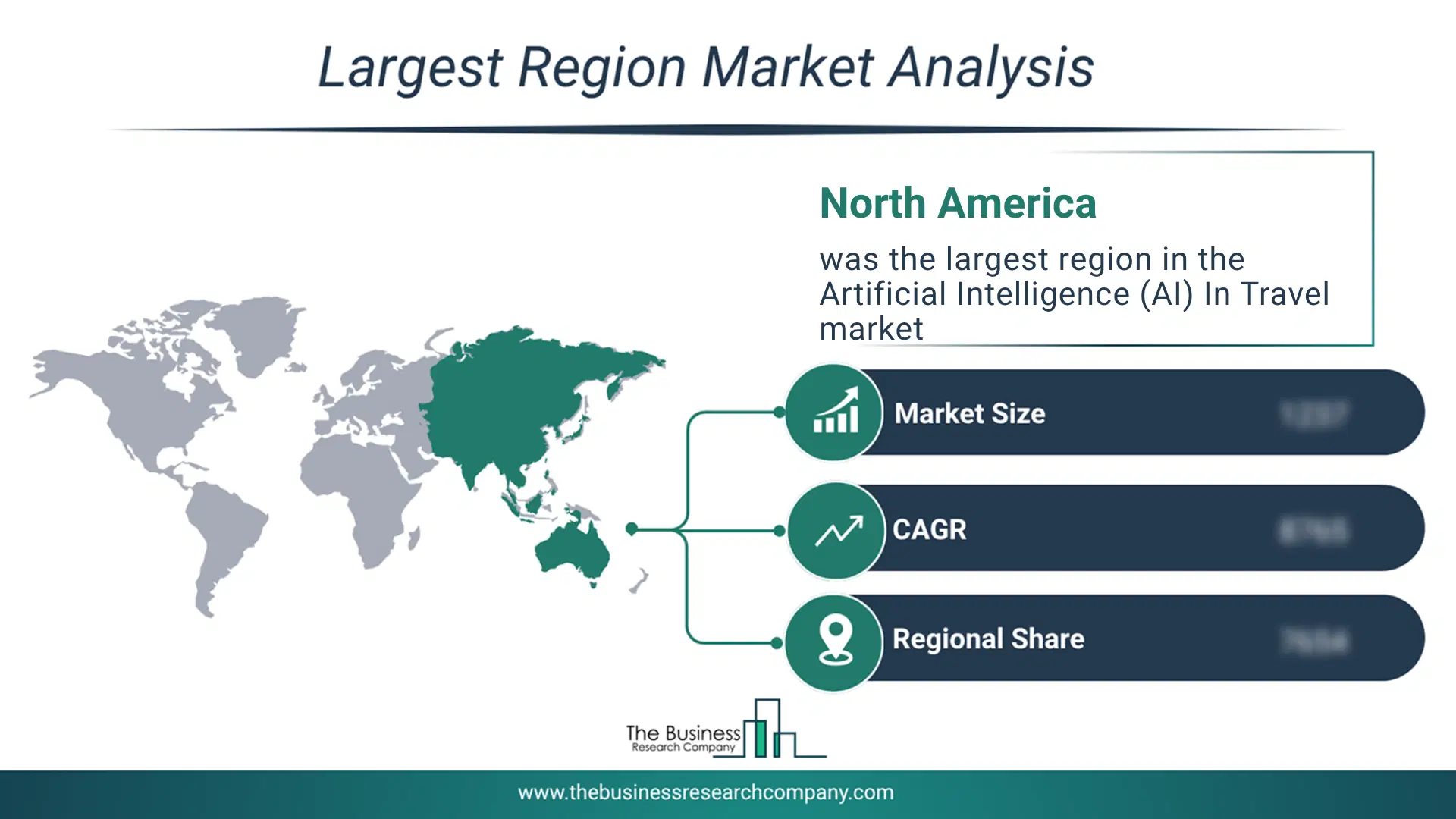
Regional Outlook
North America was the largest region in the artificial intelligence (AI) in travel market in 2025. The regions covered in this market report are Asia-Pacific, South East Asia, Western Europe, Eastern Europe, North America, South America, Middle East, Africa. The countries covered in this market report are Australia, Brazil, China, France, Germany, India, Indonesia, Japan, Taiwan, Russia, South Korea, UK, USA, Canada, Italy, Spain.What Defines the Artificial Intelligence (AI) In Travel Market?
The artificial intelligence (AI) in travel market includes revenues earned by entities by providing services such as personalized recommendations, virtual assistants and chatbots, dynamic pricing, and predictive analytics for travel demand. The market value includes the value of related goods sold by the service provider or included within the service offering. The artificial intelligence (AI) in travel market also includes sales of kiosks and self-service terminals and robotic assistants. Values in this market are ‘factory gate’ values, that is, the value of goods sold by the manufacturers or creators of the goods, whether to other entities (including downstream manufacturers, wholesalers, distributors, and retailers) or directly to end customers. The value of goods in this market includes related services sold by the creators of the goods.How is Market Value Defined and Measured?
The market value is defined as the revenues that enterprises gain from the sale of goods and/or services within the specified market and geography through sales, grants, or donations in terms of the currency (in USD unless otherwise specified). The revenues for a specified geography are consumption values that are revenues generated by organizations in the specified geography within the market, irrespective of where they are produced. It does not include revenues from resales along the supply chain, either further along the supply chain or as part of other products.
This chart presents market attractiveness based on a quantitative evaluation of growth, competition, strategic alignment, and risk, offering a clear view of opportunity areas for decision-making. This chart is for illustrative purposes; the full report contains the complete analysis.

This chart highlights the Total Addressable Market (TAM) by estimating the maximum revenue opportunity using an assumption-driven approach, supporting strategic planning and opportunity sizing across markets. The chart is illustrative; the full report provides a more comprehensive analysis.
What Key Data and Analysis Are Included in the Artificial Intelligence (AI) In Travel Market Report 2026?
The artificial intelligence (ai) in travel market research report is one of a series of new reports from The Business Research Company that provides market statistics, including industry global market size, regional shares, competitors with the market share, detailed market segments, market trends and opportunities, and any further data you may need to thrive in the artificial intelligence (ai) in travel industry. The market research report delivers a complete perspective of everything you need, with an in-depth analysis of the current and future state of the industry.Artificial Intelligence (AI) In Travel Market Report Forecast Analysis
| Report Attribute | Details |
|---|---|
| Market Size Value In 2026 | $5.37 billion |
| Revenue Forecast In 2030 | $12.11 billion |
| Growth Rate | CAGR of 22.5% from 2026 to 2030 |
| Base Year For Estimation | 2025 |
| Actual Estimates/Historical Data | 2020-2025 |
| Forecast Period | 2026 - 2030 |
| Market Representation | Revenue in USD Billion and CAGR from 2026 to 2030 |
| Segments Covered | Component, Deployment mode, Application |
| Regional Scope | Asia-Pacific, Western Europe, Eastern Europe, North America, South America, Middle East, Africa |
| Country Scope | The countries covered in the report are Australia, Brazil, China, France, Germany, India, Indonesia, Japan, Taiwan, Russia, South Korea, UK, USA, Canada, Italy, Spain. |
| Key Companies Profiled | International Business Machines Corporation, Expedia Group Inc., Priceline.com, Booking.com B.V., Airbnb Inc., Sabre Corporation, TripAdvisor Inc., Agoda Company Pte. Ltd., SAP Concur, Travelport Worldwide Ltd., Hotelbeds Group, Skyscanner Ltd., Trivago N.V., MakeMyTrip Limited, Fareportal, Kayak Software Corporation, Despegar.com Inc., Cendyn Group LLC, Hopper, Cleartrip Private Limited, Sojern Inc., OTA Insight Ltd., Adara Inc., Viator Inc., Duetto |
| Customization Scope | Request for Customization |
| Pricing And Purchase Options | Explore Purchase Options |