
Artificial Intelligence (AI) In Warehousing Market Report 2026
Global Outlook – By Component (Software, Hardware, Services), By Deployment Mode (Cloud, On Premises), By Organization Size (Small And Medium Enterprises, Large Enterprises), By Application (Inventory Optimization And Demand Forecasting, Warehouse Operations Optimization, Robotics And Automation Intelligence, Labor Management And Workforce Optimization, Predictive Maintenance And Asset Monitoring, Security Loss Prevention And Compliance), By End Use Industry (Retail And E Commerce, Logistics And Transportation, Manufacturing, Healthcare, Food And Beverage, Other End Use Industries) – Market Size, Trends, Strategies, and Forecast to 2030
Artificial Intelligence (AI) In Warehousing Market Overview
• Artificial Intelligence (AI) In Warehousing market size has reached to $7.43 billion in 2025 • Expected to grow to $23.04 billion in 2030 at a compound annual growth rate (CAGR) of 25.3% • Growth Driver: Growing Adoption Of Robotics For Warehouse Automation Fueling The Growth Of The Market Due To Increasing Labor Shortages • Market Trend: Artificial Intelligence Agent Builders Transforming Warehouse Automation And Real-Time Decision Making • North America was the largest region in 2025 and Asia-Pacific is the fastest growing region.What Is Covered Under Artificial Intelligence (AI) In Warehousing Market?
Artificial intelligence (AI) in warehousing refers to the use of AI technologies such as machine learning, computer vision, and predictive analytics to automate and optimize warehouse operations. It enables smarter inventory tracking, demand forecasting, order picking, and space utilization to improve efficiency, accuracy, and operational speed. The main components of artificial intelligence (AI) in warehousing include software, hardware, and services. Software refers to AI-powered systems used to optimize warehouse operations, improve decision-making, and enhance operational efficiency. These solutions are deployed through cloud and on premises models and are adopted by organization sizes including small and medium enterprises and large enterprises. The various applications involved are inventory optimization and demand forecasting, warehouse operations optimization, robotics and automation intelligence, labor management and workforce optimization, predictive maintenance and asset monitoring, and security loss prevention and compliance, and they are used by several end use industries such as retail and e commerce, logistics and transportation, manufacturing, healthcare, food and beverage, and others.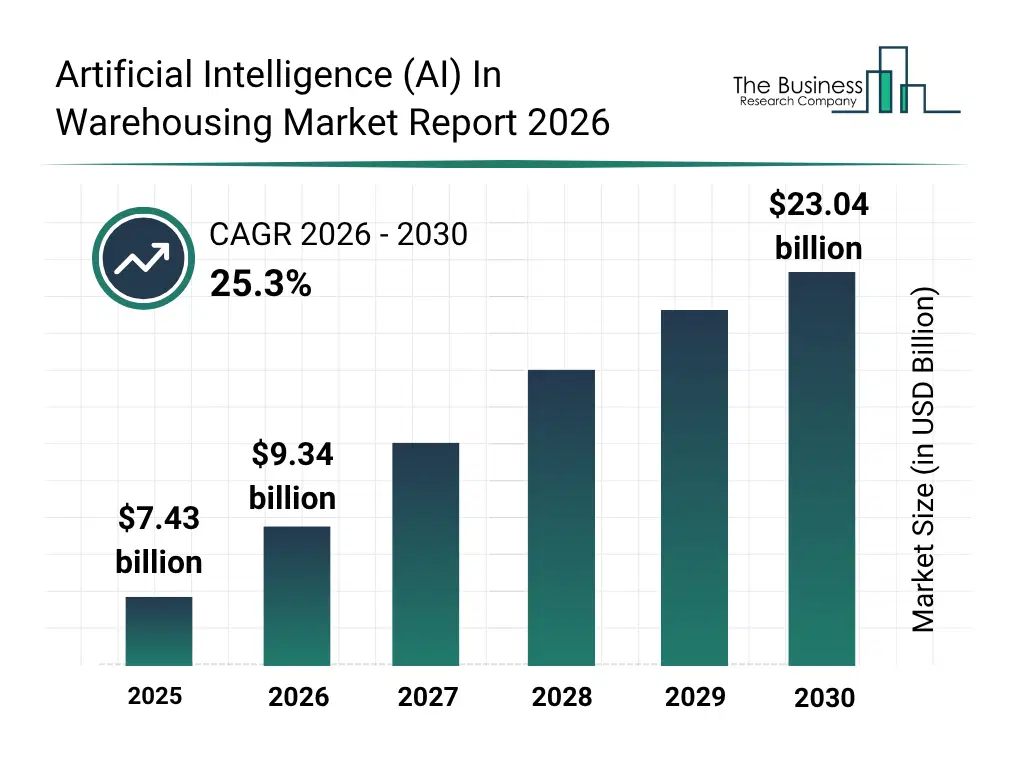
What Is The Artificial Intelligence (AI) In Warehousing Market Size and Share 2026?
The artificial intelligence (AI) in warehousing market size has grown exponentially in recent years. It will grow from $7.43 billion in 2025 to $9.34 billion in 2026 at a compound annual growth rate (CAGR) of 25.7%. The growth in the historic period can be attributed to growth in e commerce order volumes, expansion of large scale distribution centers, rising labor costs in warehousing operations, increasing adoption of basic warehouse management systems, need for improved inventory accuracy.What Is The Artificial Intelligence (AI) In Warehousing Market Growth Forecast?
The artificial intelligence (AI) in warehousing market size is expected to see exponential growth in the next few years. It will grow to $23.04 billion in 2030 at a compound annual growth rate (CAGR) of 25.3%. The growth in the forecast period can be attributed to increasing deployment of autonomous warehouse robots, rising adoption of AI driven predictive logistics systems, expansion of smart warehouse infrastructure, growing demand for real time inventory visibility, increasing integration of iot enabled warehouse ecosystems. Major trends in the forecast period include AI powered warehouse automation and intelligent inventory tracking systems, robotic order picking and autonomous fulfillment operations, computer vision based stock monitoring and space utilization optimization, predictive demand forecasting for warehouse capacity planning, real time warehouse orchestration using connected sensor networks.
Global Artificial Intelligence (AI) In Warehousing Market Segmentation
1) By Component: Software; Hardware; Services 2) By Deployment Mode: Cloud; On Premises 3) By Organization Size: Small And Medium Enterprises; Large Enterprises 4) By Application: Inventory Optimization And Demand Forecasting; Warehouse Operations Optimization; Robotics And Automation Intelligence; Labor Management And Workforce Optimization; Predictive Maintenance And Asset Monitoring; Security Loss Prevention And Compliance 5) By End Use Industry: Retail And E Commerce; Logistics And Transportation; Manufacturing; Healthcare; Food And Beverage; Other End Use Industries Subsegments: 1) By Software: Warehouse Management Software; Inventory Optimization Software; Predictive Analytics Software; Transportation Management Software; Order Fulfillment Software; Artificial Intelligence Platforms 2) By Hardware: Autonomous Mobile Robots; Automated Guided Vehicles; Sensors; Cameras; Barcode Scanners; Automated Storage And Retrieval Systems 3) By Services: Consulting Services; Integration Services; Deployment Services; Maintenance Services; Support Services; Managed ServicesWhat Is The Driver Of The Artificial Intelligence (AI) In Warehousing Market?
The growing adoption of robotics for warehouse automation is expected to propel the growth of the artificial intelligence in warehousing market going forward. Robotics for warehouse automation refers to the use of autonomous robots and intelligent robotic systems to automate warehouse operations such as picking, sorting, packing, inventory handling, and material transportation. Growing adoption of robotics for warehouse automation is primarily driven by increasing labor shortages, as companies are deploying robotic systems to maintain operational continuity, reduce dependence on manual labor, and improve warehouse efficiency and productivity. Artificial intelligence (AI) in warehousing helps robotics for warehouse automation by enabling intelligent decision-making, real-time coordination, and adaptive task execution that allows robots to efficiently perform picking, sorting, and movement operations with minimal human intervention. For instance, in 2024, according to Meteor Space Ltd., an Ireland-based third-party logistics company, over 30% of warehouses plan to adopt robotics, and the deployment of autonomous mobile robots (AMRs) is projected to grow at an annual rate of 15% through 2025. Therefore, the growing adoption of robotics for warehouse automation is driving the growth of artificial intelligence in the warehousing market.Key Players In The Global Artificial Intelligence (AI) In Warehousing Market
Major companies operating in the artificial intelligence (AI) in warehousing market are Oracle Corporation; Infor Inc.; Dematic Corp.; Blue Yonder Group Inc.; Ocado Group Plc; Symbotic Inc.; Swisslog Holding AG; AutoStore Holdings Ltd.; GreyOrange Pte. Ltd.; Hai Robotics Co. Ltd.; Geekplus Technology Co. Ltd.; Exotec SAS; Locus Robotics Corp.; Mobile Industrial Robots A/S; Brightpick Inc.; Covariant AI Inc.; Addverb Technologies Ltd.; Quicktron Intelligent Technology Co. Ltd.; RightHand Robotics Inc.; Agility Robotics Inc.Global Artificial Intelligence (AI) In Warehousing Market Trends and Insights
Major companies operating in the artificial intelligence (AI) in warehousing market are focusing on developing innovative solutions, such as artificial intelligence agent builders, to enhance warehouse automation, improve decision-making, and enable real-time optimization of supply chain execution processes. AI agent builders are advanced platforms that allow users to design, configure, and deploy intelligent software agents within warehouse management systems, where these agents can autonomously perform tasks such as inventory tracking, order allocation, demand forecasting, and workflow optimization using machine learning, data analytics, and microservices-based architectures. For instance, in January 2026, Logistics Reply S.p.A., an Italy-based supply chain technology company, launched GaliLEA Dynamic Intelligence, an AI agent builder integrated within its LEA Reply platform. The solution enables users to create and deploy customizable AI agents directly into warehouse operations, supporting tasks such as process automation, exception handling, and predictive decision-making. It is designed to work within a microservices-based architecture, allowing seamless integration with existing warehouse management systems while improving operational.What Are Latest Mergers And Acquisitions In The Artificial Intelligence (AI) In Warehousing Market?
In October 2025, Ingka Holding B.V., a Netherlands-based manufacturing company, acquired Locus for an undisclosed amount. With this acquisition, Ingka Group aims to strengthen its last-mile delivery and end-to-end logistics optimization capabilities by integrating advanced AI-driven routing, dispatch, and supply chain intelligence into IKEA’s home delivery operations, thereby improving efficiency, scalability, and customer fulfillment performance. Locus.sh is a US-based company that provides artificial intelligence (AI) in warehousing.Regional Outlook
North America was the largest region in the artificial intelligence (AI) in warehousing market in 2025. Asia-Pacific is expected to be the fastest-growing region in the forecast period. The regions covered in this market report are Asia-Pacific, South East Asia, Western Europe, Eastern Europe, North America, South America, Middle East, Africa. The countries covered in this market report are Australia, Brazil, China, France, Germany, India, Indonesia, Japan, Taiwan, Russia, South Korea, UK, USA, Canada, Italy, Spain.What Defines the Artificial Intelligence (AI) In Warehousing Market?
The artificial intelligence (AI) in warehousing market consists of revenues earned by entities by providing services such as demand forecasting, robotics automation, inventory tracking, and consulting or support services. The market value includes the value of related goods sold by the service provider or included within the service offering. The artificial intelligence (AI) in warehousing market also includes sales of autonomous mobile robots, warehouse management systems, computer vision systems, robotic picking and sorting systems, and voice-directed picking systems. Values in this market are ‘factory gate’ values, that is the value of goods sold by the manufacturers or creators of the goods, whether to other entities (including downstream manufacturers, wholesalers, distributors and retailers) or directly to end customers. The value of goods in this market includes related services sold by the creators of the goods.How is Market Value Defined and Measured?
The market value is defined as the revenues that enterprises gain from the sale of goods and/or services within the specified market and geography through sales, grants, or donations in terms of the currency (in USD unless otherwise specified). The revenues for a specified geography are consumption values that are revenues generated by organizations in the specified geography within the market, irrespective of where they are produced. It does not include revenues from resales along the supply chain, either further along the supply chain or as part of other products.What Key Data and Analysis Are Included in the Artificial Intelligence (AI) In Warehousing Market Report 2026?
The artificial intelligence (ai) in warehousing market research report is one of a series of new reports from The Business Research Company that provides market statistics, including industry global market size, regional shares, competitors with the market share, detailed market segments, market trends and opportunities, and any further data you may need to thrive in the artificial intelligence (ai) in warehousing industry. The market research report delivers a complete perspective of everything you need, with an in-depth analysis of the current and future state of the industry.Artificial Intelligence (AI) In Warehousing Market Report Forecast Analysis
| Report Attribute | Details |
|---|---|
| Market Size Value In 2026 | $9.34 billion |
| Revenue Forecast In 2030 | $23.04 billion |
| Growth Rate | CAGR of 25.3% from 2026 to 2030 |
| Base Year For Estimation | 2025 |
| Actual Estimates/Historical Data | 2020-2025 |
| Forecast Period | 2026 - 2030 |
| Market Representation | Revenue in USD Billion and CAGR from 2026 to 2030 |
| Segments Covered | Component, Deployment Mode, Organization Size, Application, End Use Industry |
| Regional Scope | Asia-Pacific, Western Europe, Eastern Europe, North America, South America, Middle East, Africa |
| Country Scope | The countries covered in the report are Australia, Brazil, China, France, Germany, India, ... |
| Key Companies Profiled | Oracle Corporation; Infor Inc.; Dematic Corp.; Blue Yonder Group Inc.; Ocado Group Plc; Symbotic Inc.; Swisslog Holding AG; AutoStore Holdings Ltd.; GreyOrange Pte. Ltd.; Hai Robotics Co. Ltd.; Geekplus Technology Co. Ltd.; Exotec SAS; Locus Robotics Corp.; Mobile Industrial Robots A/S; Brightpick Inc.; Covariant AI Inc.; Addverb Technologies Ltd.; Quicktron Intelligent Technology Co. Ltd.; RightHand Robotics Inc.; Agility Robotics Inc. |
| Customization Scope | Request for Customization |
| Pricing And Purchase Options | Explore Purchase Options |