
Artificial Intelligence (AI) Language-Tutor Robot Market Report 2026
Global Outlook – By Component (Hardware, Software, Services), By Deployment Mode (Cloud-Based, On-Premises), By Application (Education, Corporate Training, Personal Learning, Special Education, Other Applications), By End-User (K-12, Higher Education, Enterprises, Individuals, Other End-Users) – Market Size, Trends, Strategies, and Forecast to 2030
Artificial Intelligence (AI) Language-Tutor Robot Market Overview
• Artificial Intelligence (AI) Language-Tutor Robot market size has reached to $2.98 billion in 2025 • Expected to grow to $9.15 billion in 2030 at a compound annual growth rate (CAGR) of 25.1% • Growth Driver: Rising Demand For Personalized And Interactive Tutoring Fueling The Growth Of The Market Due To Increasing Need For Adaptive Language Learning Solutions • Market Trend: AI-Powered Tutors Advance Inclusive Multilingual Learning • North America was the largest region in 2025 and Asia-Pacific is the fastest growing region.What Is Covered Under Artificial Intelligence (AI) Language-Tutor Robot Market?
Artificial intelligence (AI) language-tutor robot are technology systems designed to provide personalized language learning and tutoring through interactive artificial intelligence (AI)-driven interfaces, natural language processing, and adaptive learning algorithms. They integrate speech recognition, text analysis, conversational artificial intelligence (AI), and connectivity modules to monitor pronunciation, grammar, vocabulary usage, learner progress, and engagement patterns. This technology helps enhance language acquisition, improve learning outcomes, and provide real-time feedback without requiring constant human supervision. The main component of artificial intelligence (AI) language-tutor robot includes hardware, software, and services. Hardware refers to the physical components and devices that enable an artificial intelligence language-tutor robot to operate, interact with users, and perform its functions. The deployment modes include cloud-based and on-premises configurations. The applications include education, corporate training, personal learning, special education, and others. The key end users include K-12 institutions, higher education institutions, enterprises, individual learners, and others.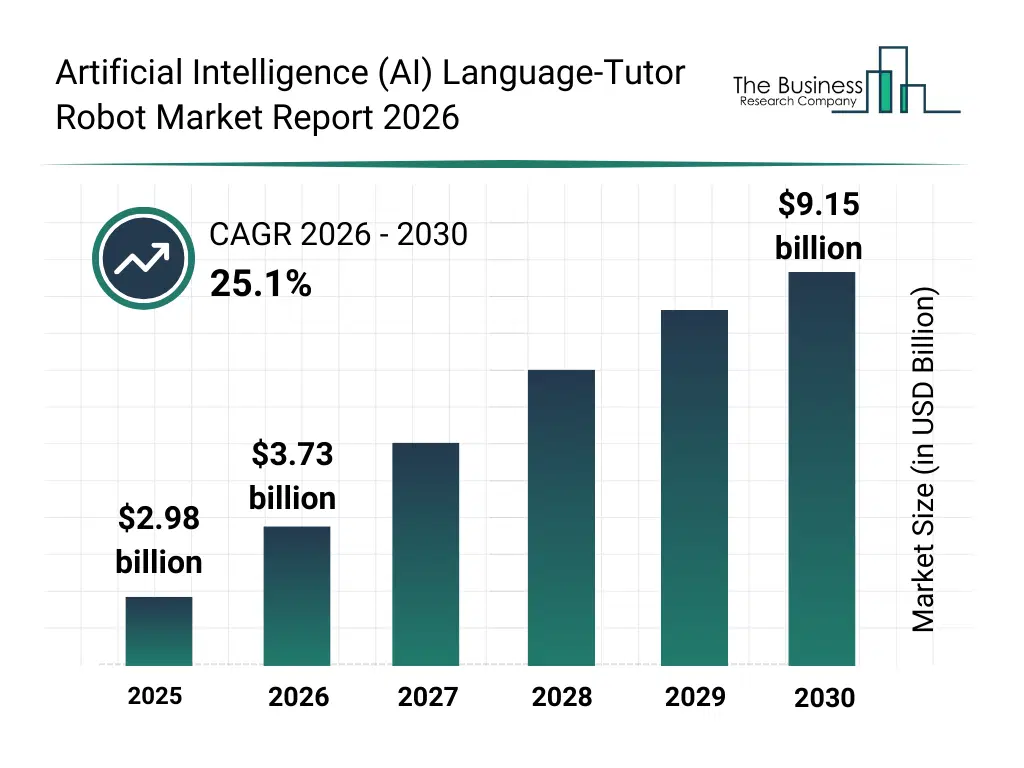
What Is The Artificial Intelligence (AI) Language-Tutor Robot Market Size and Share 2026?
The artificial intelligence (AI) language-tutor robot market size has grown exponentially in recent years. It will grow from $2.98 billion in 2025 to $3.73 billion in 2026 at a compound annual growth rate (CAGR) of 25.4%. The growth in the historic period can be attributed to increasing adoption of smart education tools, growing demand for personalized language learning, rising use of conversational artificial intelligence (AI) in tutoring, expanding integration of robots in K-12 learning, and increasing acceptance of automated teaching assistants.What Is The Artificial Intelligence (AI) Language-Tutor Robot Market Growth Forecast?
The artificial intelligence (AI) language-tutor robot market size is expected to see exponential growth in the next few years. It will grow to $9.15 billion in 2030 at a compound annual growth rate (CAGR) of 25.1%. The growth in the forecast period can be attributed to the growing deployment of AI-driven tutor robots, the rising need for multilingual workforce training, increasing investment in adaptive learning robots, the expansion of artificial intelligence (AI)-based corporate language training, and the rising preference for immersive robotic learning environments. Major trends in the forecast period include technology advancements in natural language processing, innovation in multimodal robotic interactions, developments in autonomous tutoring systems, research and development in generative artificial intelligence (AI) tutors, and integration of robots with virtual reality (VR) and augmented reality (AR) learning ecosystems.
Global Artificial Intelligence (AI) Language-Tutor Robot Market Segmentation
1) By Component: Hardware, Software, Services 2) By Deployment Mode: Cloud-Based, On-Premises 3) By Application: Education, Corporate Training, Personal Learning, Special Education, Other Applications 4) By End-User: K-12, Higher Education, Enterprises, Individuals, Other End-Users Subsegments: 1) By Hardware: Sensor Modules, Processing Units, Robotic Arms, Mobility Systems, Display Interfaces, Power Supply Units 2) By Software: Language Learning Algorithms, Speech Recognition Systems, Natural Language Processing Engines, User Interaction Interfaces, Machine Learning Frameworks, Cloud Integration Platforms 3) By Services: Installation Services, Maintenance And Support Services, Training Services, System Integration Services, Customization Services, Remote Monitoring ServicesWhat Is The Driver Of The Artificial Intelligence (AI) Language-Tutor Robot Market?
The rising demand for personalized and interactive tutoring is expected to propel the growth of the artificial intelligence (AI) language-tutor robot market going forward. Personalized and interactive tutoring refers to educational approaches that adapt teaching methods, pace, and content to individual student needs while enabling active engagement through interactive tools. Rising demand for personalized and interactive tutoring is due to addressing diverse proficiency levels in language education. The AI language-tutor robot market supports personalized and interactive tutoring by providing intelligent robotic systems capable of delivering adaptive language lessons, real-time feedback, and conversational practice tailored to each learner. For instance, in April 2025, according to the Association for the Teaching of the Social Sciences, a UK-based educational organization, 92% of undergraduates now use AI, up from 66% in 2024, and the use of generative AI for academic work has surged, with 88% employing it for assignments, compared to 53% in 2023. Therefore, the rising demand for personalized and interactive tutoring is driving the growth of the artificial intelligence (AI) language-tutor robot industry.Key Players In The Global Artificial Intelligence (AI) Language-Tutor Robot Market
Major companies operating in the artificial intelligence (AI) language-tutor robot market are iFLYTEK Co. Ltd., Cambly Inc., UBTECH Robotics Corp Ltd., Duolingo Inc., Babbel GmbH, Embodied Inc., PAL Robotics S.L., SoftBank Robotics Group Corp., Miko AI Private Limited, Busuu Limited, ELECFREAKS Technology Co. Ltd., Lingoda GmbH, italki HK Limited, Roybi Robot Inc., Memrise Limited, LuxAI S.A., Chatterbug GmbH, ELSA Corp., Promova Inc., LingQ Inc.
This chart is for illustrative purposes; the full report includes a detailed competitor analysis and comprehensive overview of the top 10 companies in the market.
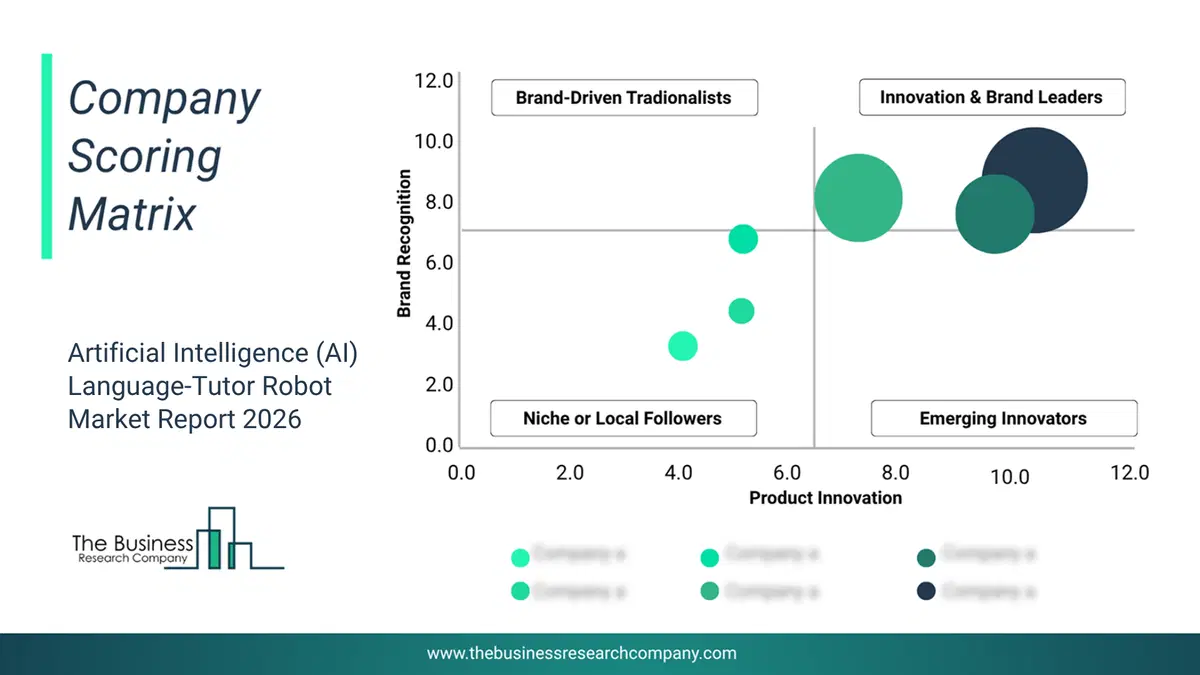
This chart maps companies by product innovation and brand strength, with bubble size indicating relative revenue, helping identify market leaders, challengers, and niche players. This is an illustrative chart; the full report provides a complete and accurate competitive analysis.
Global Artificial Intelligence (AI) Language-Tutor Robot Market Trends and Insights
Major companies operating in the artificial intelligence (AI) language-tutor robot market are focusing on developing advanced technologies, such as artificial intelligence-powered educational tools, to boost learning outcomes, enhance accessibility, and reduce educational inequality. AI-powered educational tools refer to intelligent systems in the Web3 ecosystem that use algorithms and machine learning to provide personalized, equitable, and interactive learning experiences. For instance, in August 2025, BSG Technologies Inc., a South Africa-based science and technology company, launched the IRIS robot tutor. It is a pioneering educational robot capable of teaching from grade R to tertiary levels in all 11 official South African languages. It features advanced natural language processing and emotional recognition for interactive, personalized lessons, making linguistic diversity an asset to learning. The launch, backed by the government and designed to support rather than replace teachers, marks a significant step toward using homegrown Web3 and AI innovation to transform education across the continent.What Are Latest Mergers And Acquisitions In The Artificial Intelligence (AI) Language-Tutor Robot Market?
In April 2025, eSelf AI LTD., a US-based provider of conversational AI tutoring solutions, partnered with the Center for Educational Technology (CET), to provide every K–12 student with a personalized virtual learning companion. With this partnership, eSelf aims to deliver AI-powered, face-to-face digital tutors to students nationwide in Israel, supporting personalized learning, exam preparation, and independent study through adaptive AI avatars. The Center for Educational Technology (CET) is an Israel-based educational organization and the country’s largest K-12 textbook publisher.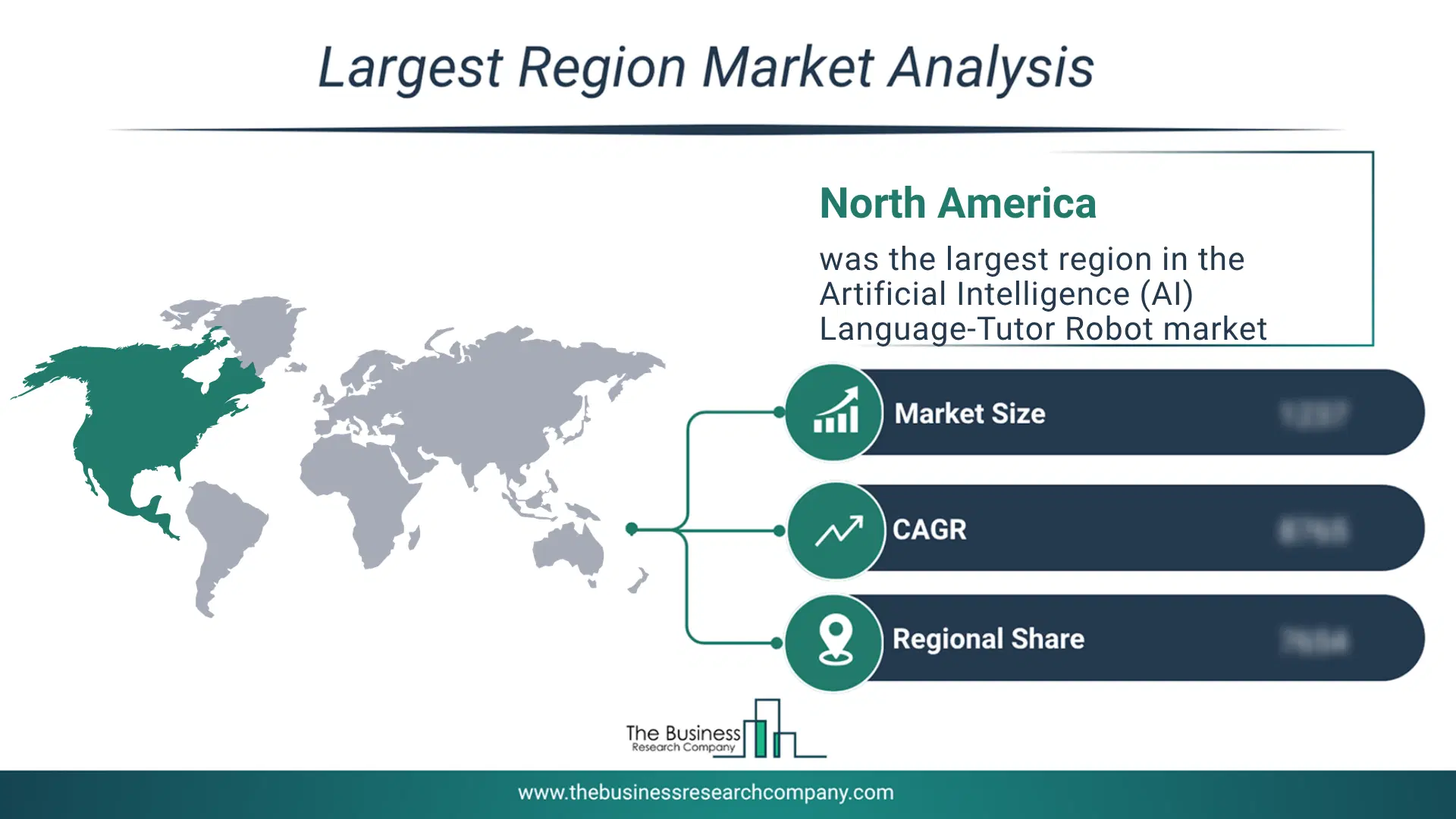
Regional Insights
North America was the largest region in the artificial intelligence (AI) language-tutor robot market in 2025. Asia-Pacific is expected to be the fastest-growing region in the forecast period. The regions covered in this market report are Asia-Pacific, South East Asia, Western Europe, Eastern Europe, North America, South America, Middle East, Africa. The countries covered in this market report are Australia, Brazil, China, France, Germany, India, Indonesia, Japan, Taiwan, Russia, South Korea, UK, USA, Canada, Italy, Spain.What Defines the Artificial Intelligence (AI) Language-Tutor Robot Market?
The artificial intelligence (AI) language-tutor robot market consists of revenues earned by entities by providing services such as interactive language tutoring, real-time pronunciation coaching, personalized learning pathway design, conversational practice simulations, and multilingual assessment services. The market value includes the value of related goods sold by the service provider or included within the service offering. The artificial intelligence (AI) language-tutor robot market also includes sales of humanoid tutoring robots, educational companion robots, voice-interactive learning robots, autonomous classroom assistance robots, and artificial intelligence (AI)-powered conversational training devices. Values in this market are ‘factory gate’ values, that is, the value of goods sold by the manufacturers or creators of the goods, whether to other entities (including downstream manufacturers, wholesalers, distributors, and retailers) or directly to end customers. The value of goods in this market includes related services sold by the creators of the goods.How is Market Value Defined and Measured?
The market value is defined as the revenues that enterprises gain from the sale of goods and/or services within the specified market and geography through sales, grants, or donations in terms of the currency (in USD unless otherwise specified). The revenues for a specified geography are consumption values that are revenues generated by organizations in the specified geography within the market, irrespective of where they are produced. It does not include revenues from resales along the supply chain, either further along the supply chain or as part of other products.
This chart presents market attractiveness based on a quantitative evaluation of growth, competition, strategic alignment, and risk, offering a clear view of opportunity areas for decision-making. This chart is for illustrative purposes; the full report contains the complete analysis.

This chart highlights the Total Addressable Market (TAM) by estimating the maximum revenue opportunity using an assumption-driven approach, supporting strategic planning and opportunity sizing across markets. The chart is illustrative; the full report provides a more comprehensive analysis.
What Key Data and Analysis Are Included in the Artificial Intelligence (AI) Language-Tutor Robot Market Report 2026?
The artificial intelligence (ai) language-tutor robot market research report is one of a series of new reports from The Business Research Company that provides market statistics, including industry global market size, regional shares, competitors with the market share, detailed market segments, market trends and opportunities, and any further data you may need to thrive in the artificial intelligence (ai) language-tutor robot industry. The market research report delivers a complete perspective of everything you need, with an in-depth analysis of the current and future state of the industry.Artificial Intelligence (AI) Language-Tutor Robot Market Report Forecast Analysis
| Report Attribute | Details |
|---|---|
| Market Size Value In 2026 | $3.73 billion |
| Revenue Forecast In 2030 | $9.15 billion |
| Growth Rate | CAGR of 25.1% from 2026 to 2030 |
| Base Year For Estimation | 2025 |
| Actual Estimates/Historical Data | 2020-2025 |
| Forecast Period | 2026 - 2030 |
| Market Representation | Revenue in USD Billion and CAGR from 2026 to 2030 |
| Segments Covered | Component, Deployment Mode, Application, End-User |
| Regional Scope | Asia-Pacific, Western Europe, Eastern Europe, North America, South America, Middle East, Africa |
| Country Scope | The Countries Covered In This Market Report Are Australia, Brazil, China, France, Germany, India, Indonesia, Japan, Taiwan, Russia, South Korea, Uk, Usa, Canada, Italy, Spain. |
| Key Companies Profiled | iFLYTEK Co. Ltd., Cambly Inc., UBTECH Robotics Corp Ltd., Duolingo Inc., Babbel GmbH, Embodied Inc., PAL Robotics S.L., SoftBank Robotics Group Corp., Miko AI Private Limited, Busuu Limited, ELECFREAKS Technology Co. Ltd., Lingoda GmbH, italki HK Limited, Roybi Robot Inc., Memrise Limited, LuxAI S.A., Chatterbug GmbH, ELSA Corp., Promova Inc., LingQ Inc. |
| Customization Scope | Request for Customization |
| Pricing And Purchase Options | Explore Purchase Options |