
Artificial Intelligence (AI)-Powered Digital Twin Heating, Ventilation, And Air Conditioning (HVAC) Tuner Market Report 2026
Global Outlook – By Component (Software, Hardware, Services), By Deployment Mode (On-Premises, Cloud), By Application (Commercial Buildings, Industrial Facilities, Residential Buildings, Data Centers, Healthcare Facilities, Other Applications), By End-User (Building Owners, Facility Managers, Heating, Ventilation, And Air Conditioning Contractors, Energy Service Companies, Other End Users) – Market Size, Trends, Strategies, and Forecast to 2030
Artificial Intelligence (AI)-Powered Digital Twin Heating, Ventilation, And Air Conditioning (HVAC) Tuner Market Overview
• Artificial Intelligence (AI)-Powered Digital Twin Heating, Ventilation, And Air Conditioning (HVAC) Tuner market size has reached to $1.34 billion in 2025 • Expected to grow to $3.73 billion in 2030 at a compound annual growth rate (CAGR) of 22.6% • Growth Driver: Growing Smart Building Adoption Driving The Market Growth Due To Rising Energy Efficiency And Sustainability Demands • Market Trend: Technological Advancements In Energy Efficiency And System Optimization • North America was the largest region in 2025 and Asia-Pacific is the fastest growing region.Market Gains By 2030 – Top Opportunities By Segment
Market Gain identifies the most promising market opportunities by highlighting the segments or products expected to generate the highest incremental revenue growth over the next five years.
What Is Covered Under Artificial Intelligence (AI)-Powered Digital Twin Heating, Ventilation, And Air Conditioning (HVAC) Tuner Market?
Artificial intelligence (AI)-powered digital twin heating, ventilation, and air conditioning (HVAC) tuner is a virtual replica of a physical HVAC system enhanced with artificial intelligence to monitor, simulate, and optimize performance in real time. It uses sensor data and predictive algorithms to fine-tune operations for maximum energy efficiency and comfort. By continuously learning from historical and live data, it predicts potential faults and suggests or automates corrective actions. The main component types of artificial intelligence (AI)-powered digital twin heating, ventilation, and air conditioning (HVAC) tuners are software, hardware, and services. Software is a set of instructions or programs that tell a computer how to perform specific tasks. These are deployed through on-premises and cloud and are applied across commercial buildings, industrial facilities, residential buildings, data centers, healthcare facilities, and others, serving end-users such as building owners, facility managers, HVAC contractors, energy service companies, and others.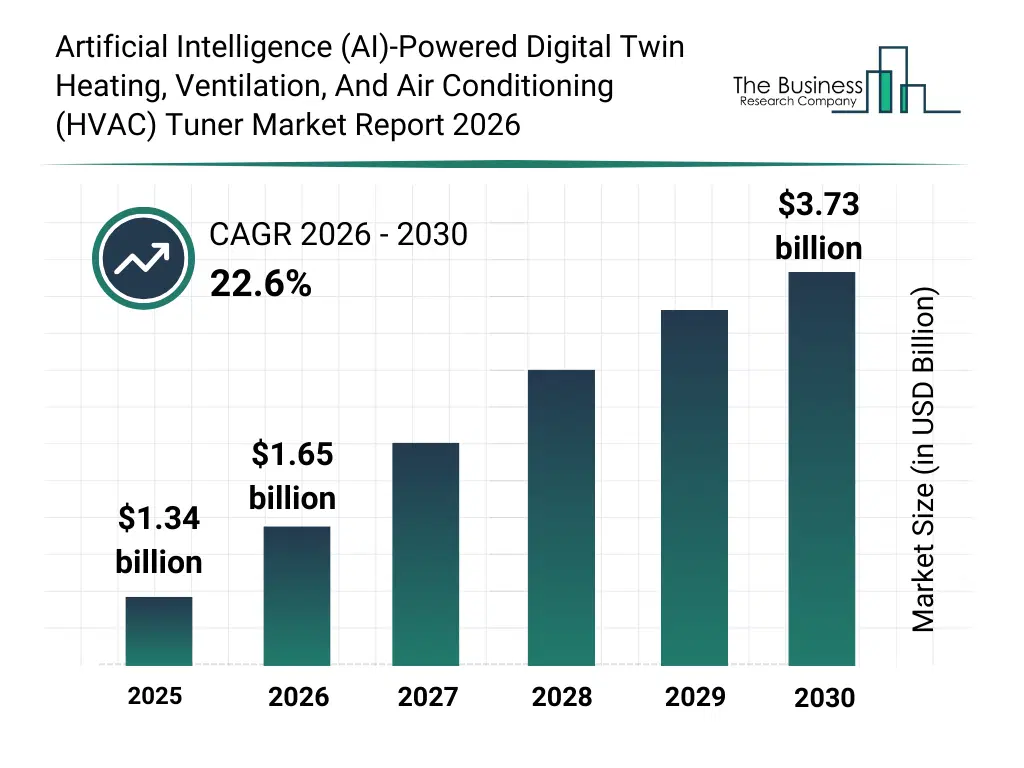
What Is The Artificial Intelligence (AI)-Powered Digital Twin Heating, Ventilation, And Air Conditioning (HVAC) Tuner Market Size and Share 2026?
The artificial intelligence (AI)-powered digital twin heating, ventilation, and air conditioning (hvac) tuner market size has grown exponentially in recent years. It will grow from $1.34 billion in 2025 to $1.65 billion in 2026 at a compound annual growth rate (CAGR) of 23.1%. The growth in the historic period can be attributed to rising adoption of digital twin technologies in HVAC, increasing demand for energy-efficient buildings, growth in predictive maintenance solutions, expansion of smart building initiatives, rising focus on operational cost reduction.What Is The Artificial Intelligence (AI)-Powered Digital Twin Heating, Ventilation, And Air Conditioning (HVAC) Tuner Market Growth Forecast?
The artificial intelligence (AI)-powered digital twin heating, ventilation, and air conditioning (hvac) tuner market size is expected to see exponential growth in the next few years. It will grow to $3.73 billion in 2030 at a compound annual growth rate (CAGR) of 22.6%. The growth in the forecast period can be attributed to increasing integration of AI-based HVAC optimization, adoption of adaptive and real-time monitoring systems, growth in cloud-based and edge computing solutions, expansion of automated performance tuning, rising use of IoT-enabled HVAC management. Major trends in the forecast period include deployment of AI-powered digital twin hvac optimization, integration of predictive maintenance platforms, adoption of IOT-enabled energy monitoring systems, expansion of cloud-based hvac control solutions, development of adaptive smart thermostat controllers.
Global Artificial Intelligence (AI)-Powered Digital Twin Heating, Ventilation, And Air Conditioning (HVAC) Tuner Market Segmentation
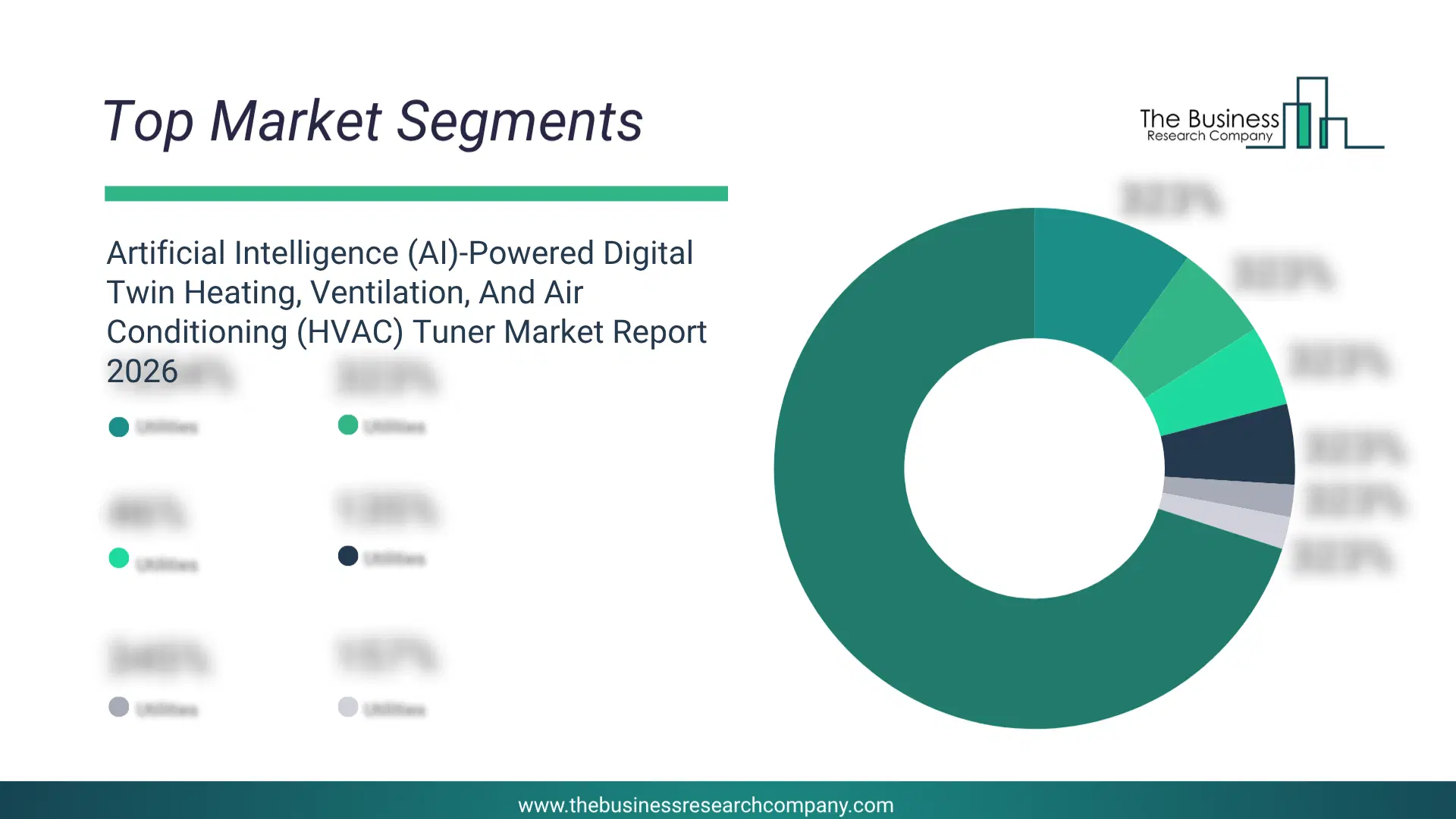
1) By Component: Software, Hardware, Services 2) By Deployment Mode: On-Premises, Cloud 3) By Application: Commercial Buildings, Industrial Facilities, Residential Buildings, Data Centers, Healthcare Facilities, Other Applications 4) By End-User: Building Owners, Facility Managers, Heating, Ventilation, And Air Conditioning Contractors, Energy Service Companies, Other End Users Subsegments: 1) By Software: Real Time Monitoring Systems, Building Energy Management Systems, Predictive Maintenance Platforms 2) By Hardware: Sensors And Actuators, Control Panels, Edge Computing Devices 3) By Services: Consulting Services, Integration Services, Training And Education Services The top segments in the artificial intelligence (ai)-powered digital twin heating, ventilation, and air conditioning (hvac) tuner market will be: • Software will reach $2705.59 Million by 2030. • On-Premises will reach $2042.7 Million by 2030. • Cloud will reach $2607.51 Million by 2030. • Commercial Buildings will reach $1476.93 Million by 2030. • Heating, Ventilation, And Air Conditioning Contractors will reach $1297.9 Million by 2030.What Is The Driver Of The Artificial Intelligence (AI)-Powered Digital Twin Heating, Ventilation, And Air Conditioning (HVAC) Tuner Market?
The growing adoption of smart buildings is expected to propel the growth of the artificial intelligence (AI)-powered digital twin heating, ventilation, and air conditioning (HVAC) tuner market going forward. Smart buildings are digitally connected structures that utilize sensors, automation, and data analytics to improve efficiency, sustainability, and the overall user experience. The increasing prevalence of smart buildings is fueled by the rising demand for energy efficiency, as sophisticated automation and analytics help minimize energy waste, lower costs, and support environmental objectives. Artificial intelligence (AI)-powered digital twin heating, ventilation, and air conditioning tuners assist smart buildings by generating a virtual model of heating, ventilation, and air conditioning systems to forecast performance, optimize energy consumption in real time, reduce maintenance expenses, and enhance occupant comfort. For instance, in July 2024, the U.S. Green Building Council, a US-based non-profit organization, reported that it contributed to over 46,000 residential projects certified under the LEED green building rating system, following an almost 5% rise in new LEED residential project registrations in 2023. Therefore, the growing adoption of smart buildings is driving the growth of the artificial intelligence (AI)-powered digital twin heating, ventilation, and air conditioning (HVAC) tuner industry.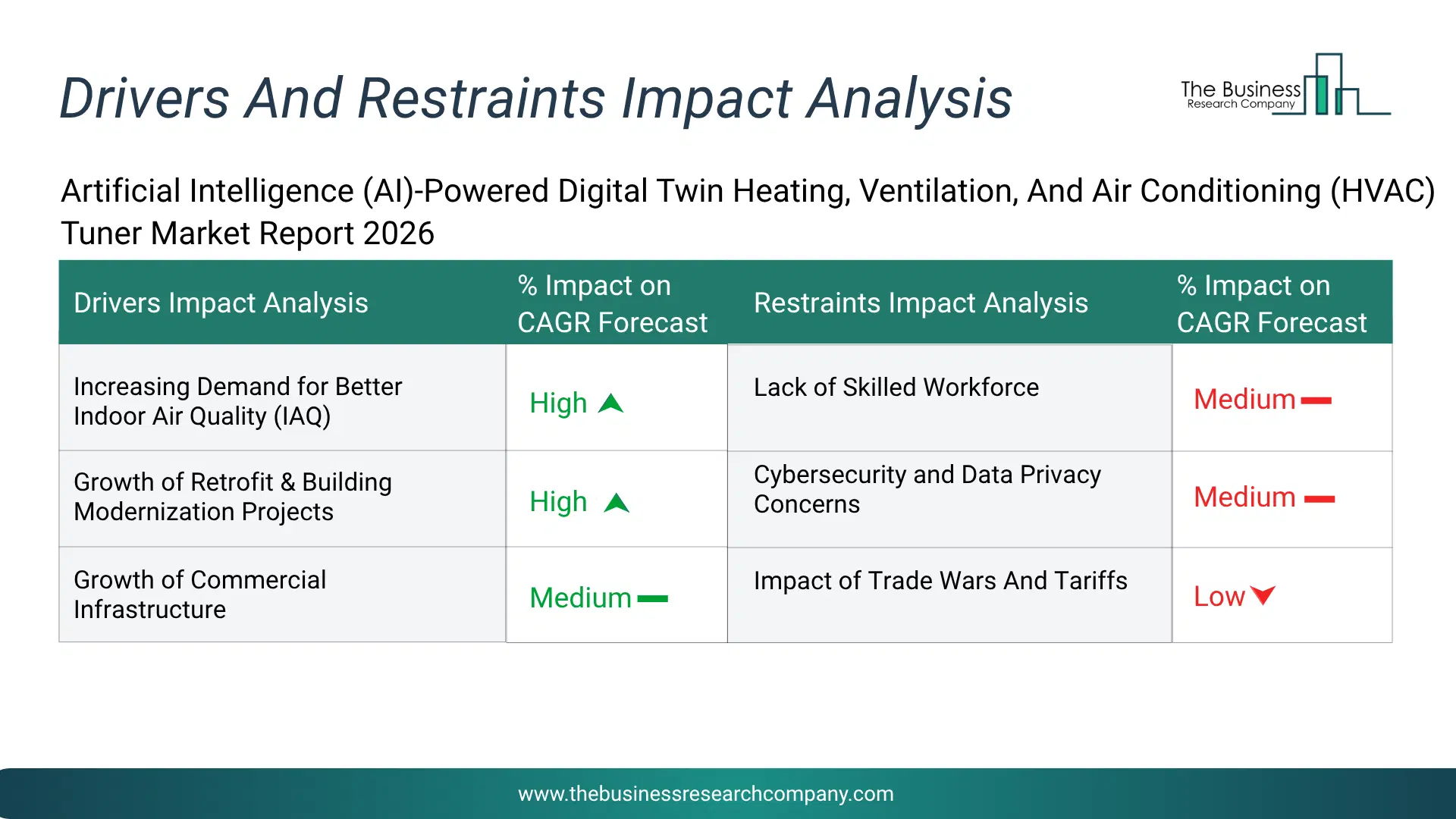
Infographic Chart Showing Key Market Drivers Analysis And Restraints For Artificial Intelligence (Ai)-Powered Digital Twin Heating, Ventilation, And Air Conditioning (Hvac) Tuner Market
The chart presents an impact analysis of key drivers and restraints, quantifying their relative influence on the market's growth rate and helping assess the balance between growth enablers and limiting factors. This chart offers a high-level perspective; the full report contains more detailed insights.
How Will The Drivers Impact Growth In The Global Artificial Intelligence (AI)-Powered Digital Twin Heating, Ventilation, And Air Conditioning (HVAC) Tuner Market?
• Increasing Demand for Better Indoor Air Quality (IAQ) (High) – During the forecast period, the increasing demand for better indoor air quality is expected to be a key driver propelling growth in the AI-powered digital twin HVAC tuner market. As building owners, facility managers, and regulatory authorities prioritize healthier indoor environments across commercial offices, hospitals, educational institutions, and public infrastructure, the need for continuous air quality monitoring and performance-based ventilation management continues to rise. Stronger focus on airborne contaminant control, optimized airflow management, and compliance with updated ventilation standards increases, the requirement for intelligent HVAC optimization platforms that can dynamically adjust temperature, humidity, filtration, and fresh air intake levels in real time will grow. This shift drives sustained demand for AI-enabled digital twin solutions that enhance system transparency, predictive control, and operational efficiency across complex building portfolios. As a result, AI-powered HVAC tuner providers are expanding analytics capabilities, integrating advanced sensor networks, and strengthening managed service offerings to help building operators achieve measurable indoor air quality improvements while maintaining energy efficiency, which sustains long-term growth in the global AI-powered digital twin HVAC tuner market. The growth in increasing demand for better indoor air quality growth contribution during the forecast period in 2025 is 2.5%. • Growth of Retrofit & Building Modernization Projects (High) – During the forecast period, the growth of retrofit and building modernization projects is expected to be a key driver propelling growth in the AI-powered digital twin HVAC tuner market. As governments and property owners upgrade aging commercial and institutional buildings to meet stricter energy efficiency standards and carbon reduction targets, investment in HVAC system optimization and performance improvement continues to increase. The expansion of retrofit initiatives raises the need for intelligent monitoring, performance simulation, and data-driven control systems that optimize existing HVAC infrastructure without requiring full system replacement, which drives sustained demand for AI-enabled digital twin platforms capable of real-time diagnostics, predictive maintenance, and energy performance benchmarking. This trend accelerates adoption of software-based optimization tools that improve asset lifespan, reduce operational expenditure, and support regulatory compliance across large building portfolios. As a result, AI-powered HVAC tuner providers are strengthening integration capabilities with legacy building management systems, expanding cloud-based analytics services, and aligning solution development with decarbonization and modernization programs to support measurable efficiency improvements, which sustains long-term growth in the global Artificial Intelligence (AI)-Powered Digital Twin HVAC Tuner market. The growth in growth of retrofit and building modernization projects growth contribution during the forecast period in 2025 is 2.0%. • Growth of Commercial Infrastructure (Medium) – During the forecast period, the growth of commercial infrastructure is expected to be a key driver propelling growth in the AI-powered digital twin HVAC tuner market. As governments and private developers expand office complexes, hospitals, airports, data centers, retail centers, and mixed-use developments, investment in large-scale building systems and energy management frameworks continues to increase. The expansion of commercial construction raises the need for intelligent HVAC optimization, continuous performance monitoring, and real-time energy management platforms that improve operational efficiency across complex facilities, which drives sustained demand for AI-enabled digital twin solutions capable of dynamic system tuning, predictive maintenance, and energy performance optimization. This trend accelerates the adoption of software-based building intelligence tools that reduce energy costs, enhance occupant comfort, and support sustainability objectives across expanding commercial portfolios. As a result, AI-powered HVAC tuner providers are strengthening integration with advanced building management systems, expanding cloud-based analytics deployment, and aligning solution capabilities with smart infrastructure development strategies to support scalable and measurable performance improvements, which sustains long-term growth in the global AI-powered digital twin HVAC tuner market. The growth in growth of commercial infrastructure growth contribution during the forecast period in 2025 is 1.8%. • Increasing Adoption of Demand Response and Smart Grid Integration (Medium) – During the forecast period, the increasing adoption of demand response and smart grid integration is expected to be a key driver propelling growth in the AI-powered digital twin HVAC tuner market. As utilities and grid operators expand smart grid programs and enrol more commercial buildings in demand response initiatives, the need for automated and responsive building energy management systems continues to increase. The expansion of grid-interactive energy programs raises the requirement for intelligent HVAC optimization platforms that can dynamically adjust system performance based on real-time grid signals, electricity pricing fluctuations, and load balancing requirements, which drives sustained demand for AI-enabled digital twin solutions capable of continuous system tuning and predictive energy optimization. This trend accelerates the deployment of advanced building intelligence technologies that improve energy flexibility, reduce peak demand charges, and enhance grid participation across commercial facilities. As a result, AI-powered HVAC tuner providers are strengthening smart grid interoperability, expanding real-time analytics capabilities, and aligning platform development strategies with utility-driven demand response frameworks to support scalable grid integration, which sustains long-term growth in the global AI-powered digital twin HVAC tuner market. The growth in increasing adoption of demand response and smart grid integration growth contribution during the forecast period in 2025 is 1.5%.How Will The Restraints Impact Growth In The Global Artificial Intelligence (AI)-Powered Digital Twin Heating, Ventilation, And Air Conditioning (HVAC) Tuner Market?
• Lack of Skilled Workforce (High) – During the forecast period, the lack of a skilled workforce is expected to restrain the growth of the AI-powered digital twin HVAC tuner market. Persistent shortages of professionals with combined expertise in HVAC engineering, building energy management, data analytics, and AI-driven optimization are placing operational strain on building owners, facility managers, and system integrators, which in turn slows large-scale deployment and effective utilization of digital twin-based tuning solutions. From a commercial and operational perspective, the limited availability of trained personnel capable of configuring AI models, interpreting performance analytics, and managing continuous commissioning processes increases reliance on specialized consultants and third-party service providers, raising implementation costs and extending project timelines. These workforce constraints, coupled with rising training expenditures, competitive labor markets, and limited cross-disciplinary education programs, intensify operational burdens and heighten the risk of underutilized systems, suboptimal performance outcomes, and delayed return on investment. As a result, HVAC solution providers, digital twin platform vendors, and facility operators may face constrained adoption rates, more cautious expansion strategies, and postponed investments in advanced AI-powered HVAC tuning platforms and workforce development initiatives during the forecast period. Growth affected by lack of a skilled workforce during the forecast period in 2025 is -1.5%. • Cybersecurity and Data Privacy Concerns (High) – During the forecast period, cybersecurity and data privacy concerns are expected to restrain the growth of the AI-powered digital twin HVAC tuner market. Persistent risks associated with unauthorized access to building management systems, exposure of sensitive operational data, and potential cyberattacks targeting connected HVAC infrastructure are placing heightened compliance and security burdens on building owners, facility managers, and enterprise operators, which in turn discourages rapid deployment of AI-driven digital twin tuning platforms. From a commercial and operational perspective, the need to implement robust encryption protocols, continuous network monitoring, secure cloud configurations, and strict data governance frameworks increases total cost of ownership and extends procurement cycles for AI-enabled HVAC optimization solutions. These cybersecurity dynamics, coupled with evolving global data protection regulations, cross-border data transfer restrictions, and liability concerns related to automated system control decisions, intensify operational complexities and elevate perceived risk among end users. As a result, HVAC system integrators, digital twin solution providers, and commercial real estate stakeholders may face slower adoption rates, more cautious investment strategies, and delayed large-scale implementation of AI-powered HVAC tuning platforms during the forecast period. Growth affected by cybersecurity and data privacy concerns during the forecast period in 2025 is -1.3%. • Impact of Trade Wars And Tariffs (Medium) – During the forecast period, the impact of trade wars and tariffs is expected to restrain the growth of the AI-powered digital twin HVAC tuner market. Persistent increases in import duties on critical components such as sensors, controllers, building automation hardware, cloud infrastructure equipment, and embedded systems are placing upward pressure on capital expenditures for HVAC manufacturers, digital twin solution providers, and building owners, which in turn discourages large-scale deployment of AI-enabled optimization platforms. From a commercial and operational perspective, tariff-driven price volatility affecting HVAC equipment, smart meters, and cross-border software licensing arrangements increases procurement uncertainty and raises total project costs for commercial and industrial facilities seeking to implement digital twin-based tuning solutions. These trade-related cost dynamics, coupled with supply chain realignments, regional sourcing constraints, and fluctuating material prices, intensify financial burdens and heighten the risk of delayed modernization initiatives and reduced return on investment expectations. As a result, HVAC system integrators, AI solution vendors, and facility operators may face slower adoption cycles, more cautious capital planning strategies, and postponed investments in advanced AI-driven performance optimization and predictive energy management solutions during the forecast period. Growth affected by impact of trade wars and tariffs during the forecast period in 2025 is -0.3%.Key Players In The Global Artificial Intelligence (AI)-Powered Digital Twin Heating, Ventilation, And Air Conditioning (HVAC) Tuner Market
Major companies operating in the artificial intelligence (AI)-powered digital twin heating, ventilation, and air conditioning (hvac) tuner market are Amazon Web Services Inc., Siemens AG, Honeywell International Inc., Daikin Industries Ltd., Johnson Controls International plc, Trane Technologies plc, Autodesk Inc., Azbil Corporation, Bentley Systems Incorporated, JLL Technologies, C3.ai Inc., PassiveLogic, 75F Inc., BrainBox AI Inc., Verdigris Technologies Inc., Enerbrain S.r.l., Hysopt NV, BuildingIQ, Exergenics Pty Ltd., TwinThread Inc., Akila 3D Pte. Ltd.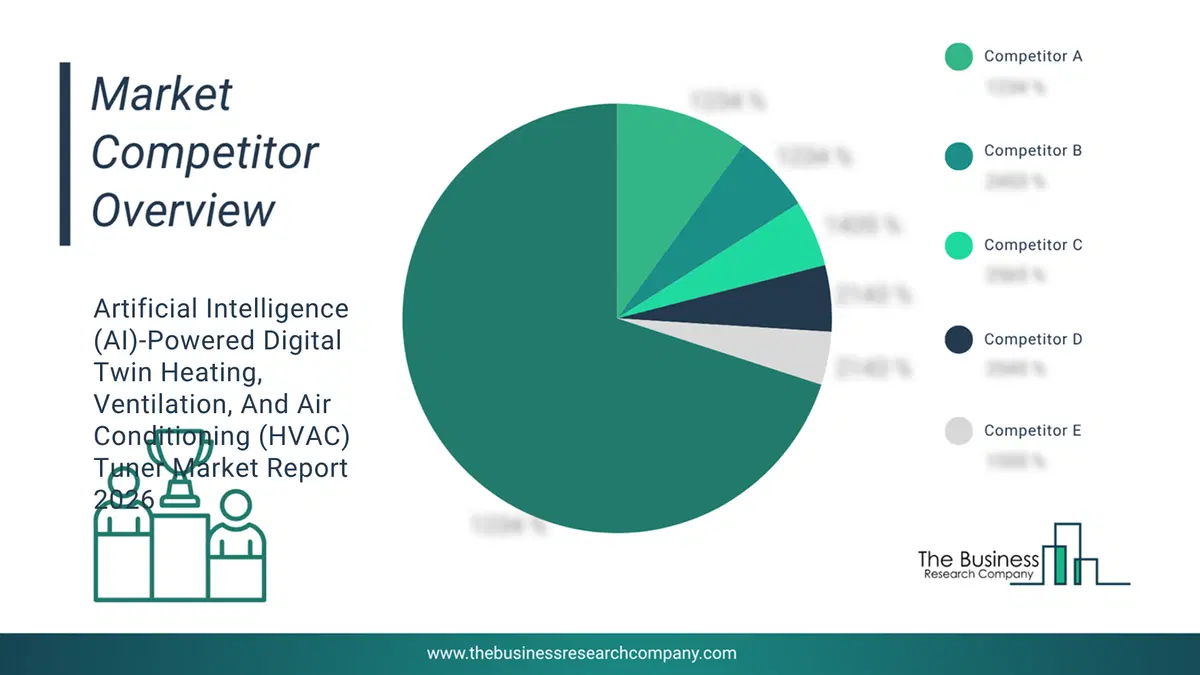
This chart is for illustrative purposes; the full report includes a detailed competitor analysis and comprehensive overview of the top 10 companies in the market.
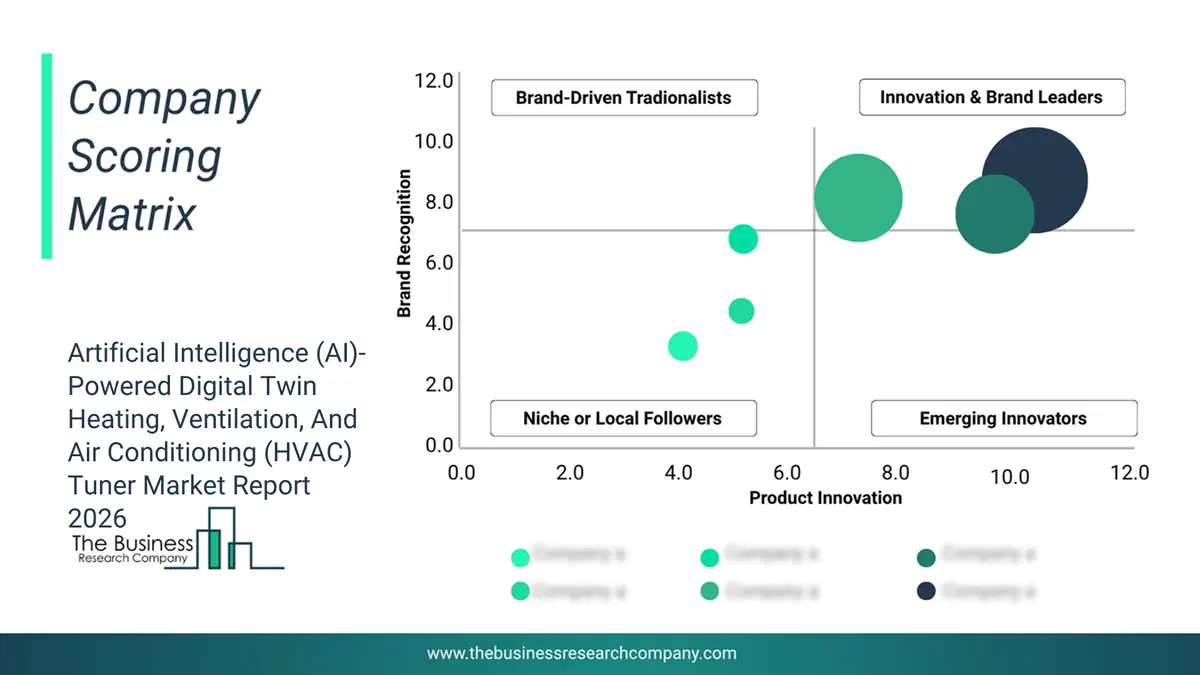
This chart maps companies by product innovation and brand strength, with bubble size indicating relative revenue, helping identify market leaders, challengers, and niche players. This is an illustrative chart; the full report provides a complete and accurate competitive analysis.
Global Artificial Intelligence (AI)-Powered Digital Twin Heating, Ventilation, And Air Conditioning (HVAC) Tuner Market Trends and Insights
Major companies operating in the artificial intelligence (AI)-powered digital twin heating, ventilation, and air conditioning (HVAC) tuner market are focusing on developing advanced solutions, such as artificial intelligence-driven performance optimization systems, to enhance energy efficiency, reduce equipment downtime, and improve predictive maintenance. Artificial intelligence-driven performance optimization systems refer to technology that continuously analyzes heating, ventilation, and air conditioning system data to automatically adjust operations, maximize efficiency, and extend equipment lifespan. For instance, in February 2025, Airedale by Modine, a UK-based thermal management company, introduced the Cooling Artificial Intelligence Control System, which optimizes chiller and fan performance to cut energy use by up to 40%. The system reduces compressor stress, extending equipment life, and dynamically adapts to fluctuating loads while predicting operational issues. Tested in high-density data centers, it demonstrated significant efficiency gains for sustainable cooling. Airedale also offered comprehensive training and integration support to ensure seamless deployment.What Are Latest Mergers And Acquisitions In The Artificial Intelligence (AI)-Powered Digital Twin Heating, Ventilation, And Air Conditioning (HVAC) Tuner Market?
In January 2025, Trane Technologies Plc, an Ireland-based manufacturing company, acquired BrainBox AI Inc. for an undisclosed amount. With this acquisition, Trane Technologies aims to lead the AI-driven energy efficiency and carbon reduction transformation in commercial real estate by accelerating the deployment of sustainable, autonomous building solutions that reduce energy consumption and greenhouse gas emissions. BrainBox AI Inc. is a Canada-based technology company that offers AI-powered software to optimize HVAC systems in commercial buildings.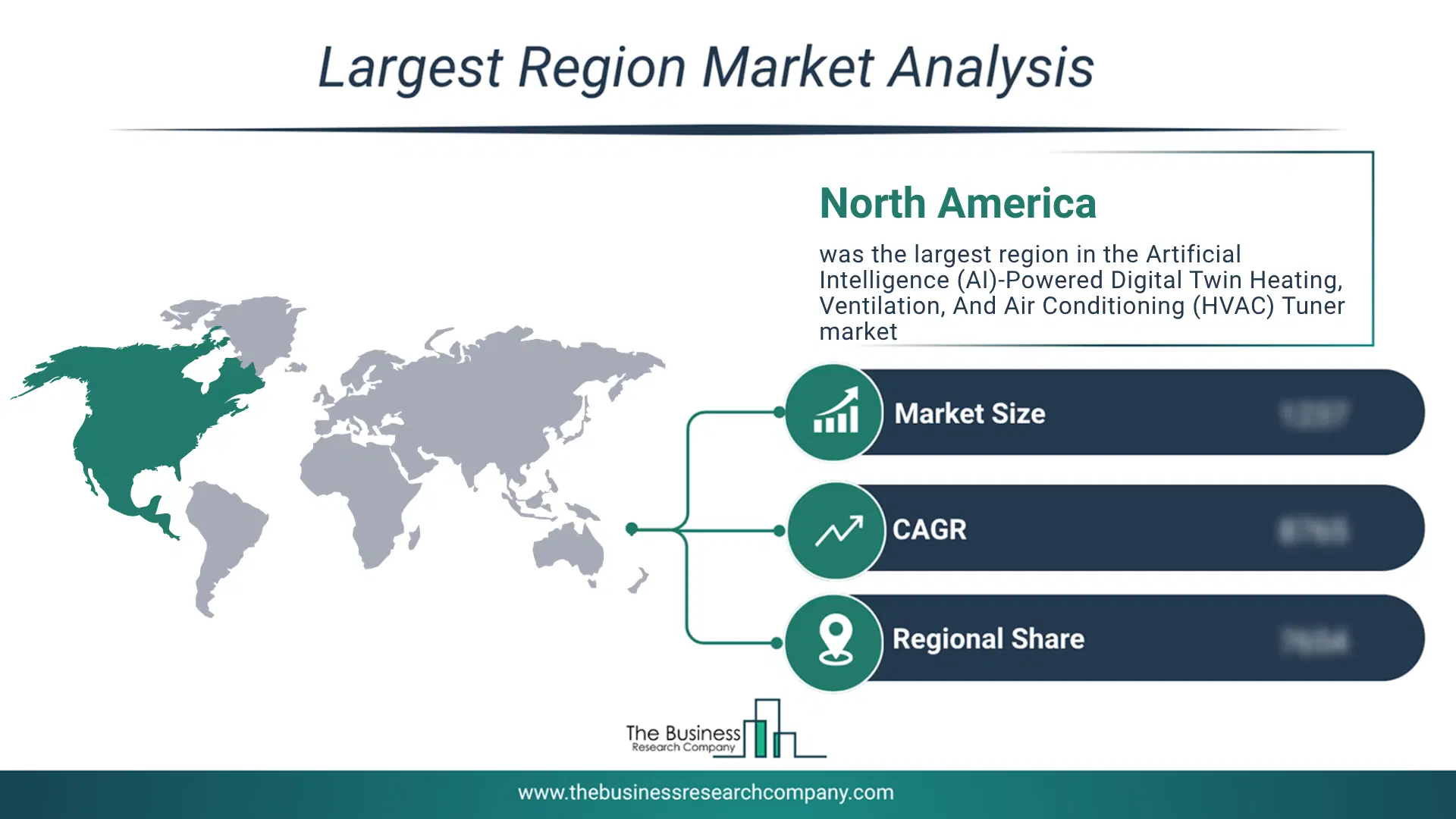
Regional Insights
North America was the largest region in the artificial intelligence (AI)-powered digital twin heating, ventilation, and air conditioning (HVAC) tuner market in 2025. Asia-Pacific is expected to be the fastest-growing region in the forecast period. The regions covered in this market report are Asia-Pacific, South East Asia, Western Europe, Eastern Europe, North America, South America, Middle East, Africa. The countries covered in this market report are Australia, Brazil, China, France, Germany, India, Indonesia, Japan, Taiwan, Russia, South Korea, UK, USA, Canada, Italy, Spain.What Defines the Artificial Intelligence (AI)-Powered Digital Twin Heating, Ventilation, And Air Conditioning (HVAC) Tuner Market?
The artificial intelligence (AI)-powered digital twin heating, ventilation, and air conditioning (HVAC) tuner market consists of revenues earned by entities by providing services such as consulting services, integration services, training and education services, support and maintenance services, and performance optimization services. The market value includes the value of related goods sold by the service provider or included within the service offering. The artificial intelligence (AI)-powered digital twin heating, ventilation, and air conditioning (HVAC) tuner market also includes sales of real-time monitoring systems, building energy management systems, predictive maintenance platforms, smart thermostat controllers, and adaptive control software. Values in this market are ‘factory gate’ values; that is, the value of goods sold by the manufacturers or creators of the goods, whether to other entities (including downstream manufacturers, wholesalers, distributors, and retailers) or directly to end customers. The value of goods in this market includes related services sold by the creators of the goods.How is Market Value Defined and Measured?
The market value is defined as the revenues that enterprises gain from the sale of goods and/or services within the specified market and geography through sales, grants, or donations in terms of the currency (in USD unless otherwise specified). The revenues for a specified geography are consumption values that are revenues generated by organizations in the specified geography within the market, irrespective of where they are produced. It does not include revenues from resales along the supply chain, either further along the supply chain or as part of other products.
This chart presents market attractiveness based on a quantitative evaluation of growth, competition, strategic alignment, and risk, offering a clear view of opportunity areas for decision-making. This chart is for illustrative purposes; the full report contains the complete analysis.

This chart highlights the Total Addressable Market (TAM) by estimating the maximum revenue opportunity using an assumption-driven approach, supporting strategic planning and opportunity sizing across markets. The chart is illustrative; the full report provides a more comprehensive analysis.
What Key Data and Analysis Are Included in theArtificial Intelligence (AI)-Powered Digital Twin Heating, Ventilation, And Air Conditioning (HVAC) Tuner Market Report 2026?
The artificial intelligence (ai)-powered digital twin heating, ventilation, and air conditioning (hvac) tuner market research report is one of a series of new reports from The Business Research Company that provides market statistics, including industry global market size, regional shares, competitors with the market share, detailed market segments, market trends and opportunities, and any further data you may need to thrive in the artificial intelligence (ai)-powered digital twin heating, ventilation, and air conditioning (hvac) tuner industry. The market research report delivers a complete perspective of everything you need, with an in-depth analysis of the current and future state of the industry.Artificial Intelligence (AI)-Powered Digital Twin Heating, Ventilation, And Air Conditioning (HVAC) Tuner Market Report Forecast Analysis
| Report Attribute | Details |
|---|---|
| Market Size Value In 2026 | $1.65 billion |
| Revenue Forecast In 2030 | $3.73 billion |
| Growth Rate | CAGR of 23.1% from 2026 to 2030 |
| Base Year For Estimation | 2025 |
| Actual Estimates/Historical Data | 2020-2025 |
| Forecast Period | 2026 - 2030 - 2035 |
| Market Representation | Revenue in USD Billion and CAGR from 2026 to 2030 |
| Segments Covered | Component, Deployment Mode, Application, End-User |
| Regional Scope | Asia-Pacific, Western Europe, Eastern Europe, North America, South America, Middle East, Africa |
| Country Scope | The countries covered in the report are Australia, Brazil, China, France, Germany, India, Indonesia, Japan, Taiwan, Russia, South Korea, UK, USA, Canada, Italy, Spain. |
| Key Companies Profiled | Amazon Web Services Inc., Siemens AG, Honeywell International Inc., Daikin Industries Ltd., Johnson Controls International plc, Trane Technologies plc, Autodesk Inc., Azbil Corporation, Bentley Systems Incorporated, JLL Technologies, C3.ai Inc., PassiveLogic, 75F Inc., BrainBox AI Inc., Verdigris Technologies Inc., Enerbrain S.r.l., Hysopt NV, BuildingIQ, Exergenics Pty Ltd., TwinThread Inc., Akila 3D Pte. Ltd. |
| Customization Scope | Request for Customization |
| Pricing And Purchase Options | Explore Purchase Options |