
Artificial Intelligence (AI)-Powered Sleep Tech Device Market Report 2026
Global Outlook – By Product Type (Smart Mattresses And Beds, Sleep Tracking Wearables, Positive Airway Pressure And Respiratory Devices, Sleep Applications And Digital Therapeutics, Smart Pillows And Bedding), By Technology (Artificial Intelligence And Machine Learning, Internet Of Things, Cloud-Based Analytics, Biosensors And Biometric Monitoring, Computer Vision And Radar Sensing), By Distribution Channel (Online Retail Or Electronic Commerce Platforms, Retail Stores, Hospital And Clinic Sales, Pharmacies), By Application (Sleep Monitoring And Tracking, Sleep Apnea Management, Insomnia Management, Snoring Detection And Control, Stress And Relaxation Management, Sleep Quality Improvement, Fitness And Wellness Monitoring), By End User (Home And Consumer, Clinical And Hospital, Sports And Athletics, Corporate Wellness) – Market Size, Trends, Strategies, and Forecast to 2030
Artificial Intelligence (AI)-Powered Sleep Tech Device Market Overview
• Artificial Intelligence (AI)-Powered Sleep Tech Device market size has reached to $36.25 billion in 2025 • Expected to grow to $89.85 billion in 2030 at a compound annual growth rate (CAGR) of 20% • Growth Driver: Rising Prevalence Of Sleep Disorders’ Driving The Market Growth Due To Increasing Sleep Health Concerns • Market Trend: Innovation In At-Home Digital Diagnostics For Sleep Disorder Detection • North America was the largest region in 2025 and Asia-Pacific is the fastest growing region.What Is Covered Under Artificial Intelligence (AI)-Powered Sleep Tech Device Market?
Artificial intelligence (AI)-powered sleep tech devices are intelligent health and wellness technologies that combine artificial intelligence, sensors, and connected hardware to monitor, analyze, and improve sleep quality. These devices use data-driven algorithms to track sleep patterns, detect disturbances, and provide personalized recommendations or automated adjustments such as sound modulation, temperature control, or vibration-based interventions to enhance sleep outcomes. The main product types of artificial intelligence (AI)-powered sleep tech device include smart mattresses and beds, sleep tracking wearables, positive airway pressure and respiratory devices, sleep applications and digital therapeutics, and smart pillows and bedding. Smart mattresses and beds refer to intelligent sleep systems that use sensors and AI algorithms to monitor sleep patterns and optimize sleeping conditions. These devices utilize technologies including artificial intelligence and machine learning, internet of things, Cloud-Based analytics, biosensors and biometric monitoring, and computer vision and radar sensing and are distributed through online retail or electronic commerce platforms, retail stores, hospital and clinic sales, and pharmacies. They find application in sleep monitoring and tracking, sleep apnea management, insomnia management, snoring detection and control, stress and relaxation management, sleep quality improvement, and fitness and wellness monitoring, serving end users including home and consumer, clinical and hospital, sports and athletics, and corporate wellness.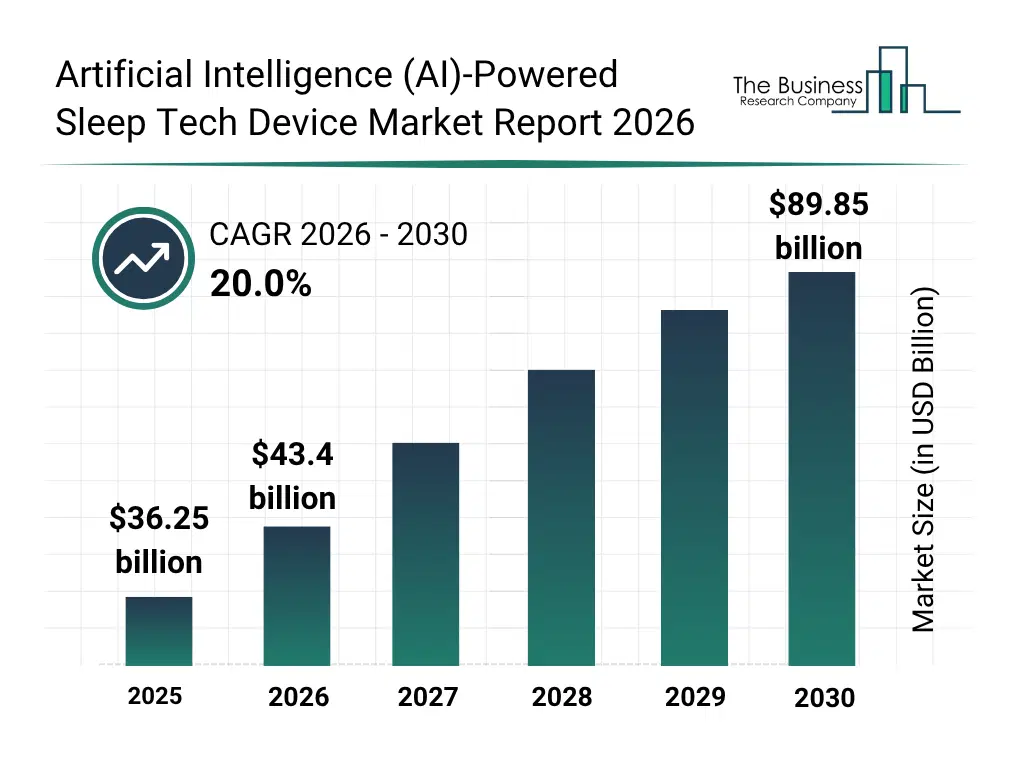
What Is The Artificial Intelligence (AI)-Powered Sleep Tech Device Market Size and Share 2026?
The artificial intelligence (AI)-powered sleep tech device market size has grown rapidly in recent years. It will grow from $36.25 billion in 2025 to $43.4 billion in 2026 at a compound annual growth rate (CAGR) of 19.7%. The growth in the historic period can be attributed to increasing awareness of sleep quality and wellness importance, rising adoption of basic sleep tracking apps and wearable devices, growing prevalence of insomnia and sleep-related disorders, expansion of consumer fitness and wellness monitoring tools, increasing use of smart home devices for comfort automation.What Is The Artificial Intelligence (AI)-Powered Sleep Tech Device Market Growth Forecast?
The artificial intelligence (AI)-powered sleep tech device market size is expected to see rapid growth in the next few years. It will grow to $89.85 billion in 2030 at a compound annual growth rate (CAGR) of 20.0%. The growth in the forecast period can be attributed to rising adoption of AI-driven autonomous health optimization systems, increasing demand for personalized sleep improvement solutions, expansion of smart home and connected bedroom ecosystems, growing integration of biosensors in consumer sleep devices, increasing use of predictive analytics for preventive sleep health management. Major trends in the forecast period include AI-powered adaptive sleep environment control systems with real-time adjustments, intelligent sleep disturbance detection and automated intervention devices, iot-enabled smart bedding ecosystems with connected sleep optimization, AI-driven personalized sleep coaching and recovery recommendation platforms, sensor-integrated smart mattresses with predictive sleep behavior analytics.
Global Artificial Intelligence (AI)-Powered Sleep Tech Device Market Segmentation
1) By Product Type: Smart Mattresses And Beds, Sleep Tracking Wearables, Positive Airway Pressure And Respiratory Devices, Sleep Applications And Digital Therapeutics, Smart Pillows And Bedding 2) By Technology: Artificial Intelligence And Machine Learning, Internet Of Things, Cloud-Based Analytics, Biosensors And Biometric Monitoring, Computer Vision And Radar Sensing 3) By Distribution Channel: Online Retail Or Electronic Commerce Platforms, Retail Stores, Hospital And Clinic Sales, Pharmacies 4) By Application: Sleep Monitoring And Tracking, Sleep Apnea Management, Insomnia Management, Snoring Detection And Control, Stress And Relaxation Management, Sleep Quality Improvement, Fitness And Wellness Monitoring 5) By End User: Home And Consumer, Clinical And Hospital, Sports And Athletics, Corporate Wellness Subsegments: 1) By Smart Mattresses And Beds: Temperature Regulating Smart Mattresses And Beds, Pressure Sensing Smart Mattresses And Beds, Artificial Intelligence Adaptive Comfort Smart Mattresses And Beds, Sleep Optimization Smart Bed Systems 2) By Sleep Tracking Wearables: Smartwatch Based Sleep Tracking Wearables, Smart Ring Sleep Tracking Devices, Fitness Band Sleep Tracking Wearables, Medical Grade Sleep Monitoring Wearables 3) By Positive Airway Pressure And Respiratory Devices: Continuous Positive Airway Pressure Devices, Bilevel Positive Airway Pressure Devices, Auto Adjusting Positive Airway Pressure Devices, Portable Sleep Apnea Therapy Devices 4) By Sleep Applications And Digital Therapeutics: Artificial Intelligence Based Sleep Coaching Applications, Cognitive Behavioral Therapy For Insomnia Applications, Sleep Monitoring And Analytics Applications, Personalized Sleep Optimization Platforms 5) By Smart Pillows And Bedding: Sensor Embedded Smart Pillows, Temperature Controlled Smart Bedding, Posture Supporting Smart Pillows, Artificial Intelligence Enabled Sleep Tracking BeddingWhat Is The Driver Of The Artificial Intelligence (AI)-Powered Sleep Tech Device Market?
The rising prevalence of sleep disorders is expected to propel the growth of the artificial intelligence (AI)-powered sleep tech device market going forward. Sleep disorders are medical conditions that disrupt normal sleep patterns, affecting sleep quality, duration, and overall health. The prevalence of sleep disorders is growing due to increasing stress levels, as chronic stress and anxiety disrupt normal sleep patterns, making it harder for individuals to fall asleep and maintain restful sleep. Artificial intelligence (AI) sleep tech devices continuously monitor sleep patterns, detect irregularities such as insomnia and sleep apnea, provide real-time health insights, and deliver personalized recommendations that help individuals improve sleep quality and manage sleep-related conditions more effectively. For instance, in November 2023, according to NHS Digital, a UK government health data and statistical authority, 37.8% of children aged 8 to 16 years in 2023 experienced sleep problems on three or more nights in the previous seven nights, while among young people aged 17 to 23 years in 2023, the share reporting frequent sleep problems reached 64.9%, with notably higher rates among young women at 74.7% compared with young men at 55.7%. Therefore, the rising prevalence of sleep disorders is driving the growth of the artificial intelligence (AI)-powered sleep tech device industry.Key Players In The Global Artificial Intelligence (AI)-Powered Sleep Tech Device Market
Major companies operating in the artificial intelligence (ai)-powered sleep tech device market are Apple Inc., Samsung Electronics Co. Ltd., Google LLC, Koninklijke Philips N.V., ResMed Inc., Garmin Ltd., Sleep Number Corporation, Zepp Health Corporation, Polar Electro Oy, Withings SA, Ōura Health Oy, WHOOP Inc., Eight Sleep Inc., Ultrahuman Healthcare Private Limited, Bryte Inc., Nanit Inc., SleepScore Labs Inc., Apollo Neuroscience Inc., StimScience Inc., Neurovalens Limited, Hapbee Technologies Inc., Loóna Inc.Global Artificial Intelligence (AI)-Powered Sleep Tech Device Market Trends and Insights
Major companies operating in the artificial intelligence (AI)-powered sleep tech device market are focusing on developing innovative products, such as home sleep apnea testing devices to enhance early disease detection, improve sleep disorder diagnosis accuracy, and increase accessibility of clinical-grade sleep monitoring outside hospitals. Home sleep apnea testing devices are portable systems that use wearable sensors to measure breathing, oxygen levels, and sleep signals at home and apply automated analysis to detect sleep apnea severity, helping improve early diagnosis, reduce in-lab testing, increase patient comfort, and support faster clinical decisions. For instance, in February 2025, PranaQ, a US-based digital health and sleep diagnostics company, received U.S. FDA 510(k) clearance for TipTraQ, an AI-enabled home sleep apnea test and an innovation introduced after 2022 in sleep diagnostics technology. The device is a compact wearable that uses advanced biosensors to capture respiratory and oxygenation signals while AI algorithms analyze sleep architecture and detect apnea severity levels with clinical-grade accuracy. It enables multi-night at-home testing without requiring patients to return the device, improving convenience and adherence while providing clinicians with longitudinal sleep data for better diagnosis and treatment planning.What Are Latest Mergers And Acquisitions In The Artificial Intelligence (AI)-Powered Sleep Tech Device Market?
In May 2025, ResMed Inc., a US-based health technology company, acquired VirtuOx for an undisclosed amount. With this acquisition, ResMed Inc. aimed to strengthen its end-to-end sleep and respiratory care ecosystem by integrating at-home diagnostic capabilities, improving early disease detection, and expanding access to virtual care solutions for sleep, respiratory, and cardiac conditions. VirtuOx LLC is a US-based software-enabled independent diagnostic testing facility (IDTF) company that specializes in providing artificial intelligence (AI)-powered sleep testing devices and software solutions.Regional Outlook
North America was the largest region in the artificial intelligence (AI)-powered sleep tech device market in 2025. Asia-Pacific is expected to be the fastest-growing region in the forecast period. The regions covered in this market report are Australia, Brazil, China, France, Germany, India, Indonesia, Japan, Taiwan, Russia, South Korea, UK, USA, Canada, Italy, Spain. The countries covered in this market report are Australia, Brazil, China, France, Germany, India, Indonesia, Japan, Taiwan, Russia, South Korea, UK, USA, Canada, Italy, Spain.What Defines the Artificial Intelligence (AI)-Powered Sleep Tech Device Market?
The artificial intelligence (AI)-powered sleep tech device market consists of revenues earned by entities by providing services such as sleep tracking analytics, AI-based sleep coaching, personalized sleep recommendations, cloud-based sleep data processing, and device connectivity and integration services. The market value includes the value of related goods sold by the service provider or included within the service offering. The artificial intelligence (AI)-powered sleep tech device market also includes sales of AI-enabled sleep trackers, smart mattresses, smart pillows, wearable sleep monitors, sleep earbuds, bedside sleep assistants, biometric sensors, and companion mobile applications. Values in this market are ‘factory gate’ values, that is, the value of goods sold by the manufacturers or creators of the goods, whether to other entities (including downstream manufacturers, wholesalers, distributors, and retailers) or directly to end customers. The value of goods in this market includes related services sold by the creators of the goods.How is Market Value Defined and Measured?
The market value is defined as the revenues that enterprises gain from the sale of goods and/or services within the specified market and geography through sales, grants, or donations in terms of the currency (in USD unless otherwise specified). The revenues for a specified geography are consumption values that are revenues generated by organizations in the specified geography within the market, irrespective of where they are produced. It does not include revenues from resales along the supply chain, either further along the supply chain or as part of other products.What Key Data and Analysis Are Included in the Artificial Intelligence (AI)-Powered Sleep Tech Device Market Report 2026?
The artificial intelligence (AI)-powered sleep tech device market research report is one of a series of new reports from The Business Research Company that provides artificial intelligence (AI)-powered sleep tech device market statistics, including artificial intelligence (AI)-powered sleep tech device industry global market size, regional shares, competitors with a artificial intelligence (AI)-powered sleep tech device market share, detailed artificial intelligence (AI)-powered sleep tech device market segments, market trends and opportunities, and any further data you may need to thrive in the artificial intelligence (AI)-powered sleep tech device industry. This artificial intelligence (AI)-powered sleep tech device market research report delivers a complete perspective of everything you need, with an in-depth analysis of the current and future scenario of the industry.Artificial Intelligence (AI)-Powered Sleep Tech Device Market Report Forecast Analysis
| Report Attribute | Details |
|---|---|
| Market Size Value In 2026 | $43.4 billion |
| Revenue Forecast In 2030 | $89.85 billion |
| Growth Rate | CAGR of 20% from 2026 to 2030 |
| Base Year For Estimation | 2025 |
| Actual Estimates/Historical Data | 2020-2025 |
| Forecast Period | 2026 - 2030 |
| Market Representation | Revenue in USD Billion and CAGR from 2026 to 2030 |
| Segments Covered | Product Type, Technology, Distribution Channel, Application, End User |
| Regional Scope | Asia-Pacific, Western Europe, Eastern Europe, North America, South America, Middle East, Africa |
| Country Scope | The countries covered in the artificial intelligence (AI)-powered sleep tech device market report are Australia, Brazil, China, France, Germany, India, Indonesia, Japan, Taiwan, Russia, South Korea, UK, USA, Canada, Italy, Spain. |
| Key Companies Profiled | Apple Inc., Samsung Electronics Co. Ltd., Google LLC, Koninklijke Philips N.V., ResMed Inc., Garmin Ltd., Sleep Number Corporation, Zepp Health Corporation, Polar Electro Oy, Withings SA, Ōura Health Oy, WHOOP Inc., Eight Sleep Inc., Ultrahuman Healthcare Private Limited, Bryte Inc., Nanit Inc., SleepScore Labs Inc., Apollo Neuroscience Inc., StimScience Inc., Neurovalens Limited, Hapbee Technologies Inc., Loóna Inc. |
| Customization Scope | Request for Customization |
| Pricing And Purchase Options | Explore Purchase Options |