
Artificial Intelligence (AI) Processor Market Report 2026
Global Outlook – By Processor Type (Graphics Processing Units, Application-Specific Integrated Circuits, Tensor Processing Units, Field-Programmable Gate Arrays, Neural Processing Units, Artificial Intelligence Accelerators), By Deployment Mode (Cloud Or Data Center, Edge Or On-Device), By Application (Image Processing And Recognition, Natural Language Processing, Machine Learning, Deep Learning, Predictive Analytics), By End-User Industry (Information Technology (IT) And Telecom, Automotive, Consumer Electronics, Healthcare, Banking, Financial Services, And Insurance, Industrial) – Market Size, Trends, Strategies, and Forecast to 2030
Artificial Intelligence (AI) Processor Market Overview
• Artificial intelligence (AI) Processor market size has reached to $48.51 billion in 2025 • Expected to grow to $140.96 billion in 2030 at a compound annual growth rate (CAGR) of 23.8% • Growth Driver: Rising Enterprise Digital Transformation Is Fueling The Growth Of The Market Due To Increasing Adoption Of AI, Cloud Computing, And Data-driven Automation Across Business Operations • Market Trend: Advancing Built-in AI Acceleration To Support Scalable Data Center Cloud And Edge Workloads • North America was the largest region in 2025 and Asia-Pacific is the fastest growing region.Market Gains By 2030 – Top Opportunities By Segment
Market Gain identifies the most promising market opportunities by highlighting the segments or products expected to generate the highest incremental revenue growth over the next five years.
What Is Covered Under Artificial Intelligence (AI) Processor Market?
An artificial intelligence (AI) processor is a specialized computing chip designed to accelerate AI-related tasks such as machine learning, deep learning, neural network inference, and data analytics. It optimizes the processing of large volumes of data with high efficiency and low latency, often outperforming general-purpose CPUs in AI workloads. It enables faster, more efficient, and scalable execution of AI algorithms, reducing computation time and energy consumption. The main processor types of artificial intelligence (AI) processors include graphics processing units, application-specific integrated circuits, tensor processing units, field-programmable gate arrays, neural processing units, and artificial intelligence accelerators. Graphics processing units (GPUs) refer to highly parallel processors designed to handle large-scale mathematical computations required for AI workloads such as training and inference of machine learning and deep learning models. The processors are deployed across cloud or data center environments and edge or on-device settings depending on latency, scalability, and performance requirements. The various applications involved are image processing and recognition, natural language processing, machine learning, deep learning, and predictive analytics. The end-user industries utilizing AI processors include information technology and telecom, automotive, consumer electronics, healthcare, banking, financial services, and insurance, and industrial sectors.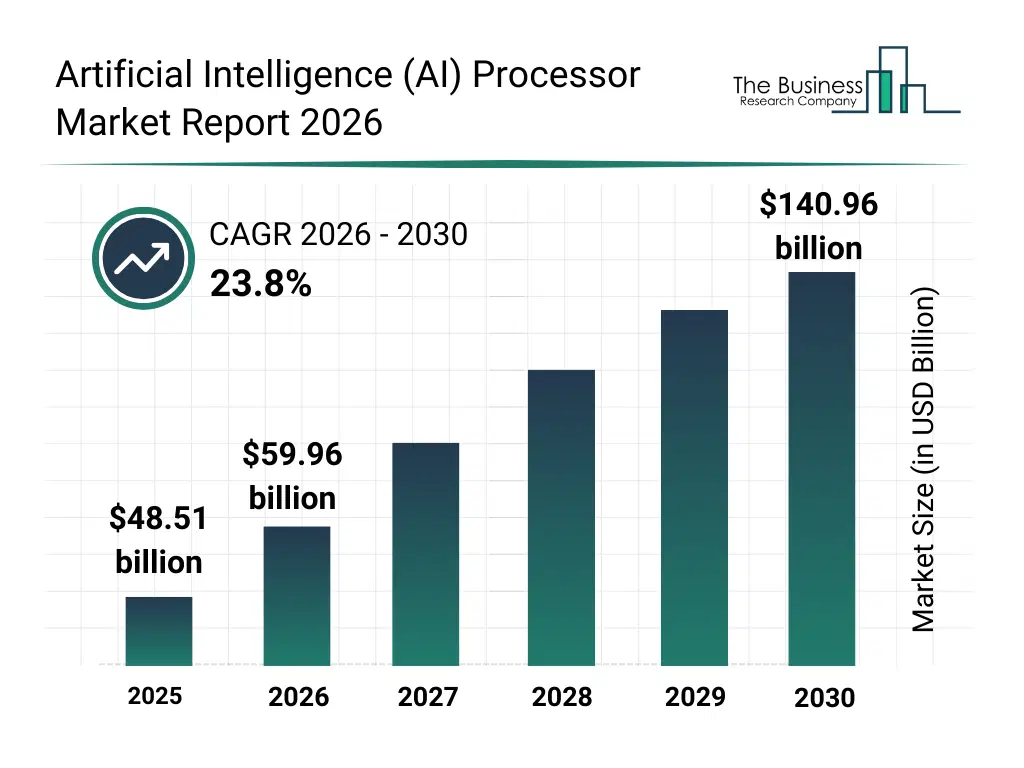
What Is The Artificial Intelligence (AI) Processor Market Size and Share 2026?
The artificial intelligence (AI) processor market size has grown exponentially in recent years. It will grow from $48.51 billion in 2025 to $59.96 billion in 2026 at a compound annual growth rate (CAGR) of 23.6%. The growth in the historic period can be attributed to deep learning workload growth, GPU dominance, cloud data center expansion, early AI hardware innovation, compute-intensive AI models.What Is The Artificial Intelligence (AI) Processor Market Growth Forecast?
The artificial intelligence (AI) processor market size is expected to see exponential growth in the next few years. It will grow to $140.96 billion in 2030 at a compound annual growth rate (CAGR) of 23.8%. The growth in the forecast period can be attributed to edge AI proliferation, autonomous system demand, generative AI workloads, semiconductor innovation, energy-efficient computing needs. Major trends in the forecast period include high-performance ai accelerators, energy-efficient edge ai chips, domain-specific ai processors, scalable cloud ai hardware, on-device inference optimization.
Global Artificial Intelligence (AI) Processor Market Segmentation
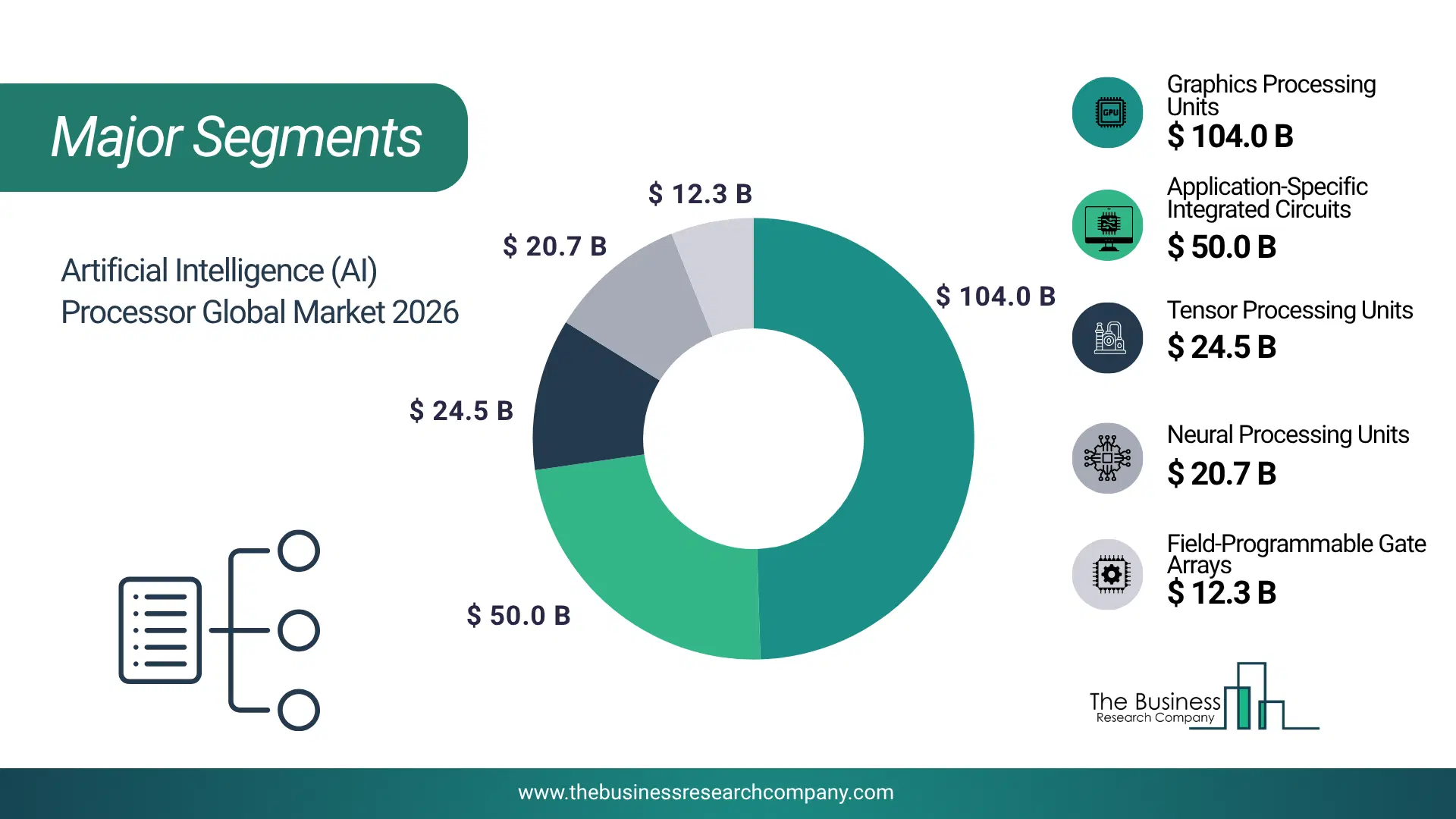
1) By Processor Type: Graphics Processing Units, Application-Specific Integrated Circuits, Tensor Processing Units, Field-Programmable Gate Arrays, Neural Processing Units, Artificial Intelligence Accelerators 2) By Deployment Mode: Cloud Or Data Center, Edge Or On-Device 3) By Application: Image Processing And Recognition, Natural Language Processing, Machine Learning, Deep Learning, Predictive Analytics 4) By End-User Industry: Information Technology (IT) And Telecom, Automotive, Consumer Electronics, Healthcare, Banking, Financial Services, And Insurance, Industrial Subsegments: 1) By Graphics Processing Units: Consumer Grade Graphics Processors, Data Center Graphics Processors, Embedded Graphics Processors, Mobile Graphics Processors 2) By Application-Specific Integrated Circuits: Training Specific Integrated Circuits, Inference Specific Integrated Circuits, Cloud Optimized Integrated Circuits, Edge Optimized Integrated Circuits 3) By Tensor Processing Units: Cloud Based Tensor Processors, Edge Based Tensor Processors, Training Tensor Processors, Inference Tensor Processors 4) By Field-Programmable Gate Arrays: Low Power Programmable Arrays, High Performance Programmable Arrays, Embedded Programmable Arrays, Data Center Programmable Arrays 5) By Neural Processing Units: Mobile Neural Processors, Edge Neural Processors, Automotive Neural Processors, Consumer Electronics Neural Processors 6) By Artificial Intelligence Accelerators: Vision Processing Accelerators, Speech Processing Accelerators, Machine Learning Accelerators, Deep Learning Accelerators The top segments in the artificial intelligence (ai) processor market will be: • Graphics Processing Units will reach $104 billion by 2030. • Application-Specific Integrated Circuits will reach $49.97 billion by 2030. • Tensor Processing Units will reach $24.5 billion by 2030. • Neural Processing Units will reach $20.71 billion by 2030. • Field-Programmable Gate Arrays will reach $12.35 billion by 2030. • Semiconductor And Related Devices will reach $1308.88 billion by 2030. • General Electronic Components will reach $361.1 billion by 2030.What Is The Driver Of The Artificial Intelligence (AI) Processor Market?
The rising enterprise digital transformation is expected to propel the growth of the artificial intelligence (AI) processor market going forward. Enterprise digital transformation refers to the adoption of digital technologies across business operations, processes, and models to improve efficiency, agility, and data-driven decision-making. The rise in enterprise digital transformation is due to the need for operational efficiency and competitiveness, which is pushing organizations to modernize legacy systems, automate workflows, and enhance digital capabilities. The artificial intelligence (AI) processors support enterprise digital transformation by enabling faster data processing, real-time analytics, and intelligent automation, allowing enterprises to deploy advanced AI-driven applications at scale. For instance, in September 2025, according to the U.S. Census Bureau, a U.S.-based government agency, 78% of organizations reported using artificial intelligence in 2024, up from 55% in the previous year. Furthermore, in March 2025, according to the Office for National Statistics (ONS), the United Kingdom’s largest independent producer of official statistics, more than 69% of UK firms increased their adoption of cloud-based systems in 2023, while 61% also expanded their use of specialized software. Therefore, rising enterprise digital transformation is driving the growth of the artificial intelligence (AI) processor industry.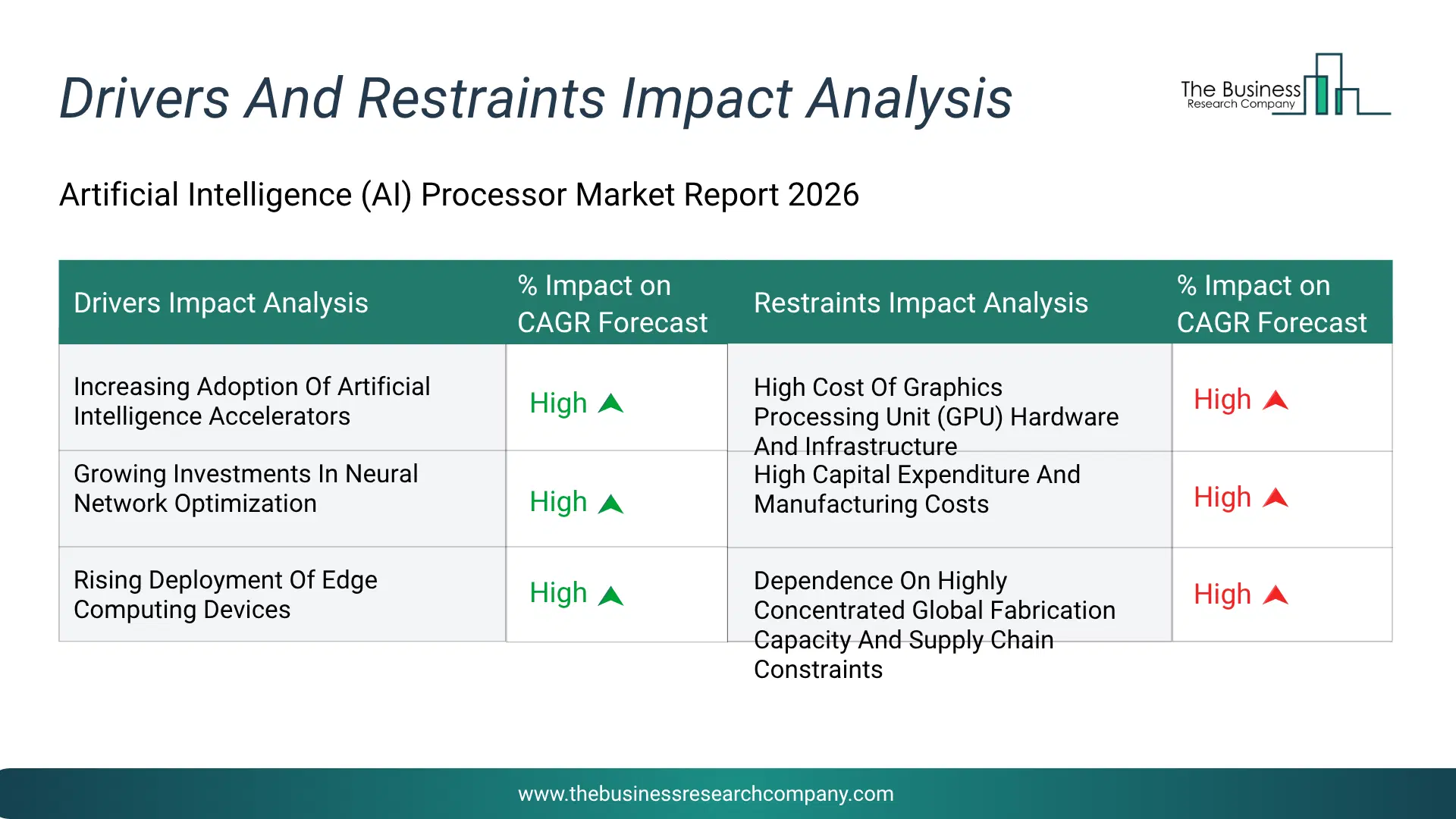
Infographic Chart Showing Key Market Drivers Analysis And Restraints For Artificial Intelligence (Ai) Processor Market
The chart presents an impact analysis of key drivers and restraints, quantifying their relative influence on the market's growth rate and helping assess the balance between growth enablers and limiting factors. This chart offers a high-level perspective; the full report contains more detailed insights.
How Will The Drivers Impact Growth In The Global Artificial Intelligence (AI) Processor Market?
• Increasing Adoption Of Artificial Intelligence Accelerators (High) – During the forecast period, the increasing adoption of artificial intelligence accelerators is expected to become a key growth driver for the artificial intelligence (ai) processor market by 2030. Organizations are increasingly deploying specialized ai accelerators to handle complex workloads such as deep learning, neural network training, and real -time inference. These processors offer higher efficiency and lower power consumption compared to traditional cpus, making them ideal for large -scale ai deployments. Technology companies are investing heavily in the development of dedicated ai chips to enhance performance and reduce latency. This transition toward specialized computing architectures is reinforcing strong market expansion. • Growing Investments In Neural Network Optimization (High) – During the forecast period, growing investments in neural network optimization are expected to emerge as a major factor driving the expansion of the artificial intelligence (ai) processor market by 2030. Companies are focusing on optimizing ai models through techniques such as quantization, pruning, and hardware-software co-design to improve processing efficiency and reduce computational requirements. These advancements enable faster training and inference while lowering energy consumption and operational costs. The need for scalable and efficient ai solutions across industries is further accelerating investments in optimized processor architectures. • Rising Deployment Of Edge Computing Devices (High) – During the forecast period, the rising deployment of edge computing devices is expected to act as a key growth catalyst for the artificial intelligence (ai) processor market by 2030. The increasing use of ai at the edge in applications such as autonomous vehicles, smart devices, and industrial automation is driving demand for compact, energy-efficient processors capable of real-time data processing. Edge ai reduces latency, enhances data privacy, and enables faster decision-making without reliance on centralized cloud infrastructure. Manufacturers are therefore developing advanced on-device ai processors to support these requirements. • Expansion Of Consumer Electronics (High) – During the forecast period, the expansion of consumer electronics is expected to become a key growth driver for the semiconductor and other electronic components market by 2030. Increasing global demand for smartphones, laptops, wearable devices, and smart home products is driving significant consumption of semiconductors and electronic components. Manufacturers are continuously enhancing device performance, energy efficiency, and connectivity features, leading to higher semiconductor content per device. Additionally, shorter product replacement cycles and rising disposable incomes in emerging markets are further boosting demand. • Growth Of Internet Of Things Devices (High) – During the forecast period, the growth of internet of things (iot) devices is expected to emerge as a major factor driving the expansion of the semiconductor and other electronic components market by 2030. The proliferation of connected devices across smart homes, industrial automation, healthcare, and logistics is significantly increasing demand for sensors, microcontrollers, and connectivity chips. Iot ecosystems require efficient, low-power semiconductor solutions to support real-time data processing and communication. Advancements in 5g networks and edge computing are further accelerating iot adoption, expanding the need for integrated electronic components. • Increasing Use Of Automotive Electronics (Medium) – During the forecast period, the increasing use of automotive electronics is expected to act as a key growth catalyst for the semiconductor and other electronic components market by 2030. Modern vehicles are increasingly equipped with advanced driver assistance systems (adas), infotainment systems, electric powertrains, and connectivity features, all of which require a high volume of semiconductors and electronic components. The transition toward electric and autonomous vehicles is further accelerating semiconductor demand, as these vehicles rely heavily on sensors, processors, and power electronics. Additionally, regulatory requirements for vehicle safety and emissions are driving further integration of electronic systems.How Will The Restraints Impact Growth In The Global Artificial Intelligence (AI) Processor Market?
• High Cost Of Graphics Processing Unit (GPU) Hardware And Infrastructure (High) – During the forecast period, the ai processors require powerful computing environments supported by advanced gpus, high-performance servers, cooling systems, and data center infrastructure. The substantial cost of acquiring and maintaining these resources creates financial barriers for many organizations. High infrastructure expenses can limit ai adoption, particularly among small and medium-sized enterprises. • High Capital Expenditure And Manufacturing Costs (High) – During the forecast period, the designing and manufacturing ai processors involves significant investments in semiconductor fabrication, advanced packaging technologies, research and development, and production facilities. Rising wafer fabrication costs and increasing design complexity further elevate capital requirements. These substantial expenditures can limit market entry for new players and increase product pricing across the industry. • Dependence On Highly Concentrated Global Fabrication Capacity And Supply Chain Constraints (High) – During the forecast period, the the heavy dependence on a limited number of global semiconductor fabrication facilities acts as a key restraint for the ai processor market. Most advanced ai processors rely on a few specialized foundries, creating bottlenecks in production and increasing vulnerability to disruptions. Supply chain constraints, including raw material shortages and geopolitical tensions, further impact timely manufacturing and delivery. This concentration reduces flexibility and increases lead times, affecting the scalability of ai processor deployment. As a result, uncertainties in supply and rising costs can hinder consistent market growth. • Supply Chain Disruptions And Raw Material Shortages (High) – During the forecast period, the the semiconductor and electronic components ecosystem relies on a highly complex global supply chain that involves raw materials, wafer fabrication, packaging, testing, and distribution. Any disruption in this chain can act as a significant restraint for the semiconductors and other electronic components market. Semiconductor manufacturing requires specialized materials such as silicon wafers, rare earth elements, gallium, helium, and other high-purity metals. When shortages of these materials occur due to geopolitical conflicts, transportation disruptions, or export restrictions, chip production slows down. Limited availability of key materials increases manufacturing costs and delays production cycles, affecting the ability of manufacturers to supply integrated circuits, memory chips, and microprocessors to downstream electronics producers. Additionally, since semiconductor production is geographically concentrated in a few regions, natural disasters or logistical issues in those areas can disrupt the entire global supply chain. These disruptions reduce product availability and increase lead times for electronic components, thereby restraining the overall revenue growth of the semiconductors and other electronic components market. • High Capital Investment And Manufacturing Complexity (High) – During the forecast period, the the semiconductor and electronic components sector requires extremely high capital investment and advanced technological infrastructure for manufacturing. Semiconductor fabrication plants, also known as fabs, involve complex processes such as photolithography, ion implantation, etching, and wafer testing, all of which require expensive equipment and cleanroom facilities. Establishing a new fabrication facility often requires billions of dollars in investment and several years to become operational. This high cost acts as a barrier for new entrants and limits expansion for existing manufacturers. Furthermore, semiconductor production involves hundreds of precise steps that must be executed with extremely low error tolerance. Even minor process failures can lead to large volumes of defective chips, increasing operational costs and reducing production efficiency. As technology nodes become smaller and more advanced, research and development expenses also increase significantly. These financial and technological barriers slow down production scalability and innovation, thereby restraining the growth potential of the semiconductors and other electronic components market • Regulatory Restrictions And Geopolitical Trade Barriers (High) – During the forecast period, the government regulations, export controls, and geopolitical tensions can significantly restrict the growth of the semiconductors and other electronic components market. Semiconductor technologies are often considered strategically important because they are used in advanced computing, defense systems, telecommunications, and artificial intelligence. As a result, governments impose strict regulations on semiconductor exports, intellectual property sharing, and foreign investments in chip manufacturing companies. Trade restrictions, tariffs, and export licensing requirements can limit the ability of companies to sell semiconductor products in certain regions or collaborate with international partners. Additionally, geopolitical conflicts between major economies can lead to technology bans or restrictions on critical raw materials required for chip manufacturing. These policies disrupt global supply chains, reduce cross-border technology exchange, and increase operational uncertainty for semiconductor manufacturers. Consequently, regulatory complexities and geopolitical tensions act as major restraints that slow down global production, investment, and distribution of semiconductor and electronic components.Key Players In The Global Artificial Intelligence (AI) Processor Market
Major companies operating in the artificial intelligence (AI) processor market are Samsung Electronics Co. Ltd., Apple Inc., Google LLC, Huawei Technologies Co. Ltd, IBM Corporation, Broadcom Inc., NVIDIA Corporation, Intel Corporation, Qualcomm Incorporated, SK Hynix Inc., Advanced Micro Devices Inc., Micron Technology Inc., NXP Semiconductors N.V., Imagination Technologies Group plc, Groq Inc, Cambricon Technologies Corporation Limited, Ceva Inc., Tenstorrent Inc., Cerebras Systems Inc., Axelera AI, Mythic AI Inc., and Black Sesame International Holding Limited.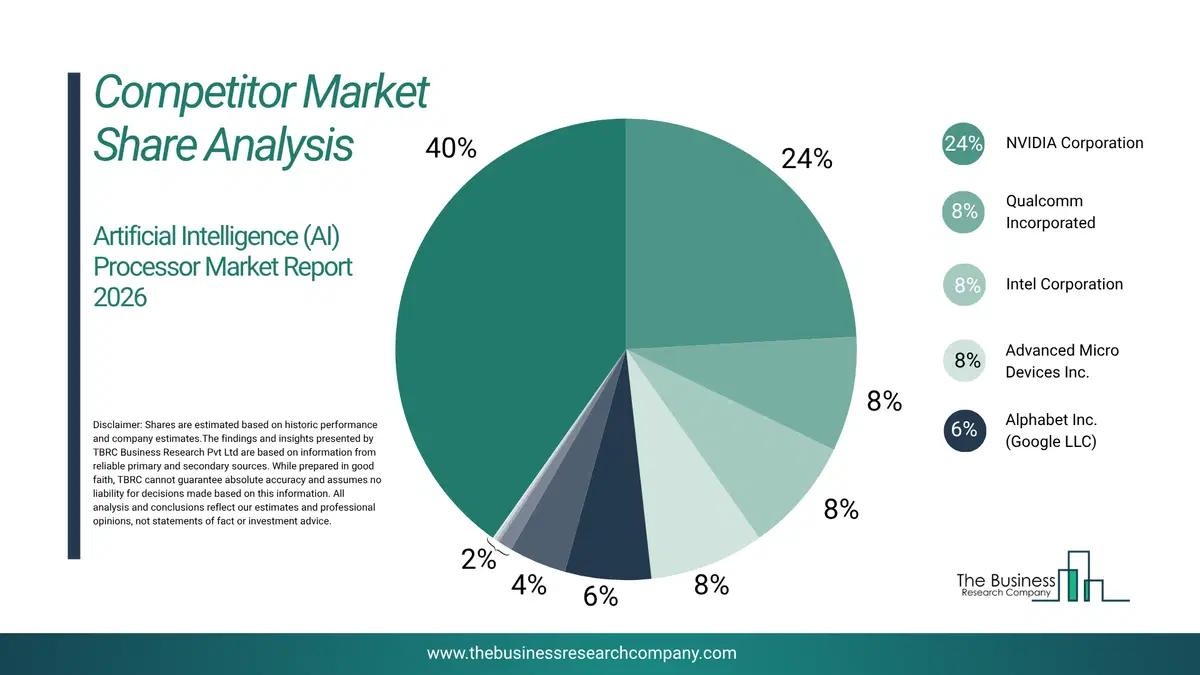
This chart is for illustrative purposes; the full report includes a detailed competitor analysis and comprehensive overview of the top 10 companies in the market.
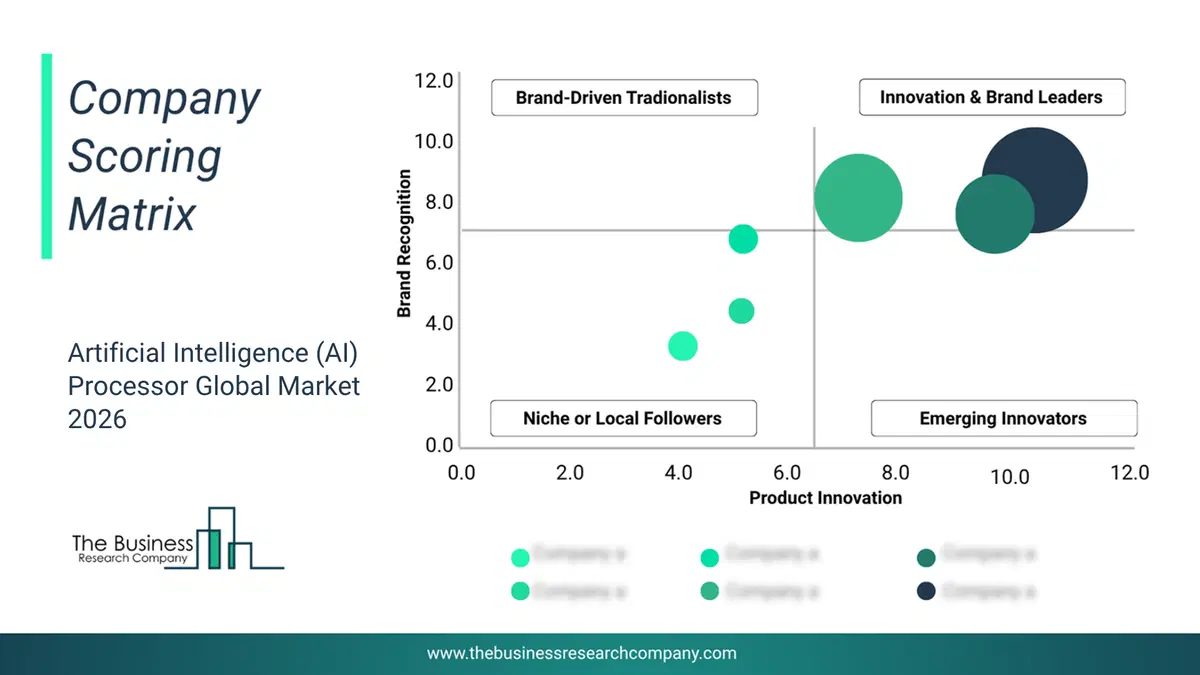
This chart maps companies by product innovation and brand strength, with bubble size indicating relative revenue, helping identify market leaders, challengers, and niche players. This is an illustrative chart; the full report provides a complete and accurate competitive analysis.
Global Artificial Intelligence (AI) Processor Market Trends and Insights
Major companies operating in the artificial intelligence (AI) processor market are focusing on advanced innovations such as 5th gen Xeon scalable processors to deliver built-in AI acceleration for data center, cloud, and edge workloads. 5th gen Xeon scalable processors refer to server-grade CPUs with AI acceleration in every core, designed for high-performance computing, AI inference, and large-scale model training. For instance, in December 2023, Intel Corporation, a US-based technology company, launched its AI Everywhere portfolio, introducing Intel Core Ultra processors with an on-chip neural processing unit (NPU), 5th Gen Intel Xeon processors with AI acceleration in every core, and the Intel Gaudi 3 AI accelerator. These products are designed to support scalable AI deployment, reduce total cost of ownership, and enable AI-driven applications across enterprise, cloud, edge, and PC environments.What Are Latest Mergers And Acquisitions In The Artificial Intelligence (AI) Processor Market?
In March 2025, SoftBank Group, a Japan-based investment holding company, acquired Ampere Computing for $6.5 billion. Through this acquisition, SoftBank Group aims to expand its AI hardware portfolio and accelerate the development of high-performance computing infrastructure to support advanced AI workloads, leveraging Ampere’s expertise in data center CPUs and Arm-based architectures. Ampere Computing LLC is a US-based company specialized in designing high-performance, Arm-based data center CPUs and AI processors, providing scalable computing solutions for cloud and enterprise AI workloads.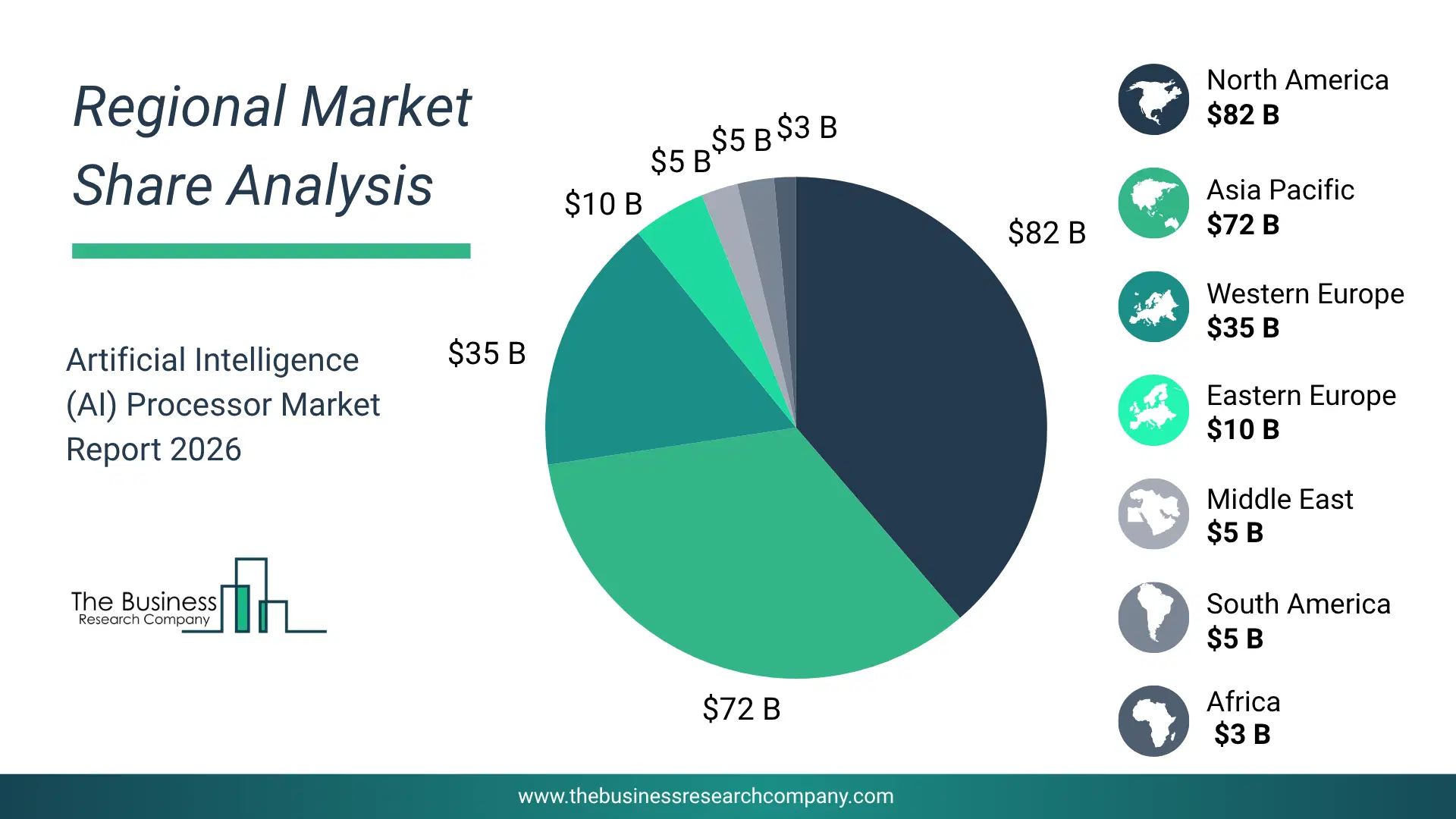
Regional Outlook
North America was the largest region in the artificial intelligence (AI) processor market in 2025. Asia-Pacific is expected to be the fastest-growing region in the forecast period. The regions covered in this market report are Asia-Pacific, South East Asia, Western Europe, Eastern Europe, North America, South America, Middle East, Africa. The countries covered in this market report are Australia, Brazil, China, France, Germany, India, Indonesia, Japan, Taiwan, Russia, South Korea, UK, USA, Canada, Italy, Spain.What Defines the Artificial Intelligence (AI) Processor Market?
The artificial intelligence (AI) processor market consists of sales of AI inference modules, AI training processors, edge AI processors, system-on-chip AI solutions, and AI-enabled microprocessors. Values in this market are ‘factory gate’ values, that is, the value of goods sold by the manufacturers or creators of the goods, whether to other entities (including downstream manufacturers, wholesalers, distributors, and retailers) or directly to end customers. The value of goods in this market includes related services sold by the creators of the goods.How is Market Value Defined and Measured?
The market value is defined as the revenues that enterprises gain from the sale of goods and/or services within the specified market and geography through sales, grants, or donations in terms of the currency (in USD unless otherwise specified). The revenues for a specified geography are consumption values that are revenues generated by organizations in the specified geography within the market, irrespective of where they are produced. It does not include revenues from resales along the supply chain, either further along the supply chain or as part of other products.
This chart presents market attractiveness based on a quantitative evaluation of growth, competition, strategic alignment, and risk, offering a clear view of opportunity areas for decision-making. This chart is for illustrative purposes; the full report contains the complete analysis.

This chart highlights the Total Addressable Market (TAM) by estimating the maximum revenue opportunity using an assumption-driven approach, supporting strategic planning and opportunity sizing across markets. The chart is illustrative; the full report provides a more comprehensive analysis.
What Key Data and Analysis Are Included in the Artificial Intelligence (AI) Processor Market Report 2026?
The artificial intelligence (ai) processor market research report is one of a series of new reports from The Business Research Company that provides market statistics, including industry global market size, regional shares, competitors with the market share, detailed market segments, market trends and opportunities, and any further data you may need to thrive in the artificial intelligence (ai) processor industry. The market research report delivers a complete perspective of everything you need, with an in-depth analysis of the current and future state of the industry.Artificial Intelligence (AI) Processor Market Report Forecast Analysis
| Report Attribute | Details |
|---|---|
| Market Size Value In 2026 | $59.96 billion |
| Revenue Forecast In 2030 | $140.96 billion |
| Growth Rate | CAGR of 23.6% from 2026 to 2030 |
| Base Year For Estimation | 2025 |
| Actual Estimates/Historical Data | 2020-2025 |
| Forecast Period | 2026 - 2030 |
| Market Representation | Revenue in USD Billion and CAGR from 2026 to 2030 |
| Segments Covered | Processor Type, Deployment Mode, Application, End-User Industry |
| Regional Scope | Asia-Pacific, Western Europe, Eastern Europe, North America, South America, Middle East, Africa |
| Country Scope | The countries covered in the report are Australia, Brazil, China, France, Germany, India, Indonesia, Japan, Taiwan, Russia, South Korea, UK, USA, Canada, Italy, Spain. |
| Key Companies Profiled | Samsung Electronics Co. Ltd., Apple Inc., Google LLC, Huawei Technologies Co. Ltd, IBM Corporation, Broadcom Inc., NVIDIA Corporation, Intel Corporation, Qualcomm Incorporated, SK Hynix Inc., Advanced Micro Devices Inc., Micron Technology Inc., NXP Semiconductors N.V., Imagination Technologies Group plc, Groq Inc, Cambricon Technologies Corporation Limited, Ceva Inc., Tenstorrent Inc., Cerebras Systems Inc., Axelera AI, Mythic AI Inc., and Black Sesame International Holding Limited. |
| Customization Scope | Request for Customization |
| Pricing And Purchase Options | Explore Purchase Options |