
Artificial Intelligence (AI) Smart Glasses Market Report 2026
Global Outlook – By Type (Augmented Reality, Mixed Reality Smart Glasses, Camera-Enabled Artificial Intelligence Glasses, Heads-Up Display Glasses), By Distribution Channel (Online, Offline), By Application (Healthcare, Manufacturing, Education, Military And Defense, Logistics And Transportation, Gaming And Entertainment), By End User (Consumer, Commercial, Enterprise) – Market Size, Trends, Strategies, and Forecast to 2030
Artificial Intelligence (AI) Smart Glasses Market Overview
• Artificial Intelligence (AI) Smart Glasses market size has reached to $2.09 billion in 2025 • Expected to grow to $3.64 billion in 2030 at a compound annual growth rate (CAGR) of 11.7% • Growth Driver: Expansion Of 5G Connectivity Fueling The Growth Of The Market Due To Increasing Demand For Real-time AI Processing And Low-latency Augmented Reality Experiences • Market Trend: Innovations In Artificial Intelligence (AI) Technology Enhance Hands Free Assistance And Real Time Visual Intelligence In Smart Glasses • North America was the largest region in 2025 and Asia-Pacific is the fastest growing region.What Is Covered Under Artificial Intelligence (AI) Smart Glasses Market?
Artificial intelligence (AI) smart glasses are wearable devices that combine artificial intelligence with augmented reality, cameras, microphones, sensors, and voice assistants to provide real-time information and hands-free user experiences. They are designed to improve productivity, communication, navigation, and everyday convenience by enabling users to access information, capture photos and videos, and interact with digital content using voice commands, visual displays, and AI-powered features without the need for a smartphone. The main types of artificial intelligence (AI) smart glasses include augmented reality, mixed reality smart glasses, camera-enabled artificial intelligence glasses, and heads-up display glasses. Augmented reality refer to wearable devices that overlay digital information, visual content, and interactive elements onto the user's view of the physical environment, often using artificial intelligence to provide context-aware assistance and real-time information. These smart glasses are distributed through online and offline channels. They find application in healthcare, manufacturing, education, military and defense, logistics and transportation, and gaming and entertainment, serving end users including consumers, commercial users, and enterprises.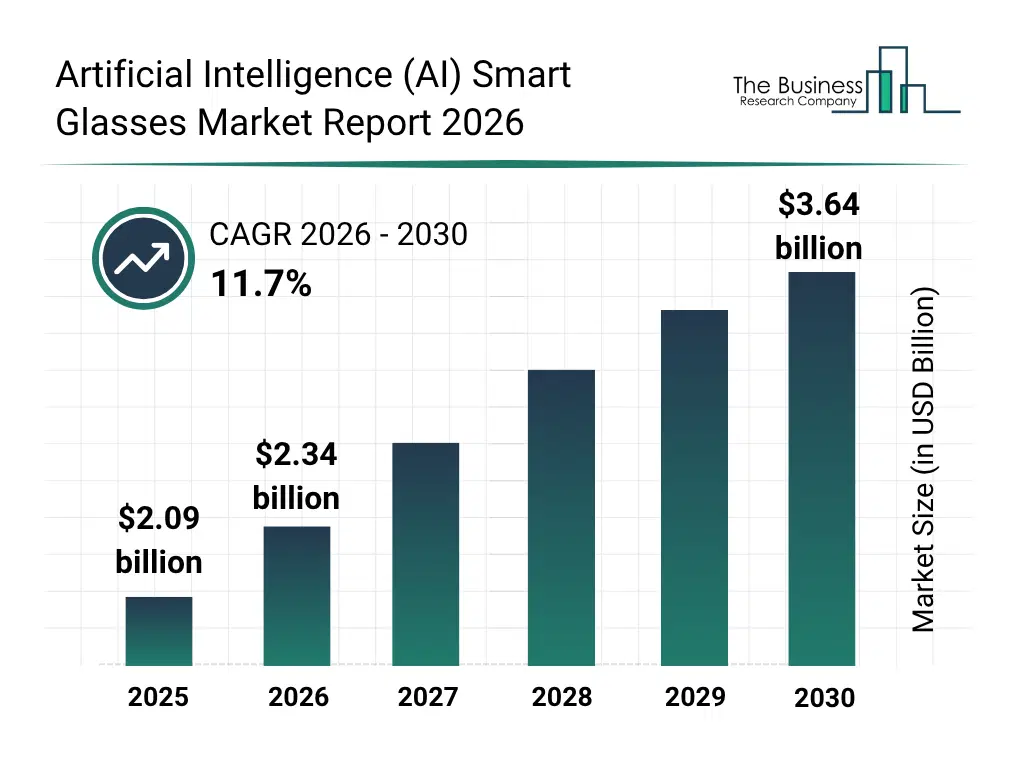
What Is The Artificial Intelligence (AI) Smart Glasses Market Size and Share 2026?
The artificial intelligence (ai) smart glasses market size has grown rapidly in recent years. It will grow from $2.09 billion in 2025 to $2.34 billion in 2026 at a compound annual growth rate (CAGR) of 12.1%. The growth in the historic period can be attributed to increasing consumer interest in wearable technology, rising demand for hands-free communication, growing adoption of voice assistants, increasing demand for portable digital information access, rising use of wearable cameras.What Is The Artificial Intelligence (AI) Smart Glasses Market Growth Forecast?
The artificial intelligence (ai) smart glasses market size is expected to see rapid growth in the next few years. It will grow to $3.64 billion in 2030 at a compound annual growth rate (CAGR) of 11.7%. The growth in the forecast period can be attributed to increasing demand for real-time visual assistance, rising adoption of AI-powered navigation features, growing demand for context-aware wearable experiences, increasing need for hands-free workplace productivity, rising demand for advanced wearable interaction capabilities. Major trends in the forecast period include increasing adoption of voice-controlled smart glasses, rising integration of real-time translation capabilities, growing demand for hands-free information access, increasing adoption of camera-enabled AI glasses, rising demand for lightweight and compact smart glasses.
Global Artificial Intelligence (AI) Smart Glasses Market Segmentation
1) By Type: Augmented Reality, Mixed Reality Smart Glasses, Camera-Enabled Artificial Intelligence Glasses, Heads-Up Display Glasses 2) By Distribution Channel: Online, Offline 3) By Application: Healthcare, Manufacturing, Education, Military And Defense, Logistics And Transportation, Gaming And Entertainment 4) By End User: Consumer, Commercial, Enterprise Subsegments: 1) By Augmented Reality: Optical See-Through Smart Glasses, Projection-Based Smart Glasses, Waveguide-Based Smart Glasses, Monocular Augmented Reality Glasses, Binocular Augmented Reality Glasses 2) By Mixed Reality Smart Glasses: Immersive Mixed Reality Glasses, Enterprise Mixed Reality Glasses, Spatial Computing Smart Glasses, Gesture-Controlled Smart Glasses, Voice-Assisted Mixed Reality Glasses 3) By Camera-Enabled Artificial Intelligence Glasses: Real-Time Translation Glasses, Object Recognition Smart Glasses, Livestreaming Smart Glasses, Health Monitoring Smart Glasses, Voice Assistant Integrated Glasses 4) By Heads-Up Display Glasses: Navigation Display Glasses, Industrial Heads-Up Display Glasses, Automotive Heads-Up Display Glasses, Sports Performance Display Glasses, Military Display Smart GlassesWhat Is The Driver Of The Artificial Intelligence (AI) Smart Glasses Market?
The expansion of 5G connectivity is expected to propel the growth of the artificial intelligence (AI) smart glasses market going forward. 5G connectivity refers to the fifth generation of mobile network technology that delivers ultra-fast data speeds, low latency, high reliability, and the ability to connect a large number of devices simultaneously. Expansion of 5G connectivity is rising due to increasing investments by telecom operators in network infrastructure to enhance coverage, capacity, and data speeds, supporting the growing demand for high-speed mobile connectivity. AI smart glasses leverage 5G connectivity to enable real-time AI processing, seamless cloud access, low-latency augmented reality experiences, instant language translation, remote collaboration, and high-quality video streaming, thereby enhancing device performance and user experience. For instance, in March 2024, according to 5G Americas, a US-based wireless industry trade association, by the end of 2023, there were 1.76 billion 5G connections worldwide, reflecting an addition of 700 million connections during the year, a 66% growth compared to 2022. Global 5G connections are projected to reach 7.9 billion by 2028. Therefore, the expansion of 5G connectivity is driving the growth of the artificial intelligence (AI) smart glasses industry.Key Players In The Global Artificial Intelligence (AI) Smart Glasses Market
Major companies operating in the artificial intelligence (AI) smart glasses market are Amazon.com Inc., Apple Inc., Google LLC, Microsoft Corporation, Samsung Electronics Co. Ltd., Meta Platforms Inc., Huawei Technologies Co. Ltd., Lenovo Group Limited, Qualcomm Incorporated, Xiaomi Corporation, Goertek Inc., Seiko Epson Corporation, Snap Inc., Magic Leap Inc., Matrixed Reality Technology Co. Ltd., Rokid Corporation Ltd., Kopin Corporation, RealWear Inc., RayNeo Technology Co. Ltd., Vuzix Corporation, Lucyd Ltd, Solos Technology Limited, Brilliant Labs Pte. Ltd.
This chart is for illustrative purposes; the full report includes a detailed competitor analysis and comprehensive overview of the top 10 companies in the market.
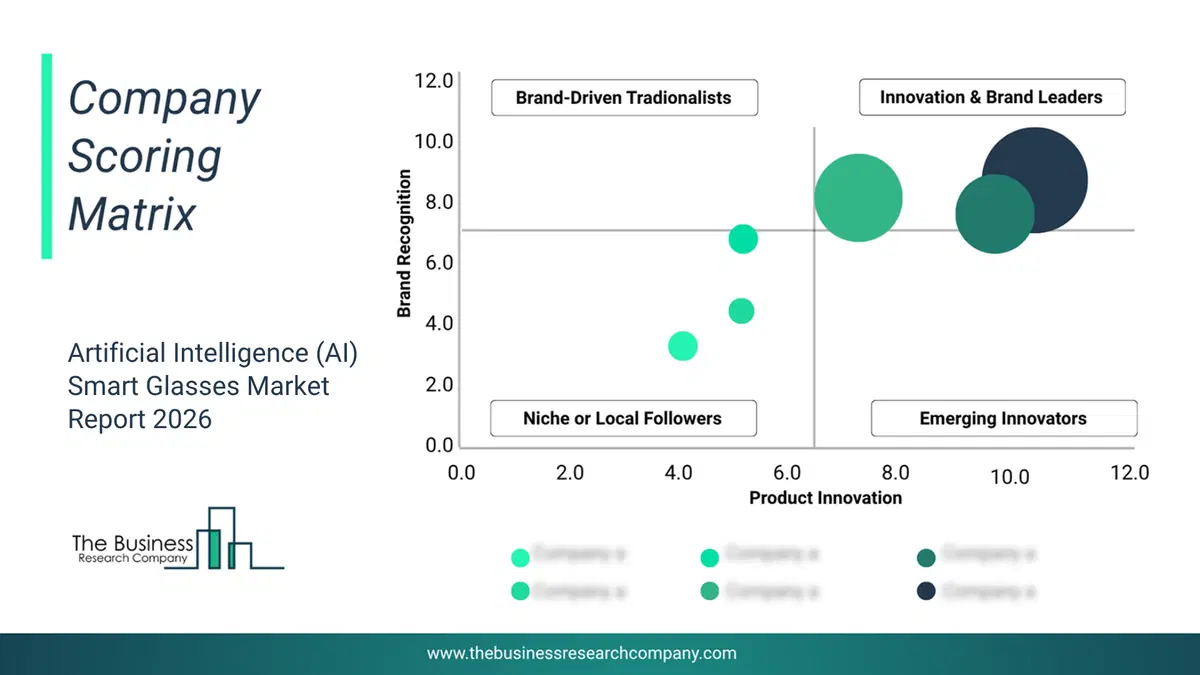
This chart maps companies by product innovation and brand strength, with bubble size indicating relative revenue, helping identify market leaders, challengers, and niche players. This is an illustrative chart; the full report provides a complete and accurate competitive analysis.
Global Artificial Intelligence (AI) Smart Glasses Market Trends and Insights
Major companies operating in the artificial intelligence (AI) smart glasses market are focusing on developing advanced AI-powered wearable solutions with multimodal artificial intelligence capabilities to enable hands-free assistance, real-time visual understanding, and seamless digital interactions. Multimodal artificial intelligence capabilities allow smart glasses to interpret visual and voice inputs simultaneously, enabling users to receive contextual information, capture content, and interact naturally with their surroundings. For instance, in September 2023, Meta Platforms Inc., a US-based technology company, in partnership with EssilorLuxottica, a France-based eyewear manufacturer, launched the Ray-Ban Meta smart glasses. The next-generation AI smart glasses integrate Meta AI, a 12-megapixel ultra-wide camera, enhanced audio, live streaming, and voice-controlled assistance to deliver seamless hands-free experiences. It is equipped with multimodal artificial intelligence capabilities, enabling users to capture photos and videos while receiving real-time contextual information about their surroundings.What Are Latest Mergers And Acquisitions In The Artificial Intelligence (AI) Smart Glasses Market?
In May 2025, Kering Eyewear, an Italy-based luxury eyewear company, partnered with Google to develop AI-powered smart glasses using the Android XR platform. With this collaboration, Kering Eyewear aimed to combine premium eyewear design expertise with advanced artificial intelligence and extended reality technologies to create stylish, AI-enabled smart glasses that enhance user interaction, contextual awareness, and everyday digital experiences. Google is a US-based technology company that provides artificial intelligence (AI) smart glasses through its Android XR platform with Gemini AI integration.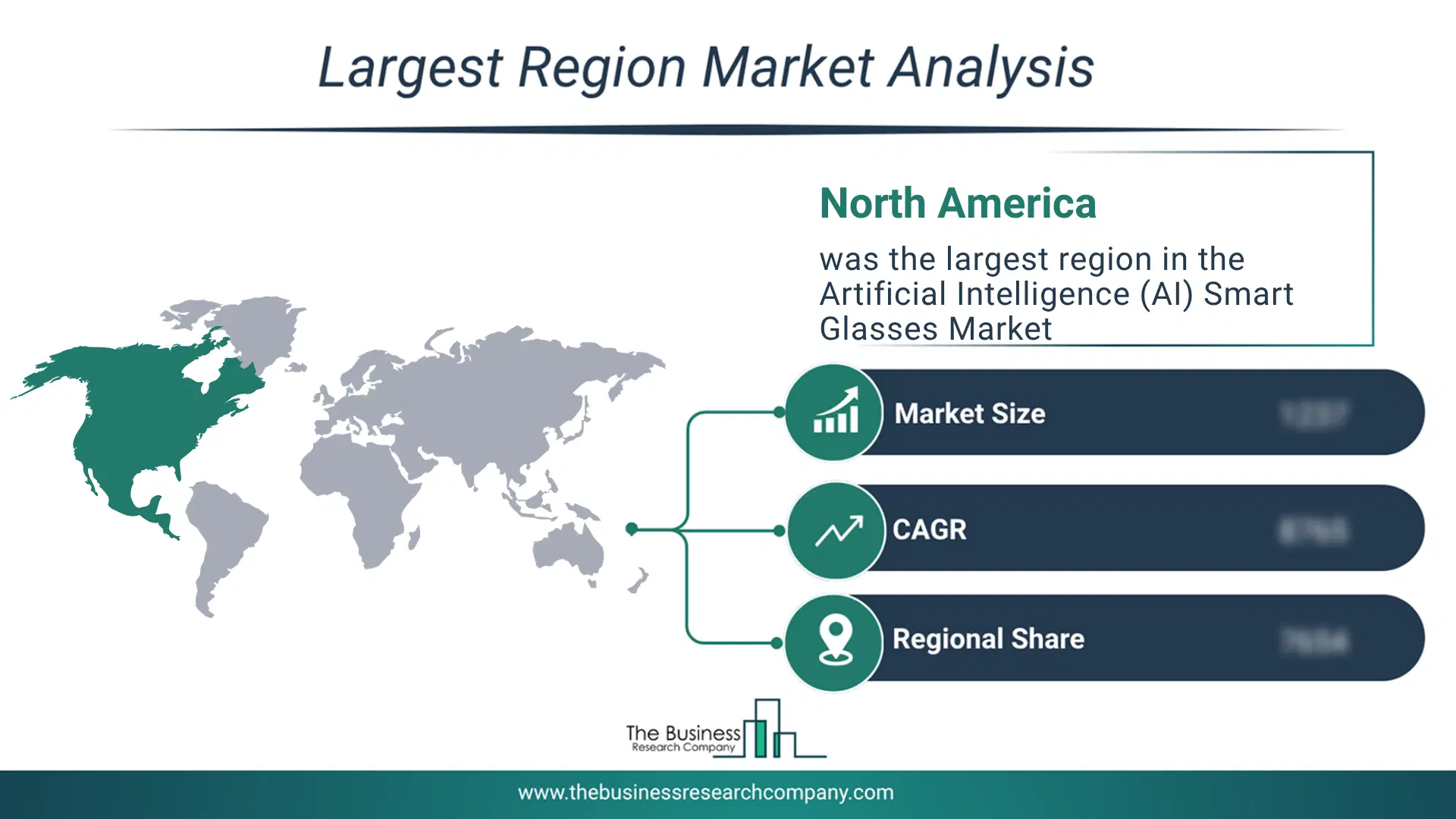
Regional Outlook
North America was the largest region in the artificial intelligence (AI) smart glasses market in 2025. Asia-Pacific is expected to be the fastest-growing region in the forecast period. The regions covered in this market report are Asia-Pacific, South East Asia, Western Europe, Eastern Europe, North America, South America, Middle East, Africa. The countries covered in this market report are Australia, Brazil, China, France, Germany, India, Indonesia, Japan, Taiwan, Russia, South Korea, UK, USA, Canada, Italy, Spain.What Defines the Artificial Intelligence (AI) Smart Glasses Market?
The artificial intelligence (AI) smart glasses market consists of revenues earned by entities by providing services such as AI-powered vision assistance, real-time language translation, voice-enabled virtual assistance, augmented reality (AR) experiences, navigation support, remote collaboration, fitness and health monitoring, object and facial recognition, and cloud-based software updates and device management. The market value includes the value of related goods sold by the service provider or included within the service offering. The artificial intelligence (AI) smart glasses market also includes sales of embedded micro-displays, cameras, sensors, processors, connectivity modules, audio systems, and battery units. Values in this market are ‘factory gate’ values, that is, the value of goods sold by the manufacturers or creators of the goods, whether to other entities (including downstream manufacturers, wholesalers, distributors, and retailers) or directly to end customers. The value of goods in this market includes related services sold by the creators of the goods.How is Market Value Defined and Measured?
The market value is defined as the revenues that enterprises gain from the sale of goods and/or services within the specified market and geography through sales, grants, or donations in terms of the currency (in USD unless otherwise specified). The revenues for a specified geography are consumption values that are revenues generated by organizations in the specified geography within the market, irrespective of where they are produced. It does not include revenues from resales along the supply chain, either further along the supply chain or as part of other products.
This chart presents market attractiveness based on a quantitative evaluation of growth, competition, strategic alignment, and risk, offering a clear view of opportunity areas for decision-making. This chart is for illustrative purposes; the full report contains the complete analysis.

This chart highlights the Total Addressable Market (TAM) by estimating the maximum revenue opportunity using an assumption-driven approach, supporting strategic planning and opportunity sizing across markets. The chart is illustrative; the full report provides a more comprehensive analysis.
What Key Data and Analysis Are Included in the Artificial Intelligence (AI) Smart Glasses Market Report 2026?
The artificial intelligence (ai) smart glasses market research report is one of a series of new reports from The Business Research Company that provides market statistics, including industry global market size, regional shares, competitors with the market share, detailed market segments, market trends and opportunities, and any further data you may need to thrive in the artificial intelligence (ai) smart glasses industry. The market research report delivers a complete perspective of everything you need, with an in-depth analysis of the current and future state of the industry.Artificial Intelligence (AI) Smart Glasses Market Report Forecast Analysis
| Report Attribute | Details |
|---|---|
| Market Size Value In 2026 | $2.34 billion |
| Revenue Forecast In 2030 | $3.64 billion |
| Growth Rate | CAGR of 11.7% from 2026 to 2030 |
| Base Year For Estimation | 2025 |
| Actual Estimates/Historical Data | 2020-2025 |
| Forecast Period | 2026 - 2030 |
| Market Representation | Revenue in USD Billion and CAGR from 2026 to 2030 |
| Segments Covered | Type, Distribution Channel, Application, End User |
| Regional Scope | Asia-Pacific, Western Europe, Eastern Europe, North America, South America, Middle East, Africa |
| Country Scope | The countries covered in the report are Australia, Brazil, China, France, Germany, India, Indonesia, Japan, Taiwan, Russia, South Korea, UK, USA, Canada, Italy, Spain. |
| Key Companies Profiled | Amazon.com Inc., Apple Inc., Google LLC, Microsoft Corporation, Samsung Electronics Co. Ltd., Meta Platforms Inc., Huawei Technologies Co. Ltd., Lenovo Group Limited, Qualcomm Incorporated, Xiaomi Corporation, Goertek Inc., Seiko Epson Corporation, Snap Inc., Magic Leap Inc., Matrixed Reality Technology Co. Ltd., Rokid Corporation Ltd., Kopin Corporation, RealWear Inc., RayNeo Technology Co. Ltd., Vuzix Corporation, Lucyd Ltd, Solos Technology Limited, Brilliant Labs Pte. Ltd. |
| Customization Scope | Request for Customization |
| Pricing And Purchase Options | Explore Purchase Options |