
Artificial Intelligence (AI) Tele-Radiology Services Market Report 2026
Global Outlook – By Service Type (Remote Radiology Reporting, Artificial Intelligence Assisted Image Interpretation, Emergency And After Hours Reporting, Subspecialty Radiology Consultation, Second Opinion Radiology Reporting), By Artificial Intelligence Function (Automated Case Triage, Abnormality Detection, Diagnostic Decision Support, Image Quality Assessment, Artificial Intelligence Assisted Report Drafting), By Imaging Modality (X Ray, Computed Tomography, Magnetic Resonance Imaging, Ultrasound, Mammography, Positron Emission Tomography Computed Tomography And Nuclear Imaging), By Clinical Application (Cardiology, Oncology, Neurology, Emergency And Trauma, Other Applications), By End User (Hospitals, Diagnostic Imaging Centers, Emergency Departments, Ambulatory Care Centers, Other Healthcare Facilities) – Market Size, Trends, Strategies, and Forecast to 2030
Artificial Intelligence (AI) Tele-Radiology Services Market Report 2026 Market Overview
• Artificial Intelligence (AI) Tele-Radiology Services Market Report 2026 market size has reached to $0.98 billion in 2025 • Expected to grow to $2.71 billion in 2030 at a compound annual growth rate (CAGR) of 22.5% • Growth Driver: The Rising Imaging Volumes Fueling the Growth of the Market Due To The Increasing Burden Of Chronic Diseases Requiring Frequent Diagnostic Imaging And Timely Radiology Interpretation • Market Trend: Development Of AI-Powered Cloud-Based Radiology Platforms To Enhance Remote Diagnostic Workflows And Improve Radiologist Productivity • North America was the largest region in 2025 and Asia-Pacific is the fastest growing region.What Is Covered Under Artificial Intelligence (AI) Tele-Radiology Services Market?
Artificial intelligence (AI) tele-radiology services refer to the integration of artificial intelligence algorithms within remote radiological interpretation workflows, enabling automated initial scans, triaging of critical findings, and diagnostic assistance for medical images like X-rays, CTs, and MRIs transmitted from distant healthcare facilities. These services optimize the workflow of radiologists by reducing diagnostic turnaround times and improving accuracy through deep learning-based pattern recognition. The main service types of artificial intelligence (AI) tele-radiology services include remote radiology reporting, artificial intelligence assisted image interpretation, emergency and after hours reporting, subspecialty radiology consultation, and second opinion radiology reporting. Remote radiology reporting refers to the interpretation and reporting of medical imaging studies by radiologists from remote locations, supported by secure digital communication technologies and artificial intelligence tools. These services utilize artificial intelligence functions such as automated case triage, abnormality detection, diagnostic decision support, image quality assessment, and artificial intelligence assisted report drafting and support imaging modalities including X ray, computed tomography, magnetic resonance imaging, ultrasound, mammography, and positron emission tomography computed tomography and nuclear imaging. They are applied in cardiology, oncology, neurology, emergency and trauma, and others and are utilized by end users such as hospitals, diagnostic imaging centers, emergency departments, ambulatory care centers, and other healthcare facilities.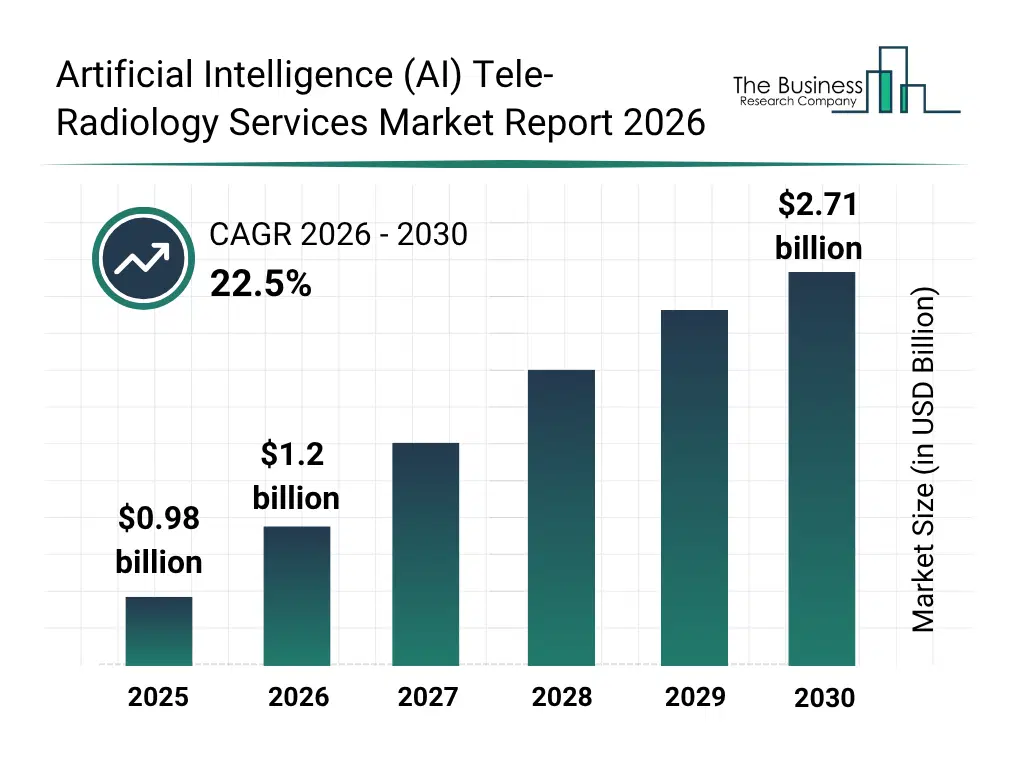
What Is The Artificial Intelligence (AI) Tele-Radiology Services Market Size and Share 2026?
The artificial intelligence (AI) tele-radiology services market size has grown exponentially in recent years. It will grow from $0.98 billion in 2025 to $1.2 billion in 2026 at a compound annual growth rate (CAGR) of 22.3%. The growth in the historic period can be attributed to rising diagnostic imaging volumes, increasing shortage of radiologists, growing adoption of telemedicine services, expanding access to advanced imaging technologies, improving healthcare digital infrastructure.What Is The Artificial Intelligence (AI) Tele-Radiology Services Market Growth Forecast?
The artificial intelligence (AI) tele-radiology services market size is expected to see exponential growth in the next few years. It will grow to $2.71 billion in 2030 at a compound annual growth rate (CAGR) of 22.5%. The growth in the forecast period can be attributed to increasing demand for remote diagnostic services, growing investment in healthcare IT infrastructure, expanding adoption of AI-assisted clinical workflows, rising need for early disease detection, increasing cross-border radiology collaborations. Major trends in the forecast period include increasing adoption of remote radiology reporting services, growing demand for faster diagnostic turnaround times, rising utilization of subspecialty radiology consultations, expanding use of emergency and after-hours radiology reporting, increasing focus on diagnostic workflow optimization.
Global Artificial Intelligence (AI) Tele-Radiology Services Market Segmentation
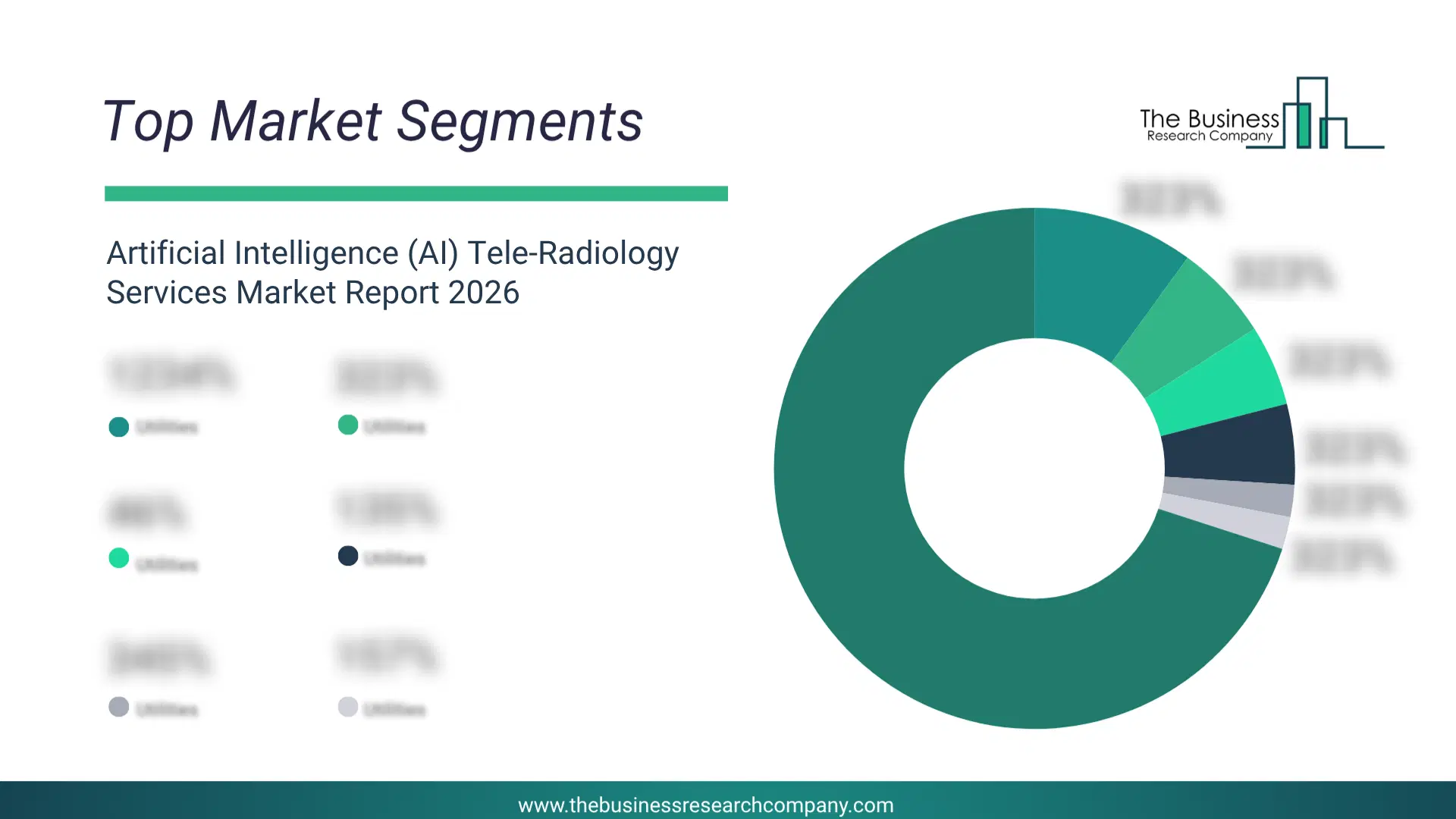
1) By Service Type: Remote Radiology Reporting, Artificial Intelligence Assisted Image Interpretation, Emergency And After Hours Reporting, Subspecialty Radiology Consultation, Second Opinion Radiology Reporting 2) By Artificial Intelligence Function: Automated Case Triage, Abnormality Detection, Diagnostic Decision Support, Image Quality Assessment, Artificial Intelligence Assisted Report Drafting 3) By Imaging Modality: X Ray, Computed Tomography, Magnetic Resonance Imaging, Ultrasound, Mammography, Positron Emission Tomography Computed Tomography And Nuclear Imaging 4) By Clinical Application: Cardiology, Oncology, Neurology, Emergency And Trauma, Other Applications 5) By End User: Hospitals, Diagnostic Imaging Centers, Emergency Departments, Ambulatory Care Centers, Other Healthcare Facilities Subsegments: 1) By Remote Radiology Reporting: X Ray Reporting, Computed Tomography Reporting, Magnetic Resonance Imaging Reporting, Ultrasound Reporting, Mammography Reporting, Nuclear Medicine Reporting 2) By Artificial Intelligence Assisted Image Interpretation: Chest Imaging Analysis, Brain Imaging Analysis, Cardiovascular Imaging Analysis, Musculoskeletal Imaging Analysis, Oncology Imaging Analysis, Abdominal Imaging Analysis 3) By Emergency And After Hours Reporting: Trauma Imaging Reporting, Stroke Imaging Reporting, Emergency Computed Tomography Reporting, Emergency Magnetic Resonance Imaging Reporting, Emergency X Ray Reporting, Critical Care Imaging Reporting 4) By Subspecialty Radiology Consultation: Neuroradiology Consultation, Musculoskeletal Radiology Consultation, Pediatric Radiology Consultation, Cardiothoracic Radiology Consultation, Breast Imaging Consultation, Abdominal Radiology Consultation 5) By Second Opinion Radiology Reporting: Oncology Imaging Review, Neurology Imaging Review, Orthopedic Imaging Review, Cardiovascular Imaging Review, Pediatric Imaging Review, Complex Case Imaging ReviewWhat Is The Driver Of The Artificial Intelligence (AI) Tele-Radiology Services Market?
The rising imaging volumes are expected to propel the growth of the artificial intelligence (AI) tele-radiology services market going forward. Imaging volumes refer to the total number of medical imaging procedures or examinations performed within a specific period. Imaging volumes are rising due to the increasing prevalence of chronic diseases, which require frequent diagnostic imaging for early diagnosis, treatment planning, and disease monitoring. AI teleradiology services support the increasing volume of diagnostic imaging examinations by enabling radiologists to interpret medical images remotely, leveraging artificial intelligence to prioritize urgent cases, automate workflow, reduce reporting turnaround times, improve diagnostic efficiency, and address radiologist shortages while maintaining timely and accurate patient care. For instance, in November 2025, according to the Organization for Economic Co-operation and Development (OECD), a France-based intergovernmental organization, the average number of computed tomography (CT) examinations reached 132 per 1,000 population and magnetic resonance imaging (MRI) examinations reached 46 per 1,000 population across OECD countries. Therefore, the rising imaging volumes are driving the growth of the artificial intelligence (AI) tele-radiology services industry.Key Players In The Global Artificial Intelligence (AI) Tele-Radiology Services Market
Major companies operating in the artificial intelligence (AI) tele-radiology services market report are Medica Group, Teleradiology Solutions, Aidoc, Viz.ai, Everlight Radiology, Qure.ai, Apollo Radiology International, Rad AI, Annalise.ai, Lunit, DeepHealth, ScreenPoint Medical, 5C Network, DeepTek, deepc, Brainomix, Riverain Technologies, CARPL.ai, Nanox Imaging, Aster Medical Imaging, Enlitic, Vital Radiology Services, Radblox Healthcare Services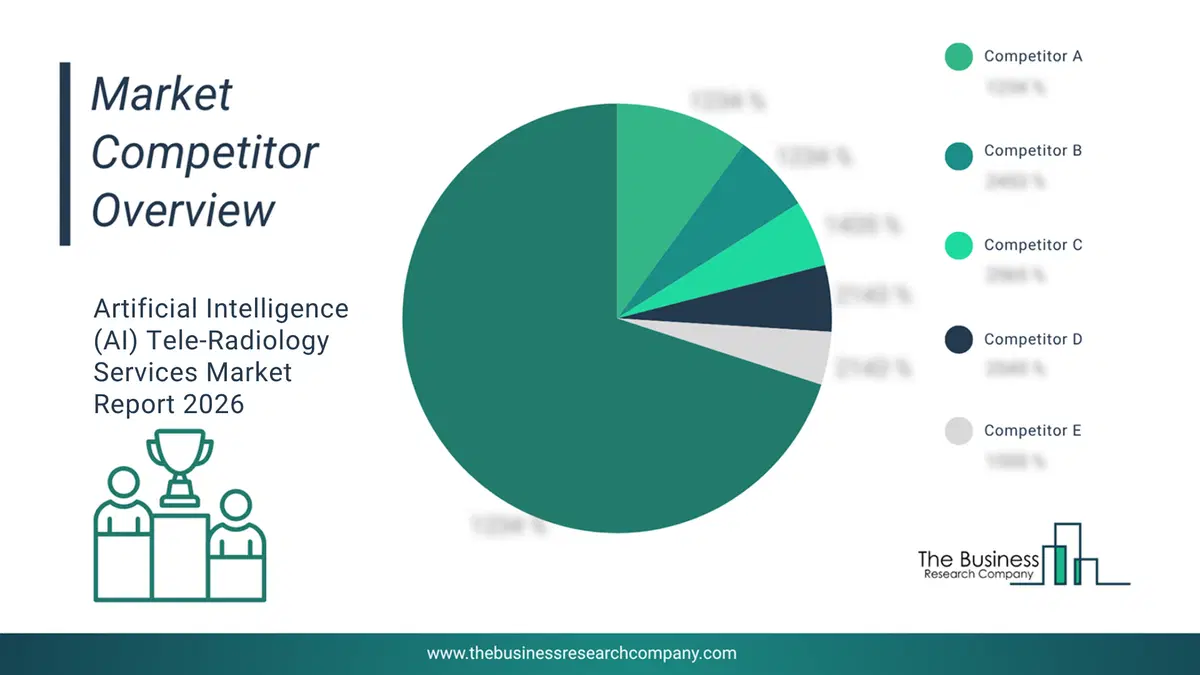
This chart is for illustrative purposes; the full report includes a detailed competitor analysis and comprehensive overview of the top 10 companies in the market.
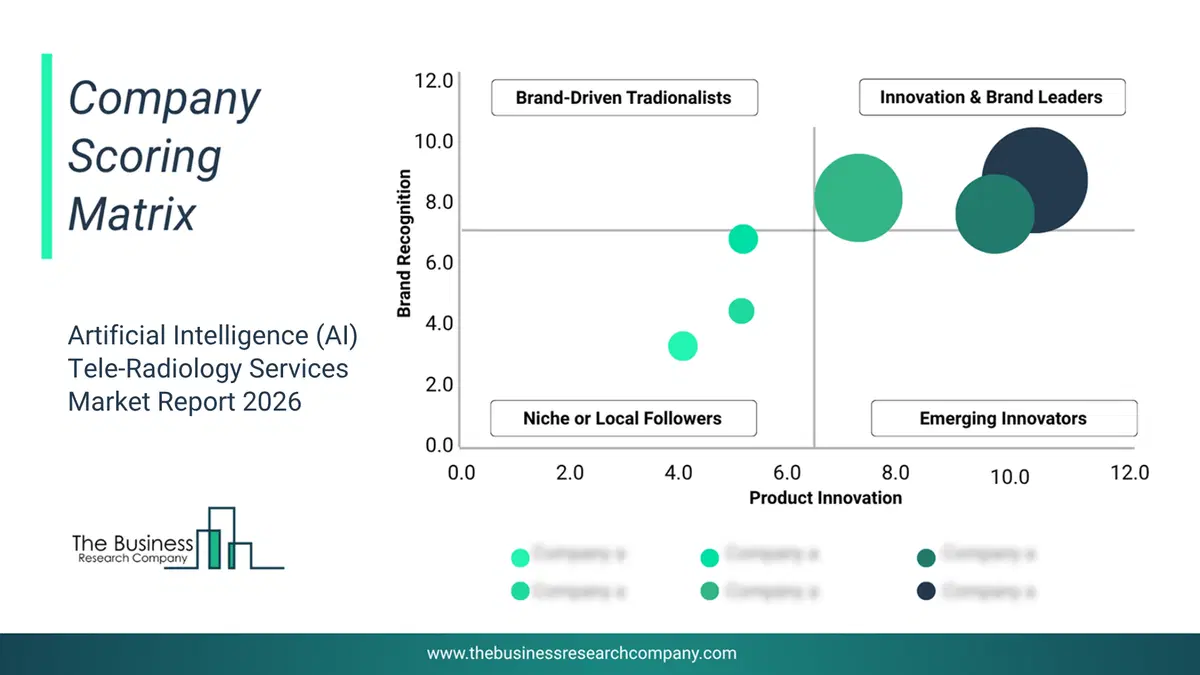
This chart maps companies by product innovation and brand strength, with bubble size indicating relative revenue, helping identify market leaders, challengers, and niche players. This is an illustrative chart; the full report provides a complete and accurate competitive analysis.
Global Artificial Intelligence (AI) Tele-Radiology Services Market Trends and Insights
Major companies operating in the artificial intelligence (AI) tele-radiology services market are focusing on developing cloud-native AI-powered radiology platforms to enhance remote diagnostic workflows, improve radiologist productivity, and enable scalable imaging services. Cloud-native AI-powered radiology platforms integrate artificial intelligence, diagnostic technologies, and workflow automation tools within cloud-based environments to streamline image interpretation, reporting, and radiology operations. For instance, in July 2025, Radiology Partners (RP), a US-based technology-enabled radiology services provider, launched Mosaic Clinical Technologies and MosaicOS, a cloud and AI-native radiology operating platform. The platform integrates AI-powered tools, diagnostic technologies, and smart workflows to help radiologists improve clinical capacity, streamline reporting processes, address rising imaging demand, and scale radiology services efficiently. This launch highlights the growing adoption of AI-enabled platforms to enhance the efficiency and scalability of teleradiology and enterprise imaging workflows.What Are Latest Mergers And Acquisitions In The Artificial Intelligence (AI) Tele-Radiology Services Market?
In January 2025, ONRAD Inc., a US-based radiology services provider, acquired Direct Radiology for an undisclosed amount. Through the acquisition, ONRAD expanded its teleradiology network, increased its radiologist capacity, and strengthened its ability to deliver remote radiology interpretation services across healthcare facilities. The combined organization leveraged AI-powered technology platforms and workflow optimization tools to improve diagnostic efficiency, address rising imaging volumes, and enhance scalable teleradiology services. Direct Radiology is a US-based teleradiology services provider that delivers AI-powered teleradiology services.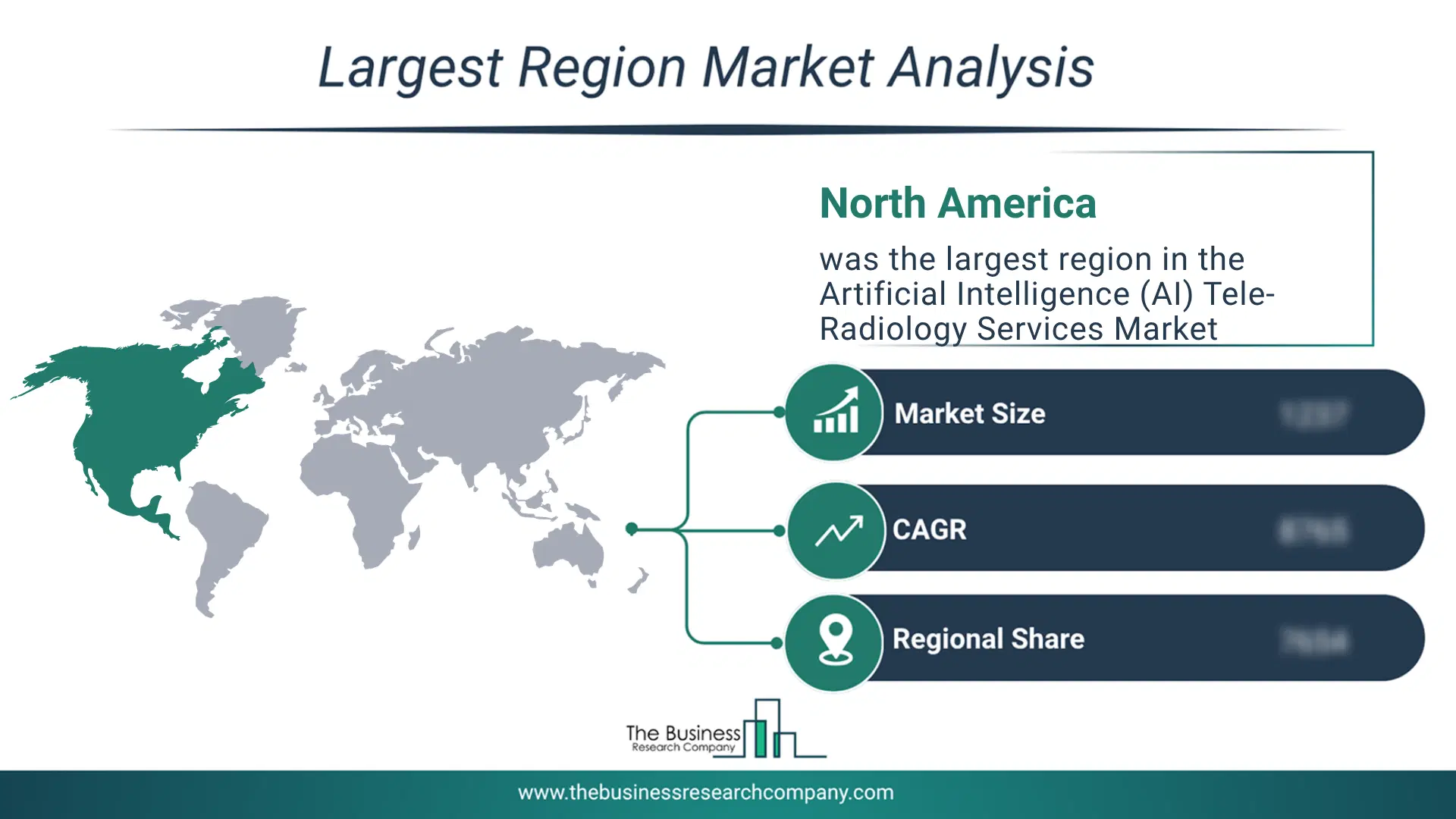
Regional Outlook
North America was the largest region in the artificial intelligence (AI) tele-radiology services market in 2025. Asia-Pacific is expected to be the fastest-growing region in the forecast period. The regions covered in this market report are Asia-Pacific, South East Asia, Western Europe, Eastern Europe, North America, South America, Middle East, Africa. The countries covered in this market report are Australia, Brazil, China, France, Germany, India, Indonesia, Japan, Taiwan, Russia, South Korea, UK, USA, Canada, Italy, Spain.What Defines the Artificial Intelligence (AI) Tele-Radiology Services Market?
The artificial intelligence (AI) tele-radiology services market includes revenues earned by entities by providing services such as AI-powered workflow automation, radiology triage, structured reporting, clinical decision support, cloud-based image sharing, picture archiving and communication system (PACS) and radiology information system (RIS) integration. The market value includes the value of related goods sold by the service provider or included within the service offering. Only goods and services traded between entities or sold to end consumers are included.How is Market Value Defined and Measured?
The market value is defined as the revenues that enterprises gain from the sale of goods and/or services within the specified market and geography through sales, grants, or donations in terms of the currency (in USD unless otherwise specified). The revenues for a specified geography are consumption values that are revenues generated by organizations in the specified geography within the market, irrespective of where they are produced. It does not include revenues from resales along the supply chain, either further along the supply chain or as part of other products.
This chart presents market attractiveness based on a quantitative evaluation of growth, competition, strategic alignment, and risk, offering a clear view of opportunity areas for decision-making. This chart is for illustrative purposes; the full report contains the complete analysis.

This chart highlights the Total Addressable Market (TAM) by estimating the maximum revenue opportunity using an assumption-driven approach, supporting strategic planning and opportunity sizing across markets. The chart is illustrative; the full report provides a more comprehensive analysis.
What Key Data and Analysis Are Included in the Artificial Intelligence (AI) Tele-Radiology Services Market Report 2026?
The artificial intelligence (ai) tele-radiology services market research report is one of a series of new reports from The Business Research Company that provides market statistics, including industry global market size, regional shares, competitors with the market share, detailed market segments, market trends and opportunities, and any further data you may need to thrive in the artificial intelligence (ai) tele-radiology services industry. The market research report delivers a complete perspective of everything you need, with an in-depth analysis of the current and future state of the industry.Artificial Intelligence (AI) Tele-Radiology Services Market Report Forecast Analysis
| Report Attribute | Details |
|---|---|
| Market Size Value In 2026 | $1.2 billion |
| Revenue Forecast In 2030 | $2.71 billion |
| Growth Rate | CAGR of 22.5% from 2026 to 2030 |
| Base Year For Estimation | 2025 |
| Actual Estimates/Historical Data | 2020-2025 |
| Forecast Period | 2026 - 2030 |
| Market Representation | Revenue in USD Billion and CAGR from 2026 to 2030 |
| Segments Covered | Service Type, Artificial Intelligence Function, Imaging Modality, Clinical Application, End User |
| Regional Scope | Asia-Pacific, Western Europe, Eastern Europe, North America, South America, Middle East, Africa |
| Country Scope | The countries covered in the report are Australia, Brazil, China, France, Germany, India, Indonesia, Japan, Taiwan, Russia, South Korea, UK, USA, Canada, Italy, Spain. |
| Key Companies Profiled | Medica Group, Teleradiology Solutions, Aidoc, Viz.ai, Everlight Radiology, Qure.ai, Apollo Radiology International, Rad AI, Annalise.ai, Lunit, DeepHealth, ScreenPoint Medical, 5C Network, DeepTek, deepc, Brainomix, Riverain Technologies, CARPL.ai, Nanox Imaging, Aster Medical Imaging, Enlitic, Vital Radiology Services, Radblox Healthcare Services |
| Customization Scope | Request for Customization |
| Pricing And Purchase Options | Explore Purchase Options |