

Artificial Intelligence (AI) Visual Inspection System Market Report 2026
Global Outlook – By Type (Deep Learning Model, Pre-Trained Model, Other Types), By Component (Hardware, Software, Services), By Application (Industrial, Medical Treatment, Semiconductor, Rail Transit, Other Applications) – Market Size, Trends, Strategies, and Forecast to 2030
Artificial Intelligence (AI) Visual Inspection System Market Overview
• Artificial Intelligence (AI) Visual Inspection System market size has reached to $29.82 billion in 2025 • Expected to grow to $85.24 billion in 2030 at a compound annual growth rate (CAGR) of 23.3% • Growth Driver: Rise In Demand For Automation Fueling The Growth Of The Market Due To Need For Higher Efficiency And Accuracy • Market Trend: Technological Advancements in AI Visual Inspection Systems to Enhance Real-Time Defect Detection and Manufacturing Efficiency • North America was the largest region in 2025 and Asia-Pacific is the fastest growing region.Market Gains By 2030 – Top Opportunities By Segment
Market Gain identifies the most promising market opportunities by highlighting the segments or products expected to generate the highest incremental revenue growth over the next five years.
What Is Covered Under Artificial Intelligence (AI) Visual Inspection System Market?
Artificial intelligence (AI) visual inspection systems are automated, intelligent solutions that use artificial intelligence and computer vision to inspect products or processes for defects or anomalies, eliminating reliance on manual inspection. Their primary goal is to enhance quality control and production efficiency, and to provide real-time defect detection, improve accuracy, reduce human error, and ensure consistent product quality. The main types in the artificial intelligence (AI) visual inspection system market are deep learning models, pre-trained models, and others. Deep learning models mimic the human brain's neural networks to process data and identify patterns. Trained on large datasets, they can detect complex features in images, making them effective for spotting defects or anomalies in visual inspection tasks. The various components of the artificial intelligence (AI) visual inspection system are software and services, and several applications include industrial, medical treatment, semiconductor, rail transit, and others.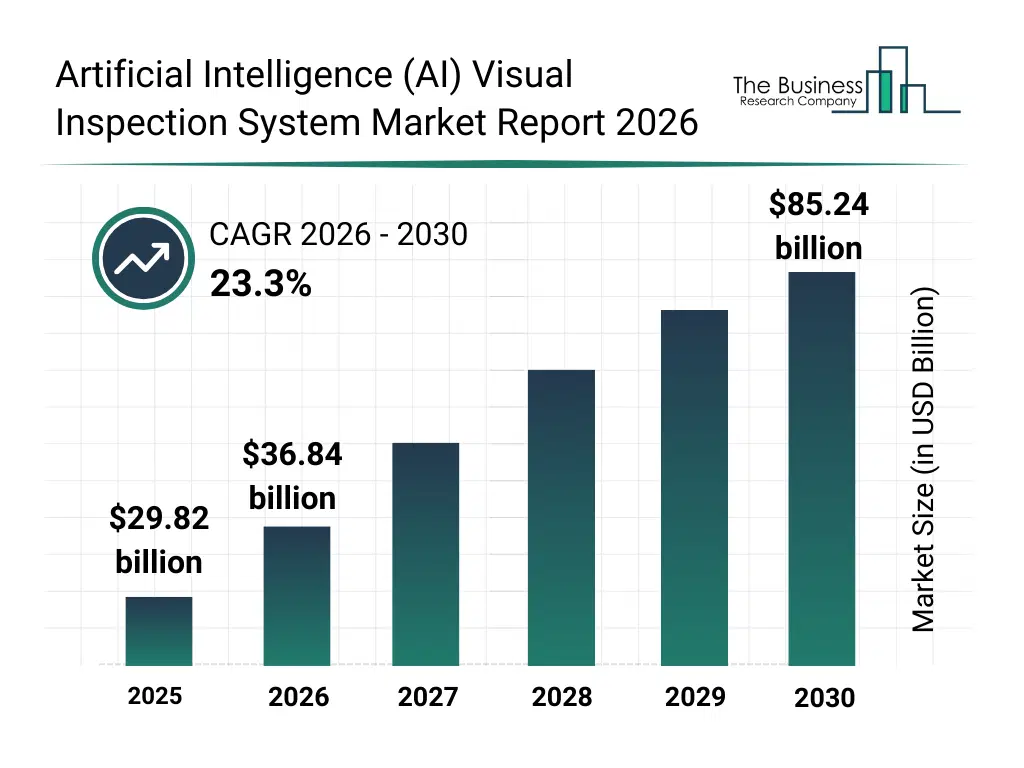
What Is The Artificial Intelligence (AI) Visual Inspection System Market Size and Share 2026?
The artificial intelligence (AI) visual inspection system market size has grown exponentially in recent years. It will grow from $29.82 billion in 2025 to $36.84 billion in 2026 at a compound annual growth rate (CAGR) of 23.5%. The growth in the historic period can be attributed to manual quality inspection limitations, rising manufacturing automation, increasing product complexity, demand for consistent quality output, reduction of human inspection errors.What Is The Artificial Intelligence (AI) Visual Inspection System Market Growth Forecast?
The artificial intelligence (AI) visual inspection system market size is expected to see exponential growth in the next few years. It will grow to $85.24 billion in 2030 at a compound annual growth rate (CAGR) of 23.3%. The growth in the forecast period can be attributed to smart factory expansion, adoption of edge AI systems, rising semiconductor manufacturing demand, increasing focus on zero-defect manufacturing, integration of AI inspection with robotics. Major trends in the forecast period include real-time defect detection automation, AI-based quality control standardization, edge-based visual inspection systems, high-speed inspection for production lines, integration with manufacturing execution systems.
Global Artificial Intelligence (AI) Visual Inspection System Market Segmentation
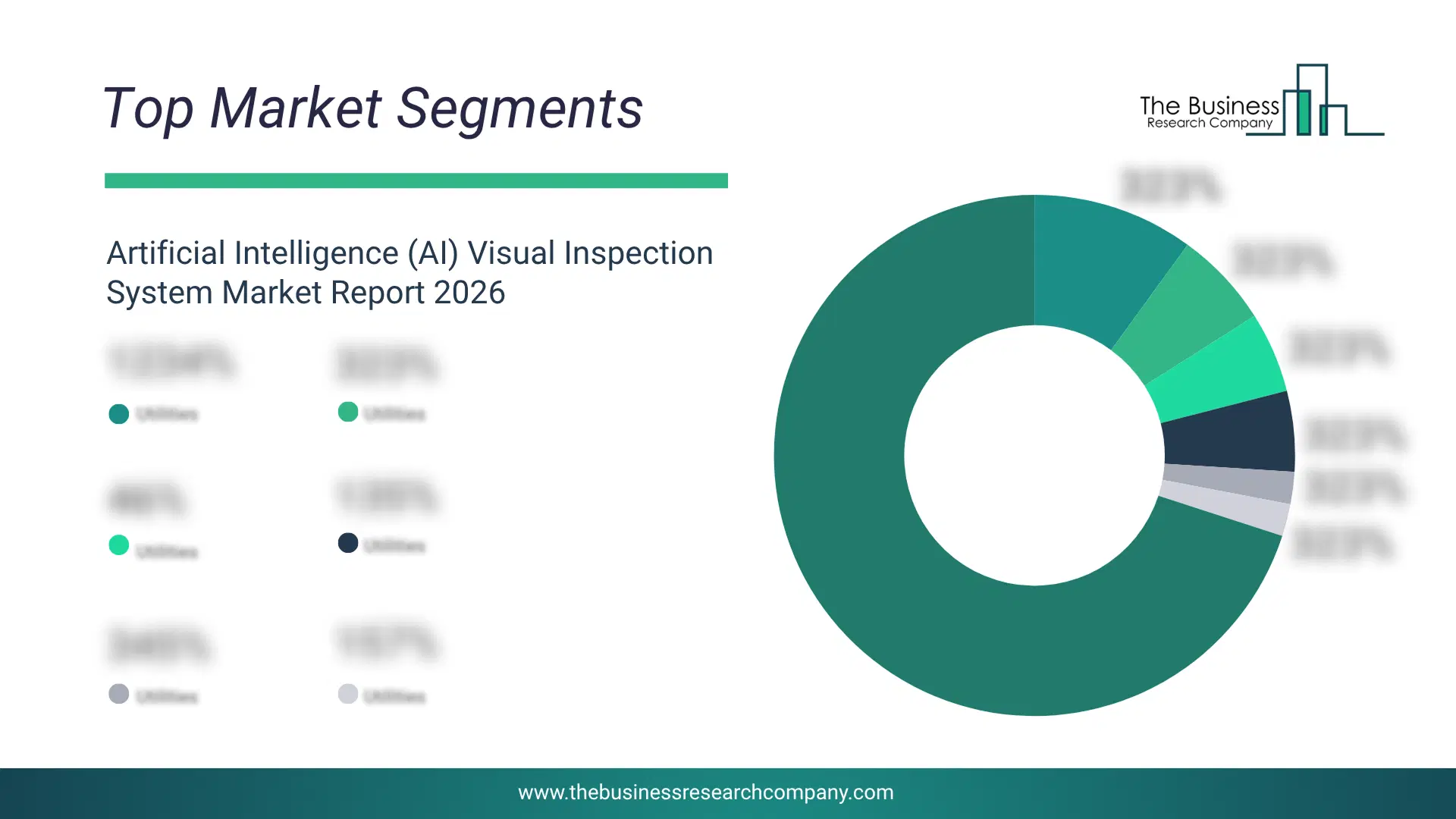
1) By Type: Deep Learning Model, Pre-Trained Model, Other Types 2) By Component: Hardware, Software, Services 3) By Application: Industrial, Medical Treatment, Semiconductor, Rail Transit, Other Applications Subsegments: 1) By Deep Learning Model: Convolutional Neural Networks (CNNs), Recurrent Neural Networks (RNNs), Generative Adversarial Networks (GANs), Transformer-Based Models, Self-Supervised Learning Models 2) By Pre-Trained Model: ImageNet-Based Models, Transfer Learning Models, Domain-Specific Pre-Trained Models, Vision Transformer (ViT) Models, Federated Learning Models 3) By Other Types: Rule-Based AI Inspection Systems, Hybrid AI Inspection Systems, Edge AI Visual Inspection Systems, Cloud-Based AI Inspection Systems, Traditional Machine Vision Systems With AI Integration The top segments in the artificial intelligence (ai) visual inspection system market will be: • Deep Learning Model will reach $16680.84 Million by 2025. • Hardware will reach $13716.09 Million by 2025. • Software will reach $10949.23 Million by 2025. • Industrial will reach $9847.38 Million by 2025. • Medical Treatment will reach $9018.02 Million by 2025.What Is The Driver Of The Artificial Intelligence (AI) Visual Inspection System Market?
The rise in demand for automation is expected to drive the growth of the artificial intelligence (AI) visual inspection system market going forward. Automation is the application of technology to carry out tasks automatically, reducing the need for human involvement and enhancing efficiency and precision. The demand for automation is increasing due to the need for higher efficiency, reduced labor costs, and improved accuracy in industrial and business processes. Artificial intelligence (AI) visual inspection systems enhance automation by enabling real-time, accurate detection of defects, inconsistencies, and quality issues, reducing human intervention while improving efficiency and consistency in production processes. For instance, in July 2024, according to a report published by Flow, a US-based workflow automation company, the workflow automation sector is growing at 20% per year and reached $5 billion by 2024. Robotic process automation (RPA) leads with 31% adoption, while AI adoption is at 18%. Moreover, in May 2023, according to Formstack, a US-based software company, around 76% of organizations employ automation to optimize their daily workflows, 58% utilize automation for data and reporting to facilitate planning, and 36% integrate automation to ensure compliance with regulations. Therefore, the rise in demand for automation is driving the growth of the artificial intelligence (AI) visual inspection system industry.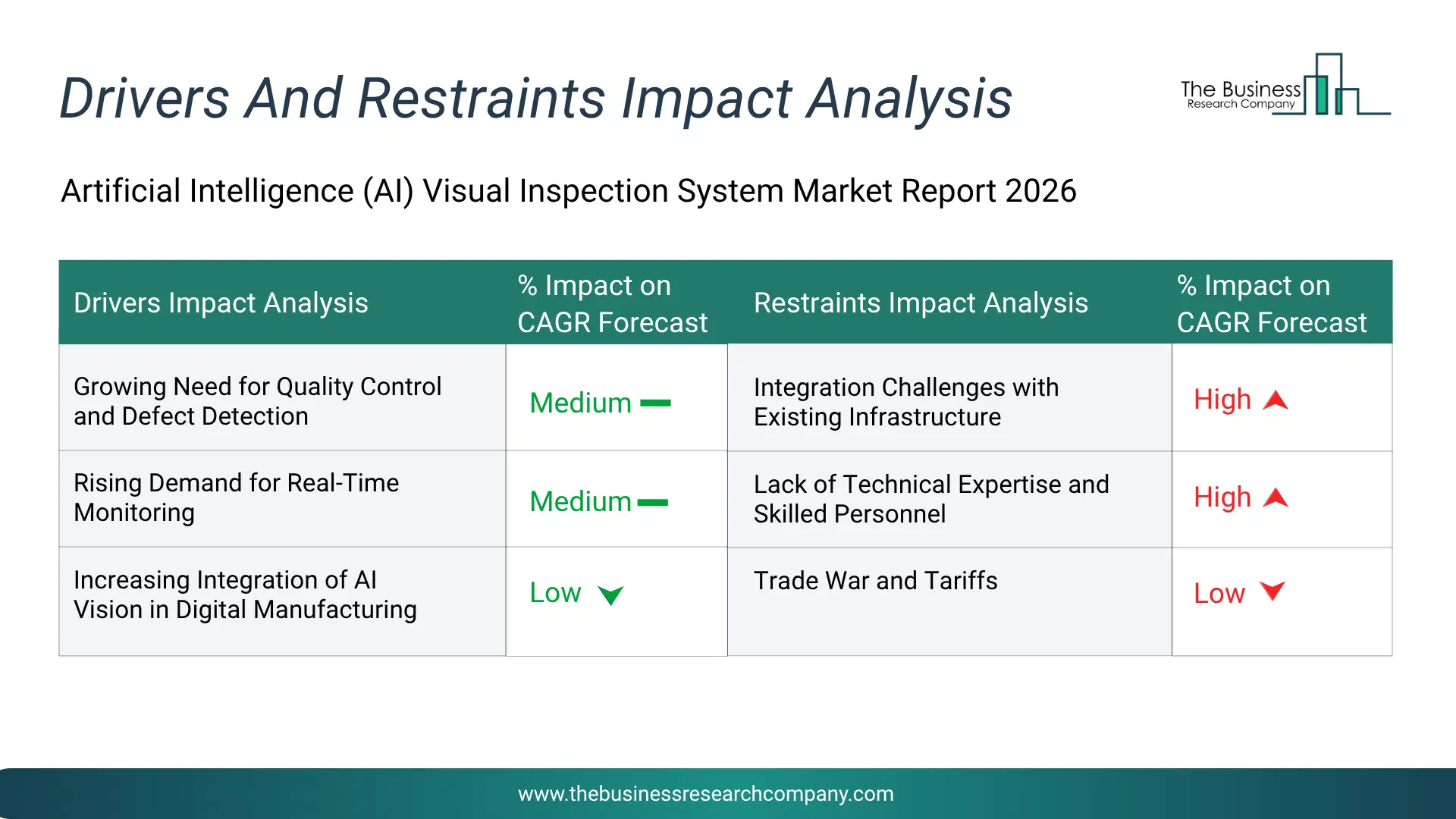
Infographic Chart Showing Key Market Drivers Analysis And Restraints For Artificial Intelligence (Ai) Visual Inspection System Market
The chart presents an impact analysis of key drivers and restraints, quantifying their relative influence on the market's growth rate and helping assess the balance between growth enablers and limiting factors. This chart offers a high-level perspective; the full report contains more detailed insights.
How Will The Drivers Impact Growth In The Global Artificial Intelligence (AI) Visual Inspection System Market?
• Growing Need for Quality Control and Defect Detection (Medium) – The increasing emphasis on quality control and defect detection will become a key driver of growth in the ai visual inspection system market by 2030. as manufacturers focus on enhancing accuracy, consistency, and compliance with stringent quality standards, the inefficiencies and error susceptibility of traditional manual inspection processes have become significant constraints. to overcome these limitations, industries are progressively adopting ai-powered visual inspection solutions that enable faster, more reliable, and scalable quality assessment. this transition is particularly evident across the electronics, automotive, and healthcare sectors, where maintaining high product quality and customer trust remains critical to competitiveness. as a result, the growing deployment of quality control and defect detection is anticipated to contributing to a 1.3% annual growth in the market. • Rising Demand for Real-Time Monitoring (Medium) – The growing focus on real-time monitoring will emerge as a major factor driving the expansion of the artificial intelligence (ai) visual inspection system market by 2030. this shift reflects manufacturers’ increasing need for instant detection of defects and anomalies within production processes to ensure continuous quality control and operational efficiency in modern manufacturing environments. ai-powered visual inspection systems enable real-time analysis of products on assembly lines, allowing immediate identification of quality issues and minimizing human error. consequently, the accelerating adoption of real-time monitoring capabilities is projected to contributing to a 1.0% annual growth in the market. • Increasing Integration of AI Vision in Digital Manufacturing (Low) – The expanding integration of ai vision technologies within digital manufacturing processes will serve as a key growth catalyst for the artificial intelligence (ai) visual inspection system market by 2030, as manufacturers increasingly adopt smart production systems to enhance automation and data - driven decision - making. by embedding ai vision into digital manufacturing frameworks, factories can automatically detect defects, monitor product quality in real time, and optimize process performance with minimal human intervention. therefore, this growing integration of ai vision technologies across digital manufacturing operations is projected to supporting to a 0.8% annual growth in the market. • Increased Focus on Predictive Maintenance (Low) – The increasing emphasis on predictive maintenance will become a significant driver contributing to the growth of the artificial intelligence (AI) visual inspection system market by 2030 This growing focus reflects manufacturers’ efforts to enhance equipment reliability and minimize unplanned downtime through advanced monitoring and early fault detection. Integrating AI visual inspection enables continuous monitoring of machinery and early detection of wear, defects, or potential failures, allowing timely intervention before critical breakdowns occur. This proactive approach to maintenance supports operational efficiency and cost savings across production environments. Consequently, the rising adoption of predictive maintenance strategies is projected to contributing to a 0.3% annual growth in the market.How Will The Restraints Impact Growth In The Global Artificial Intelligence (AI) Visual Inspection System Market?
• Integration Challenges with Existing Infrastructure (Medium) – Integration Challenges with Existing Infrastructure will restrict the growth of the Artificial Intelligence (AI) Visual Inspection System market during the forecast period. Integrating AI-based visual inspection systems into legacy manufacturing lines often requires significant retrofitting, which can be both complex and costly. This complexity is further amplified by the need to ensure seamless data flow between new AI systems and existing equipment, potentially leading to operational downtime and requiring specialized expertise that many facilities may lack, thus slowing down adoption rates. • Lack of Technical Expertise and Skilled Personnel (Medium) – Lack of Technical Expertise and Skilled Personnel will restrict the growth of the Artificial Intelligence (AI) Visual Inspection System market during the forecast period. The deployment and maintenance of AI-powered inspection systems require specialized skills in machine learning, computer vision, and data science, which are in short supply globally. The scarcity of qualified professionals to develop, train, and fine-tune AI models for specific manufacturing applications increases operational costs and delays implementation, thereby limiting market expansion. • Trade War and Tariffs (Low) – Trade War and Tariffs will restrict the growth of the Artificial Intelligence (AI) Visual Inspection System market during the forecast period. Escalating trade tensions between major economies, particularly the US and China, have led to the imposition of tariffs on electronic components and AI hardware essential for visual inspection systems. These trade barriers increase the cost of critical components such as high-resolution cameras, specialized processors, and sensors, making systems less affordable for end-users and disrupting established supply chains.Key Players In The Global Artificial Intelligence (AI) Visual Inspection System Market
Major companies operating in the artificial intelligence (AI) visual inspection system market are Siemens AG, Intel Corporation, International Business Machines Corporation, Keyence Corporation, Omron Corporation, Teledyne Technologies Incorporated, Zebra Technologies Corporation, SICK AG, National Instruments Corporation, Cognex Corporation, Baumer Group, Datalogic S.p.A., ISRA Vision, VITRONIC Machine Vision GmbH, Basler AG, Matrox Imaging, Allied Vision Technologies, LMI Technologies, Stemmer Imaging, IDS Imaging Development Systems, Opto Engineering, Pleora Technologies, JAI A/S, Vision Components
This chart is for illustrative purposes; the full report includes a detailed competitor analysis and comprehensive overview of the top 10 companies in the market.
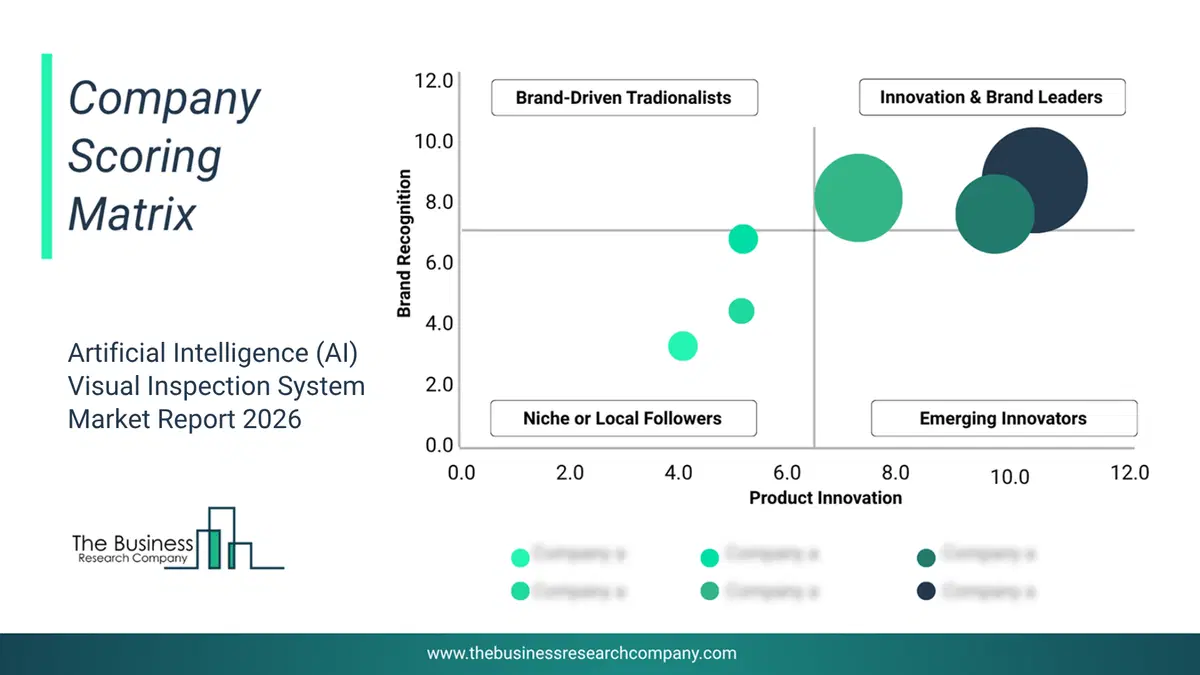
This chart maps companies by product innovation and brand strength, with bubble size indicating relative revenue, helping identify market leaders, challengers, and niche players. This is an illustrative chart; the full report provides a complete and accurate competitive analysis.
Global Artificial Intelligence (AI) Visual Inspection System Market Trends and Insights
Major companies operating in the artificial intelligence (AI) visual inspection system market are focusing on technological advancements, such as edge AI powered 3D vision systems, to meet the rising demand for real time, high precision defect detection and quality control in automated manufacturing environments. Edge AI 3D vision systems combine deep learning inference directly on the inspection device (rather than in the cloud) with three dimensional imaging, enabling faster, more reliable detection of subtle defects that traditional 2D or rule based vision systems often miss. For instance, in April 2024, Cognex Corporation, a US-based provider of industrial machine vision systems, launched its In-Sight L38 3D Vision System, an AI-powered 3D vision tool that integrates AI, 2D, and 3D technologies. This system projects complex 3D structures into 2D image representations for easier labeling, uses AI algorithms to detect variable or undefined features, and leverages rule-based analysis for precise 3D measurements, offering faster deployment and more reliable inspections than traditional vision-only systems. The In Sight L38 is particularly suited for manufacturing automation tasks where both dimensional accuracy and defect recognition matter, such as electronics assembly, precision molding, and high-volume inspection lines. By embedding AI inference at the edge, it reduces latency, minimizes data transfer, and improves scalability for factory floors.What Are Latest Mergers And Acquisitions In The Artificial Intelligence (AI) Visual Inspection System Market?
In September 2023, Wenglor Sensoric Group, a Germany-based automation machinery manufacturing company, acquired Deevio for an undisclosed amount. This acquisition allows Wenglor to expand its expertise in artificial intelligence and data science, particularly in the field of machine vision. Additionally creating new opportunities for growth in machine vision by bringing together skills and technology. Deevio is a Germany-based software development company that specializes in AI-based visual inspection solutions.
Regional Insights
North America was the largest region in the artificial intelligence (AI) visual inspection system market in 2025. Asia-Pacific is expected to be the fastest-growing region in the forecast period. The regions covered in this market report are Asia-Pacific, South East Asia, Western Europe, Eastern Europe, North America, South America, Middle East, Africa. The countries covered in this market report are Australia, Brazil, China, France, Germany, India, Indonesia, Japan, Taiwan, Russia, South Korea, UK, USA, Canada, Italy, Spain.What Defines the Artificial Intelligence (AI) Visual Inspection System Market?
The artificial intelligence (AI) visual inspection systems market consists of revenues earned by entities providing services such as automated defect detection, quality control, and real-time monitoring using artificial intelligence and computer vision technologies. The market value includes the value of related goods sold by the service provider or included within the service offering. The artificial intelligence (AI) visual inspection systems market consists of sales of cameras and imaging sensors, LED lights, lasers, and robotic arms or automated conveyor systems. Values in this market are ‘factory gate’ values, that is, the value of goods sold by the manufacturers or creators of the goods, whether to other entities (including downstream manufacturers, wholesalers, distributors, and retailers) or directly to end customers. The value of goods in this market includes related services sold by the creators of the goods.How is Market Value Defined and Measured?
The market value is defined as the revenues that enterprises gain from the sale of goods and/or services within the specified market and geography through sales, grants, or donations in terms of the currency (in USD unless otherwise specified). The revenues for a specified geography are consumption values that are revenues generated by organizations in the specified geography within the market, irrespective of where they are produced. It does not include revenues from resales along the supply chain, either further along the supply chain or as part of other products.
This chart presents market attractiveness based on a quantitative evaluation of growth, competition, strategic alignment, and risk, offering a clear view of opportunity areas for decision-making. This chart is for illustrative purposes; the full report contains the complete analysis.

This chart highlights the Total Addressable Market (TAM) by estimating the maximum revenue opportunity using an assumption-driven approach, supporting strategic planning and opportunity sizing across markets. The chart is illustrative; the full report provides a more comprehensive analysis.
What Key Data and Analysis Are Included in the Artificial Intelligence (AI) Visual Inspection System Market Report 2026?
The artificial intelligence (ai) visual inspection system market research report is one of a series of new reports from The Business Research Company that provides market statistics, including industry global market size, regional shares, competitors with the market share, detailed market segments, market trends and opportunities, and any further data you may need to thrive in the artificial intelligence (ai) visual inspection system industry. The market research report delivers a complete perspective of everything you need, with an in-depth analysis of the current and future state of the industry.Artificial Intelligence (AI) Visual Inspection System Market Report Forecast Analysis
| Report Attribute | Details |
|---|---|
| Market Size Value In 2026 | $36.84 billion |
| Revenue Forecast In 2030 | $85.24 billion |
| Growth Rate | CAGR of 23.5% from 2026 to 2030 |
| Base Year For Estimation | 2025 |
| Actual Estimates/Historical Data | 2020-2025 |
| Forecast Period | 2026 - 2030 |
| Market Representation | Revenue in USD Billion and CAGR from 2026 to 2030 |
| Segments Covered | Type, Component, Application |
| Regional Scope | Asia-Pacific, Western Europe, Eastern Europe, North America, South America, Middle East, Africa |
| Country Scope | The countries covered in the report are Australia, Brazil, China, France, Germany, India, Indonesia, Japan, Taiwan, Russia, South Korea, UK, USA, Canada, Italy, Spain. |
| Key Companies Profiled | Siemens AG, Intel Corporation, International Business Machines Corporation, Keyence Corporation, Omron Corporation, Teledyne Technologies Incorporated, Zebra Technologies Corporation, SICK AG, National Instruments Corporation, Cognex Corporation, Baumer Group, Datalogic S.p.A., ISRA Vision, VITRONIC Machine Vision GmbH, Basler AG, Matrox Imaging, Allied Vision Technologies, LMI Technologies, Stemmer Imaging, IDS Imaging Development Systems, Opto Engineering, Pleora Technologies, JAI A/S, Vision Components |
| Customization Scope | Request for Customization |
| Pricing And Purchase Options | Explore Purchase Options |