
Artificial Intelligence-Driven Hospital Energy Optimization Market Report 2026
Global Outlook – By Component (Software, Hardware, Services), By Deployment Mode (On-Premises, Cloud), By Hospital Size (Small And Medium Hospitals, Large Hospitals), By Application (Heating, Ventilation, And Air Conditioning Optimization, Lighting Control, Energy Management, Equipment Monitoring, Other Applications), By End-User (Public Hospitals, Private Hospitals, Specialty Hospitals, Other End-Users) - Market Size, Trends, Strategies, and Forecast to 2030
Artificial Intelligence-Driven Hospital Energy Optimization Market Overview
• Artificial Intelligence-Driven Hospital Energy Optimization market size has reached to $2.49 billion in 2025 • Expected to grow to $7.15 billion in 2030 at a compound annual growth rate (CAGR) of 23.4% • Growth Driver: Increasing Adoption Of Smart Hospital Infrastructure Drives The Market Growth Due To Enhanced Real-Time Data And Automation • Market Trend: Advancements In AI-Driven Solutions Accelerating Energy Efficiency And Carbon Reduction In Hospitals • North America was the largest region in 2025 and Asia-Pacific is the fastest growing region.What Is Covered Under Artificial Intelligence-Driven Hospital Energy Optimization Market?
Artificial intelligence (AI)-driven hospital energy optimization uses artificial intelligence to monitor and manage energy consumption in hospitals. It aims to enhance energy efficiency, cut costs, and reduce environmental impact without compromising smooth hospital operations. The main components of the artificial intelligence-driven hospital energy optimization are software, hardware, and services. Software is a digital system that leverages AI to track, evaluate, and improve hospital energy consumption continuously. It is deployed through on-premises and cloud-based solutions and is adopted by various hospital sizes, including small and medium hospitals as well as large hospitals. It is used for various applications, including heating, ventilation, and air conditioning optimization, lighting control, energy management, equipment monitoring, and others, and the key end users are public hospitals, private hospitals, specialty hospitals, and others.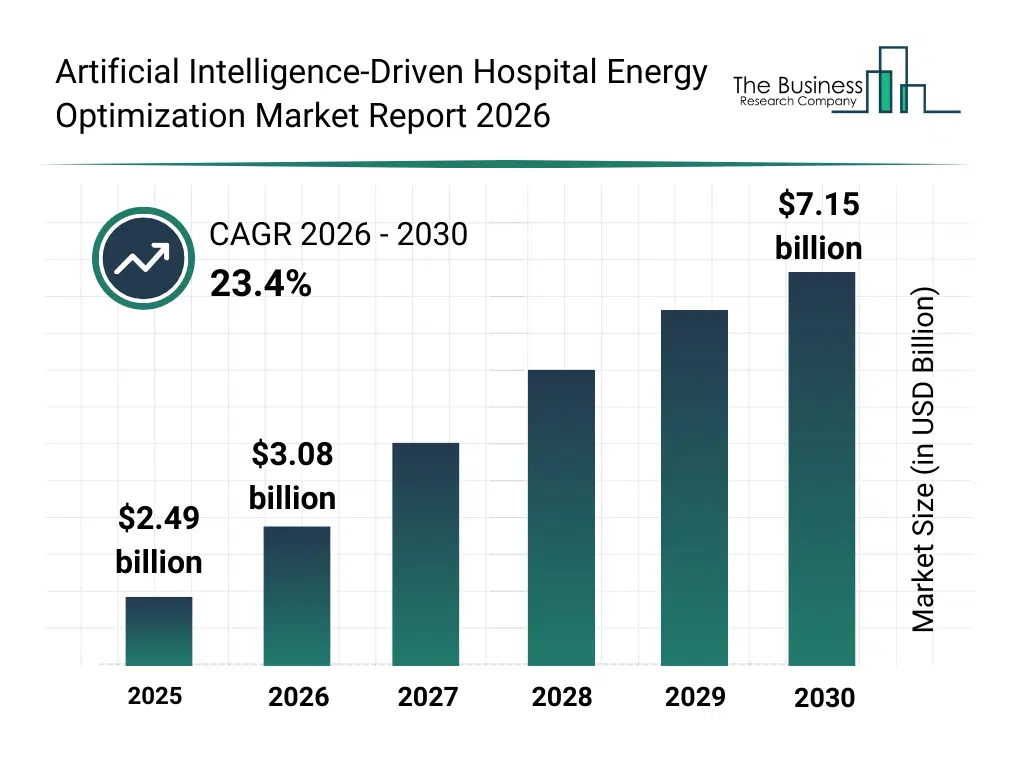
What Is The Artificial Intelligence-Driven Hospital Energy Optimization Market Size and Share 2026?
The artificial intelligence-driven hospital energy optimization market size has grown exponentially in recent years. It will grow from $2.49 billion in 2025 to $3.08 billion in 2026 at a compound annual growth rate (CAGR) of 23.7%. The growth in the historic period can be attributed to increasing hospital energy consumption levels, rising operational cost pressures, early adoption of building management systems, expansion of digital hospital infrastructure, growing focus on operational efficiency.What Is The Artificial Intelligence-Driven Hospital Energy Optimization Market Growth Forecast?
The artificial intelligence-driven hospital energy optimization market size is expected to see exponential growth in the next few years. It will grow to $7.15 billion in 2030 at a compound annual growth rate (CAGR) of 23.4%. The growth in the forecast period can be attributed to increasing investments in green hospital initiatives, rising demand for carbon footprint reduction, expansion of smart hospital projects, growing adoption of ai-driven facility management, increasing regulatory focus on energy efficiency standards. Major trends in the forecast period include increasing deployment of AI-based energy management platforms, rising adoption of smart sensors and meters, expansion of predictive maintenance for hospital utilities, growing integration of building automation systems, enhanced focus on energy cost optimization.
Global Artificial Intelligence-Driven Hospital Energy Optimization Market Segmentation
1) By Component: Software, Hardware, Services 2) By Deployment Mode: On-Premises, Cloud 3) By Hospital Size: Small And Medium Hospitals, Large Hospitals 4) By Application: Heating, Ventilation, And Air Conditioning Optimization, Lighting Control, Energy Management, Equipment Monitoring, Other Applications 5) By End-User: Public Hospitals, Private Hospitals, Specialty Hospitals, Other End-Users Subsegments: 1) By Software: Energy Management Software, Building Automation Software, Predictive Maintenance Software, Data Analytics and Visualization Tools, Artificial Intelligence Algorithms And Optimization Engines 2) By Hardware: Smart Sensors And Internet Of Things Devices, Smart Meters, Controllers And Actuators, Heating, Ventilation, And Air Conditioning Systems, Lighting Control Systems, Edge Devices And Gateways 3) By Services: Consulting And Advisory Services, Installation And Integration Services, Maintenance And Support Services, Energy Auditing Services, Training And Education ServicesWhat Are The Drivers Of The Artificial Intelligence-Driven Hospital Energy Optimization Market?
The increasing adoption of smart hospital infrastructure is expected to propel the growth of the artificial intelligence-driven hospital energy optimization market going forward. Smart hospital infrastructure is an advanced network of digital technologies that enables efficient healthcare delivery, real-time monitoring, and automated management of hospital resources. Increasing smart hospital infrastructure is driven by the need to improve patient outcomes through real-time data monitoring, enabling faster diagnosis and personalized treatment, ultimately enhancing the quality and efficiency of care. Smart hospital infrastructure supports Artificial Intelligence-Driven Hospital Energy Optimization by providing interconnected sensors and real-time data from various systems, enabling AI algorithms to analyze energy usage patterns and automatically adjust settings to reduce consumption and improve efficiency. For instance, in December 2024, according to the Centers for Disease Control and Prevention (CDC), a US-based national public health agency, the percentage of office-based physicians using the electronic health records system was 88.2%, however, the adoption of certified EHR systems percentage is 77.8%. Therefore, the increasing adoption of smart hospital infrastructure is driving the growth of the artificial intelligence-driven hospital energy optimization industry. The growing shift towards remote monitoring solutions is expected to propel the growth of the artificial intelligence-driven hospital energy optimization market going forward. Remote monitoring solutions involve the use of digital tools and technologies to track patient health data outside traditional clinical settings, enabling continuous care and early intervention. Remote monitoring is rising as healthcare providers seek real-time patient insights, allowing continuous tracking of health conditions and timely interventions, enhancing care quality and efficiency. AI-driven hospital energy management provides real-time remote monitoring of energy usage and equipment performance, detecting inefficiencies and forecasting maintenance needs while allowing hospitals to optimize energy consumption and implement adjustments remotely. For instance, in December 2023, according to the National Health Service, a UK-based government department, there were 33.6 million app users, with monthly logins rising 54% over the past year from 16.8 million to 25.8 million. Therefore, the growing shift towards remote monitoring solutions is driving the growth of the artificial intelligence-driven hospital energy optimization industry.Key Players In The Global Artificial Intelligence-Driven Hospital Energy Optimization Market
Major companies operating in the artificial intelligence-driven hospital energy optimization market are Enel S.p.A., General Electric Company, Veolia Environnement S.A., Schneider Electric SE, Honeywell International Inc., ABB Group, Eaton Corporation Plc, Johnson Controls International Plc, Trane Technologies Plc, Centrica Business Solutions Ltd., Rockwell Automation Inc., Ameresco Inc., ENGIE Impact, GridPoint Inc., Optimum Energy LLC, Verdigris Technologies, Enerbrain, BuildingIQ Inc., Deerns, Resync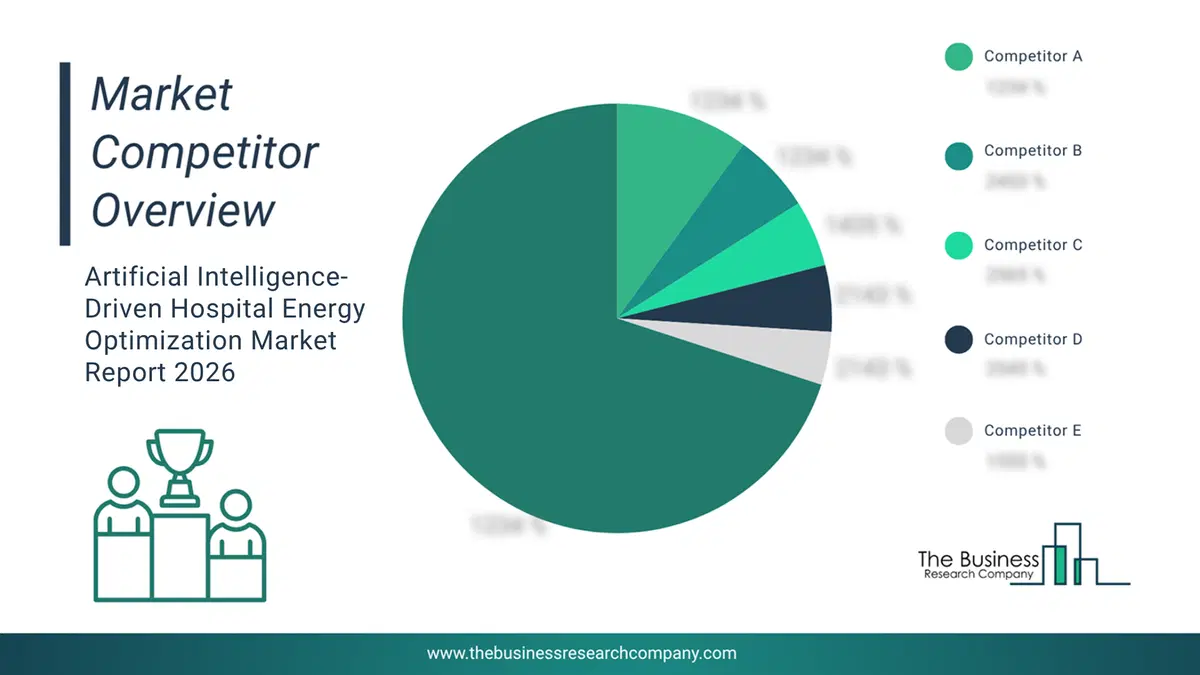
This chart is for illustrative purposes; the full report includes a detailed competitor analysis and comprehensive overview of the top 10 companies in the market.
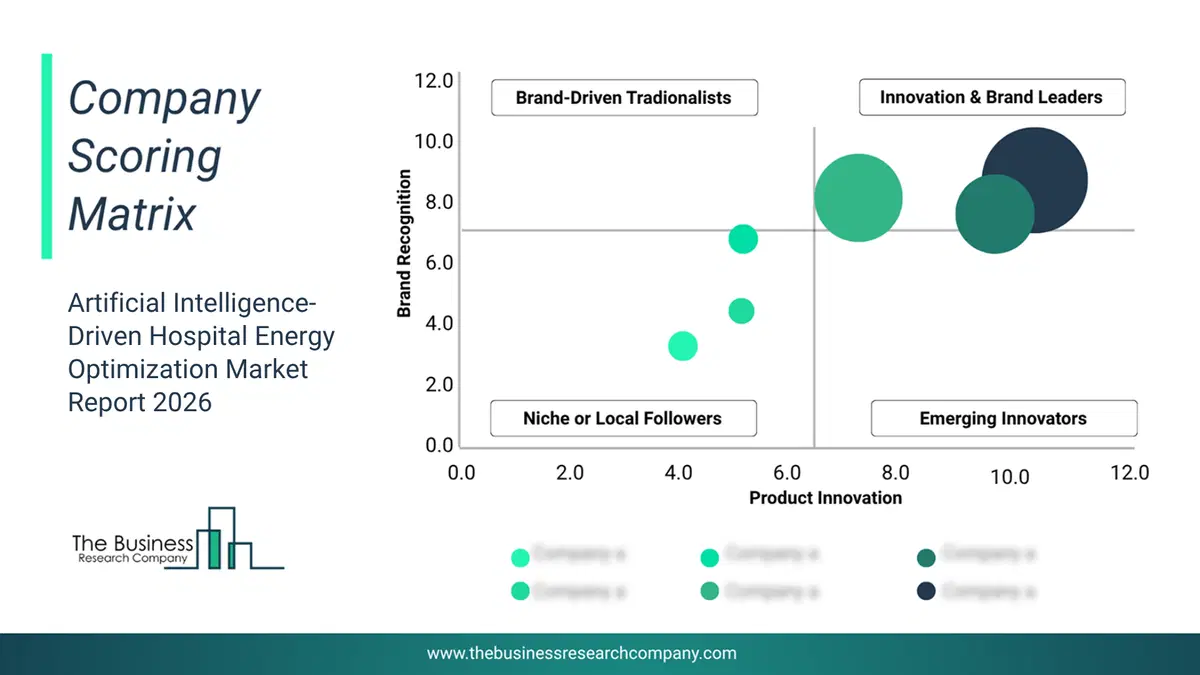
This chart maps companies by product innovation and brand strength, with bubble size indicating relative revenue, helping identify market leaders, challengers, and niche players. This is an illustrative chart; the full report provides a complete and accurate competitive analysis.
Global Artificial Intelligence-Driven Hospital Energy Optimization Market Trends and Insights
Major companies operating in the Artificial Intelligence-Driven Hospital Energy Optimization market are focusing on intelligent energy management to accelerate the deployment of energy-efficient solutions across healthcare facilities. Intelligent energy management refers to the use of AI, cloud computing, and IoT technologies to monitor, analyze, and automatically optimize hospital energy systems (such as HVAC) for improved efficiency and reduced consumption. For instance, in April 2024, True Digital Group, a Thailand-based digital transformation and technology services company, collaborated with Alibaba Cloud, a China-based cloud computing company, to launch the Climate Technology Platform. The platform uses Alibaba Cloud’s AI-driven "Energy Expert" solution combined with cloud, IoT, and big data analytics to help businesses in Thailand identify energy efficiency challenges, reduce greenhouse gas emissions, and adopt sustainable technologies. It supports real-time energy management and predictive insights aimed at accelerating Thailand’s green transition and reducing emissions by up to 40% by 2030, aiming for carbon neutrality by 2050. The platform has already demonstrated up to 15% energy consumption reduction in pilot projects such as Bangkok Hospital's heating, ventilation, and air conditioning system.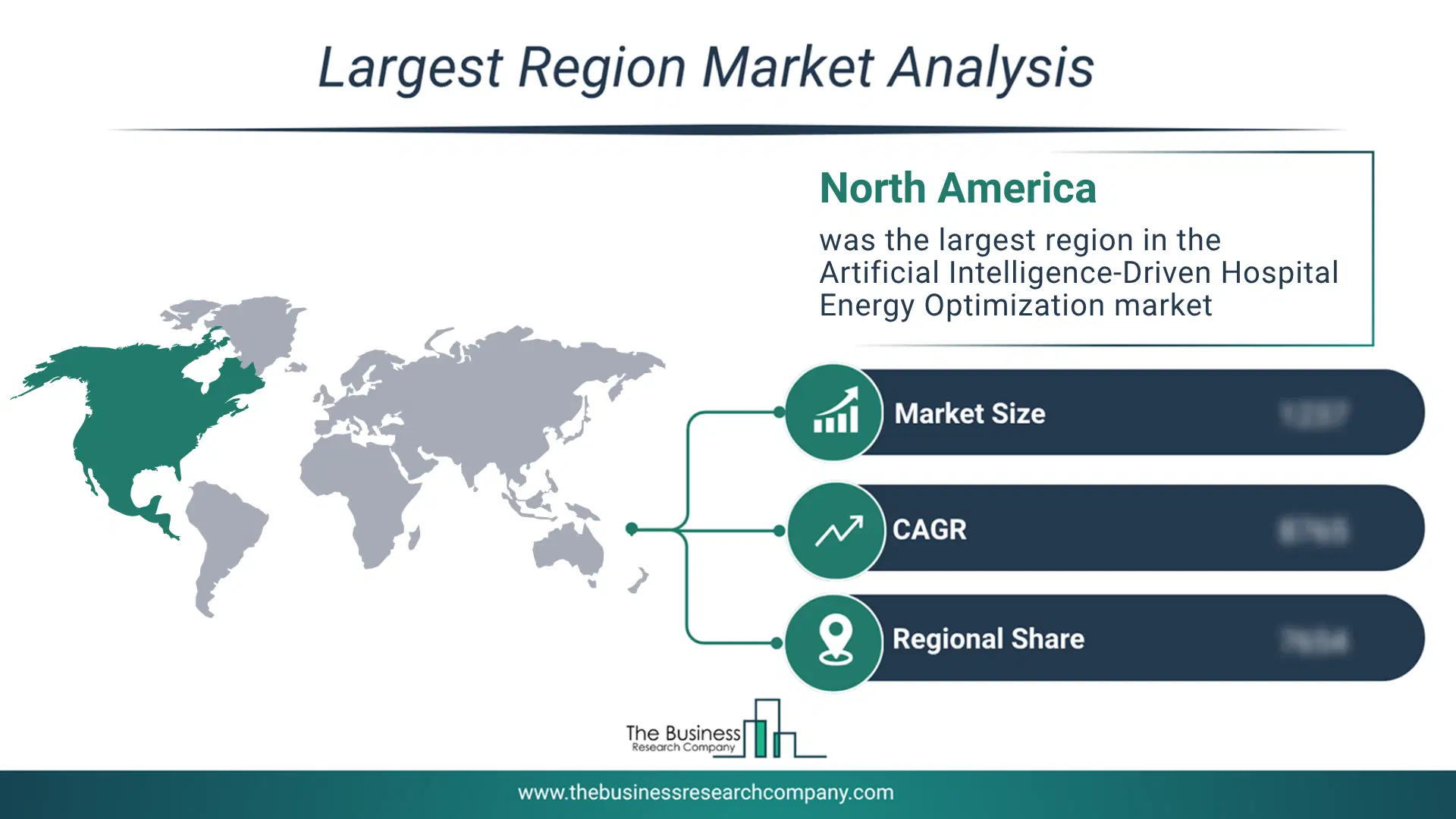
Regional Outlook
North America was the largest region in the artificial intelligence-driven hospital energy optimization market in 2025. Asia-Pacific is expected to be the fastest-growing region in the forecast period. The regions covered in this market report are Asia-Pacific, South East Asia, Western Europe, Eastern Europe, North America, South America, Middle East, Africa. The countries covered in this market report are Australia, Brazil, China, France, Germany, India, Indonesia, Japan, Taiwan, Russia, South Korea, UK, USA, Canada, Italy, Spain.What Defines the Artificial Intelligence-Driven Hospital Energy Optimization Market?
The artificial intelligence-driven hospital energy optimization market consists of revenues earned by entities by providing services such as energy consumption monitoring and analysis, predictive maintenance and fault detection, and automated energy control and scheduling. The market value includes the value of related goods sold by the service provider or included within the service offering. The artificial intelligence-driven hospital energy optimization market also includes sales of energy management systems, predictive maintenance tools, and energy usage analytics dashboards. Values in this market are ‘factory gate’ values; that is, the value of goods sold by the manufacturers or creators of the goods, whether to other entities (including downstream manufacturers, wholesalers, distributors, and retailers) or directly to end customers. The value of goods in this market includes related services sold by the creators of the goods.How is Market Value Defined and Measured?
The market value is defined as the revenues that enterprises gain from the sale of goods and/or services within the specified market and geography through sales, grants, or donations in terms of the currency (in USD unless otherwise specified). The revenues for a specified geography are consumption values that are revenues generated by organizations in the specified geography within the market, irrespective of where they are produced. It does not include revenues from resales along the supply chain, either further along the supply chain or as part of other products.
This chart presents market attractiveness based on a quantitative evaluation of growth, competition, strategic alignment, and risk, offering a clear view of opportunity areas for decision-making. This chart is for illustrative purposes; the full report contains the complete analysis.

This chart highlights the Total Addressable Market (TAM) by estimating the maximum revenue opportunity using an assumption-driven approach, supporting strategic planning and opportunity sizing across markets. The chart is illustrative; the full report provides a more comprehensive analysis.
What Key Data and Analysis Are Included in the Artificial Intelligence-Driven Hospital Energy Optimization Market Report 2026?
The artificial intelligence-driven hospital energy optimization market research report is one of a series of new reports from The Business Research Company that provides market statistics, including industry global market size, regional shares, competitors with the market share, detailed market segments, market trends and opportunities, and any further data you may need to thrive in the artificial intelligence-driven hospital energy optimization industry. The market research report delivers a complete perspective of everything you need, with an in-depth analysis of the current and future state of the industry.Artificial Intelligence-Driven Hospital Energy Optimization Market Report Forecast Analysis
| Report Attribute | Details |
|---|---|
| Market Size Value In 2026 | $3.08 billion |
| Revenue Forecast In 2030 | $7.15 billion |
| Growth Rate | CAGR of 23.4% from 2026 to 2030 |
| Base Year For Estimation | 2025 |
| Actual Estimates/Historical Data | 2020-2025 |
| Forecast Period | 2026 - 2030 |
| Market Representation | Revenue in USD Billion and CAGR from 2026 to 2030 |
| Segments Covered | Component, Deployment Mode, Hospital Size, Application, End-User |
| Regional Scope | Asia-Pacific, Western Europe, Eastern Europe, North America, South America, Middle East, Africa |
| Country Scope | The countries covered in the report are Australia, Brazil, China, France, Germany, India, Indonesia, Japan, Taiwan, Russia, South Korea, UK, USA, Canada, Italy, Spain |
| Key Companies Profiled | Enel S.p.A., General Electric Company, Veolia Environnement S.A., Schneider Electric SE, Honeywell International Inc., ABB Group, Eaton Corporation Plc, Johnson Controls International Plc, Trane Technologies Plc, Centrica Business Solutions Ltd., Rockwell Automation Inc., Ameresco Inc., ENGIE Impact, GridPoint Inc., Optimum Energy LLC, Verdigris Technologies, Enerbrain, BuildingIQ Inc., Deerns, Resync |
| Customization Scope | Request for Customization |
| Pricing And Purchase Options | Explore Purchase Options |