
Artificial Organ Market Report 2026
Global Outlook – By Organ Type (Artificial Heart, Artificial Kidney, Artificial Liver, Artificial Pancreas), By Material (Silicone, Plastic, Steel, Biomaterials), By Fixation (Implantable, External), By End Users (Hospitals, Ambulatory Surgical Centers, Other End Users) – Market Size, Trends, Strategies, and Forecast to 2030
Artificial Organ Market Overview
• Artificial Organ market size has reached to $25.73 billion in 2025 • Expected to grow to $41.12 billion in 2030 at a compound annual growth rate (CAGR) of 9.7% • Growth Driver: Rising Demand For Organ Transplants Fuels Growth In The Artificial Organ Market • Market Trend: Advancement In AI-Powered Pathology Solution With Deep Learning Technology • North America was the largest region in 2025 and Asia-Pacific is the fastest growing region.What Is Covered Under Artificial Organ Market?
An artificial organ is a device that may be implanted or integrated into a human body to replace a natural organ, duplicate or augment a certain function, and allow the patient to return to normal life as quickly as feasible. The main organ types of artificial organs include artificial hearts, artificial kidneys, artificial livers, artificial pancreas, and others. An artificial heart is a pump that is implanted in the chest to replace damaged heart ventricles and valves. After the pump is installed in the chest, a mechanism called a driver operates the pump from outside the body. The pump (artificial heart) and driver are used to replace the function of a healthy heart by allowing blood to circulate to and from the heart. The materials are silicone, plastic, steel, and biomaterials, and fixations include implantable, and external. The end users include hospitals, ambulatory surgical centers, laboratories and diagnostic centers, research and academic institute, and others.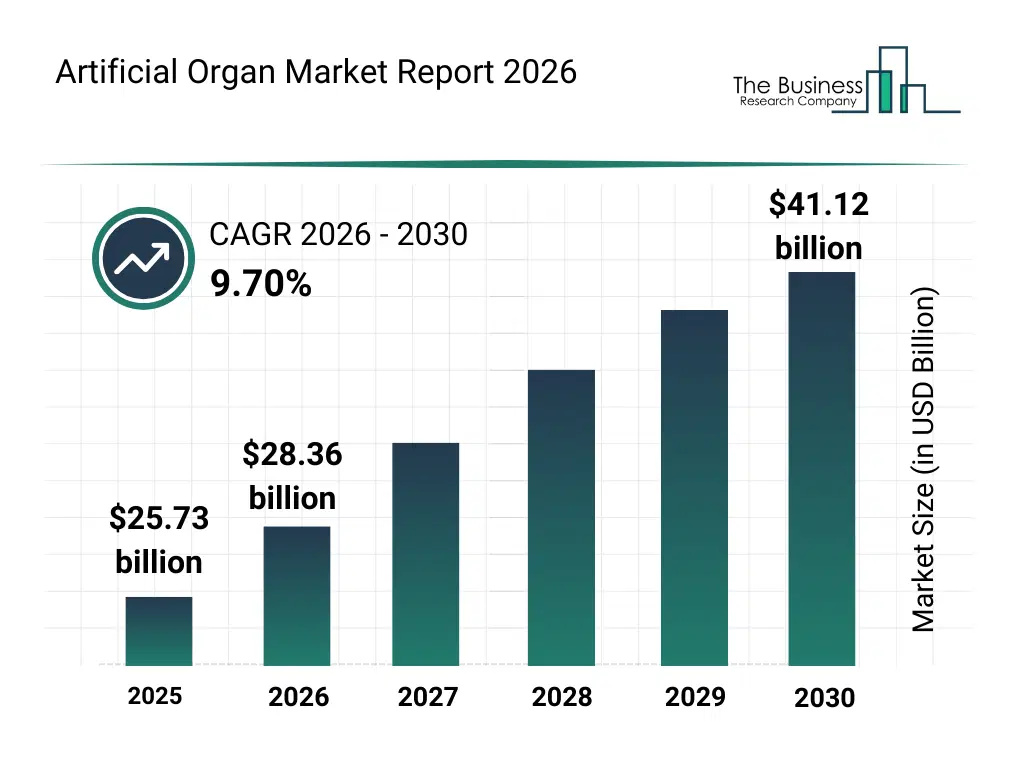
What Is The Artificial Organ Market Size and Share 2026?
The artificial organ market size has grown rapidly in recent years. It will grow from $25.73 billion in 2025 to $28.36 billion in 2026 at a compound annual growth rate (CAGR) of 10.2%. The growth in the historic period can be attributed to increasing organ failure cases, shortage of donor organs, advancements in biomedical engineering, growth of dialysis and cardiac support therapies, expanding transplant waiting lists.What Is The Artificial Organ Market Growth Forecast?
The artificial organ market size is expected to see strong growth in the next few years. It will grow to $41.12 billion in 2030 at a compound annual growth rate (CAGR) of 9.7%. The growth in the forecast period can be attributed to increasing investments in bioengineered organs, rising adoption of personalized implant solutions, expansion of artificial organ research funding, technological progress in regenerative medicine, growing acceptance of long-term implantable devices. Major trends in the forecast period include increasing adoption of implantable artificial organs, rising use of advanced biomaterials, growing integration of smart and sensor-enabled organs, expansion of minimally invasive implantation techniques, enhanced focus on long-term biocompatibility.
Global Artificial Organ Market Segmentation
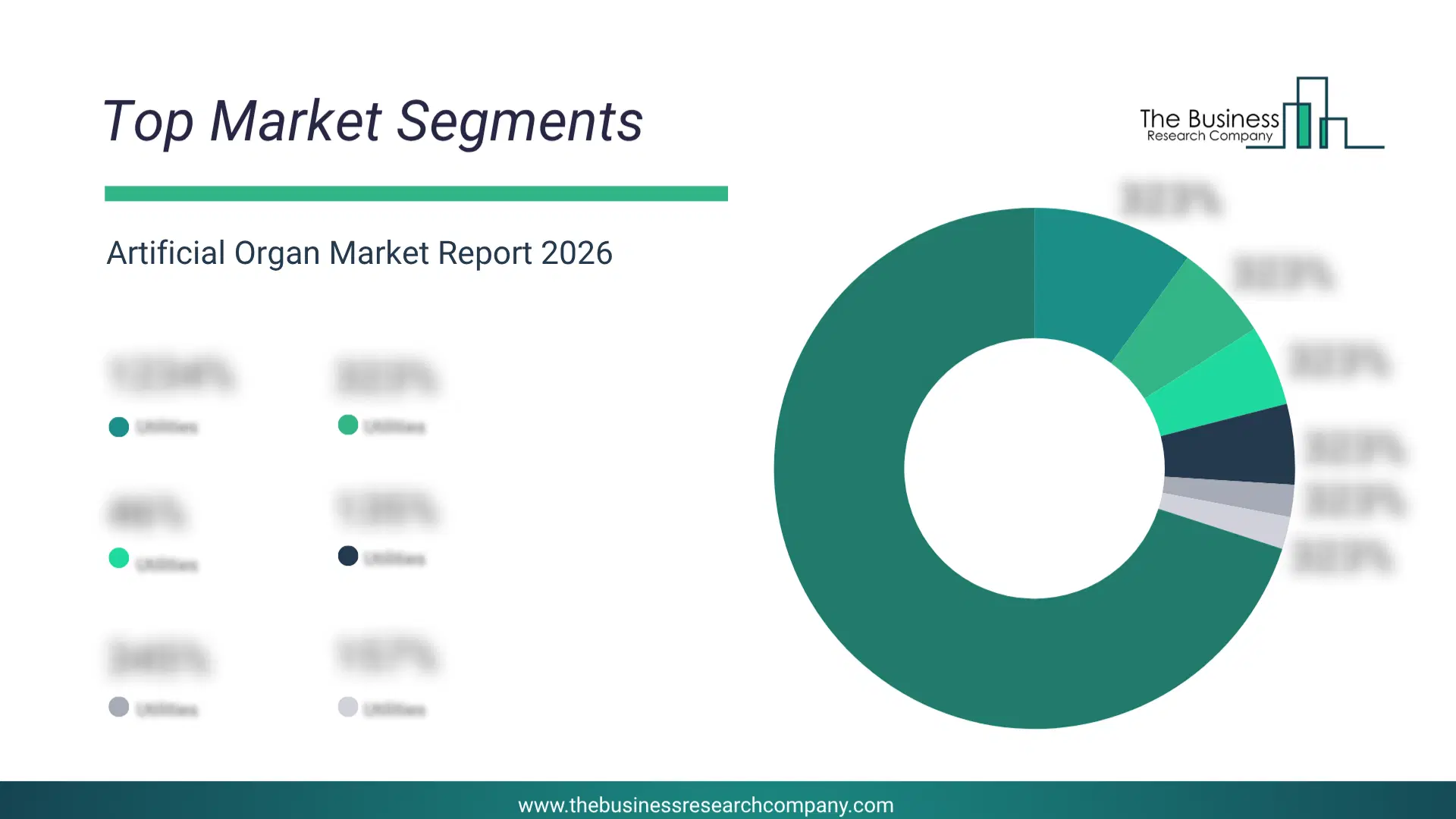
1) By Organ Type: Artificial Heart, Artificial Kidney, Artificial Liver, Artificial Pancreas 2) By Material: Silicone, Plastic, Steel, Biomaterials 3) By Fixation: Implantable, External 4) By End Users: Hospitals, Ambulatory Surgical Centers, Other End Users Subsegments: 1) By Artificial Heart: Total Artificial Heart, Ventricular Assist Devices (VADs) 2) By Artificial Kidney: Hemodialysis Systems, Peritoneal Dialysis Devices 3) By Artificial Liver: Bioartificial Liver Devices, Liver Support Systems 4) By Artificial Pancreas: Closed-Loop Insulin Delivery Systems, Bionic Pancreas SystemsWhat Is The Driver Of The Artificial Organ Market?
The increasing demand for organ transplants is expected to propel the growth of the artificial organ market going forward. Organ transplantation is a medical procedure in which an organ or tissue is removed from one person (the donor) and surgically implanted into another person (the recipient) to replace a damaged or failing organ. Artificial organ technology helps organ transplants by providing temporary or permanent replacement organs, reducing the dependence on donor availability, and improving patient survival rates. For instance, in July 2025, according to a report published by NHS Blood and Transplant, a UK-based government organization, as of March 2025, there were 8,096 patients on the active transplant waiting list (including 276 children), marking the highest number ever recorded; additionally, nearly 3,883 people were temporarily suspended. Therefore, the increasing demand for organ transplants is driving the growth of the artificial organ industry.Key Players In The Global Artificial Organ Market
Major companies operating in the artificial organ market are Medtronic plc, Abbott Laboratories Inc., SynCardia Systems LLC, Berlin Heart GmbH, ABIOMED Inc., Carmat SA, Jarvik Heart Inc., Baxter International Inc., B. Braun Melsungen AG, Terumo Corporation, Organovo Holdings Inc., Satellite Bio, HeartWare plc, Boston Scientific Services Private Limited, Edwards Lifesciences India Pvt. Ltd., LIVANOVA plc, NeuroPace Inc., Cochlear Limited, Cyberonics Inc., Demant A/S, LifeNet Health Inc., Vivani Medical Inc., Tissium SAS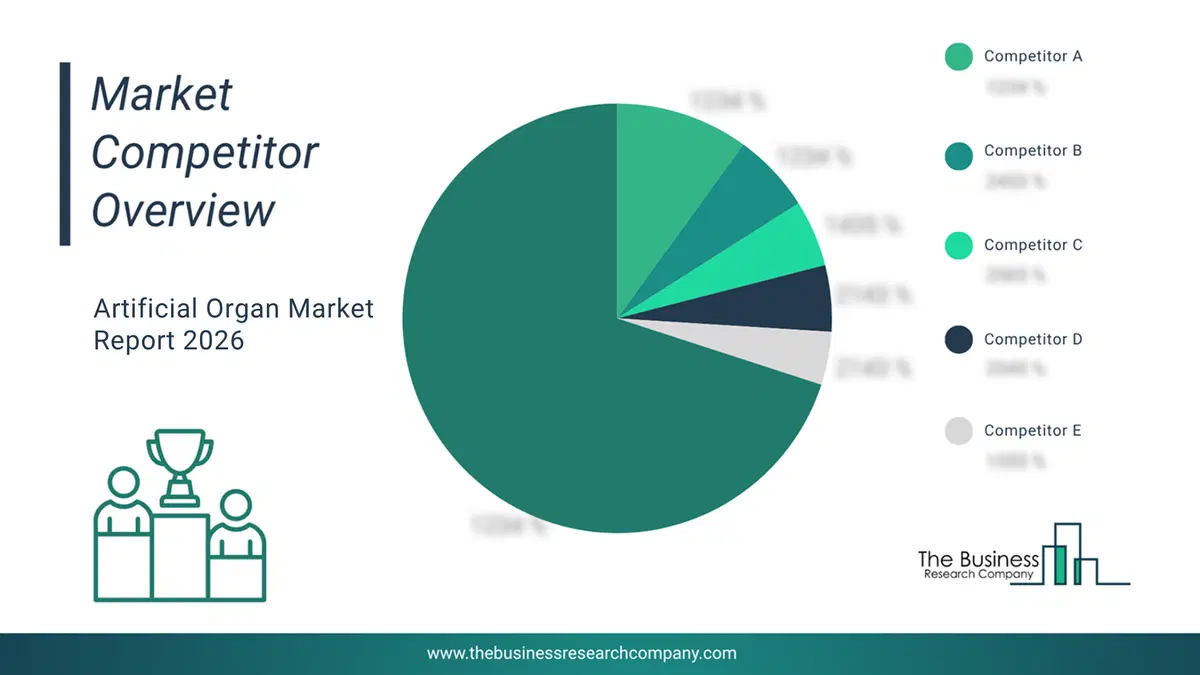
This chart is for illustrative purposes; the full report includes a detailed competitor analysis and comprehensive overview of the top 10 companies in the market.
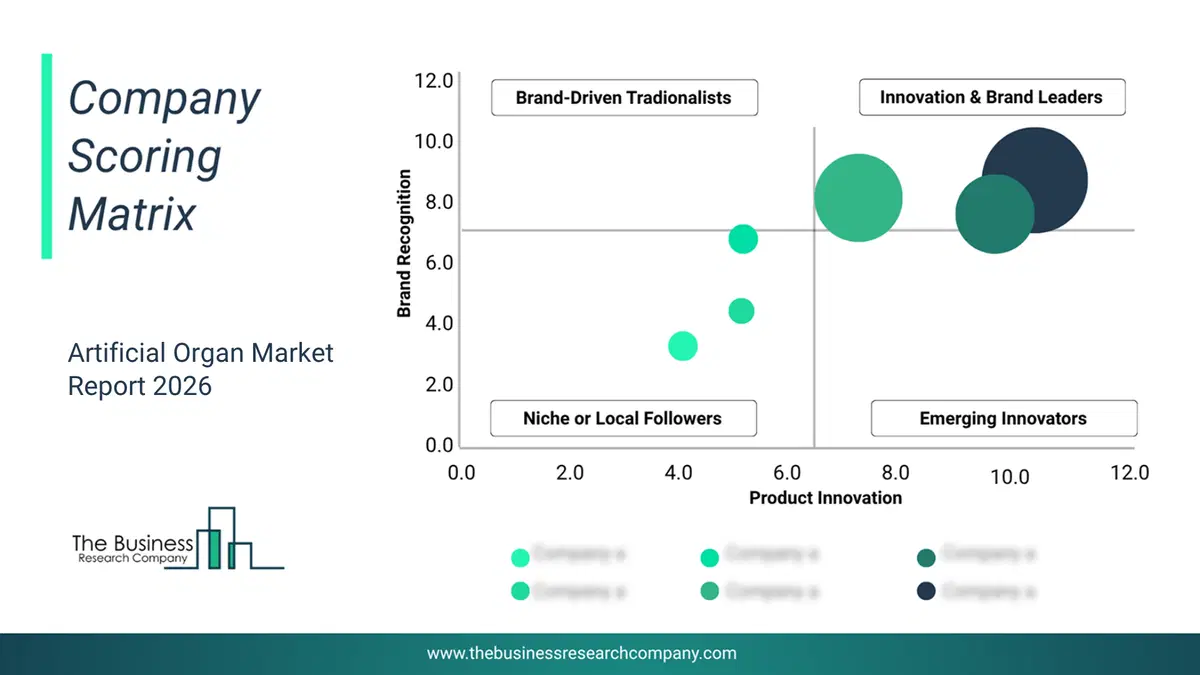
This chart maps companies by product innovation and brand strength, with bubble size indicating relative revenue, helping identify market leaders, challengers, and niche players. This is an illustrative chart; the full report provides a complete and accurate competitive analysis.
Global Artificial Organ Market Trends and Insights
Major companies operating in the artificial organ market are focusing on innovative products such as AI-powered pathology solutions to drive revenues in their market. AI-powered pathology solutions are transforming the field of pathology by providing pathologists with powerful tools to improve diagnostic accuracy, efficiency, and patient care. For instance, in September 2023, Aiosyn, a Netherlands-based medical software company that develops AI-powered pathology solutions, launched an AI kidney suite. The new suite will objectively quantify kidney lesion ratings to increase repeatability and accelerate medication discovery through the use of AI-powered computational pathology techniques. The new platform allows research organizations and biopharma to analyze kidney structures and quantify lesions that impact kidney health by utilizing cutting-edge deep-learning technology.What Are Latest Mergers And Acquisitions In The Artificial Organ Market?
In March 2024, Nippon Express Holdings, Inc., a Japan-based logistics services company, acquired a stake in Instalimb, Inc. for an undisclosed amount. With this acquisition, Nippon aims to enhance its corporate value while addressing social issues. The investment will facilitate Instalimb's logistics and business growth in Asian markets and potentially in emerging regions of Africa in the future. Instalimb, Inc. is a Japan-based start-up specializing in 3D-printed prosthetics.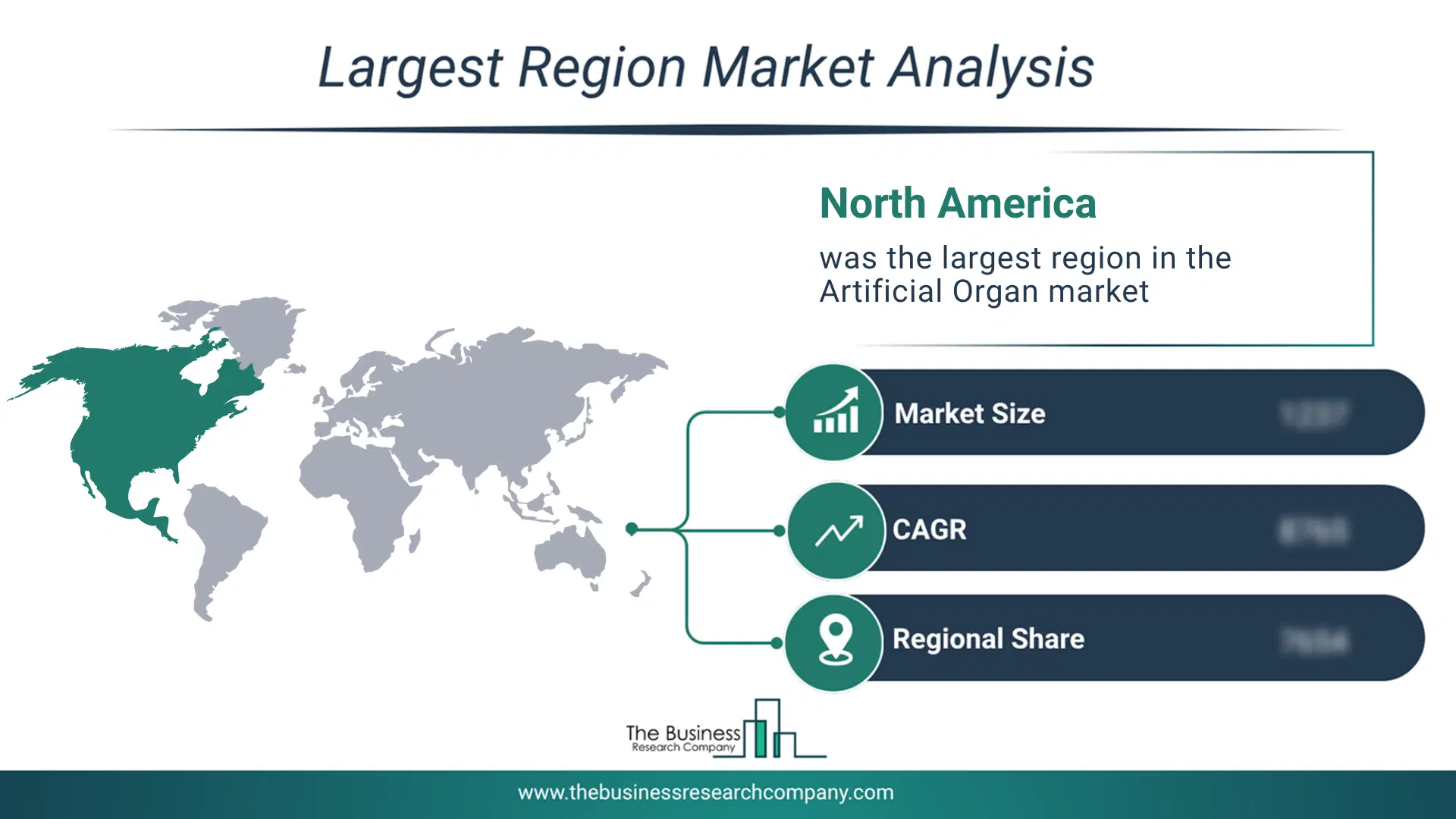
Regional Outlook
North America was the largest region in the artificial organ market in 2025. Asia-Pacific is expected to be the fastest-growing region in the forecast period. The regions covered in this market report are Asia-Pacific, South East Asia, Western Europe, Eastern Europe, North America, South America, Middle East, Africa. The countries covered in this market report are Australia, Brazil, China, France, Germany, India, Indonesia, Japan, Taiwan, Russia, South Korea, UK, USA, Canada, Italy, SpainWhat Defines the Artificial Organ Market?
The artificial organ market consists of sales of orthopedic devices, neuroprostheses and neurological support, urological support, visual support systems, blood cell and tissue replacement systems, mechanical organs made of inanimate polymers, and biomechanical organs made of partially living cells and inanimate polymers. Values in this market are ‘factory gate’ values, that is the value of goods sold by the manufacturers or creators of the goods, whether to other entities (including downstream manufacturers, wholesalers, distributors, and retailers) or directly to end customers. The value of goods in this market includes related services sold by the creators of the goods.How is Market Value Defined and Measured?
The market value is defined as the revenues that enterprises gain from the sale of goods and/or services within the specified market and geography through sales, grants, or donations in terms of the currency (in USD unless otherwise specified). The revenues for a specified geography are consumption values that are revenues generated by organizations in the specified geography within the market, irrespective of where they are produced. It does not include revenues from resales along the supply chain, either further along the supply chain or as part of other products.
This chart presents market attractiveness based on a quantitative evaluation of growth, competition, strategic alignment, and risk, offering a clear view of opportunity areas for decision-making. This chart is for illustrative purposes; the full report contains the complete analysis.

This chart highlights the Total Addressable Market (TAM) by estimating the maximum revenue opportunity using an assumption-driven approach, supporting strategic planning and opportunity sizing across markets. The chart is illustrative; the full report provides a more comprehensive analysis.
What Key Data and Analysis Are Included in the Artificial Organ Market Report 2026?
The artificial organ market research report is one of a series of new reports from The Business Research Company that provides market statistics, including industry global market size, regional shares, competitors with the market share, detailed market segments, market trends and opportunities, and any further data you may need to thrive in the artificial organ industry. The market research report delivers a complete perspective of everything you need, with an in-depth analysis of the current and future state of the industry.Artificial Organ Market Report Forecast Analysis
| Report Attribute | Details |
|---|---|
| Market Size Value In 2026 | $28.36 billion |
| Revenue Forecast In 2030 | $41.12 billion |
| Growth Rate | CAGR of 9.7% from 2026 to 2030 |
| Base Year For Estimation | 2025 |
| Actual Estimates/Historical Data | 2020-2025 |
| Forecast Period | 2026 - 2030 |
| Market Representation | Revenue in USD Billion and CAGR from 2026 to 2030 |
| Segments Covered | Organ Type, Material, Fixation, End Users |
| Regional Scope | Asia-Pacific, Western Europe, Eastern Europe, North America, South America, Middle East, Africa |
| Country Scope | The countries covered in the report are Australia, Brazil, China, France, Germany, India, Indonesia, Japan, Taiwan, Russia, South Korea, UK, USA, Canada, Italy, Spain. |
| Key Companies Profiled | Medtronic plc, Abbott Laboratories Inc., SynCardia Systems LLC, Berlin Heart GmbH, ABIOMED Inc., Carmat SA, Jarvik Heart Inc., Baxter International Inc., B. Braun Melsungen AG, Terumo Corporation, Organovo Holdings Inc., Satellite Bio, HeartWare plc, Boston Scientific Services Private Limited, Edwards Lifesciences India Pvt. Ltd., LIVANOVA plc, NeuroPace Inc., Cochlear Limited, Cyberonics Inc., Demant A/S, LifeNet Health Inc., Vivani Medical Inc., Tissium SAS |
| Customization Scope | Request for Customization |
| Pricing And Purchase Options | Explore Purchase Options |