

Assured Positioning, Navigation, And Timing (PNT) Global Market Opportunities And Strategies To 2035
By Component (Atomic Clocks, Antennas, Transponders, Sensors, Power Amplifiers, Receivers, Other Components), By Platform (Air, Land, Naval), By End User (Defense, Homeland Security), And By Region, Opportunities And Strategies – Global Forecast To 2035
Assured Positioning, Navigation, And Timing (PNT) Market Definition
Assured Positioning, Navigation, and Timing (PNT) refers to the set of technologies and systems designed to provide continuous, reliable, and tamper-resistant location, navigation, and timing data, especially in environments where conventional Global Navigation Satellite Systems (GNSS) may be compromised due to interference, jamming, spoofing, or environmental constraints. Assured PNT systems are critical for military operations, homeland security, and infrastructure systems that require high precision, resilience, and trust in the integrity of location and timing information. These systems are used predominantly by defense organizations, armed forces, border security agencies, and other national security entities operating in contested or GPS-denied environments. The assured positioning, navigation, and timing (PNT) market consists of sales by entities (organizations, sole traders, or partnerships) of technologies ensuring reliable location, navigation, and time data in GPS-denied or contested environments.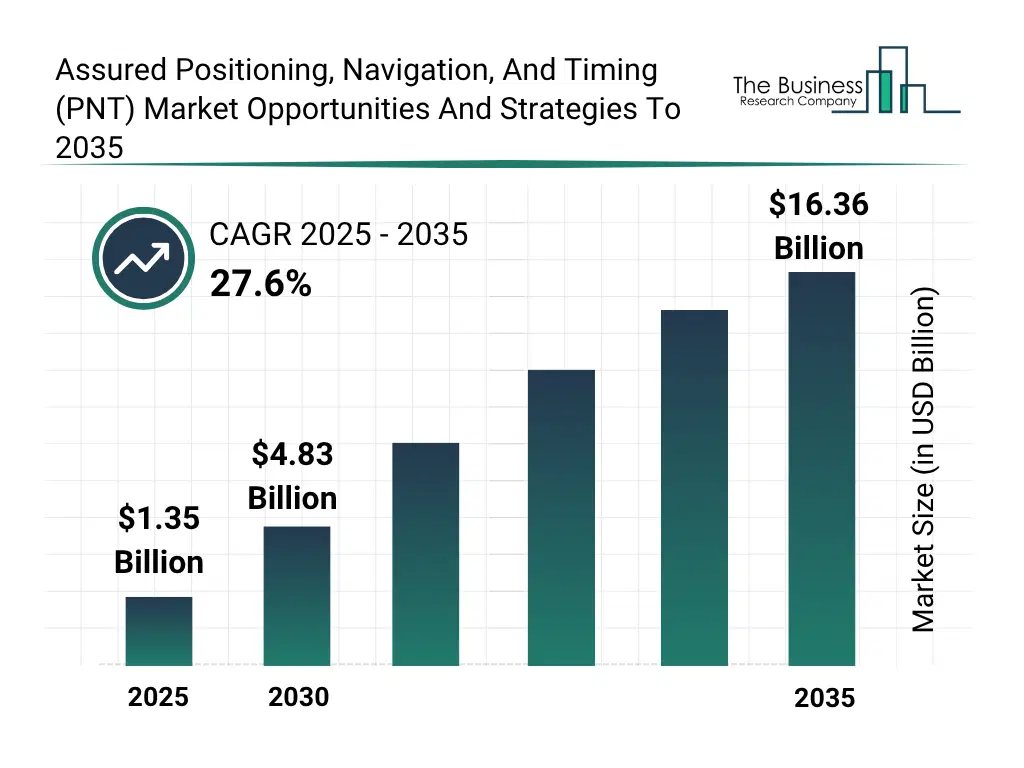
Assured Positioning, Navigation, And Timing (PNT) Market Size
The global assured positioning, navigation and timing (PNT) market reached a value of nearly $1,351.6 million in 2025, having grown at a compound annual growth rate (CAGR) of 25.5% since 2020. The market is expected to grow from $1,351.6 million in 2025 to $4,826.5 million in 2030 at a rate of 29.0%. The market is then expected to grow at a CAGR of 27.6% from 2030 and reach $16,357.4 million in 2035. Growth in the historic period resulted from defense and military modernization spending, expansion of maritime trade, growth of national space programs and growth in commercial aviation and air traffic. Factors that negatively affected growth in the historic period were high implementation and maintenance costs and shortage of trained personnel. Going forward, expansion of autonomous transportation, rising global navigation satellite system (GNSS) threats, growth in border surveillance and monitoring needs and need for protection of critical infrastructure will drive the growth. Factors that could hinder the growth of the assured positioning, navigation and timing (PNT) market in the future include limited government budgets and funding constraints, system complexity and integration challenges and impact of trade wars and tariffs.
Assured Positioning, Navigation, And Timing (PNT) Market Segmentation
The assured positioning, navigation and timing (PNT) market is segmented by component, by platform and by end user.By Component –
The assured positioning, navigation and timing (PNT) market is segmented by component into:
- a) Atomic Clocks
- b) Antennas
- c) Transponders
- d) Sensors
- e) Power Amplifiers
- f) Receivers
- g) Other Components
By Platform –
The assured positioning, navigation and timing (PNT) market is segmented by platform into:
- a) Air
- b) Land
- c) Naval
By End User –
The assured positioning, navigation and timing (PNT) market is segmented by end user into:
- a) Defense
- b) Homeland Security
By Geography - The assured positioning, navigation and timing (PNT) market is segmented by geography into:
- China
- India
- Japan
- Australia
- Taiwan
- South Korea
- Indonesia
- USA
- Canada
- Brazil
- France
- Germany
- UK
- Italy
- Spain
- Russia
-
o Asia Pacific
o Africa