
Asymmetric Digital Subscriber Line (ADSL) Modems Market Report 2026
Global Outlook – By Product Type (External Modems, Internal Modems, Universal Serial Bus (USB) Modems, Wireless Modems), By Connectivity Type (Wired, Wireless), By Distribution Channel (Online Stores, Offline Retail, Specialty Stores), By Application (Residential, Commercial, Industrial), By End-User (Individual Consumers, Enterprises, Internet Service Providers (ISPs)) – Market Size, Trends, Strategies, and Forecast to 2030
Asymmetric Digital Subscriber Line (ADSL) Modems Market Overview
• Asymmetric Digital Subscriber Line (ADSL) Modems market size has reached to $2.56 billion in 2025 • Expected to grow to $3.46 billion in 2030 at a compound annual growth rate (CAGR) of 6.3% • Growth Driver: Surge In Demand For Basic And Reliable Internet Connectivity Fueling The Growth Of The Market Due To The Need For Uninterrupted Online Access • Market Trend: Cutting-edge Modem Router Optimizes Connectivity And Reduces Network Congestion • North America was the largest region in 2025 and Asia-Pacific is the fastest growing region.What Is Covered Under Asymmetric Digital Subscriber Line (ADSL) Modems Market?
Asymmetric digital subscriber line (ADSL) modems are communication devices that enable high-speed internet access over existing copper telephone lines. They provide faster data download speeds compared to upload speeds, making them suitable for typical residential and small business use. These modems separate voice and data signals to allow simultaneous phone and internet usage. They are used to deliver reliable broadband connectivity without requiring new cabling infrastructure. The main product types of asymmetric digital subscriber line (ADSL) modems include external modems, internal modems, universal serial bus (USB) modems, and wireless modems. External modems refer to standalone networking devices that connect to computers or routers via Ethernet or USB interfaces to provide ADSL broadband connectivity over telephone lines. These modems support connectivity types such as wired and wireless connections. The distribution channels for ADSL modems include online stores, offline retail outlets, and specialty stores. The various applications involved are residential, commercial, and industrial use cases and are used by end users such as individual consumers, enterprises, and internet service providers (ISPs).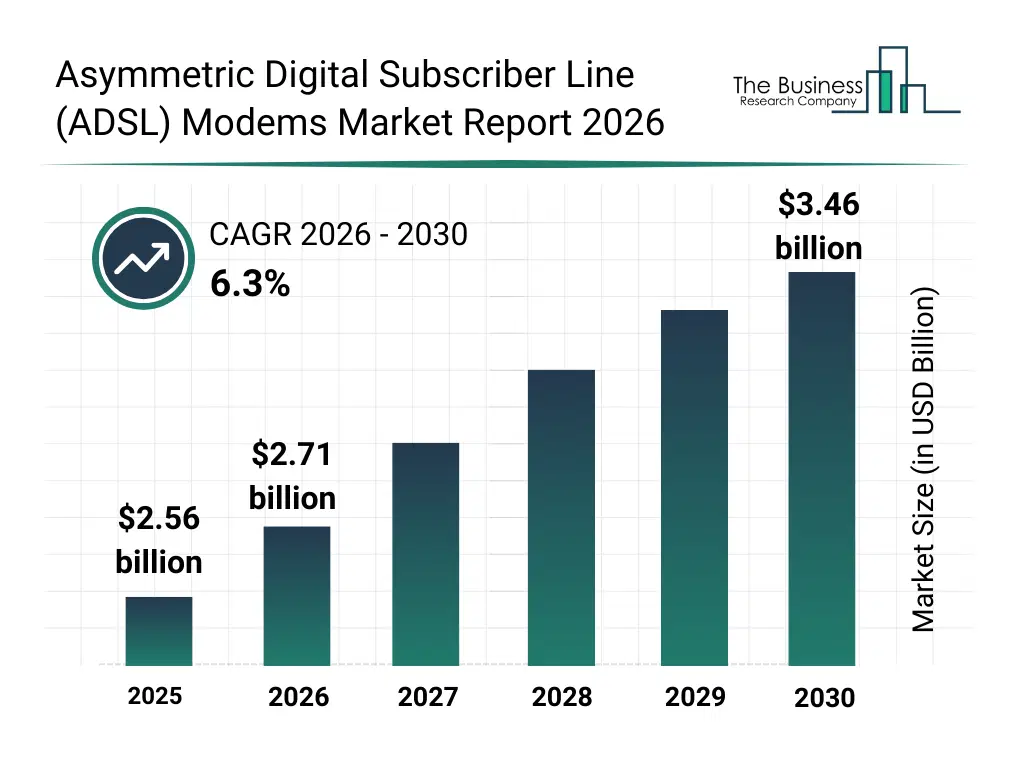
What Is The Asymmetric Digital Subscriber Line (ADSL) Modems Market Size and Share 2026?
The asymmetric digital subscriber line (adsl) modems market size has grown strongly in recent years. It will grow from $2.56 billion in 2025 to $2.71 billion in 2026 at a compound annual growth rate (CAGR) of 6.1%. The growth in the historic period can be attributed to existing copper infrastructure utilization, early broadband adoption, ISP network expansion, affordability requirements, residential internet demand.What Is The Asymmetric Digital Subscriber Line (ADSL) Modems Market Growth Forecast?
The asymmetric digital subscriber line (adsl) modems market size is expected to see strong growth in the next few years. It will grow to $3.46 billion in 2030 at a compound annual growth rate (CAGR) of 6.3%. The growth in the forecast period can be attributed to digital inclusion programs, rural internet expansion, hybrid network deployments, low-cost connectivity demand, developing market penetration. Major trends in the forecast period include cost-effective broadband connectivity, extended lifecycle of copper networks, integrated modem-router devices, energy-efficient modem designs, rural connectivity expansion.
Global Asymmetric Digital Subscriber Line (ADSL) Modems Market Segmentation
1) By Product Type: External Modems, Internal Modems, Universal Serial Bus (USB) Modems, Wireless Modems 2) By Connectivity Type: Wired, Wireless 3) By Distribution Channel: Online Stores, Offline Retail, Specialty Stores 4) By Application: Residential, Commercial, Industrial 5) By End-User: Individual Consumers, Enterprises, Internet Service Providers (ISPs) Subsegments: 1) By External Modems: Standalone External Modems, Ethernet Connected External Modems, Multi Port External Modems, Business Grade External Modems 2) By Internal Modems: Desktop Computer Internal Modems, Embedded Device Internal Modems, Motherboard Integrated Modems, Expansion Slot Internal Modems 3) By Universal Serial Bus (USB) Modems: Plug And Play Universal Serial Bus (USB) Modems, Portable Universal Serial Bus (USB) Modems, High Speed Universal Serial Bus (USB) Modems, Multi Device Compatible Universal Serial Bus (USB) Modems 4) By Wireless Modems: Single Band Wireless Modems, Dual Band Wireless Modems, Multi Device Wireless Modems, Long Range Wireless ModemsWhat Are The Drivers Of The Asymmetric Digital Subscriber Line (ADSL) Modems Market?
The rising demand for basic and reliable internet connectivity is expected to propel the growth of the asymmetric digital subscriber line (ADSL) modems market going forward. Internet connectivity refers to the ability of devices or users to access and communicate over the internet reliably. Internet connectivity is increasing due to the widespread rollout of high-speed mobile networks and affordable broadband access across urban and rural areas. Asymmetric digital subscriber line (ADSL) modems help reliable internet connectivity by using existing telephone lines to provide stable, high-speed internet, allowing users to browse, stream, and work online without interruption. For instance, in December 2024, according to the Office of Communications, a UK-based government agency, as of July 2024, 7.5 million premises, or 35% of all premises, had full-fiber networks, up from 28% in May 2023. Therefore, the rising demand for basic and reliable internet connectivity is expected to drive the growth of the asymmetric digital subscriber line (ADSL) modems industry. The rise in remote work is expected to propel the growth of the asymmetric digital subscriber line (ADSL) modems market going forward. Remote work refers to performing job duties outside a traditional office, typically from home or any location with internet access. Remote work is increasing due to widespread access to high-speed internet and cloud-based collaboration tools that enable employees to work effectively from anywhere. Asymmetric digital subscriber line (ADSL) modems help the rise in remote work by providing high-speed internet over existing telephone lines, enabling reliable connectivity for virtual meetings, cloud access, and seamless communication from home. For instance, in March 2025, according to the U.S. Bureau of Labor Statistics, a US-based government agency, in 2024, 35.5 million people teleworked or worked from home for pay in the first quarter, an increase of 5.1 million from the previous year, accounting for 22.9% of the workforce, up from 19.6% a year earlier. Therefore, the rise in remote work is expected to drive the growth of the asymmetric digital subscriber line (ADSL) modems industry.Key Players In The Global Asymmetric Digital Subscriber Line (ADSL) Modems Market
Major companies operating in the asymmetric digital subscriber line (adsl) modems market are Huawei Technologies Co. Ltd., Cisco Systems Inc., ZTE Corporation, ASUSTeK Computer Inc., TP-Link Technologies Co. Ltd., Calix Inc., Alpha Networks Inc., Aztech Systems Ltd, Technicolor SA, Netgear Inc., Cambridge Industries Group, Zyxel Communications Corporation, Actiontec Electronics Inc., USRobotics LLC, Edimax Technology Co. Ltd., Billion Electric Co. Ltd., TRENDnet Inc., Planet Technology Corporation, Tenda Technology Co. Ltd., DrayTek Corp., D-Link Systems Inc.
This chart is for illustrative purposes; the full report includes a detailed competitor analysis and comprehensive overview of the top 10 companies in the market.
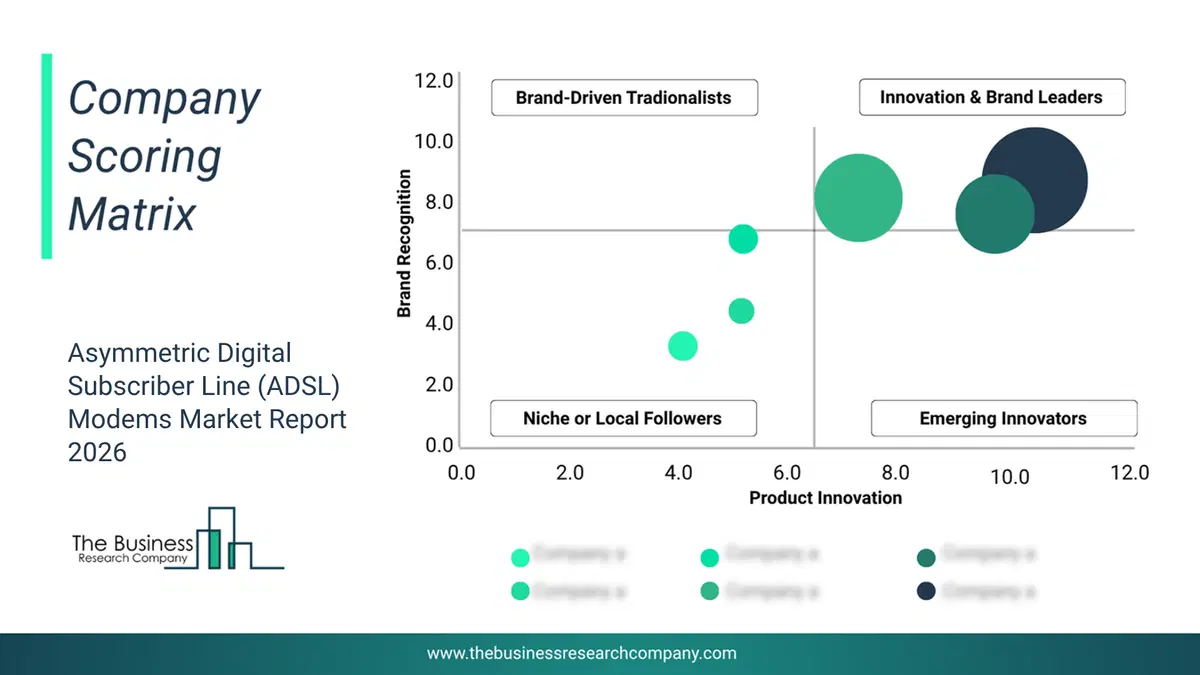
This chart maps companies by product innovation and brand strength, with bubble size indicating relative revenue, helping identify market leaders, challengers, and niche players. This is an illustrative chart; the full report provides a complete and accurate competitive analysis.
Global Asymmetric Digital Subscriber Line (ADSL) Modems Market Trends and Insights
Major companies operating in the asymmetric digital subscriber line (ADSL) modems market are focusing on developing advanced solutions, such as high-speed Wi-Fi 6 connectivity, to enhance internet speed, improve network reliability, and optimize user experience. High-speed Wi-Fi 6 connectivity refers to modem-router technology that delivers faster data transfer rates, lower latency, and greater capacity to handle multiple connected devices simultaneously. For instance, in July 2024, D-Link, a Taiwan-based networking equipment company, introduced its DSL-X3052E AX3000 Wi-Fi 6 VDSL2/ADSL2+ modem router designed to provide superior broadband performance for both residential and business users. The solution integrates VoIP capabilities, enhanced security features, and support for multiple device connections, enabling seamless streaming, gaming, and remote work applications. By leveraging advanced modulation techniques and dual-band operation, the modem router ensures stable and high-speed internet access, reduces network congestion, and improves overall connectivity reliability. It is engineered to support next-generation internet services, ensuring efficient performance in demanding digital environments.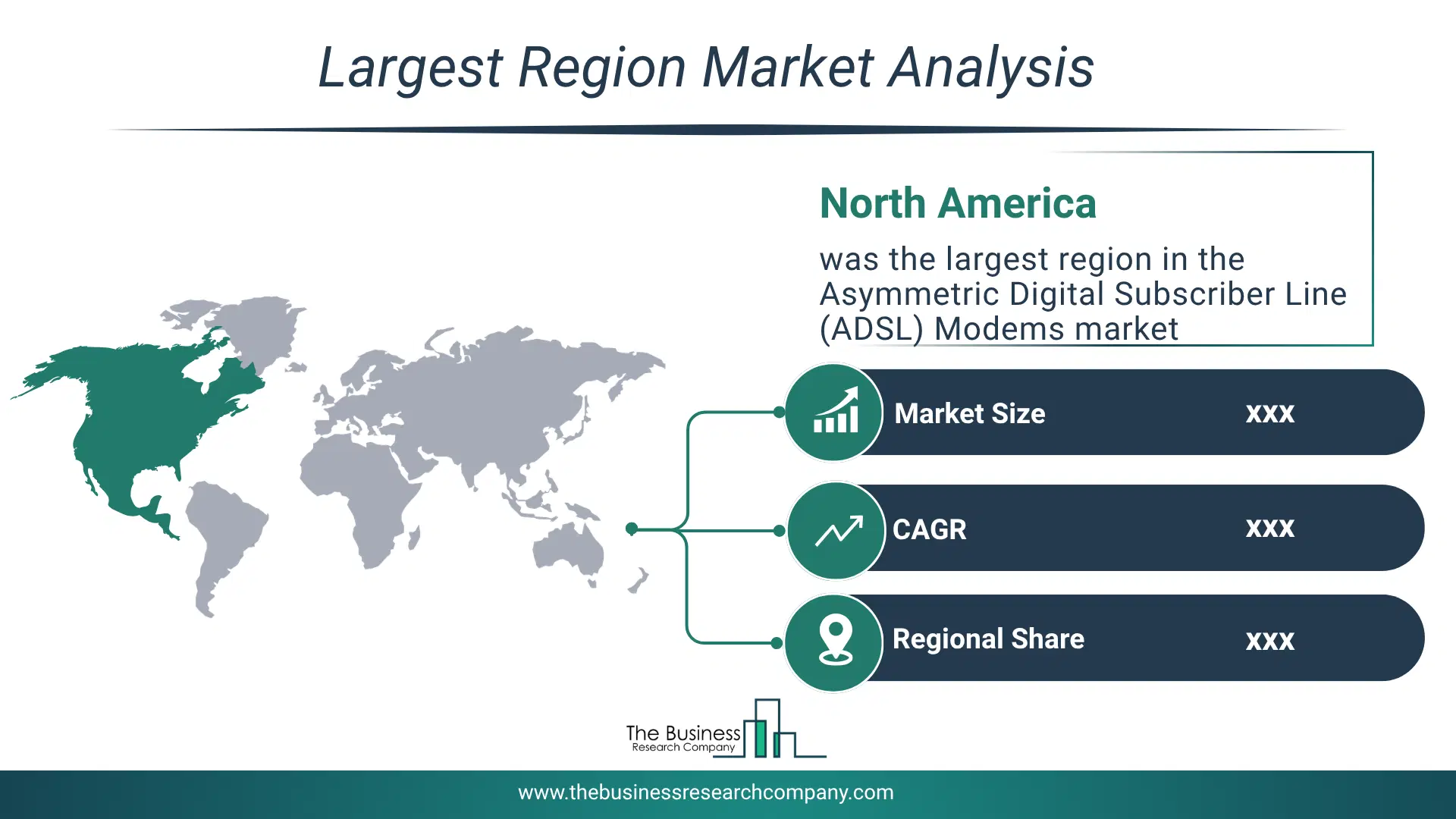
Regional Outlook
North America was the largest region in the asymmetric digital subscriber line (ADSL) modems market in 2025. Asia-Pacific is expected to be the fastest-growing region in the forecast period. The regions covered in this market report are Asia-Pacific, South East Asia, Western Europe, Eastern Europe, North America, South America, Middle East, Africa. The countries covered in this market report are Australia, Brazil, China, France, Germany, India, Indonesia, Japan, Taiwan, Russia, South Korea, UK, USA, Canada, Italy, Spain.What Defines the Asymmetric Digital Subscriber Line (ADSL) Modems Market?
The asymmetric digital subscriber line (ADSL) modems market consists of sales of standalone asymmetric digital subscriber line (ADSL) modems, asymmetric digital subscriber line (ADSL) modem-routers, integrated access devices (iads), asymmetric digital subscriber line (ADSL) gateway devices, asymmetric digital subscriber line (ADSL) fiber hybrid modems, and high-speed asymmetric digital subscriber line (ADSL) modems. Values in this market are ‘factory gate’ values, that is, the value of goods sold by the manufacturers or creators of the goods, whether to other entities (including downstream manufacturers, wholesalers, distributors, and retailers) or directly to end customers. The value of goods in this market includes related services sold by the creators of the goods.How is Market Value Defined and Measured?
The market value is defined as the revenues that enterprises gain from the sale of goods and/or services within the specified market and geography through sales, grants, or donations in terms of the currency (in USD unless otherwise specified). The revenues for a specified geography are consumption values that are revenues generated by organizations in the specified geography within the market, irrespective of where they are produced. It does not include revenues from resales along the supply chain, either further along the supply chain or as part of other products.
This chart presents market attractiveness based on a quantitative evaluation of growth, competition, strategic alignment, and risk, offering a clear view of opportunity areas for decision-making. This chart is for illustrative purposes; the full report contains the complete analysis.

This chart highlights the Total Addressable Market (TAM) by estimating the maximum revenue opportunity using an assumption-driven approach, supporting strategic planning and opportunity sizing across markets. The chart is illustrative; the full report provides a more comprehensive analysis.
What Key Data and Analysis Are Included in the Asymmetric Digital Subscriber Line (ADSL) Modems Market Report 2026?
The asymmetric digital subscriber line (adsl) modems market research report is one of a series of new reports from The Business Research Company that provides market statistics, including industry global market size, regional shares, competitors with the market share, detailed market segments, market trends and opportunities, and any further data you may need to thrive in the asymmetric digital subscriber line (adsl) modems industry. The market research report delivers a complete perspective of everything you need, with an in-depth analysis of the current and future state of the industry.Asymmetric Digital Subscriber Line (ADSL) Modems Market Report Forecast Analysis
| Report Attribute | Details |
|---|---|
| Market Size Value In 2026 | $2.71 billion |
| Revenue Forecast In 2030 | $3.46 billion |
| Growth Rate | CAGR of 6.1% from 2026 to 2030 |
| Base Year For Estimation | 2025 |
| Actual Estimates/Historical Data | 2020-2025 |
| Forecast Period | 2026 - 2030 |
| Market Representation | Revenue in USD Billion and CAGR from 2026 to 2030 |
| Segments Covered | Product Type, Connectivity Type, Distribution Channel, Application, End-User |
| Regional Scope | Asia-Pacific, Western Europe, Eastern Europe, North America, South America, Middle East, Africa |
| Country Scope | The countries covered in the report are Australia, Brazil, China, France, Germany, India, Indonesia, Japan, Taiwan, Russia, South Korea, UK, USA, Canada, Italy, Spain. |
| Key Companies Profiled | Huawei Technologies Co. Ltd., Cisco Systems Inc., ZTE Corporation, ASUSTeK Computer Inc., TP-Link Technologies Co. Ltd., Calix Inc., Alpha Networks Inc., Aztech Systems Ltd, Technicolor SA, Netgear Inc., Cambridge Industries Group, Zyxel Communications Corporation, Actiontec Electronics Inc., USRobotics LLC, Edimax Technology Co. Ltd., Billion Electric Co. Ltd., TRENDnet Inc., Planet Technology Corporation, Tenda Technology Co. Ltd., DrayTek Corp., D-Link Systems Inc. |
| Customization Scope | Request for Customization |
| Pricing And Purchase Options | Explore Purchase Options |