
At-Home Fertility Hormone Test Panels Market Report 2026
Global Outlook – By Product Type (Female Fertility Test Panels, Male Fertility Test Panels, Combined Fertility Test Panels), By Sample Type (Blood, Urine, Saliva, Other Sample Types), By Distribution Channel (Direct To Consumer, Online Pharmacies, Retail Pharmacies, Supermarkets And Hypermarkets, Other Distribution Channels), By Application (Ovulation Prediction, Ovarian Reserve Testing, Hormone Level Monitoring, Other Applications), By End User (Home Care, Fertility Clinics, Diagnostic Centers) – Market Size, Trends, Strategies, and Forecast to 2030
At-Home Fertility Hormone Test Panels Market Overview
• At-Home Fertility Hormone Test Panels market size has reached to $4.96 billion in 2025 • Expected to grow to $8.64 billion in 2030 at a compound annual growth rate (CAGR) of 11.7% • Growth Driver: Rising Infertility Rates Fueling The Growth Of The Market Due To Delayed Parenthood And Increasing Fertility Concerns • Market Trend: Innovations In Connected At-Home Hormone Testing Devices Expand Couple-Based Fertility Insights • North America was the largest region in 2025 and Asia-Pacific is the fastest growing region.What Is Covered Under At-Home Fertility Hormone Test Panels Market?
The at-home fertility hormone test panels is a diagnostic testing solution that allows individuals to measure fertility-related hormone levels using samples collected outside of a clinical setting. It helps assess hormonal patterns associated with reproductive health, ovulation, ovarian function, and overall fertility status. The at-home fertility hormone test panel provides laboratory-based or digital analysis of hormone biomarkers, enabling users to gain insights into their fertility health from home. The main product types of at-home fertility hormone test panels include female fertility test panels, male fertility test panels, and combined fertility test panels. Female fertility test panels refer to home-based diagnostic kits designed to measure fertility-related hormone levels to help assess reproductive health and support fertility planning. These panels use blood, urine, saliva, and other sample types and are distributed through direct to consumer channels, online pharmacies, retail pharmacies, supermarkets and hypermarkets, and other distribution channels. The various applications involved are ovulation prediction, ovarian reserve testing, hormone level monitoring, and others, and they are used by several end users such as home care, fertility clinics, and diagnostic centers.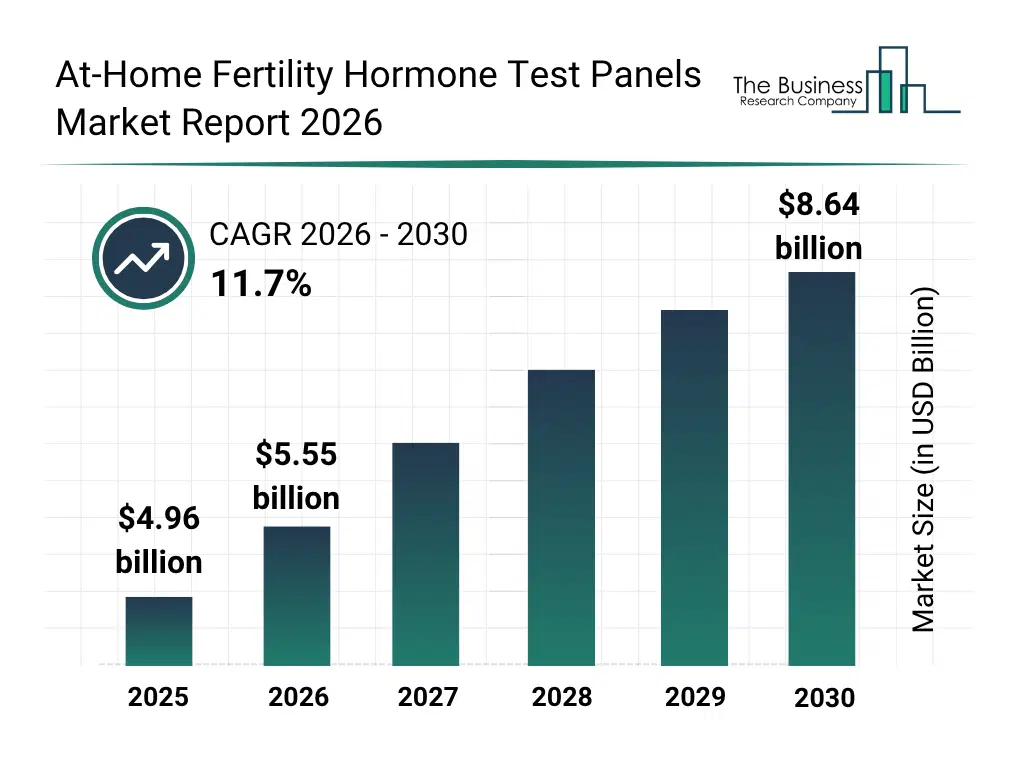
What Is The At-Home Fertility Hormone Test Panels Market Size and Share 2026?
The at-home fertility hormone test panels market size has grown rapidly in recent years. It will grow from $4.96 billion in 2025 to $5.55 billion in 2026 at a compound annual growth rate (CAGR) of 12.1%. The growth in the historic period can be attributed to increasing infertility prevalence, growing awareness of reproductive health, rising demand for home-based diagnostics, expanding access to fertility testing services, increasing delayed parenthood trends.What Is The At-Home Fertility Hormone Test Panels Market Growth Forecast?
The at-home fertility hormone test panels market size is expected to see rapid growth in the next few years. It will grow to $8.64 billion in 2030 at a compound annual growth rate (CAGR) of 11.7%. The growth in the forecast period can be attributed to growing demand for personalized fertility monitoring, increasing adoption of preventive reproductive healthcare, rising acceptance of self-testing solutions, expanding availability of digital diagnostic services, increasing focus on family planning. Major trends in the forecast period include rising adoption of at-home fertility testing, growing demand for early fertility assessment, increasing preference for non-invasive hormone testing, expansion of direct-to-consumer diagnostic services, growing consumer awareness of reproductive health.
Global At-Home Fertility Hormone Test Panels Market Segmentation
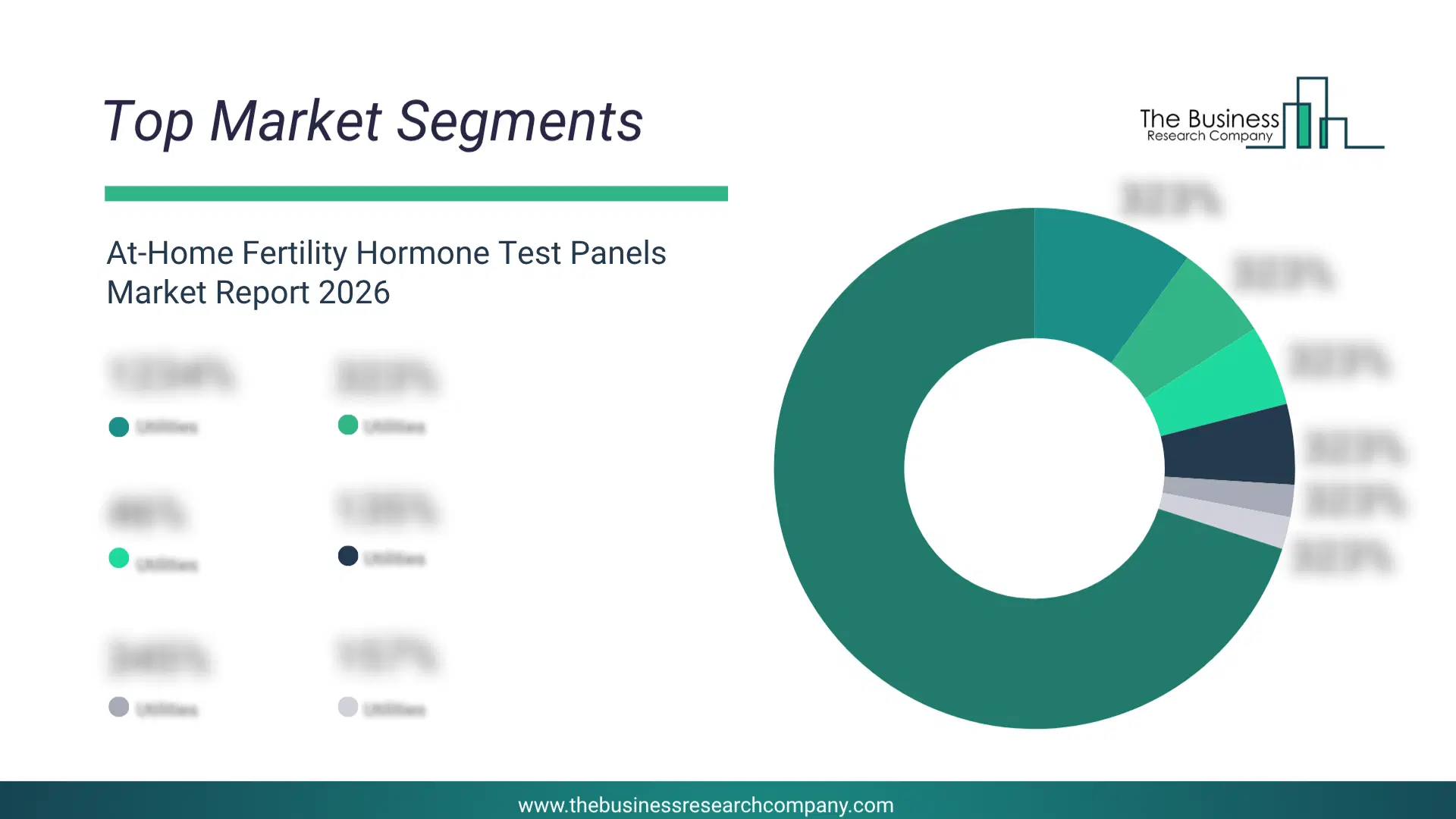
1) By Product Type: Female Fertility Test Panels, Male Fertility Test Panels, Combined Fertility Test Panels 2) By Sample Type: Blood, Urine, Saliva, Other Sample Types 3) By Distribution Channel: Direct To Consumer, Online Pharmacies, Retail Pharmacies, Supermarkets And Hypermarkets, Other Distribution Channels 4) By Application: Ovulation Prediction, Ovarian Reserve Testing, Hormone Level Monitoring, Other Applications 5) By End User: Home Care, Fertility Clinics, Diagnostic Centers Subsegments: 1) By Female Fertility Test Panels: Ovulation Prediction Test Panels, Ovarian Reserve Test Panels, Hormone Monitoring Test Panels, Pregnancy Planning Test Panels 2) By Male Fertility Test Panels: Sperm Analysis Test Panels, Male Hormone Assessment Test Panels, Fertility Health Screening Test Panels 3) By Combined Fertility Test Panels: Couple Fertility Assessment Test Panels, Comprehensive Reproductive Health Test Panels, Preconception Fertility Screening Test PanelsWhat Is The Driver Of The At-Home Fertility Hormone Test Panels Market?
The rising infertility rates globally are expected to propel the growth of the at-home fertility hormone test panels market going forward. Infertility refers to the inability to achieve pregnancy after a prolonged period of regular unprotected intercourse, typically due to reproductive health issues affecting either partner. The infertility rates are increasing due to delayed parenthood, as advancing age can reduce reproductive potential and fertility outcomes, leading to a higher prevalence of infertility. The at-home fertility hormone test panels support infertility rates by providing accessible, private, and convenient fertility assessment tools that help individuals monitor reproductive hormone levels and identify potential fertility concerns early. For instance, in October 2024, according to the Office for National Statistics (ONS), a UK-based government department, the total fertility rate (TFR) in England and Wales declined to a record low of 1.44 children per woman in 2023, compared to 1.49 in 2022. Therefore, the rising infertility rates globally are driving the growth of the at-home fertility hormone test panels industry.Key Players In The Global At-Home Fertility Hormone Test Panels Market
Major companies operating in the at-home fertility hormone test panels market are Abbott Laboratories, Church & Dwight Co. Inc., Swiss Precision Diagnostics GmbH, Everly Health Inc., Ro Health Inc., LetsGetChecked Inc., Easy Healthcare Corporation, Mira Fertility Inc., Inito Inc., Sugentech Inc., Fairhaven Health LLC, Fertility Focus Limited, GiveLegacy Inc., MFB Fertility Inc., Ava AG, Hertility Health Ltd., Oova Inc., ExSeed Health, Fellow Health Inc., Inne Bioscience GmbH, Arva Health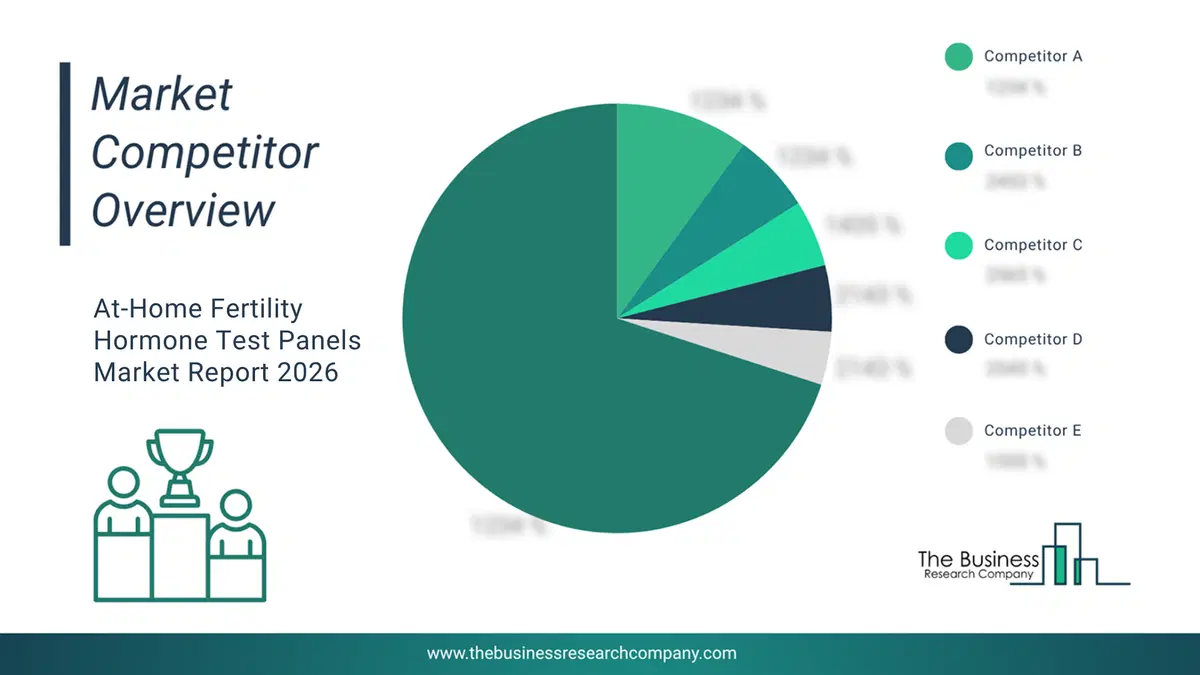
This chart is for illustrative purposes; the full report includes a detailed competitor analysis and comprehensive overview of the top 10 companies in the market.
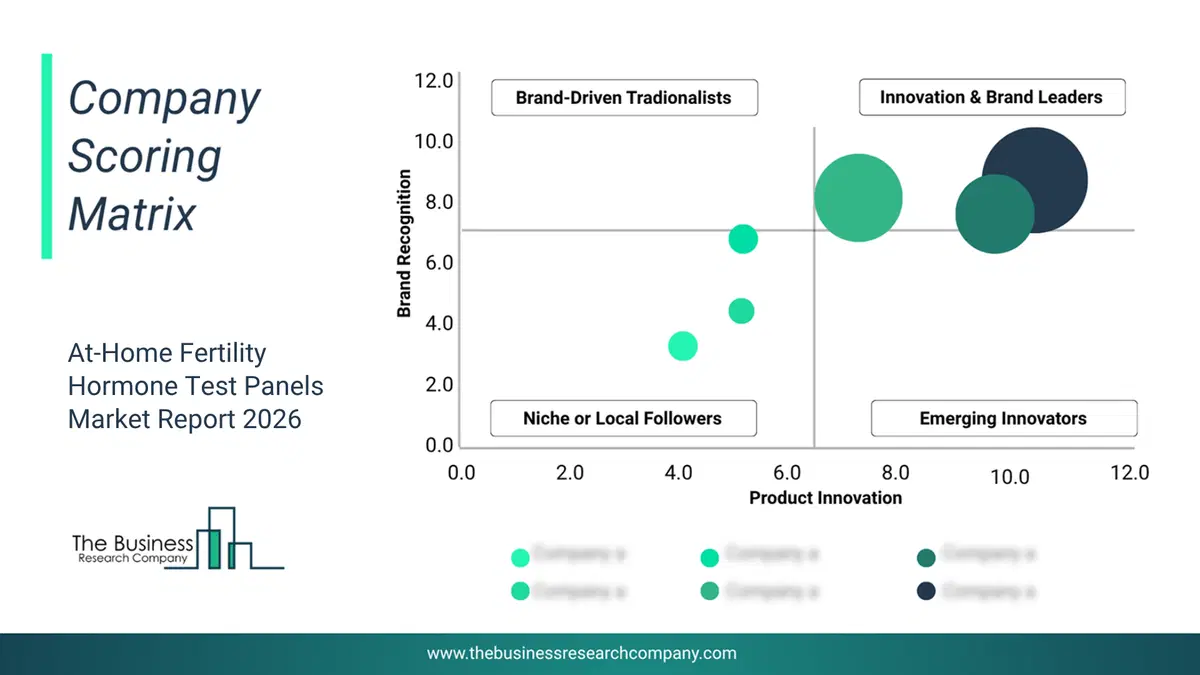
This chart maps companies by product innovation and brand strength, with bubble size indicating relative revenue, helping identify market leaders, challengers, and niche players. This is an illustrative chart; the full report provides a complete and accurate competitive analysis.
Global At-Home Fertility Hormone Test Panels Market Trends and Insights
Major companies operating in the at-home fertility hormone test panels market are focusing on developing advanced connected testing devices, such as app-integrated hormone monitors, to give couples shared, real-time visibility into fertility hormone patterns rather than isolated, individual results. A connected hormone testing device refers to an at-home diagnostic tool that measures fertility-related hormone biomarkers and syncs the results directly into a companion mobile application, allowing users to track cycle, ovulation, and hormone data alongside a partner. For instance, in June 2026, Vespexx Inc., a South Korea-based femtech company, officially launched Soonr Health in the US to enhance women’s health management through AI-powered cycle tracking, personalized reproductive health insights, symptom monitoring, and predictive wellness recommendations. Soonr Health combines cycle and ovulation tracking, habit and symptom logging, partner-aware sharing, and integrated at-home hormone testing, with both partners using the app on their own phones.What Are Latest Mergers And Acquisitions In The At-Home Fertility Hormone Test Panels Market?
In July 2023, Quest Diagnostics Incorporated, a US-based healthcare company, partnered with Proov to commercialize fertility testing. Through this partnership, Quest Diagnostics aimed to expand its women's health and fertility testing portfolio by offering Proov's at-home fertility hormone testing solutions through its direct-to-consumer platform, improving access to fertility assessment and reproductive health insights. Proov is a US-based women's health diagnostics company that develops at-home fertility and hormone testing products.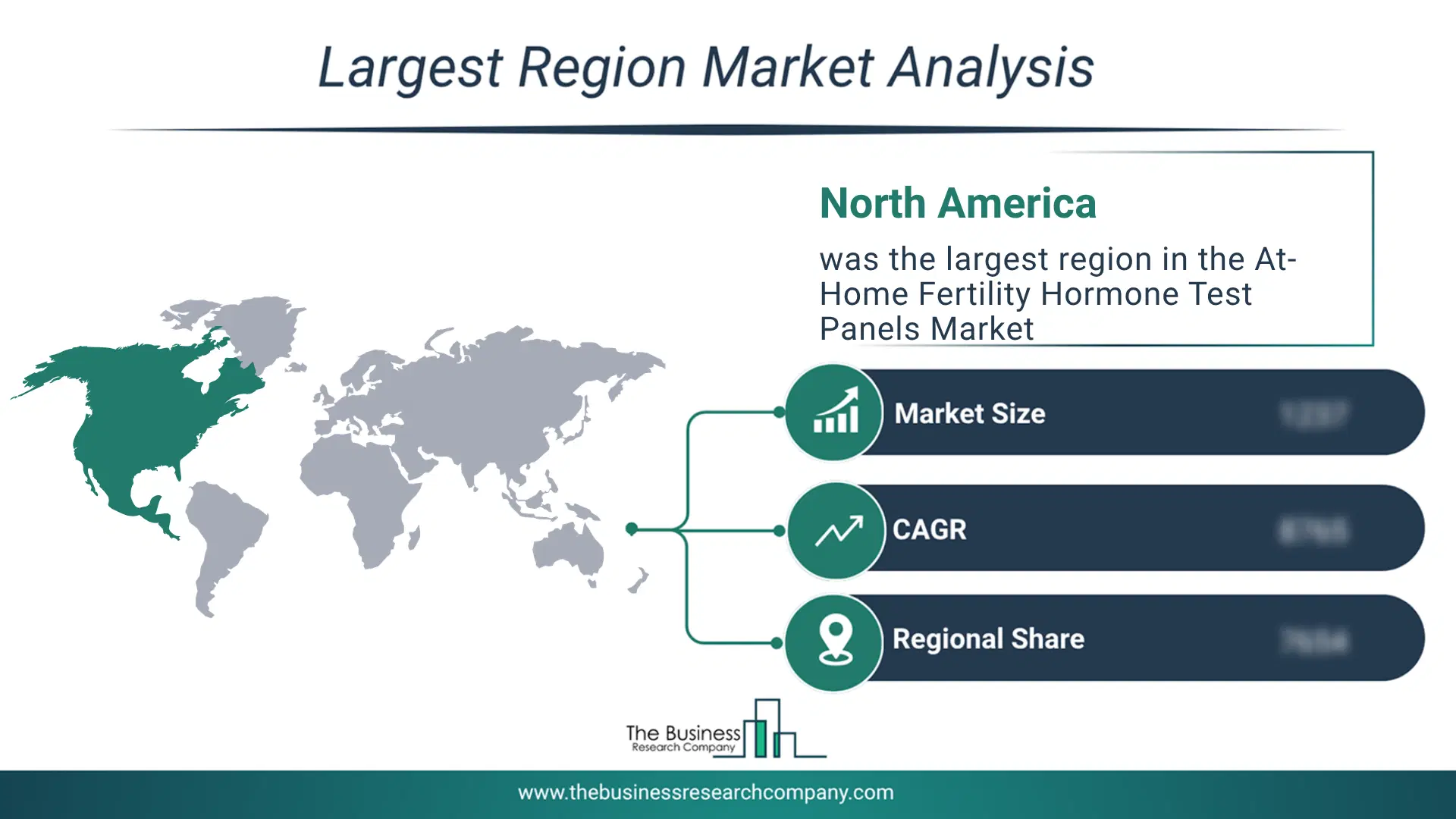
Regional Insights
North America was the largest region in the at-home fertility hormone test panels market in 2025. Asia-Pacific is expected to be the fastest-growing region in the forecast period. The regions covered in this market report are Asia-Pacific, South East Asia, Western Europe, Eastern Europe, North America, South America, Middle East, Africa. The countries covered in this market report are Australia, Brazil, China, France, Germany, India, Indonesia, Japan, Taiwan, Russia, South Korea, UK, USA, Canada, Italy, Spain.What Defines the At-Home Fertility Hormone Test Panels Market?
The at-home fertility hormone test panels market consists of sales of ovulation hormone test kits, reproductive health hormone test kits, fertility monitoring devices, and hormone analysis test strips. Values in this market are ‘factory gate’ values, that is, the value of goods sold by the manufacturers or creators of the goods, whether to other entities (including downstream manufacturers, wholesalers, distributors, and retailers) or directly to end customers. The value of goods in this market includes related services sold by the creators of the goods.How is Market Value Defined and Measured?
The market value is defined as the revenues that enterprises gain from the sale of goods and/or services within the specified market and geography through sales, grants, or donations in terms of the currency (in USD unless otherwise specified). The revenues for a specified geography are consumption values that are revenues generated by organizations in the specified geography within the market, irrespective of where they are produced. It does not include revenues from resales along the supply chain, either further along the supply chain or as part of other products.
This chart presents market attractiveness based on a quantitative evaluation of growth, competition, strategic alignment, and risk, offering a clear view of opportunity areas for decision-making. This chart is for illustrative purposes; the full report contains the complete analysis.

This chart highlights the Total Addressable Market (TAM) by estimating the maximum revenue opportunity using an assumption-driven approach, supporting strategic planning and opportunity sizing across markets. The chart is illustrative; the full report provides a more comprehensive analysis.
What Key Data and Analysis Are Included in the At-Home Fertility Hormone Test Panels Market Report 2026?
The at-home fertility hormone test panels market research report is one of a series of new reports from The Business Research Company that provides market statistics, including industry global market size, regional shares, competitors with the market share, detailed market segments, market trends and opportunities, and any further data you may need to thrive in the at-home fertility hormone test panels industry. The market research report delivers a complete perspective of everything you need, with an in-depth analysis of the current and future state of the industry.At-Home Fertility Hormone Test Panels Market Report Forecast Analysis
| Report Attribute | Details |
|---|---|
| Market Size Value In 2026 | $5.55 billion |
| Revenue Forecast In 2030 | $8.64 billion |
| Growth Rate | CAGR of 11.7% from 2026 to 2030 |
| Base Year For Estimation | 2025 |
| Actual Estimates/Historical Data | 2020-2025 |
| Forecast Period | 2026 - 2030 |
| Market Representation | Revenue in USD Billion and CAGR from 2026 to 2030 |
| Segments Covered | Product Type, Sample Type, Distribution Channel, Application, End User |
| Regional Scope | Asia-Pacific, Western Europe, Eastern Europe, North America, South America, Middle East, Africa |
| Country Scope | The countries covered in the report are Australia, Brazil, China, France, Germany, India, Indonesia, Japan, Taiwan, Russia, South Korea, UK, USA, Canada, Italy, Spain. |
| Key Companies Profiled | Abbott Laboratories, Church & Dwight Co. Inc., Swiss Precision Diagnostics GmbH, Everly Health Inc., Ro Health Inc., LetsGetChecked Inc., Easy Healthcare Corporation, Mira Fertility Inc., Inito Inc., Sugentech Inc., Fairhaven Health LLC, Fertility Focus Limited, GiveLegacy Inc., MFB Fertility Inc., Ava AG, Hertility Health Ltd., Oova Inc., ExSeed Health, Fellow Health Inc., Inne Bioscience GmbH, Arva Health |
| Customization Scope | Request for Customization |
| Pricing And Purchase Options | Explore Purchase Options |