
Atomic Emission Spectroscopy Market Report 2026
Global Outlook – By Type (Flame Emission Spectroscopy (FES), Spark Atomic Emission Spectroscopy (SAES), Arc Atomic Emission Spectroscopy (AES), Inductively Coupled Plasma Atomic Emission Spectroscopy (ICP-AES), Other Types), By Application (Biotechnology, Environmental Testing, Clinical Applications), By End-User (Pharmaceutical companies, Hospitals, Laboratories, Research institutes, Other End Users) – Market Size, Trends, Strategies, and Forecast to 2030
Atomic Emission Spectroscopy Market Overview
• Atomic Emission Spectroscopy market size has reached to $6.32 billion in 2025 • Expected to grow to $9.55 billion in 2030 at a compound annual growth rate (CAGR) of 8.5% • Growth Driver: Rising Pharmaceutical Industry Drives Growth Of Atomic Emission Spectroscopy Market • Market Trend: Next-Generation Spectroscopy Innovations Advancing Speed, Stability, And Analytical Precision • North America was the largest region in 2025 and Asia-Pacific is the fastest growing region.What Is Covered Under Atomic Emission Spectroscopy Market?
Atomic emission spectroscopy (AES) is an analytical technique used to determine the concentration of elements in a sample by measuring the emitted light from atoms excited by energy sources, such as plasma or flame. The intensity of the emitted light at specific wavelengths is directly related to the element's concentration. AES is commonly used in materials analysis, environmental testing, and chemical analysis. The main types of atomic emission spectroscopy are flame emission spectroscopy (FES), spark atomic emission spectroscopy (SAES), arc atomic emission spectroscopy (AES), inductively coupled plasma atomic emission spectroscopy (ICP-AES), and others. Flame emission spectroscopy (FES) is a technique that uses a flame to excite atoms in a sample, causing them to emit light at characteristic wavelengths. This method is primarily used for detecting and measuring the concentration of metal ions, especially alkali and alkaline earth metals, in various samples. This is used in various applications such as biotechnology, environmental testing, and clinical applications by end-users, including pharmaceutical companies, hospitals, laboratories, research institutes, and others.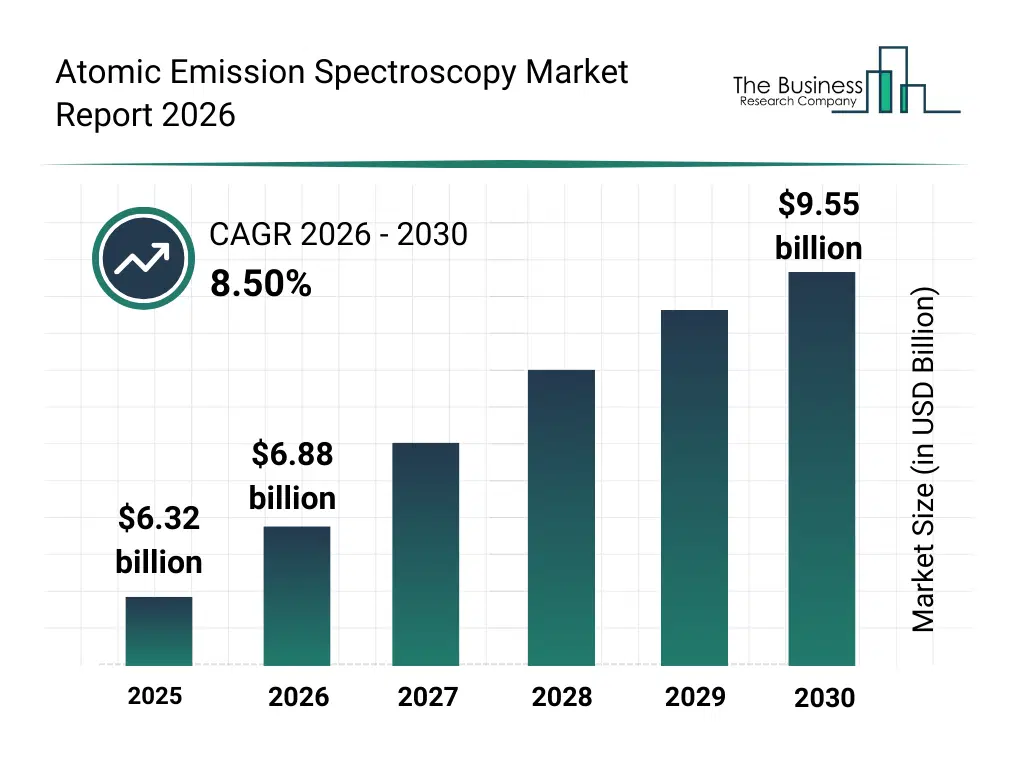
What Is The Atomic Emission Spectroscopy Market Size and Share 2026?
The atomic emission spectroscopy market size has grown strongly in recent years. It will grow from $6.32 billion in 2025 to $6.88 billion in 2026 at a compound annual growth rate (CAGR) of 8.9%. The growth in the historic period can be attributed to reliance on conventional flame and arc emission spectrometers, limited multi-element analysis capabilities, growing industrial and laboratory applications, increasing regulatory compliance for elemental testing, expansion of environmental monitoring programs.What Is The Atomic Emission Spectroscopy Market Growth Forecast?
The atomic emission spectroscopy market size is expected to see strong growth in the next few years. It will grow to $9.55 billion in 2030 at a compound annual growth rate (CAGR) of 8.5%. The growth in the forecast period can be attributed to technological advancements in icp-aes and mp-aes, rising adoption of portable and handheld spectrometers, increasing pharmaceutical and biotechnology testing, growth in high-throughput and automated analysis, integration with digital data management and cloud-based systems. Major trends in the forecast period include rising demand for multi-element and high-precision spectroscopy, expansion of portable and handheld aes instruments, increasing applications in environmental and clinical testing, growth of icp-aes systems in pharmaceutical analysis, adoption of automated sample handling and high-throughput analysis.
Global Atomic Emission Spectroscopy Market Segmentation
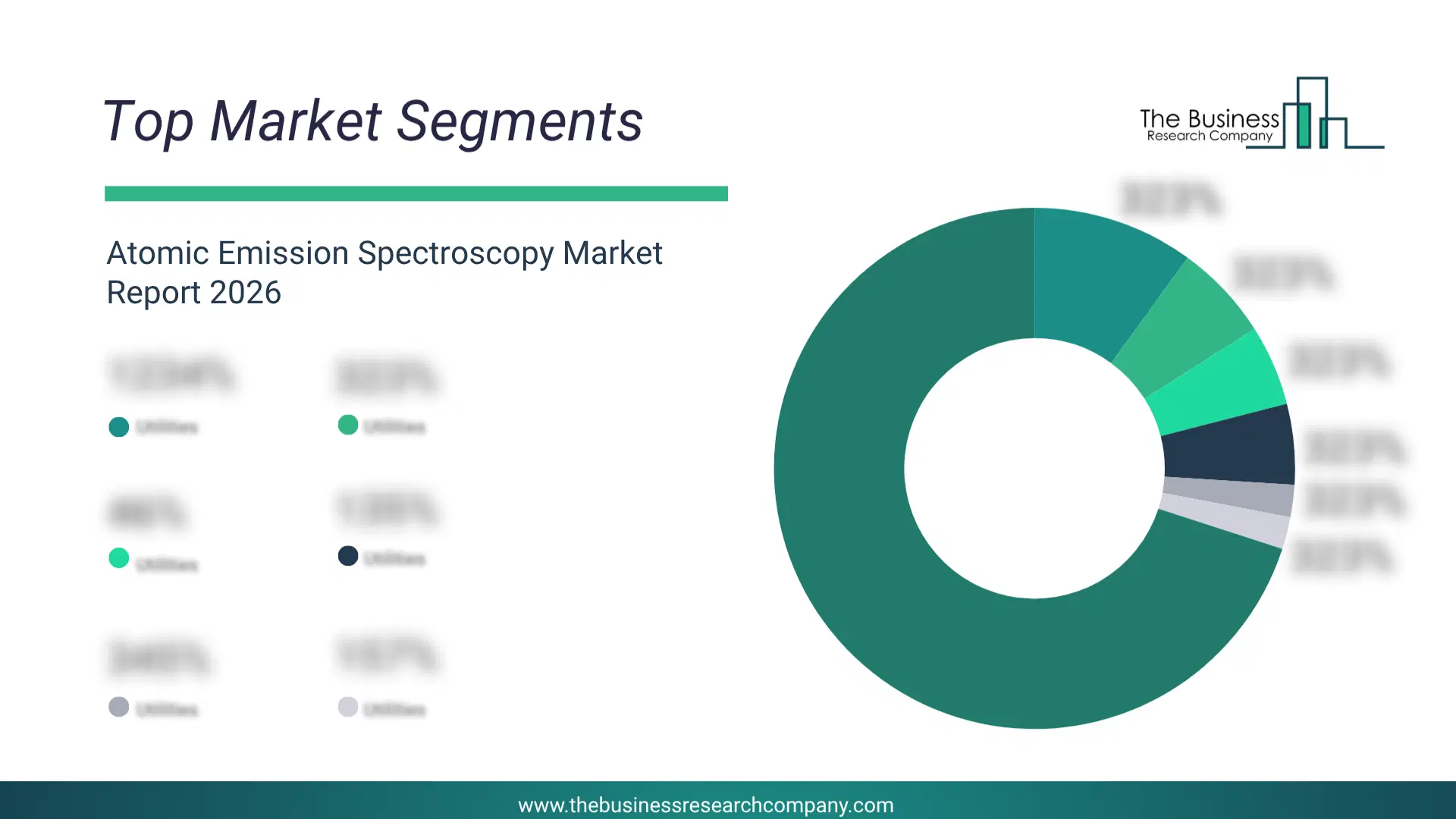
1) By Type: Flame Emission Spectroscopy (FES), Spark Atomic Emission Spectroscopy (SAES), Arc Atomic Emission Spectroscopy (AES), Inductively Coupled Plasma Atomic Emission Spectroscopy (ICP-AES), Other Types 2) By Application: Biotechnology, Environmental Testing, Clinical Applications 3) By End-User: Pharmaceutical companies, Hospitals, Laboratories, Research institutes, Other End Users Subsegments: 1) By Flame Emission Spectroscopy (FES): Single Element Flame Emission Spectrometers, Multi-Element Flame Emission Spectrometers, Portable Flame Emission Spectrometers, High-Throughput Flame Emission Spectrometers 2) By Spark Atomic Emission Spectroscopy (SAES): Laboratory Spark Atomic Emission Spectrometers, Industrial Spark Atomic Emission Spectrometers, Handheld Spark Atomic Emission Spectrometers, High-Precision Spark Atomic Emission Spectrometers 3) By Arc Atomic Emission Spectroscopy (AES): Direct Current Arc Atomic Emission Spectrometers, Radio Frequency Arc Atomic Emission Spectrometers, High-Temperature Arc Atomic Emission Spectrometers, Portable Arc Atomic Emission Spectrometers 4) By Inductively Coupled Plasma Atomic Emission Spectroscopy (ICP-AES): Quadrupole ICP-AES, High-Resolution ICP-AES, Multi-Element ICP-AES, Portable ICP-AES Systems, High-Sensitivity ICP-AES Systems 5) By Other Types: Laser-Induced Breakdown Spectroscopy (LIBS), Microwave Plasma Atomic Emission Spectroscopy (MP-AES), Continuous Wave Atomic Emission Spectroscopy (CWAES)What Is The Driver Of The Atomic Emission Spectroscopy Market?
The growing pharmaceutical industry is expected to propel the growth of the atomic emission spectroscopy market going forward. The pharmaceutical industry focuses on the research, development, production, and marketing of medications to improve health outcomes. The pharmaceutical industry is growing due to increasing demand for innovative treatments, advancements in drug development technologies, and rising healthcare needs globally. Atomic emission spectroscopy is used in the pharmaceutical industry for the precise detection and quantification of trace elements and metal impurities in drugs and formulations, ensuring compliance with regulatory standards. For instance, in August 2025, according to the European Federation of Pharmaceutical Industries and Associations (EFPIA), a Belgium-based trade association representing the pharmaceutical industry, in 2023 the pharmaceutical industry invested about ($ 60364.80 million) €52,400 million in R&D in Europe. Therefore, the growing pharmaceutical industry is driving the growth of the atomic emission spectroscopy industry.Key Players In The Global Atomic Emission Spectroscopy Market
Major companies operating in the atomic emission spectroscopy market are Hitachi Ltd, Thermo Fisher Scientific Inc., Agilent Technologies Inc., Wuxi Jinyibo Instrument Technology, Shimadzu Corporation, Bruker Corporation, Horiba Ltd., Oxford Instruments PLC, Leco Corporation, SPECTRO Analytical Instruments GmbH, Jiangsu Skyray Instrument Co. Ltd., CAMECA Instruments Inc., Teledyne Leeman Labs, Nippon Instruments Corporation, PerkinElmer Inc, Analytik Jena AG, AMETEK Inc, Rigaku Corporation, JEOL Ltd, Focused Photonics Inc, GNR Analytical Instruments Group SpA, Aurora Instruments Ltd.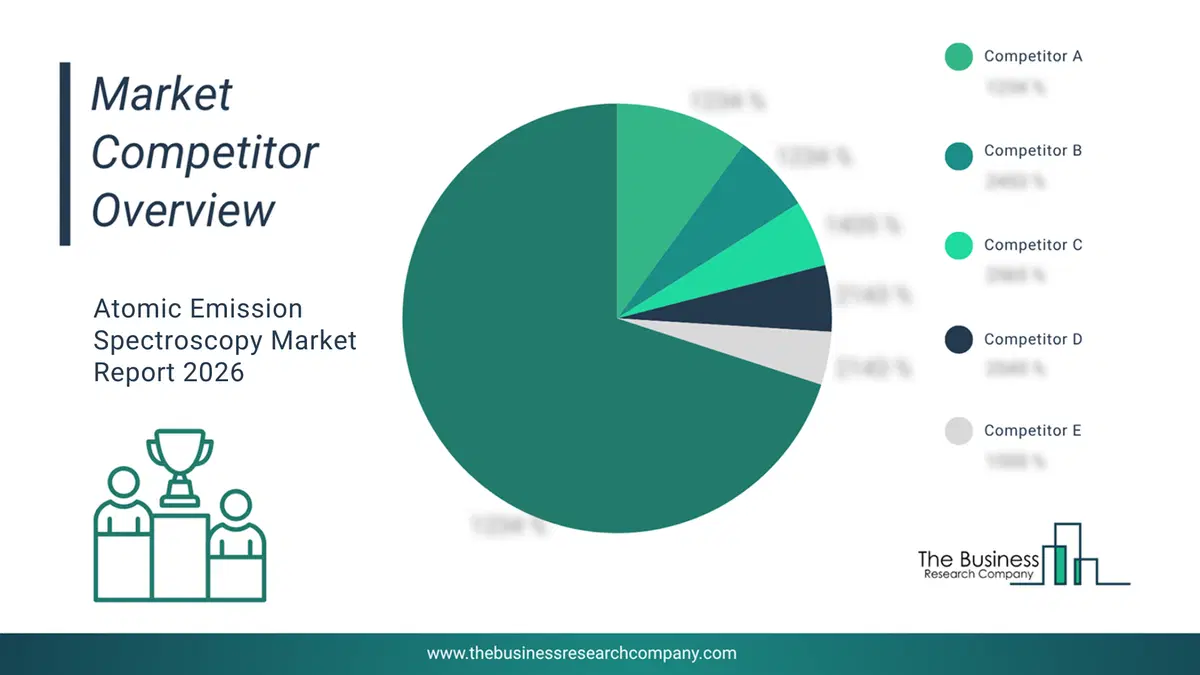
This chart is for illustrative purposes; the full report includes a detailed competitor analysis and comprehensive overview of the top 10 companies in the market.
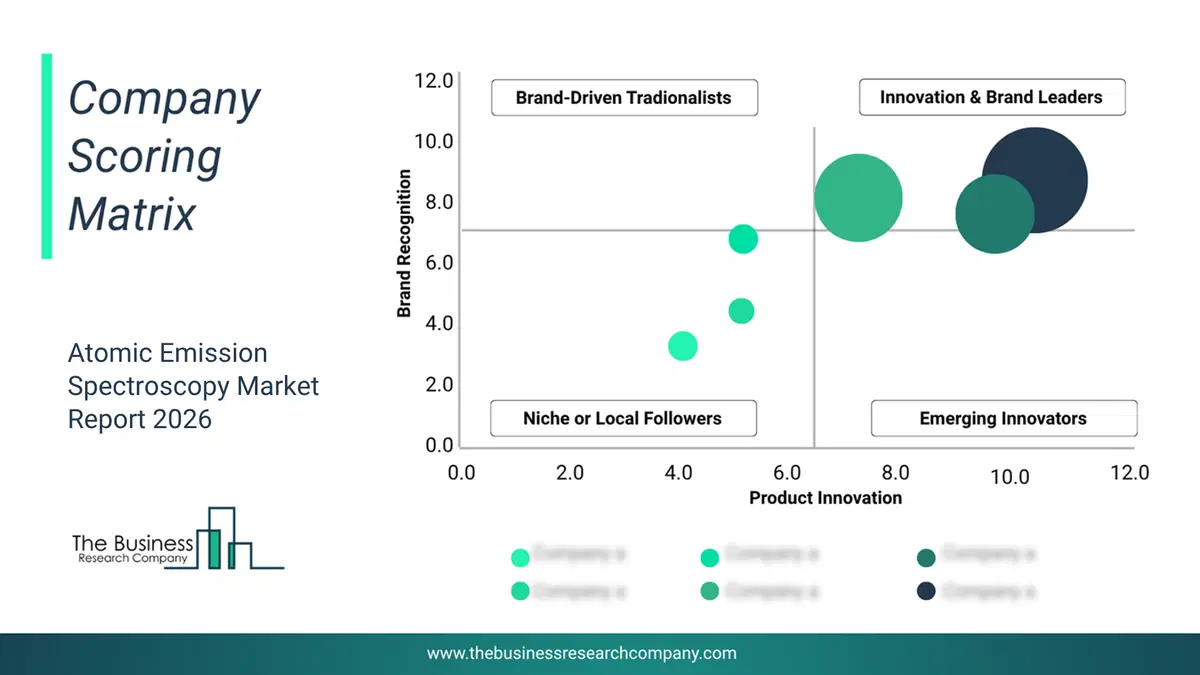
This chart maps companies by product innovation and brand strength, with bubble size indicating relative revenue, helping identify market leaders, challengers, and niche players. This is an illustrative chart; the full report provides a complete and accurate competitive analysis.
Global Atomic Emission Spectroscopy Market Trends and Insights
Major companies operating in the atomic emission spectroscopy market are focusing on advancing instrument performance through faster processing, enhanced stability, extended maintenance intervals, and integrated automation technologies to deliver more accurate, efficient, and reliable elemental analysis solutions for industrial and research applications. For instance, in November 2023, Thermo Fisher Scientific, a US-based medical technology company, has introduced its next-generation ARL iSpark Plus Optical Emission Spectrometers, designed to deliver faster, more reliable elemental analysis for metal producers, processors, recyclers, and research labs. Building on the established ARL iSpark series, the new systems feature upgraded optics, digital spark generation, intelligent algorithms, and an enhanced spark stand that reduces signal drift, eliminates memory effects, and extends maintenance intervals by 30%. Their optimized software and firmware also reduce processing time by 15%. These advancements enable ultra-fast detection of non-metallic inclusions and support higher productivity, energy savings, and improved quality control across metal production and processing environments.What Are Latest Mergers And Acquisitions In The Atomic Emission Spectroscopy Market?
In October 2023, Calibre Scientific Inc., a US-based manufacturer of precision instruments, acquired CPS Analitica Srl for an undisclosed amount. The acquisition of CPS Analitica strengthens Calibre Scientific's position as a diversified global provider of life science reagents, tools, instruments, and other consumables to various industries, including lab research, diagnostics, and biopharmaceuticals. CPS Analitica Srl is an Italy-based company offering various analytical solutions, including absorption spectrometers.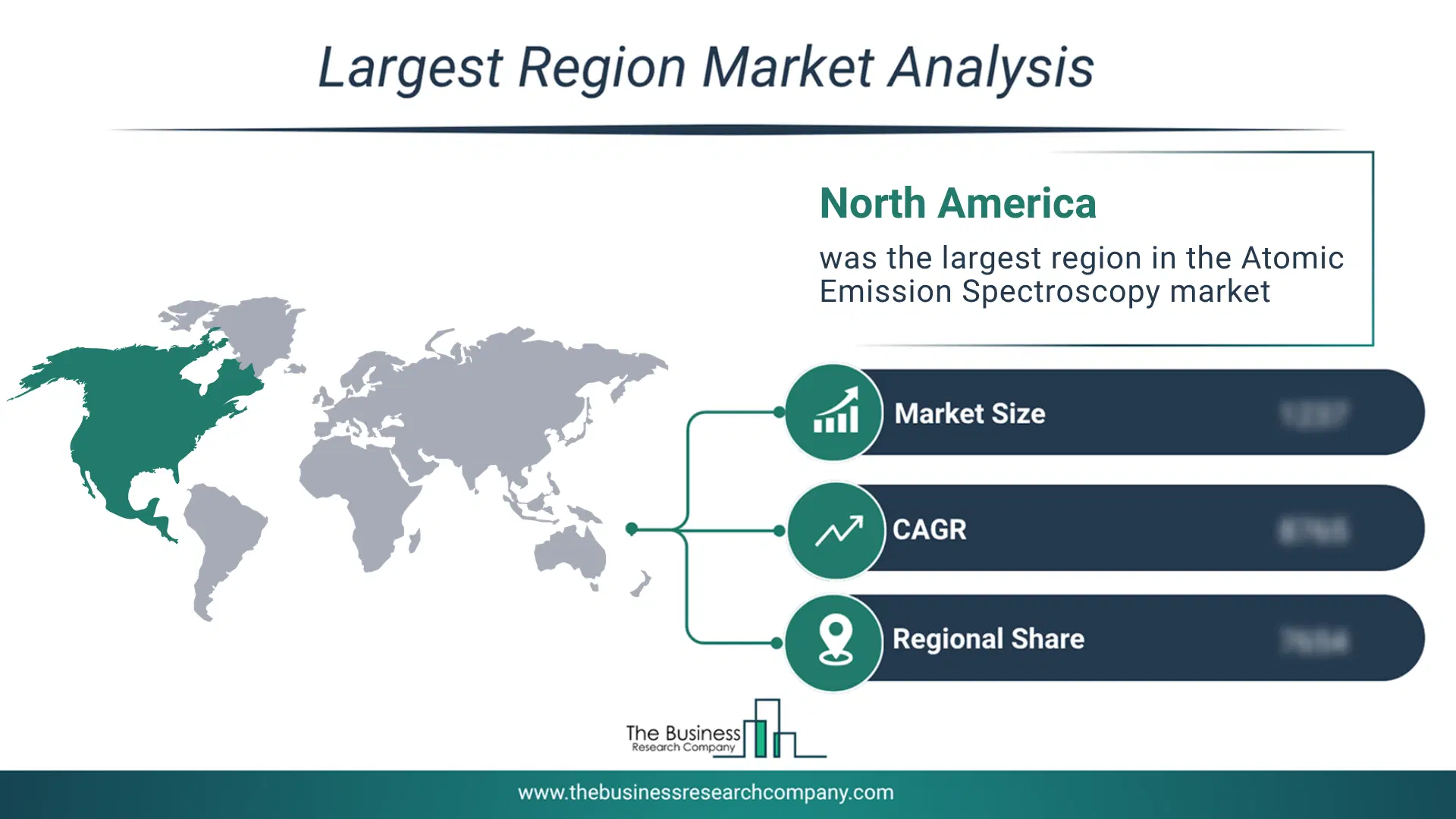
Regional Outlook
North America was the largest region in the atomic emission spectroscopy market in 2025. Asia-Pacific is expected to be the fastest-growing region in the forecast period. The regions covered in this market report are Asia-Pacific, South East Asia, Western Europe, Eastern Europe, North America, South America, Middle East, Africa. The countries covered in this market report are Australia, Brazil, China, France, Germany, India, Indonesia, Japan, Taiwan, Russia, South Korea, UK, USA, Canada, Italy, SpainWhat Defines the Atomic Emission Spectroscopy Market?
The atomic emission spectroscopy market includes revenues earned by entities by providing services such as elemental analysis services, calibration and validation services, maintenance and repair services, installation and setup services, and application support services. The market value includes the value of related goods sold by the service provider or included within the service offering. Only goods and services traded between entities or sold to end consumers are included.How is Market Value Defined and Measured?
The market value is defined as the revenues that enterprises gain from the sale of goods and/or services within the specified market and geography through sales, grants, or donations in terms of the currency (in USD unless otherwise specified). The revenues for a specified geography are consumption values that are revenues generated by organizations in the specified geography within the market, irrespective of where they are produced. It does not include revenues from resales along the supply chain, either further along the supply chain or as part of other products.
This chart presents market attractiveness based on a quantitative evaluation of growth, competition, strategic alignment, and risk, offering a clear view of opportunity areas for decision-making. This chart is for illustrative purposes; the full report contains the complete analysis.

This chart highlights the Total Addressable Market (TAM) by estimating the maximum revenue opportunity using an assumption-driven approach, supporting strategic planning and opportunity sizing across markets. The chart is illustrative; the full report provides a more comprehensive analysis.
What Key Data and Analysis Are Included in the Atomic Emission Spectroscopy Market Report 2026?
The atomic emission spectroscopy market research report is one of a series of new reports from The Business Research Company that provides market statistics, including industry global market size, regional shares, competitors with the market share, detailed market segments, market trends and opportunities, and any further data you may need to thrive in the atomic emission spectroscopy industry. The market research report delivers a complete perspective of everything you need, with an in-depth analysis of the current and future state of the industry.Atomic Emission Spectroscopy Market Report Forecast Analysis
| Report Attribute | Details |
|---|---|
| Market Size Value In 2026 | $6.88 billion |
| Revenue Forecast In 2030 | $9.55 billion |
| Growth Rate | CAGR of 8.5% from 2026 to 2030 |
| Base Year For Estimation | 2025 |
| Actual Estimates/Historical Data | 2020-2025 |
| Forecast Period | 2026 - 2030 |
| Market Representation | Revenue in USD Billion and CAGR from 2026 to 2030 |
| Segments Covered | Type, Application, End-User |
| Regional Scope | Asia-Pacific, Western Europe, Eastern Europe, North America, South America, Middle East, Africa |
| Country Scope | The countries covered in the report are Australia, Brazil, China, France, Germany, India, Indonesia, Japan, Taiwan, Russia, South Korea, UK, USA, Canada, Italy, Spain. |
| Key Companies Profiled | Hitachi Ltd, Thermo Fisher Scientific Inc., Agilent Technologies Inc., Wuxi Jinyibo Instrument Technology, Shimadzu Corporation, Bruker Corporation, Horiba Ltd., Oxford Instruments PLC, Leco Corporation, SPECTRO Analytical Instruments GmbH, Jiangsu Skyray Instrument Co. Ltd., CAMECA Instruments Inc., Teledyne Leeman Labs, Nippon Instruments Corporation, PerkinElmer Inc, Analytik Jena AG, AMETEK Inc, Rigaku Corporation, JEOL Ltd, Focused Photonics Inc, GNR Analytical Instruments Group SpA, Aurora Instruments Ltd. |
| Customization Scope | Request for Customization |
| Pricing And Purchase Options | Explore Purchase Options |