

Audio Plug-In Software Application Market Report 2026
Global Outlook – By Type (Editing, Mixing, Recording), By Software (On-Premise, Cloud-Based), By Operating System (Windows, Mac Operating System (OS)), By End-User (Professionals Or Audio Engineers And Mixers, Songwriters And Production teams, Electronic Musicians, Artists Or Performers, Education Institutes, Music Studios, Other End-Users) – Market Size, Trends, Strategies, and Forecast to 2035
Audio Plug-In Software Application Market Overview
• Audio Plug-In Software Application market size has reached to $5.64 billion in 2025 • Expected to grow to $10.08 billion in 2030 at a compound annual growth rate (CAGR) of 11.9% • Growth Driver: Driving Growth of Audio Plug-In Software Applications with High-Definition Audio • Market Trend: Futuristic DAW Plug-ins Revolutionize Remote Collaboration In Audio Production • North America was the largest region in 2025 and Asia-Pacific is the fastest growing region.Market Gains By 2030 – Top Opportunities By Segment
Market Gain identifies the most promising market opportunities by highlighting the segments or products expected to generate the highest incremental revenue growth over the next five years.
What Is Covered Under Audio Plug-In Software Application Market?
An audio plug-in software application, also known as a plug-in, is a piece of software designed to work with digital audio workstations (DAWs) or other audio software to enhance or modify audio signals in a variety of ways, such as introducing effects, processing sounds, or creating new sounds entirely. This software application enables users to edit and manipulate audio recordings or synthetic sounds to achieve certain artistic or technical objectives. The main types of audio plug-in software applications are editing, mixing, and recording. Editing is the process of manipulating and refining audio recordings by modifying components such as volume, pitch, and timing to obtain the intended results, and audio plugins are necessary for fine-tuning and improving audio tracks before final production. The software is categorized as on-premise and cloud-based for operating systems such as Windows and Mac operating systems (OS) used by end-users such as professionals, audio engineers and mixers, songwriters and production teams, electronic musicians, artists or performers, education institutes, music studios, and others.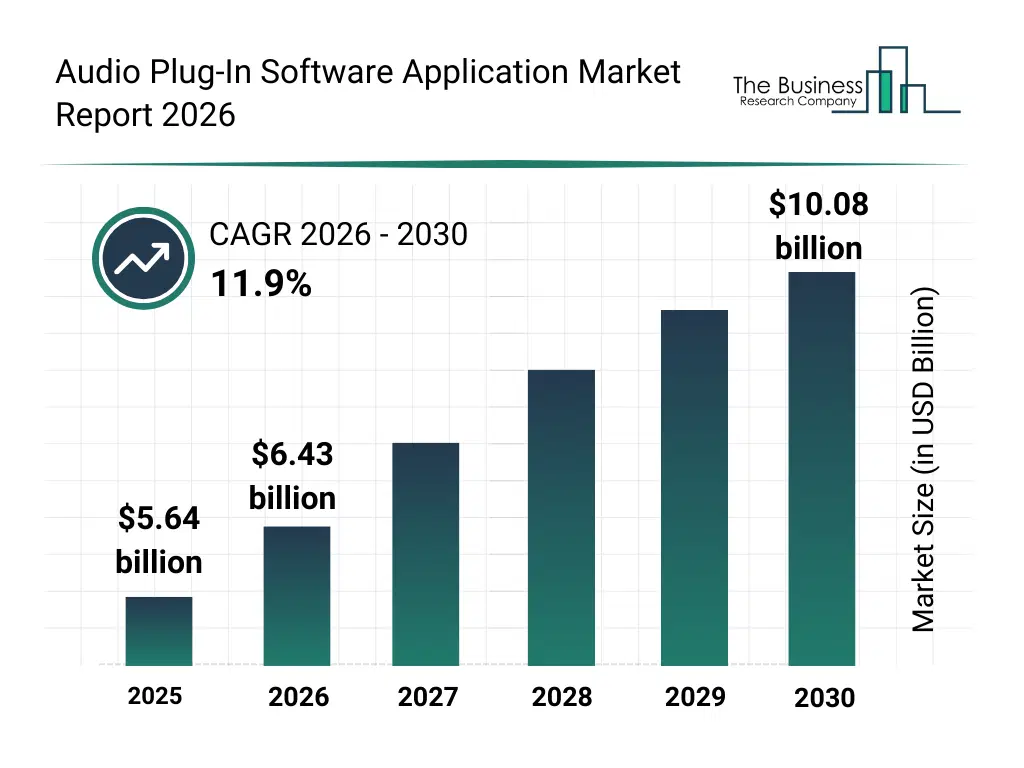
What Is The Audio Plug-In Software Application Market Size and Share 2026?
The audio plug-in software application market size has grown rapidly in recent years. It will grow from $5.64 billion in 2025 to $6.43 billion in 2026 at a compound annual growth rate (CAGR) of 14.1%. The growth in the historic period can be attributed to growth of digital audio workstations adoption, increasing home studio setups, rising popularity of electronic music production, expanding professional music studios, affordability of audio production software.What Is The Audio Plug-In Software Application Market Growth Forecast?
The audio plug-in software application market size is expected to see rapid growth in the next few years. It will grow to $10.08 billion in 2030 at a compound annual growth rate (CAGR) of 11.9%. The growth in the forecast period can be attributed to growth in cloud-based audio production tools, increasing creator economy participation, demand for immersive audio experiences, advancements in real-time audio processing, expansion of online music education platforms. Major trends in the forecast period include rising adoption of ai-assisted audio processing tools, growing demand for subscription-based plug-in licensing models, increased use of real-time audio effects in live streaming, expansion of cross-platform plug-in compatibility, rising focus on user-friendly interfaces for non-professional creators.
Global Audio Plug-In Software Application Market Segmentation
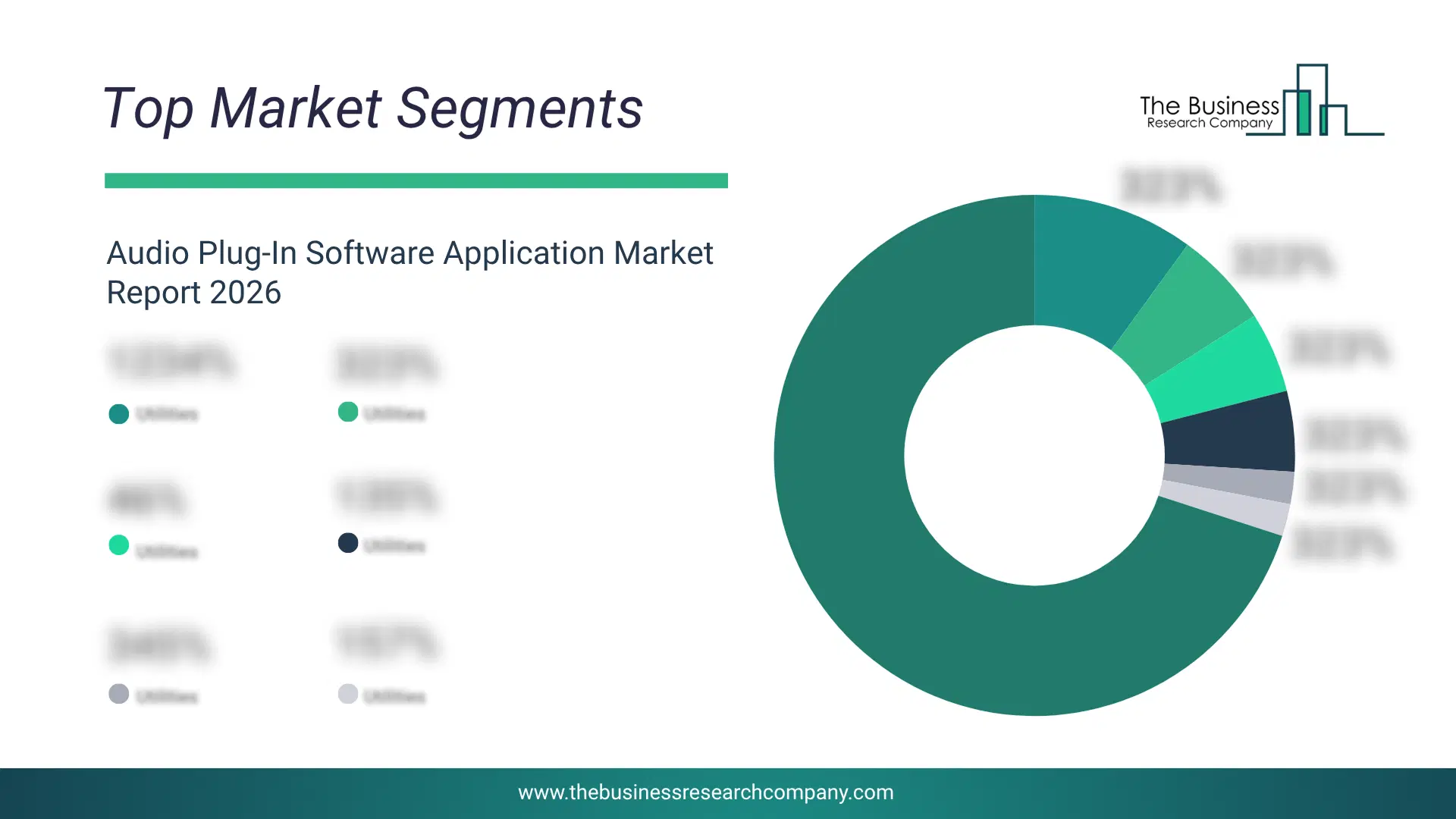
1) By Type: Editing, Mixing, Recording 2) By Software: On-Premise, Cloud-Based 3) By Operating System: Windows, Mac Operating System (OS) 4) By End-User: Professionals Or Audio Engineers And Mixers, Songwriters And Production teams, Electronic Musicians, Artists Or Performers, Education Institutes, Music Studios, Other End-Users Subsegments: 1) By Editing: Audio Restoration Plug-Ins, Noise Reduction Plug-Ins, Equalizers And Filters, Time Stretching And Pitch Shifting Plug-ins 2) By Mixing: Reverb And Delay Plug-Ins, Compression And Limiting Plug-Ins, Eq And Panning Plug-Ins, Multi-Band Compression Plug-Ins, Stereo Imaging Plug-Ins 3) By Recording: Virtual Instruments, Audio Capture Plug-Ins, Looping And Sampling Plug-Ins, Sound Design Plug-Ins The top segments in the audio plug-in software application market will be: • On-Premise will reach $1790.1 Million by 2025. • Windows will reach $1377 Million by 2025. • Mixing will reach $1164.3 Million by 2025. • Cloud-Based will reach $962.2 Million by 2025. • Editing will reach $925.5 Million by 2025.What Is The Driver Of The Audio Plug-In Software Application Market?
The growing demand for high-definition audio is expected to propel the growth of audio plug-in software applications going forward. High-definition audio refers to audio technology that offers higher quality, fidelity, and resolution than standard audio format. The demand for high-definition audio is growing as it provides superior sound quality compared to standard audio formats. Audio plug-ins that leverage high-definition audio processing can enhance audio recordings' clarity, fidelity, and realism, making them more appealing to musicians, producers, and audio engineers. For example, in October 2024, according to the Prism.fm an US-based concert and live event management platform, the global live music market has increased by 25% in 2023 as compared to 2022 reaching up to $33 billion. Therefore, the increasing demand for high-definition audio is driving the growth of audio plug-in software applications industry.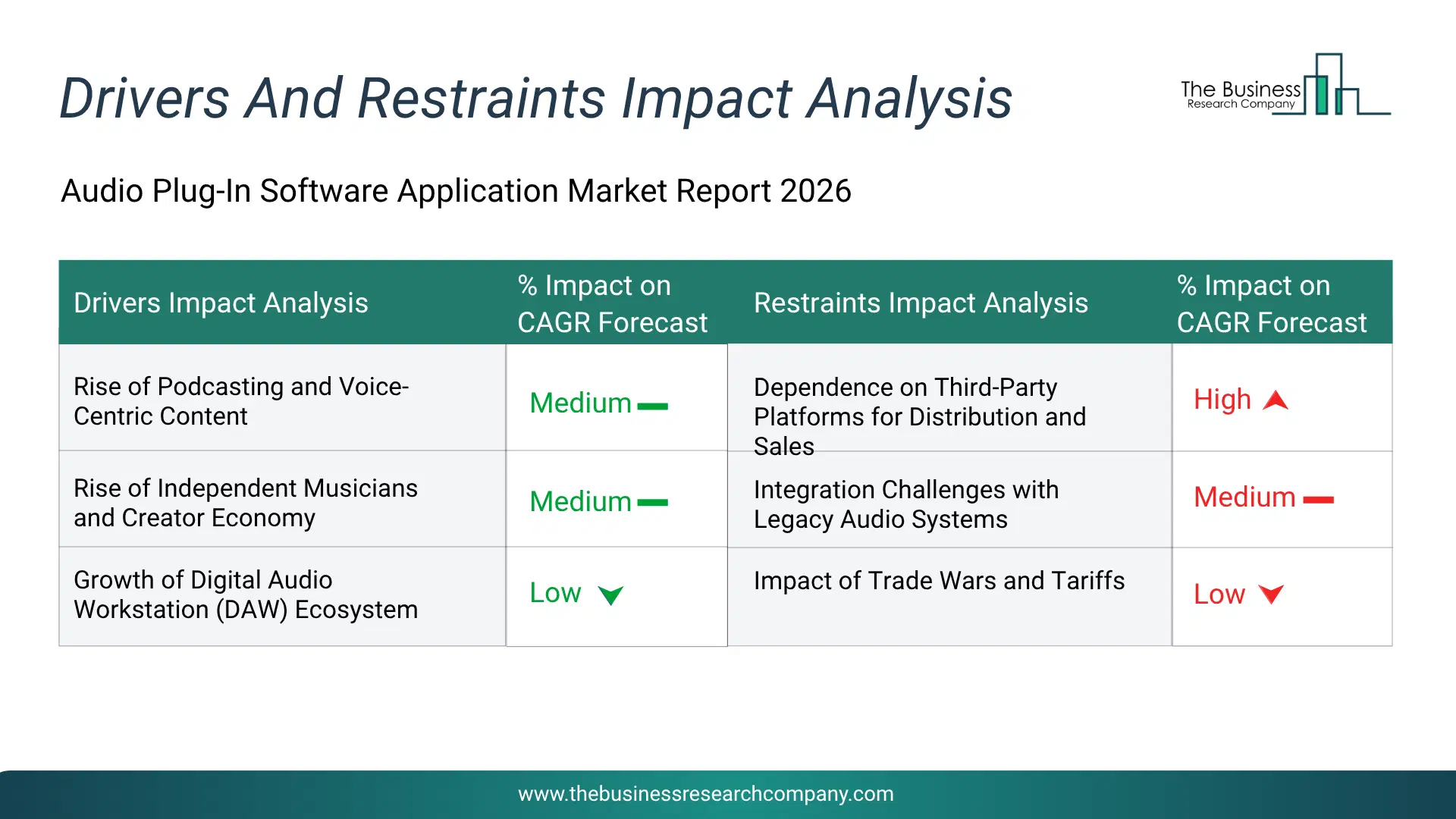
Infographic Chart Showing Key Market Drivers Analysis And Restraints For Audio Plug-In Software Application Market
The chart presents an impact analysis of key drivers and restraints, quantifying their relative influence on the market's growth rate and helping assess the balance between growth enablers and limiting factors. This chart offers a high-level perspective; the full report contains more detailed insights.
How Will The Drivers Impact Growth In The Global Audio Plug-In Software Application Market?
• Rise of Podcasting and Voice-Centric Content (Medium) – The rise of podcasting and voice-centric content will become a key driver of growth in the audio plug-in software market by 2030. Rise of podcasting and voice-centric content is increasing the demand for tools that enhance speech clarity, remove background noise, and ensure consistent vocal quality across recordings. As podcasts, audiobooks, webinars, and voice-based content grow in popularity, creators require plug-ins for tasks such as noise reduction, equalization, compression, and de-easing. These tools help achieve professional-grade audio without relying on expensive studio environments. The surge in individual creators and small teams producing voice content further amplifies the need for accessible and efficient processing solutions. This shift encourages continuous innovation in plug-ins optimized specifically for spoken-word audio workflows. As a result, the rise of podcasting and voice-centric content is anticipated to contributing to a 1.5% annual growth in the market. • Rise of Independent Musicians and Creator Economy (Medium) – The rise of independent musicians and creator economy will emerge as a major factor driving the expansion of the audio plug-in software market by 2030. Rise of independent musicians and creator economy is expanding the number of individuals producing and distributing music independently, reducing dependence on traditional studios and record labels. Independent creators rely heavily on plug-ins to handle recording, mixing, mastering, and sound design within home or small-scale setups. Tools such as virtual instruments, effects processors, and mastering suites enable high-quality production at lower costs. The growth of social platforms and streaming services allows creators to directly reach audiences, increasing the importance of polished audio output. This environment drives consistent demand for versatile and affordable plug-in solutions that support diverse creative needs. Consequently, the rise of independent musicians and creator economy is projected to contributing to a 1.0% annual growth in the market. • Growth of Digital Audio Workstation (DAW) Ecosystem (Low) – The growth of digital audio workstation (DAW) ecosystem will serve as a key growth catalyst for the audio plug-in software market by 2030. Growth of digital audio workstation (DAW) ecosystem is enhancing the role of plug-ins as essential components of modern audio production workflows. DAWs provide platforms where users can integrate a wide range of third-party tools for effects, instruments, and signal processing. As production techniques become more advanced, users seek specialized plug-ins for tasks like spatial audio, automation, mixing precision, and real-time processing. The interoperability of plug-in formats allows seamless customization of production environments. Continuous updates and feature expansions in DAWs further encourage users to adopt new plug-ins to improve efficiency and creative control. Therefore, this growth of digital audio workstation (DAW) ecosystem is projected to supporting to a 0.8% annual growth in the market. • Government and Institutional Support for Creative Industries and Digital Skills (Low) – The government and institutional support for creative industries and digital skills will become a significant driver contributing to the growth of the audio plug-in software market by 2030. Government and institutional support for creative industries and digital skills is helping expand the pool of trained individuals capable of using advanced audio production tools. Educational programs, training initiatives, and funding for creative projects are encouraging skill development in music production, sound engineering, and digital media. As more individuals gain exposure to audio technologies, the adoption of plug-ins becomes more widespread across academic and professional settings. Institutions integrating audio production into curricula also increase familiarity with industry-standard tools. This support strengthens the overall ecosystem by building a knowledgeable user base that actively utilizes plug-ins in various creative applications. Consequently, the government and institutional support for creative industries and digital skills is projected to contributing to a 0.5% annual growth in the market.How Will The Restraints Impact Growth In The Global Audio Plug-In Software Application Market?
• Dependence on Third-Party Platforms for Distribution and Sales (Medium) – Dependence on third-party platforms for distribution and sales is expected to restrain market growth during the forecast period. It creates operational, financial, regulatory, or commercial challenges that can increase costs, delay projects, reduce investments, or discourage purchasing decisions depending on the market. These challenges can reduce product adoption, affect business confidence, and limit the ability of companies to expand efficiently across key regions. This can reduce operational efficiency, delay expansion plans, and affect the ability of companies to achieve sustainable business growth. • Integration Challenges with Legacy Audio Systems (Medium) – During the forecast period, integration challenges with legacy audio systems is likely to limit market expansion. It creates operational, financial, regulatory, or commercial challenges that can increase costs, delay projects, reduce investments, or discourage purchasing decisions depending on the market. These challenges can reduce product adoption, affect business confidence, and limit the ability of companies to expand efficiently across key regions. As a result, businesses may face increased cost pressures, slower commercial adoption, and reduced revenue opportunities. • Impact of Trade Wars and Tariffs (Low) – The market is expected to face challenges due to impact of trade wars and tariffs over the forecast period. It creates operational, financial, regulatory, or commercial challenges that can increase costs, delay projects, reduce investments, or discourage purchasing decisions depending on the market. These challenges can reduce product adoption, affect business confidence, and limit the ability of companies to expand efficiently across key regions. This may discourage new investments, delay strategic expansion initiatives, and weaken the overall competitive position of market participants.Key Players In The Global Audio Plug-In Software Application Market
Major companies operating in the audio plug-in software application market are Apple Inc., Avid Technology Inc., Magix Software GmbH, Universal Audio, Steinberg Media Technologies GmbH, Image Line Software, Arturia SA, Eventide Inc., PreSonus Audio Electronics Inc., Waves Audio Ltd., Native Instruments USA Inc., NCH Software, Softube, HoRNet SRL, Antares Audio Technologies, Plugin Alliance, Soundtoys, Blue Cat Audio, FabFilter, Slate Digital, Sonnox, MeldaProduction, Cableguys, Acon Digital AS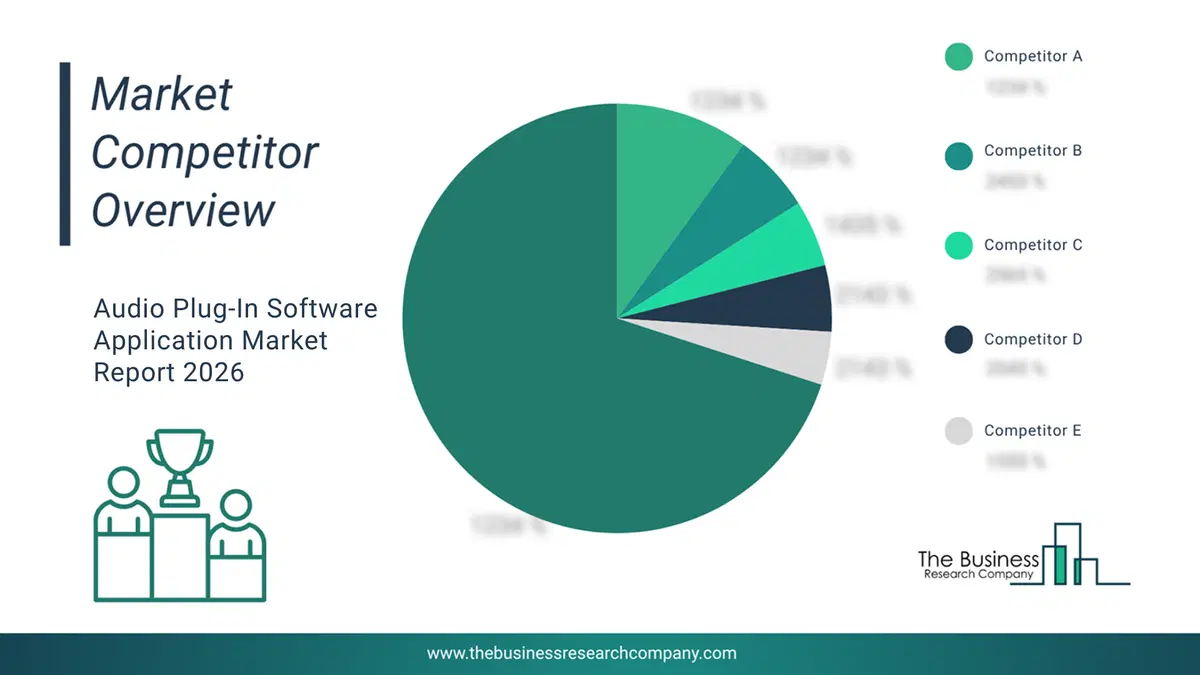
This chart is for illustrative purposes; the full report includes a detailed competitor analysis and comprehensive overview of the top 10 companies in the market.
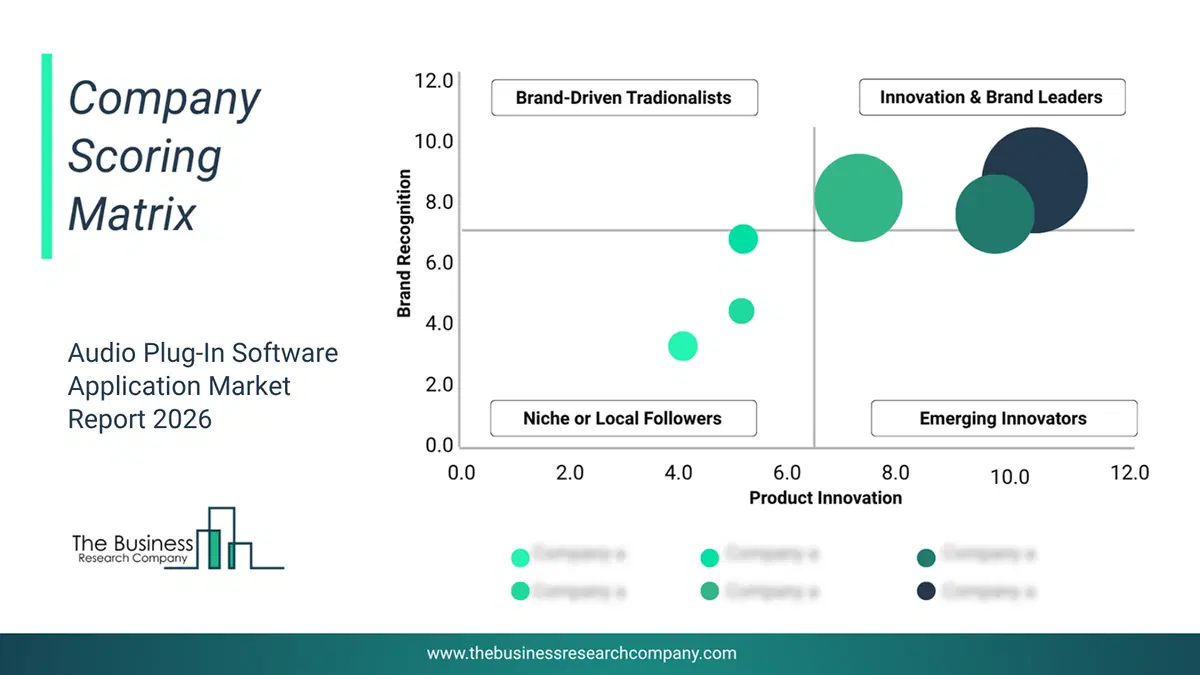
This chart maps companies by product innovation and brand strength, with bubble size indicating relative revenue, helping identify market leaders, challengers, and niche players. This is an illustrative chart; the full report provides a complete and accurate competitive analysis.
Global Audio Plug-In Software Application Market Trends and Insights
Major companies operating in the audio plug-in software application market are focused on developing audio collaboration plug-ins to engage in remote collaboration with top-notch streaming capabilities. Audio collaboration plug-ins facilitate real-time collaboration among multiple users within a digital audio workstation (DAW), allowing them to collaborate remotely on music production projects by sharing audio tracks, virtual instruments, and effects in a synchronized environment. For instance, in March 2024, Ginger Audio Technology Ltd., a US-based company that offers advanced audio solutions, launched an authentic audio collaboration plug-in. The plug-in provides a talkback functionality feature that allows collaborators to speak with one another via a talkback system, ensuring that everyone is on the same page during the collaboration process. The authentic audio plug-in enables an unlimited number of connections, allowing multiple contributors to join in a single session. The plug-in supports binaural rendering, which allows collaborators to hear how their spatialized audio will sound on platforms. This plug-in is compatible with VST3, AAX, and AU plug-in hosts, making it available to a diverse set of users.What Are Latest Mergers And Acquisitions In The Audio Plug-In Software Application Market?
In October 2023, DiGiCo UK Limited, a UK-based designer and manufacturer of digital mixing consoles and other audio technologies, acquired Fourier Audio for an undisclosed amount. Through this acquisition aims to integrate high-quality, studio-grade audio processing capabilities into the live sound pipeline, allowing engineers and artists to deliver more dynamic and engaging live performances. Fourier Audio Ltd is a UK-based provider of audio plug-in software applications.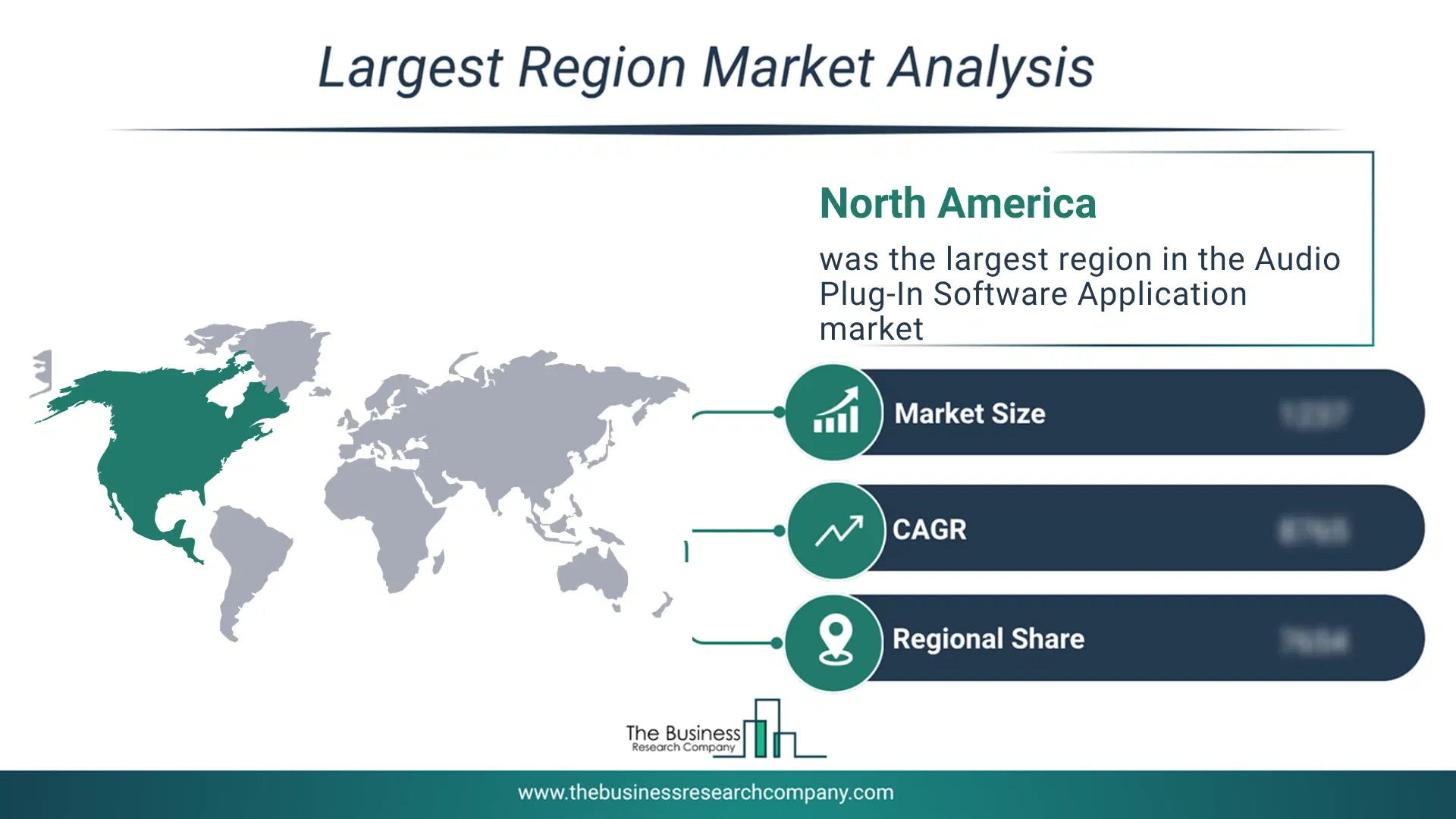
Regional Outlook
North America was the largest region in the audio plug-in software application market in 2025. Asia-Pacific is expected to be the fastest-growing region in the forecast period. The regions covered in this market report are Asia-Pacific, South East Asia, Western Europe, Eastern Europe, North America, South America, Middle East, Africa. The countries covered in this market report are Australia, Brazil, China, France, Germany, India, Indonesia, Japan, Taiwan, Russia, South Korea, UK, USA, Canada, Italy, Spain.What Defines the Audio Plug-In Software Application Market?
The audio plug-in software application market consists of revenues earned by entities by providing services such as audio effects processing, real-time processing and performance, stereo imaging, noise reduction and restoration, and spatial audio processing. The market value includes the value of related goods sold by the service provider or included within the service offering. The audio plug-in software application market also includes sales of effects plug-ins, utility plug-ins, virtual instruments, pitch correction and time manipulation plug-ins. Values in this market are ‘factory gate’ values, that is, the value of goods sold by the manufacturers or creators of the goods, whether to other entities (including downstream manufacturers, wholesalers, distributors, and retailers) or directly to end customers. The value of goods in this market includes related services sold by the creators of the goods.How is Market Value Defined and Measured?
The market value is defined as the revenues that enterprises gain from the sale of goods and/or services within the specified market and geography through sales, grants, or donations in terms of the currency (in USD unless otherwise specified). The revenues for a specified geography are consumption values that are revenues generated by organizations in the specified geography within the market, irrespective of where they are produced. It does not include revenues from resales along the supply chain, either further along the supply chain or as part of other products.
This chart presents market attractiveness based on a quantitative evaluation of growth, competition, strategic alignment, and risk, offering a clear view of opportunity areas for decision-making. This chart is for illustrative purposes; the full report contains the complete analysis.

This chart highlights the Total Addressable Market (TAM) by estimating the maximum revenue opportunity using an assumption-driven approach, supporting strategic planning and opportunity sizing across markets. The chart is illustrative; the full report provides a more comprehensive analysis.
What Key Data and Analysis Are Included in the Audio Plug-In Software Application Market Report 2026?
The audio plug-in software application market research report is one of a series of new reports from The Business Research Company that provides market statistics, including industry global market size, regional shares, competitors with the market share, detailed market segments, market trends and opportunities, and any further data you may need to thrive in the audio plug-in software application industry. The market research report delivers a complete perspective of everything you need, with an in-depth analysis of the current and future state of the industry.Audio Plug-In Software Application Market Report Forecast Analysis
| Report Attribute | Details |
|---|---|
| Market Size Value In 2026 | $6.43 billion |
| Revenue Forecast In 2035 | $10.08 billion |
| Growth Rate | CAGR of 11.9% from 2026 to 2035 |
| Base Year For Estimation | 2025 |
| Actual Estimates/Historical Data | 2020-2025 |
| Forecast Period | 2026 - 2030 - 2035 |
| Market Representation | Revenue in USD Billion and CAGR from 2026 to 2035 |
| Segments Covered | Type, Software, Operating System, End-User |
| Regional Scope | Asia-Pacific, Western Europe, Eastern Europe, North America, South America, Middle East, Africa |
| Country Scope | The countries covered in the report are Australia, Brazil, China, France, Germany, India, ... |
| Key Companies Profiled | Apple Inc., Avid Technology Inc., Magix Software GmbH, Universal Audio, Steinberg Media Technologies GmbH, Image Line Software, Arturia SA, Eventide Inc., PreSonus Audio Electronics Inc., Waves Audio Ltd., Native Instruments USA Inc., NCH Software, Softube, HoRNet SRL, Antares Audio Technologies, Plugin Alliance, Soundtoys, Blue Cat Audio, FabFilter, Slate Digital, Sonnox, MeldaProduction, Cableguys, Acon Digital AS |
| Customization Scope | Request for Customization |
| Pricing And Purchase Options | Explore Purchase Options |