
Augmented Reality (AR) And Virtual Reality (VR) Hardware Market Report 2026
Global Outlook – By Hardware Type ( Cameras, Controllers, Display Monitors, Headphones, Processors, Sensors, Other Hardware Types), By Application ( Handheld Devices, Head Mounted Display, Head Up Display), By Industry Vertical ( Aerospace And Defense, Automotive, Education And Training, Gaming And Entertainment, Healthcare, Other Industry Verticals) – Market Size, Trends, Strategies, and Forecast to 2030
Augmented Reality (AR) And Virtual Reality (VR) Hardware Market Overview
• Augmented Reality (AR) And Virtual Reality (VR) Hardware market size has reached to $82.88 billion in 2025 • Expected to grow to $349.18 billion in 2030 at a compound annual growth rate (CAGR) of 33.3% • Growth Driver: Cloud Gaming Driving Growth In The Market By Enabling Seamless Access And Expanding Player Base • Market Trend: Innovative Enterprise-Grade VR Headsets Driving Growth In The Market • North America was the largest region in 2025 and Asia-Pacific is the fastest growing region.Market Gains By 2030 – Top Opportunities By Segment
Market Gain identifies the most promising market opportunities by highlighting the segments or products expected to generate the highest incremental revenue growth over the next five years.
What Is Covered Under Augmented Reality (AR) And Virtual Reality (VR) Hardware Market?
Augmented reality (AR) and virtual reality (VR) hardware refer to the physical devices used to create immersive digital experiences. These devices are designed to interact with users in virtual or augmented environments, providing either a fully simulated experience or enhancing the real world with digital elements. The main hardware types of augmented reality (AR) and virtual reality (VR) hardware are cameras, controllers, display monitors, headphones, processors, sensors, and others. Cameras are devices used to capture images or videos, often featuring lenses and sensors to record visual data for various purposes such as photography, security, or media production. The various applications include handheld devices, head-mounted displays, and head-up displays and are used by several industry verticals such as aerospace and defense, automotive, education and training, gaming and entertainment, healthcare, and others.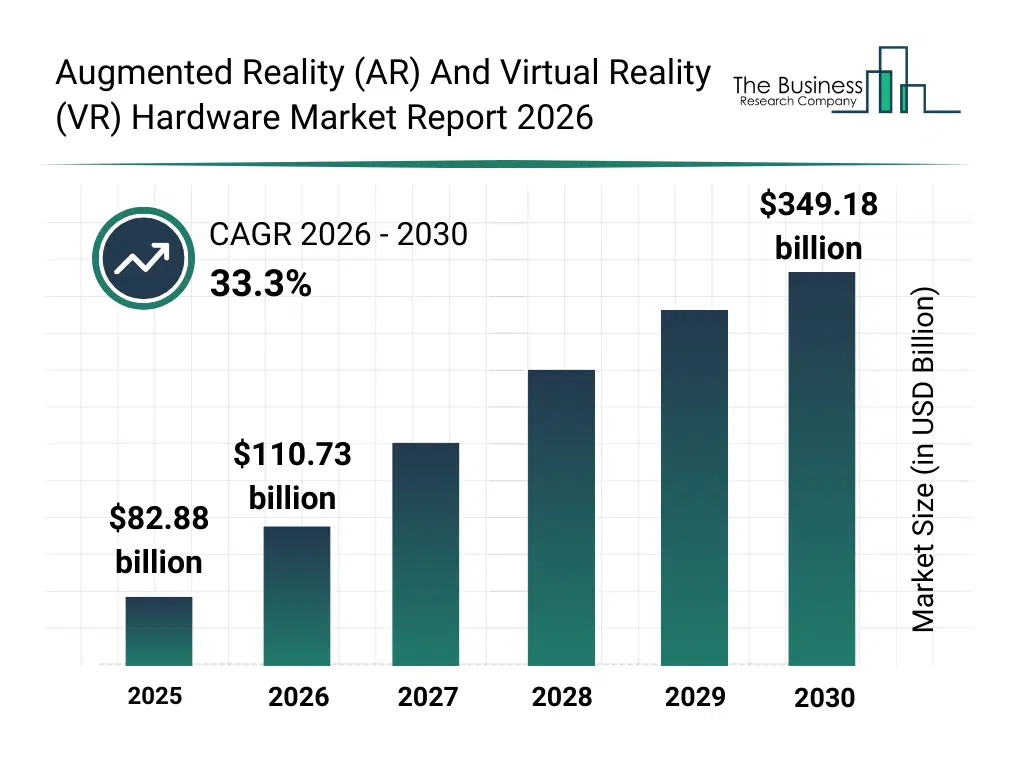
What Is The Augmented Reality (AR) And Virtual Reality (VR) Hardware Market Size 2026 And Growth Rate?
The augmented reality (ar) and virtual reality (vr) hardware market size has grown exponentially in recent years. It will grow from $82.88 billion in 2025 to $110.73 billion in 2026 at a compound annual growth rate (CAGR) of 33.6%. The growth in the historic period can be attributed to rise of gaming and entertainment, increasing adoption in education and training, growth in healthcare simulations, early investment by automotive and aerospace, advancements in processor and sensor technology.What Is The Augmented Reality (AR) And Virtual Reality (VR) Hardware Market Growth Forecast?
The augmented reality (ar) and virtual reality (vr) hardware market size is expected to see exponential growth in the next few years. It will grow to $349.18 billion in 2030 at a compound annual growth rate (CAGR) of 33.3%. The growth in the forecast period can be attributed to expansion in enterprise training solutions, integration with ai-driven analytics, adoption in smart manufacturing, growth in remote healthcare and telemedicine, development of next-gen haptic and wearable devices. Major trends in the forecast period include edge computing integration, wearable AR or VR devices, haptic feedback enhancement, cloud-based AR or VR platforms, real-time motion tracking.
Global Augmented Reality (AR) And Virtual Reality (VR) Hardware Market Segmentation
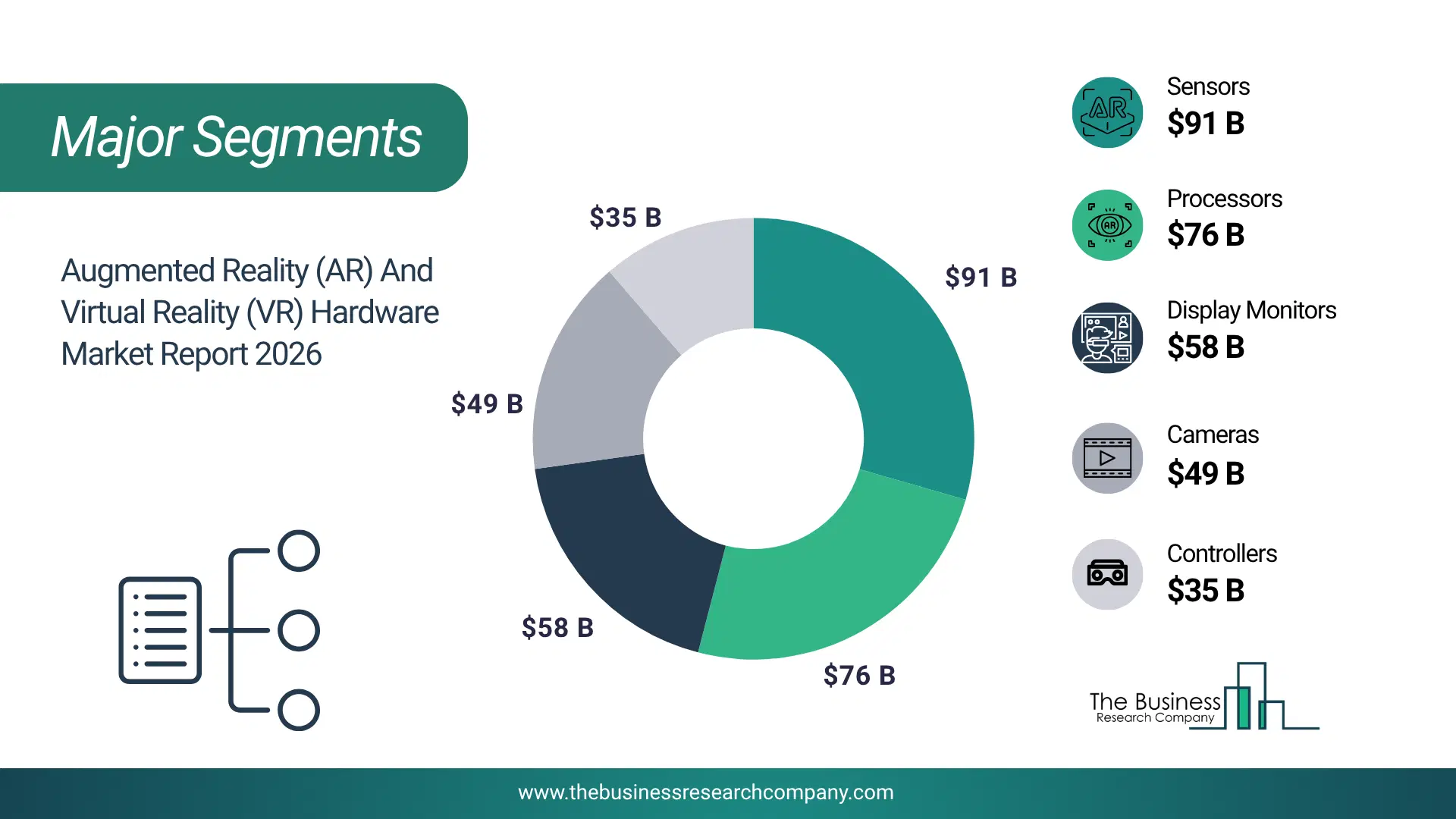
1) By Hardware Type: Cameras, Controllers, Display Monitors, Headphones, Processors, Sensors, Other Hardware Types 2) By Application: Handheld Devices, Head Mounted Display, Head Up Display 3) By Industry Vertical: Aerospace And Defense, Automotive, Education And Training, Gaming And Entertainment, Healthcare, Other Industry Verticals Subsegments: 1) By Cameras: Depth Cameras, RGB Cameras, Stereoscopic Cameras 2) By Controllers: Motion Controllers, Handheld Controllers, Wearable Controllers 3) By Display Monitors: AR Glasses, VR Headsets, Smart Glasses, Projection Displays 4) By Headphones: Stereo Headphones, 3D Audio Headphones, Noise Cancelling Headphones 5) By Processors: Graphics Processing Units (GPUs), Central Processing Units (CPUs), Application-Specific Integrated Circuits (ASICs) 6) By Sensors: Motion Sensors, Proximity Sensors, Positional Sensors, Eye-Tracking Sensors 7) By Other Hardware Types: Haptic Devices, AR Or VR Gloves, Tracking Devices The top segments in the power infrastructure market will be: • Non-Renewable will reach $1278.03 Billion by 2030. • Renewable will reach $749.25 Billion by 2030. The top segments in the augmented reality (ar) and virtual reality (vr) hardware market will be: • Sensors will reach $91.48 Billion by 2030. • Processors will reach $76.35 Billion by 2030. • Display Monitors will reach $58.13 Billion by 2030. • Cameras will reach $48.64 Billion by 2030. • Controllers will reach $35.27 Billion by 2030.What Is The Driver Of The Augmented Reality (AR) And Virtual Reality (VR) Hardware Market?
The rise of cloud gaming is expected to propel growth of the augmented reality (AR) and virtual reality (VR) hardware market going forward. Cloud gaming refers to playing video games streamed from remote servers rather than running locally on a player's device, eliminating the need for powerful hardware. The rise of cloud gaming is driven by faster internet, reduced hardware costs, and the convenience of instant, cross-device access through subscription services. Augmented Reality (AR) and Virtual Reality (VR) hardware enhance cloud gaming by providing immersive, interactive experiences that seamlessly integrate with cloud-based platforms, delivering high-quality, real-time graphics and responsive gameplay. For instance, in August 2024, according to a report published by Uswitch Limited, a UK-based online and telephone comparison and switching service, the number of online gamers in the UK is projected to increase by 6.64%, rising from 10.84 million in 2023 to 11.56 million by 2027. Moreover, in 2023, according to the Interactive Games and Entertainment Association, an Australia-based trade association, in 2021, 67% of Australians (17 million) played video games. This figure increased to 81% (21 million) in 2023. Therefore, the rise of cloud gaming is driving the growth of the augmented reality (AR) and virtual reality (VR) hardware industry.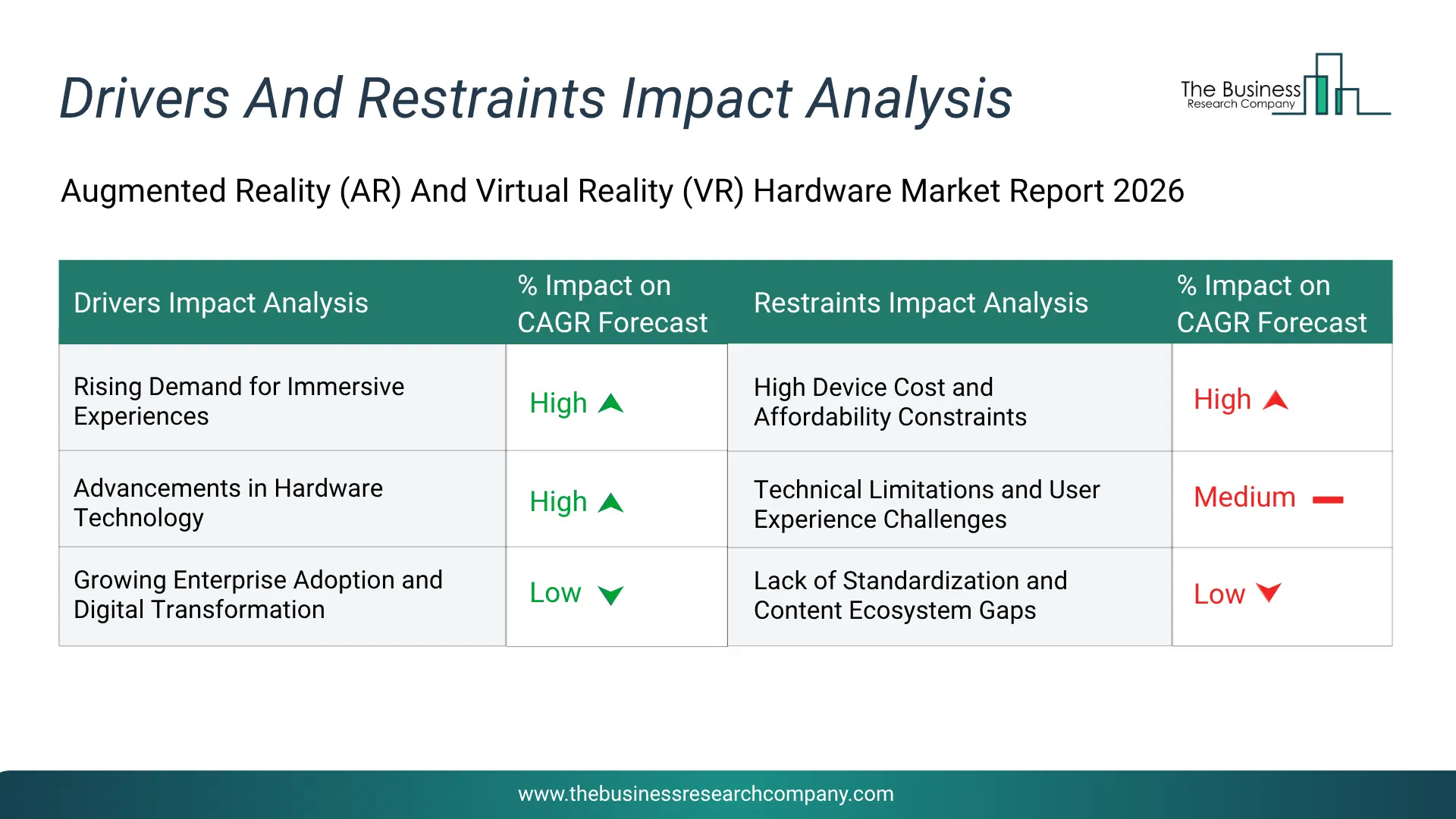
Infographic Chart Showing Key Market Drivers Analysis And Restraints For Augmented Reality (Ar) And Virtual Reality (Vr) Hardware Market
The chart presents an impact analysis of key drivers and restraints, quantifying their relative influence on the market's growth rate and helping assess the balance between growth enablers and limiting factors. This chart offers a high-level perspective; the full report contains more detailed insights.
How Will The Drivers Impact Growth In The Global Augmented Reality (AR) And Virtual Reality (VR) Hardware Market?
• Rising Demand for Immersive Experiences (High) – During the forecast period, the rising demand for immersive experiences is expected to become a key growth driver for the augmented reality (AR) and virtual reality (VR) hardware market by 2030. Increasing consumer interest in immersive digital experiences is accelerating demand for advanced AR and VR hardware solutions across gaming, entertainment, education, and social interaction platforms. As users seek more realistic and interactive virtual environments, manufacturers are investing in high-performance displays, motion tracking systems, and sensory technologies to enhance engagement and user experience. This growing demand is encouraging the adoption of sophisticated headsets, sensors, controllers, and spatial computing devices capable of delivering seamless immersion. Additionally, the expansion of metaverse platforms and immersive content ecosystems is strengthening the need for reliable and responsive hardware technologies. Collectively, these factors support steady market growth by directly linking immersive experience demand with increased hardware adoption. • Advancements in Hardware Technology (High) – During the forecast period, the advancements in hardware technology are expected to emerge as a major factor driving the expansion of the augmented reality (AR) and virtual reality (VR) hardware market by 2030. Continuous improvements in processing power, display quality, sensor accuracy, and connectivity technologies strongly support market growth by enabling the development of more efficient and compact AR and VR devices. With rapid technological innovation, manufacturers can deliver lightweight headsets, faster graphics rendering, improved motion sensing, and extended battery performance that enhance overall device functionality. Such advancements are also improving comfort, usability, and real-time responsiveness, which increases consumer and enterprise acceptance of immersive technologies. Higher investments in semiconductor development and edge computing infrastructure further strengthen the production of advanced hardware systems. • Growing Enterprise Adoption and Digital Transformation (Low) – During the forecast period, the growing enterprise adoption and digital transformation are expected to act as a key growth catalyst for the augmented reality (AR) and virtual reality (VR) hardware market by 2030. The increasing integration of AR and VR technologies into enterprise operations is accelerating demand for specialized hardware solutions as organizations focus on improving productivity, training, collaboration, and operational efficiency. The adoption of immersive technologies in sectors such as healthcare, manufacturing, automotive, retail, and defense requires advanced hardware systems capable of supporting complex simulations and real-time data visualization. This growing enterprise demand is encouraging technology providers to expand their hardware capabilities, thereby increasing the need for high-performance processors, sensors, displays, and wearable devices. Furthermore, the rapid pace of digital transformation across industries underscores the importance of immersive computing environments for workforce development and decision-making processes. Consequently, the expansion of enterprise-focused immersive applications directly supports the adoption of AR and VR hardware worldwide.How Will The Restraints Impact Growth In The Global Augmented Reality (AR) And Virtual Reality (VR) Hardware Market?
• High Device Cost and Affordability Constraints (High) – During the forecast period, the high device cost and affordability constraints act as a major restraint for the AR/VR hardware market by limiting widespread consumer and enterprise adoption. Advanced headsets, sensors, and computing units require significant investment, making them expensive for end-users and small businesses. The cost of high-performance components such as displays, processors, and tracking systems further increases the overall price of devices. This pricing barrier discourages mass-market penetration, particularly in price-sensitive regions. As a result, adoption rates remain slower than expected despite strong technological advancements. • Technical Limitations and User Experience Challenges (High) – During the forecast period, the technical limitations and user experience challenges restrain the AR/VR hardware market by affecting usability and long-term engagement. Issues such as limited battery life, motion sickness, latency, and low field-of-view reduce the overall immersive experience for users. Hardware constraints in processing power and display quality can lead to performance inefficiencies in real-time applications. Additionally, bulky device designs reduce comfort, making prolonged usage difficult. These challenges hinder consumer satisfaction and slow down large-scale adoption across industries. • Lack of Standardization and Content Ecosystem Gaps (Low) – During the forecast period, the lack of standardization and content ecosystem gaps pose a significant restraint for the AR/VR hardware market by creating fragmentation across platforms and devices. Different hardware manufacturers operate on varying software frameworks, limiting compatibility and scalability of applications. The shortage of high-quality, industry-specific content further reduces the value proposition for users and enterprises. Developers face challenges in creating universally compatible solutions, which slows innovation and deployment. Consequently, inconsistent ecosystems restrict seamless integration and hinder overall market growth.Key Players In The Global Augmented Reality (AR) And Virtual Reality (VR) Hardware Market
Major companies operating in the augmented reality (ar) and virtual reality (vr) hardware market are Apple Inc., Samsung Electronics Co. Ltd., Microsoft Corporation, Sony Interactive Entertainment LLC, Lenovo Group Limited, NVIDIA Corporation, Goertek Inc., NXP Semiconductor N.V., Valve Corporation, Acer Incorporated, High Tech Computer Corporation, Bose Corporation, Robert Bosch GmbH, Magic Leap Inc., TCL Technology Group Corporation, Pimax Technology Co. Ltd., Varjo Technologies Oy, Vuzix Corporation, Deepoon VR, AjnaLens Private Limited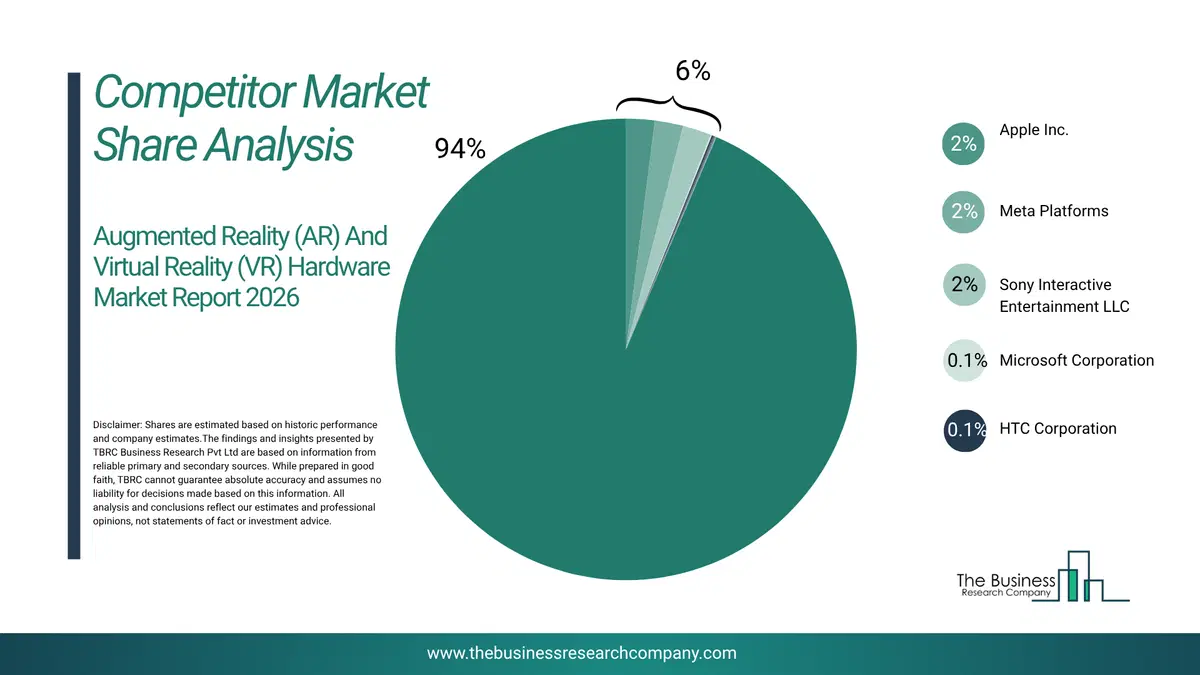
This chart is for illustrative purposes; the full report includes a detailed competitor analysis and comprehensive overview of the top 10 companies in the market.
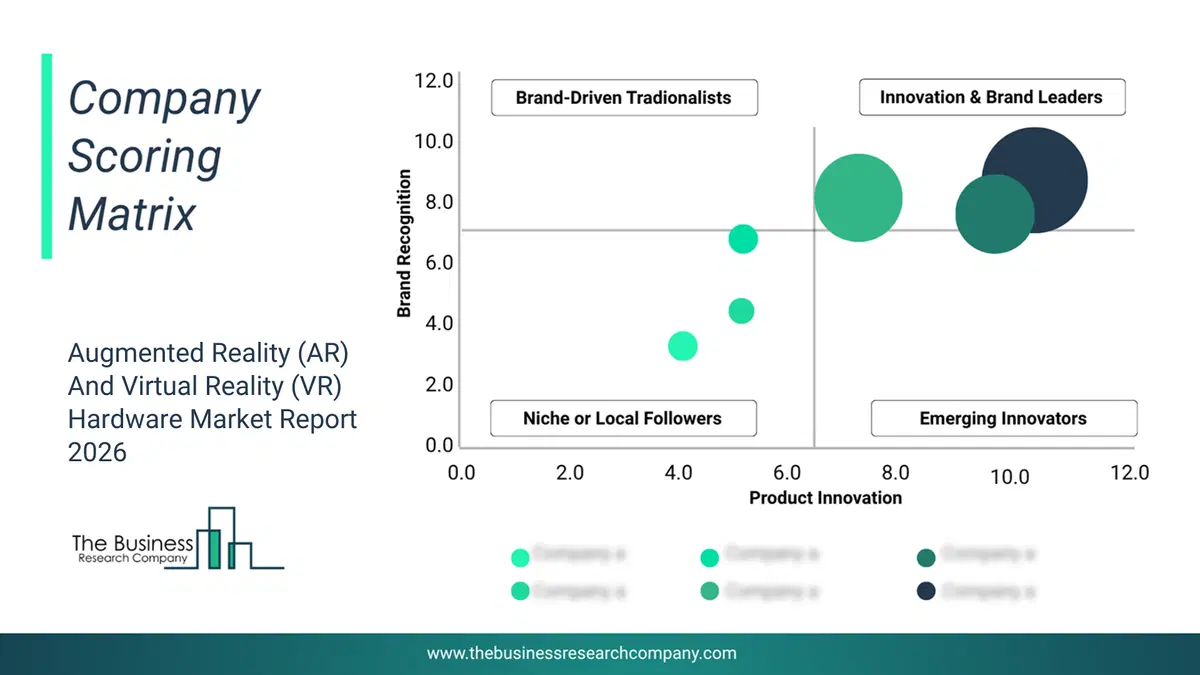
This chart maps companies by product innovation and brand strength, with bubble size indicating relative revenue, helping identify market leaders, challengers, and niche players. This is an illustrative chart; the full report provides a complete and accurate competitive analysis.
Global Augmented Reality (AR) And Virtual Reality (VR) Hardware Market Trends and Insights
Major companies operating in the augmented reality (AR) and virtual reality (VR) hardware market are focusing on developing innovative solutions, such as enterprise-grade virtual reality headsets, to enhance immersive experiences across various sectors. An enterprise-grade virtual reality headset refers to one designed for professional use, offering high-resolution displays, precise tracking, and robust build quality for industries like training, design, and engineering. For instance, in September 2023, Deepoon (DPVR), a China-based technology company, launched the DPVR P2, an enterprise-grade virtual reality headset designed to enhance immersive experiences in education, business, and healthcare. This headset boasts superior visual quality with high-resolution displays and wide field-of-view optics, delivering immersive experiences crucial for training, simulations, and collaborative work environments. Its robust connectivity options, including wireless and tethered capabilities, ensure seamless integration with existing enterprise systems. Additionally, the headset supports customizable software solutions, enabling businesses to tailor the VR experience to their unique requirements.What Are Latest Mergers And Acquisitions In The Augmented Reality (AR) And Virtual Reality (VR) Hardware Market?
In November 2024, RealWear Inc., a US-based company that provides software solutions, acquired Almer Technologies AG for an undisclosed amount. With this acquisition, RealWear aims to strengthen its position in the augmented reality (AR) market by integrating Almer's advanced AR technology to enhance immersive, hands-free solutions for industrial applications. Almer Technologies AG is a Switzerland-based company specializing in developing advanced AR and VR hardware to enhance immersive experiences across industries.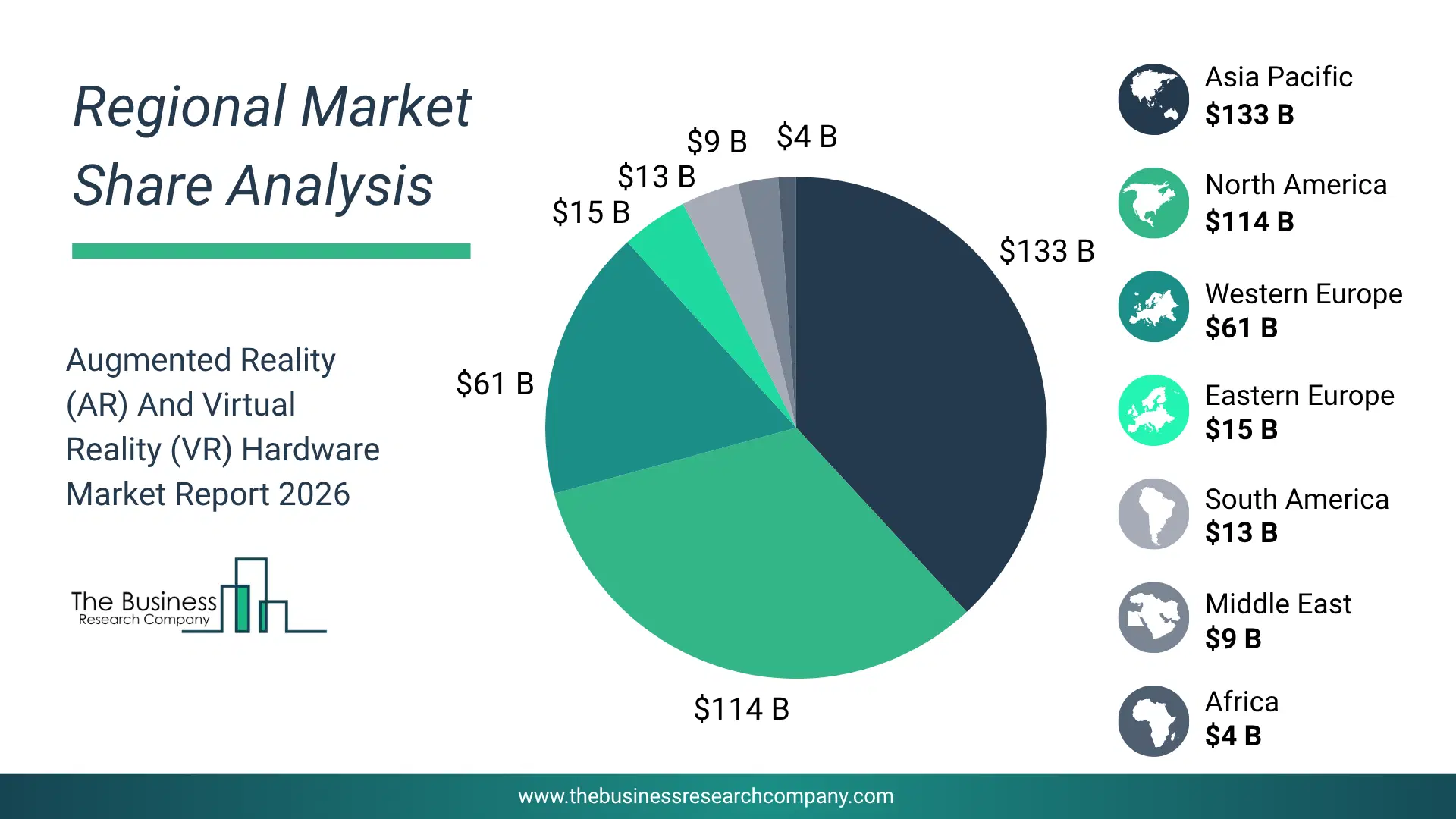
Regional Outlook
North America was the largest region in the augmented reality (AR) and virtual reality (VR) hardware market in 2025. Asia-Pacific is expected to be the fastest-growing region in the forecast period. The regions covered in this market report are Asia-Pacific, South East Asia, Western Europe, Eastern Europe, North America, South America, Middle East, Africa. The countries covered in this market report are Australia, Brazil, China, France, Germany, India, Indonesia, Japan, Taiwan, Russia, South Korea, UK, USA, Canada, Italy, Spain.What Defines the Augmented Reality (AR) And Virtual Reality (VR) Hardware Market?
The augmented reality (AR) and virtual reality (VR) hardware includes revenues earned by entities by providing services such as system integration services, installation and maintenance, content creation, cloud and data services, and consultation services. The market value includes the value of related goods sold by the service provider or included within the service offering. The augmented reality (AR) and virtual reality (VR) hardware market also consists of sales of products including tracking systems, display systems, wearable devices, sensors, cameras, and computing units. Values in this market are ‘factory gate’ values, that is, the value of goods sold by the manufacturers or creators of the goods, whether to other entities (including downstream manufacturers, wholesalers, distributors, and retailers) or directly to end customers. The value of goods in this market includes related services sold by the creators of the goods.How is Market Value Defined and Measured?
The market value is defined as the revenues that enterprises gain from the sale of goods and/or services within the specified market and geography through sales, grants, or donations in terms of the currency (in USD unless otherwise specified). The revenues for a specified geography are consumption values that are revenues generated by organizations in the specified geography within the market, irrespective of where they are produced. It does not include revenues from resales along the supply chain, either further along the supply chain or as part of other products.
This chart presents market attractiveness based on a quantitative evaluation of growth, competition, strategic alignment, and risk, offering a clear view of opportunity areas for decision-making. This chart is for illustrative purposes; the full report contains the complete analysis.

This chart highlights the Total Addressable Market (TAM) by estimating the maximum revenue opportunity using an assumption-driven approach, supporting strategic planning and opportunity sizing across markets. The chart is illustrative; the full report provides a more comprehensive analysis.
What Key Data and Analysis Are Included in the Augmented Reality (AR) And Virtual Reality (VR) Hardware Market Report 2026?
The augmented reality (ar) and virtual reality (vr) hardware market research report is one of a series of new reports from The Business Research Company that provides market statistics, including industry global market size, regional shares, competitors with the market share, detailed market segments, market trends and opportunities, and any further data you may need to thrive in the augmented reality (ar) and virtual reality (vr) hardware industry. The market research report delivers a complete perspective of everything you need, with an in-depth analysis of the current and future state of the industry.Augmented Reality (AR) And Virtual Reality (VR) Hardware Market Report Forecast Analysis Market Report Forecast Analysis
| Report Attribute | Details |
|---|---|
| Market Size Value In 2026 | $110.73 billion |
| Revenue Forecast In 2030 | $349.18 billion |
| Growth Rate | CAGR of 33.6% from 2026 to 2030 |
| Base Year For Estimation | 2025 |
| Actual Estimates/Historical Data | 2020-2025 |
| Forecast Period | 2026 - 2030 |
| Market Representation | Revenue in USD Billion and CAGR from 2026 to 2030 |
| Segments Covered | Hardware Type, Application, Industry Vertical |
| Regional Scope | Asia-Pacific, Western Europe, Eastern Europe, North America, South America, Middle East, Africa |
| Country Scope | The countries covered in the report are Australia, Brazil, China, France, Germany, India, Indonesia, Japan, Taiwan, Russia, South Korea, UK, USA, Canada, Italy, Spain. |
| Key Companies Profiled | Apple Inc., Samsung Electronics Co. Ltd., Microsoft Corporation, Sony Interactive Entertainment LLC, Lenovo Group Limited, NVIDIA Corporation, Goertek Inc., NXP Semiconductor N.V., Valve Corporation, Acer Incorporated, High Tech Computer Corporation, Bose Corporation, Robert Bosch GmbH, Magic Leap Inc., TCL Technology Group Corporation, Pimax Technology Co. Ltd., Varjo Technologies Oy, Vuzix Corporation, Deepoon VR, AjnaLens Private Limited |
| Customization Scope | Request for Customization |
| Pricing And Purchase Options | Explore Purchase Options |