
Automated Aerial Refueling (AAR) Systems Market Report 2026
Global Outlook – By System Type (Probe And Drogue Systems, Flying Boom Systems, Wing To Wing Refueling Systems, Buddy Refueling Systems, Hybrid Refueling Systems), By Component Type (Refueling Pods, Receiver Aircraft Systems, Refueling Control Systems, Communication Systems, Navigation And Guidance Systems, Sensors And Cameras), By Technology (Autonomous Aerial Refueling, Semi Autonomous Aerial Refueling), By Application (Military Operations, Surveillance And Reconnaissance, Long Haul Drone Missions, Cargo And Logistics) – Market Size, Trends, Strategies, and Forecast to 2035
Automated Aerial Refueling (AAR) Systems Market Overview
• Automated Aerial Refueling (AAR) Systems market size has reached to $0.78 billion in 2025 • Expected to grow to $1.4 billion in 2030 at a compound annual growth rate (CAGR) of 12.4% • Growth Driver: Rising Defense Budgets Driving The Market Growth Due To Increasing Investment In Advanced Military Aviation Capabilities • Market Trend: Technological Advancements In Autonomous Tanker-Receiver Systems Improve Refueling Precision And Mission Endurance • North America was the largest region in 2025 and Asia-Pacific is the fastest growing region.What Is Covered Under Automated Aerial Refueling (AAR) Systems Market?
Automated aerial refueling (AAR) systems are aviation technologies that automate or assist the in-flight transfer of fuel between aircraft through sensing, navigation, communication, guidance, and control technologies. These systems support precise aircraft positioning, refueling connection, fuel transfer, and separation while reducing crew workload and improving operational efficiency and safety. The main system types of automated aerial refueling (AAR) systems include probe and drogue systems, flying boom systems, wing to wing refueling systems, buddy refueling systems, and hybrid refueling systems. Probe and drogue systems refer to aerial refueling arrangements in which a receiver aircraft connects to a flexible hose and drogue extended by a tanker aircraft to transfer fuel during flight. These systems incorporate refueling pods, receiver aircraft systems, refueling control systems, communication systems, navigation and guidance systems, and sensors and cameras, and use autonomous aerial refueling, and semi autonomous aerial refueling. The various applications involved are military operations, surveillance and reconnaissance, long haul drone missions, and cargo and logistics.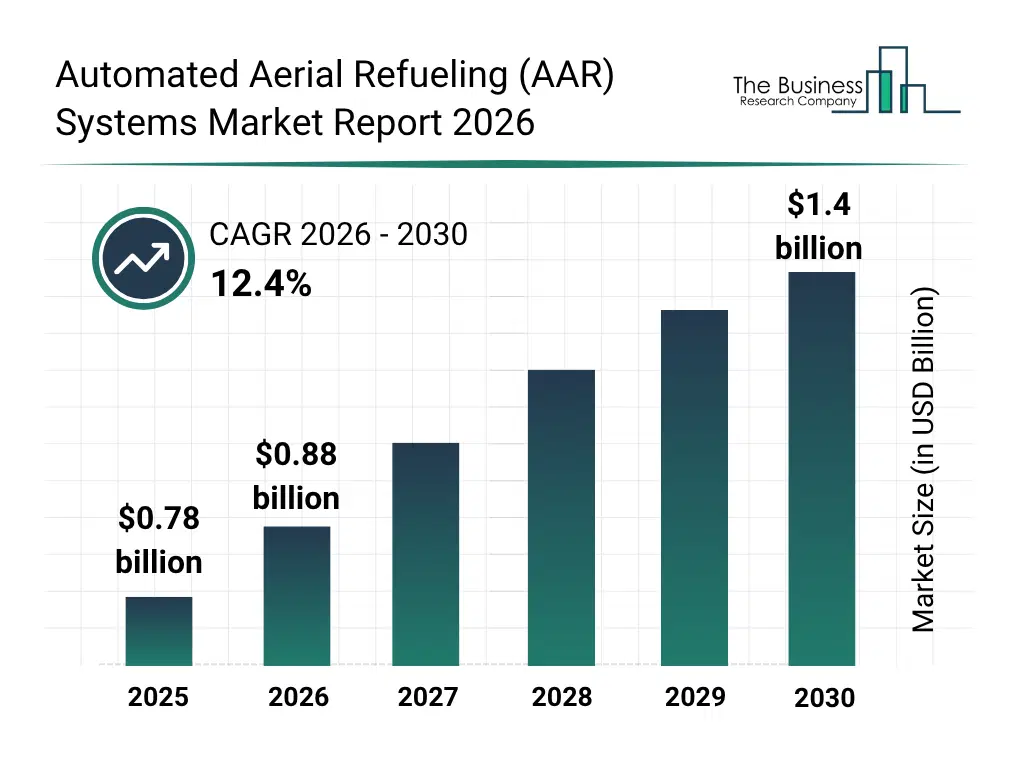
What Is The Automated Aerial Refueling (AAR) Systems Market Size and Share 2026?
The automated aerial refueling (AAR) systems market size has grown rapidly in recent years. It will grow from $0.78 billion in 2025 to $0.88 billion in 2026 at a compound annual growth rate (CAGR) of 12.1%. The growth in the historic period can be attributed to increasing demand for extended military mission endurance, rising procurement of aerial refueling aircraft fleets, growing deployment of unmanned aircraft for long-duration missions, increasing need to reduce pilot workload during refueling operations, expanding military air operations requiring mid-air fuel replenishment.What Is The Automated Aerial Refueling (AAR) Systems Market Growth Forecast?
The automated aerial refueling (AAR) systems market size is expected to see rapid growth in the next few years. It will grow to $1.4 billion in 2030 at a compound annual growth rate (CAGR) of 12.4%. The growth in the forecast period can be attributed to increasing demand for contested-environment aerial refueling capabilities, rising adoption of unmanned tanker and receiver aircraft, growing need for cross-platform refueling interoperability, increasing demand for precision aircraft positioning during fuel transfer, expanding use of autonomous refueling for long-range drone missions. Major trends in the forecast period include increasing adoption of multi-aircraft aerial refueling compatibility, rising demand for extended aircraft mission endurance, growing integration of advanced refueling interfaces, increasing focus on in-flight refueling operational reliability, expanding use of aerial refueling for unmanned aircraft operations.Tariff Impact On Automated Aerial Refueling (AAR) Systems Market
Tariffs are impacting the automated aerial refueling (AAR) systems market by increasing the cost of imported sensors, avionics, communication equipment, precision mechanical components, and semiconductor-based aerospace systems required for automated refueling platforms. This is increasing procurement and manufacturing costs for defense and unmanned aviation programs, particularly in regions dependent on international aerospace supply chains such as Asia-Pacific and Europe. Hardware-intensive segments such as refueling pods, sensors and cameras, navigation and guidance systems, and refueling control systems are most affected due to their reliance on specialized components. However, tariffs are also encouraging local aerospace manufacturing, regional supplier diversification, and domestic production of critical refueling components, creating greater long-term supply-chain resilience.
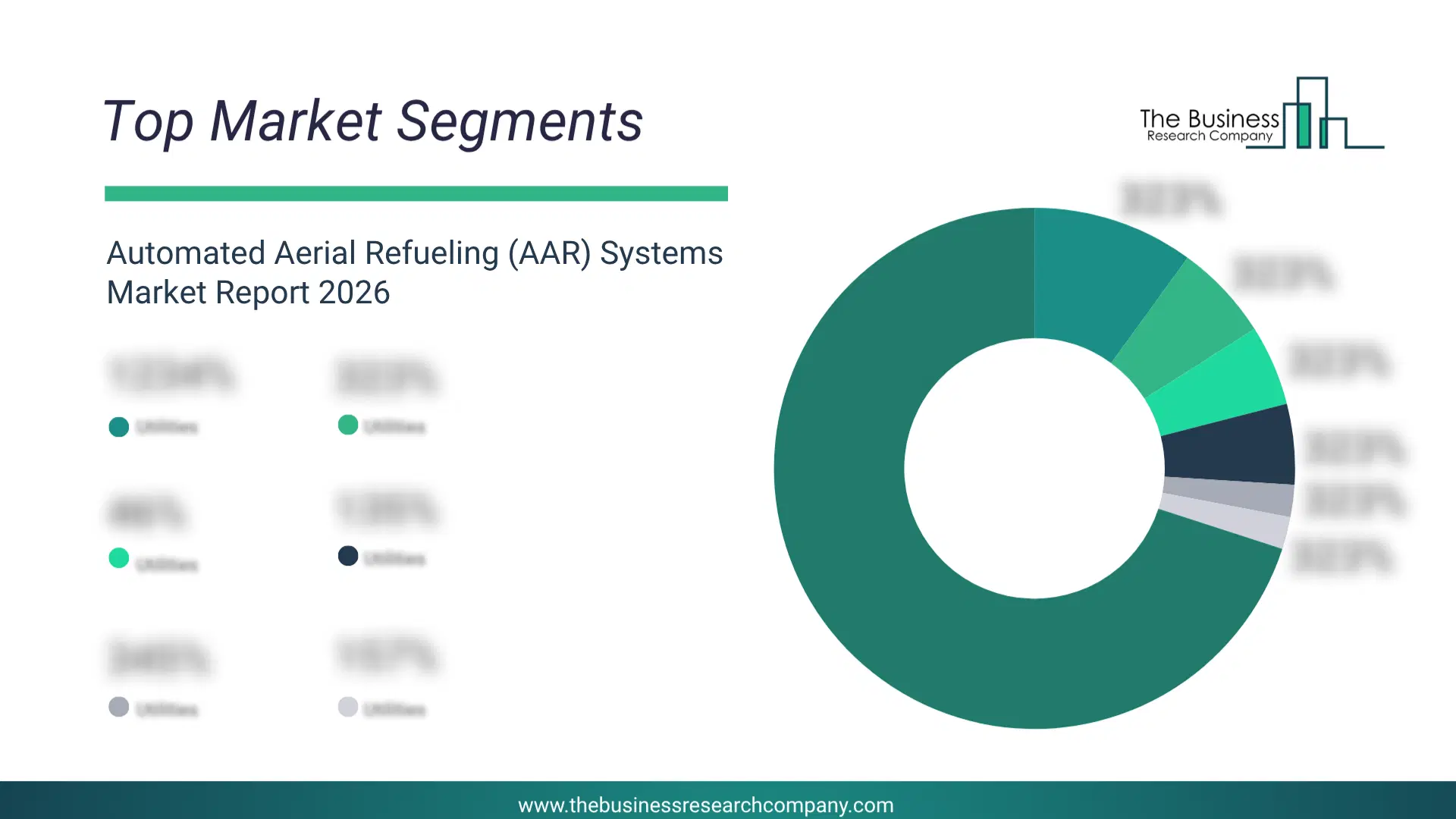
Global Automated Aerial Refueling (AAR) Systems Market Segmentation
2) By Component Type: Refueling Pods, Receiver Aircraft Systems, Refueling Control Systems, Communication Systems, Navigation And Guidance Systems, Sensors And Cameras 3) By Technology: Autonomous Aerial Refueling, Semi Autonomous Aerial Refueling 4) By Application: Military Operations, Surveillance And Reconnaissance, Long Haul Drone Missions, Cargo And Logistics Subsegments: 1) By Probe And Drogue Systems: Centerline Probe And Drogue Systems, Wing Mounted Probe And Drogue Systems, Hose Reel Probe And Drogue Systems, Multi Point Probe And Drogue Systems, High Capacity Probe And Drogue Systems 2) By Flying Boom Systems: Rigid Flying Boom Systems, Telescopic Flying Boom Systems, Remote Controlled Flying Boom Systems, High Flow Flying Boom Systems, Advanced Automated Flying Boom Systems 3) By Wing To Wing Refueling Systems: Single Point Wing To Wing Refueling Systems, Dual Point Wing To Wing Refueling Systems, Flexible Hose Wing To Wing Refueling Systems, Fixed Hose Wing To Wing Refueling Systems, High Speed Wing To Wing Refueling Systems 4) By Buddy Refueling Systems: External Pod Buddy Refueling Systems, Internal Tank Buddy Refueling Systems, Carrier Based Buddy Refueling Systems, Tactical Buddy Refueling Systems, Multi Mission Buddy Refueling Systems 5) By Hybrid Refueling Systems: Probe And Boom Hybrid Refueling Systems, Multi Mode Hybrid Refueling Systems, Autonomous Hybrid Refueling Systems, Modular Hybrid Refueling Systems, Advanced Hybrid Refueling SystemsWhat Is The Driver Of The Automated Aerial Refueling (AAR) Systems Market?
The rising defense budgets are expected to propel the growth of the automated aerial refueling (AAR) systems market going forward. Defense budgets refer to the financial allocations made by governments to support military operations, procurement, modernization, research, and national security initiatives. Defense budgets are increasing due to growing geopolitical tensions, as governments seek to strengthen national security, modernize military capabilities, enhance defense preparedness, and address evolving regional and global security threats. Rising defense budgets drive demand for automated aerial refueling (AAR) systems by enabling greater investments in advanced force-multiplying technologies that enhance mission endurance, improve operational efficiency, reduce pilot workload, and support the expanding deployment of modern military aircraft. For instance, in April 2026, according to the Stockholm International Peace Research Institute (SIPRI), a Sweden-based research institute, world military expenditure reached $2.887 trillion in 2025, representing a 2.9% increase in real terms compared with 2024. Therefore, the rising defense budgets are driving the growth of the automated aerial refueling (AAR) systems industry.Key Players In The Global Automated Aerial Refueling (AAR) Systems Market
Major companies operating in the automated aerial refueling (AAR) systems market are The Boeing Company, RTX Corporation, Lockheed Martin Corporation, Airbus SE, GE Aerospace, Northrop Grumman Corporation, BAE Systems plc, L3Harris Technologies Inc, Leonardo S.p.A., Safran, Honeywell International Inc, Eaton Corporation plc, Parker-Hannifin Corporation, Israel Aerospace Industries Ltd, Embraer S.A., Melrose Industries plc, Saab AB, Elbit Systems Ltd, Liebherr-Aerospace Lindenberg GmbH, Moog Inc, General Atomics Aeronautical Systems Inc, Sierra Nevada Corporation, Curtiss-Wright Corporation, AMETEK Inc, Marshall Group, SENER Aeroespacial S.A., ARESIA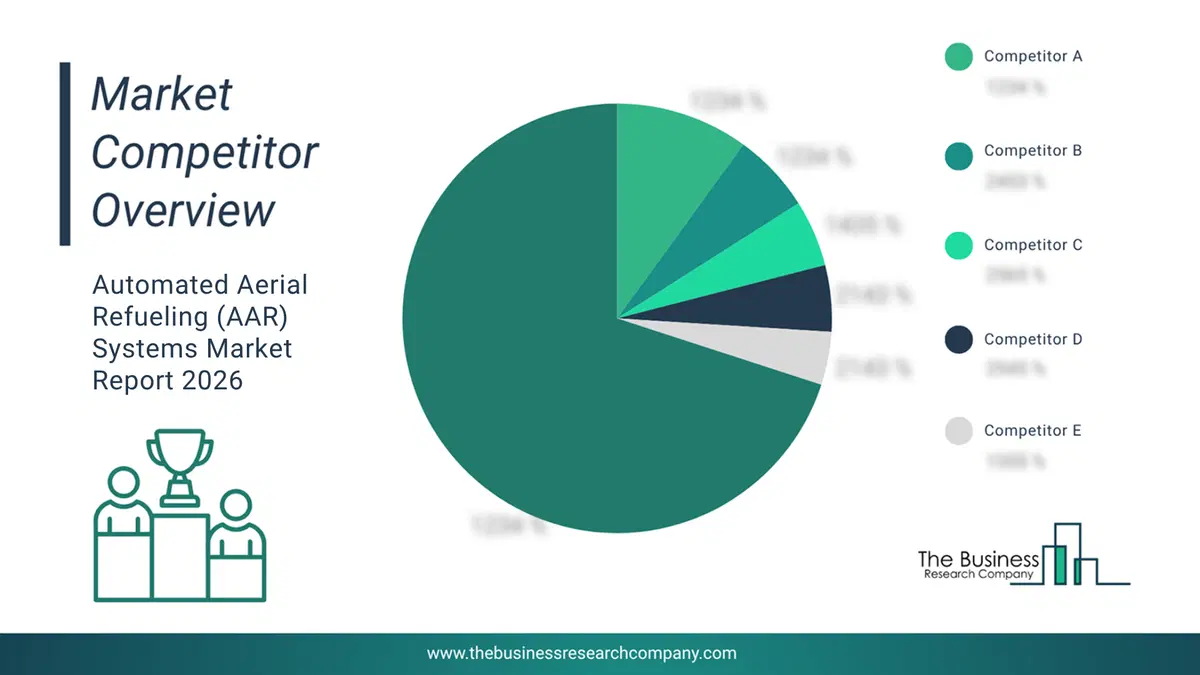
This chart is for illustrative purposes; the full report includes a detailed competitor analysis and comprehensive overview of the top 10 companies in the market.
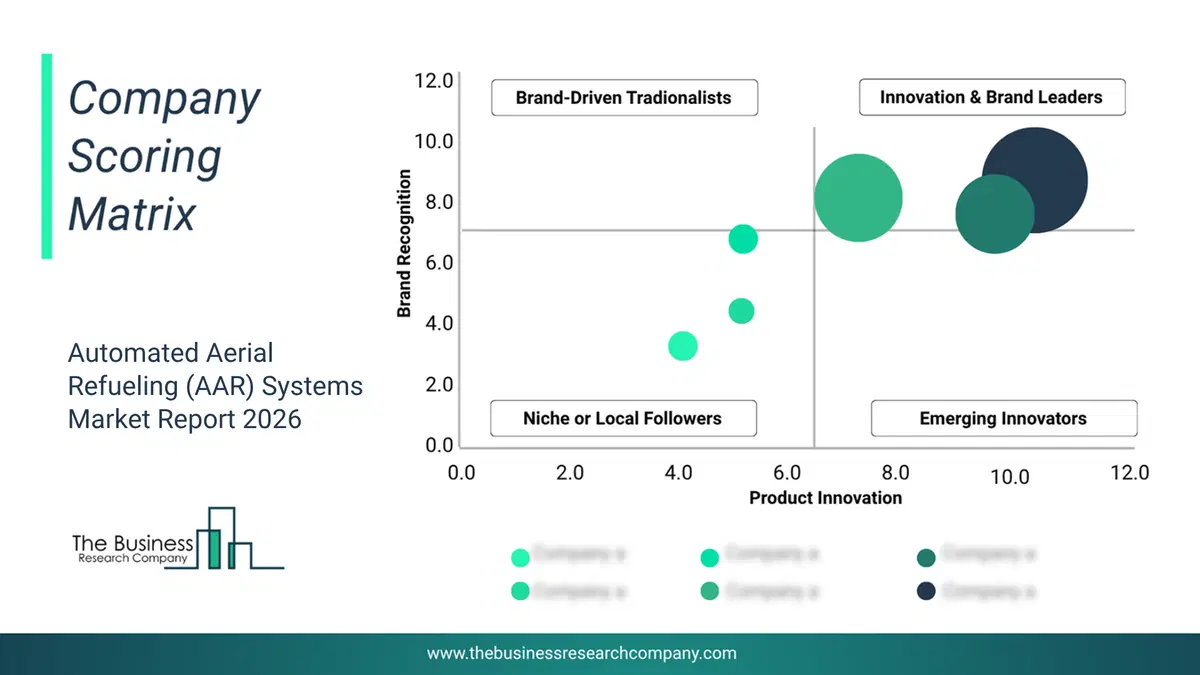
This chart maps companies by product innovation and brand strength, with bubble size indicating relative revenue, helping identify market leaders, challengers, and niche players. This is an illustrative chart; the full report provides a complete and accurate competitive analysis.
Global Automated Aerial Refueling (AAR) Systems Market Trends and Insights
Major companies operating in the automated aerial refueling (AAR) systems market are focusing on developing advanced systems such as, autonomous tanker-receiver systems to enhance mission endurance, operational efficiency, refueling precision, and the seamless integration of crewed and uncrewed aircraft in contested environments. Autonomous tanker-receiver systems are advanced aerial refueling technologies that use automation, artificial intelligence, relative navigation, and sensor-based control to enable tankers and receiver aircraft to autonomously coordinate rendezvous and fuel transfer with minimal human intervention, improving refueling accuracy, reducing pilot workload, and increasing mission safety compared to conventional manually controlled aerial refueling systems. For instance, in April 2025, The Boeing Company, a US-based aerospace and defense company, advanced its autonomous aerial refueling capabilities through the Combat Refueling and Operations Network User System (CRONUS) program under a contract awarded by the U.S. Air Force Research Laboratory. The program integrates Boom Automation for automated airborne refueling and Relative Navigation (RelNav) technologies that enable uncrewed receiver aircraft to autonomously navigate aerial refueling rendezvous. The solution builds on Boeing's demonstrated autonomous boom refueling capabilities for the KC-46A Pegasus and autonomous navigation technologies for the MQ-25 Stingray, supporting scalable next-generation aerial refueling operations for both crewed and uncrewed platforms.What Are Latest Mergers And Acquisitions In The Automated Aerial Refueling (AAR) Systems Market?
In February 2026, Embraer S.A., a Brazil-based aerospace and defense company that specializes in providing military transport and aerial refueling aircraft, partnered with Northrop Grumman Corporation to jointly develop advanced air-tanking capabilities for the KC-390 Millennium for the U.S. and allied markets. Through this partnership, Embraer S.A. and Northrop Grumman Corporation aim to advance next-generation aerial refueling capabilities by incorporating an advanced autonomous aerial refueling boom into the proposed KC-390 Multi-Mission Tanker, enhancing automated refueling operations, mission flexibility, and operational efficiency for defense applications. Northrop Grumman Corporation is a US-based aerospace and defense company that specializes in providing advanced autonomous, surveillance, and mission systems.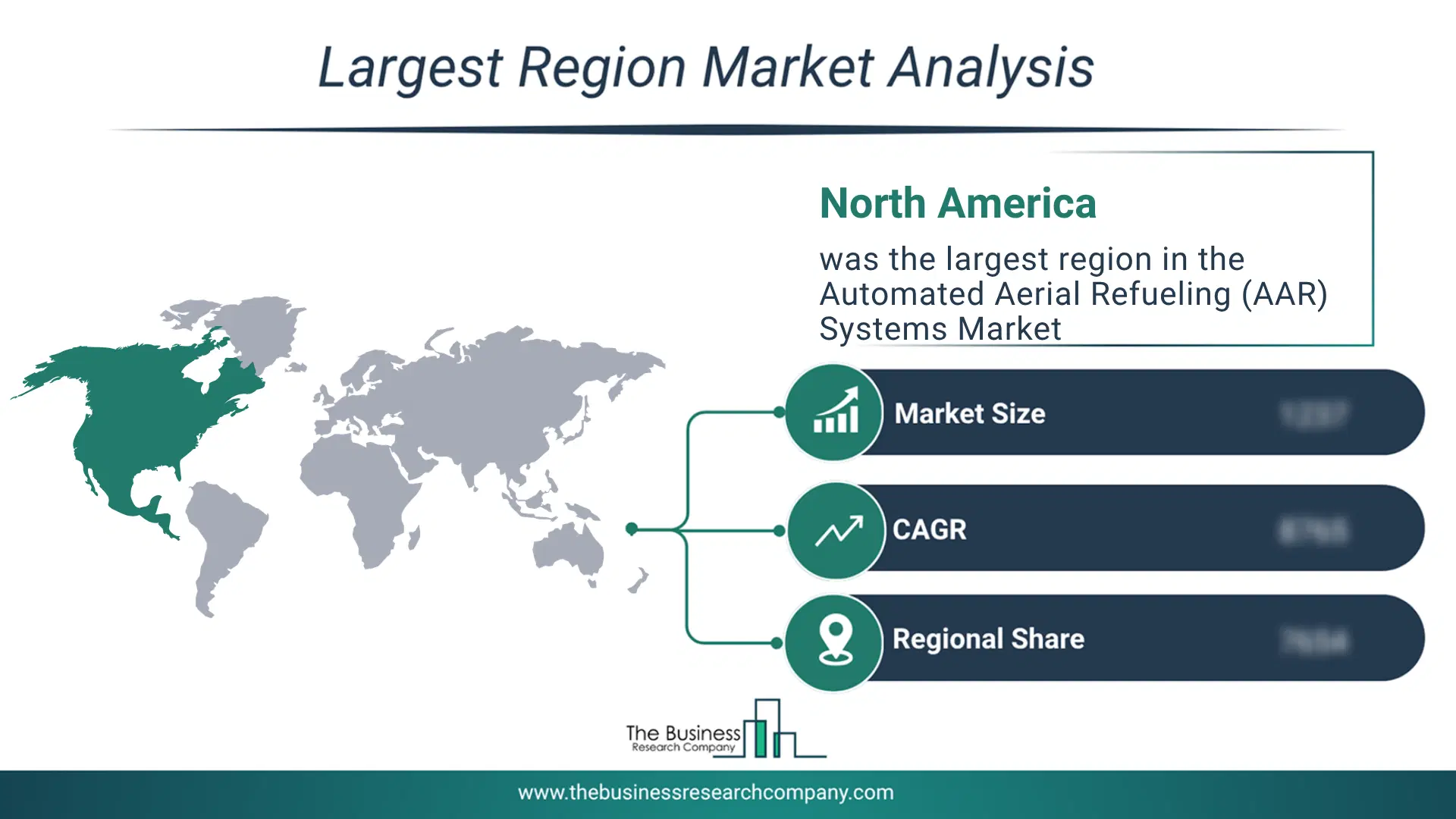
Regional Outlook/Insights
North America was the largest region in the automated aerial refueling (AAR) systems market in 2025. Asia-Pacific is expected to be the fastest-growing region in the forecast period. The regions covered in this market report are Asia-Pacific, South East Asia, Western Europe, Eastern Europe, North America, South America, Middle East, Africa. The countries covered in this market report are Australia, Brazil, China, France, Germany, India, Indonesia, Japan, Taiwan, Russia, South Korea, UK, USA, Canada, Italy, Spain.What Defines the Automated Aerial Refueling (AAR) Systems Market?
The automated aerial refueling (AAR) systems market consists of sales of mission management computers, flight control computers, boom actuation modules, drogue stabilization units, fuel flow control valves, and refueling interface controllers. Values in this market are ‘factory gate’ values, that is, the value of goods sold by the manufacturers or creators of the goods, whether to other entities (including downstream manufacturers, wholesalers, distributors, and retailers) or directly to end customers. The value of goods in this market includes related services sold by the creators of the goods.How is Market Value Defined and Measured?
The market value is defined as the revenues that enterprises gain from the sale of goods and/or services within the specified market and geography through sales, grants, or donations in terms of the currency (in USD unless otherwise specified). The revenues for a specified geography are consumption values that are revenues generated by organizations in the specified geography within the market, irrespective of where they are produced. It does not include revenues from resales along the supply chain, either further along the supply chain or as part of other products.
This chart presents market attractiveness based on a quantitative evaluation of growth, competition, strategic alignment, and risk, offering a clear view of opportunity areas for decision-making. This chart is for illustrative purposes; the full report contains the complete analysis.

This chart highlights the Total Addressable Market (TAM) by estimating the maximum revenue opportunity using an assumption-driven approach, supporting strategic planning and opportunity sizing across markets. The chart is illustrative; the full report provides a more comprehensive analysis.
What Key Data and Analysis Are Included in the Automated Aerial Refueling (AAR) Systems Market Report 2026?
The automated aerial refueling (aar) systems market research report is one of a series of new reports from The Business Research Company that provides market statistics, including industry global market size, regional shares, competitors with the market share, detailed market segments, market trends and opportunities, and any further data you may need to thrive in the automated aerial refueling (aar) systems industry. The market research report delivers a complete perspective of everything you need, with an in-depth analysis of the current and future state of the industry.Automated Aerial Refueling (AAR) Systems Market Report Forecast Analysis
| Report Attribute | Details |
|---|---|
| Market Size Value In 2026 | $0.88 billion |
| Revenue Forecast In 2030 | $1.4 billion |
| Growth Rate | CAGR of 12.4% from 2026 to 2035 |
| Base Year For Estimation | 2025 |
| Actual Estimates/Historical Data | 2020-2025 |
| Forecast Period | 2026 - 2030 |
| Market Representation | Revenue in USD Billion and CAGR from 2026 to 2030 |
| Segments Covered | System Type, Component Type, Technology, Application |
| Regional Scope | Asia-Pacific, Western Europe, Eastern Europe, North America, South America, Middle East, Africa |
| Country Scope | The countries covered in the report are Australia, Brazil, China, France, Germany, India, Indonesia, Japan, Taiwan, Russia, South Korea, UK, USA, Canada, Italy, Spain. |
| Customization Scope | Request for Customization |
| Pricing And Purchase Options | Explore Purchase Options |