

Automated Cell Cultures Market Report 2026
Global Outlook – By Type (Modular Automation, Whole Label Automation), By Equipment Type (Automated Liquid Handling Systems, Microplate Readers, Robotic Systems, Automated Storage And Retrieval Systems, Other Equipment Types), By Application (Biopharmaceuticals Production, Diagnostics, Gene Therapy, Drug Screening And Development, Toxicity Testing, Stem Cell Research, Tissue Engineering And Regenerative Medicine, Personalized Medicine, Other Applications), By End User (Pharmaceuticals And Biotechnology Companies, Hospital And Diagnostic Laboratories, Research Institutes, Cell Banks) - Market Size, Trends, Strategies, and Forecast to 2030
Automated Cell Cultures Market Overview
• Automated Cell Cultures market size has reached to $7.02 billion in 2025 • Expected to grow to $11.58 billion in 2030 at a compound annual growth rate (CAGR) of 10.5% • Growth Driver: Growth In Biopharmaceutical Production Driving Expansion In Automated Cell Culture Market • Market Trend: The Rise Of AI-Powered Automated Cell Culture Systems In Drug Discovery • North America was the largest region in 2025 and Asia-Pacific is the fastest growing region.What Is Covered Under Automated Cell Cultures Market?
Automated cell cultures refer to the use of automated systems and robotics to perform cell culture tasks, such as seeding, feeding, and harvesting cells. These systems reduce manual labor, improve reproducibility, and enhance the scalability of cell culture processes. Automation in cell culture helps maintain sterile conditions and consistent results. The main types of automated cell cultures are modular automation and whole-label automation. Modular automation refers to the use of consolidated, integrated, pre or post-analytical automation modules in laboratories to streamline workflows and increase efficiency. The equipment types are automated liquid handling systems, microplate readers, robotic systems, automated storage and retrieval systems, and others, and their applications include biopharmaceuticals production, diagnostics, gene therapy, drug screening and development, toxicity testing, stem cell research, tissue engineering and regenerative medicine, personalized medicine, and others. It is used by various end users, such as pharmaceutical and biotechnology companies, hospital and diagnostic laboratories, research institutes, and cell banks.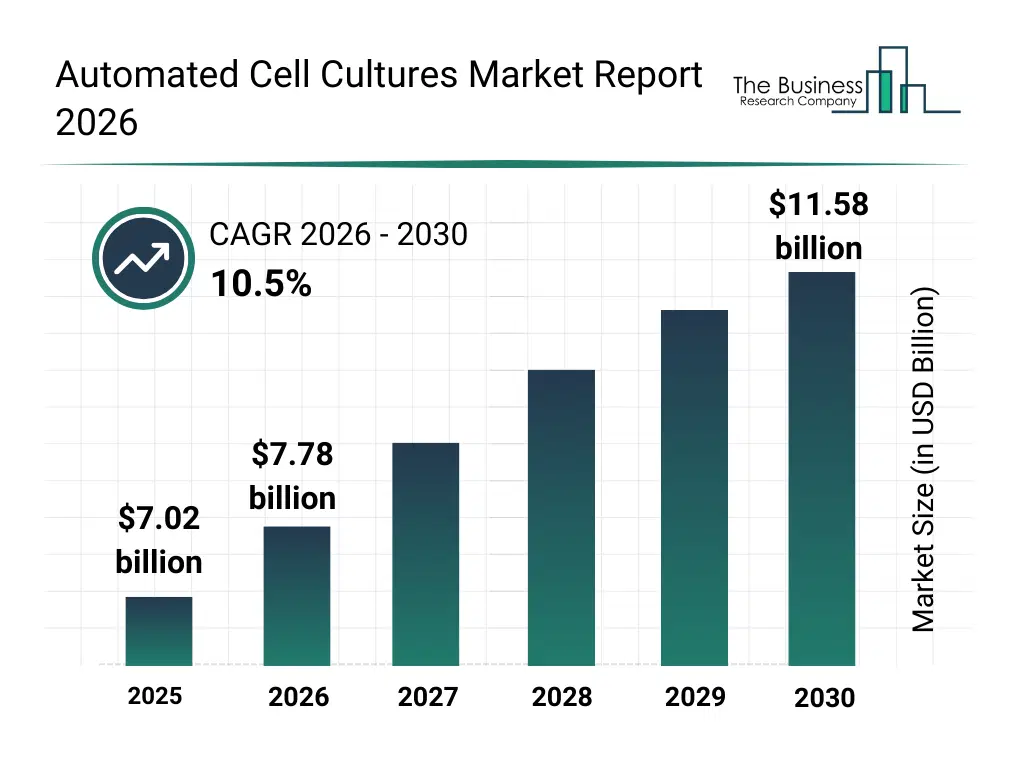
What Is The Automated Cell Cultures Market Size and Share 2026?
The automated cell cultures market size has grown rapidly in recent years. It will grow from $7.02 billion in 2025 to $7.78 billion in 2026 at a compound annual growth rate (CAGR) of 10.8%. The growth in the historic period can be attributed to increasing biopharmaceutical research activity, rising demand for standardized cell culture processes, expansion of drug discovery programs, availability of modular automation solutions, growth in academic life science research.What Is The Automated Cell Cultures Market Growth Forecast?
The automated cell cultures market size is expected to see rapid growth in the next few years. It will grow to $11.58 billion in 2030 at a compound annual growth rate (CAGR) of 10.5%. The growth in the forecast period can be attributed to increasing investments in cell and gene therapy manufacturing, rising demand for high-throughput screening, expansion of personalized medicine research, growing adoption of automation in laboratories, increasing focus on scalable biologics production. Major trends in the forecast period include increasing deployment of fully automated cell culture platforms, rising adoption of robotic liquid handling systems, growing use of scalable cell culture automation, expansion of closed-system cell processing, enhanced focus on reproducibility and sterility control.
Global Automated Cell Cultures Market Segmentation
1) By Type: Modular Automation, Whole Label Automation 2) By Equipment Type: Automated Liquid Handling Systems, Microplate Readers, Robotic Systems, Automated Storage And Retrieval Systems, Other Equipment Types 3) By Application: Biopharmaceuticals Production, Diagnostics, Gene Therapy, Drug Screening And Development, Toxicity Testing, Stem Cell Research, Tissue Engineering And Regenerative Medicine, Personalized Medicine, Other Applications 4) By End User: Pharmaceuticals And Biotechnology Companies, Hospital And Diagnostic Laboratories, Research Institutes, Cell Banks Subsegments: 1) By Modular Automation: Automated Cell Culture Systems, Robotic Workstations, Modular Bioreactors 2) By Whole Label Automation: Fully Automated Cell Culture Systems, Integrated Cell Culture Platforms, Automated Cell Handling SolutionsWhat Is The Driver Of The Automated Cell Cultures Market?
The increasing the production of biopharmaceuticals is expected to propel the growth of the automated cell cultures market going forward. Biopharmaceuticals are medical drugs produced using biotechnology methods, including recombinant DNA technology and cell culture techniques. The growing demand for biopharmaceuticals is driven by their ability to offer targeted, effective treatments with fewer side effects compared to traditional therapies. Automated cell culture enhances efficiency and consistency in biopharmaceutical production by streamlining cell growth, monitoring, and harvesting processes. For instance, in July 2025, according to Sartorius, a Germany-based international life science technology company, global sales of biopharmaceutical drugs rose by about 9% to reach USD 458 billion in 2024, up from the previous year, accounting for 41% of the total pharmaceutical market compared with 40% in 2023. Therefore, increasing the production of biopharmaceuticals is driving the growth of the automated cell cultures industry.Key Players In The Global Automated Cell Cultures Market
Major companies operating in the automated cell cultures market are Hitachi Ltd., Panasonic Holdings Corporation, Thermo Fisher Scientific Inc., Danaher Corporation, Corning Incorporated, Lonza Group AG, Nikon healthcare, Sartorius AG, Beckman Coulter Inc., Celltrio Inc., Eppendorf AG, Tecan Trading AG, Shibuya Corp, Hamilton Company, Molecular Devices LLC, FORMULATRIX, Highres Biosolutions, Biotron Healthcare, Agilent Technologies, Miltenyi Biotec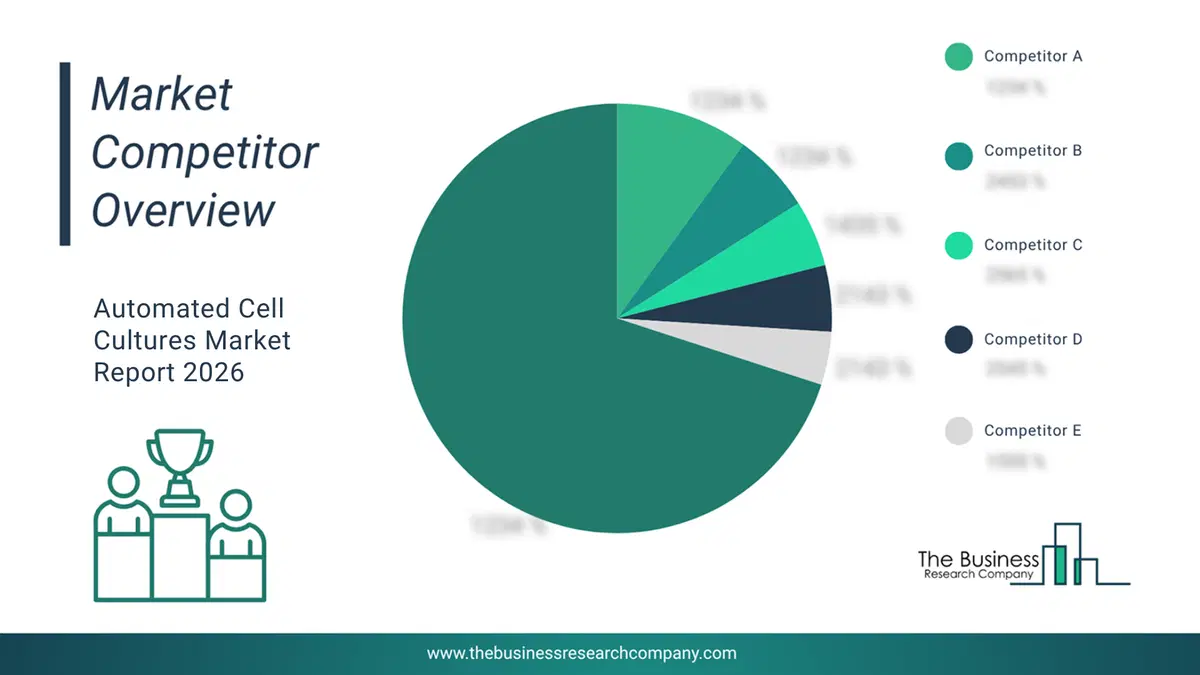
This chart is for illustrative purposes; the full report includes a detailed competitor analysis and comprehensive overview of the top 10 companies in the market.
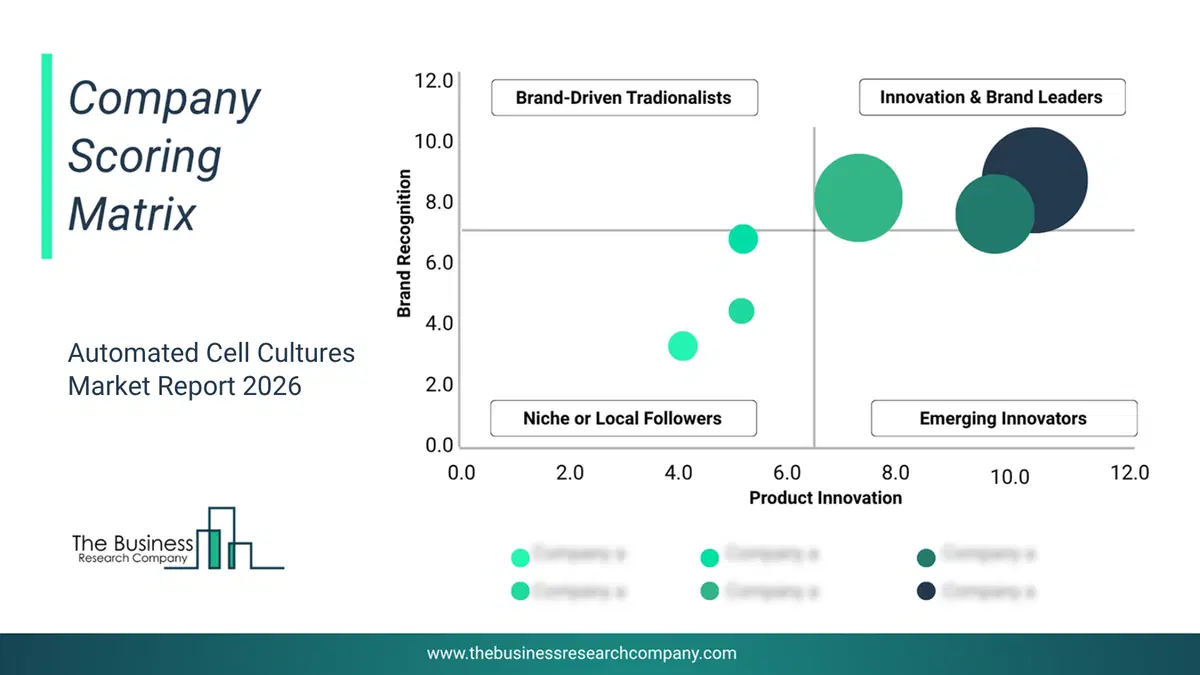
This chart maps companies by product innovation and brand strength, with bubble size indicating relative revenue, helping identify market leaders, challengers, and niche players. This is an illustrative chart; the full report provides a complete and accurate competitive analysis.
Global Automated Cell Cultures Market Trends and Insights
Major companies operating in the automated cell cultures market are focusing on technological advancements such as integrated artificial intelligence (AI)-powered software to gain a competitive advantage. Integrated AI-powered software in automated cell culture optimizes experimental conditions and enhances efficiency by analyzing real-time data to improve cell growth and productivity. For instance, in October 2023, Molecular Devices LLC, a US-based biotechnology company, launched the CellXpress.ai Automated Cell Culture System, a groundbreaking innovation aimed at enhancing drug discovery processes through advanced automation and artificial intelligence. This system is designed to streamline complex cell culture workflows, allowing researchers to focus on more critical tasks while improving efficiency and reliability.What Are Latest Mergers And Acquisitions In The Automated Cell Cultures Market?
In February 2023, Thermo Fisher Scientific Inc., a US-based biotechnology company, partnered with Celltrio Inc. to bring a fully automated cell culture system to biotherapeutics customers. By merging Thermo Fisher's Momentum software with Celltrio's RoboCell platform, the collaboration seeks to achieve fully automated cell line culturing. Celltrio Inc. is a US-based company that develops and delivers automation solutions for biobanking and cell line development processes.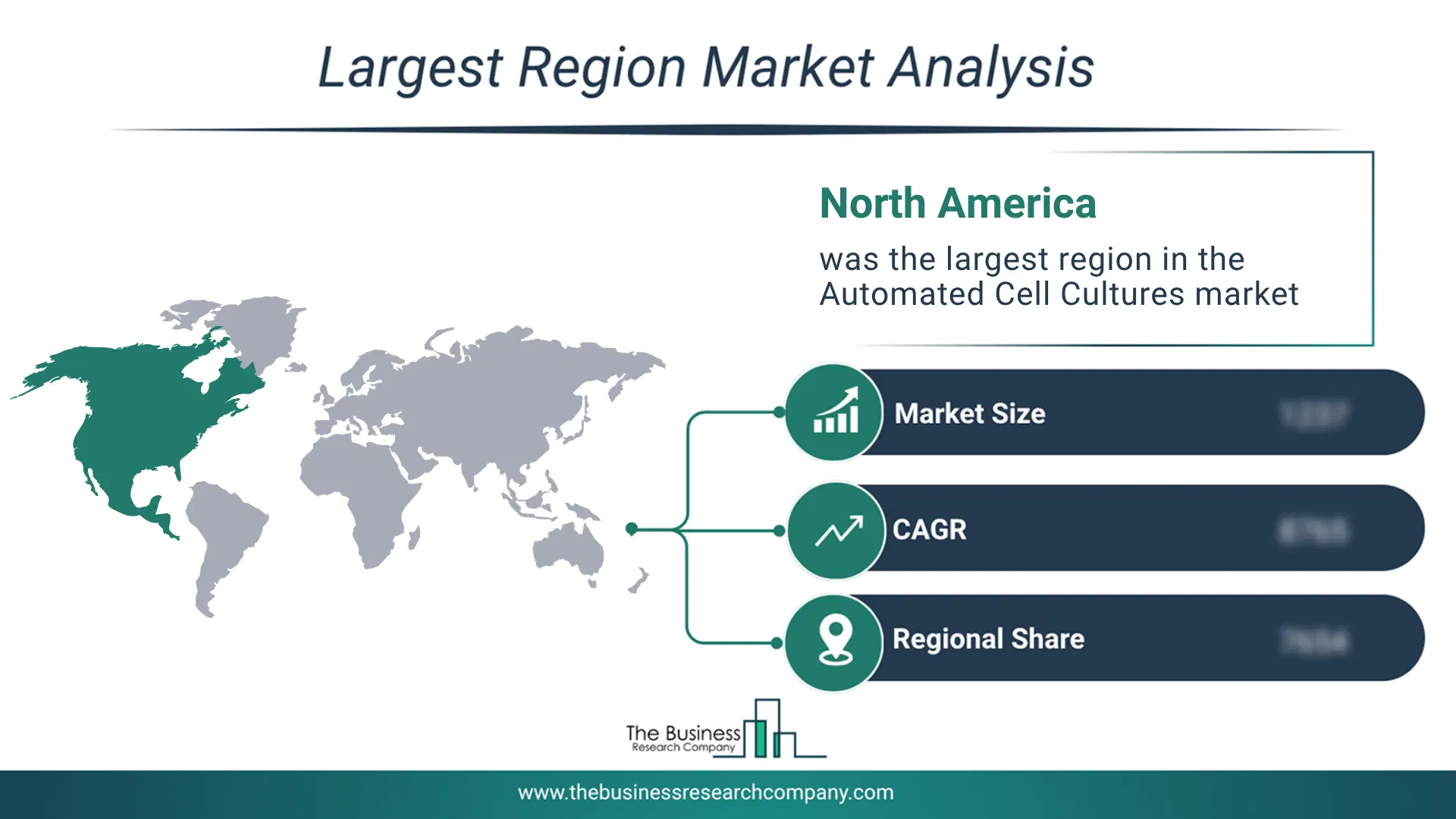
Regional Outlook
North America was the largest region in the automated cell cultures market in 2025. Asia-Pacific is expected to be the fastest-growing region in the forecast period. The regions covered in this market report are Asia-Pacific, South East Asia, Western Europe, Eastern Europe, North America, South America, Middle East, Africa. The countries covered in this market report are Australia, Brazil, China, France, Germany, India, Indonesia, Japan, Taiwan, Russia, South Korea, UK, USA, Canada, Italy, Spain.What Defines the Automated Cell Cultures Market?
The automated cell cultures market consists of sales of automated bioreactors, cell culture platforms, and associated software for managing and analyzing cell growth and behavior. Values in this market are ‘factory gate’ values, that is, the value of goods sold by the manufacturers or creators of the goods, whether to other entities (including downstream manufacturers, wholesalers, distributors, and retailers) or directly to end customers. The value of goods in this market includes related services sold by the creators of the goods.How is Market Value Defined and Measured?
The market value is defined as the revenues that enterprises gain from the sale of goods and/or services within the specified market and geography through sales, grants, or donations in terms of the currency (in USD unless otherwise specified). The revenues for a specified geography are consumption values that are revenues generated by organizations in the specified geography within the market, irrespective of where they are produced. It does not include revenues from resales along the supply chain, either further along the supply chain or as part of other products.
This chart presents market attractiveness based on a quantitative evaluation of growth, competition, strategic alignment, and risk, offering a clear view of opportunity areas for decision-making. This chart is for illustrative purposes; the full report contains the complete analysis.

This chart highlights the Total Addressable Market (TAM) by estimating the maximum revenue opportunity using an assumption-driven approach, supporting strategic planning and opportunity sizing across markets. The chart is illustrative; the full report provides a more comprehensive analysis.
What Key Data and Analysis Are Included in the Automated Cell Cultures Market Report 2026?
The automated cell cultures market research report is one of a series of new reports from The Business Research Company that provides market statistics, including industry global market size, regional shares, competitors with the market share, detailed market segments, market trends and opportunities, and any further data you may need to thrive in the automated cell cultures industry. The market research report delivers a complete perspective of everything you need, with an in-depth analysis of the current and future state of the industry.Automated Cell Cultures Market Report Forecast Analysis
| Report Attribute | Details |
|---|---|
| Market Size Value In 2026 | $7.78 billion |
| Revenue Forecast In 2030 | $11.58 billion |
| Growth Rate | CAGR of 10.5% from 2026 to 2030 |
| Base Year For Estimation | 2025 |
| Actual Estimates/Historical Data | 2020-2025 |
| Forecast Period | 2026 - 2030 |
| Market Representation | Revenue in USD Billion and CAGR from 2026 to 2030 |
| Segments Covered | Type, Equipment Type, Application, End User |
| Regional Scope | Asia-Pacific, Western Europe, Eastern Europe, North America, South America, Middle East, Africa |
| Country Scope | The countries covered in the report are Australia, Brazil, China, France, Germany, India, Indonesia, Japan, Taiwan, Russia, South Korea, UK, USA, Canada, Italy, Spain |
| Key Companies Profiled | Hitachi Ltd., Panasonic Holdings Corporation, Thermo Fisher Scientific Inc., Danaher Corporation, Corning Incorporated, Lonza Group AG, Nikon healthcare, Sartorius AG, Beckman Coulter Inc., Celltrio Inc., Eppendorf AG, Tecan Trading AG, Shibuya Corp, Hamilton Company, Molecular Devices LLC, FORMULATRIX, Highres Biosolutions, Biotron Healthcare, Agilent Technologies, Miltenyi Biotec |
| Customization Scope | Request for Customization |
| Pricing And Purchase Options | Explore Purchase Options |