
Automated Compounding Devices Market Report 2026
Global Outlook – By Component (Automated Compounding Systems Equipment, Automated Compounding Systems Software), By Product Type (Intravenous Compounding Systems, Oral Compounding Systems, Total Parenteral Nutrition (TPN) Compounding Systems), By Mode Of Operation (Fully Automated Compounding Systems, Semi-Automated Compounding Systems), By End-User (Hospitals, Ambulatory Surgical Centers, Other End Users) – Market Size, Trends, Strategies, and Forecast to 2030
Automated Compounding Devices Market Overview
• Automated Compounding Devices market size has reached to $2.51 billion in 2025 • Expected to grow to $3.53 billion in 2030 at a compound annual growth rate (CAGR) of 7% • Growth Driver: Rise In Personalized Medicines Driving Growth Of Market • Market Trend: AI-Enabled IV Robotic Compounding Systems Enhance Safety and Workflow Efficiency • North America was the largest region in 2025 and Asia-Pacific is the fastest growing region.What Is Covered Under Automated Compounding Devices Market?
Automated compounding devices refer to specialized equipment designed to automate the preparation of medications, including intravenous (IV) solutions, in healthcare settings. These devices ensure precise and efficient compounding, enhancing patient safety and reducing the risk of human error in medication preparation. The main component types of automated compounding devices are equipment and software. Equipment in automated compounding devices refers to the physical components of the devices used for automated medication preparation, such as robotic arms, dispensing units, and mixing chambers, essential for the mechanical and physical operations that automate the compounding process, ensuring accuracy and efficiency in medication preparation. The product types are categorized into intravenous compounding systems, oral compounding systems, and total parenteral nutrition (TPN) compounding systems, and the mode of operation includes fully automated compounding systems and semi-automated compounding systems. The end-users are hospitals, ambulatory surgical centers, and others.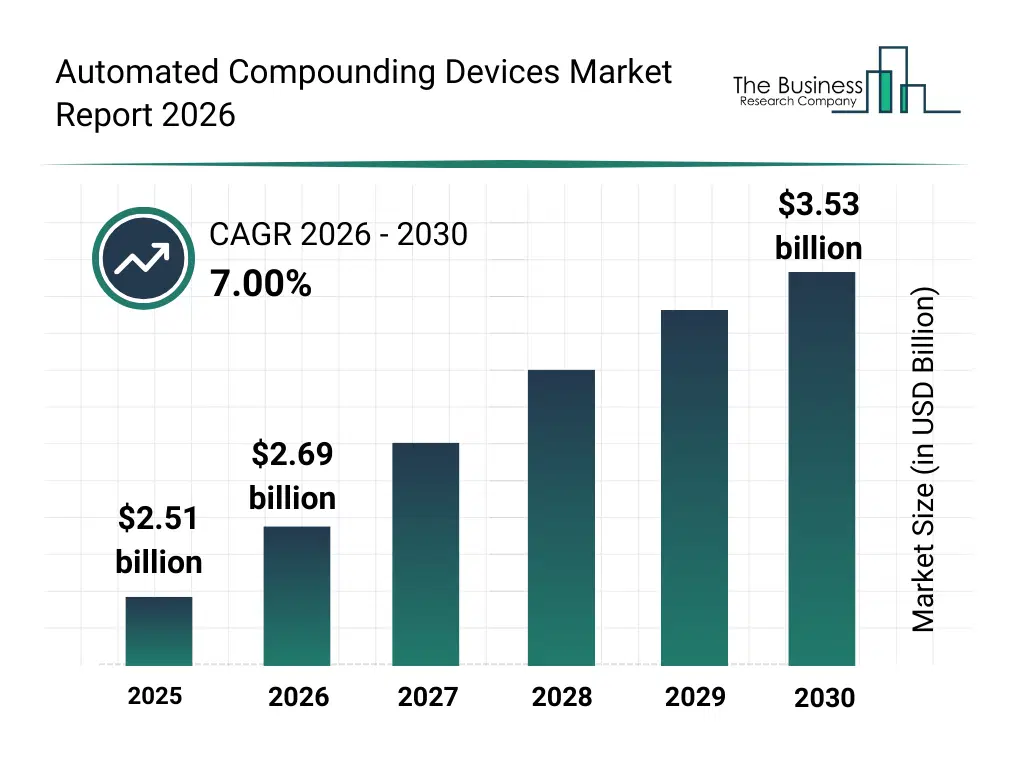
What Is The Automated Compounding Devices Market Size and Share 2026?
The automated compounding devices market size has grown strongly in recent years. It will grow from $2.51 billion in 2025 to $2.69 billion in 2026 at a compound annual growth rate (CAGR) of 7.1%. The growth in the historic period can be attributed to increasing hospital pharmacy workload, rising demand for sterile iv preparation, early adoption of tpn compounding automation, hospital initiatives to reduce compounding errors, expansion of inpatient medication therapy volumes.What Is The Automated Compounding Devices Market Growth Forecast?
The automated compounding devices market size is expected to see strong growth in the next few years. It will grow to $3.53 billion in 2030 at a compound annual growth rate (CAGR) of 7.0%. The growth in the forecast period can be attributed to growing emphasis on medication safety compliance, rising investments in automated pharmacy technology, increasing outsourcing of sterile compounding services, expansion of oncology and critical care drug compounding, growing integration of digital workflow and reporting systems. Major trends in the forecast period include increasing adoption of automated compounding devices to reduce manual medication preparation errors in hospital and pharmacy settings, rising demand for high-precision compounding of iv formulations, oncology drugs, and tpn solutions, growing shift toward centralized and large-volume sterile compounding facilities in healthcare systems, expanding use of automated workflow validation and barcode-based verification in compounding processes, increasing preference for compact, modular, and upgradeable automated compounding platforms for pharmacy operations.
Global Automated Compounding Devices Market Segmentation
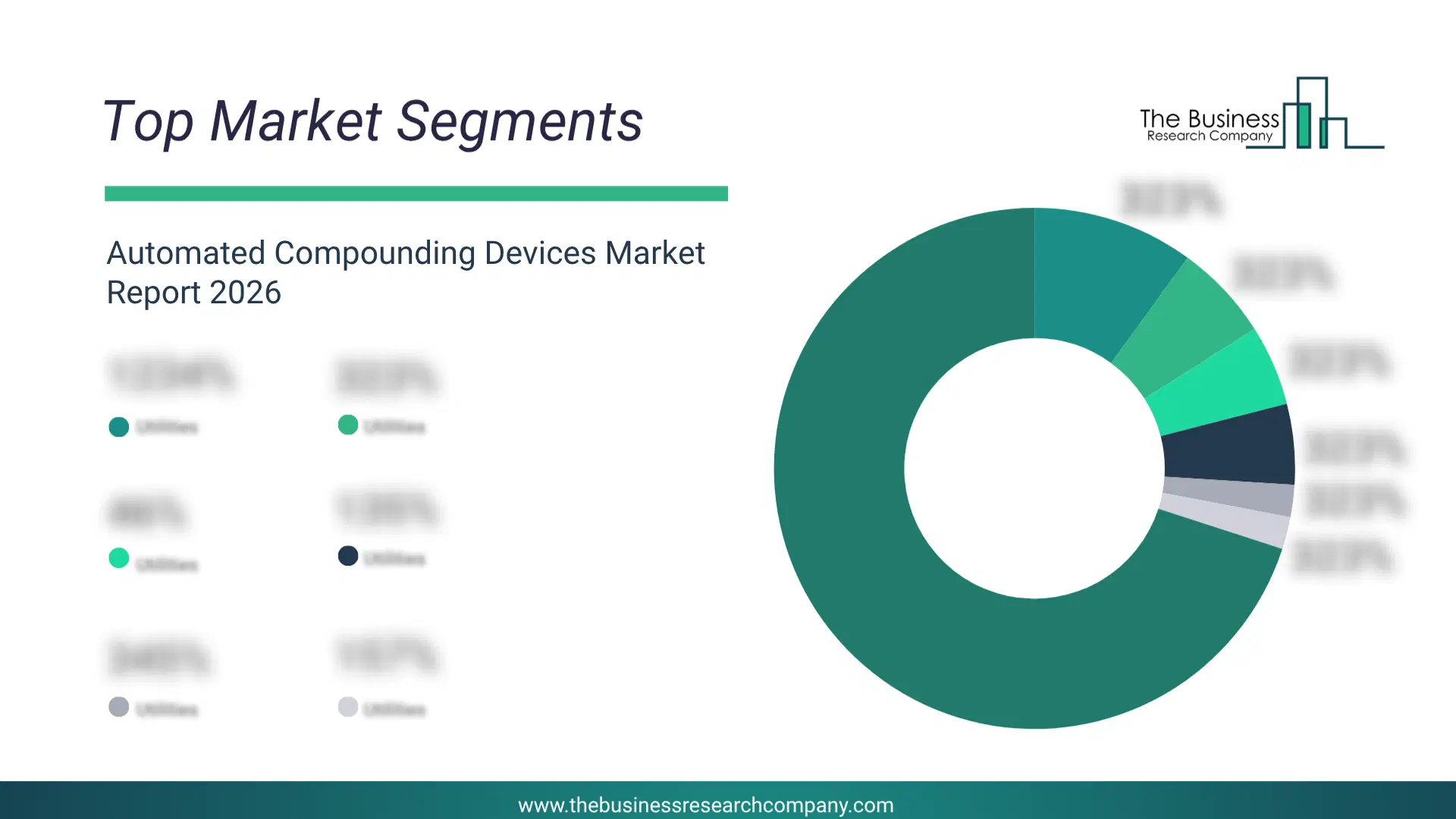
1) By Component: Automated Compounding Systems Equipment, Automated Compounding Systems Software 2) By Product Type: Intravenous Compounding Systems, Oral Compounding Systems, Total Parenteral Nutrition (TPN) Compounding Systems 3) By Mode Of Operation: Fully Automated Compounding Systems, Semi-Automated Compounding Systems 4) By End-User: Hospitals, Ambulatory Surgical Centers, Other End Users Subsegments: 1) By Automated Compounding Systems Equipment: Compounding Workstations, Compounding Pumps, Mixing Chambers, Scales And Balances, Dispensing Units, Vial And Syringe Filling Systems, Other Related Equipment (Filtration Devices) 2) By Automated Compounding Systems Software: Prescription Management Software, Workflow Management Software, Monitoring And Control Software, Data Analytics And Reporting Software, Safety And Compliance Software, Integration Software For Hospital Or Pharmacy Management SystemsWhat Is The Driver Of The Automated Compounding Devices Market?
The increasing number of personalized medicines is expected to fuel the growth of the automated compounding devices market going forward. Personalized medicine refers to a medical approach that tailors healthcare decisions, practices, interventions, and treatments to the individual characteristics of each patient. The increasing number of personalized medicines is due to a better understanding of genetics, patient-specific data, and regulatory support. Automated compounding devices (ACDs) play a crucial role in the field of personalized medicine by enabling the precise and accurate preparation of custom medication formulations tailored to individual patient needs. These devices automate the process of combining various pharmaceutical ingredients in specific proportions, which is essential for creating personalized treatments. For instance, in February 2024, according to the Personalized Medicine Coalition, a US-based non-profit organization, the FDA approved 16 novel personalized therapies for patients with rare diseases in 2023, compared to six in 2022. Therefore, the increasing number of personalized medicines is driving the growth of the automated compounding devices industry.Key Players In The Global Automated Compounding Devices Market
Major companies operating in the automated compounding devices market are Becton Dickinson and Company, Baxter International Inc, B Braun Melsungen AG, Fresenius Kabi AG, Terumo Corporation, ICU Medical Inc., Omnicell Inc., Tecan Group Ltd., Fagron NV, Swisslog Healthcare, ScriptPro LLC, PharMEDium Services LLC, Loccioni Group SPA, ARxIUM Inc., Codonics Inc., Equashield LLC, Yuyama Mfg Co Ltd, Shanghai Weibond Technology Co Ltd, Medimpex LLC, Medica Inc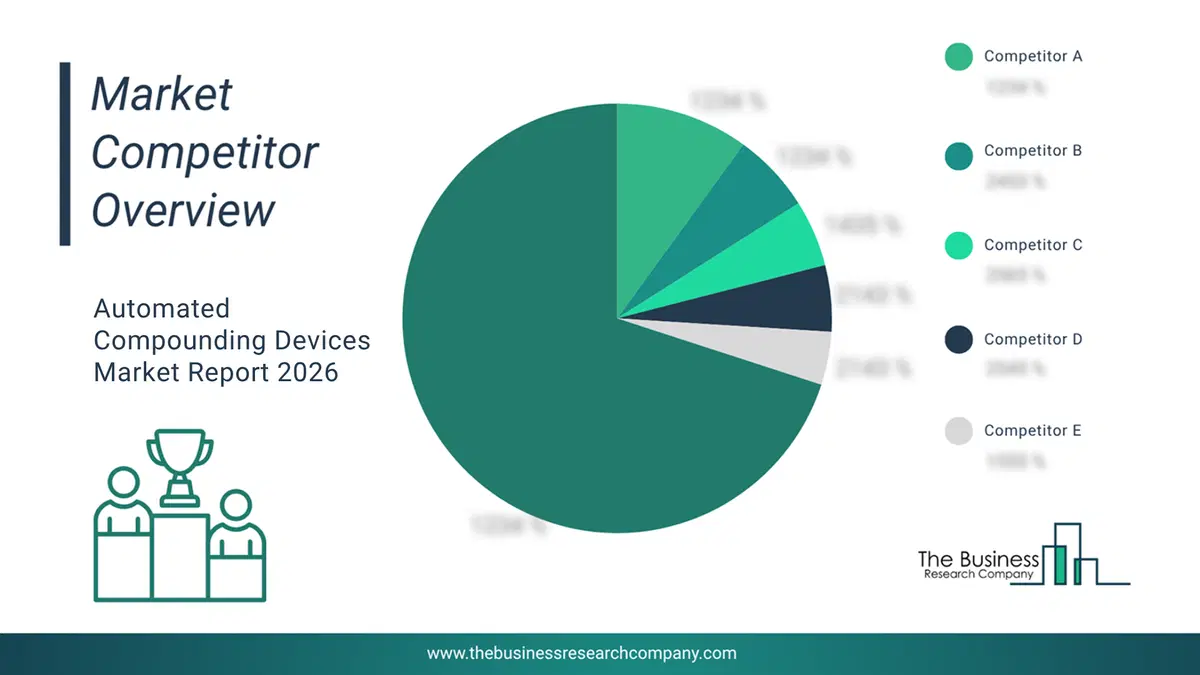
This chart is for illustrative purposes; the full report includes a detailed competitor analysis and comprehensive overview of the top 10 companies in the market.
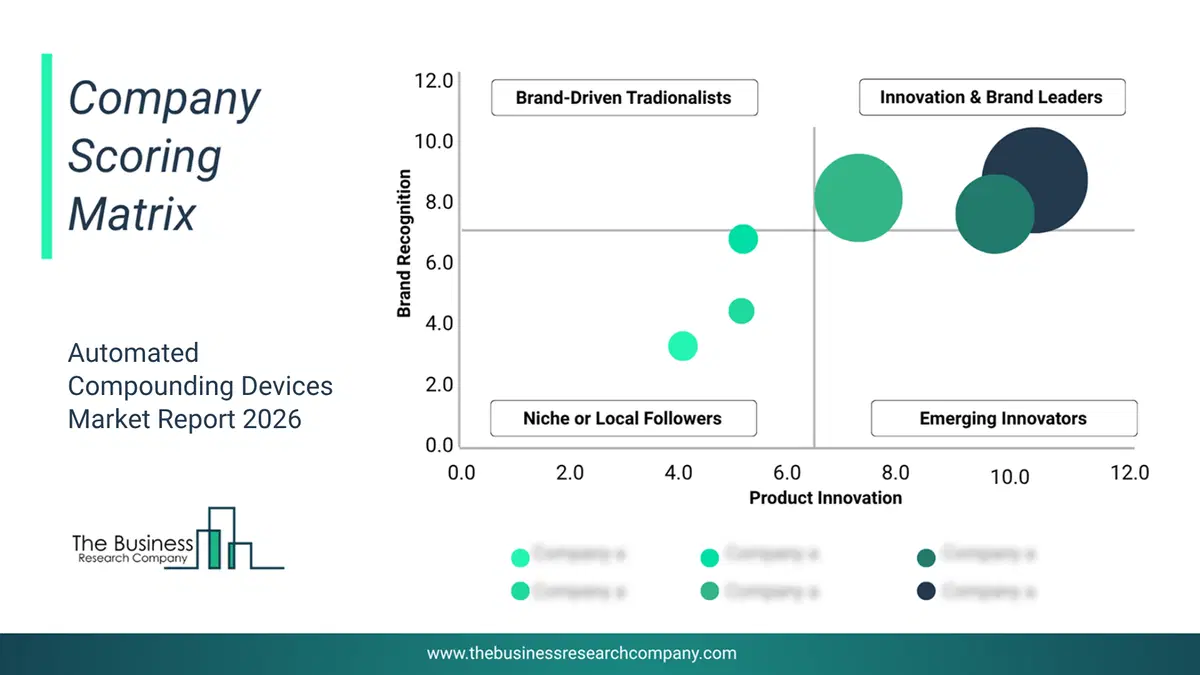
This chart maps companies by product innovation and brand strength, with bubble size indicating relative revenue, helping identify market leaders, challengers, and niche players. This is an illustrative chart; the full report provides a complete and accurate competitive analysis.
Global Automated Compounding Devices Market Trends and Insights
Major companies operating in the automated compounding devices market are focusing on AI-powered robotic compounding, such as AI-enabled IV compounding platforms systems that use artificial intelligence, gravimetric verification, and cloud-based monitoring to automate sterile admixture preparation with high precision, real-time quality checks, and continuous oversight. For instance, in August 2025, Omnicell, a US-based health-technology company, launched an AI-enhanced upgrade to its IV compounding system designed to strengthen safety and accuracy in medication preparation. The updated system integrates advanced AI-based quality-assurance tools that continuously monitor compounding activities, automatically detecting and flagging any deviations from expected procedures. By introducing this level of automated oversight, Omnicell aims to reduce human error, improve workflow efficiency, and support higher standards of medication quality in pharmacy operations.What Are Latest Mergers And Acquisitions In The Automated Compounding Devices Market?
In October 2024, Biovalley Investments & Partners S.p.A. (BIP), an Italy-based healthcare-focused industrial investment and pharma-automation company, partnered with Engmotion d.o.o., to co-develop and industrialize the ChemoMaker automated IV chemotherapy compounding system. With this partnership, Biovalley and Engmotion aim to bring to market a compact, hospital-ready hazardous IV compounding solution that automates the preparation of patient-specific chemotherapy doses inside existing laminar flow hoods, improving accuracy, sterility, operator safety, and drug utilization while offering a more accessible alternative to large, high-cost IV robotic compounding systems. Engmotion d.o.o. is a Slovenia-based provider of high-precision automated filling and compounding systems for syringes, vials, cytostatics, and antibiotics used in medical and pharmaceutical applications.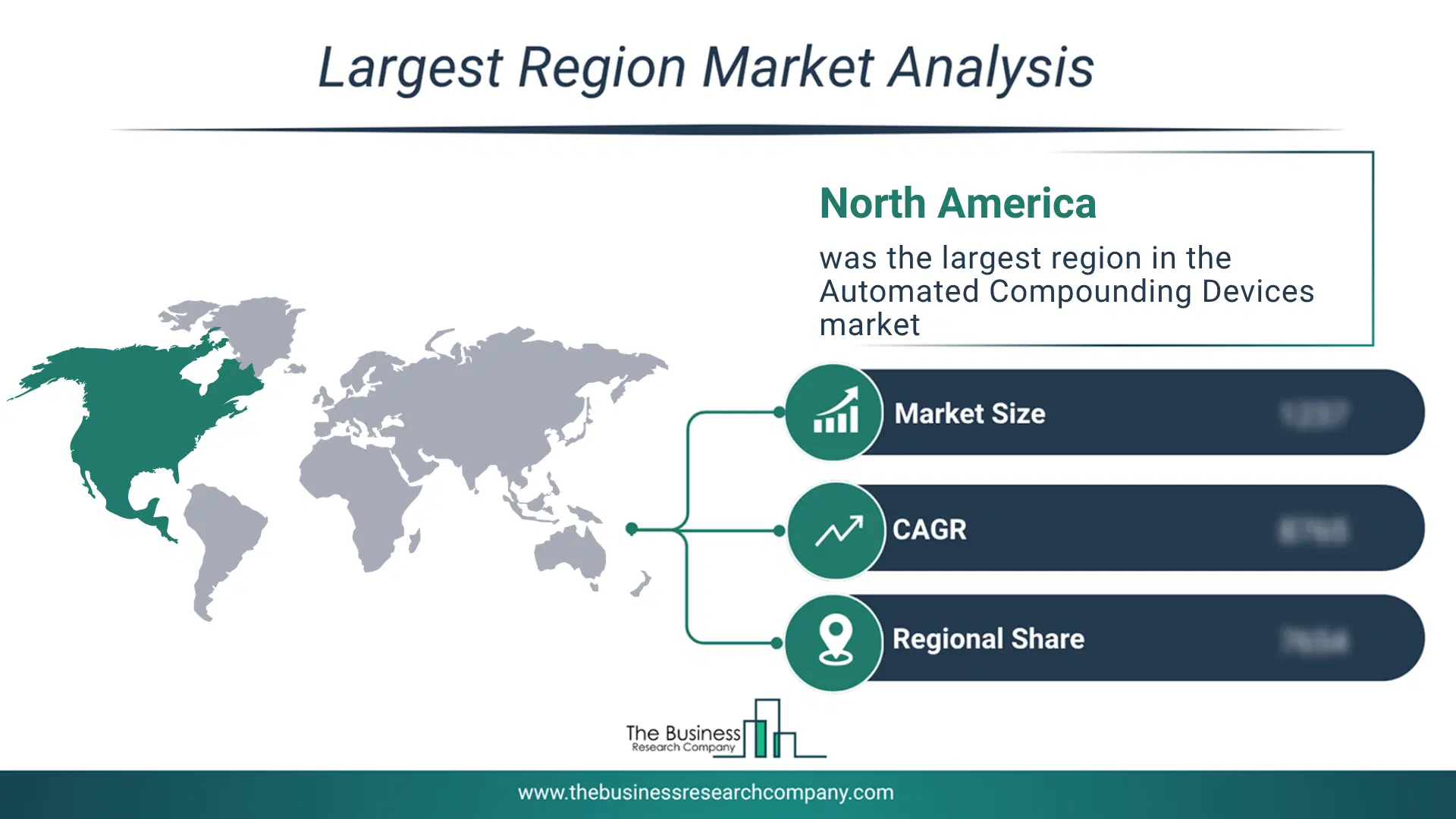
Regional Outlook
North America was the largest region in the automated compounding devices market in 2025. Asia-Pacific is expected to be the fastest-growing region in the forecast period. The regions covered in this market report are Asia-Pacific, South East Asia, Western Europe, Eastern Europe, North America, South America, Middle East, Africa. The countries covered in this market report are Australia, Brazil, China, France, Germany, India, Indonesia, Japan, Taiwan, Russia, South Korea, UK, USA, Canada, Italy, SpainWhat Defines the Automated Compounding Devices Market?
The automated compounding devices market consists of closed-system transfer devices, automated oral solid dose dispensers, and dispensing cabinets. Values in this market are ‘factory gate’ values, that is the value of goods sold by the manufacturers or creators of the goods, whether to other entities (including downstream manufacturers, wholesalers, distributors and retailers) or directly to end customers. The value of goods in this market includes related services sold by the creators of the goods.How is Market Value Defined and Measured?
The market value is defined as the revenues that enterprises gain from the sale of goods and/or services within the specified market and geography through sales, grants, or donations in terms of the currency (in USD unless otherwise specified). The revenues for a specified geography are consumption values that are revenues generated by organizations in the specified geography within the market, irrespective of where they are produced. It does not include revenues from resales along the supply chain, either further along the supply chain or as part of other products.
This chart presents market attractiveness based on a quantitative evaluation of growth, competition, strategic alignment, and risk, offering a clear view of opportunity areas for decision-making. This chart is for illustrative purposes; the full report contains the complete analysis.

This chart highlights the Total Addressable Market (TAM) by estimating the maximum revenue opportunity using an assumption-driven approach, supporting strategic planning and opportunity sizing across markets. The chart is illustrative; the full report provides a more comprehensive analysis.
What Key Data and Analysis Are Included in the Automated Compounding Devices Market Report 2026?
The automated compounding devices market research report is one of a series of new reports from The Business Research Company that provides market statistics, including industry global market size, regional shares, competitors with the market share, detailed market segments, market trends and opportunities, and any further data you may need to thrive in the automated compounding devices industry. The market research report delivers a complete perspective of everything you need, with an in-depth analysis of the current and future state of the industry.Automated Compounding Devices Market Report Forecast Analysis
| Report Attribute | Details |
|---|---|
| Market Size Value In 2026 | $2.69 billion |
| Revenue Forecast In 2030 | $3.53 billion |
| Growth Rate | CAGR of 7% from 2026 to 2030 |
| Base Year For Estimation | 2025 |
| Actual Estimates/Historical Data | 2020-2025 |
| Forecast Period | 2026 - 2030 |
| Market Representation | Revenue in USD Billion and CAGR from 2026 to 2030 |
| Segments Covered | Component, Product Type, Mode Of Operation, End-User |
| Regional Scope | Asia-Pacific, Western Europe, Eastern Europe, North America, South America, Middle East, Africa |
| Country Scope | The countries covered in the report are Australia, Brazil, China, France, Germany, India, Indonesia, Japan, Taiwan, Russia, South Korea, UK, USA, Canada, Italy, Spain. |
| Key Companies Profiled | Becton Dickinson and Company, Baxter International Inc, B Braun Melsungen AG, Fresenius Kabi AG, Terumo Corporation, ICU Medical Inc., Omnicell Inc., Tecan Group Ltd., Fagron NV, Swisslog Healthcare, ScriptPro LLC, PharMEDium Services LLC, Loccioni Group SPA, ARxIUM Inc., Codonics Inc., Equashield LLC, Yuyama Mfg Co Ltd, Shanghai Weibond Technology Co Ltd, Medimpex LLC, Medica Inc |
| Customization Scope | Request for Customization |
| Pricing And Purchase Options | Explore Purchase Options |