
Automated Window Blinds Market Report 2026
Global Outlook – By Product Type (Automated Roller Blinds, Automated Venetian Blinds, Automated Vertical Blinds, Smart Roman Shades, Motorized Curtains And Drapes, Skylight Blinds, Other Product Types), By Operation (Fully Automatic, Semi Automatic), By Material (Aluminum, Wooden, Polyvinyl Chloride, Other Materials), By Distribution Channel (Online Retail, Specialty Home Automation Stores, Home Improvement Stores, Direct Sales, Contractors And Installers), By End Use (Home, Office, Restaurants And Hotels, Hospitals And Nursing Homes, School And University, Other End Uses) – Market Size, Trends, Strategies, and Forecast to 2030
Automated Window Blinds Market Overview
• Automated Window Blinds market size has reached to $2.1 billion in 2025 • Expected to grow to $2.72 billion in 2030 at a compound annual growth rate (CAGR) of 5.2% • Growth Driver: The Increasing Adoption Of Smart Home Automation Systems Driving The Growth Of The Market Due To Rising Demand For Energy Efficiency • Market Trend: Intelligent Daylight Control Solutions Transform Modern Home Interiors • North America was the largest region in 2025 and Asia-Pacific is the fastest growing region.What Is Covered Under Automated Window Blinds Market?
Automated window blinds refer to motorized window covering systems that can be controlled remotely using switches, smartphones, voice assistants, or automated scheduling systems. These blinds are designed to improve convenience, energy efficiency, privacy, and indoor comfort by automatically adjusting based on user preferences, sunlight, or room temperature. They are widely used in residential, commercial, and smart home environments due to their ability to integrate with home automation and smart building systems. The main product types of automated window blinds include automated roller blinds, automated venetian blinds, automated vertical blinds, smart Roman shades, motorized curtains and drapes, skylight blinds, and other product types. Automated roller blinds refer to motor-driven shading systems designed to automatically adjust light and privacy levels using remote or smart control systems. These products operate through fully automatic and semi automatic mechanisms and are manufactured using materials including aluminum, wooden, polyvinyl chloride, and other materials. They are distributed through online retail, specialty home automation stores, home improvement stores, direct sales, and contractors and installers channels and they are used by several end uses such as home, office, restaurants and hotels, hospitals and nursing homes, school and university, and others.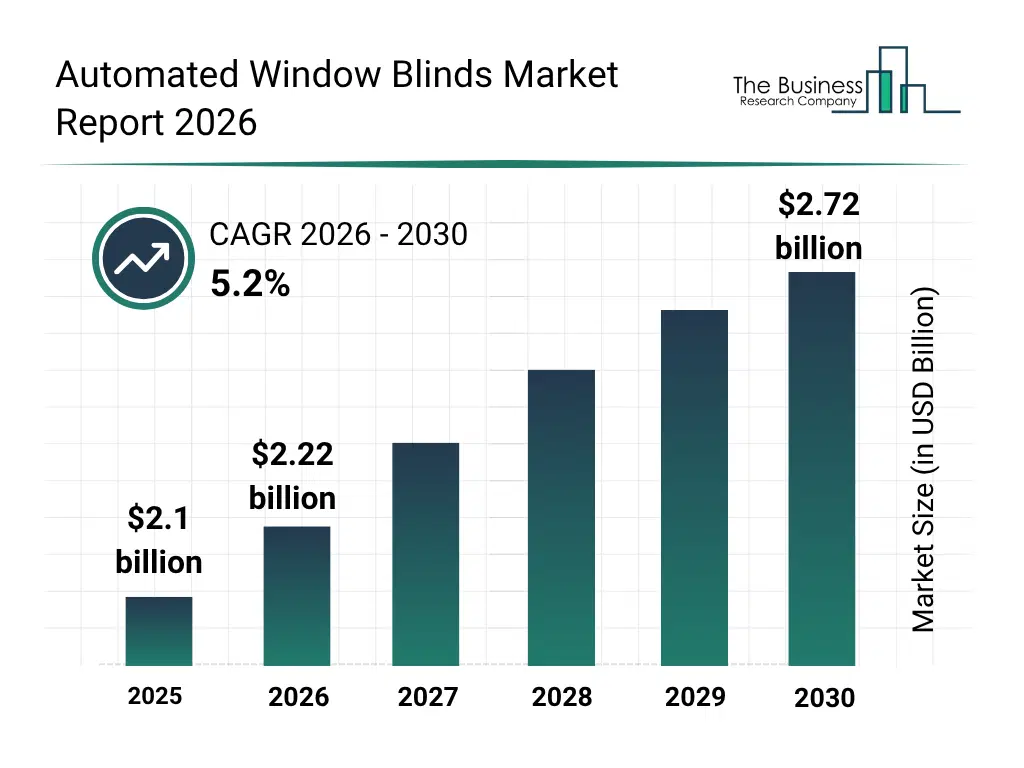
What Is The Automated Window Blinds Market Size and Share 2026?
The automated window blinds market size has grown strongly in recent years. It will grow from $2.1 billion in 2025 to $2.22 billion in 2026 at a compound annual growth rate (CAGR) of 5.6%. The growth in the historic period can be attributed to manual blind operation systems, low smart home penetration, limited adoption of home automation devices, high cost of motorized shading systems, lack of interoperability standards in smart homes.What Is The Automated Window Blinds Market Growth Forecast?
The automated window blinds market size is expected to see strong growth in the next few years. It will grow to $2.72 billion in 2030 at a compound annual growth rate (CAGR) of 5.2%. The growth in the forecast period can be attributed to rapid growth of smart home ecosystems, increasing demand for energy efficient buildings, expansion of iot enabled residential infrastructure, rising adoption of voice controlled devices, integration of ai based building automation systems. Major trends in the forecast period include AI enabled smart shading and environmental automation systems, sensor based light and temperature adaptive blinds, voice assistant integrated home automation blinds, energy efficient smart building shading solutions, predictive occupancy based window covering control systems.
Global Automated Window Blinds Market Segmentation
1) By Product Type: Automated Roller Blinds; Automated Venetian Blinds; Automated Vertical Blinds; Smart Roman Shades; Motorized Curtains And Drapes; Skylight Blinds; Other Product Types 2) By Operation: Fully Automatic; Semi Automatic 3) By Material: Aluminum; Wooden; Polyvinyl Chloride; Other Materials 4) By Distribution Channel: Online Retail; Specialty Home Automation Stores; Home Improvement Stores; Direct Sales; Contractors And Installers 5) By End Use: Home; Office; Restaurants And Hotels; Hospitals And Nursing Homes; School And University; Other End Uses Subsegments: 1) By Automated Roller Blinds: Wi Fi Enabled Roller Blinds; Battery Powered Roller Blinds; Hardwired Roller Blinds; Solar Powered Roller Blinds; Remote Controlled Roller Blinds; Voice Controlled Roller Blinds 2) By Automated Venetian Blinds: Wood Venetian Blinds; Aluminum Venetian Blinds; Faux Wood Venetian Blinds; Motorized Mini Blinds; Cordless Venetian Blinds; Smart Venetian Blinds 3) By Automated Vertical Blinds: Fabric Vertical Blinds; Vinyl Vertical Blinds; Motorized Sliding Vertical Blinds; Remote Controlled Vertical Blinds; Smart Vertical Blinds; Blackout Vertical Blinds 4) By Smart Roman Shades: Flat Roman Shades; Relaxed Roman Shades; Pleated Roman Shades; Blackout Roman Shades; Thermal Roman Shades; Remote Controlled Roman Shades 5) By Motorized Curtains And Drapes: Wave Fold Curtains; Pinch Pleat Drapes; Blackout Curtains; Sheer Curtains; Remote Controlled Drapes; Voice Activated Curtains 6) By Skylight Blinds: Honeycomb Skylight Blinds; Blackout Skylight Blinds; Solar Powered Skylight Blinds; Remote Controlled Skylight Blinds; Pleated Skylight Shades; Motorized Roof Window Blinds 7) By Other Product Types: Panel Track Blinds; Cellular Shades; Outdoor Automated Shades; Dual Layer Zebra Blinds; Bamboo Smart Shades; Smart Projection ScreensWhat Is The Driver Of The Automated Window Blinds Market?
The increasing adoption of smart home automation systems is expected to propel the growth of the automated window blinds market going forward. Smart home automation systems refer to connected technologies that enable users to remotely monitor and control household functions such as internet-connected alarm systems, smoke detectors, security cameras, and smart doorbells. The increasing adoption of smart home automation systems is driven by rising demand for energy efficiency, as consumers seek technologies that reduce power consumption, lower utility costs, and optimize the use of lighting, heating, and cooling through intelligent, automated control. Automated window blinds support smart home ecosystems by enabling remote operation, automated scheduling, voice control integration, and improved indoor energy management through intelligent light regulation. For instance, in October 2024, according to the Central Statistics Office, an Ireland-based government agency, in 2024, 30% of internet users used smart home security solutions such as internet-connected alarm systems, smoke detectors, security cameras, and smart doorbells, compared with just 17% in 2022. Therefore, the increasing adoption of smart home automation systems is driving the growth of the automated window blinds industry.Key Players In The Global Automated Window Blinds Market
Major companies operating in the automated window blinds market are Hunter Douglas N.V.; Somfy SA; Legrand SA; Springs Window Fashions LLC; Lutron Electronics Co. Inc.; Nien Made Enterprise Co. Ltd.; WAREMA Renkhoff SE; Coulisse B.V.; Crestron Electronics Inc.; IKEA Group; Ningbo Dooya Mechanic and Electronic Technology Co. Ltd.; Rollease Acmeda; Bandalux Industrial S.A; Griesser AG; Draper Inc.; Tuya Smart; Changzhou TM Innovation Technology Co. Ltd.; Yoolax; SmartWings Home LLC; OmniaBlinds AB; Bofu; Lafayette Venetian Blind Inc.; Shenzhen Zemismart Technology Co. Ltd.Global Automated Window Blinds Market Trends and Insights
Major companies operating in the automated window blinds market are focusing on developing innovative products, such as sun-responsive smart wood blinds to enhance automated daylight control, improve energy efficiency, and deliver personalized indoor comfort through intelligent light management. Sun-responsive smart wood blinds are automated shading systems equipped with sensors, wireless connectivity, and programmable tilt mechanisms that automatically adjust blind positioning based on sunlight intensity and time of day, helping reduce indoor heat gain, minimize glare, and optimize natural lighting compared to traditional manually operated blinds. For instance, in January 2026, Lutron Electronics Co Inc., a US-based lighting and shading systems company, launched Caséta Smart Wood Blinds, a DIY-friendly automated shading solution featuring automatic sun-based tilt adjustment technology. The system integrates with the Caséta Wireless platform and enables blinds to automatically tilt throughout the day in response to changing sunlight conditions, enhancing comfort and reducing reliance on artificial lighting and cooling systems. It supports app-based remote control, voice assistant compatibility, scheduling functions, and seamless smart home integration, allowing users to customize lighting preferences and automate indoor ambiance management. The blinds are designed for residential applications and combine natural wood aesthetics with intelligent automation, making them suitable for modern connected home environments.What Are Latest Mergers And Acquisitions In The Automated Window Blinds Market?
In September 2025, Springs Window Fashions LLC, a US-based manufacturing company, acquired PowerShades for an undisclosed amount. With this acquisition, Springs Window Fashions aims to strengthen its position in the rapidly growing motorized and smart shading segment by integrating PowerShades’ automation technology and expanding its capabilities in the residential and commercial home automation market. Power Shades Inc. is a US-based company that provides automated window blinds or shades, including motorized and smart-controlled options.Regional Outlook
North America was the largest region in the automated window blinds market in 2025. Asia-Pacific is expected to be the fastest-growing region in the forecast period. The regions covered in this market report are Asia-Pacific, South East Asia, Western Europe, Eastern Europe, North America, South America, Middle East, Africa. The countries covered in this market report are Australia, Brazil, China, France, Germany, India, Indonesia, Japan, Taiwan, Russia, South Korea, UK, USA, Canada, Italy, Spain.What Defines the Automated Window Blinds Market?
The automated window blinds market consists of sales of motorized roller blinds, smart window covering systems, and related accessories. Values in this market are ‘factory gate’ values, that is the value of goods sold by the manufacturers or creators of the goods, whether to other entities (including wholesalers, distributors, retailers, contractors, and installers) or directly to end customers. The value of goods in this market includes related services sold by the creators of the goods.How is Market Value Defined and Measured?
The market value is defined as the revenues that enterprises gain from the sale of goods and/or services within the specified market and geography through sales, grants, or donations in terms of the currency (in USD unless otherwise specified). The revenues for a specified geography are consumption values that are revenues generated by organizations in the specified geography within the market, irrespective of where they are produced. It does not include revenues from resales along the supply chain, either further along the supply chain or as part of other products.What Key Data and Analysis Are Included in the Automated Window Blinds Market Report 2026?
The automated window blinds market research report is one of a series of new reports from The Business Research Company that provides market statistics, including industry global market size, regional shares, competitors with the market share, detailed market segments, market trends and opportunities, and any further data you may need to thrive in the automated window blinds industry. The market research report delivers a complete perspective of everything you need, with an in-depth analysis of the current and future state of the industry.Automated Window Blinds Market Report Forecast Analysis
| Report Attribute | Details |
|---|---|
| Market Size Value In 2026 | $2.22 billion |
| Revenue Forecast In 2030 | $2.72 billion |
| Growth Rate | CAGR of 5.2% from 2026 to 2030 |
| Base Year For Estimation | 2025 |
| Actual Estimates/Historical Data | 2020-2025 |
| Forecast Period | 2026 - 2030 |
| Market Representation | Revenue in USD Billion and CAGR from 2026 to 2030 |
| Segments Covered | Product Type, Operation, Material, Distribution Channel, End Use |
| Regional Scope | Asia-Pacific, Western Europe, Eastern Europe, North America, South America, Middle East, Africa |
| Country Scope | The countries covered in the report are Australia, Brazil, China, France, Germany, India, ... |
| Key Companies Profiled | Hunter Douglas N.V.; Somfy SA; Legrand SA; Springs Window Fashions LLC; Lutron Electronics Co. Inc.; Nien Made Enterprise Co. Ltd.; WAREMA Renkhoff SE; Coulisse B.V.; Crestron Electronics Inc.; IKEA Group; Ningbo Dooya Mechanic and Electronic Technology Co. Ltd.; Rollease Acmeda; Bandalux Industrial S.A; Griesser AG; Draper Inc.; Tuya Smart; Changzhou TM Innovation Technology Co. Ltd.; Yoolax; SmartWings Home LLC; OmniaBlinds AB; Bofu; Lafayette Venetian Blind Inc.; Shenzhen Zemismart Technology Co. Ltd. |
| Customization Scope | Request for Customization |
| Pricing And Purchase Options | Explore Purchase Options |