
Automatic Filament Winding Machines Market Report 2026
Global Outlook – By Type (2-Axis Filament Winding Machine, 3-Axis Filament Winding Machine, 4-Axis Filament Winding Machine, 5-Axis And 6-Axis Filament Winding Machine), By Application (Pressure Vessels, Pipes And Tanks), By End-Use Industries (Aerospace And Defense, Automotive) – Market Size, Trends, Strategies, and Forecast to 2030
Automatic Filament Winding Machines Market Overview
• Automatic Filament Winding Machines market size has reached to $1.85 billion in 2025 • Expected to grow to $3.23 billion in 2030 at a compound annual growth rate (CAGR) of 11.8% • Growth Driver: Automatic Filament Winding Machines In Response To Surging Demand For Composite Materials • Market Trend: Technological Developments In Automated Fiber Winding And Filament Placement Machines • North America was the largest region in 2025 and Asia-Pacific is the fastest growing region.What Is Covered Under Automatic Filament Winding Machines Market?
Automatic filament winding machines are specialized manufacturing devices designed to automate the process of filament winding in the production of composite materials. It is used to create high-strength composite structures by winding continuous filaments or fibers around a rotating mandrel or mold. The main types of automatic filament winding machines are 2-axis filament winding machines, 3-axis filament winding machines, 4-axis filament winding machines, and 5-axis and 6-axis filament winding machines. A 2-axis filament winding machine is a type of automatic filament winding machine specifically designed to control the filament winding process along two primary axes and is used to create cylindrical composite constructions with specific winding patterns and orientations. They are used in several applications, such as pressure vessels and pipes and tanks, by various end-use industries, including aerospace, defense, and automotive.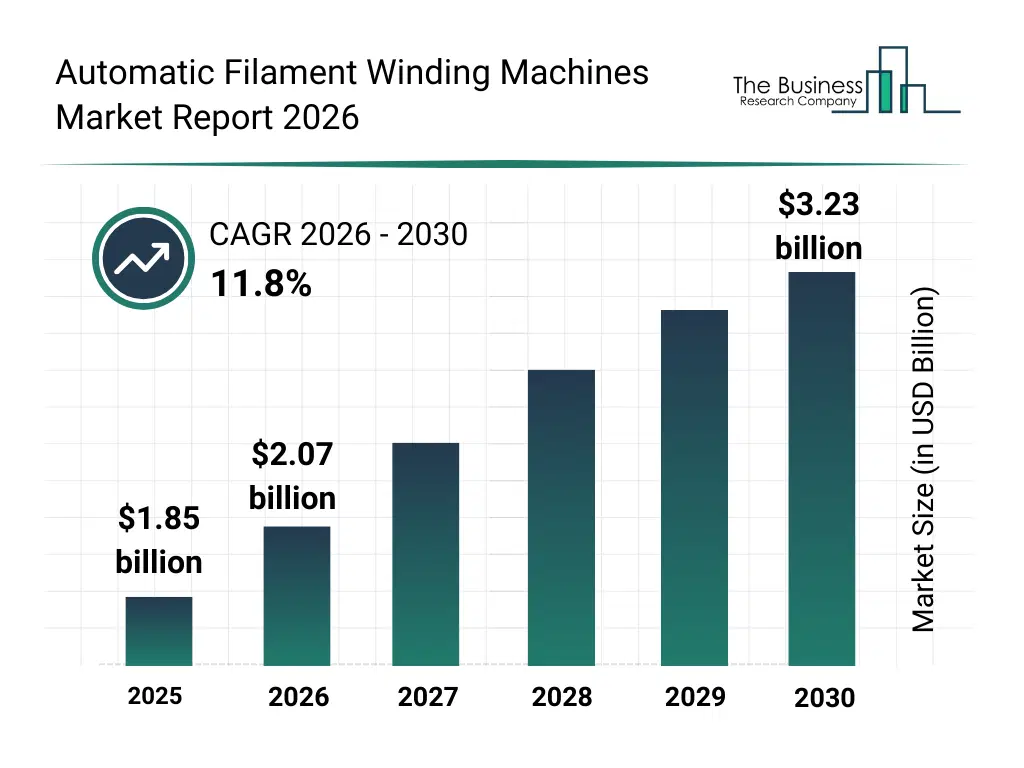
What Is The Automatic Filament Winding Machines Market Size and Share 2026?
The automatic filament winding machines market size has grown rapidly in recent years. It will grow from $1.85 billion in 2025 to $2.07 billion in 2026 at a compound annual growth rate (CAGR) of 11.8%. The growth in the historic period can be attributed to growth of aerospace composite structures, increasing use of pressure vessels and tanks, expansion of automotive lightweighting initiatives, adoption of automated composite fabrication, advancements in fiber materials.What Is The Automatic Filament Winding Machines Market Growth Forecast?
The automatic filament winding machines market size is expected to see rapid growth in the next few years. It will grow to $3.23 billion in 2030 at a compound annual growth rate (CAGR) of 11.8%. The growth in the forecast period can be attributed to increasing investments in advanced composite manufacturing, rising demand for high-performance materials, expansion of electric vehicle component production, growing adoption in hydrogen storage systems, increasing focus on production scalability. Major trends in the forecast period include increasing adoption of multi-axis filament winding systems, rising integration of cnc and robotic controls, growing demand for high-strength composite manufacturing, expansion of automated mandrel handling, enhanced focus on process precision and repeatability.Tariff Impact On Automatic Filament Winding Machines Market
Tariffs are influencing the automatic filament winding machines market by increasing costs of imported servo motors, control systems, precision bearings, and carbon fiber handling components. Aerospace and automotive manufacturers in North America and Europe are most affected due to reliance on specialized imported machinery, while Asia-Pacific exporters face reduced price competitiveness. These tariffs are raising capital investment costs and extending project timelines. However, they are also promoting local machine integration, regional component sourcing, and innovation in modular winding platforms.
Global Automatic Filament Winding Machines Market Segmentation
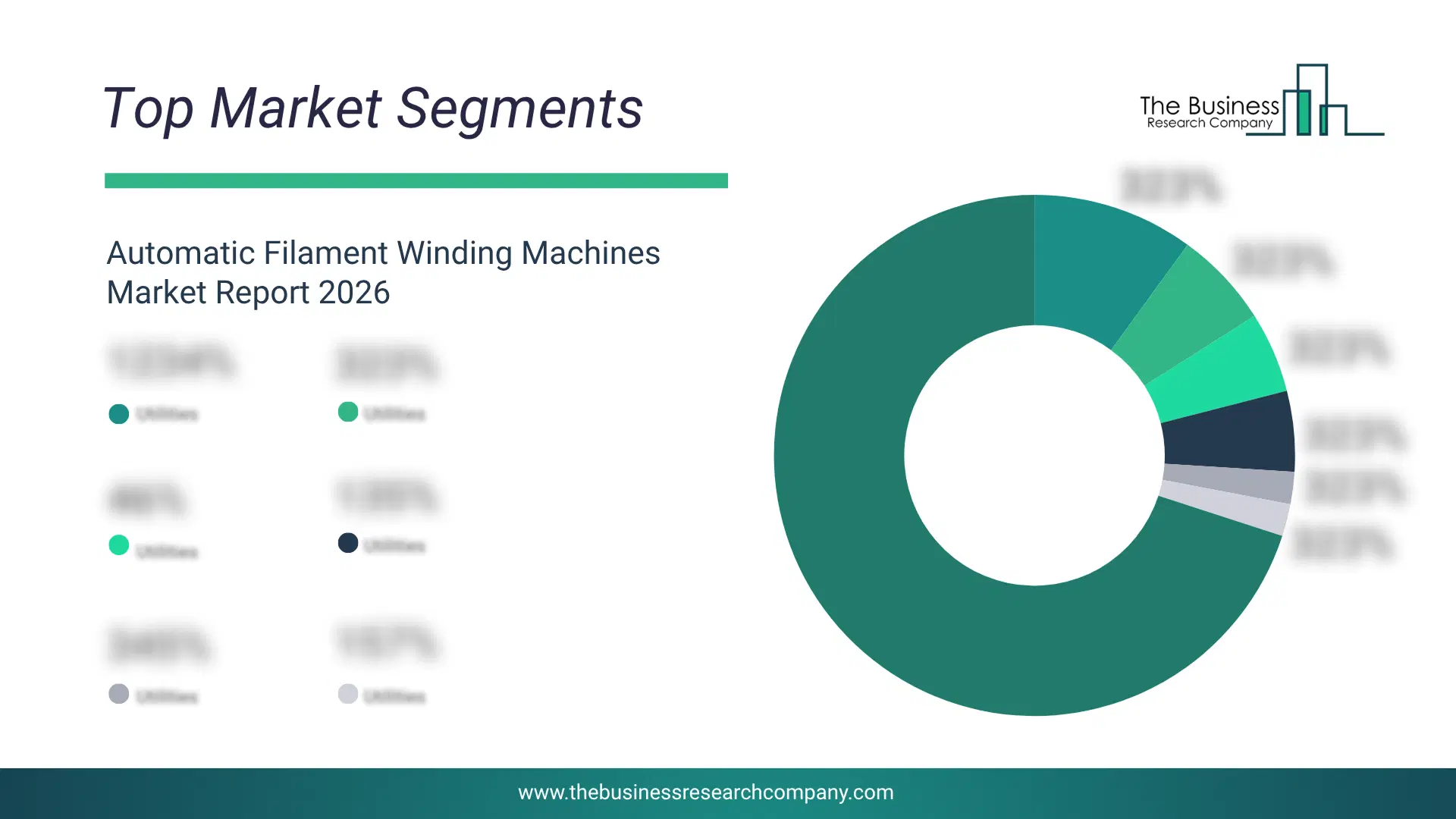
1) By Type: 2-Axis Filament Winding Machine, 3-Axis Filament Winding Machine, 4-Axis Filament Winding Machine, 5-Axis And 6-Axis Filament Winding Machine 2) By Application: Pressure Vessels, Pipes And Tanks 3) By End-Use Industries: Aerospace And Defense, Automotive Subsegments: 1) By 2-Axis Filament Winding Machine: Manual Control 2-Axis Machines, Automated Control 2-Axis Machines 2) By 3-Axis Filament Winding Machine: Manual Control 3-Axis Machines, Automated Control 3-Axis Machines 3) By 4-Axis Filament Winding Machine: Manual Control 4-Axis Machines, Automated Control 4-Axis Machines 4) By 5-Axis and 6-Axis Filament Winding Machine: 5-Axis Machines, 6-Axis Machines, Automated Control Systems For 5-Axis And 6-Axis MachinesWhat Are The Drivers Of The Automatic Filament Winding Machines Market?
The rising demand for composite materials is expected to propel the growth of the automatic filament winding machine market going forward. Composite materials are products engineered by combining two or more distinct types of constituents with different physical or chemical properties. Automatic filament winding machines are employed in composite material production to produce high-strength structures such as pressure tanks, aircraft components, and automobile parts with accuracy and efficiency. For instance, in April 2025, according to the Aerospace Technology Institute (ATI), a UK-based organization that sets the technology strategy, the expanding use of composite components in the civil aircraft fleet is projected to drive their market value to double by 2032, with sustained growth expected through 2050. Therefore, the rising demand for composite materials is driving the automatic filament winding machine industry. The increasing demand for renewable energy is expected to drive the growth of the automatic filament winding machines market going forward. Renewable energy refers to energy derived from natural resources that are replenished on a continual basis, such as sunlight, wind, water flow, and geothermal heat, and can be harnessed without depleting finite reserves. The primary factor driving the increasing demand for renewable energy is the global priority to reduce carbon emissions, which encourages governments, industries, and consumers to shift toward cleaner power sources that align with long-term environmental and sustainability objectives. Automatic filament winding machines enable the efficient, precise, and scalable production of advanced composite components required for renewable energy technologies, particularly in wind and hydrogen applications. For instance, in September 2025, according to the Department for Energy Security and Net Zero, a UK-based government department, renewable generation reached 35 TWh and climbed to a record 54.5 percent share in the second quarter of 2025, rising 2.8 percentage points year-on-year as stronger wind capacity and exceptional solar hours drove a lower-carbon mix, offset falling nuclear output, and pushed fossil fuels to a matching record low of 26.7 percent, with wind once again surpassing gas. Therefore, the increasing demand for renewable energy is driving the automatic filament winding machines industry.Key Players In The Global Automatic Filament Winding Machines Market
Major companies operating in the automatic filament winding machines market are Murata Machinery Ltd., GTI Composite, Ingersoll Machine Tools, Magnum Venus Products (MVP), Pultrex, Advanced Composites Inc., Cygnet Texkimp, Autonational Composite Machinery, Mikrosam, EMAI Composites, Vem Technologies S.r.l., Matrasur Composites, Engineering Technology Corp. (Toray), Roth Composite Machinery, MF Tech, Comec Innovative Srl, Hille Engineering, X-Winder LLC, Beijing Vidatech, Schmidt & Heinzmann GmbH & Co. KG, McClean Anderson, Harbin Composite Equipment, Shanghai Vanguard Composites Technique, Cincinnati Composite Machines (CCM), Rooks Automation, TANIQ BV, Shenzhen HONEST Intelligent Equipment Co. Ltd.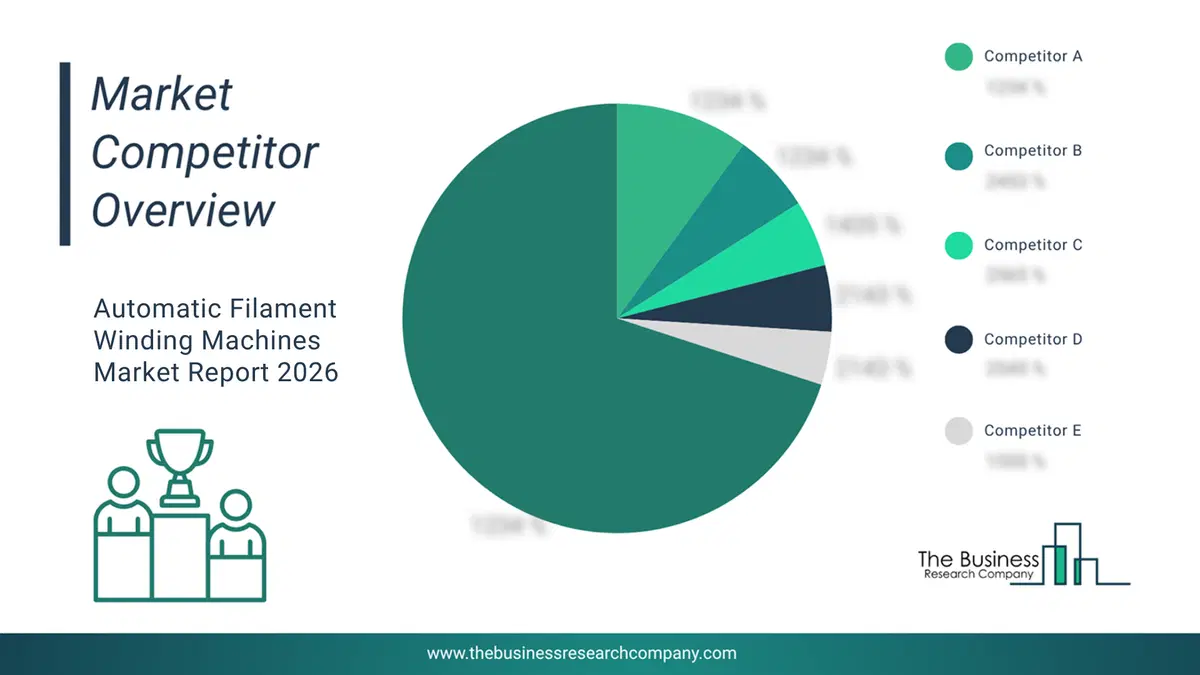
This chart is for illustrative purposes; the full report includes a detailed competitor analysis and comprehensive overview of the top 10 companies in the market.
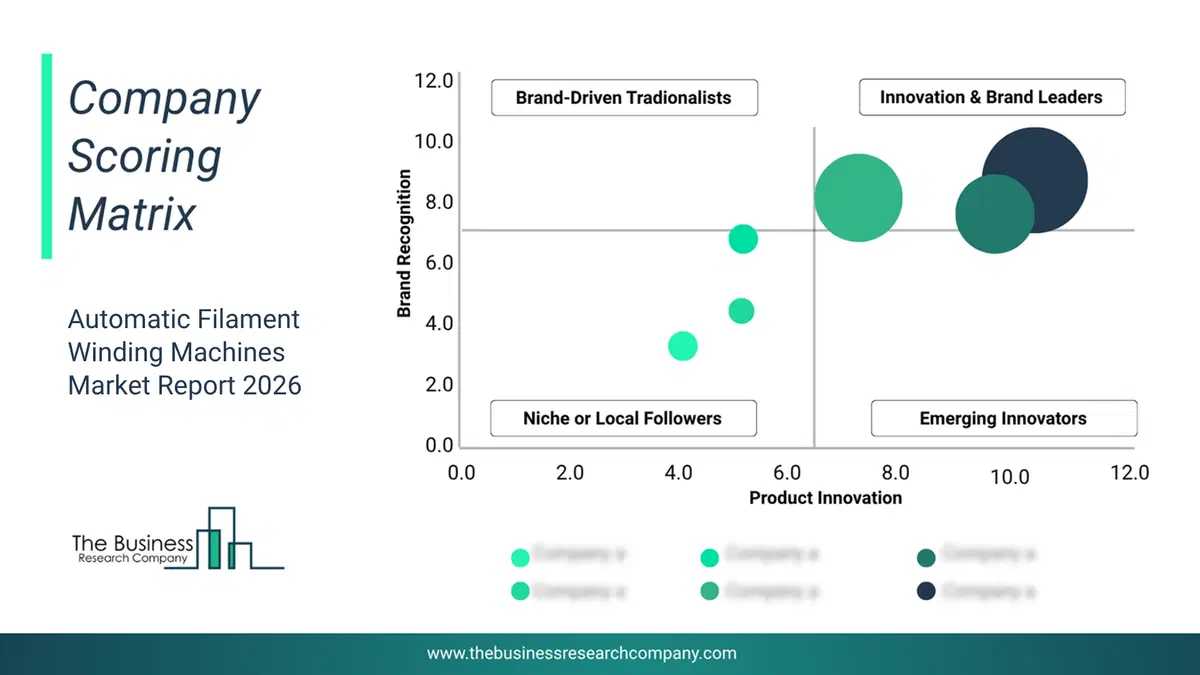
This chart maps companies by product innovation and brand strength, with bubble size indicating relative revenue, helping identify market leaders, challengers, and niche players. This is an illustrative chart; the full report provides a complete and accurate competitive analysis.
Global Automatic Filament Winding Machines Market Trends and Insights
Major companies operating in the automatic filament winding machines market are focused on developing technologically advanced products, such as automated fiber winding and filament placement machines, to better serve customers with advanced features. Automated fiber winding and filament placement machines are advanced manufacturing equipment designed to automate the process of winding materials, such as fiberglass, onto a rotating mandrel. For instance, in October 2023, CompoTech, a US-based manufacturing and technology company, launched 'Turnkey'. The turnkey is an automated fiber winding and filament placement machine and incorporates an integrated FANUC (Rochester Hills, Mich., USA) M-20iA/20M with an R-30iB six-axis robot arm and remote controller unit, as well as an in-house-created Shneg 2.0 fiber placement and winding software that manages the robot arm and winding mandrel. The software translates a design specification into a manufacturing program, allowing for the accurate fabrication of carbon fiber components. Standard program preparation winding codes for popular types of products, such as round tubes, beams, and n-edge profiles, are included with all machines, as well as operator training and comprehensive system support.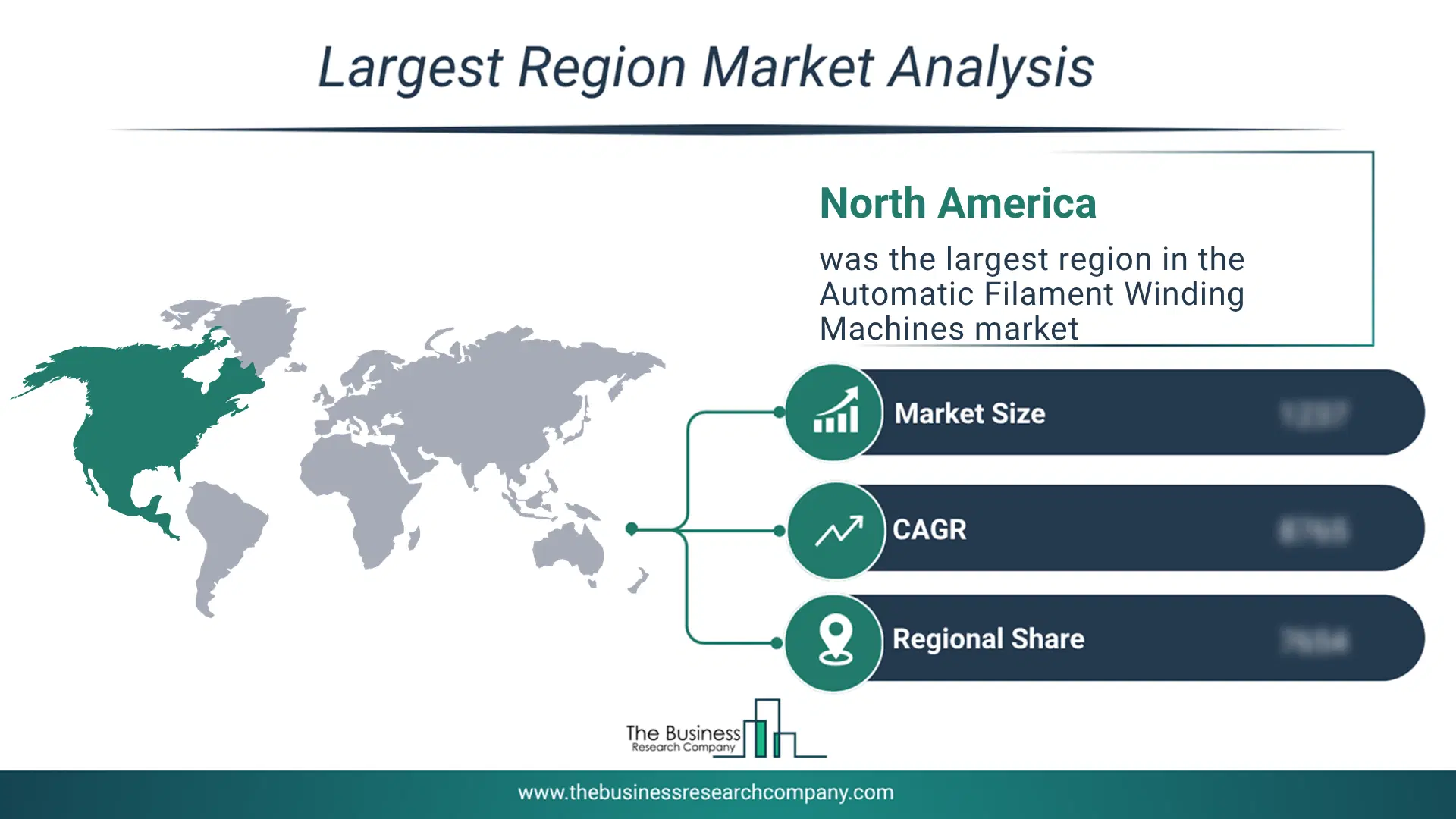
Regional Outlook
North America was the largest region in the automatic filament winding machines market in 2025. Asia-Pacific is expected to be the fastest-growing region in the forecast period. The regions covered in this market report are Asia-Pacific, South East Asia, Western Europe, Eastern Europe, North America, South America, Middle East, Africa The countries covered in this market report are Australia, Brazil, China, France, Germany, India, Indonesia, Japan, Taiwan, Russia, South Korea, UK, USA, Canada, Italy, Spain.What Defines the Automatic Filament Winding Machines Market?
The automatic filament winding machines market consists of sales of polar filament winding machines, horizontal filament winding machines, vertical filament winding machines, robotic filament winding machines, and computer-controlled machines. Values in this market are ‘factory gate’ values, that is, the value of goods sold by the manufacturers or creators of the goods, whether to other entities (including downstream manufacturers, wholesalers, distributors, and retailers) or directly to end customers. The value of goods in this market includes related services sold by the creators of the goods.How is Market Value Defined and Measured?
The market value is defined as the revenues that enterprises gain from the sale of goods and/or services within the specified market and geography through sales, grants, or donations in terms of the currency (in USD unless otherwise specified). The revenues for a specified geography are consumption values that are revenues generated by organizations in the specified geography within the market, irrespective of where they are produced. It does not include revenues from resales along the supply chain, either further along the supply chain or as part of other products.
This chart presents market attractiveness based on a quantitative evaluation of growth, competition, strategic alignment, and risk, offering a clear view of opportunity areas for decision-making. This chart is for illustrative purposes; the full report contains the complete analysis.

This chart highlights the Total Addressable Market (TAM) by estimating the maximum revenue opportunity using an assumption-driven approach, supporting strategic planning and opportunity sizing across markets. The chart is illustrative; the full report provides a more comprehensive analysis.
What Key Data and Analysis Are Included in the Automatic Filament Winding Machines Market Report 2026?
The automatic filament winding machines market research report is one of a series of new reports from The Business Research Company that provides market statistics, including industry global market size, regional shares, competitors with the market share, detailed market segments, market trends and opportunities, and any further data you may need to thrive in the automatic filament winding machines industry. The market research report delivers a complete perspective of everything you need, with an in-depth analysis of the current and future state of the industry.Automatic Filament Winding Machines Market Report Forecast Analysis
| Report Attribute | Details |
|---|---|
| Market Size Value In 2026 | $2.07 billion |
| Revenue Forecast In 2030 | $3.23 billion |
| Growth Rate | CAGR of 11.8% from 2026 to 2030 |
| Base Year For Estimation | 2025 |
| Actual Estimates/Historical Data | 2020-2025 |
| Forecast Period | 2026 - 2030 |
| Market Representation | Revenue in USD Billion and CAGR from 2026 to 2030 |
| Segments Covered | Type, Application, End-Use Industries |
| Regional Scope | Asia-Pacific, Western Europe, Eastern Europe, North America, South America, Middle East, Africa |
| Key Companies Profiled | Murata Machinery Ltd., GTI Composite, Ingersoll Machine Tools, Magnum Venus Products (MVP), Pultrex, Advanced Composites Inc., Cygnet Texkimp, Autonational Composite Machinery, Mikrosam, EMAI Composites, Vem Technologies S.r.l., Matrasur Composites, Engineering Technology Corp. (Toray), Roth Composite Machinery, MF Tech, Comec Innovative Srl, Hille Engineering, X-Winder LLC, Beijing Vidatech, Schmidt & Heinzmann GmbH & Co. KG, McClean Anderson, Harbin Composite Equipment, Shanghai Vanguard Composites Technique, Cincinnati Composite Machines (CCM), Rooks Automation, TANIQ BV, Shenzhen HONEST Intelligent Equipment Co. Ltd. |
| Customization Scope | Request for Customization |
| Pricing And Purchase Options | Explore Purchase Options |