
Automotive Adaptive Cruise Control Market Report 2026
Global Outlook – By Component ( LIN, CAN, ECU, MCU, Wire harness), By Technology ( RADAR Sensor, LIDAR Sensor), By Mode Of Operation ( Normal Adaptive Cruise Control System, Connected Adaptive Cruise Control System), By Vehicle ( Passenger Vehicle, Commercial Vehicle), By Distribution Channel ( OEM, Aftermarket) – Market Size, Trends, Strategies, and Forecast to 2030
Automotive Adaptive Cruise Control Market Overview
• Automotive Adaptive Cruise Control market size has reached to $24.92 billion in 2025 • Expected to grow to $40.19 billion in 2030 at a compound annual growth rate (CAGR) of 10% • Growth Driver: The Role Of Electric Vehicles In Advancing The Automotive Adaptive Cruise Control Market • Market Trend: Innovative Advancements Drive Growth In The Automotive Adaptive Cruise Control Market • North America was the largest region in 2025.What Is Covered Under Automotive Adaptive Cruise Control Market?
Automotive adaptive cruise control refers to advanced driver assistance systems that automatically adjust a vehicle's speed to maintain a safe following distance from the vehicle ahead. It enhances driving convenience by managing speed variations and reducing driver fatigue during long journeys. The main components of automotive adaptive cruise control are LIN, CAN, ECU, MCU, and wire harness. The LIN refers to the Local Interconnect Network (LIN), a low-cost serial network for connecting car electronics. The different vehicles include passenger vehicles and commercial vehicles. The technologies used are radar sensors and lidar sensors. The mode of operation includes a normal adaptive cruise control system and a connected adaptive cruise control system that is distributed through the OEM and aftermarket.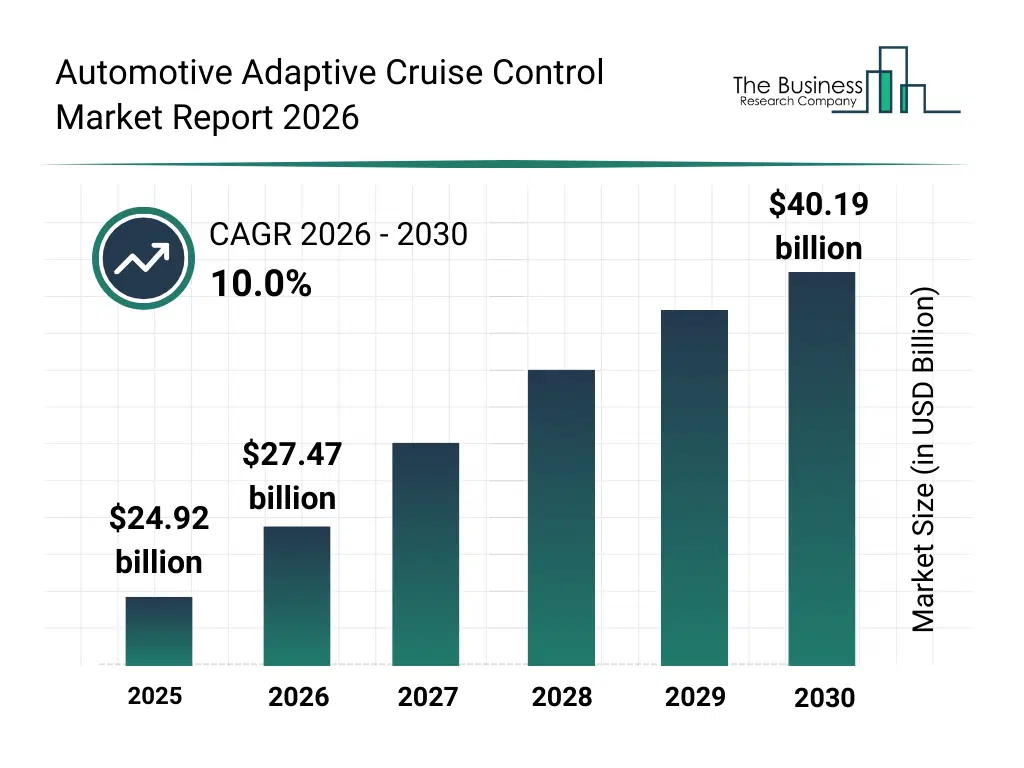
What Is The Automotive Adaptive Cruise Control Market Size 2026 And Growth Rate?
The automotive adaptive cruise control market size has grown rapidly in recent years. It will grow from $24.92 billion in 2025 to $27.47 billion in 2026 at a compound annual growth rate (CAGR) of 10.2%. The growth in the historic period can be attributed to rising use of conventional cruise control systems, early adoption of radar-based sensors, reliance on CAN and LIN networks, growth in passenger vehicle ACC deployment, initial integration in commercial vehicles.What Is The Automotive Adaptive Cruise Control Market Growth Forecast?
The automotive adaptive cruise control market size is expected to see strong growth in the next few years. It will grow to $40.19 billion in 2030 at a compound annual growth rate (CAGR) of 10.0%. The growth in the forecast period can be attributed to rising adoption of connected and AI-enabled ACC systems, deployment of advanced ECUs and MCUs, integration with smart vehicle networks, expansion in commercial vehicle applications, growth in OEM and aftermarket ACC solutions. Major trends in the forecast period include integration of AI-powered adaptive cruise control systems, deployment of radar and lidar sensor technologies, expansion of connected adaptive cruise control, adoption of smart ecu and mcu solutions, implementation of automated vehicle speed control systems.
Global Automotive Adaptive Cruise Control Market Segmentation
1) By Component: LIN, CAN, ECU, MCU, Wire harness 2) By Technology: RADAR Sensor, LIDAR Sensor 3) By Mode Of Operation: Normal Adaptive Cruise Control System, Connected Adaptive Cruise Control System 4) By Vehicle: Passenger Vehicle, Commercial Vehicle 5) By Distribution Channel: OEM, Aftermarket Subsegments: 1) By LIN (Local Interconnect Network): LIN Transceivers, LIN Controllers 2) By CAN (Controller Area Network): CAN Transceivers, CAN Controllers 3) By ECU (Electronic Control Unit): Adaptive Cruise Control ECUs, Centralized ECUs 4) By MCU (Microcontroller Unit): 8-bit MCUs, 16-bit MCUs, 32-bit MCUs 5) By Wire Harness: Adaptive Cruise Control Wire Harnesses, Connector Assemblies for Wire HarnessesWhat Is The Driver Of The Automotive Adaptive Cruise Control Market?
The increasing demand for electric vehicles is expected to propel the growth of the automotive adaptive cruise control market going forward. Electric vehicles (EVs) are automobiles that are powered primarily or entirely by electricity stored in rechargeable batteries. Automotive Adaptive Cruise Control is used in electric vehicles to provide the same core benefits of increased safety and driver convenience. It enhances the overall electric vehicle experience by making driving safer, more efficient, and less frustrating. For instance, in January 2024, according to a report published by Kelley Blue Book, a US-based automotive company, in 2023, a record 1.2 million car buyers in the United States chose electric vehicles, which accounted for 7.6% of the entire U.S. vehicle market, up from 5.9% in 2022. Therefore, the increasing demand for electric vehicles is driving the growth of the automotive adaptive cruise control industry.Key Players In The Global Automotive Adaptive Cruise Control Market
Major companies operating in the automotive adaptive cruise control market are Magna International Inc, Continental AG, Denso Corporation, Hitachi Automotive Systems Ltd., Robert Bosch GmbH, Valeo SA, HyundAI Motor Company, ZF Friedrichshafen AG, Mando Corporation, Nidec Elesys America Corporation, Velodyne Lidar, Knorr-Bremse AG, Eaton Corporation plc, ADVICS Co Ltd, Visteon Corporation, Autoliv Inc., Delphi Automotive LLP, WABCO Holdings Inc., TRW Automotive Holdings Corp., Hella KGaA Hueck & Co., Mobileye N.V., Gentex Corporation, Aptiv plc, Infineon Technologies AG, NXP Semiconductors N.V., Texas Instruments Inc., STMicroelectronics N.V., Analog Devices Inc., Renesas Electronics Corporation, ON Semiconductor Corporation, Maxim Integrated Products Inc., Melexis NV, Sensata Technologies Inc., TE Connectivity Ltd., Panasonic Corporation, Toshiba Corporation
This chart is for illustrative purposes; the full report includes a detailed competitor analysis and comprehensive overview of the top 10 companies in the market.
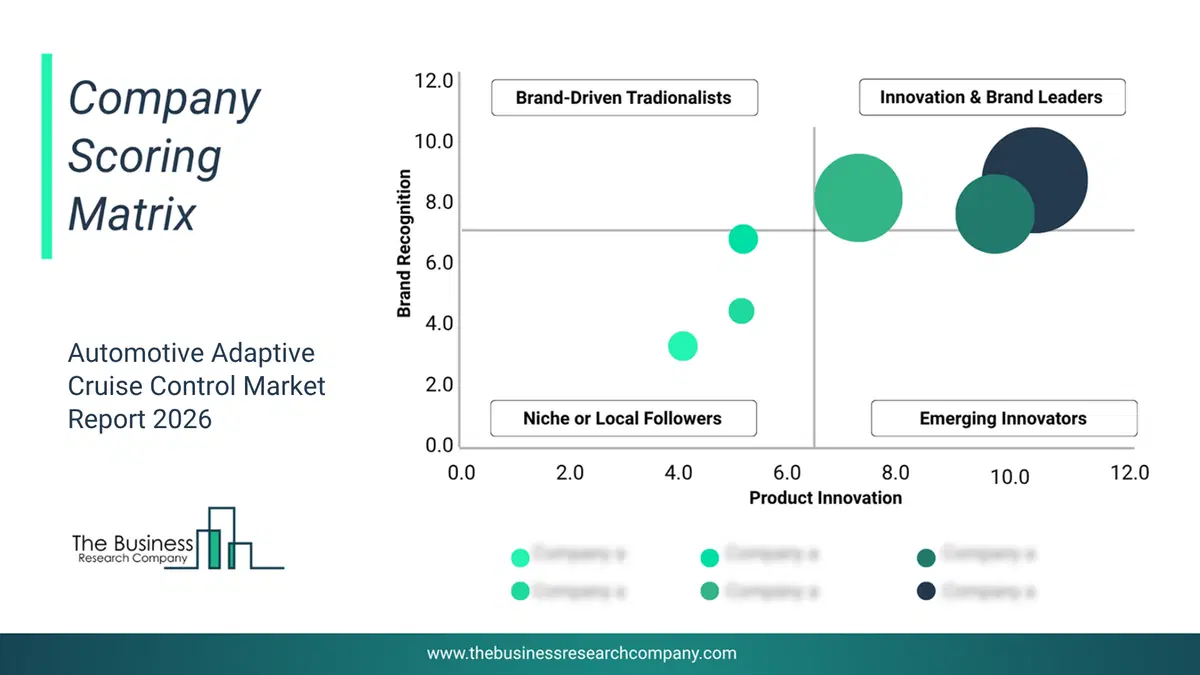
This chart maps companies by product innovation and brand strength, with bubble size indicating relative revenue, helping identify market leaders, challengers, and niche players. This is an illustrative chart; the full report provides a complete and accurate competitive analysis.
Global Automotive Adaptive Cruise Control Market Trends and Insights
Major companies operating in the automotive adaptive cruise control market are focusing on developing innovative technological solutions such as magnet-free inductive position sensing to enhance motor control accuracy, improve system reliability, and reduce costs in electric and hybrid vehicle applications. Magnet-free inductive position sensing refers to a technology that determines the position or movement of a target using electromagnetic induction instead of magnets, offering high accuracy, durability, and immunity to magnetic interference. For instance, in October 2023, Renesas, a Japan-based semiconductor company, launched an induction motor position sensing technology that optimizes performance in various applications such as electric vehicles and industrial automation. By accurately determining the rotor’s position, this technology enhances torque output, reduces energy consumption, and improves overall system reliability. Its application is particularly significant in advanced automotive systems, including electric drivetrains and adaptive cruise control, thereby strengthening Renesas’s position in the automotive technology market.What Are Latest Mergers And Acquisitions In The Automotive Adaptive Cruise Control Market?
In June 2023, Magna International Inc. a US-based mobility technology company, completed the acquisition of Veoneer Active Safety for an undisclosed amount. This acquisition aims to to strengthen its position in the market and expand its product portfolio and customer base. Veoneer Active Safety is a Sweden-based automotive electronics safetysystems company that provides automotive adaptive cruise control systems.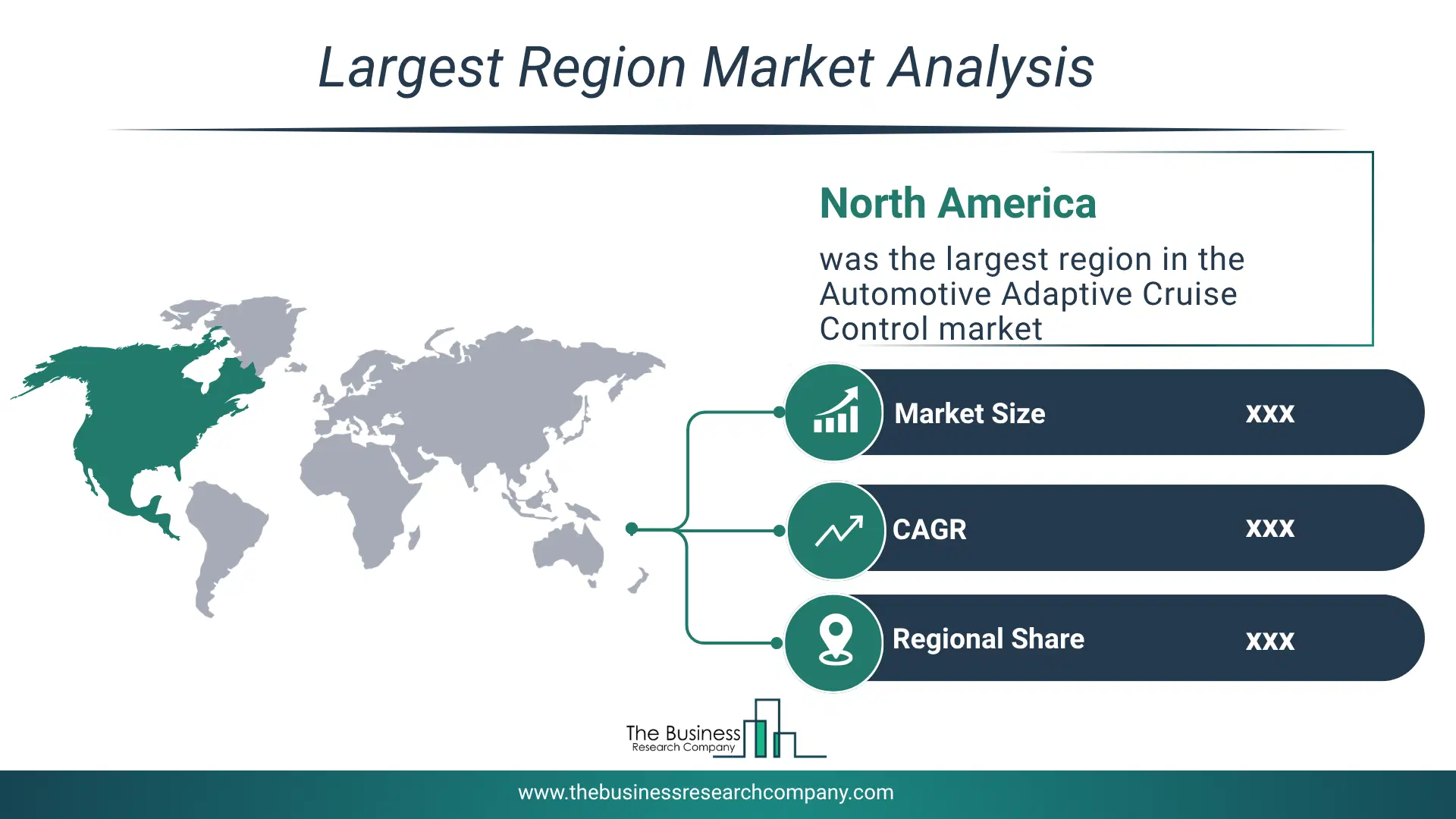
Regional Outlook
North America will be the largest region in the automotive adaptive cruise control market in 2025. The regions covered in this market report are Asia-Pacific, South East Asia, Western Europe, Eastern Europe, North America, South America, Middle East, Africa. The countries covered in this market report are Australia, Brazil, China, France, Germany, India, Indonesia, Japan, Taiwan, Russia, South Korea, UK, USA, Canada, Italy, Spain.What Defines the Automotive Adaptive Cruise Control Market?
The automotive adaptor cruise control market consists of revenues earned by entities by providing automotive adaptor cruise control solutions such as blind-spot detection, emergency braking, emergency lane keeping, road hazard services, lane assistance systems, and lane keeping assist. The market value includes the value of related goods sold by the service provider or included within the service offering. The automotive adaptor cruise control market also includes sales of front radar sensors and multipurpose cameras. Values in this market are ‘factory gate’ values, that is the value of goods sold by the manufacturers or creators of the goods, whether to other entities (including downstream manufacturers, wholesalers, distributors, and retailers) or directly to end customers. The value of goods in this automotive adaptor cruise control market includes related services sold by the creators of the goods.How is Market Value Defined and Measured?
The market value is defined as the revenues that enterprises gain from the sale of goods and/or services within the specified market and geography through sales, grants, or donations in terms of the currency (in USD unless otherwise specified). The revenues for a specified geography are consumption values that are revenues generated by organizations in the specified geography within the market, irrespective of where they are produced. It does not include revenues from resales along the supply chain, either further along the supply chain or as part of other products.
This chart presents market attractiveness based on a quantitative evaluation of growth, competition, strategic alignment, and risk, offering a clear view of opportunity areas for decision-making. This chart is for illustrative purposes; the full report contains the complete analysis.

This chart highlights the Total Addressable Market (TAM) by estimating the maximum revenue opportunity using an assumption-driven approach, supporting strategic planning and opportunity sizing across markets. The chart is illustrative; the full report provides a more comprehensive analysis.
What Key Data and Analysis Are Included in the Automotive Adaptive Cruise Control Market Report 2026?
The automotive adaptive cruise control market research report is one of a series of new reports from The Business Research Company that provides market statistics, including industry global market size, regional shares, competitors with the market share, detailed market segments, market trends and opportunities, and any further data you may need to thrive in the automotive adaptive cruise control industry. The market research report delivers a complete perspective of everything you need, with an in-depth analysis of the current and future state of the industry.Automotive Adaptive Cruise Control Market Report Forecast Analysis
| Report Attribute | Details |
|---|---|
| Market Size Value In 2026 | $27.47 billion |
| Revenue Forecast In 2030 | $40.19 billion |
| Growth Rate | CAGR of 10% from 2026 to 2030 |
| Base Year For Estimation | 2025 |
| Actual Estimates/Historical Data | 2020-2025 |
| Forecast Period | 2026 - 2030 |
| Market Representation | Revenue in USD Billion and CAGR from 2026 to 2030 |
| Segments Covered | Component, Technology, Mode Of Operation, Vehicle, Distribution Channel |
| Regional Scope | Asia-Pacific, Western Europe, Eastern Europe, North America, South America, Middle East, Africa |
| Country Scope | The countries covered in the report are Australia, Brazil, China, France, Germany, India, Indonesia, Japan, Taiwan, Russia, South Korea, UK, USA, Canada, Italy, Spain. |
| Key Companies Profiled | Magna International Inc, Continental AG, Denso Corporation, Hitachi Automotive Systems Ltd., Robert Bosch GmbH, Valeo SA, HyundAI Motor Company, ZF Friedrichshafen AG, Mando Corporation, Nidec Elesys America Corporation, Velodyne Lidar, Knorr-Bremse AG, Eaton Corporation plc, ADVICS Co Ltd, Visteon Corporation, Autoliv Inc., Delphi Automotive LLP, WABCO Holdings Inc., TRW Automotive Holdings Corp., Hella KGaA Hueck & Co., Mobileye N.V., Gentex Corporation, Aptiv plc, Infineon Technologies AG, NXP Semiconductors N.V., Texas Instruments Inc., STMicroelectronics N.V., Analog Devices Inc., Renesas Electronics Corporation, ON Semiconductor Corporation, Maxim Integrated Products Inc., Melexis NV, Sensata Technologies Inc., TE Connectivity Ltd., Panasonic Corporation, Toshiba Corporation |
| Customization Scope | Request for Customization |
| Pricing And Purchase Options | Explore Purchase Options |