
Automotive Adaptive Front Lighting Market Report 2026
Global Outlook – By Technology (Adaptive Front-lighting System (AFS), Dynamic Bending Light, Adaptive High Beam, Automatic High Beam, Glare-Free High Beam, Matrix LED/Pixel LED Lighting, Other Technologies), By Component (Headlamp/Lighting Module, Electronic Control Unit, Sensors, Actuators, Optical Components, Other Components), By Light Source (Halogen, Xenon, Light-Emitting Diode (LED), Laser, Other Light Sources), By Vehicle Type (Passenger Cars, Light Commercial Vehicles, Heavy Commercial Vehicles), By Sales Channel (Original Equipment Manufacturer (OEM), Aftermarket) – Market Size, Trends, Strategies, and Forecast to 2030
Automotive Adaptive Front Lighting Market Overview
• Automotive Adaptive Front Lighting market size has reached to $1.82 billion in 2025 • Expected to grow to $3.41 billion in 2030 at a compound annual growth rate (CAGR) of 13.3% • Growth Driver: Growth In Premium And Luxury Vehicle Sales Driving The Market Growth Due To Rising Disposable Incomes • Market Trend: Technological Advancements In Intelligent Vehicle Lighting Technologies For Improved Visibility And Driver Assistance • Western Europe was the largest region in 2025 and Asia-Pacific is the fastest growing region.What Is Covered Under Automotive Adaptive Front Lighting Market?
Automotive adaptive front lighting refers to an intelligent vehicle lighting system that automatically adjusts the direction, intensity, and beam pattern of the front lighting according to driving conditions, vehicle speed, steering angle, road curvature, and surrounding traffic. These systems enhance nighttime visibility, improve driving safety, and reduce glare for other road users by providing optimized illumination under varying operating conditions. They are engineered to deliver precise light distribution, energy efficiency, and reliable performance across diverse driving environments. The main technologies of automotive adaptive front lighting include adaptive front-lighting systems, dynamic bending light, adaptive high beam, automatic high beam, glare-free high beam, matrix light-emitting diode or pixel light-emitting diode lighting, and other technologies. Adaptive front-lighting systems refer to vehicle lighting systems that automatically adjust the direction, intensity, or distribution of headlamp illumination according to driving conditions and vehicle movement. These technologies incorporate headlamp or lighting modules, electronic control units, sensors, actuators, optical components, and other components, and use halogen, xenon, light-emitting diode, laser, and other light sources. They are used in passenger cars, light commercial vehicles, and heavy commercial vehicles, and are sold through original equipment manufacturers and aftermarket channels.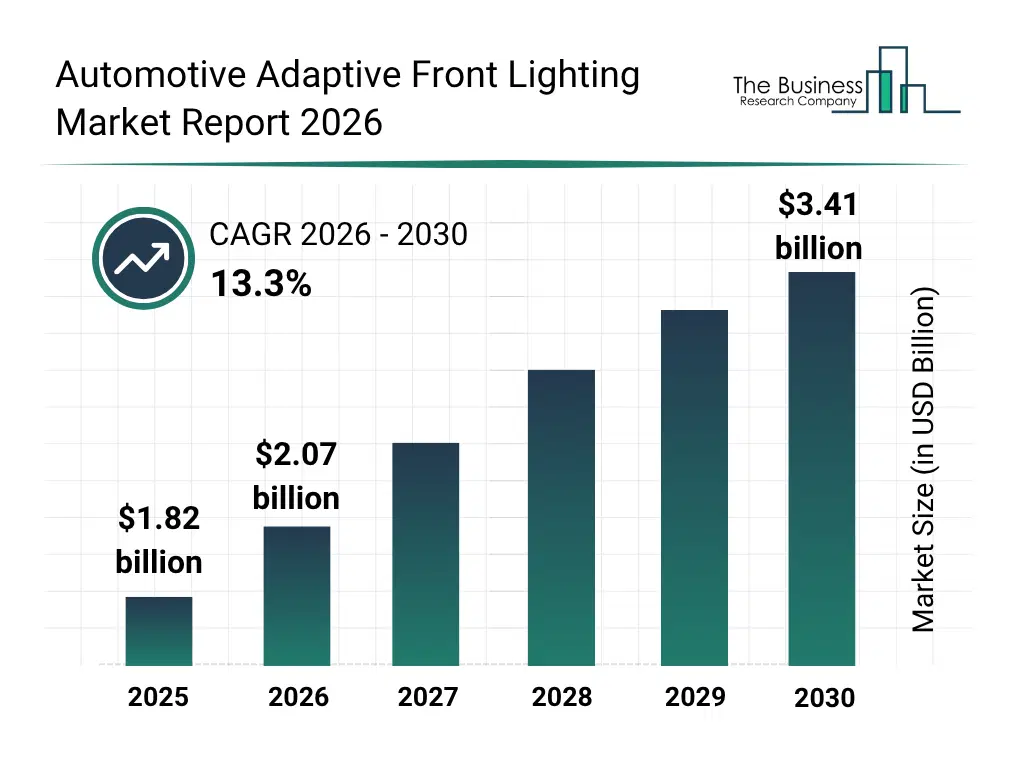
What Is The Automotive Adaptive Front Lighting Market Size and Share 2026?
The automotive adaptive front lighting market size has grown rapidly in recent years. It will grow from $1.82 billion in 2025 to $2.07 billion in 2026 at a compound annual growth rate (CAGR) of 13.7%. The growth in the historic period can be attributed to rising demand for improved nighttime driving visibility, increasing adoption of premium vehicle lighting systems, growing emphasis on vehicle safety regulations, increasing consumer preference for advanced automotive features, rising production of passenger vehicles.What Is The Automotive Adaptive Front Lighting Market Growth Forecast?
The automotive adaptive front lighting market size is expected to see rapid growth in the next few years. It will grow to $3.41 billion in 2030 at a compound annual growth rate (CAGR) of 13.3%. The growth in the forecast period can be attributed to growing demand for advanced driver assistance systems, increasing penetration of electric vehicles, rising adoption of software-defined vehicle technologies, growing demand for energy-efficient led lighting, increasing integration of connected vehicle technologies. Major trends in the forecast period include increasing adoption of matrix led and pixel-based headlighting, growing development of high-resolution digital headlamps, rising integration of road-curve and speed-adaptive lighting, increasing use of camera and sensor-based beam adjustment, development of advanced glare-reduction lighting systems.Tariff Impact On Automotive Adaptive Front Lighting Market
Tariffs are impacting the automotive adaptive front lighting market by increasing the cost of imported LED modules, semiconductor components, sensors, optical components, and electronic control units required for adaptive lighting systems. This is increasing production costs and affecting matrix LED, pixel LED, adaptive high-beam, and other advanced lighting systems, particularly in North America, Europe, and Asia-Pacific where automotive supply chains depend on international sourcing. Hardware-intensive segments such as LED lighting modules and electronic control units are most affected due to their reliance on imported components. However, tariffs are also encouraging local manufacturing, regional supplier diversification, and increased investment in domestic automotive lighting supply chains, creating long-term resilience in the market.
Global Automotive Adaptive Front Lighting Market Segmentation
1) By Technology: Adaptive Front-lighting System (AFS), Dynamic Bending Light, Adaptive High Beam, Automatic High Beam, Glare-Free High Beam, Matrix LED/Pixel LED Lighting, Other Technologies 2) By Component: Headlamp/Lighting Module, Electronic Control Unit, Sensors, Actuators, Optical Components, Other Components 3) By Light Source: Halogen, Xenon, Light-Emitting Diode (LED), Laser, Other Light Sources 4) By Vehicle Type: Passenger Cars, Light Commercial Vehicles, Heavy Commercial Vehicles 5) By Sales Channel: Original Equipment Manufacturer (OEM), Aftermarket Subsegments: 1) By Adaptive Front-lighting System (AFS): Static Bending Systems, Dynamic Bending Systems, Cornering Light Systems, Speed-Adaptive Lighting Systems, Road-Curve-Adaptive Lighting Systems 2) By Dynamic Bending Light: Steering-Linked Bending Lights, Speed-Sensitive Bending Lights, Cornering-Responsive Bending Lights, Automatic Bending Lights 3) By Adaptive High Beam: Automatic High Beam Systems, Traffic-Responsive High Beam Systems, Adaptive Beam-Shaping Systems 4) By Automatic High Beam: Camera-Based High Beam Systems, Sensor-Based High Beam Systems, Speed-Responsive High Beam Systems, Automatic High Beam Switching Systems 5) By Glare-Free High Beam: Traffic-Responsive Glare-Free High Beam Systems, Dynamic Beam-Shaping Systems, Sensor-Fusion Glare-Free High Beam Systems 6) By Matrix LED/Pixel LED Lighting: Matrix LED Headlamps, Pixel LED Headlamps, High-Resolution LED Headlamps, Digital Light Projection Systems, Individually Controlled LED Systems 7) By Other Technologies: Weather-Adaptive Lighting, Navigation-Based Lighting, Intelligent Beam ControlWhat Is The Driver Of The Automotive Adaptive Front Lighting Market?
The growth in premium and luxury vehicle sales is expected to propel the growth of the automotive adaptive front lighting market going forward. Premium and luxury vehicles are high-end automobiles that offer superior performance, advanced technologies, enhanced safety features, premium materials, and greater comfort compared to standard vehicles. The demand for premium and luxury vehicles is rising due to increasing disposable incomes, as consumers seek enhanced comfort, advanced safety features, and superior driving experiences. Rising sales of premium and luxury vehicles drive demand for automotive adaptive front lighting systems by increasing the adoption of advanced safety technologies that improve nighttime visibility, enhance driving comfort, and provide intelligent illumination based on road and driving conditions. For instance, in March 2026, according to BMW Group, a Germany-based premium automobile manufacturer, the company delivered 2,463,681 premium vehicles worldwide in 2025, compared with 2,450,854 in 2024, representing a 0.5% increase. Therefore, the growth in premium and luxury vehicle sales is driving the growth of the automotive adaptive front lighting industry.Key Players In The Global Automotive Adaptive Front Lighting Market
Major companies operating in the automotive adaptive front lighting market are Texas Instruments Incorporated, Continental AG, DENSO Corporation, FORVIA HELLA, NXP Semiconductors N.V., Infineon Technologies AG, Hyundai Mobis Co. Ltd., Valeo SA, Koito Manufacturing Co. Ltd., Marelli Holdings Co. Ltd., LG Innotek Co. Ltd., LG Electronics Inc., Stanley Electric Co. Ltd., Nichia Corporation, OPmobility SE, SL Corporation, ROHM Co. Ltd., Melexis NV, Lumax Industries Ltd.
This chart is for illustrative purposes; the full report includes a detailed competitor analysis and comprehensive overview of the top 10 companies in the market.
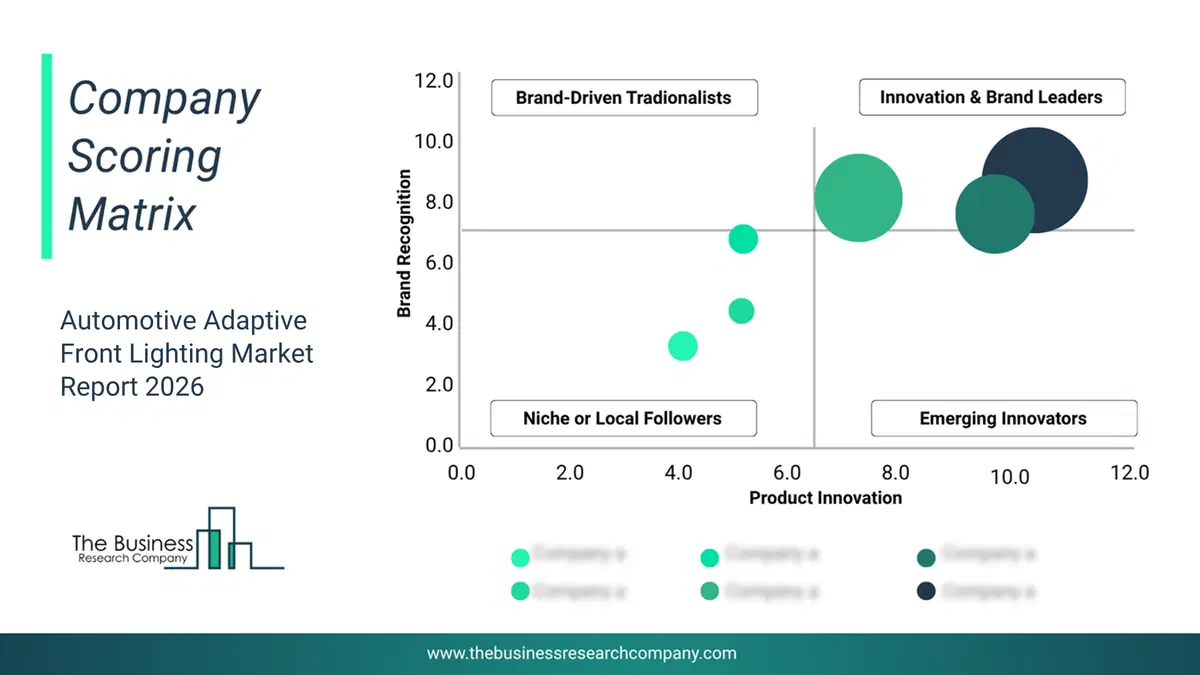
This chart maps companies by product innovation and brand strength, with bubble size indicating relative revenue, helping identify market leaders, challengers, and niche players. This is an illustrative chart; the full report provides a complete and accurate competitive analysis.
Global Automotive Adaptive Front Lighting Market Trends and Insights
Major companies operating in the automotive adaptive front lighting market are focusing on developing advanced lighting systems such as, high-resolution MicroLED adaptive front lighting systems to enhance driving safety, night-time visibility, and intelligent vehicle-lighting performance. High-resolution MicroLED adaptive front lighting systems are advanced lighting technologies that use thousands of individually controlled MicroLED pixels to precisely adjust the headlight beam, enabling adaptive driving beams, glare-free illumination, dynamic road projections, and intelligent lighting functions compared to conventional LED headlamps with limited beam control. For instance, in April 2026, Marelli Holdings Co., Ltd., a Japan-based automotive technology company, unveiled its h-Digi® MicroLED adaptive front lighting technology at Auto China 2026. Available in 25K and 40K pixel versions, the production-ready system delivers high-resolution adaptive driving beams that automatically optimize illumination based on road and traffic conditions while supporting dynamic road projections and intelligent lighting animations. The technology enhances driver safety and comfort by improving night-time visibility, reducing glare for oncoming vehicles, and enabling personalized lighting experiences. It also provides automakers with scalable, software-defined lighting solutions that strengthen vehicle differentiation and support future intelligent mobility applications.What Are Latest Mergers And Acquisitions In The Automotive Adaptive Front Lighting Market?
In April 2025, Valeo SE, a France-based automotive technology company that specializes in advanced vehicle lighting systems and software solutions, partnered with Appotronics Corporation Limited to develop next-generation automotive front lighting systems integrating laser projection technology. Through this partnership, Valeo SE and Appotronics Corporation Limited aim to combine Valeo’s expertise in lighting system integration, electronic control units, and software with Appotronics’ ALPD laser display technology to deliver advanced adaptive driving beam (ADB) headlights, high-definition road projection, and in-car entertainment capabilities. The collaboration is intended to improve road safety, enhance driver comfort, and enable intelligent, multifunctional lighting solutions for future vehicles. Appotronics Corporation Limited is a China-based developer of laser display technologies specializes in providing of automotive front-lighting technology.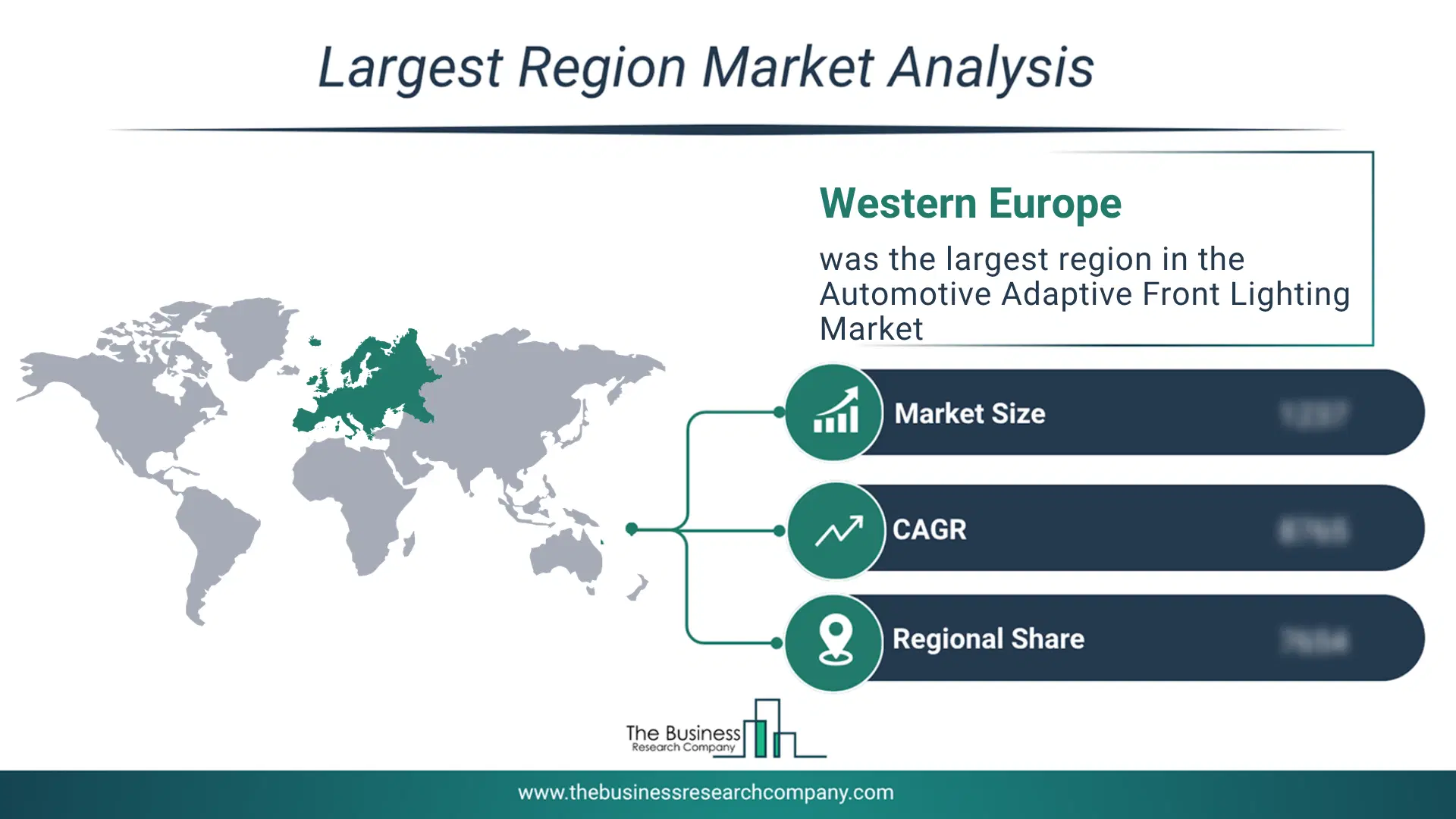
Regional Outlook
Western Europe was the largest region in the automotive adaptive front lighting market in 2025. Asia-Pacific is expected to be the fastest-growing region in the forecast period. The regions covered in this market report are Asia-Pacific, South East Asia, Western Europe, Eastern Europe, North America, South America, Middle East, Africa. The countries covered in this market report are Australia, Brazil, China, France, Germany, India, Indonesia, Japan, Taiwan, Russia, South Korea, UK, USA, Canada, Italy, Spain.What Defines the Automotive Adaptive Front Lighting Market?
The automotive adaptive front lighting market consists of sales of adaptive lighting systems, matrix lighting systems, laser lighting systems, dynamic bending lighting systems, cornering lighting systems, automatic high-beam lighting systems, adaptive driving beam systems, and lighting control software. Values in this market are ‘factory gate’ values, that is, the value of goods sold by the manufacturers or creators of the goods, whether to other entities (including downstream manufacturers, wholesalers, distributors, and retailers) or directly to end customers. The value of goods in this market includes related services sold by the creators of the goods.How is Market Value Defined and Measured?
The market value is defined as the revenues that enterprises gain from the sale of goods and/or services within the specified market and geography through sales, grants, or donations in terms of the currency (in USD unless otherwise specified). The revenues for a specified geography are consumption values that are revenues generated by organizations in the specified geography within the market, irrespective of where they are produced. It does not include revenues from resales along the supply chain, either further along the supply chain or as part of other products.
This chart presents market attractiveness based on a quantitative evaluation of growth, competition, strategic alignment, and risk, offering a clear view of opportunity areas for decision-making. This chart is for illustrative purposes; the full report contains the complete analysis.

This chart highlights the Total Addressable Market (TAM) by estimating the maximum revenue opportunity using an assumption-driven approach, supporting strategic planning and opportunity sizing across markets. The chart is illustrative; the full report provides a more comprehensive analysis.
What Key Data and Analysis Are Included in the Automotive Adaptive Front Lighting Market Report 2026?
The automotive adaptive front lighting market research report is one of a series of new reports from The Business Research Company that provides market statistics, including industry global market size, regional shares, competitors with the market share, detailed market segments, market trends and opportunities, and any further data you may need to thrive in the automotive adaptive front lighting industry. The market research report delivers a complete perspective of everything you need, with an in-depth analysis of the current and future state of the industry.Automotive Adaptive Front Lighting Market Report Forecast Analysis
| Report Attribute | Details |
|---|---|
| Market Size Value In 2026 | $2.07 billion |
| Revenue Forecast In 2030 | $3.41 billion |
| Growth Rate | CAGR of 13.3% from 2026 to 2030 |
| Base Year For Estimation | 2025 |
| Actual Estimates/Historical Data | 2020-2025 |
| Forecast Period | 2026 - 2030 |
| Market Representation | Revenue in USD Billion and CAGR from 2026 to 2030 |
| Segments Covered | Technology, Component, Light Source, Vehicle Type, Sales Channel |
| Regional Scope | Asia-Pacific, Western Europe, Eastern Europe, North America, South America, Middle East, Africa |
| Country Scope | The countries covered in the report are Australia, Brazil, China, France, Germany, India, Indonesia, Japan, Taiwan, Russia, South Korea, UK, USA, Canada, Italy, Spain. |
| Key Companies Profiled | Texas Instruments Incorporated, Continental AG, DENSO Corporation, FORVIA HELLA, NXP Semiconductors N.V., Infineon Technologies AG, Hyundai Mobis Co. Ltd., Valeo SA, Koito Manufacturing Co. Ltd., Marelli Holdings Co. Ltd., LG Innotek Co. Ltd., LG Electronics Inc., Stanley Electric Co. Ltd., Nichia Corporation, OPmobility SE, SL Corporation, ROHM Co. Ltd., Melexis NV, Lumax Industries Ltd. |
| Customization Scope | Request for Customization |
| Pricing And Purchase Options | Explore Purchase Options |