

Automotive Aftermarket Market 2026
By Type (Tire, Battery, Brake Parts, Filters, Body Parts, Lighting And Electronic Components, Wheels, Exhaust Components, Turbochargers, Others), By Vehicle Type (Passenger Cars, Commercial Vehicles), By Certification Outlook (Genuine Parts, Certified Parts, Uncertified Parts), By Distribution Channel (Offline Distribution Channel, Online Distribution Channel), And By Region, Opportunities And Strategies – Global Forecast To 2035
Automotive Aftermarket Market Definition
The automotive aftermarket refers to the secondary market of the automotive industry, which deals with the manufacturing, remanufacturing, distribution, retailing and installation of all vehicle parts, equipment and accessories after the sale of the automobile by the original equipment manufacturer (OEM) to the consumer. The automotive aftermarket market consists of revenues generated by entities that play a crucial role in vehicle maintenance, repair and customization and is vital for extending vehicle lifespans and enhancing performance. The market caters to a broad user base including individual car owners, fleet operators, independent repair shops, franchised dealers and commercial garages. It is used throughout a vehicle’s lifecycle, particularly after the original warranty period has expired, when parts and maintenance become the responsibility of the owner.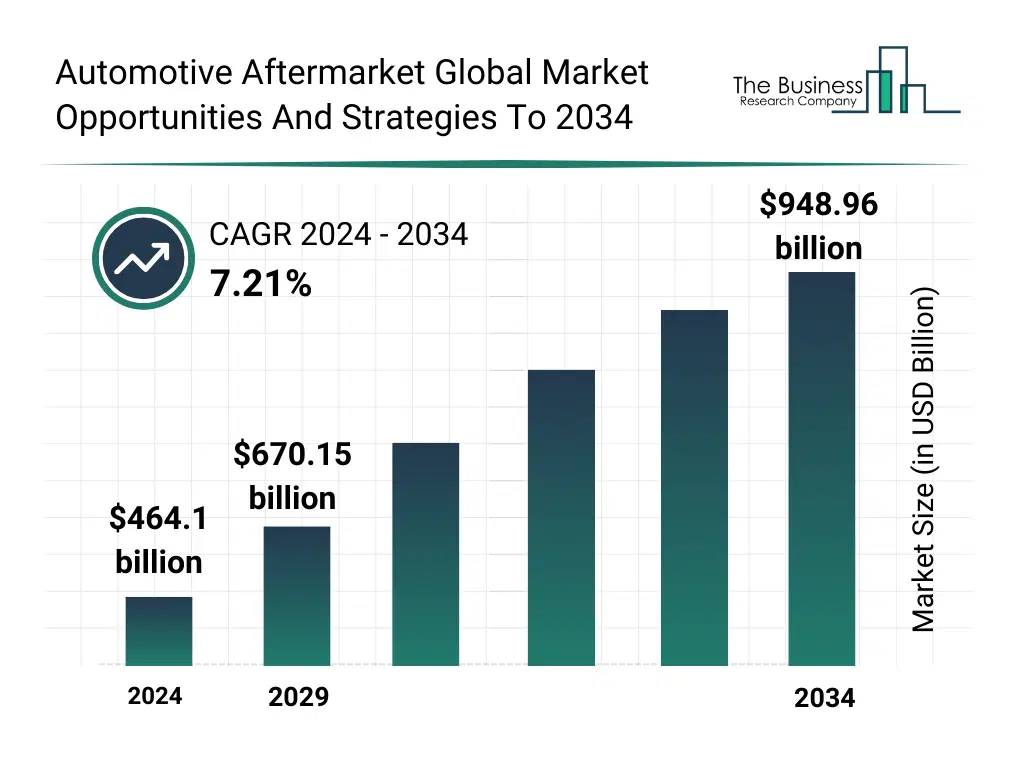
Automotive Aftermarket Market Size
The global automotive aftermarket market reached a value of nearly $464,104.46 million in 2024, having grown at a compound annual growth rate (CAGR) of 4.04% since 2019. The market is expected to grow from $464,104.46 million in 2024 to $670,153.50 million in 2029 at a rate of 7.62%. The market is then expected to grow at a CAGR of 7.21% from 2029 and reach $948,964.07 million in 2034. Growth in the historic period resulted from shift toward shared mobility, increasing demand for spare parts, increased usage of commercial vehicles and expansion of automotive industry. Factors that negatively affected growth in the historic period were the shortage of skilled labor and competition from counterfeit and grey-market parts. Going forward, increasing vehicle ownership, expansion of e-commerce platforms for auto parts sales, stringent zero emission mandates and regulations and rising adoption of automation in fleet management will drive growth. Factor that could hinder the growth of the automotive aftermarket market in the future include were recycling rules and waste handling, environmental and climate change risks and impact of trade war and tariff.Automotive Aftermarket Market Drivers
The key drivers of the automotive aftermarket market include: Increasing Vehicle Ownership During the forecast period, increasing vehicle ownership will propel the growth of the automotive aftermarket market. As rising incomes, urbanization and improved infrastructure enable more individuals to afford private mobility, the number of vehicles on roads is expected to grow substantially, fueling demand for servicing, spare parts and related aftermarket services. More vehicles in use means more wear and tear, more regular maintenance, more component replacements and higher utilization of repair networks. Moreover, as ownership penetrates into smaller towns and rural districts, demand for spare parts and authorized service centers will spread beyond major cities, compelling aftermarket suppliers to expand reach and capacity. Rising vehicle ownership per capita will be driven not only by greater affordability but also by changing mobility preferences, ensuring a sustained increase in demand for maintenance and aftermarket solutions. The increasing vehicle ownership contribution during the forecast period in 2024 is 1.50%.Automotive Aftermarket Market Restraints
The key restraints on the automotive aftermarket market include: Recycling Rules And Waste Handling Recycling rules and waste handling is restricting the growth of the automotive aftermarket market during the forecast period. New regulations, especially in regions adopting extended producer responsibility (EPR) for batteries, require manufacturers, importers and distributors to manage end-of-life batteries more strictly. Parts such as electric vehicle batteries, light-transport batteries and industrial storage batteries now face obligations for free collection, recycling and minimum recycled content. These requirements introduce added costs for compliance, redesign of components, more rigorous supply chain tracking and investments in recycling infrastructure. Many aftermarket suppliers may find these burdensome, particularly smaller firms without scalable waste-handling systems or the capital to retrofit operations. Growth affected by recycling rules and waste handling during the forecast period in 2024 is -1.50%.Automotive Aftermarket Market Trends
Major trends shaping the automotive aftermarket market include: Integration Of Hydrogen-Compatible Turbochargers To Support Low-Emission Heavy Vehicles Key companies in the automotive aftermarket market are focusing on integrating components tailored for hydrogen internal combustion engine (H2 ICE) systems, especially turbochargers, to support the transition toward lower-emission heavy vehicles. These innovations involve the design of bespoke turbocharging solutions that can handle the unique combustion and flow characteristics of hydrogen fuel, while maintaining performance, durability, and compliance with emission standards. In this way, aftermarket participants can position themselves as enablers of the low-carbon drivetrain ecosystem. For instance, in April 2025, Cummins, a US-based global power and technology leader, launched an industry-first turbocharger specifically engineered for hydrogen internal combustion engines, targeting on-highway heavy-duty vehicle applications in Europe. The new turbocharger features design optimizations for hydrogen combustion, advanced prognostic capabilities, and alignment with upcoming standards like Euro VII. By incorporating hydrogen-specific turbocharger technology into their portfolios, aftermarket companies can prepare for servicing of next-generation drivetrains, capture incremental value in the evolving powertrain ecosystem, and ensure relevance in a shifting regulatory landscape. Broadening Brake Pad Coverage To Enhance Safety And Vehicle Parc Accessibility Key players in the automotive aftermarket market are focusing on expanding the vehicle coverage of critical safety components like brake pads to enhance part availability, service reach, and customer trust. These efforts not only improve accessibility of replacement parts across diverse vehicle models but also support reliability, safety, and performance standards in the repair ecosystem. For instance, in January 2025, ZF Aftermarket, German technology manufacturing company that supplies systems for passenger cars, commercial vehicles and industrial technology, announced that it had expanded TRW brake pad coverage to encompass roughly 90 % of the Indian vehicle part, following the introduction of 50 new part numbers. By leveraging broad catalog expansion, distribution network scaling, and localized product development, ZF aims to set a benchmark in aftermarket service coverage and reinforce its market leadership in India’s automotive sector.Opportunities And Recommendations In The Automotive Aftermarket Market
Opportunities – The top opportunities in the automotive aftermarket market segmented by type will arise in the battery segment, which will gain $116,557.63 million of global annual sales by 2029. The top opportunities in the automotive aftermarket market segmented by vehicle type will arise in the passenger cars segment, which will gain $467,554.63 million of global annual sales by 2029. The top opportunities in the automotive aftermarket market segmented by certification outlook will arise in the genuine parts segment, which will gain $376,895.55 million of global annual sales by 2029. The top opportunities in the automotive aftermarket market segmented by distribution channel will arise in the online distribution channel segment, which will gain $292,757.77 million of global annual sales by 2029. The automotive aftermarket market size will gain the most in the USA at $54,587.64 million. Recommendations- To take advantage of the opportunities, The Business Research Company recommends the automotive aftermarket companies to focus on advancing hydrogen-compatible turbocharging solutions, focus on expanding vehicle coverage and localized product development, focus on high-performance and customizable wheel solutions, focus on expanding product portfolios aligned with emerging vehicle technologies, focus on expanding specialized filtration solutions for advanced vehicle needs, focus on developing advanced body repair tools for efficient collision restoration, focus on advancing exhaust technologies for performance and personalization, focus on integrating fast-charging battery technologies to strengthen ev support services, focus on expanding sustainable material integration to drive green aftermarket growth, focus on advancing microled lighting to expand aftermarket opportunities, focus on lighting and electronic components to drive accelerated aftermarket growth, focus on passenger cars to maximize aftermarket expansion, expand in emerging markets, focus on expanding multichannel distribution networks, focus on building competitive and value-based pricing structures, develop an integrated and data-driven digital promotion strategy, strengthen trade partnerships and customer engagement for sustainable promotion, focus on online distribution channel to capture rapid market growth.
Automotive Aftermarket Market Segmentation
The automotive aftermarket market is segmented by type, by vehicle type, by certification outlook and by distribution channel.By Type –
The automotive aftermarket market is segmented by type into:
- a) Tire
- b) Battery
- c) Brake Parts
- b) Filters
- e) Body Parts
- f) Lighting And Electronic Components
- g) Wheels
- h) Exhaust Components
- i) Turbochargers
By Vehicle Type –
The automotive aftermarket market is segmented by vehicle type into:
- a) Passenger Cars
- b) Commercial Vehicles
By Certification Outlook –
The automotive aftermarket market is segmented by Certification Outlook into:
- a) Genuine Parts
- b) Certified Parts
- c) Uncertified Parts
By Distribution Channel –
The automotive aftermarket market is segmented by distribution channel into:
- a) Offline Distribution Channel
- b) Online Distribution Channel
By Geography - The automotive aftermarket market is segmented by geography into:
- • China
- • India
- • Japan
- • Australia
- • Indonesia
- • South Korea
- • USA
- • Canada
- • Brazil
- • France
- • Germany
- • UK
- • Italy
- • Spain
- • Russia
-
o Asia Pacific
o Africa